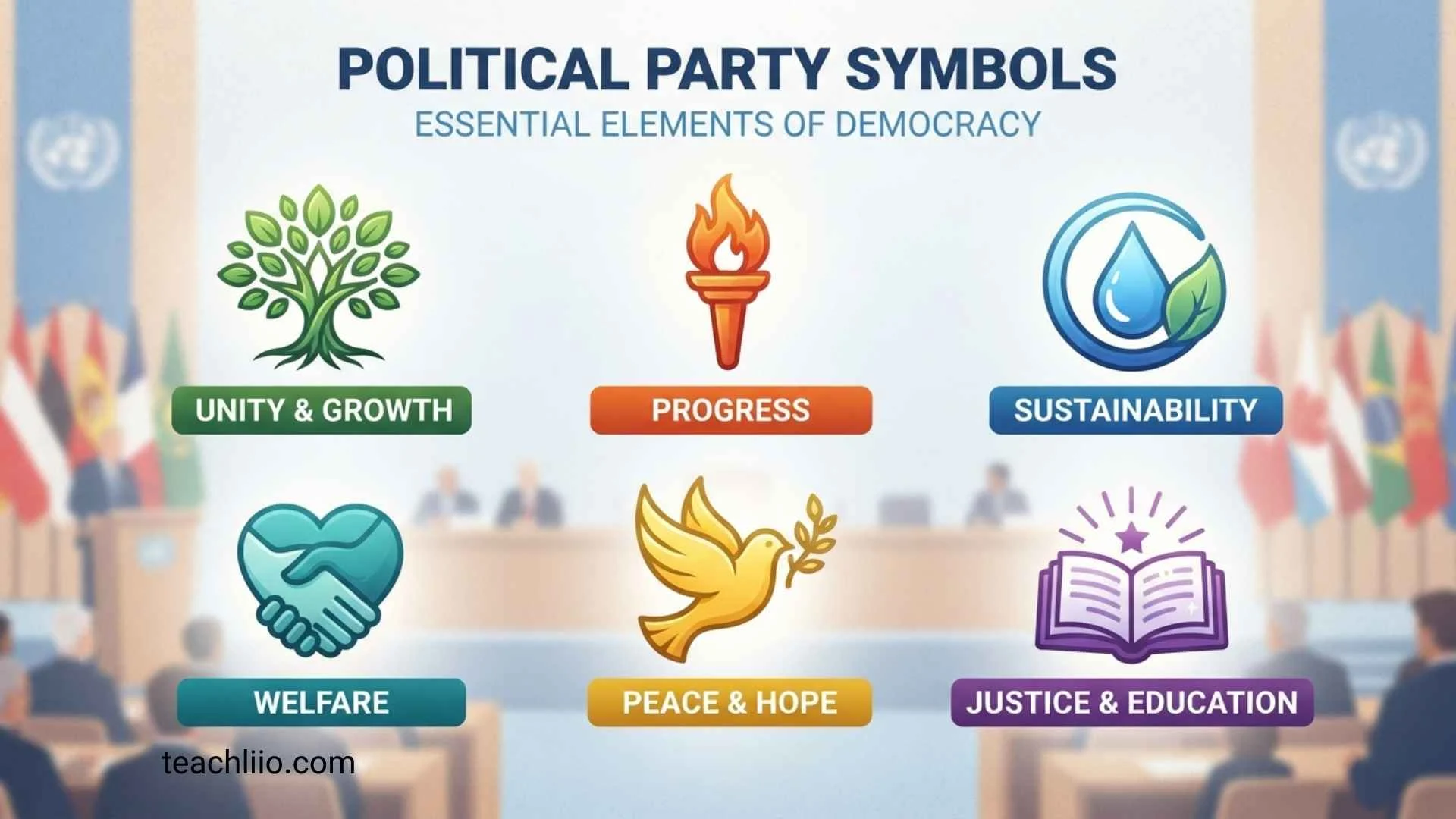
Political party symbols are simple images that help voters recognize political parties and candidates. A symbol may be an animal, plant, object, tool, hand, star, arrow, or another easily recognizable design. In some countries, an election authority officially assigns these symbols for use on ballots and election materials.
The meaning of political party symbols can vary greatly from one country to another. A symbol used as an official election mark in one country may simply be a historical or cultural political symbol somewhere else.
That is why it is important to distinguish between an official election symbol, party logo, ideological symbol, and popular political symbol. Understanding this difference makes it easier to identify parties accurately and understand why particular symbols become associated with them.
What Are Political Party Symbols?
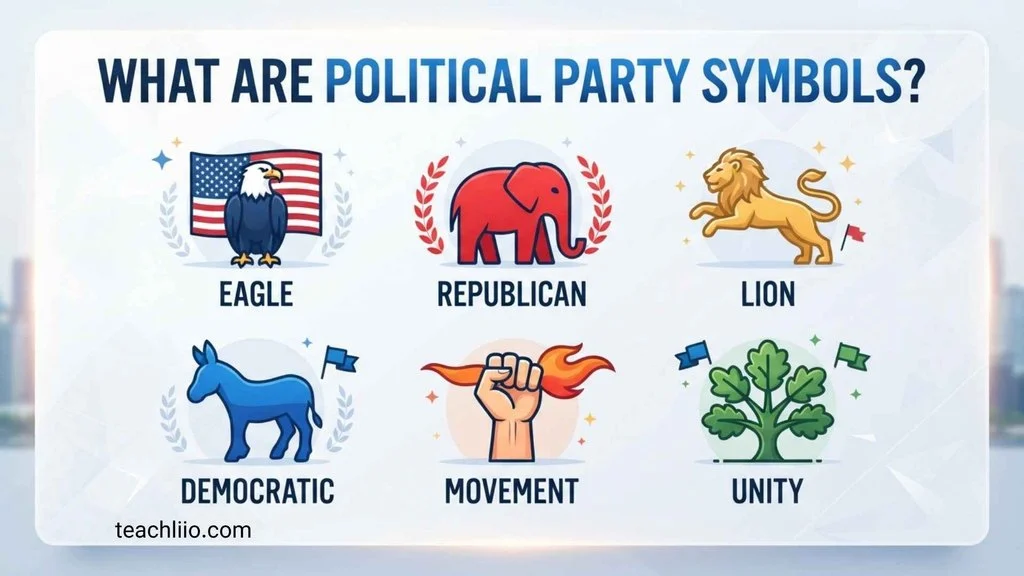
Political party symbols are visual images associated with political parties or candidates. They make political organizations easier to recognize, particularly during elections.
In countries where election symbols are officially regulated, the symbol can become an important part of the voting process. Instead of relying only on a party’s written name, voters may recognize the party through a familiar image.
For example, India’s Election Commission operates a formal system for election symbols and maintains information about political parties, candidates, reserved symbols, and symbol allotment.
Political symbols can also exist outside formal election systems. A party may use a particular animal, color, object, or graphic as part of its public identity without that image functioning as an official ballot symbol.
Political Party Symbols vs. Election Symbols
The terms are sometimes used interchangeably, but they are not always identical.
An election symbol is a symbol used for electoral identification and, in some countries, is officially regulated or assigned by an election authority.
A political party symbol can have a broader meaning. It may include a party’s official election symbol, logo, colors, historical imagery, or another image strongly associated with the organization.
For example, a party’s website might use a modern logo while its official election symbol has a simpler design intended to be recognizable on election materials.
Political Party Symbols vs. Party Logos
A party logo is primarily a branding element. It may appear on websites, social media, posters, banners, merchandise, and campaign materials.
An election symbol, by contrast, may be governed by election laws and regulations.
The two can look similar, but they should not automatically be treated as the same thing.
Why Are Political Party Symbols Important?
Political party symbols are important because politics can involve many parties, candidates, languages, and complicated names. A simple visual mark can make identification much easier.
Voter Identification
A recognizable symbol gives voters a quick visual reference.
This can be especially useful when several candidates appear on a ballot or when voters are more familiar with a party’s symbol than its formal name.
Ballot Recognition
In electoral systems that officially use symbols, the symbol can help voters locate their preferred party or candidate on the ballot.
India’s election-symbol rules, for example, distinguish reserved symbols from other symbols and establish rules governing their allotment to candidates.
Political Branding
Symbols also help political parties develop a recognizable identity.
A repeated image can appear on:
- Campaign posters
- Flags
- Election advertisements
- Social media
- Public rallies
- Ballots
- Educational voter material
Over time, voters may associate the image with the party even outside election periods.
Visual Recognition Across Languages
Political symbols can also provide a visual identification method that does not depend entirely on reading a party’s name.
This can be particularly useful in multilingual societies where party names may be written in different languages or scripts.
Historical Identity
Some political symbols become connected to a party because of decades of political history.
A symbol can therefore represent more than a campaign. It may become part of a party’s historical identity and public memory.
Types of Political Party Symbols
Political parties and election authorities use many different types of imagery.
Animal Symbols
Animals are among the most recognizable political symbols.
Examples can include:
- Elephant
- Donkey
- Eagle
- Lion
- Horse
- Tiger
- Fish
- Bird
An animal may represent strength, unity, national identity, tradition, or another idea, but its specific meaning depends on the party and country.
Plant Symbols
Plants and flowers can also become political symbols.
Examples include:
- Lotus
- Rose
- Tree
- Leaf
- Flower
- Wheat
- Fruit
A plant may communicate ideas such as growth, renewal, agriculture, peace, or cultural identity, but readers should not assume that every party uses the same symbolic interpretation.
Object Symbols
Objects are particularly useful as election symbols because they are usually easy to recognize.
Examples include:
- Broom
- Bicycle
- Lantern
- Scale
- Torch
- Arrow
- Bell
- Key
- Plough
- Book
Their practical appearance can make them memorable when printed in small sizes.
Human and Hand Symbols
Hands and human figures are also common political imagery.
A hand can represent ideas such as participation, solidarity, service, or unity depending on the political context.
However, the exact meaning belongs to the organization using it and should not be generalized across countries.
Star and Geometric Symbols
Stars, circles, arrows, wheels, crosses, and other geometric designs can become political identifiers.
These symbols may be linked to party history, ideology, national traditions, or electoral branding.
Color-Based Symbols
Political identity is not limited to pictures.
Colors can become strongly associated with political parties or movements. Red, blue, green, yellow, orange, white, black, and purple may all carry different political associations depending on the country.
A color should therefore be interpreted within its political and cultural context rather than through a universal dictionary.
Political Party Symbols Around the World
Political party symbols do not operate under one global system.
Some countries have highly regulated election-symbol systems, while others rely more heavily on party names, logos, colors, or other forms of identification.
Political Party Symbols in India
India provides one of the clearest examples of a formal election-symbol system.
The Election Commission of India maintains official information concerning political parties and election symbols. Its rules distinguish reserved symbols from free symbols and establish conditions for symbol allotment.
Well-known examples associated with Indian political parties include:
| Political Party | Commonly Associated Symbol |
| Bharatiya Janata Party (BJP) | Lotus |
| Indian National Congress | Hand |
| Bahujan Samaj Party (BSP) | Elephant |
| Aam Aadmi Party (AAP) | Broom |
| Communist Party of India (Marxist) | Hammer, Sickle and Star |
These examples are useful for understanding the concept, but current election information should always be checked against the Election Commission because political-party recognition and symbol arrangements can change.
The Election Commission continues to publish current symbol-allotment decisions and archives, demonstrating that symbol information is an active electoral matter rather than a permanently fixed historical list.
Political Party Symbols in Pakistan
Pakistan also has a formal election-symbol system administered by the Election Commission of Pakistan.
The ECP publishes lists identifying political parties and their allotted symbols. Its published materials include symbols such as a scale, lantern, bicycle, tree, kite, torch, leaf, and many others.
This demonstrates why election symbols can be especially important in countries with multiple political parties.
The symbol provides voters with a recognizable visual identifier alongside the party or candidate information presented during an election.
Because Pakistani party and election arrangements can change, readers should use the latest Election Commission of Pakistan information when checking the symbol for a particular election.
Political Party Symbols in the United States
The United States provides a useful contrast.
The Democratic Party is widely associated with the donkey, while the Republican Party is widely associated with the elephant.
These images are important political symbols, but they should not automatically be treated as equivalent to the officially regulated election-symbol systems found in countries such as India or Pakistan.
In the United States, party identification generally relies heavily on party names, logos, colors, candidate information, and state-specific ballot rules.
The donkey and elephant are therefore best understood as major historical and cultural political symbols.
Political Party Symbols in Other Countries
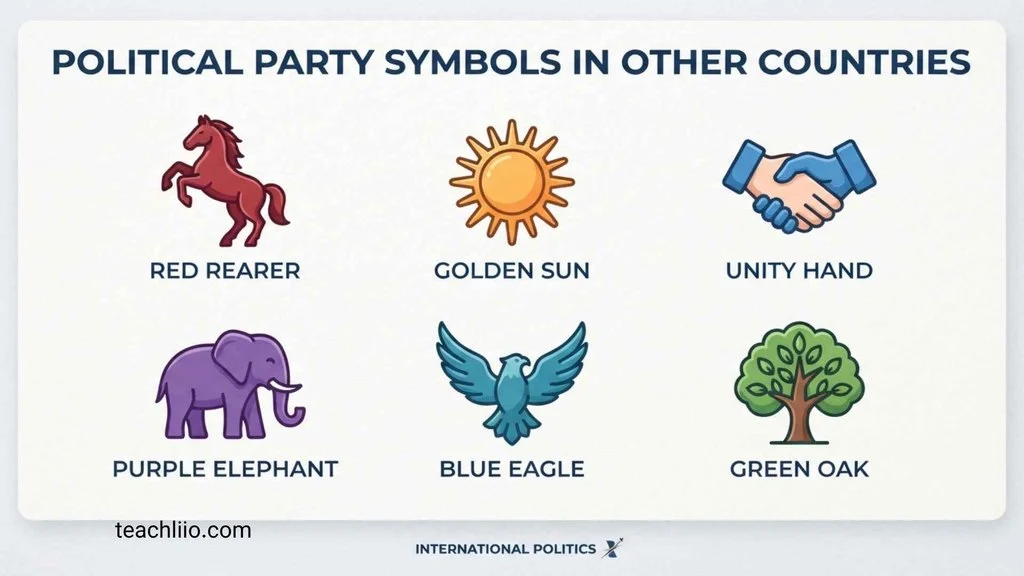
Other countries use different approaches.
Some may use:
- Party logos
- Letters
- Numbers
- Colors
- Candidate names
- Pictures
- Election symbols
- Combinations of these identifiers
The rules depend on each country’s electoral system.
Therefore, there is no single worldwide list of political party symbols that applies to every election.
Famous Political Party Symbols and Their Meanings
Some political symbols are recognized by millions of people. However, their meaning should always be connected to the political organization and country where they are used.
Lotus
The lotus is a well-known political symbol in India and is associated with the Bharatiya Janata Party.
Because the lotus also has religious, cultural, artistic, and natural significance in South Asia, its broader cultural meaning should not automatically be confused with its electoral meaning.
Elephant
The elephant has been used as an important political symbol in India and is associated with the Bahujan Samaj Party.
The elephant can also carry different cultural meanings in other societies, so the political meaning comes from its specific party context.
Broom
The broom is associated with India’s Aam Aadmi Party.
As an everyday household object, it is visually simple and easy to recognize. Its political significance comes from its association with the party rather than from a universal political meaning attached to every broom image.
Hand
The hand is associated with India’s Indian National Congress.
Hand imagery is also used in many other contexts around the world, so identifying the exact party requires considering the country and election.
Donkey
The donkey is strongly associated with the Democratic Party in the United States.
Its association developed through American political history and became a recognizable representation of the Democratic Party.
Elephant in U.S. Politics
The elephant is strongly associated with the Republican Party in the United States.
This is an important example of why the same type of symbol can have completely different political associations in different countries.
An elephant in one country’s politics does not necessarily identify the same party or ideology elsewhere.
Political Party Colors and Their Meanings
Colors can be just as memorable as images.
Political organizations may develop recognizable color combinations for their:
- Flags
- Posters
- Logos
- Campaign clothing
- Websites
- Social media
- Election materials
However, colors do not have one universal political meaning.
For example, red may represent a particular ideological tradition in one country while being associated with a completely different party or movement elsewhere.
Green can be connected to environmental politics in some contexts but may represent religion, nationalism, or another political tradition in others.
Blue, yellow, orange, black, white, and purple can also have different associations.
The safest approach is to identify the party and country before interpreting the color.
How Are Election Symbols Assigned?
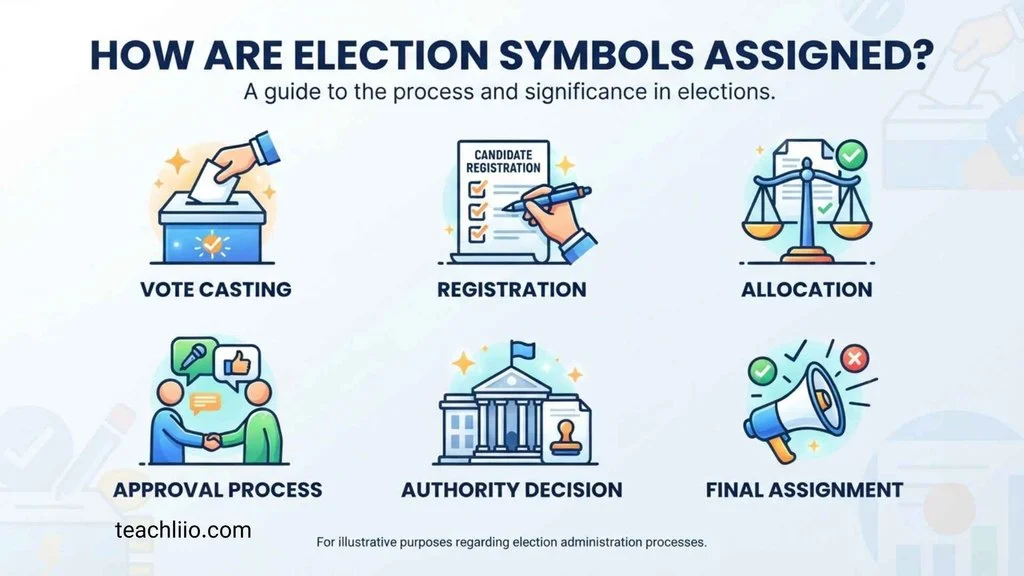
The process depends on national election law.
In some systems, a recognized political party receives a reserved symbol. Other symbols may be available for candidates or parties under specific rules.
India provides a clear example of this structured approach. Its Election Symbols (Reservation and Allotment) Order establishes rules for reserved symbols and their use by recognized national and state parties.
Reserved Symbols
A reserved symbol is associated with a particular recognized political party under the applicable election rules.
In India’s system, candidates set up by recognized national or state parties are allotted the party’s reserved symbol subject to the applicable rules.
Free Symbols
Some electoral systems maintain a pool of symbols that can be allotted to candidates or parties that do not have a reserved symbol.
The exact conditions vary by country.
India’s Election Commission also publishes information concerning free symbols and common-symbol allotment.
Candidate Symbols
Independent candidates may receive symbols according to the rules of the relevant election authority.
This is another reason why readers should not assume that every symbol appearing on a ballot represents a permanent political party.
What Happens When Political Parties Split?
Political-party splits can create difficult questions about party names, leadership, organizational control, and election symbols.
The outcome depends on the country’s election law and the decisions of its election authority or courts.
India, for example, has formal procedures and decisions concerning recognition and symbol-related disputes. The Election Commission maintains current records of recognition and de-recognition matters.
This means that a party’s historical symbol should not automatically be assumed to remain available to every faction after a political split.
Can a Political Party Lose or Change Its Election Symbol?
Yes, depending on the country’s electoral rules and circumstances.
A symbol can become the subject of regulatory decisions when:
- A party loses recognition
- A party splits
- A new party seeks recognition
- A party merges
- A court or election authority makes a ruling
- Election laws change
- A symbol is reassigned under applicable rules
India’s current Election Commission records show that recognition and symbol allotment remain active administrative matters.
The same principle applies more broadly: never rely on an old political-symbol list when researching a current election.
How to Identify a Political Party by Its Symbol
If you see an unfamiliar political symbol, follow a few simple steps.
Step 1: Identify the Country
The same symbol can represent completely different parties in different countries.
Step 2: Identify the Election
Symbols can differ between elections, especially when party recognition or candidate arrangements change.
Step 3: Check the Official Election Authority
Look for the country’s election commission or electoral authority.
This is more reliable than relying on an old social-media graphic or an unofficial list.
Step 4: Compare the Symbol With the Party Name
Do not identify a party from the image alone when several organizations use similar imagery.
Step 5: Check Whether It Is Official
Determine whether the image is an official election symbol, a party logo, or simply a symbol commonly associated with the party.
This five-step approach is particularly useful for students, first-time voters, researchers, and anyone trying to verify political information online.
Official vs. Unofficial Political Symbols
This distinction is essential when researching political party symbols.
Official Election Symbol
A symbol formally recognized or assigned for electoral purposes under the relevant rules.
Party Logo
A visual brand used by a political organization.
Historical Symbol
An image that became associated with a party through its history.
Ideological Symbol
An image representing a political ideology or movement rather than one particular party.
Popular Political Symbol
An image that the public commonly associates with a party even though it may not be its current official election symbol.
Understanding these categories prevents many common mistakes.
Political Party Symbols for Students
Political party symbols can be an easy way for students to understand how visual communication works in democracy.
A political party may use a symbol because it is:
- Easy to recognize
- Easy to reproduce
- Visually memorable
- Useful on election material
- Associated with the party’s identity
- Helpful for distinguishing candidates
A simple student definition is:
A political party symbol is a recognizable image associated with a political party or candidate that can help people identify them, especially during elections.
Students should remember that the exact rules for election symbols differ between countries.
Why Political Symbols Matter in Democracy
Political symbols are more than decorative images.
They can make political participation easier by providing voters with recognizable visual identifiers. They can also become powerful parts of campaign communication and party identity.
At the same time, symbols should not replace informed decision-making.
A symbol tells you who or what is being identified. It does not by itself tell you whether a party’s policies, candidates, promises, or record are good or bad.
For voters, the best approach is to use the symbol for identification and then examine reliable information about the party and candidates before making a decision.
Frequently Asked Questions
What is a political party symbol?
A political party symbol is an image associated with a political party or candidate. In some countries, an election authority officially assigns the symbol for electoral use.
Why do political parties use symbols?
Political parties use symbols because images can be easier to recognize and remember than long party names. In some electoral systems, symbols also help voters identify parties or candidates on ballots.
What is an election symbol?
An election symbol is a visual identifier used during an election. In some countries, election authorities officially regulate and assign these symbols to political parties or candidates.
Are political party symbols the same in every country?
No. Political symbols vary significantly between countries. A symbol used by one party in one country may have an entirely different meaning elsewhere.
What is the difference between a party logo and an election symbol?
A party logo is primarily a branding element, while an election symbol may be an officially regulated identifier used during an election. In some cases, the two may look similar, but they serve different purposes.
Why are symbols used on ballots?
Symbols can make parties and candidates easier to identify, particularly where there are many candidates or where voters may not rely entirely on written party names.
Who assigns election symbols?
The relevant election authority usually establishes or administers the symbol system where official election symbols are used. The exact process varies by country.
Can a political party change its symbol?
It can happen under the applicable election rules. Changes may result from recognition decisions, party splits, mergers, legal rulings, or changes in electoral regulations.
What is the Democratic Party symbol?
The donkey is the best-known historical and cultural symbol associated with the Democratic Party in the United States.
What is the Republican Party symbol?
The elephant is the best-known historical and cultural symbol associated with the Republican Party in the United States.
What is the BJP symbol?
The Bharatiya Janata Party in India is associated with the lotus as its election symbol.
What is the Congress Party symbol in India?
The Indian National Congress is associated with the hand symbol.
What is the AAP symbol?
The Aam Aadmi Party in India is associated with the broom symbol.
Why can the same symbol represent different political parties?
Election symbols are country- and system-specific. A symbol such as an elephant, rose, tree, or star can be used by different political organizations in different places.
Are political party symbols permanent?
Not necessarily. Official symbols can be affected by election rules, party recognition, organizational changes, mergers, splits, and decisions by election authorities.
Conclusion
Political party symbols provide a simple visual way to identify political organizations and candidates. In countries with formal election-symbol systems, they can play an important role in helping voters recognize choices on election materials.
However, not every political symbol has the same legal status. An official election symbol, party logo, ideological image, historical emblem, and popular political symbol are different things.
The meaning of a symbol also depends on its political and national context. A lotus, elephant, hand, broom, donkey, or other image can have one meaning in one political system and a completely different association somewhere else.
For accurate information, especially during an active election, always verify the symbol through the relevant election authority. India’s Election Commission maintains current symbol and party information, while Pakistan’s Election Commission publishes official election-symbol material.
Ultimately, political symbols are useful tools for recognition, but they are only one part of understanding an election. Voters should look beyond the symbol and consider the party, candidates, policies, record, and reliable election information before making an informed choice.

I’m Oscar Radcliffe, a British writer who enjoys uncovering the numbers hidden within ordinary questions. My work explores quantities, counts, statistics, measurements, and fascinating comparisons across different subjects. I aim to present reliable information clearly, helping readers satisfy their curiosity while discovering interesting facts they may never have considered before.
Books:
The Science of Counting
How Many? Fascinating Numbers Explained