
Travel symbols make it easier to explore unfamiliar places, understand directions, and find important services during a journey. From airplane and suitcase icons to airport signs, road symbols, and navigation pictograms, these visual signs communicate useful information without requiring long explanations.
Whether you are preparing for an international vacation, learning about transportation signs, exploring different destinations, or looking for travel icons and their meanings, understanding these symbols can make your experience more convenient. Some represent transportation and tourism, while others provide practical information about airport facilities, road directions, accommodation, and accessibility.
In this guide, you will discover more than 40 common travel symbols, what they represent, where they are used, and how to recognize the difference between official public information signs and decorative travel icons.
What Are Travel Symbols?
Travel symbols are visual representations, icons, signs, and pictograms associated with transportation, navigation, tourism, destinations, and public facilities. They help people understand information quickly, particularly when traveling somewhere unfamiliar.
For example, an airplane represents air transportation, a suitcase represents luggage, and a location pin identifies a place on a map. Other symbols communicate practical information, such as where to collect baggage, find a restroom, access an elevator, or obtain travel assistance.
Travel symbols appear in airports, railway stations, hotels, highways, tourist attractions, maps, websites, and mobile applications.
However, not every travel-related picture is an official sign. Some symbols are standardized public information pictograms, while others are decorative illustrations used to represent vacations and adventure.
40+ Common Travel Symbols and Their Meanings
Travel symbols represent different activities, facilities, and experiences. The following examples explain their common meanings and practical uses.
Transportation and Vehicle Symbols
These symbols identify different ways to travel between destinations.
- Airplane Symbol: Represents air transportation, flights, and aviation. It commonly appears on airport signs, flight information displays, and travel applications.
- Train Symbol: Represents railway transportation and train services. It helps passengers identify railway stations, train routes, and transportation facilities.
- Bus Symbol: Represents public bus transportation, bus terminals, and designated bus stops. It is commonly used on public transportation maps.
- Car Symbol: Represents road transportation, personal vehicles, and car rental services. It may also identify parking facilities and driving routes.
- Ship Symbol: Represents water transportation, cruises, ports, and journeys across oceans or waterways.
- Bicycle Symbol: Represents cycling, bicycle routes, and bicycle rental facilities. Depending on the sign, it may also indicate an area reserved for cyclists.
- Taxi Symbol: Represents taxi services and designated passenger pickup locations. Travelers often see it near airports, hotels, and transportation terminals.
- Helicopter Symbol: Represents helicopter transportation or a designated heliport. It is useful for identifying helicopter facilities and services.
- Metro Symbol: Represents underground railway systems and urban rapid transit. Its design varies between cities and transportation networks.
- Ferry Symbol: Represents ferry services that transport passengers, vehicles, or both across water.
Navigation and Direction Symbols
Navigation symbols help travelers understand their location, identify destinations, and follow routes.
- Compass Symbol: Represents direction, orientation, and navigation. Its north, south, east, and west markings help travelers understand geographical direction.
- Map Symbol: Represents geographical information, routes, and trip planning. Maps help visitors explore unfamiliar cities and identify important places.
- Location Pin Symbol: Marks a specific location, such as a hotel, tourist attraction, restaurant, or meeting point.
- Direction Arrow: Indicates the direction people should follow. Arrows are commonly used on airport signs, road signs, and pedestrian routes.
- Signpost Symbol: Represents directions to different destinations. It is frequently associated with hiking trails, tourist routes, and road navigation.
- Route Marker: Identifies a particular route, trail, or transportation path. Its appearance depends on the relevant navigation system.
- Bridge Symbol: Represents a bridge or crossing over a river, valley, or other obstacle. It can appear on maps and infrastructure diagrams.
Tourism and Vacation Symbols
Tourism symbols represent holiday destinations, recreational activities, and enjoyable travel experiences.
- Globe Symbol: Represents the world, international destinations, and global exploration. It is commonly used by travel agencies and tourism websites.
- Palm Tree Symbol: Represents tropical destinations, warm weather, island holidays, and beach vacations. It is usually a decorative travel symbol rather than an official direction sign.
- Beach Symbol: Represents seaside destinations, swimming, coastal tourism, and relaxing holidays.
- Mountain Symbol: Represents mountain destinations, hiking, climbing, and outdoor exploration.
- Tent Symbol: Represents camping, campsites, and outdoor accommodation. It is commonly used in tourism materials and camping information.
- Camera Symbol: Represents photography, sightseeing, and capturing travel memories. It is frequently used in travel blogs and vacation graphics.
- Anchor Symbol: Represents sailing, maritime activities, and connections with the sea. It is also used decoratively to represent stability and nautical themes.
- Sun Symbol: Represents sunny weather, summer holidays, and warm destinations.
- Tourist Information Symbol: Identifies visitor information services where travelers can obtain maps, directions, and local guidance.
- Viewpoint Symbol: Represents a location offering scenic views of mountains, coastlines, cities, or natural landscapes.
- Picnic Area Symbol: Identifies an outdoor location where visitors can stop, eat, and relax.
Accommodation and Hospitality Symbols
These symbols help travelers identify places to stay and facilities available during their journeys.
- Hotel Symbol: Represents hotels and overnight accommodation. It commonly appears on tourism maps and accommodation signs.
- Bed Symbol: Represents sleeping facilities and guest accommodation. It may identify hotel rooms, hostels, or other lodging services.
- Restaurant Symbol: Identifies places where visitors can purchase meals and refreshments.
- Coffee Cup Symbol: Represents cafés, coffee shops, and refreshment facilities.
- Swimming Pool Symbol: Identifies swimming facilities at hotels, resorts, and recreational destinations.
- Wi-Fi Symbol: Indicates wireless internet availability. Travelers commonly find it in hotels, airports, cafés, and public facilities.
- Elevator Symbol: Identifies elevators or lifts that provide access between different floors of a building.
Travel Documents and Passenger Symbols

These symbols are associated with travel procedures, documents, and passenger services.
- Passport Symbol: Represents international identification and travel documentation. Passports are commonly associated with border control and international journeys.
- Boarding Pass Symbol: Represents flight check-in and permission to board a particular flight. It is associated with passenger and flight information.
- Baggage Trolley Symbol: Identifies luggage carts used to move bags through airports and transportation terminals.
- Baggage Claim Symbol: Directs arriving passengers toward the area where checked luggage is collected.
- Currency Exchange Symbol: Identifies services where travelers can exchange one currency for another.
- Information Desk Symbol: Directs visitors toward assistance and information services.
- Restroom Symbol: Identifies public toilet facilities in airports, hotels, railway stations, and other public buildings.
- Drinking Water Symbol: Identifies drinking water facilities or water fountains where the relevant pictogram is displayed.
Safety and Accessibility Symbols
These symbols communicate important information about public facilities, assistance, and safety.
- Emergency Exit Symbol: Identifies an emergency evacuation route or exit. Follow the displayed directional instructions during an emergency.
- First Aid Symbol: Identifies medical assistance or first aid facilities.
- Fire Extinguisher Symbol: Indicates the location of firefighting equipment.
- Wheelchair Accessibility Symbol: Identifies accessible facilities, entrances, parking spaces, or services for people with mobility disabilities.
- Accessible Elevator Symbol: Identifies an elevator designed to provide accessible movement between floors.
- Pedestrian Symbol: Represents walking routes, pedestrian-only areas, or designated crossing facilities, depending on the sign.
- Life Jacket Symbol: Represents flotation equipment and water safety information, particularly on boats and ferries.
Remember that the appearance and official meaning of a pictogram depend on the relevant standard or local signage system. A decorative illustration of a life jacket, for example, should not be confused with an actual safety instruction.
Airport Symbols and Their Meanings
Airports use pictograms to help passengers find their way through busy terminals. These signs are particularly important because international airports serve people who speak different languages.
Flight and Passenger Information Symbols
Common flight-related symbols include:
- Departures: Directs passengers toward departing flight information and departure areas.
- Arrivals: Identifies areas associated with arriving flights.
- Check-in: Directs passengers toward airline check-in counters.
- Boarding Gate: Identifies the location where passengers board an aircraft.
- Connecting Flights: Helps passengers locate transfer routes and connecting flight facilities.
- Airport Information: Identifies information desks where passengers can request assistance.
Baggage and Luggage Symbols
Airport baggage symbols help passengers understand where to handle their luggage.
- Baggage Claim: Shows where arriving passengers collect checked bags.
- Baggage Trolley: Identifies luggage carts.
- Lost and Found: Directs passengers toward services for reporting lost property.
- Luggage Storage: Identifies facilities where luggage can be stored temporarily.
Security and Immigration Symbols
These signs guide passengers through airport entry and security procedures.
- Security Screening: Directs passengers toward passenger and baggage screening.
- Passport Control: Identifies immigration inspection areas.
- Customs: Shows where travelers may need to declare goods or complete customs procedures.
- Restricted Area: Indicates an area where access is limited to authorized people.
Airport Facilities and Services
Other airport symbols help travelers locate useful facilities.
- Restrooms: Identifies public toilet facilities.
- Accessible Restrooms: Indicates accessible toilet facilities.
- Drinking Water: Identifies water fountains or drinking water points.
- Airport Bus: Indicates bus transportation connecting airport facilities or destinations.
- Taxi: Identifies designated taxi services or pickup areas.
- Parking: Shows parking facilities.
- Medical Assistance: Directs passengers toward healthcare or emergency assistance.
Road and Tourist Symbols
Road symbols provide information about directions, restrictions, services, and attractions. Their appearance and legal meanings depend on the country where they are displayed.
Common Road Symbols
Some frequently encountered road signs include:
- Parking: Identifies designated parking areas.
- Pedestrian Crossing: Warns drivers or directs pedestrians toward a designated crossing.
- Bicycle Route: Identifies cycling routes or bicycle-related restrictions.
- Hospital: Indicates a hospital or medical facility.
- Fuel Station: Identifies a place where drivers can refuel their vehicles.
- No Entry: Indicates that vehicles or other road users are prohibited from entering.
- Road Works: Warns about construction or maintenance activities.
- One-Way Arrow: Indicates the permitted direction of travel.
Drivers should always follow their country’s official traffic regulations rather than assuming that every road symbol has an identical meaning worldwide.
Tourist Attraction Signs
Tourist signs help visitors find destinations and recreational facilities.
In the United Kingdom, brown-background direction signs are commonly used for tourist destinations and leisure facilities. Their symbols can identify attractions such as castles, historic houses, museums, beaches, nature reserves, and campsites.
Some signs use a destination’s name and symbol initially, while later signs along the route may display only the associated symbol. This helps drivers continue following the correct route. The specific rules and designs depend on the relevant road-sign regulations.
Other common tourist sign categories include:
- Castle: Indicates a historic castle or castle attraction.
- Museum: Identifies a museum or cultural destination.
- Beach: Directs visitors toward a beach.
- Nature Reserve: Identifies a protected natural area or wildlife destination.
- Camping Site: Indicates a campsite or caravan facility.
- Picnic Area: Identifies a designated outdoor picnic location.
- Tourist Information: Directs visitors toward local information services.
Different Categories of Travel Symbols
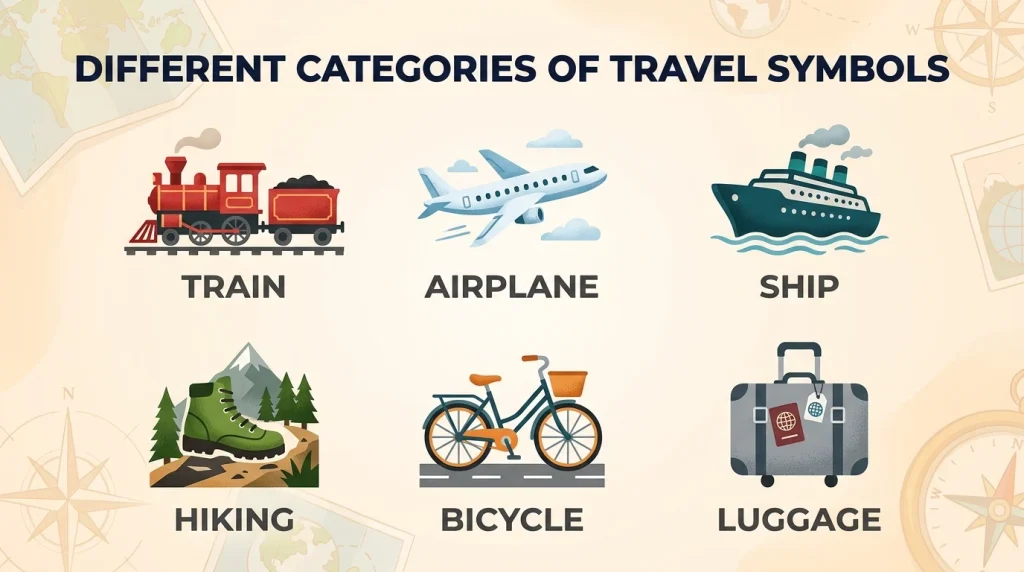
Travel symbols can be organized into broader categories according to the information they communicate.
Transportation Symbols
These represent vehicles and transportation services, including airplanes, trains, buses, taxis, bicycles, ships, and ferries.
Navigation Symbols
Maps, compasses, arrows, signposts, and location pins help travelers understand routes and directions.
Tourism Symbols
Palm trees, beaches, mountains, tents, cameras, and viewpoints commonly represent holiday activities, sightseeing, and adventure.
Public Information Symbols
These communicate useful information about facilities and services available to visitors. Examples include restrooms, elevators, baggage services, information desks, and drinking water.
Accessibility Symbols
These identify facilities and services designed to improve access for people with disabilities. Examples include accessible toilets, wheelchair-accessible routes, and accessible elevators.
International Travel Symbols and Their Meanings
Travel symbols are often designed to be understood by people from different countries. However, not every symbol has an identical appearance or official meaning worldwide.
What Is ISO 7001?
ISO 7001 is an international standard titled Graphical Symbols — Registered Public Information Symbols. It provides registered pictograms intended to communicate public information in places where people need to identify facilities and services.
Its categories include public facilities, transport facilities, tourism, culture and heritage, commercial facilities, public behavior, and accessibility.
The standard helps create greater consistency in public information signage. However, ISO 7001 does not cover safety signs or traffic signs on public roads, which are subject to separate requirements.
Are Travel Symbols Universal?
Some travel symbols are widely recognizable because their pictures clearly represent familiar objects.
For example, most people can recognize an airplane as a representation of air travel or a suitcase as a representation of luggage.
Nevertheless, a familiar picture is not automatically an officially standardized sign. Different countries may use different pictograms, colors, layouts, or regulations.
Three important distinctions are worth remembering:
- Standardized public information symbols: Registered pictograms intended for consistent public communication.
- Traffic and safety signs: Signs governed by specific road traffic and safety regulations.
- Decorative travel icons: Illustrations used in websites, logos, posters, and vacation designs.
How Travel Signs Differ Between Countries
Travel signage can vary because countries have different transportation systems, languages, regulations, and design traditions.
For example, brown tourist direction signs are used in the United Kingdom to identify tourist destinations and facilities. Other countries may use different colors, layouts, or destination symbols.
Airport signs may also differ in appearance, even when they communicate similar information.
When traveling internationally, pay attention to the pictogram, accompanying text, arrows, and surrounding instructions rather than relying on color alone.
How to Identify Unfamiliar Travel Symbols
Encountering an unfamiliar sign is common when visiting a new airport, railway station, or tourist destination. A few simple steps can help you understand its purpose.
1. Examine the Main Picture
Look at the object or person shown in the pictogram. A train, airplane, suitcase, or bed may provide an immediate clue about the service being represented.
2. Consider the Location
The place where a sign appears can help explain its meaning. A baggage symbol near an airport arrivals area is likely to refer to luggage collection or handling.
3. Check the Arrows and Direction
Arrows often provide important information about where to go. Follow the complete sign rather than looking at the picture alone.
4. Look for Supporting Text
Words printed beside a symbol can clarify its meaning. This is particularly useful when a pictogram is unfamiliar or could represent several different services.
5. Consult Official Information
If you are uncertain about a road sign, safety instruction, or airport procedure, check the relevant transportation authority’s guidance or ask an authorized staff member.
Never assume that an unfamiliar warning or restriction sign is merely decorative.
Travel Symbols Used in Art and Design
Travel symbols are also popular in graphic design because they make travel-related content easy to recognize.
Travel Logos
Travel agencies, tour operators, and tourism businesses often use airplanes, globes, compasses, and location pins in their logos.
Travel Posters
Posters may feature mountains, beaches, historic landmarks, and suitcases to communicate the atmosphere of a destination.
Social Media Graphics
Travel bloggers use cameras, airplanes, maps, and palm trees in posts, thumbnails, and promotional graphics.
Travel Invitations and Scrapbooks
Decorative icons help create attractive travel journals, vacation invitations, photo albums, and memory books.
Educational Materials
Teachers use travel pictograms to explain geography, transportation, tourism, and navigation to students.
When using symbols for design purposes, remember that decorative artwork is different from official signage. A creative travel illustration should not be presented as an authentic safety or traffic sign.
Frequently Asked Questions
What Are the Most Common Travel Symbols?
Some common travel symbols include airplanes, suitcases, globes, maps, compasses, trains, buses, ships, location pins, and cameras. They represent transportation, luggage, navigation, destinations, and travel experiences.
What Symbols Are Used at Airports?
Airports commonly use symbols for departures, arrivals, check-in, boarding gates, baggage claim, customs, passport control, restrooms, parking, and passenger information services.
What Does a Compass Symbol Mean?
A compass symbol represents direction, orientation, and navigation. Its directional markings help travelers understand geographical positions and find their way.
What Does a Suitcase Symbol Represent?
A suitcase symbolizes luggage, packing, and preparing for a journey. It is also commonly associated with vacations, business travel, and international exploration.
What Is the Universal Symbol for Travel?
There is no single official universal symbol that represents every type of travel. Airplanes, globes, suitcases, and compasses are widely recognized visual representations, but each communicates a different aspect of traveling.
What Is the Difference Between Travel Icons and Travel Signs?
Travel icons are generally small graphics used in websites, applications, and designs. Travel signs are visual displays used to communicate directions, instructions, restrictions, or information in real-world locations.
Are International Travel Symbols the Same Everywhere?
No. Some pictograms are internationally standardized or widely recognized, but transportation signs, road markings, and local public information symbols can differ between countries.
What Are Public Information Symbols?
Public information symbols are pictograms that communicate information about facilities, services, and public spaces. ISO 7001 is an international standard that specifies registered symbols for public information.
What Does a Brown Tourist Sign Mean?
In the United Kingdom, a brown tourist direction sign indicates a route toward a tourist attraction or leisure facility. It may feature symbols representing castles, museums, beaches, campsites, and other visitor destinations. Rules vary in other countries.
What Symbols Indicate Accessible Travel Facilities?
Common accessibility symbols include the wheelchair accessibility pictogram, accessible restroom symbol, accessible elevator symbol, and assistance dog symbol. Their purpose is to help people identify facilities and services designed for accessibility.
Conclusion
Travel symbols make it easier to understand transportation systems, navigate unfamiliar destinations, and identify useful public facilities. From airplanes and suitcases to airport pictograms, road signs, and accessibility symbols, each visual representation communicates a particular type of information.
Understanding the difference between decorative travel icons and official public information signs is equally important. While a palm tree may represent a tropical vacation, an airport pictogram or road sign provides practical information that travelers may need during their journeys.
Whether you are planning a holiday, exploring a new city, studying international signage, or creating travel-related designs, learning these symbols can help you understand the visual language of travel and make your next journey easier to navigate.
