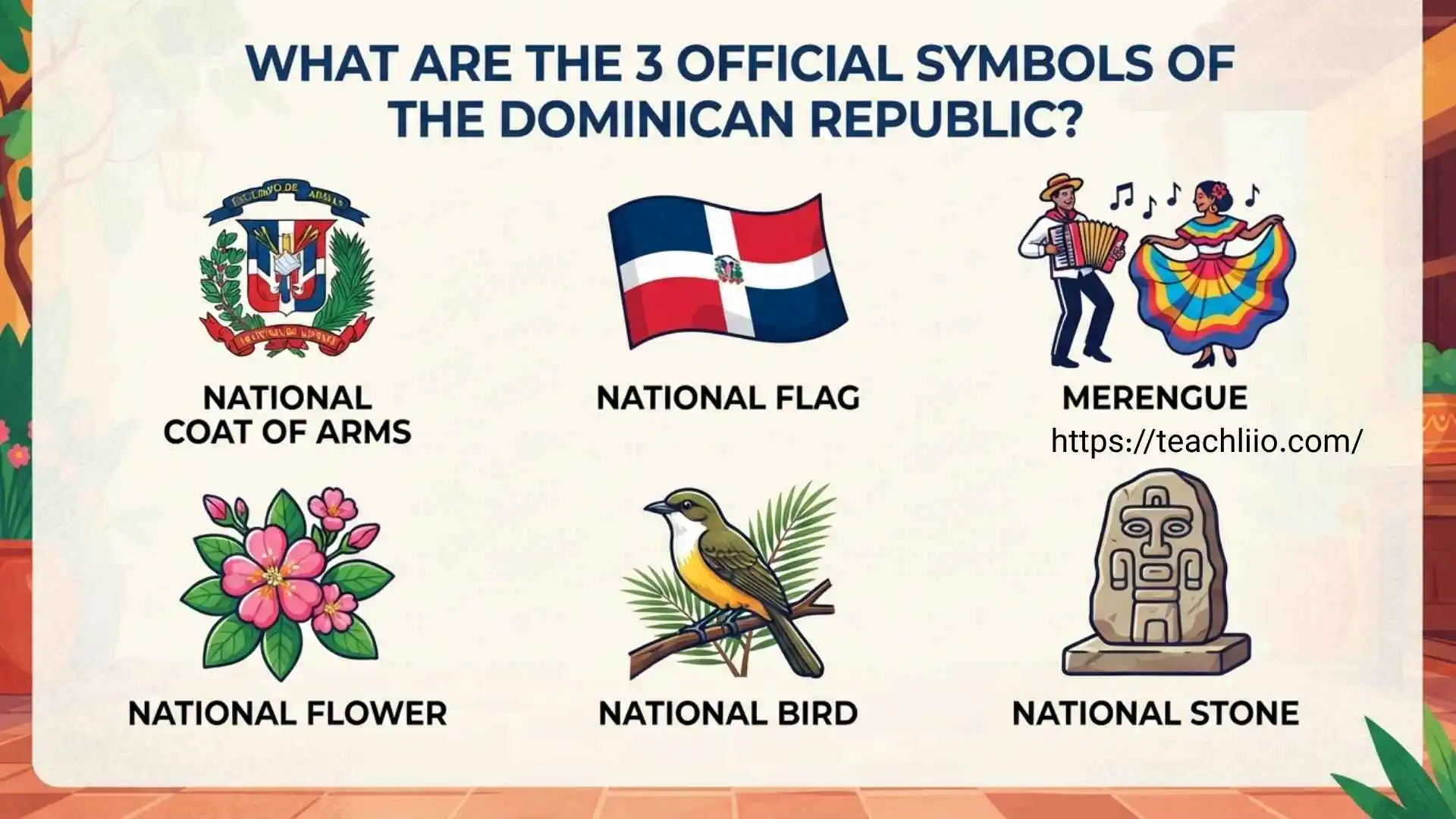
The three principal patriotic symbols are the national flag, coat of arms, and national anthem. Beyond these official emblems, the country is also closely associated with the Bayahibe rose, palmchat, West Indian mahogany, Larimar, merengue, bachata, baseball, and the name Quisqueya.
The Dominican Republic symbols tell the story of a country shaped by independence, history, nature, music, and cultural pride. Some symbols are officially recognized by the Dominican state, while others have become powerful representations of Dominican life and identity.
Knowing the difference between official and cultural symbols is important. It prevents popular icons from being presented as official national emblems while giving readers a fuller picture of what represents the Dominican Republic.
What Are the 3 Official Symbols of the Dominican Republic?
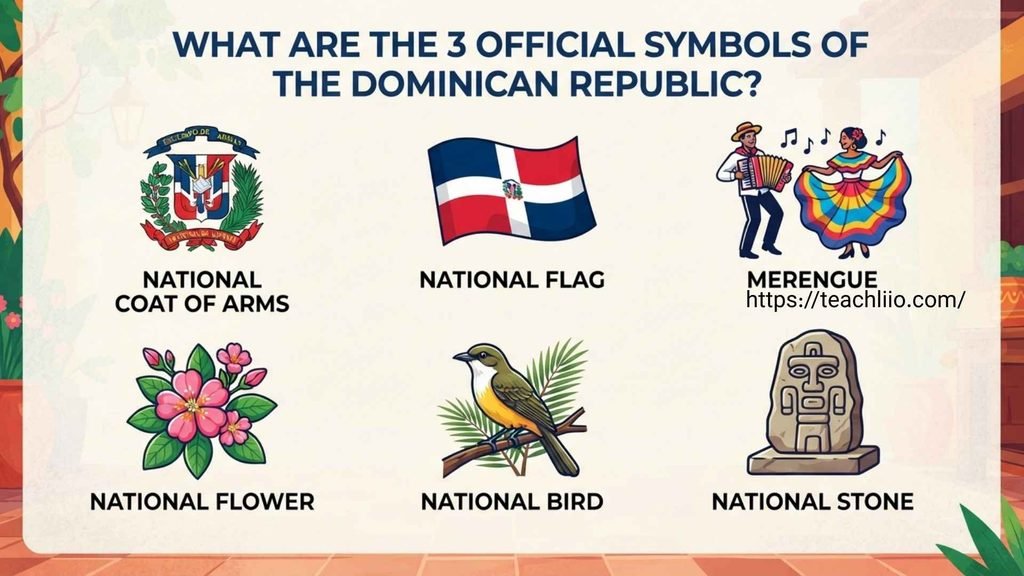
The three principal official patriotic symbols of the Dominican Republic are the national flag, national coat of arms, and national anthem. They have a special place in the country’s history and public life.
| Official symbol | What it represents |
| National Flag | Independence, sovereignty, peace, and national identity |
| Coat of Arms | Faith, liberty, patriotism, and the Dominican state |
| National Anthem | Independence, courage, patriotism, and love of country |
These three symbols are the best starting point for anyone researching Dominican Republic symbols because they have an official patriotic status.
Other plants, animals, gemstones, music, sports, and cultural traditions are also important, but they should be described separately as national, natural, historical, or cultural symbols and icons.
Dominican Republic Flag
The Dominican Republic flag is perhaps the country’s most recognizable symbol. Its distinctive design consists of a white cross dividing four rectangular sections. The upper-left and lower-right sections are blue, while the upper-right and lower-left sections are red. The national coat of arms appears at the center of the cross.
The flag is closely connected with the Dominican struggle for independence and remains a powerful expression of national sovereignty.
What Do the Colors of the Dominican Flag Mean?
The colors of the flag have important symbolic associations.
Blue is connected with the sky, ideals, progress, and divine protection.
Red recalls the blood and sacrifice associated with the struggle for independence.
White represents peace and union.
The white cross is especially important because it is not simply a decorative feature. It is the central element that separates the four colored sections and gives the Dominican flag its distinctive appearance.
When Was the Dominican Flag First Used?
The history of the Dominican flag is closely connected with the independence movement of the 19th century.
Juan Pablo Duarte and the independence movement played an important role in developing the national identity represented by the flag. The first Dominican flag was raised on February 27, 1844, when the Dominican Republic declared independence from Haitian rule.
That date is now celebrated as Dominican Independence Day.
The flag therefore represents much more than a combination of colors. It is connected to the creation of the modern Dominican nation.
What Makes the Dominican Flag Different?
The Dominican flag has several features that make it especially distinctive.
The central white cross divides the flag into four quarters, and the coat of arms occupies the middle. This combination gives the flag a visual identity that is immediately recognizable.
The presence of the coat of arms also means that the flag carries several national symbols within a single design.
Dominican Republic Coat of Arms
The coat of arms of the Dominican Republic is another major patriotic symbol. It appears in the center of the national flag and contains several elements with religious, historical, and national significance.
Rather than being a single picture with one meaning, the coat of arms works more like a collection of symbols.
What Is Shown on the Dominican Coat of Arms?
The central shield contains a Bible, a cross, and other elements associated with Dominican history and identity.
The surrounding design includes national flags, branches, lances, and ribbons. The words “Dios, Patria, Libertad” appear as the national motto.
The Spanish phrase means:
“God, Fatherland, Liberty.”
What Does the Bible Represent?
The open Bible is one of the most distinctive features of the Dominican coat of arms.
It is traditionally shown open to a passage from the Gospel of John, associated with the idea that truth brings freedom.
The Bible therefore connects the coat of arms with the religious and historical traditions reflected in Dominican national identity.
What Do the Palm and Laurel Branches Represent?
The coat of arms includes a palm branch and a laurel branch.
The branches contribute traditional ideas of victory, peace, honor, and national achievement to the emblem.
They also give the design a strong connection with nature while surrounding the central shield with recognizable symbolic imagery.
What Does “Dios, Patria, Libertad” Mean?
“Dios, Patria, Libertad” translates to:
“God, Fatherland, Liberty.”
The motto expresses three concepts strongly associated with Dominican national identity.
- Dios means God.
- Patria means fatherland or homeland.
- Libertad means liberty or freedom.
Because the phrase appears directly on the national coat of arms, it is one of the most recognizable expressions of Dominican patriotism.
Dominican National Anthem
The national anthem of the Dominican Republic, known as Himno Nacional, is the country’s third principal patriotic symbol.
Its music was composed by José Rufino Reyes y Siancas, while the lyrics were written by Emilio Prud’Homme.
The anthem expresses patriotic feeling and recalls the country’s struggle for independence.
Who Wrote the Dominican National Anthem?
José Rufino Reyes composed the music, and Emilio Prud’Homme wrote the words.
Their collaboration created a work that eventually became one of the defining symbols of the Dominican Republic.
The anthem’s history stretches back to the 19th century, making it closely connected with the period when Dominican national identity was developing.
When Was the Dominican Anthem First Performed?
The anthem was first publicly performed in 1883. Its lyrics later underwent changes before the anthem was formally adopted by the Dominican state in 1934.
This history makes the anthem particularly interesting because it was not created and immediately adopted in its final form. It developed over time before becoming a formal national symbol.
Why Is the National Anthem Important?
The anthem is performed at official events, schools, ceremonies, and other occasions where national identity is emphasized.
Like the flag and coat of arms, it provides a way for people to express connection to their country.
National Natural Symbols of the Dominican Republic
The Dominican Republic is known for its tropical environment and remarkable biodiversity. Several plants and animals are strongly associated with the country’s national identity.
These should be distinguished from the three principal patriotic symbols because they represent natural heritage rather than the state itself.
Bayahibe Rose
The Bayahibe rose, scientifically known as Pereskia quisqueyana, is the national flower of the Dominican Republic.
It is a particularly interesting plant because it belongs to the cactus family but has leaves and a tree-like appearance that may not immediately resemble a typical cactus.
Why Is the Bayahibe Rose Important?
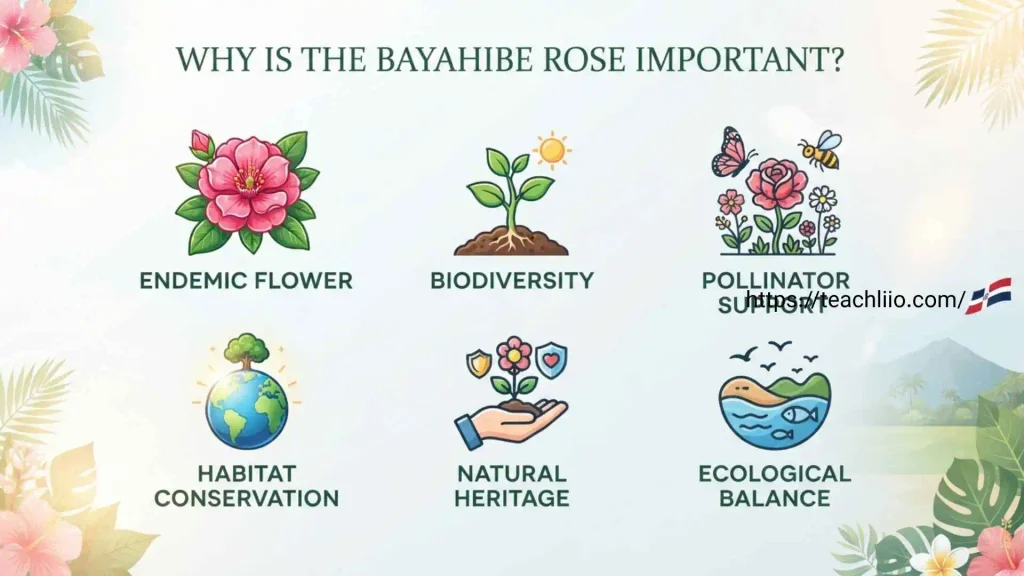
The plant is native to the Dominican Republic, giving it a particularly strong connection to the country’s natural heritage.
Its flowers provide a beautiful representation of Dominican biodiversity.
The Bayahibe rose also reminds people that national identity is not limited to historical events and political institutions. A country’s native plants can become meaningful symbols of its landscape and ecological heritage.
Palmchat
The palmchat, scientifically called Dulus dominicus, is the national bird of the Dominican Republic.
It is especially significant because it is endemic to the island of Hispaniola.
What Makes the Palmchat Special?
The palmchat is strongly associated with palm trees and Dominican tropical landscapes.
It is a social bird and is known for building large communal nests. Its relationship with the island’s environment makes it a natural representation of Dominican wildlife.
For a country-symbol article, the palmchat is particularly valuable because it gives readers a clear example of how a native species can represent national identity.
West Indian Mahogany
The West Indian mahogany, Swietenia mahagoni, is recognized as the national tree of the Dominican Republic.
Mahogany has long been valued for its strong, attractive wood and has historical importance in the Caribbean.
Why Is Mahogany a Dominican Symbol?
The tree represents the country’s natural resources and connection to its forests.
It also demonstrates how national symbols can emerge from the natural environment. The Bayahibe rose represents plant diversity, the palmchat represents wildlife, and mahogany represents the importance of trees and forests.
Larimar
Larimar is one of the Dominican Republic’s most recognizable natural treasures.
This distinctive blue gemstone is associated particularly strongly with the country and has become an important part of Dominican jewelry, tourism, and cultural imagery.
Why Is Larimar Associated With the Dominican Republic?
Its blue coloring can evoke the Caribbean sea and tropical skies, while its rarity gives it a special appeal.
Larimar is best described as a Dominican natural and cultural icon, rather than grouping it with the country’s three principal official patriotic symbols.
That distinction is important for factual accuracy.
Cultural Symbols of the Dominican Republic
National identity is also expressed through everyday culture. Music, dance, sport, language, and traditions can become powerful symbols even when they are not official state emblems.
Several cultural icons have become particularly associated with the Dominican Republic.
Merengue
Merengue is one of the strongest cultural symbols of the Dominican Republic.
Its lively rhythm and distinctive dance style have become closely associated with Dominican celebrations and social life.
Merengue represents the country’s musical creativity and its ability to preserve cultural traditions while sharing them with audiences around the world.
Why Is Merengue Important to Dominican Identity?
Music is often one of the easiest ways for people to express cultural identity.
For Dominicans, merengue is connected with celebrations, family gatherings, dancing, festivals, and national culture.
It therefore represents a living tradition rather than simply a historical artifact.
Bachata
Bachata is another major musical tradition associated with the Dominican Republic.
Its history reflects the development of Dominican popular music, and its influence has expanded far beyond the Caribbean.
Today, bachata is recognized internationally and is strongly connected with Dominican culture.
How Did Bachata Become a Cultural Symbol?
Bachata demonstrates how a musical style can evolve from local roots into a global cultural phenomenon.
Its rhythms, guitar-based sound, and dance tradition have helped make it one of the most recognizable forms of Dominican cultural expression.
Baseball
Baseball is one of the most influential sports in Dominican culture.
Although it is not one of the three official patriotic symbols, it is an important cultural symbol of modern Dominican life.
The Dominican Republic has produced many successful professional baseball players, and the sport plays an important role in communities, youth development, and national pride.
Why Is Baseball Important in the Dominican Republic?
For many young players, baseball represents opportunity and ambition.
The sport has also created a strong connection between the Dominican Republic and international professional baseball.
As a result, baseball has become part of how the country is recognized internationally.
Quisqueya
Quisqueya is a culturally important name associated with the island of Hispaniola and the Dominican homeland.
The term has Indigenous Taíno associations and has become deeply established in Dominican literature, music, poetry, and expressions of national identity.
Why Do Dominicans Use the Word Quisqueya?
The word provides a poetic and cultural way to refer to the homeland.
You may also encounter Quisqueyano or Quisqueyana, terms associated with Dominican people.
This makes Quisqueya a cultural identity symbol rather than an official patriotic emblem.
Dominican Republic Symbols: Official vs. Cultural
One of the easiest ways to understand this topic is to divide the symbols into categories.
| Symbol | Category | Main significance |
| Dominican Flag | Official patriotic | Independence and national identity |
| Coat of Arms | Official patriotic | Faith, liberty, and state identity |
| National Anthem | Official patriotic | Patriotism and independence |
| Bayahibe Rose | Natural/national | Native plant and biodiversity |
| Palmchat | Natural/national | Endemic Dominican wildlife |
| West Indian Mahogany | Natural/national | Forests and natural heritage |
| Larimar | Natural/cultural | Dominican gemstone and tourism |
| Merengue | Cultural | Music, dance, and celebration |
| Bachata | Cultural | Musical heritage |
| Baseball | Cultural | Sport and national pride |
| Quisqueya | Cultural/historical | Homeland and identity |
| Caribbean landscape | Geographic/cultural | Tropical environment and tourism |
This distinction makes the topic easier to understand and avoids incorrectly suggesting that every famous Dominican icon has the same official status.
Historical Symbols Connected to Dominican Independence
The story behind Dominican symbols cannot be separated from the country’s independence.
Dominican independence was declared on February 27, 1844. The independence movement was strongly associated with Juan Pablo Duarte and the secret organization La Trinitaria.
Juan Pablo Duarte
Juan Pablo Duarte is one of the central figures in Dominican independence.
His ideas about national sovereignty and self-government helped shape the independence movement.
Because the national flag and other patriotic symbols emerged within this historical context, understanding Duarte helps explain why Dominican symbols carry such strong associations with liberty and national identity.
La Trinitaria
La Trinitaria was an independence organization founded by Duarte and his associates.
Its activities contributed to the movement that eventually led to Dominican independence.
The organization’s role helps explain the historical background behind the symbols that later came to represent the Dominican Republic.
What Do Dominican Republic Symbols Represent?
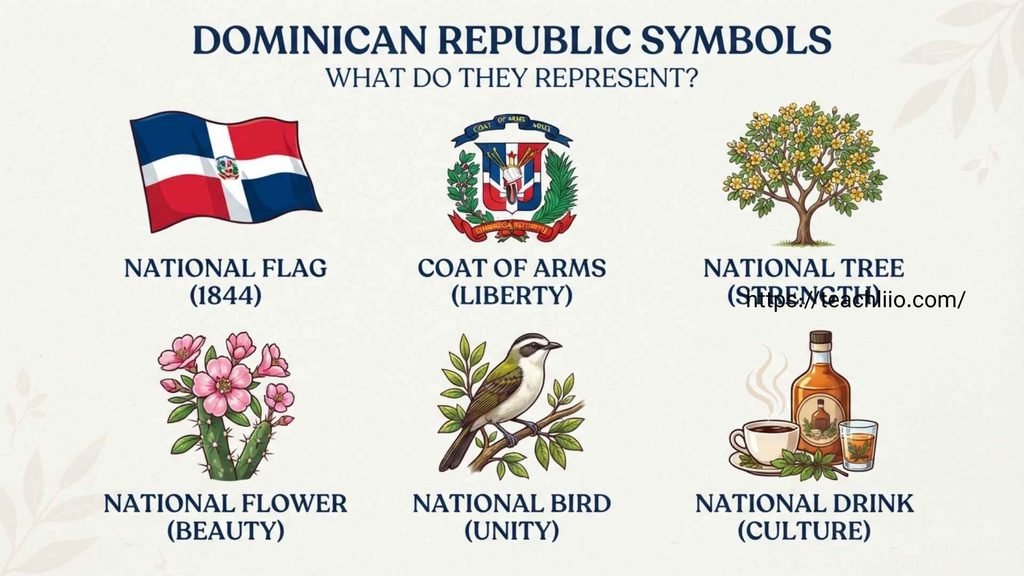
Taken together, Dominican symbols communicate several major themes.
Independence and Freedom
The flag, coat of arms, motto, and anthem are closely connected with independence and the defense of national sovereignty.
Faith
Religious imagery, particularly the Bible and cross in the coat of arms, reflects an important part of the country’s historical identity.
Nature
The Bayahibe rose, palmchat, mahogany, Larimar, and tropical landscape demonstrate the importance of the natural environment.
Cultural Creativity
Merengue and bachata demonstrate the country’s influence on music and dance.
National Pride
Baseball, music, national celebrations, and the flag all provide ways for Dominicans to express national pride.
Why Are Dominican Republic Symbols Important?
Symbols give abstract ideas a form that people can see, hear, wear, celebrate, or pass from one generation to another.
A flag can represent independence. An anthem can express patriotism through music. A coat of arms can preserve historical and religious ideas in a single design. A national flower or bird can represent biodiversity.
Cultural symbols work in a similar way.
Merengue and bachata connect people with music and dance. Baseball connects generations through sport. Larimar connects the country with a distinctive natural resource.
Together, these symbols create a much broader picture of Dominican identity.
Dominican Republic Symbols at a Glance
If you need a quick answer for a school project, quiz, travel research, or general knowledge, remember these key examples:
- Flag: The country’s most recognizable patriotic emblem.
- Coat of Arms: Contains the Bible, cross, flags, branches, and national motto.
- National Anthem: A patriotic musical symbol written by Emilio Prud’Homme with music by José Rufino Reyes.
- Bayahibe Rose: National flower and native plant.
- Palmchat: National bird and a species associated with Hispaniola.
- West Indian Mahogany: National tree.
- Larimar: Distinctive Dominican gemstone and cultural icon.
- Merengue: Major Dominican musical and dance tradition.
- Bachata: Globally recognized Dominican music and dance.
- Baseball: Major cultural symbol of modern Dominican life.
- Quisqueya: A culturally important name for the homeland.
The most important distinction is simple: the flag, coat of arms, and national anthem are the principal official patriotic symbols; the other examples represent nature, culture, geography, or Dominican identity in broader ways.
Frequently Asked Questions
What are the three official symbols of the Dominican Republic?
The three principal patriotic symbols are the national flag, coat of arms, and national anthem.
What is the national symbol of the Dominican Republic?
There is not just one principal patriotic symbol. The national flag, coat of arms, and national anthem are the country’s three principal patriotic symbols.
What does the Dominican Republic flag symbolize?
The flag represents Dominican independence, sovereignty, national identity, peace, and the sacrifices associated with the struggle for independence. Its blue, red, and white elements have specific historical and symbolic associations.
What do the colors of the Dominican flag mean?
Blue is associated with the sky, ideals, progress, and divine protection; red recalls sacrifice and the blood shed in the independence struggle; and white represents peace and union.
What does the Dominican coat of arms represent?
The coat of arms brings together religious, patriotic, and national imagery, including the Bible, cross, flags, branches, and the motto “Dios, Patria, Libertad,” meaning “God, Fatherland, Liberty.”
What does “Dios, Patria, Libertad” mean?
The Spanish phrase means “God, Fatherland, Liberty.” It is the national motto displayed on the Dominican coat of arms.
What is the national flower of the Dominican Republic?
The Bayahibe rose, scientifically known as Pereskia quisqueyana, is the national flower.
What is the national bird of the Dominican Republic?
The palmchat, or Dulus dominicus, is the national bird. It is notable for being endemic to Hispaniola.
What is the national tree of the Dominican Republic?
The West Indian mahogany, Swietenia mahagoni, is the national tree.
Is Larimar an official national symbol?
Larimar is a highly recognizable Dominican natural and cultural icon, but it should be distinguished from the country’s three principal official patriotic symbols: the flag, coat of arms, and national anthem.
What music is the Dominican Republic known for?
The Dominican Republic is particularly associated with merengue and bachata, both of which are important parts of Dominican musical and cultural identity.
Why is baseball important to the Dominican Republic?
Baseball has become a major part of Dominican culture and national pride. The country has produced many prominent professional players, making the sport an important part of its modern international identity.
What is Quisqueya?
Quisqueya is a culturally important name associated with the island of Hispaniola and the Dominican homeland. It has Indigenous Taíno associations and remains common in Dominican cultural expression.
Conclusion
The Dominican Republic symbols are best understood as a combination of official patriotic emblems and broader cultural and natural icons. The national flag, coat of arms, and national anthem form the core group of official patriotic symbols and are closely connected with independence and national identity.
Beyond those three, the Bayahibe rose, palmchat, and West Indian mahogany highlight the country’s natural heritage, while Larimar represents a distinctive Dominican natural and cultural treasure. Merengue, bachata, baseball, and Quisqueya show how music, sport, language, and history continue to shape Dominican identity.
Together, these symbols tell a richer story than any single emblem could. They connect the Dominican Republic’s struggle for independence with its landscapes, wildlife, traditions, and modern culture—giving both Dominicans and visitors a deeper understanding of what makes the country distinctive.

I’m Hugo Wetherby, a British author interested in the numbers behind everyday questions. I explore quantities, populations, measurements, records, comparisons, and surprising statistics, turning complicated information into accessible answers. I believe a simple “how many” question can lead to fascinating discoveries, and I enjoy helping readers find those answers.
Books:
How Many? A Guide to Everyday Numbers
The Great Book of Numbers and Quantities