
JoJo’s Bizarre Adventure is famous for much more than dramatic battles and memorable characters. Hirohiko Araki’s series uses recurring marks, objects, visual motifs, sound effects, and character designs that can carry story meaning or instantly remind fans of a particular JoJo Part.
Some are directly connected to the story, such as the Joestar Star Birthmark, Stand Arrow, and Stone Mask. Others are better described as visual trademarks of the manga and anime, including the famous ゴゴゴゴ (Gogogogo) effect. The official JoJo production notes specifically identify unusual onomatopoeia, poses, motion lines, and theatrical presentation as important elements of the series’ distinctive visual language.
This guide explains the most recognizable JoJo symbols and their meanings, where they appear, and how to distinguish an actual story symbol from a recurring artistic motif.
Spoiler warning: This guide discusses story elements from multiple parts of JoJo’s Bizarre Adventure.
JoJo Symbols Quick Reference
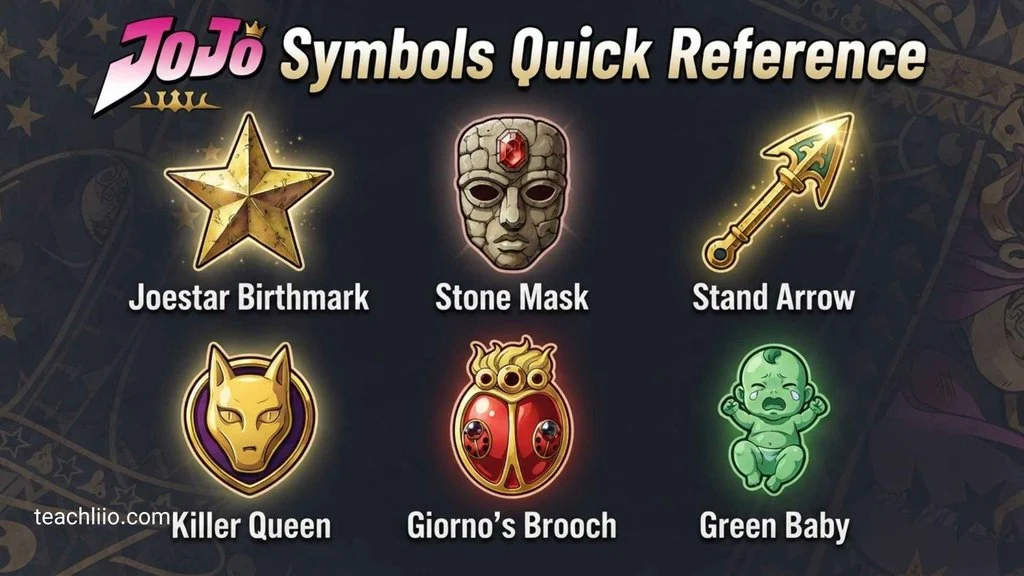
| JoJo symbol or motif | Meaning or role | Most associated with |
| ⭐ Star Birthmark | Joestar bloodline connection | Joestar family |
| 🏹 Stand Arrow | Awakening or evolving Stand abilities | Parts 4–6 especially |
| 🗿 Stone Mask | Vampirism and supernatural transformation | Parts 1–2 |
| ゴゴゴゴ | Menacing or ominous atmosphere | Manga/anime presentation |
| 🦋 Butterfly motifs | Character and thematic imagery | Part 6 and related designs |
| ❤️ Heart motifs | Character fashion and visual symbolism | Various characters |
| ⭐ Star patterns | Joestar identity and recurring design language | Multiple Parts |
| 🐞 Ladybug imagery | Character-specific design motif | Part 5 |
| 🐎 Horseshoe imagery | Character-specific identity | Part 7 |
| 🌹 Floral motifs | Character and fashion symbolism | Various Parts |
Not every item in this table is an official emblem with a single fixed definition. Some are story objects, some are family marks, and others are recurring artistic or character-design motifs.
That distinction is important when interpreting JoJo symbols.
What Are JoJo Symbols?
“JoJo symbols” is a broad fan term rather than the name of one official collection of symbols.
It can refer to several different things:
- symbols that exist inside the story
- marks carried by characters
- supernatural objects
- recurring visual motifs
- manga sound effects
- logos and Part-related imagery
- clothing designs associated with characters
- symbols that fans use to identify JoJo
The official JoJo portal divides the series into different Parts, beginning with Phantom Blood and continuing through The JOJOLands. Each Part introduces its own setting, characters, visual identity, and supernatural concepts.
Therefore, there is no single universal “JoJo symbol.”
Instead, the best way to understand them is to group them according to what they actually do.
The Joestar Star Birthmark
The Star Birthmark is probably the most recognizable JoJo symbol associated with the Joestar family.
It is a five-pointed, star-shaped mark generally found around the back of the left shoulder or near the nape. It is associated with JoJos and members of the Joestar bloodline, although its appearance and significance become more complicated across the different continuities.
What Does the Joestar Star Mean?
At the most basic level, the star identifies a connection to the Joestar bloodline.
Its importance goes beyond decoration. The mark becomes connected to the unusual relationship between members of the Joestar family and the supernatural events surrounding Jonathan Joestar’s descendants.
The birthmark is particularly important in Stardust Crusaders and later becomes significant again in Stone Ocean. The mark also appears in the second continuity, although its circumstances are not identical to the original continuity.
Who Has the Joestar Birthmark?
Different Joestar descendants are shown or established as having the mark, including important characters from several Parts.
The mark is also relevant to characters whose connection to the Joestar bloodline is unusual. This is one reason it should not be reduced to a simple statement such as “every JoJo has a star.”
The exact circumstances vary between continuities.
Why Does DIO Have the Joestar Star?
DIO’s connection to the star is one of the reasons the symbol is so important.
After DIO takes Jonathan Joestar’s body, the body retains the Joestar-related mark. The story later uses this physical connection to explain supernatural effects involving Jonathan’s descendants.
This is also connected to the concept of a Spiritual Signal, a supernatural bond that can exist between certain family members and related individuals. Such connections can involve sensing another person, awakening Stand abilities, or even sharing physical effects.
So DIO having the star does not simply mean that DIO was originally born a Joestar.
The mark reflects the complicated relationship between DIO and Jonathan’s body.
The Stand Arrow
The Stand Arrow is another major JoJo symbol, although it is more accurately described as a supernatural artifact than a family emblem.
The Bow and Arrow is introduced as an important story object in Diamond Is Unbreakable. Its arrows can awaken Stand abilities in people with the necessary potential.
What Does the Stand Arrow Represent?
The arrow is strongly associated with:
- Stand awakening
- supernatural power
- danger
- evolution
- fate
- the discovery of new abilities
Its importance increases because the arrows do not simply give characters a decorative symbol. They can fundamentally change a person’s place in the story.
According to the established story information, the arrows were made from meteorite material and can trigger Stand abilities in suitable individuals. Someone without the necessary qualities can die from the process instead.
What Is the Requiem Arrow?
One particular arrow is associated with the development of Requiem Stands.
The arrow therefore becomes more than a symbol of obtaining a Stand. In Vento Aureo, its power becomes connected with the evolution of existing Stand abilities.
This makes the arrow a useful symbol for one of JoJo’s recurring ideas: power can transform the person who possesses it, but that transformation comes with serious consequences.
The Stone Mask
The Stone Mask is one of the defining objects of the early JoJo storyline.
It first appears in Phantom Blood and remains important in Battle Tendency. The masks are ancient artifacts associated with supernatural transformation and the origins of the vampire conflict.
What Does the Stone Mask Mean?
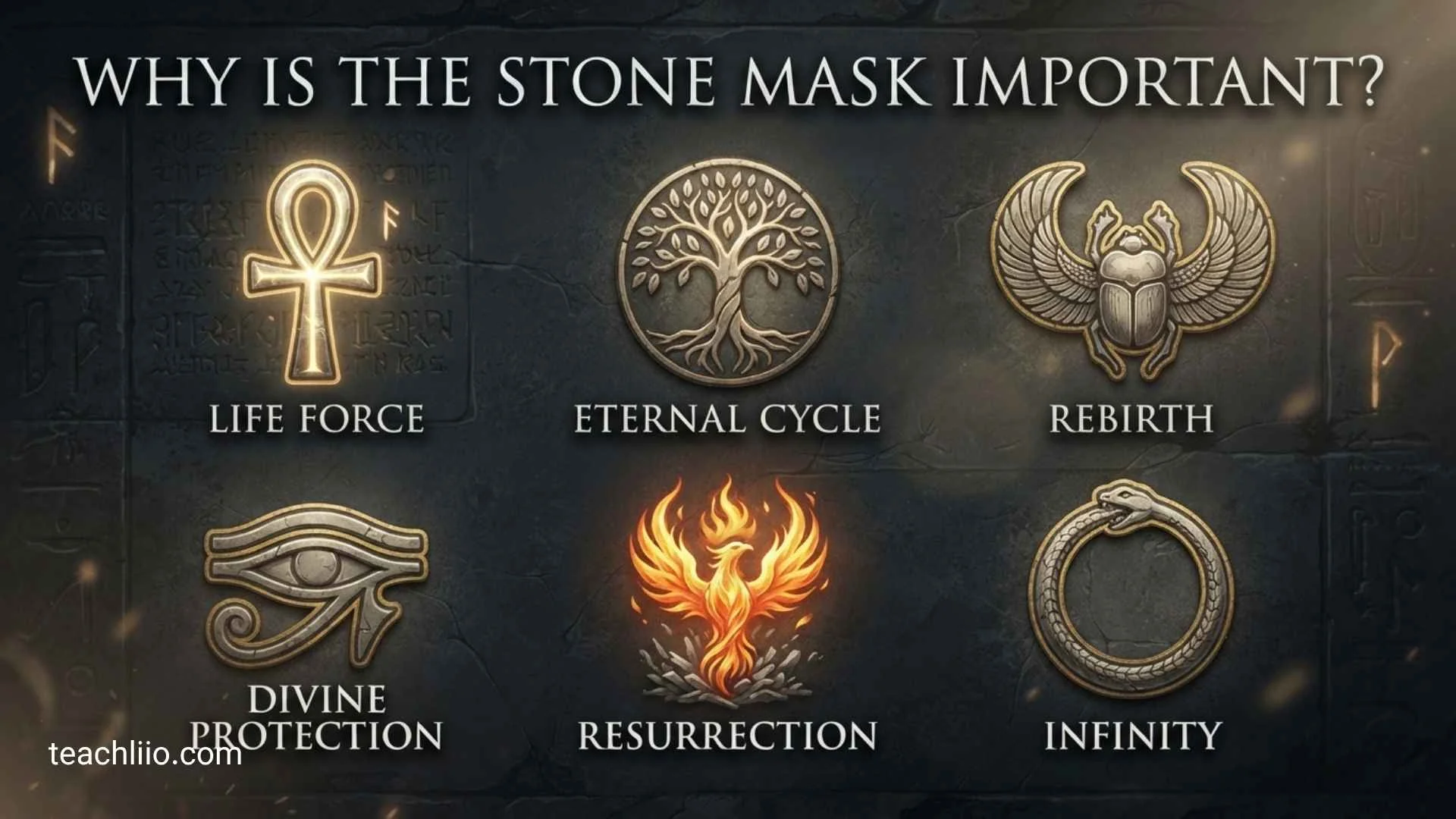
The Stone Mask can represent:
- transformation
- immortality
- supernatural power
- corruption
- the pursuit of power
- the boundary between humanity and something monstrous
Its importance becomes especially clear through DIO.
When DIO uses the mask, he becomes a vampire, turning the mask into one of the visual objects most strongly associated with the beginning of the series’ supernatural conflict.
Why Is the Stone Mask Important?
The Stone Mask is not just an ancient-looking prop.
It establishes one of the central conflicts of the early Parts: what happens when humans gain power that exceeds ordinary biological limits?
The later revelation involving Kars and the Pillar Men also expands the mask’s importance beyond DIO’s transformation.
The JoJo Menacing Symbol: ゴゴゴゴ
One of the most recognizable visual elements associated with JoJo is:
ゴゴゴゴ
Often romanized as Gogogogo, this Japanese onomatopoeic effect is used to create a threatening, dramatic, or ominous atmosphere.
What Does Gogogogo Mean in JoJo?
It does not function like the Joestar birthmark.
Instead, it is a stylized sound effect and visual storytelling device.
The official JoJo anime production notes specifically mention “Gogogogo” alongside other distinctive sounds and explain that the anime team worked to reproduce the manga’s unusual onomatopoeia, poses, motion lines, and page composition.
That is why fans often recognize the effect even outside a specific scene.
Why Is Gogogogo So Important?
JoJo frequently turns sound effects into part of the visual experience.
Instead of merely telling the reader that a scene is tense, the manga can surround a character with dramatic lettering, poses, shadows, motion lines, and unusual compositions.
This makes the “symbol” feel almost like a character in the scene.
It is therefore more accurate to call Gogogogo a visual sound-effect motif than a conventional symbol.
JoJo Symbols and Motifs by Part
Each JoJo Part develops its own visual language.
Phantom Blood
Phantom Blood introduces several foundational symbols and objects.
The most important include:
- the Joestar family identity
- the Stone Mask
- vampire imagery
- the Joestar star
- the recurring conflict between Jonathan and DIO
The Stone Mask is especially important because it establishes the supernatural transformation that drives much of the early story.
Battle Tendency
Battle Tendency expands the mythology surrounding the Stone Mask.
The Pillar Men, ancient artifacts, the Red Stone of Aja, and Ripple-related imagery become central to the Part.
Here, symbols often represent ancient power, evolution, survival, and the conflict between human beings and supernatural beings.
Stardust Crusaders
Stardust Crusaders shifts the franchise toward the modern Stand system.
The Joestar Star Birthmark becomes particularly recognizable, while Stand imagery becomes one of the defining visual features of the series.
The official JoJo portal describes Part 3 as the story in which DIO awakens after a century and confronts the protagonists, marking a major stage in the series’ Stand-focused storytelling.
Diamond Is Unbreakable
Part 4 brings the Stand Arrow to the forefront.
The arrow becomes important because it can awaken Stand abilities and helps explain the growing number of Stand users in Morioh.
Morioh itself also develops a distinctive visual identity, making this Part particularly rich in location-based and character-based motifs.
Golden Wind
Golden Wind combines Stand imagery with fashion, gang symbolism, insects, religious references, and strong character-specific designs.
The Stand Arrow becomes important again, especially because of the development of Requiem abilities.
This Part demonstrates why “JoJo symbols” should not be treated as one fixed list. Character fashion and visual motifs can be just as recognizable to fans as literal story objects.
Stone Ocean
Stone Ocean continues the importance of the Joestar birthmark while introducing a new visual identity through Jolyne Cujoh, the Green Baby storyline, and the prison setting.
The Star Birthmark becomes particularly important in the supernatural connections between characters.
Steel Ball Run
Steel Ball Run represents a new continuity and develops its own visual language.
Johnny Joestar’s design uses stars extensively, including star patterns on his clothing and hat. He is also associated with horseshoe imagery, reflecting the Part’s American frontier and horse-racing setting.
JoJolion
JoJolion introduces another continuity and gives the Star Birthmark additional significance through Josuke Higashikata.
Josuke’s appearance includes the star-shaped birthmark as well as anchor and compass motifs in his clothing.
This is a good example of why character design should not automatically be treated as a universal JoJo symbol.
The JOJOLands
The JOJOLands continues the newer continuity with Jodio and Dragona Joestar.
The official JoJo portal identifies Hawaii as the setting and Jodio Joestar as the central protagonist.
The Joestar birthmark also remains relevant in this continuity.
Joestar Family Symbols and Motifs
The Joestar identity is reinforced through several recurring visual ideas.
The most important is the five-pointed star.
However, the family identity is not limited to one graphic mark. It is reinforced through:
- recurring character names
- the Joestar bloodline
- family relationships
- the Star Birthmark
- Stand connections
- recurring star imagery
- distinctive character poses and clothing
The official portal itself explains the “JoJo” naming pattern by noting that many protagonists have names whose first two letters correspond with “JoJo,” such as Jonathan Joestar.
This makes the JoJo identity partly a name-based symbol, not merely a graphic one.
Character-Specific JoJo Symbols
Some visual motifs are best understood as part of a character’s design rather than universal symbols.
For example, Johnny Joestar’s clothing uses stars extensively, while Josuke Higashikata from JoJolion has anchor and compass motifs incorporated into his outfit.
These details can help readers recognize characters, but they should not automatically be described as official symbols with a universal meaning.
Why Character Motifs Matter
Araki’s character designs often combine:
- clothing
- accessories
- geometric shapes
- animals
- stars
- hearts
- flowers
- unusual patterns
The combination creates a visual identity.
That is different from saying that every shape has a hidden canonical meaning.
JoJo Symbols vs Manga Sound Effects
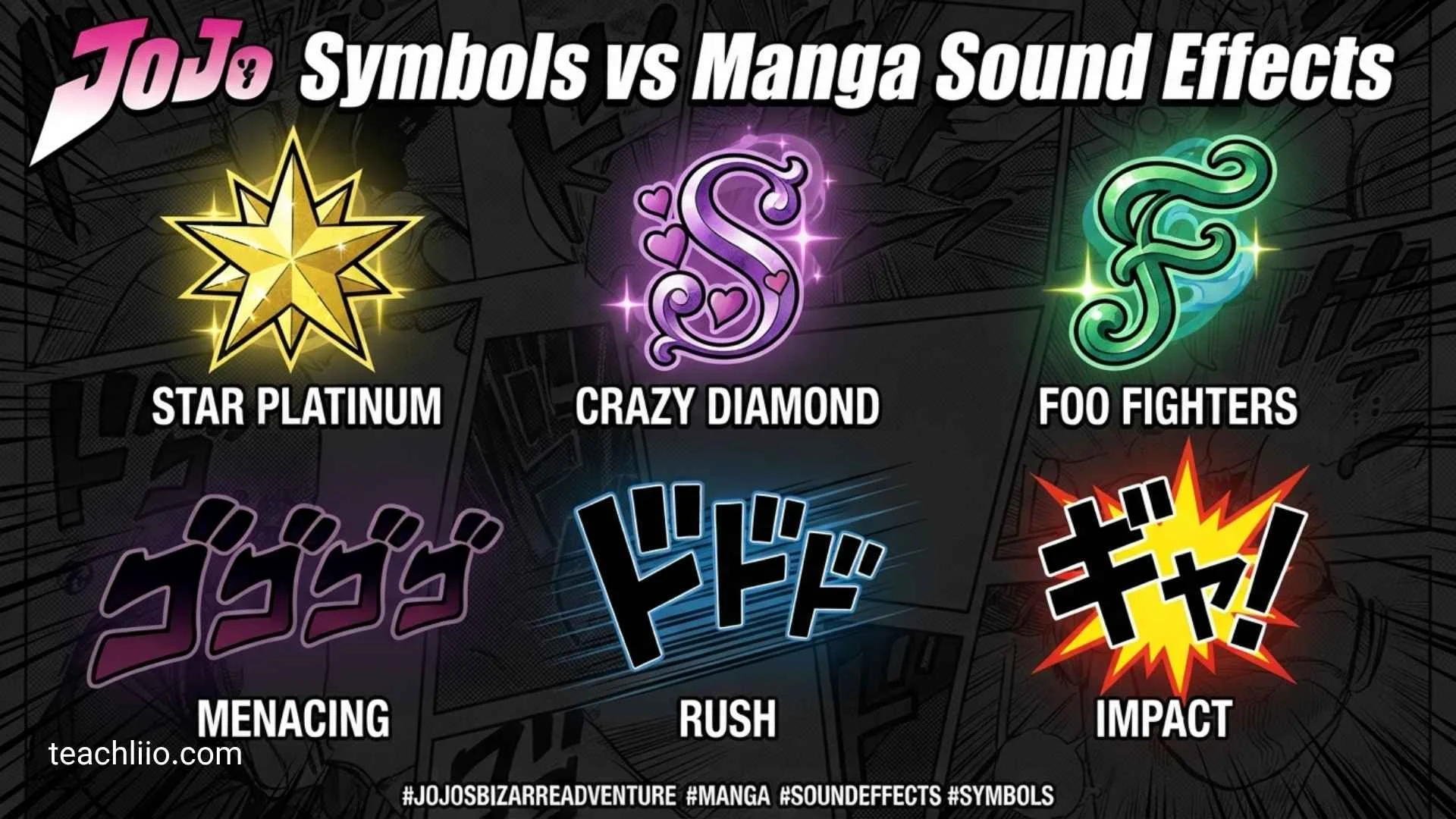
This is one of the most important distinctions for beginners.
A story symbol exists as part of the fictional world.
Examples include:
- Star Birthmark
- Stone Mask
- Stand Arrow
A visual sound effect exists primarily to communicate atmosphere or action.
Examples include:
- Gogogogo
- other stylized Japanese sound effects
- exaggerated motion lettering
The official production notes specifically explain that JoJo’s anime adaptation worked to reproduce the manga’s distinctive onomatopoeia and visual techniques.
Understanding this difference prevents readers from treating every Japanese character printed on a manga page as an in-universe emblem.
Canon Symbols vs Fan Interpretations
Not every meaning attached to a JoJo symbol is officially confirmed.
For example, the Star Birthmark clearly has an established connection to the Joestar bloodline. The Stand Arrow has a defined supernatural function. The Stone Mask has an established role in vampire transformation.
Other interpretations may be thematic.
A reader might interpret a star as representing destiny, inheritance, or family.
That can be an interesting interpretation, but it should be presented as interpretation, not as a confirmed statement from the author.
This distinction makes a JoJo symbols guide more reliable.
Commonly Confused JoJo Symbols
Joestar Star vs Ordinary Star
Not every star shown in JoJo is the Star Birthmark.
A star used in clothing or artwork may simply be a design element.
Stand Arrow vs Ordinary Arrow
The supernatural Stand Arrow has a specific story function.
A normal arrow appearing in an illustration should not automatically be treated as the same artifact.
Gogogogo vs a Character Symbol
Gogogogo is a stylized sound effect and atmospheric device.
It is not the same kind of symbol as the Joestar birthmark.
Character Motif vs Official Emblem
A butterfly, heart, horseshoe, flower, or other repeated design may be strongly associated with a character without having one universal canonical meaning.
How to Recognize JoJo Symbols
When you see an unfamiliar symbol in JoJo, ask five questions:
- Does it physically exist in the story?
- Is it connected to a specific character or family?
- Does it have a supernatural function?
- Does it appear repeatedly as an artistic device?
- Is its meaning actually confirmed, or is it a fan interpretation?
This simple method helps separate canon information from visual speculation.
For example, if you see the five-pointed mark associated with the Joestar bloodline, you can identify it as the Star Birthmark. If you see large “Gogogogo” lettering surrounding a dramatic scene, you are looking at a stylized sound effect rather than a supernatural artifact.
Frequently Asked Questions
What Does the JoJo Star Symbol Mean?
The JoJo star usually refers to the five-pointed Star Birthmark, which is associated with the Joestar bloodline. It appears on characters connected to the Joestar family and becomes important to several major story events.
What Is the Joestar Birthmark?
The Joestar Birthmark is a five-pointed star-shaped mark generally found near the back of the left shoulder or nape. It is one of the most recognizable visual identifiers of the Joestar bloodline.
Why Does DIO Have the Joestar Star?
DIO has the mark because he takes over Jonathan Joestar’s body. The physical connection between DIO and Jonathan’s body becomes important to the supernatural relationship between DIO and Jonathan’s descendants.
What Does the Purple JoJo Symbol Mean?
The purple “menacing” effect often associated with JoJo is generally the stylized ゴゴゴゴ (Gogogogo) sound effect. It is used to create a tense, ominous, or dramatic atmosphere rather than to identify a particular character. The official anime production notes specifically discuss reproducing Gogogogo and other distinctive JoJo sound effects.
What Does the Stand Arrow Mean?
The Stand Arrow is a supernatural artifact capable of awakening Stand abilities in people with the necessary potential. It can also play a role in developing stronger or evolved Stand abilities.
What Does the Stone Mask Represent?
The Stone Mask is an ancient artifact associated with supernatural transformation and vampirism in the early Parts of JoJo. It is particularly important in Phantom Blood and Battle Tendency.
Do All JoJos Have the Same Birthmark?
The Star Birthmark is strongly associated with the Joestar bloodline, but its appearance and circumstances vary between characters and continuities. Some characters’ marks are shown directly, while others are established through story information.
Are JoJo Symbols Different in Each Part?
Yes. Each Part has its own setting, characters, objects, motifs, and visual identity. The official JoJo portal treats the Parts as distinct stages of the larger series, from Phantom Blood through The JOJOLands.
Is Gogogogo an Actual JoJo Symbol?
It is better described as a recurring onomatopoeic visual effect rather than an in-universe symbol. It is used to create atmosphere and emphasize dramatic moments. The anime’s production team specifically worked to preserve this characteristic of the original manga.
What Is the Most Recognizable JoJo Symbol?
The answer depends on what is meant by “symbol.” The Star Birthmark is one of the clearest recurring family marks, while the Stand Arrow and Stone Mask are important supernatural objects. Gogogogo is one of the franchise’s most recognizable visual effects.
Conclusion
JoJo symbols are not limited to one logo or one official set of icons. They include family marks, supernatural artifacts, character motifs, recurring imagery, and distinctive manga effects.
The Joestar Star Birthmark represents one of the clearest recurring connections to the Joestar bloodline. The Stand Arrow represents the dangerous awakening and evolution of Stand abilities. The Stone Mask is tied to the supernatural transformation and vampire mythology of the early Parts. Meanwhile, Gogogogo demonstrates how JoJo turns sound effects and visual composition into recognizable parts of its identity.
The most important thing is to distinguish confirmed story symbols from character motifs and fan interpretations. Once that distinction is clear, the many unusual shapes, objects, marks, and visual effects throughout JoJo’s Bizarre Adventure become much easier to understand.
