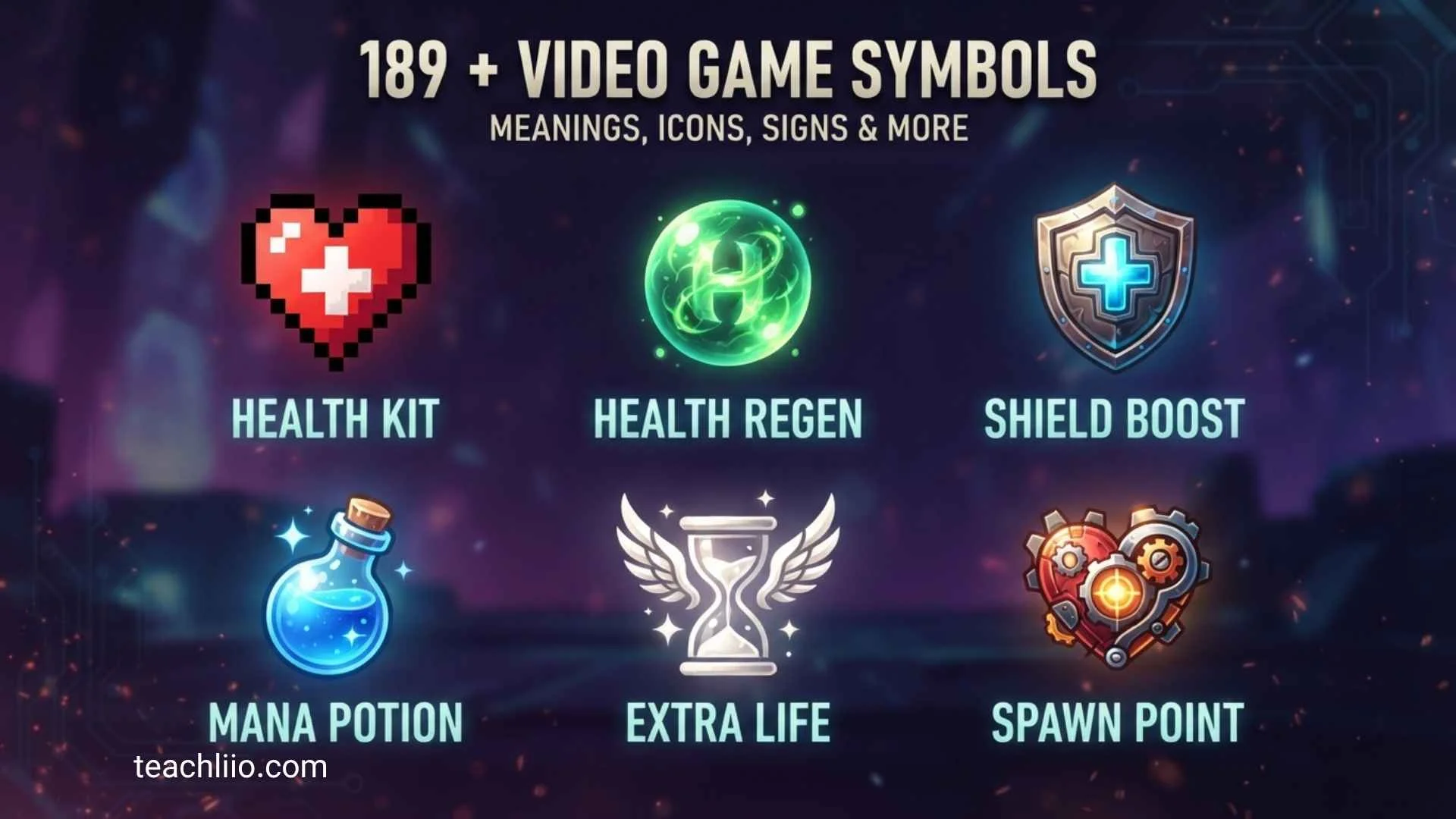
Video game symbols are everywhere. From a heart that represents health to a lock showing that an area is unavailable, these small visual elements help players understand what is happening without stopping the game to read long instructions.
But not every symbol has the same meaning in every game. A flame might represent fire damage in one title and a special ability or power-up in another. Controller buttons can also differ between PlayStation, Xbox, Nintendo, and PC games.
So, what are video game symbols, and what do they mean?
Video game symbols are visual icons, signs, shapes, and indicators used to communicate actions, information, locations, status effects, rewards, warnings, and gameplay mechanics. Their exact meaning depends on the game’s design and context.
This guide explains common gaming symbols, controller icons, HUD indicators, map markers, status effects, colors, shapes, and more. It also explains why games use symbols and why the same icon may have different meanings across different titles.
What Are Video Game Symbols?
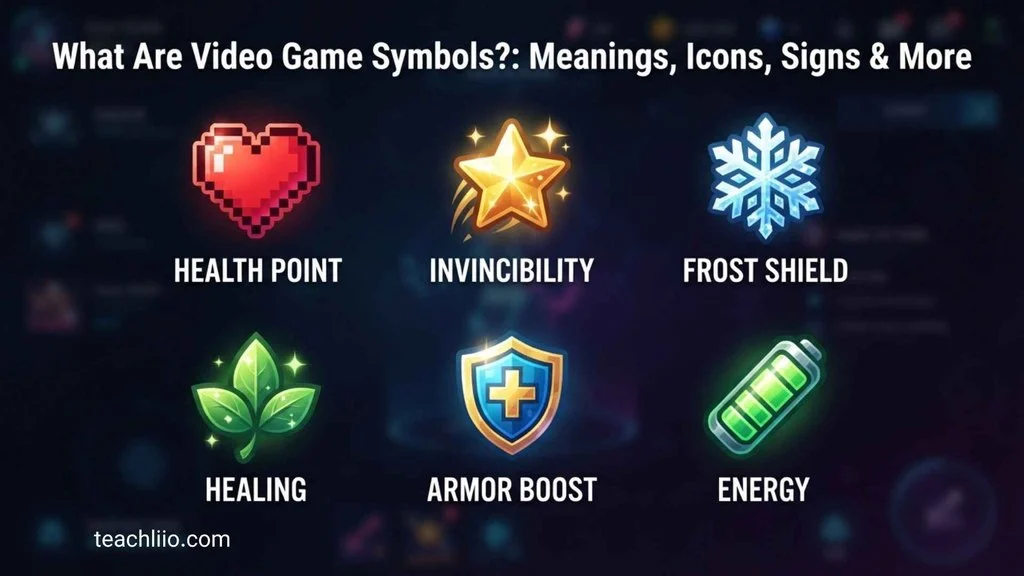
Video game symbols are visual shortcuts that communicate information to players.
Instead of writing “Your character has low health,” a game can display a heart, health bar, or other recognizable indicator. Instead of writing “Press this button to interact,” it can display the appropriate controller button.
This makes gameplay faster and easier to understand.
Video game symbols can appear in many places, including:
- Heads-up displays (HUDs)
- Character menus
- Inventory screens
- World maps
- Quest menus
- Controllers
- Loading screens
- Tutorials
- Achievement screens
- Multiplayer interfaces
- Warning notifications
Some symbols are based on familiar real-world objects, while others are completely fictional and designed specifically for a particular game.
Why Are Symbols Important in Games?
Games often need to communicate information while the player is moving, fighting, exploring, or making decisions.
Symbols solve this problem by presenting information visually.
For example, a small shield can communicate protection much faster than a sentence explaining a defensive effect.
Good symbols can therefore improve:
- Game readability
- Player awareness
- Navigation
- Reaction time
- Interface organization
- Accessibility
- Learning speed
The best game interfaces usually make important information understandable without forcing players to pause constantly.
Common Video Game Symbols and Their Meanings
Although games create their own visual languages, many symbols have commonly understood meanings.
| Symbol | Common Meaning |
| Heart | Health or life |
| Shield | Defense or protection |
| Sword | Combat or attack |
| Crossed swords | Battle or combat |
| Skull | Death, danger, or defeat |
| Coin | Currency |
| Star | Reward, rating, or achievement |
| Lock | Locked or unavailable |
| Key | Access or unlocking |
| Arrow | Direction or movement |
| Target | Objective, aim, or target |
| Flame | Fire, heat, or burning |
| Lightning bolt | Energy, electricity, or power |
| Backpack | Inventory |
| Map | Navigation |
| Exclamation mark | Warning or important information |
| Question mark | Help, mystery, or unknown information |
| Check mark | Completed or confirmed |
| Clock | Time or countdown |
| Speech bubble | Dialogue or communication |
These meanings are conventions rather than universal rules. A game can assign a completely different function to an icon.
Health and Life Symbols
Health is one of the most commonly represented concepts in gaming.
A heart often represents life or health. Other games may use a cross, medical symbol, character portrait, bar, or custom icon.
Common health-related symbols include:
- Heart
- Cross
- Medical kit
- Shield
- Plus sign
- Character portrait
A red heart might indicate remaining health, while a flashing icon could warn the player that health is critically low.
Defense and Armor Symbols
Defense is often represented with a shield, armor icon, helmet, or similar protective object.
These symbols may indicate:
- Armor level
- Damage reduction
- Temporary protection
- Defensive abilities
- Shield durability
- Invulnerability
However, the exact function depends on the game.
Currency and Reward Symbols
Games frequently use coins, gems, crystals, stars, tokens, or other objects to represent resources.
For example:
- Coin → money
- Gem → premium or valuable resource
- Star → reward or rating
- Crown → special achievement or rank
- Chest → loot or rewards
These symbols help players understand resources at a glance.
Warning and Danger Symbols
An exclamation mark, skull, red triangle, or other warning icon may alert players to danger.
Possible meanings include:
- Enemy nearby
- Low health
- Mission warning
- Dangerous area
- Failed action
- Incoming attack
- Important notification
Because warnings require quick recognition, game designers often make them visually prominent.
Video Game Controller Symbols and Their Meanings
Controller symbols are among the most recognizable gaming icons.
They tell players which physical button to press to perform an action.
The important thing to remember is that button layouts differ between platforms.
PlayStation Symbols
PlayStation controllers are known for four main face-button symbols:
- Triangle
- Circle
- Cross
- Square
These buttons may perform different actions depending on the game.
For example, one game may use Circle for crouching while another uses it for canceling or performing a special move.
Other common PlayStation controller symbols include:
- L1 and L2
- R1 and R2
- L3 and R3
- D-pad
- Options
- Touchpad
- Share/Create
What Do the PlayStation Symbols Mean?
The symbols themselves identify physical buttons rather than having one universal gameplay function.
Triangle commonly appears as one of the action buttons.
Circle often appears for actions such as canceling, crouching, or interacting, depending on the game’s control scheme.
Cross is frequently used for jumping, confirming, or selecting.
Square can be used for attacks, reloading, interacting, or other actions.
The important point is that the game determines the function.
Xbox Controller Symbols
Xbox controllers commonly use four letter buttons:
- A
- B
- X
- Y
They also include:
- LB
- LT
- RB
- RT
- D-pad
- View
- Menu
- Left stick
- Right stick
The exact actions assigned to these buttons vary from game to game.
For example, A might be used for jumping in one game and interacting in another.
Nintendo Controller Symbols
Nintendo systems use their own button arrangements and labels.
Common symbols include:
- A
- B
- X
- Y
- L
- R
- ZL
- ZR
- −
- D-pad
Nintendo’s layout can differ from Xbox and PlayStation layouts, which is why cross-platform games often display platform-specific button prompts.
Video Game HUD Symbols
A HUD, or heads-up display, presents important gameplay information while the player is actively playing.
HUD symbols may show:
- Health
- Armor
- Stamina
- Mana
- Ammunition
- Experience
- Currency
- Abilities
- Objectives
- Mini-map information
- Character status
A well-designed HUD gives players useful information without covering too much of the game world.
Health and Stamina Indicators
Health may be displayed as a bar, number, heart, or character icon.
Stamina may appear as:
- Lightning bolt
- Circular meter
- Green or yellow bar
- Energy icon
Some games use separate symbols for health, stamina, and special energy.
Ammo and Weapon Symbols
Shooter and action games frequently display weapon icons and ammunition counts.
Common symbols include:
- Bullet
- Magazine
- Crosshair
- Weapon silhouette
- Grenade
- Reload icon
These tell players what weapon they are holding and how much ammunition remains.
Experience and Level Symbols
Games with progression systems often use:
- XP bars
- Stars
- Level numbers
- Character icons
- Rank symbols
These indicators show progress toward the next level or reward.
Ability and Cooldown Symbols
Many games display abilities as individual icons.
When an ability is unavailable, the icon may become:
- Darkened
- Grayed out
- Covered by a timer
- Partially filled
- Surrounded by a countdown
This lets players know when a special action becomes available again.
Video Game Status Effect Symbols
Status effects are temporary conditions that affect a character.
Their symbols are particularly important in RPGs, action games, strategy games, and multiplayer titles.
Common status effects include:
- Poison
- Burning
- Bleeding
- Freezing
- Stun
- Slow
- Silence
- Sleep
- Fear
- Confusion
- Regeneration
- Strength boost
- Defense boost
- Weakness
Poison Symbol
Poison is often represented with a skull, green substance, vial, dripping effect, or similar icon.
It may indicate that a character is gradually losing health.
Fire or Burn Symbol
A flame is a common visual representation of fire or burning.
It can indicate:
- Fire damage
- Burning status
- Heat
- Fire resistance
- Fire-based abilities
Freeze Symbol
Snowflakes, ice crystals, or frozen effects commonly represent freezing or cold-related conditions.
A frozen character may have restricted movement or temporarily lose the ability to act.
Buff and Debuff Symbols
A buff generally improves a character’s abilities, while a debuff creates a negative effect.
For example:
- Sword icon → attack increase
- Shield icon → defense increase
- Heart icon → regeneration
- Broken shield → reduced defense
- Downward arrow → weakened attribute
These are common conventions, not universal rules.
Video Game Map Symbols and Their Meanings
Maps can contain dozens of symbols.
They help players locate important areas without requiring every location to be labeled with words.
Common map symbols include:
- Player location
- Quest marker
- Fast travel
- Shop
- Merchant
- Treasure
- Enemy
- Boss
- Safe zone
- Collectible
- Waypoint
- Mission objective
- Unexplored area
- Completed location
Quest Markers
Quest markers can appear as:
- Exclamation marks
- Question marks
- Diamonds
- Flags
- Custom symbols
An exclamation mark may indicate a new quest, while a different marker may show an active objective.
The exact system differs between games.
Fast Travel Symbols
Fast-travel locations often use:
- Wings
- Teleportation icons
- Location pins
- Gates
- Circular symbols
Once unlocked, these locations allow players to move between areas more quickly.
Shops and Merchants
Games commonly use recognizable objects to identify merchants.
Examples include:
- Shopping bag
- Coin
- Cart
- Weapon
- Potion bottle
- Blacksmith hammer
The icon gives the player a quick idea of what type of service is available.
Treasure and Collectible Symbols
Treasure may be represented by a chest, while collectibles can have their own unique icons.
Some games deliberately hide collectible markers to encourage exploration.
What Do Colors Mean in Video Game Symbols?
Color is another major part of video game visual language.
Common associations include:
| Color | Common Association |
| Red | Danger, damage, health, attack |
| Green | Healing, health, safe, positive effect |
| Blue | Energy, mana, water, information |
| Yellow | Warning, objective, interaction |
| Purple | Magic, rarity, special status |
| Orange | Fire, alert, high-level status |
| Gray | Disabled, unavailable, inactive |
| White | Neutral or standard information |
These meanings should never be treated as universal.
A particular game may deliberately reverse or change these conventions.
Why Can Color Mean Different Things?
Game developers create their own visual systems.
A green icon might mean healing in one title but poison resistance in another. Purple might indicate rare equipment in one RPG and a faction or quest category in another.
For that reason, players should check the game’s tutorial, legend, settings, or icon descriptions when the meaning is unclear.
What Do Shapes Mean in Video Game Symbols?
Shapes can communicate meaning even without color.
Common examples include:
Circle: selection, confirmation, repetition, or status
Triangle: direction, warning, action, or hierarchy
Square: button identification, item, menu, or interface element
Arrow: direction or movement
Diamond: objective, waypoint, or special location
Star: reward, rating, or important item
Cross: health, medical function, or addition
Again, these are conventions rather than strict rules.
The surrounding interface determines the actual meaning.
Do Video Game Symbols Have the Same Meaning in Every Game?
No. Video game symbols do not have universal meanings across every game.
Some conventions are widely recognizable, but individual games can create their own symbols.
For example, a heart usually suggests health, but a game could use it to represent friendship, relationship status, or another mechanic.
Similarly, a skull might mean death, but it could also represent a faction, ability, enemy type, or collectible.
The safest approach is to consider:
- The symbol itself
- Its color
- Its location on the screen
- Nearby text
- The game’s genre
- The game’s tutorial
- The game’s symbol or map legend
This explains why two games can use nearly identical icons for completely different purposes.
Why Do Video Games Use Symbols Instead of Words?
Symbols can communicate information quickly.
Imagine a racing game displaying a full sentence every time the player needs to turn. That would interrupt gameplay.
An arrow can communicate the same basic idea almost instantly.
Symbols also save screen space.
They are particularly useful for:
- Small HUDs
- Mobile games
- Fast-paced combat
- Multiplayer interfaces
- Controller prompts
- Maps
- Inventory menus
Symbols can also help games support multiple languages because a recognizable visual icon may require less text translation.
However, symbols are not always self-explanatory. Games often need tutorials, labels, tooltips, or legends to teach unfamiliar icons.
Video Game Symbols by Genre
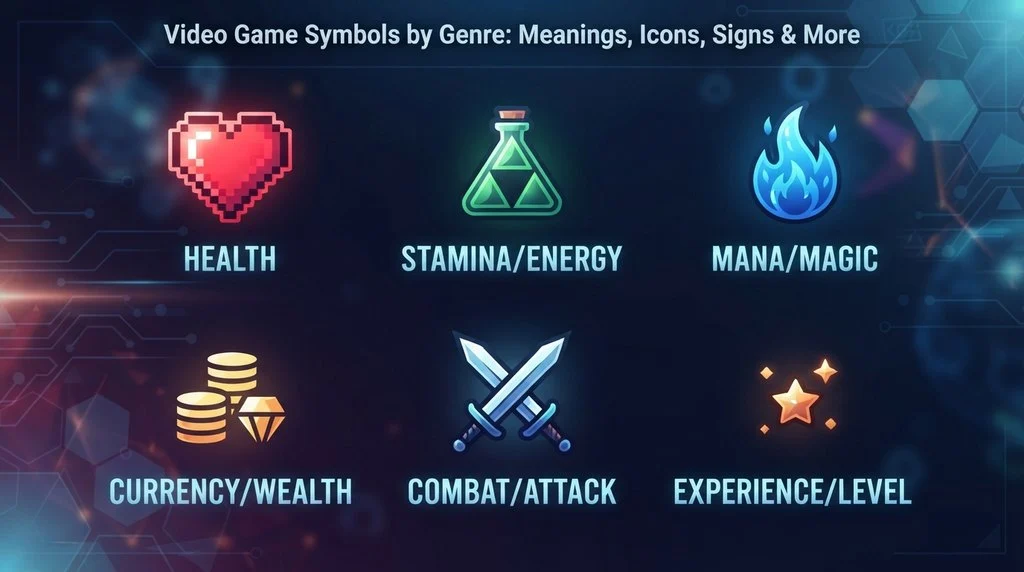
Different genres use different visual languages because they need to communicate different types of information.
RPG Symbols
Role-playing games commonly use:
- Health icons
- Mana icons
- Buffs
- Debuffs
- Quest markers
- Equipment rarity
- Skill icons
- Experience
- Inventory symbols
RPGs often have especially complex symbol systems because players manage characters, equipment, abilities, resources, and quests.
Shooter Symbols
Shooter games frequently use:
- Ammo
- Weapon icons
- Crosshairs
- Hit markers
- Armor
- Squad indicators
- Objective markers
- Grenade icons
Fast recognition is particularly important because players may need to react while simultaneously aiming or moving.
Strategy Game Symbols
Strategy games often use symbols for:
- Resources
- Units
- Buildings
- Technology
- Diplomacy
- Attack ranges
- Production
- Territory
Because strategy games can contain large amounts of information, symbols help organize complicated systems.
Racing Game Symbols
Racing games may use:
- Position numbers
- Speed
- Lap counters
- Fuel
- Damage
- Track direction
- Pit-stop indicators
- Race warnings
These symbols allow players to monitor the race without looking away from the track for long.
Survival Game Symbols
Survival games often display:
- Hunger
- Thirst
- Temperature
- Health
- Stamina
- Crafting
- Equipment durability
- Environmental dangers
The player may need to monitor several survival needs simultaneously.
Video Game Symbols and Accessibility
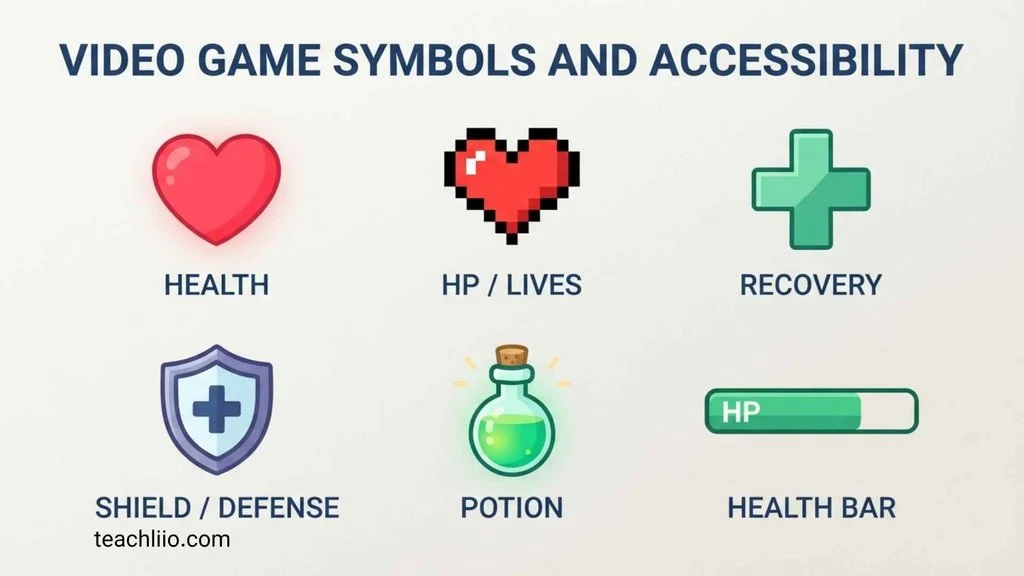
Symbols can improve accessibility, but they can also create problems when poorly designed.
For example, if a game communicates all important information through color alone, players with color-vision differences may struggle to understand it.
Good interface design can combine:
- Color
- Shape
- Text
- Position
- Animation
- Sound
- Contrast
Using several visual cues makes information easier to recognize.
Why Should Games Avoid Color-Only Information?
Consider two symbols that are identical except that one is red and the other is green.
If color is the only difference, some players may have difficulty distinguishing them.
Changing the shapes as well makes the interface clearer.
For example:
Red circle = danger
Green check = safe
The shape and icon now provide additional information beyond color.
Video Game Symbols vs. Video Game Logos
The terms symbols and logos are sometimes confused, but they usually refer to different things.
A video game symbol generally communicates gameplay information.
Examples include:
- Health icons
- Map markers
- Controller buttons
- Quest icons
- Status effects
A video game logo primarily identifies a game, franchise, company, team, or brand.
For example, a game’s title logo may appear on its cover or loading screen but may not communicate an active gameplay mechanic.
This distinction is useful because someone searching for “video game symbols” may be interested in either visual game elements or recognizable franchise imagery.
How to Understand an Unknown Video Game Symbol
If you encounter an icon you do not recognize, don’t guess based only on its appearance.
Try these steps:
Check the Location
An icon beside the health bar probably relates to character status, while one on the map probably represents a location.
Look for a Tooltip
Many games reveal an explanation when you hover over an icon or pause the game.
Check the Game’s Legend
Maps and menus sometimes include an icon key explaining every marker.
Consider the Context
Look at what happens when the symbol appears.
Does your character lose health? Receive a power boost? Enter a new area?
The gameplay event may reveal the meaning.
Check the Game’s Guide or Manual
Official tutorials and game documentation can explain symbols that are difficult to interpret.
Frequently Asked Questions
What are video game symbols?
Video game symbols are visual icons used to communicate information, actions, locations, status effects, rewards, warnings, and other gameplay elements.
What is the most common video game symbol?
There is no single universal gaming symbol, but familiar icons such as hearts for health, arrows for direction, shields for defense, and locks for unavailable content are widely used.
What does a heart symbol mean in video games?
A heart commonly represents health, life, healing, or remaining vitality. Its exact function depends on the game.
What does a skull symbol mean in a game?
A skull often represents death, danger, defeat, or a powerful enemy. Some games use it for completely different purposes.
What does a shield symbol mean?
A shield usually represents defense, protection, armor, or damage reduction.
What does a flame symbol mean in video games?
A flame commonly represents fire, burning, heat, or a fire-based ability. Some games use it as a symbol for power or another special mechanic.
What do video game map symbols mean?
Map symbols identify locations and gameplay elements such as quests, shops, treasure, enemies, fast travel points, collectibles, and objectives.
What do controller symbols mean?
Controller symbols identify physical buttons and controls. Their gameplay functions depend on the specific game and platform.
Are PlayStation symbols universal?
The PlayStation face-button symbols identify the controller buttons, but the actions assigned to those buttons can change between games.
Are video game symbols universal?
No. Some symbols follow common conventions, but individual games can give symbols different meanings.
Why do games use symbols?
Games use symbols because they can communicate information quickly, save screen space, reduce text, and help players understand gameplay while remaining focused on the action.
What does a red symbol usually mean?
Red commonly communicates danger, damage, attack, or critical status. However, its exact meaning depends on the game’s interface design.
What does a green symbol usually mean?
Green is often associated with healing, health, safety, or positive effects, but individual games may use it differently.
What is a HUD symbol?
A HUD symbol is an icon displayed in the game’s heads-up display to communicate information such as health, ammunition, abilities, objectives, or character status.
Conclusion
Video game symbols form a visual language that helps players understand complex information quickly. From hearts and shields to arrows, skulls, controller buttons, map markers, and status icons, these symbols make games easier to navigate and play.
However, there is no universal dictionary that defines every gaming icon. Common conventions exist, but each game can create its own system.
The most useful way to understand a symbol is to consider its shape, color, location, surrounding information, and gameplay context.
Whether you are trying to understand a mysterious HUD icon, controller prompt, quest marker, or status effect, recognizing these common conventions can make unfamiliar games much easier to understand.

I’m Hugo Wetherby, a British author interested in the numbers behind everyday questions. I explore quantities, populations, measurements, records, comparisons, and surprising statistics, turning complicated information into accessible answers. I believe a simple “how many” question can lead to fascinating discoveries, and I enjoy helping readers find those answers.
Books:
How Many? A Guide to Everyday Numbers
The Great Book of Numbers and Quantities