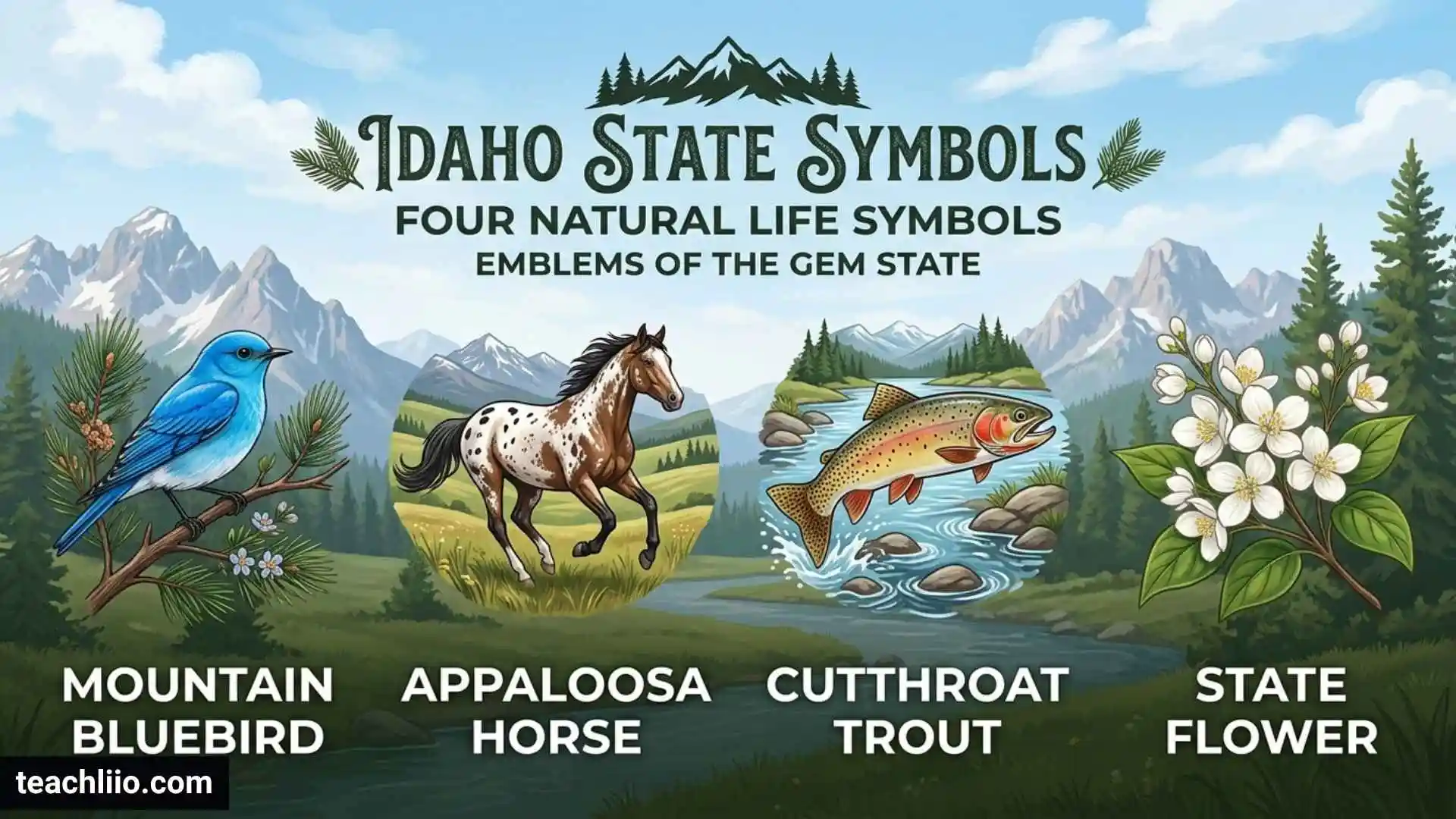
Idaho state symbols represent the state’s natural beauty, wildlife, agriculture, history, and cultural traditions. Known as the Gem State, Idaho recognizes official emblems such as the mountain bluebird, syringa flower, western white pine, cutthroat trout, star garnet, Appaloosa horse, and potato.
These symbols tell a bigger story about Idaho. Some highlight its mountains, forests, and rivers, while others honor its farming industry, Indigenous history, and scientific discoveries. The state also has an official flag, Great Seal, motto, song, and folk dance.
This guide covers Idaho’s major official state symbols, explains what makes each one special, and includes useful dates and facts for students, researchers, and anyone interested in the Gem State.
Quick List of Idaho State Symbols
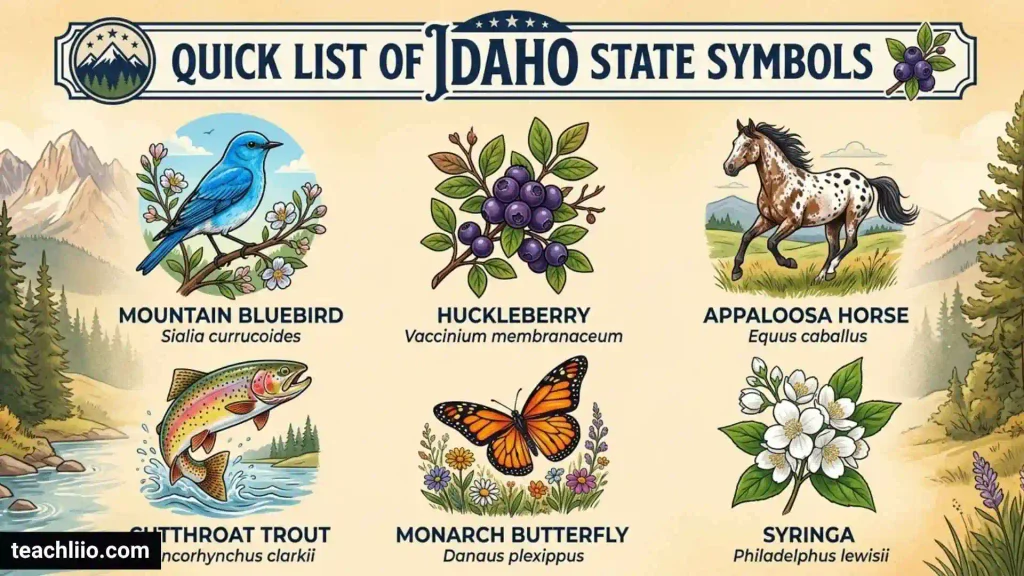
Use this chart to find Idaho’s best-known state symbols and their official designations.
| Symbol category | Idaho’s official symbol | Designation year |
| State bird | Mountain bluebird | 1931 |
| State flower | Syringa | 1931 |
| State tree | Western white pine | 1935 |
| State fish | Cutthroat trout | 1990 |
| State fruit | Huckleberry | 2000 |
| State vegetable | Potato | 2002 |
| State gem | Star garnet | 1967 |
| State gem cut | Idaho Cut | See official record |
| State horse | Appaloosa | 1975 |
| State fossil | Hagerman horse | 1988 |
| State insect | Monarch butterfly | 1992 |
| State raptor | Peregrine falcon | See official record |
| State amphibian | Idaho giant salamander | 2015 |
| State dinosaur | Oryctodromeus | 2023 |
| State American folk dance | Square dance | 1989 |
| State song | “Here We Have Idaho” | 1931 |
| State flag | Idaho state flag | 1907 |
| State motto | “Esto Perpetua” | Appears on the Great Seal |
| Great Seal | Great Seal of the State of Idaho | Original seal adopted in 1891 |
The years above are included where the official Idaho Capitol Commission or state resources provide a designation date. The Idaho Cut and state raptor entries are included without a year rather than assigning an unverified date. Idaho’s official symbol list is the best reference for checking the current designations.
What Are Idaho’s Official State Symbols?
Idaho State Bird: Mountain Bluebird
The mountain bluebird (Sialia currucoides) became Idaho’s official state bird in 1931.
This small songbird is known for its bright blue coloring. Adult males have vivid sky-blue feathers, while females usually have more muted blue-gray plumage. The species is commonly found in open grasslands, meadows, and other open habitats.
Mountain bluebirds often nest in cavities, including holes in trees and nest boxes. Their ability to thrive in open country makes them a familiar part of the western landscape.
As Idaho’s state bird, the mountain bluebird represents the state’s wildlife and open natural spaces. Its distinctive appearance also makes it one of the easiest state symbols to recognize.
Idaho State Flower: Syringa
The syringa (Philadelphus lewisii), also known as wild mock orange, is Idaho’s official state flower. It was designated in 1931.
This native shrub produces clusters of white, fragrant flowers that resemble orange blossoms. Despite its common name, syringa is not a true orange tree.
Its scientific name honors Meriwether Lewis of the Lewis and Clark expedition. Lewis documented the plant during the expedition’s exploration of the American West.
Syringa also has cultural and practical significance. Indigenous peoples used its branches to make items such as bows and arrows. Today, the flower represents Idaho’s native plant life, natural beauty, and history.
Idaho State Tree: Western White Pine
The western white pine (Pinus monticola) became Idaho’s official state tree in 1935.
This evergreen tree is native to western North America and is especially associated with northern Idaho’s forests. It can grow very tall and has long been valued for its relatively straight-grained, workable wood.
The western white pine has played an important role in the state’s timber industry. However, the species has also faced threats, including white pine blister rust, a fungal disease that has affected populations across its range.
The tree represents Idaho’s forests, forestry heritage, and natural resources.
Idaho State Fish: Cutthroat Trout
The cutthroat trout became Idaho’s official state fish in 1990.
Its name comes from the red or orange markings along the underside of its lower jaw. The fish’s coloring varies with its habitat, but it often has a darker back and lighter sides.
Cutthroat trout are native to Idaho’s waters. Different forms occur in different parts of the state, including the Westslope cutthroat trout in northern and central areas and the Yellowstone cutthroat trout in southeastern Idaho.
These fish are important to Idaho’s freshwater ecosystems and recreational fishing traditions. Their designation highlights the value of the state’s rivers, streams, and lakes.
Idaho State Fruit: Huckleberry
The huckleberry is Idaho’s official state fruit, designated in 2000.
Several huckleberry species grow in Idaho, especially in mountainous and forested areas. The black or thin-leaved huckleberry (Vaccinium membranaceum) is among the best-known varieties.
These small, dark purple berries are popular in pies, jams, syrups, sauces, and desserts. Many people associate huckleberry picking with summer outings in Idaho’s forests.
Huckleberry plants grow slowly and can be difficult to cultivate commercially. As a result, wild berries remain especially important to local food traditions.
The huckleberry represents Idaho’s mountain environment, native plants, and outdoor culture.
Idaho State Vegetable: Potato

The potato is Idaho’s official state vegetable, designated in 2002.
Idaho is widely recognized for potato farming. The state’s agricultural conditions, including suitable soils, irrigation water, sunny days, and cool nights, support the production of potatoes used in homes, restaurants, and food manufacturing.
Potatoes can be baked, boiled, roasted, mashed, or turned into products such as fries and chips. Their versatility has helped make them one of Idaho’s best-known agricultural products.
The potato represents the importance of farming, food production, and rural communities to Idaho’s economy and public image.
Idaho State Gem: Star Garnet
The star garnet became Idaho’s official state gem in 1967.
Star garnets are unusual gemstones that display a star-like pattern when light reflects from internal inclusions. This optical effect is called asterism. Idaho star garnets are commonly dark purple or plum-colored, and many display four rays, although six-ray examples can occur.
The effect is natural rather than painted onto the stone. Tiny inclusions, including rutile, contribute to the appearance of the star.
Star garnets are rare, and Idaho is one of the best-known places associated with them. Their distinctive appearance connects the gemstone with the state’s mineral resources and its nickname, the Gem State.
Idaho State Gem Cut: The Idaho Cut
Idaho’s official symbols also include a distinctive gemstone design known as the Idaho Cut. It is different from the star garnet: the star garnet is a gemstone, while the Idaho Cut is a faceting design.
The Idaho Cut is associated with gem cutter Quincy Douglas Howell, who developed the design in 1977. Faceting involves cutting and polishing a gemstone’s surface into carefully arranged flat faces to influence how light travels through the stone.
Howell refined his techniques through hands-on work, studying how angles and symmetry affect a gem’s brightness. His design honors the craftsmanship involved in transforming a rough stone into a finished gemstone.
The Idaho Cut adds a different dimension to the state’s gem heritage by recognizing skill, design, and lapidary artistry.
Idaho State Horse: Appaloosa
The Appaloosa became Idaho’s official state horse in 1975.
The breed is famous for its varied coat patterns, which may include spots, leopard-like markings, or a white blanket over the hindquarters. Individual horses can look quite different from one another.
The Appaloosa’s history is closely connected to the Nez Perce people, also known as the Nimiipuu. Their horsemanship and selective breeding helped develop horses known for endurance, intelligence, and agility.
The breed’s name is generally linked to the Palouse region of the Pacific Northwest. In 1938, horse enthusiasts founded the Appaloosa Horse Club in Moscow, Idaho, helping preserve and promote the breed.
The Appaloosa represents Idaho’s equestrian heritage and the important role of Indigenous horse culture in the region’s history.
Idaho State Fossil: Hagerman Horse
The Hagerman horse is Idaho’s official state fossil, designated in 1988.
Its fossils were discovered near Hagerman in southern Idaho, an area known for its important paleontological deposits. The animal lived approximately 3.7 million years ago during the Pliocene epoch.
The Hagerman horse, commonly identified as Equus simplicidens, was an ancient member of the horse family. Its remains help scientists investigate the evolution of horses and the environments they inhabited.
This fossil is not the same as Idaho’s state horse. The Hagerman horse represents prehistoric life, while the Appaloosa represents a living horse breed and its historical connection to Idaho.
Idaho State Insect: Monarch Butterfly
The monarch butterfly became Idaho’s official state insect in 1992.
Monarchs are recognizable by their orange wings, black veins, and white spots. Like other butterflies, they pass through four stages: egg, caterpillar, pupa, and adult.
Female monarchs lay their eggs on milkweed plants, and the caterpillars feed on milkweed as they grow. Adult butterflies feed on nectar from flowering plants.
Monarchs are also famous for their long migrations. Their journeys depend on suitable habitats and food sources, making them an important species in discussions about pollinator conservation.
The monarch represents Idaho’s insect life and the importance of protecting natural habitats.
Idaho State Raptor: Peregrine Falcon
The peregrine falcon is Idaho’s official state raptor.
A raptor is a bird of prey that hunts other animals. Peregrine falcons have pointed wings, powerful flight, and excellent eyesight. During hunting dives, they can reach extraordinary speeds while pursuing birds in the air.
They inhabit a wide range of environments, including cliffs, river valleys, and increasingly, urban structures such as bridges and tall buildings.
Peregrine falcons were seriously affected by pesticide use during the twentieth century, but conservation efforts helped populations recover in many regions.
As Idaho’s state raptor, the peregrine falcon represents wild landscapes, ecological balance, and the importance of wildlife protection.
Idaho State Amphibian: Idaho Giant Salamander
The Idaho giant salamander (Dicamptodon aterrimus) became the official state amphibian in 2015.
It is a large salamander associated with Idaho’s moist forest environments, especially areas with streams and suitable cover. Adults may have dark markings across a tan or copper-colored body.
One unusual feature of this species is that some individuals become land-dwelling adults, while others retain larval characteristics, such as external gills. This variation is part of what makes the species scientifically interesting.
The salamander represents Idaho’s distinctive native wildlife and the importance of healthy forest and stream habitats.
Idaho State Dinosaur: Oryctodromeus
Oryctodromeus (Oryctodromeus cubicularis) became Idaho’s official state dinosaur in 2023.
This small, plant-eating dinosaur lived about 98 million years ago. Fossils discovered in eastern Idaho have helped scientists understand its anatomy and behavior.
Evidence suggests that Oryctodromeus lived in groups and used burrows, possibly for shelter and raising its young. Such discoveries give researchers clues about how some dinosaurs lived beyond simply what they ate or how they moved.
The designation followed efforts involving students, educators, and paleontologists. It highlights Idaho’s prehistoric history and the value of scientific discovery.
Idaho’s Flag, Great Seal, Motto, Song, and Dance
Idaho State Flag
Idaho’s state flag was adopted in 1907. It has a blue background with the Great Seal of Idaho in the center and a red banner beneath it bearing the words “State of Idaho” in gold lettering.
The seal brings together imagery associated with the state’s land, people, industries, and natural resources. Displaying it on the flag makes the emblem a recognizable symbol of Idaho’s government and identity.
The flag is used at government buildings, schools, official events, and public ceremonies.
Great Seal of Idaho
The Great Seal of Idaho represents the state’s government, resources, and history.
Idaho became a state in 1890, and the legislature adopted a seal designed by Emma Edwards Green on March 14, 1891. Green is recognized for being the only woman to design an official state Great Seal in the United States.
The seal in use today is not identical to Green’s original artwork. In 1957, the legislature authorized an updated design to emphasize Idaho’s natural beauty and major industries, including mining, agriculture, and forestry. Paul B. Evans and Caxton Printers were commissioned to revise it.
The seal includes figures and imagery connected to justice, mining, agriculture, forestry, and the state’s landscape. Its details show how Idaho’s leaders sought to represent the state’s priorities through an official emblem.
Idaho State Motto: “Esto Perpetua”
Idaho’s state motto is “Esto Perpetua,” a Latin phrase often translated as “May it endure forever” or “Be eternal.”
The motto expresses the idea of lasting strength and continuity. It appears on the state’s Great Seal and connects Idaho’s identity with the hope that its institutions and communities will endure.
English translations vary slightly, but the central idea is permanence.
Idaho State Song: “Here We Have Idaho”
“Here We Have Idaho” is the official state song. It was adopted in 1931.
The song celebrates Idaho’s landscape, communities, and identity. Like other state songs, it offers a musical expression of state pride and is associated with public events and educational settings.
Idaho State Dance: Square Dance

Idaho designated the square dance as its American folk dance in 1989.
Square dancing usually involves four couples arranged in a square. Dancers follow calls that tell them which movements to perform and how to change partners or positions.
The dance developed from several folk traditions and became part of community gatherings and social events in the United States. Idaho’s designation recognizes the place of traditional dance in the state’s cultural heritage.
What Do Idaho State Symbols Represent?
Idaho’s state symbols can be grouped into several themes that explain what the state values and how it is known.
Nature and Wildlife
The mountain bluebird, cutthroat trout, monarch butterfly, peregrine falcon, and Idaho giant salamander highlight Idaho’s wildlife. The syringa and western white pine represent native plants and forests.
Together, these symbols reflect the importance of healthy habitats, rivers, mountains, and open spaces.
Agriculture and Natural Resources
The potato represents Idaho’s agricultural reputation, while the huckleberry connects the state with its mountain forests and food traditions. The star garnet and Idaho Cut highlight its gemstone heritage.
The western white pine also reflects the historical importance of forests and timber.
History and Culture
The Appaloosa connects Idaho with Nez Perce horsemanship and the region’s equestrian history. The flag, Great Seal, motto, song, and square dance represent civic identity and cultural traditions.
These symbols show that a state’s identity is shaped not only by its geography but also by the people who have lived there and the traditions they have developed.
Science and Prehistoric Life
The Hagerman horse fossil and Oryctodromeus dinosaur represent Idaho’s ancient past. Their fossils help scientists reconstruct earlier ecosystems and understand how animals lived millions of years ago.
They also demonstrate how paleontological discoveries can become part of a state’s modern identity.
Frequently Asked Questions
What is Idaho’s state nickname?
Idaho is widely known as the Gem State, a nickname associated with its mineral resources and natural beauty.
What is Idaho’s state bird and flower?
Idaho’s state bird is the mountain bluebird, and its state flower is the syringa. Both were officially designated in 1931.
What is Idaho’s state gem?
Idaho’s state gem is the star garnet. It is known for a natural star-like optical effect that often appears as four rays on a dark purple or plum-colored surface.
What is the difference between the star garnet and the Idaho Cut?
The star garnet is a gemstone, while the Idaho Cut is a gemstone faceting design associated with Quincy Douglas Howell. They represent two different parts of Idaho’s gem heritage.
Why is the Appaloosa Idaho’s state horse?
The Appaloosa has a strong historical connection to the Nez Perce people and the region’s horsemanship traditions. Its endurance, intelligence, and distinctive coat patterns have made it an important part of Idaho’s equestrian identity.
What does the Great Seal of Idaho represent?
The Great Seal represents Idaho’s government, people, natural landscape, and major industries. Its imagery includes references to justice, mining, agriculture, and forestry.
What is Idaho’s state motto?
Idaho’s motto is “Esto Perpetua,” a Latin phrase commonly translated as “May it endure forever” or “Be eternal.”
What is Idaho’s state dinosaur?
Idaho’s state dinosaur is Oryctodromeus, a small plant-eating dinosaur designated in 2023. Fossil evidence suggests it used burrows and lived about 98 million years ago.
What is Idaho’s state fossil?
Idaho’s state fossil is the Hagerman horse, an ancient member of the horse family whose fossils were found near Hagerman in southern Idaho.
What is Idaho’s state song?
Idaho’s official state song is “Here We Have Idaho,” adopted in 1931.
Conclusion
Idaho state symbols reflect the state’s natural beauty, agricultural success, mineral resources, cultural heritage, and prehistoric history. The mountain bluebird, syringa, western white pine, cutthroat trout, huckleberry, potato, and star garnet are among its best-known emblems.
Other designations, including the Appaloosa horse, Idaho giant salamander, Oryctodromeus dinosaur, state flag, Great Seal, motto, song, and square dance, tell additional stories about the Gem State.
Learning these symbols provides more than a list of facts. It offers a clearer picture of how Idaho represents its landscape, history, communities, and traditions.

I’m Arthur Ellison, a British writer with a fascination for numbers, quantities, and the questions people ask about how many. I enjoy researching facts, comparisons, measurements, and everyday statistics, presenting them in straightforward language. My goal is to make numerical information easy to understand, useful, and interesting for curious readers everywhere.
Books:
The Curious World of How Many
Numbers, Quantities and Everyday Facts