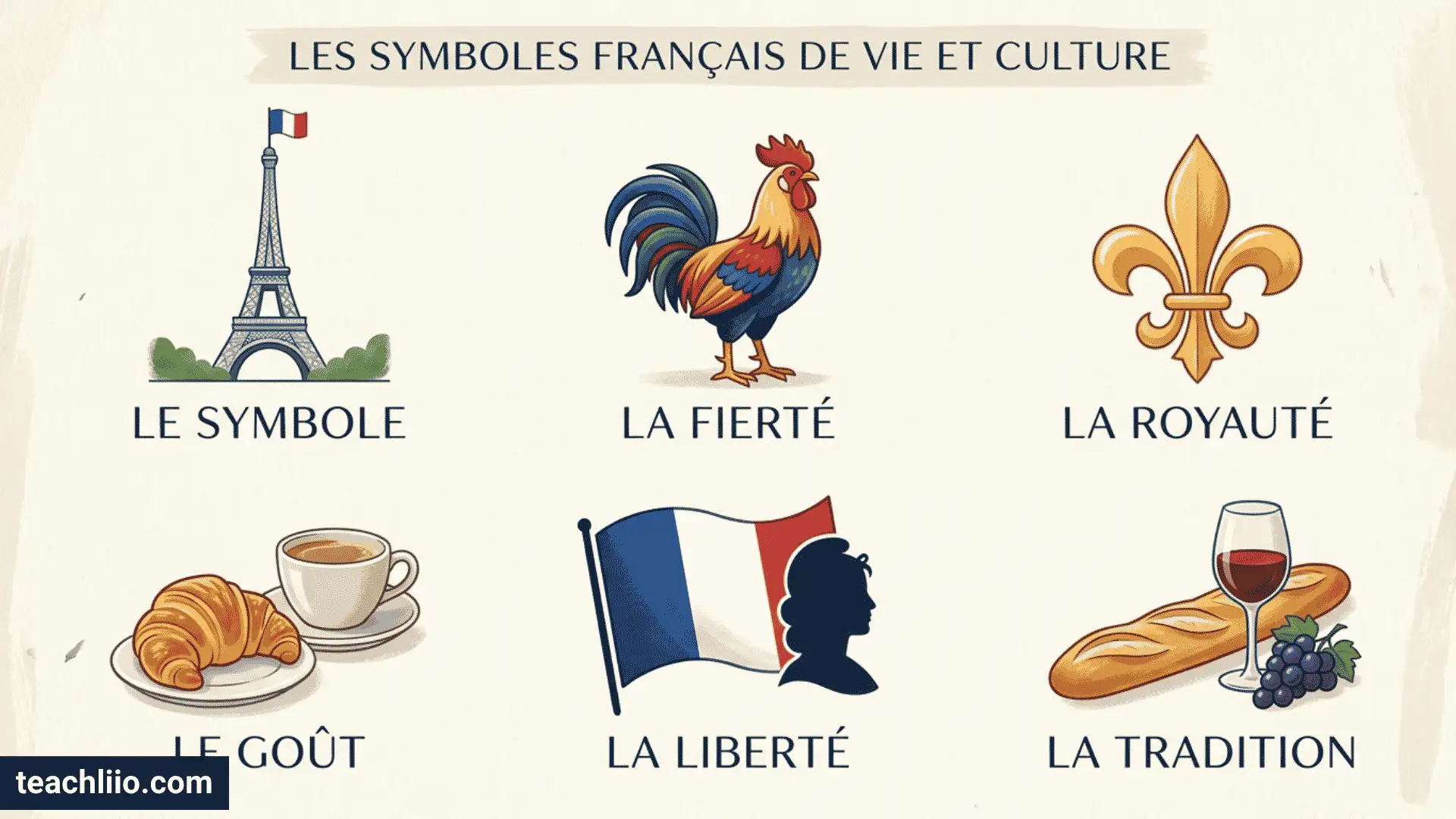
France is known for its rich history, art, architecture, traditions, and revolutionary ideals. Its symbols tell stories about freedom, national identity, royal power, democracy, remembrance, and French culture. From the blue, white, and red national flag to Marianne, the Gallic rooster, and the famous Eiffel Tower, each symbol has a different story to tell.
Some symbols are officially connected to the French Republic, while others come from royal history, the French Revolution, or everyday cultural life. Understanding this difference helps you discover what these symbols really represent instead of treating every famous French icon as an official national emblem.
In this guide, you will learn about 13 famous France symbols and their meanings, including their historical backgrounds, cultural importance, and roles in modern French life.
What Are the National Symbols of France?
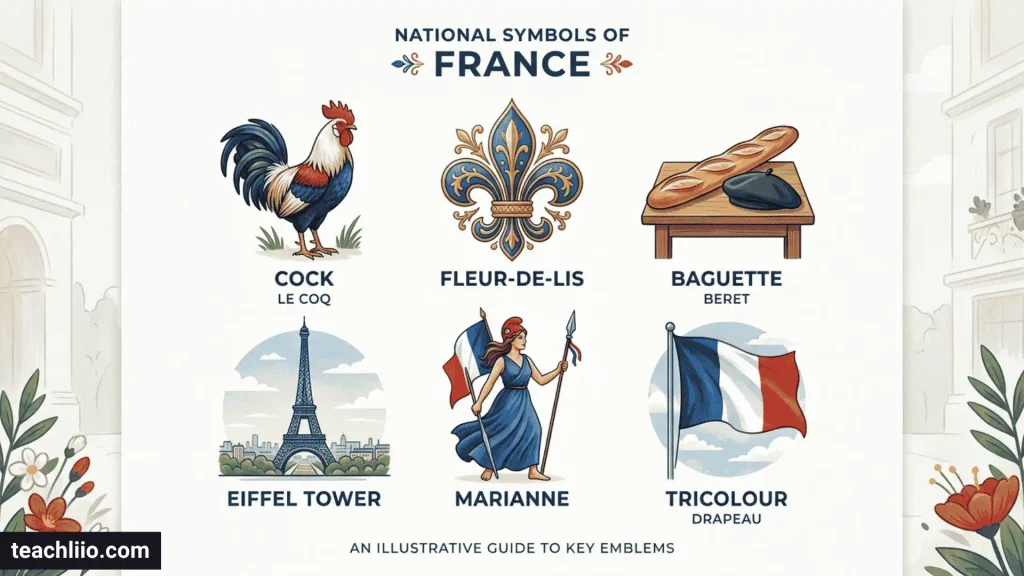
France has several important national and republican symbols. The French tricolor flag, the national anthem La Marseillaise, and the motto Liberty, Equality, Fraternity are among the country’s most recognizable official symbols. Marianne represents the French Republic, while other symbols reflect historical traditions or cultural identity.
Here is a quick overview of the most famous symbols of France.
| Symbol | Meaning or significance | Category |
| French flag | National identity and the Republic | Official national symbol |
| Marianne | Liberty and the French Republic | Republican symbol |
| Gallic rooster | French identity and resilience | Historical and cultural emblem |
| La Marseillaise | Freedom and national unity | National anthem |
| Liberty, Equality, Fraternity | Core republican ideals | National motto |
| Bastille Day | Revolution and republican history | National celebration |
| Phrygian cap | Freedom from oppression | Revolutionary symbol |
| Fleur-de-lis | French monarchy and royal heritage | Historical symbol |
| Great Seal of France | Constitutional and state authority | Official state seal |
| Lictor’s fasces | Authority, justice, and peace | Historical republican emblem |
| Eiffel Tower | French engineering and cultural identity | Cultural landmark |
| Arc de Triomphe | Military remembrance and national pride | Historical monument |
| Bleuet de France | Remembrance and support for veterans | Commemorative symbol |
These symbols do not all have the same official status. The flag, anthem, and motto have a formal place in the French Republic, while the rooster and fleur-de-lis are better understood through their historical and cultural associations. The Eiffel Tower is an internationally recognized landmark rather than an official national emblem.
Official Symbols of the French Republic
France’s official republican symbols reflect the country’s political history and the principles on which its modern government is based. Article 2 of the Constitution of the Fifth Republic identifies the national flag, national anthem, and republican motto, along with French as the national language and the principle of government by the people, for the people, and by the people.
Other symbols, including Marianne and the Great Seal, are closely connected to the institutions and traditions of the Republic.
1. The French Flag: Blue, White, and Red
The French flag, known as the drapeau tricolore, is one of the most recognizable symbols of France. It consists of three vertical bands of blue, white, and red.
The flag developed during the French Revolution in 1789. Blue and red were associated with Paris, while white was associated with the monarchy. Bringing these colors together reflected an attempt to unite the people and the king during a period of major political change. The flag later became a lasting symbol of the French Republic.
The three colors are often given broader symbolic interpretations:
- Blue: Commonly associated with freedom, loyalty, and civic identity.
- White: Historically associated with the monarchy and often linked with peace.
- Red: Associated with Paris and frequently connected with courage and revolutionary struggle.
These additional meanings are popular interpretations rather than a single, legally fixed explanation of every color.
Today, the tricolor appears on public buildings, government documents, military uniforms, and official occasions. It is also displayed during sporting events and national celebrations.
Why it matters: The French flag represents the country as a whole and serves as its constitutional national emblem.
2. Marianne: The Personification of Liberty and the Republic
Marianne is a symbolic female figure representing liberty and the French Republic. Rather than portraying one specific historical person, she personifies the ideals and identity of the nation.
Her association with the Republic grew during the French Revolution, when revolutionary supporters used female figures to represent freedom and popular sovereignty. The name Marianne became associated with this personification of the French people and the Republic.
Marianne is often shown wearing a Phrygian cap, a traditional head covering that became a powerful emblem of liberation. Her image can be found in town halls, on stamps, and in other official or civic settings.
Over the years, artists have given Marianne different facial features and styles. Some versions appear traditional and solemn, while others reflect contemporary French society.
Her meaning includes:
- Liberty and freedom from oppression
- Republican government and citizenship
- The sovereignty of the French people
- Equality and democratic ideals
Why it matters: Marianne gives a human face to the abstract principles of the French Republic.
3. The Gallic Rooster: A Symbol of French Identity
The Gallic rooster, or coq gaulois, is one of the most familiar animals associated with France. It appears in sports imagery, historical artwork, and cultural representations of the country.
Its association with France partly comes from a linguistic coincidence. The Latin word gallus can mean both “rooster” and “Gaul,” the ancient region associated with the ancestors of modern France. Over time, this wordplay helped the rooster become linked with French identity.
The rooster’s proud stance and alert behavior have also made it a natural symbol of vigilance, confidence, and resilience. It became particularly visible in French political and national imagery during different periods of the country’s history.
Today, the rooster is strongly associated with French sports teams and international competitions. Supporters often see it as a sign of national pride and determination.
However, the rooster is not France’s constitutional national emblem. It is a historical and cultural emblem, while the tricolor flag holds that specific constitutional status.
Why it matters: The rooster connects France’s ancient past with its modern sporting and cultural identity.
4. La Marseillaise: The French National Anthem
La Marseillaise is the national anthem of France. It was composed in 1792 by Claude Joseph Rouget de Lisle during the French Revolutionary period.
The song was originally written in a context of war and political upheaval. Its adoption by volunteers from Marseille helped establish the name by which it became known. It later developed into a powerful expression of revolutionary feeling and national identity.
The anthem’s opening is widely recognized, even by people who do not speak French. Its stirring melody and forceful lyrics make it especially prominent at official ceremonies, commemorations, and international sporting events.
The anthem is associated with:
- National unity
- Freedom and resistance
- Revolutionary history
- Civic commitment and patriotism
Its lyrics reflect the conflict and urgency of its historical setting, so the song should be understood within the circumstances of the French Revolution rather than as a simple celebration of peace.
Why it matters: La Marseillaise gives France a shared musical symbol used in public ceremonies and moments of national importance.
5. Liberty, Equality, Fraternity: The National Motto
The French national motto is Liberté, Égalité, Fraternité, translated as Liberty, Equality, Fraternity. These three words express the central ideals associated with the French Republic.
Each word carries a distinct meaning.
- Liberty: People should enjoy freedom within the framework of the law.
- Equality: Citizens should receive equal treatment under the law.
- Fraternity: People should show solidarity, responsibility, and concern for one another.
The motto is closely connected to the ideals of the French Revolution. Although its use and prominence changed throughout French political history, it became firmly established as a republican motto during the nineteenth century.
Today, the phrase appears on public buildings and in civic settings. It is also used in discussions about citizenship, justice, public responsibility, and the relationship between individuals and society.
The motto expresses an ideal, not a claim that every person in France has always experienced perfect liberty or equality. Its continued importance lies partly in the way it provides a standard against which society can measure its own actions.
Why it matters: The motto summarizes the values the French Republic seeks to uphold.
6. Bastille Day: A National Celebration of Freedom
Bastille Day, celebrated every year on July 14, is France’s national day. In French, it is called la Fête nationale.
The date is connected to two important events from the French Revolution. On July 14, 1789, a Parisian crowd stormed the Bastille, a fortress and prison that had become a symbol of royal authority. The event came to represent resistance to the monarchy and the upheaval of the revolutionary era.
On July 14, 1790, the Fête de la Fédération celebrated national unity. The modern national celebration draws historical significance from both events, rather than commemorating only the storming of the Bastille.
Bastille Day celebrations may include:
- Military parades, especially in Paris
- Fireworks and public festivities
- Concerts and community gatherings
- Displays of the French tricolor flag
- Ceremonies honoring national history
The day is both a celebration and a moment for reflection. It recalls the struggle over political authority and the development of modern republican ideals.
Why it matters: Bastille Day connects France’s revolutionary past with its contemporary national identity.
7. The Great Seal of France: Authority and Constitutional Tradition
The Great Seal of France is a historic state seal used to authenticate particularly important official documents. Unlike the national flag, it is not something most people encounter in everyday life.
The current design dates to the Second Republic in 1848. It features a seated female figure representing Liberty, a lictor’s fasces, a ship’s tiller bearing a rooster, and other details associated with civic life and the Republic.
Seals have long served as marks of authority and authenticity. Historically, they helped demonstrate that a document had been formally issued or approved by the appropriate institution.
In modern France, the Great Seal is used only on rare and particularly solemn occasions, including certain constitutional acts and amendments.
Why it matters: The Great Seal represents the continuity of French state institutions and the formal authority of important constitutional documents.
8. The Lictor’s Fasces: Unity, Justice, and Authority
The lictor’s fasces is a bundle of rods traditionally bound together, sometimes with an axe. Its origins lie in ancient Rome, where fasces were carried by attendants known as lictors as a sign of official authority.
French revolutionaries adopted the motif as part of their republican symbolism. The bound rods can be interpreted as representing strength through unity, while the broader historical imagery connects the symbol with public authority and justice.
The fasces also appears in French state-related imagery, including the Great Seal and certain official insignia. It should not, however, be described as France’s main national emblem or as an exclusively French symbol.
Although the Élysée includes it among symbols associated with the Republic, its official page clarifies that the fasces has no official status as a national emblem today.
Élysée
+1
Why it matters: The fasces illustrates how the French Republic adapted imagery from earlier civilizations to express ideas about unity and public authority.
Historical Symbols of France
France’s past includes centuries of monarchy, revolution, and changing political systems. Some of the country’s best-known symbols come from these earlier periods and remain culturally significant even though they are not current official national emblems.
9. The Phrygian Cap: Freedom from Oppression
The Phrygian cap is a soft, usually pointed cap with a top that bends forward. During the French Revolution, it became a recognizable symbol of liberty and the rejection of oppressive rule.
The cap’s history reaches back to the ancient Mediterranean world, where similar head coverings became associated with freedom in certain historical contexts. French revolutionaries adopted it as a visible sign of liberation and political change.
Élysée
The cap is closely connected to Marianne, who is frequently depicted wearing it. It can also appear independently in revolutionary artwork, illustrations, and representations of republican values.
Its meaning is especially powerful because it represents freedom as something people claim or regain, rather than simply a gift from those in authority.
Why it matters: The Phrygian cap is a visual reminder of the French Revolution and its emphasis on liberty.
10. The Fleur-de-lis: French Royal Heritage
The fleur-de-lis is a stylized lily-like floral design associated with French monarchy and royal heraldry. It is one of the most recognizable symbols connected to France’s pre-revolutionary history.
For centuries, fleur-de-lis designs appeared in royal decorations, coats of arms, architecture, textiles, and religious artwork. The motif became particularly associated with the French monarchy, although its precise origins and early development involve a mixture of historical tradition and legend.
The symbol is often linked with royalty, authority, nobility, and Christian imagery. Its association with the monarchy made it especially prominent in representations of the old French kingdom.
After the French Revolution challenged royal authority, the fleur-de-lis lost its former position as a central symbol of the state. It remains visible in historical sites, decorative art, heraldry, and communities influenced by French heritage.
It is important to distinguish its historical significance from modern official status. The fleur-de-lis is not the current national emblem of France, and France does not have an officially designated national flower simply because the design resembles a lily.
Why it matters: The fleur-de-lis represents the royal chapter of French history and helps explain the contrast between monarchy and republican government.
Famous Cultural Symbols of France
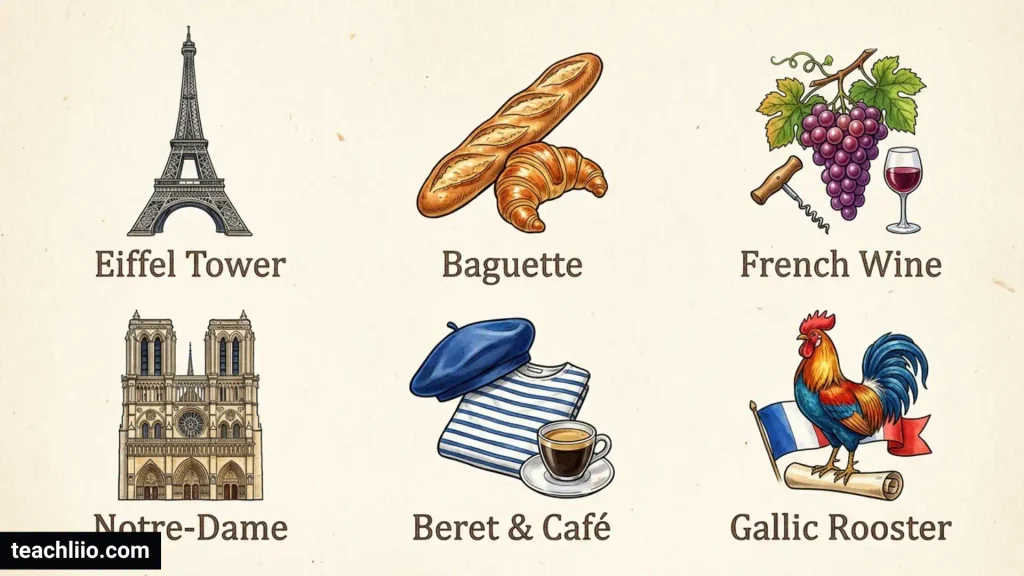
Not every symbol of France comes from a constitution, a political movement, or a royal dynasty. Some became famous because they represent the country’s architecture, history, remembrance traditions, food, and artistic influence.
11. The Eiffel Tower: Engineering and French Identity
The Eiffel Tower is one of the most recognizable landmarks in the world. Located in Paris, it was built for the 1889 Exposition Universelle, which marked the centenary of the French Revolution.
Designed by a team of engineers and named after Gustave Eiffel, the tower demonstrated the possibilities of large-scale iron construction. Although it faced criticism when first proposed and built, it gradually became a defining feature of the Paris skyline.
Today, the Eiffel Tower is associated with:
- French engineering and innovation
- Parisian architecture and tourism
- Art, romance, and popular culture
- France’s international reputation
The tower appears on postcards, travel posters, souvenirs, and countless photographs. It often serves as a visual shortcut for France itself, even though the country has many other important regions and cultural traditions.
Why it matters: The Eiffel Tower represents modern French creativity and is a powerful cultural icon, not an official constitutional emblem.
12. The Arc de Triomphe: Military Remembrance and National Pride
The Arc de Triomphe stands at the Place Charles de Gaulle in Paris. Napoleon commissioned the monument in 1806 to commemorate French military victories, and it was completed in 1836.
Its monumental arches and sculpted reliefs celebrate military campaigns and honor those who served France. The monument also contains the Tomb of the Unknown Soldier, established after the First World War, with an eternal flame that commemorates fallen soldiers.
The Arc de Triomphe therefore carries more than one meaning. It represents military achievement, but it also serves as a place of remembrance and respect for those who died in war.
National ceremonies held at the monument reinforce its connection with collective memory and the sacrifices associated with French history.
Why it matters: The Arc de Triomphe connects France’s military past with modern traditions of remembrance.
13. Bleuet de France: Remembrance and Solidarity
The Bleuet de France, or French blue cornflower, is a commemorative symbol associated with remembrance and support for veterans, wounded service members, and victims of war.
Its use developed after the First World War. The blue cornflower became associated with remembrance partly because of its color and its connection to the landscapes and experiences of wartime France.
People may wear a blue cornflower pin during commemorations, particularly around national remembrance occasions. The symbol also supports charitable efforts connected with veterans and those affected by conflict.
The Bleuet de France should not be confused with an officially designated national flower. Its significance is specifically commemorative and charitable.
Why it matters: The blue cornflower represents compassion, remembrance, and ongoing responsibility toward people affected by war.
What Do French Symbols Represent?
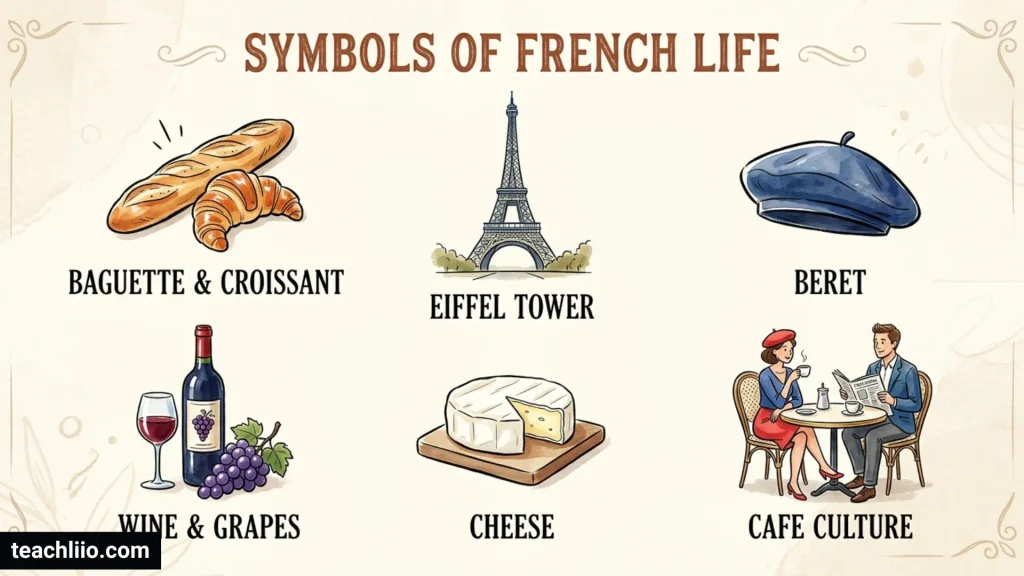
France’s symbols reflect several overlapping themes. Understanding these themes helps explain why some symbols are used by the state, while others remain popular in culture and historical memory.
| Theme | Examples | What they communicate |
| National identity | French flag, Gallic rooster | Belonging and shared identity |
| Republican ideals | Marianne, national motto | Liberty, equality, citizenship |
| Revolution and freedom | Phrygian cap, Bastille Day | Resistance to oppression and political change |
| Government and authority | Great Seal, lictor’s fasces | State institutions and official power |
| Royal history | Fleur-de-lis | Monarchy and historical heritage |
| Remembrance | Arc de Triomphe, Bleuet de France | Military memory, sacrifice, solidarity |
| Culture and innovation | Eiffel Tower | Architecture, engineering, and international recognition |
These meanings can overlap. For example, the Arc de Triomphe began as a monument connected to military victories but now also serves as a place of remembrance. Likewise, the Gallic rooster has historical roots but remains visible in modern sports and popular culture.
A symbol’s meaning may also change over time. Political movements, artists, institutions, and ordinary people can give familiar images new interpretations while preserving links to their past.
Interesting Facts About France Symbols
Here are some useful facts that help distinguish France’s most famous symbols.
- The tricolor flag has constitutional status. Article 2 of the French Constitution identifies the blue, white, and red flag as the national emblem.
Élysée - Marianne is a symbolic figure, not a single historical woman. Different artists and periods have given her different appearances.
- The rooster is a cultural emblem. It is especially popular in sporting contexts but is not the constitutional national emblem.
- Bastille Day connects two historical events. The storming of the Bastille took place in 1789, while the Fête de la Fédération took place on the same date in 1790.
- The Great Seal is rarely used. It is reserved for particularly solemn official occasions rather than everyday government paperwork.
Élysée - The fleur-de-lis represents a different political era. It is associated with French royal heritage, not the current Republic.
- The Eiffel Tower is a cultural landmark. Its global fame does not make it an official national emblem.
These distinctions are useful for students, travelers, teachers, and anyone researching French culture or national identity.
Frequently Asked Questions
What are the main symbols of France?
The main symbols of France include the tricolor flag, La Marseillaise, the motto Liberty, Equality, Fraternity, and Marianne. Other important historical and cultural symbols include the Gallic rooster, Phrygian cap, fleur-de-lis, Great Seal, Eiffel Tower, and Arc de Triomphe.
What do the colors of the French flag mean?
The French flag combines blue, white, and red. Blue and red were associated with Paris, while white was associated with the monarchy when the tricolor developed during the French Revolution. The combined colors became a symbol of national unity. Other interpretations, such as associating the colors with particular virtues, are common but should not be treated as fixed constitutional definitions.
What is the national animal of France?
The Gallic rooster is the animal most commonly associated with France. It has historical roots in the Latin word gallus, which means both “rooster” and “Gaul.” It is a popular cultural emblem, particularly in sports, rather than the country’s constitutional national emblem.
What does Marianne symbolize in France?
Marianne personifies the French Republic and represents liberty, democracy, and the sovereignty of the people. She is often shown wearing a Phrygian cap, which became a revolutionary symbol of freedom.
What is the national flower of France?
France does not have an officially designated national flower. The fleur-de-lis is a famous historical floral design associated with the French monarchy, while the Bleuet de France, or blue cornflower, is a commemorative symbol connected with remembrance and support for veterans.
Why is the fleur-de-lis associated with France?
The fleur-de-lis became closely associated with French kings and royal heraldry over many centuries. It appeared in royal decorations and coats of arms, making it a prominent symbol of monarchy. Today, it remains a historical and cultural emblem rather than the official symbol of the French Republic.
Why is July 14 celebrated in France?
July 14 is France’s national day, commonly known as Bastille Day in English. It recalls the storming of the Bastille on July 14, 1789, and the Fête de la Fédération held on July 14, 1790. Celebrations often include military parades, fireworks, concerts, and public gatherings.
Is the Eiffel Tower an official symbol of France?
The Eiffel Tower is one of France’s most famous cultural landmarks, but it is not the country’s constitutional national emblem. Its international recognition makes it a common visual representation of France and Paris.
What is the difference between official and cultural symbols of France?
Official symbols have a formal connection to the state or its institutions. The French flag, national anthem, and republican motto are examples. Cultural symbols become widely associated with a country through history, art, traditions, or public life. The Eiffel Tower and Gallic rooster are examples of cultural symbols, while the fleur-de-lis represents royal heritage.
Conclusion
France’s symbols reveal how the country developed from a monarchy into a modern republic while preserving a rich cultural and historical legacy. The tricolor flag, La Marseillaise, and Liberty, Equality, Fraternity express important republican ideals, while Marianne personifies liberty and the Republic itself.
Other symbols tell different stories. The Gallic rooster reflects historical identity, the Phrygian cap recalls revolutionary freedom, and the fleur-de-lis represents royal heritage. The Great Seal and lictor’s fasces connect France with traditions of public authority, while the Eiffel Tower, Arc de Triomphe, and Bleuet de France represent cultural achievement and remembrance.
The most important distinction is that not every famous symbol of France is an official national emblem. Some have constitutional status, others represent earlier political eras, and still others became meaningful through culture and collective memory. Together, they help explain France’s history, values, and place in the world.
Is this conversation helpful so far?

I’m Arthur Ellison, a British writer with a fascination for numbers, quantities, and the questions people ask about how many. I enjoy researching facts, comparisons, measurements, and everyday statistics, presenting them in straightforward language. My goal is to make numerical information easy to understand, useful, and interesting for curious readers everywhere.
Books:
The Curious World of How Many
Numbers, Quantities and Everyday Facts