JoJo’s Bizarre Adventure is known for its dramatic poses, unforgettable characters, powerful Stands, unusual fashion, and one of the most recognizable visual styles in manga and anime. But another major part of its identity is its use of symbols, motifs, icons, and Japanese sound effects.
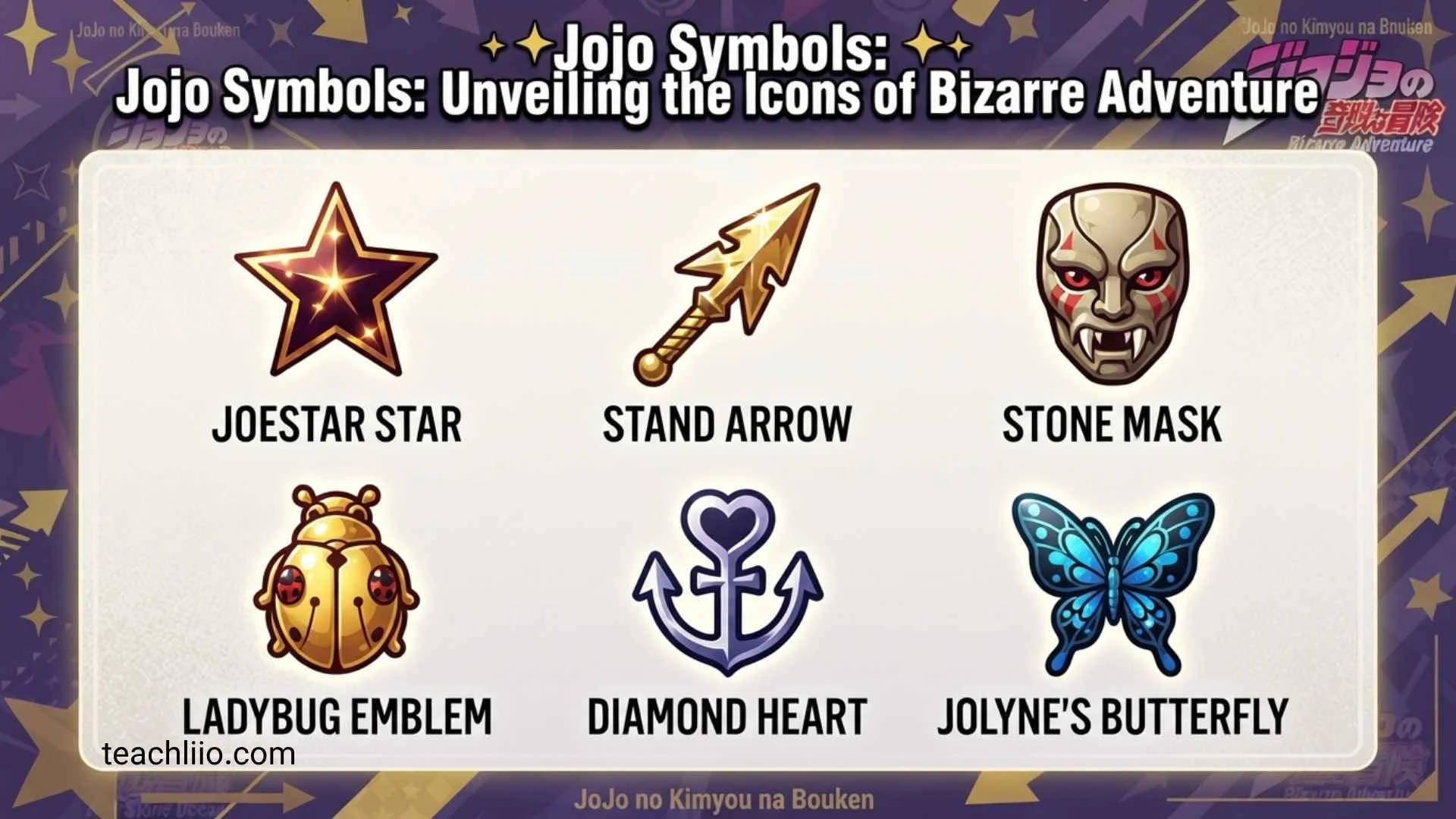
If you are searching for JoJo symbols, you may be looking for the famous Joestar star, the mysterious ゴゴゴ characters that appear during tense scenes, the Stand Arrow, the Stone Mask, or character-specific designs such as Jolyne’s butterfly and Giorno’s ladybug motif.
The important thing to remember is that not every JoJo symbol has a secret or officially defined meaning. Some are important story objects, some identify characters or families, some are recurring design motifs, and others are manga sound effects. Understanding that difference makes the symbolism much easier to appreciate.
This guide explains the most recognizable JoJo symbols and their meanings, how to identify them, which ones are officially established, and which interpretations come mainly from fans.
What Are JoJo Symbols?
JoJo symbols are recurring visual elements associated with JoJo’s Bizarre Adventure. They can appear as birthmarks, objects, costume designs, logos, manga lettering, Stand-related imagery, or character motifs.
Some have a direct connection to the story. The five-pointed Joestar birthmark, for example, is associated with the Joestar bloodline. The Stand Arrow is connected to the awakening of Stand abilities. The Stone Mask is an important supernatural object.
Other elements work differently. The famous ゴゴゴ lettering is a visual sound effect that creates an ominous atmosphere rather than functioning as a conventional symbol.
That distinction is important because online discussions sometimes call every recognizable JoJo graphic a “symbol,” even when it is technically a motif, logo, object, or sound effect.
Quick Guide to the Most Famous JoJo Symbols
| JoJo symbol | What it is associated with |
| ★ Joestar star | Joestar bloodline |
| ゴゴゴ | Menacing or ominous atmosphere |
| Stone Mask | Vampirism and supernatural transformation |
| Stand Arrow | Awakening Stand abilities |
| Red Stone of Aja | Battle Tendency and the Stone Mask |
| Butterfly | Jolyne Cujoh |
| Ladybug | Giorno Giovanna |
| Zipper | Bruno Bucciarati and Sticky Fingers |
| Lucky Land hand | Hirohiko Araki’s creator/business emblem |
| To Be Continued arrow | JoJo’s famous ending presentation |
| Heart motifs | Character and artistic design |
| Star patterns | Joestar and character-related imagery |
Not all of these have a single official symbolic definition. Some are simply strongly associated with particular characters, objects, or parts of the series.
The JoJo Menacing Symbol ゴゴゴ
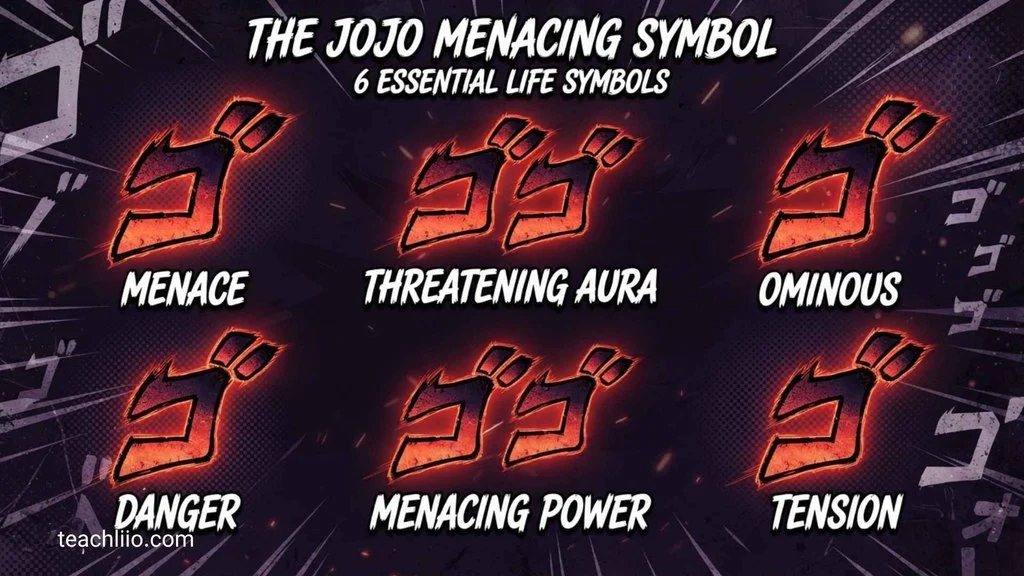
One of the most recognizable JoJo symbols is:
ゴゴゴゴ
Fans commonly call it the JoJo menacing symbol, Gogogo, or JoJo menacing sound effect.
The Japanese characters are written in katakana. In JoJo, they are used as a dramatic visual effect to create a feeling of tension, danger, pressure, or an ominous presence.
Japanese-language explanations describe ゴゴゴゴ as an ideophone associated with a tense or menacing atmosphere rather than ordinary dialogue.
What Does ゴゴゴ Mean?
The simplest explanation is that ゴゴゴ conveys a low, rumbling, ominous feeling.
It is often translated in English as something like “menacing”, but that does not mean that ゴゴゴ literally translates to the English adjective “menacing.” It is better understood as a stylized Japanese sound or atmosphere effect.
The effect can make an ordinary character standing silently appear extremely intimidating.
How Do You Pronounce ゴゴゴ?
The character ゴ is pronounced approximately “go.”
Therefore:
ゴゴゴゴ = go-go-go-go
In JoJo, however, you are not expected to treat it as ordinary spoken dialogue. Its visual presentation is part of the effect.
Why Is ゴゴゴ So Famous?
JoJo makes manga lettering part of the artwork itself. Instead of placing sound effects quietly in the background, Araki often makes them visually dominant.
The result is an effect that fans can recognize immediately.
It has also become an internet meme, where people add ゴゴゴゴ to photographs or ordinary scenes to make them look dramatically threatening.
JoJo Menacing Symbol Copy and Paste
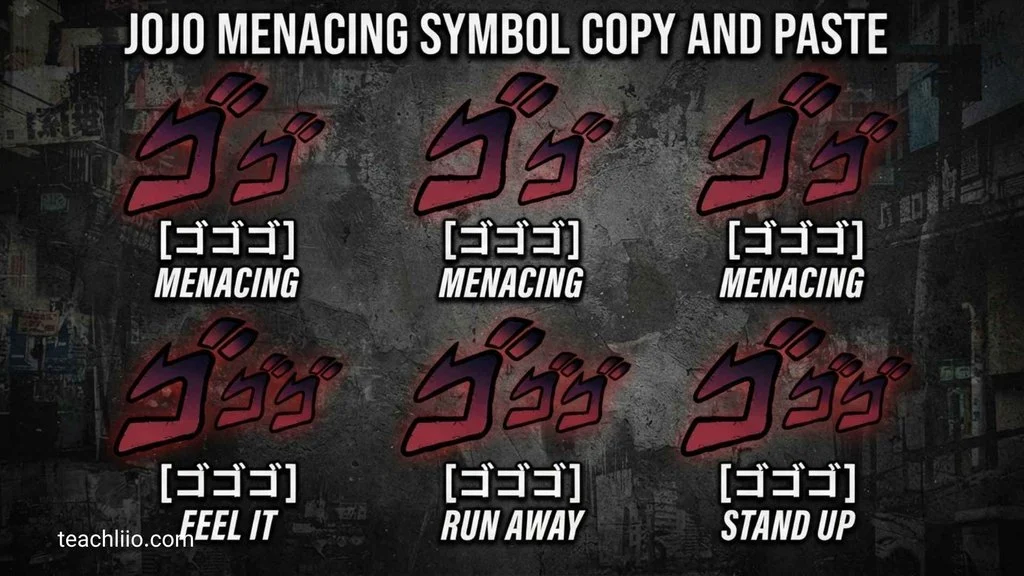
If you came here because you want to copy the famous JoJo-style menacing text, here are some simple versions:
ゴゴゴゴ
ゴゴゴゴゴゴ
『ゴゴゴ』
〖ゴゴゴゴ〗
These are text representations, not official downloadable JoJo artwork.
You can also combine them with emojis for a fan-made effect:
😈 ゴゴゴゴ
👊 ゴゴゴゴ 👊
⭐ ゴゴゴゴ ⭐
Remember that emoji combinations are fan creations. They should not be confused with canon JoJo symbols.
Other Japanese JoJo Sound Effects
ゴゴゴ is not the only dramatic lettering associated with JoJo.
ドドド
Another repeated Japanese effect is ドドド, commonly rendered as “dododo.”
It can create a feeling of heavy movement, impact, intensity, or dramatic presence depending on the scene.
Are These Really Symbols?
Technically, these are better described as manga sound effects or ideophones rather than conventional symbols.
That distinction matters because they communicate atmosphere through typography. Japanese manga has a rich tradition of integrating sound-effect lettering directly into artwork.
For readers searching for “JoJo Japanese symbols,” however, these effects are often exactly what they mean.
The Joestar Star Birthmark
The Joestar star birthmark is arguably the most important traditional symbol associated with the Joestar family.
It is a five-pointed, star-shaped mark generally found around the back of the left shoulder or near the nape of the neck. It is associated with JoJos and members of the Joestar bloodline, although the series also includes unusual connections to the mark.
What Does the Joestar Star Mean?
The clearest established meaning is bloodline and family connection.
The star visually connects characters from different generations and helps reinforce one of the major themes of the franchise: the continuing story of the Joestar family.
The birthmark became especially important in Stardust Crusaders and later plays a significant role in Stone Ocean. It also appears in the later continuity.
Is the Joestar Star the Same as Every Star in JoJo?
No.
A star appearing on clothing or in artwork is not automatically the Joestar birthmark.
The birthmark is a specific physical mark connected to the Joestar lineage. Other stars may simply be decorative patterns or character-design elements.
The Stone Mask
The Stone Mask is one of the earliest and most important supernatural objects in JoJo’s Bizarre Adventure.
It plays a central role in Phantom Blood and becomes even more significant as the history of the Pillar Men and their ambitions is explored.
What Does the Stone Mask Represent?
Rather than having one simple symbolic meaning, the Stone Mask is closely connected with:
- Transformation
- Supernatural power
- Vampirism
- Immortality
- The consequences of seeking power
Later story information reveals that the masks were connected to Kars’s attempt to allow his race to overcome its vulnerability to sunlight.
For a new reader, the easiest way to identify the Stone Mask is its distinctive stone face and supernatural purpose.
The Red Stone of Aja
The Red Stone of Aja is another important symbol from Battle Tendency.
It is especially important because of its connection to the Stone Mask and the Pillar Men.
The Red Stone should not be confused with the Joestar star. Although both can appear in discussions of JoJo symbolism, they have completely different roles.
The Red Stone becomes particularly significant when the story explores the ultimate potential of the Stone Mask and Kars’s ambitions.
The Stand Arrow
The Stand Arrow is one of the most recognizable objects associated with the Stand system.
It represents a pathway to supernatural ability and becomes particularly important in later parts of the series.
What Does the Stand Arrow Mean?
Within the story, the Arrow is associated with the awakening of Stand abilities.
It therefore works as a visual representation of transformation and supernatural potential.
However, the Arrow does not simply mean “power” in every context. Its effects and importance vary depending on the story and the people involved.
What Is the Requiem Arrow?
The Requiem Arrow is a special development of the Stand Arrow concept associated particularly with Golden Wind.
It is important to distinguish the ordinary Stand Arrow from the Requiem-related Arrow because fans sometimes combine both into one general “JoJo arrow symbol.”
Hearts in JoJo
Heart shapes appear throughout JoJo’s character designs, clothing, artwork, and visual motifs.
Their meaning changes according to context.
A heart can suggest love or emotion, but it can also simply be an attractive design element. Hirohiko Araki has discussed using hearts and other icons as part of his artistic approach, including using them to introduce a sense of peace into a battle-oriented work.
That means it is better not to claim that every heart in JoJo has one secret meaning.
Jolyne Cujoh’s Butterfly Symbol
Butterfly imagery is strongly associated with Jolyne Cujoh, particularly through her fashion and character design.
Her visual identity combines several motifs, including butterfly imagery, stars, web-like patterns, and other decorative elements.
What Does the Butterfly Represent?
Fans may interpret a butterfly as representing change, freedom, or transformation, but those interpretations should be presented as analysis rather than automatically treated as official explanations.
The safer factual statement is that the butterfly is a strong visual motif associated with Jolyne.
This distinction keeps the article accurate while still acknowledging why fans find the imagery meaningful.
Giorno Giovanna’s Ladybug Motif
Ladybugs are strongly associated with Giorno Giovanna.
They appear in his clothing and accessories and are one of the easiest ways to identify his visual design.
Is the Ladybug an Official Symbol of Giorno?
It is more accurate to call it a character motif rather than claim that Araki gave it one fixed symbolic definition.
For readers trying to identify a JoJo character from a symbol, however, the ladybug is a useful visual clue for Giorno.
Bruno Bucciarati’s Zipper Motif
The zipper is one of the clearest character-specific motifs in JoJo’s Bizarre Adventure.
It is closely associated with Bruno Bucciarati and his Stand, Sticky Fingers.
The zipper design is not merely decorative. It connects directly to the Stand’s distinctive ability, making it an excellent example of JoJo’s approach to character design.
The visual motif tells the viewer something about the character’s supernatural ability without requiring a long explanation.
Killer Queen and Its Visual Motifs
Killer Queen, Yoshikage Kira’s Stand, has a distinctive appearance with cat-like facial characteristics and skull-like design elements.
Because the Stand itself is strongly connected to Kira’s character and abilities, fans sometimes discuss these elements symbolically.
It is important, however, to separate visual association from confirmed authorial symbolism. A character design can communicate an idea without the creator explicitly declaring that every element represents a particular concept.
The Lucky Land Communications Symbol
Another interesting recurring JoJo symbol is the Lucky Land Communications hand emblem.
Lucky Land Communications is associated with Hirohiko Araki and the creation of JoJo’s Bizarre Adventure. The emblem has appeared in different parts of the franchise as an Easter egg and recurring visual detail.
According to JoJo reference material, Araki originally designed the hand logo for his business card and gave it a large callus as a badge-of-honor reference to the work of a manga artist.
This makes the symbol different from something like the Joestar birthmark: it is connected to the creator and production side of JoJo rather than being a supernatural family mark.
The JoJo “To Be Continued” Arrow
The To Be Continued arrow has become one of the most recognizable visual features associated with JoJo.
It is especially famous because of the way JoJo anime episodes can end with an arrow pointing toward the words To Be Continued.
The presentation became popular outside the series as a meme format, with people using the arrow to create humorous cliffhanger endings.
Although it is not a story symbol like the Joestar birthmark, it is an important part of JoJo’s broader visual identity.
Famous JoJo Character Symbols and Motifs
Different characters have different visual signatures.
Jonathan Joestar
Jonathan is associated with Joestar family imagery, including the star birthmark in later depictions and adaptations.
Joseph Joestar
Joseph continues the Joestar visual lineage while having his own distinctive clothing and accessories.
Jotaro Kujo
Jotaro is strongly recognizable through his hat, coat, chain, star-related imagery, and imposing character design.
Josuke Higashikata
Josuke’s hairstyle, school uniform, heart-shaped motifs, and distinctive fashion are more useful for identification than searching for one single official “Josuke symbol.”
Giorno Giovanna
Giorno is strongly associated with ladybug imagery and his distinctive golden outfit.
Jolyne Cujoh
Jolyne is associated with butterflies, stars, web-like patterns, and her unique prison-inspired fashion.
Bruno Bucciarati
Bruno’s zipper imagery is directly connected with Sticky Fingers and is one of his most recognizable motifs.
Okuyasu Nijimura
Okuyasu’s Stand, The Hand, contains currency-related visual elements, including dollar and yen symbols, as part of its design. These details connect the Stand’s appearance with Okuyasu’s character presentation.
JoJo Symbols by Part
Looking at symbols by Part is another useful way to understand the franchise.
Part 1: Phantom Blood
Important visual elements include:
- Stone Mask
- Joestar family imagery
- Vampire-related transformation
The Stone Mask is particularly important to the story.
Part 2: Battle Tendency
Major recognizable objects include:
- Red Stone of Aja
- Stone Masks
- Pillar Men imagery
Part 3: Stardust Crusaders
This Part makes the Joestar star birthmark especially important and expands the visual language surrounding Stands.
Part 4: Diamond Is Unbreakable
The Stand Arrow becomes an important part of the story, while character-specific Stand designs provide many recognizable motifs.
Part 5: Golden Wind
Important imagery includes:
- Stand and Requiem Arrow
- Giorno’s ladybug motif
- Bruno’s zipper motif
- Distinctive gang and Stand designs
Part 6: Stone Ocean
Jolyne’s butterfly, star, and web-related motifs are among the most recognizable visual elements.
The Joestar star birthmark also remains important to the wider family story.
Official Meaning vs. Fan Interpretation
This is one of the most important things to understand when researching JoJo symbols.
There are three useful categories.
Canon Meaning
This is information directly established by the manga, anime, or official material.
For example, the Joestar birthmark is associated with the Joestar bloodline.
Design Association
A symbol can be strongly connected with a character without having an officially stated symbolic meaning.
Jolyne’s butterfly and Giorno’s ladybugs are good examples.
Fan Interpretation
Fans may interpret a symbol as representing freedom, destiny, transformation, love, death, or another theme.
These interpretations can be interesting, but they should not automatically be presented as confirmed facts.
This distinction is particularly important for SEO because readers looking for factual explanations can become confused when theories are presented as canon.
How to Identify a JoJo Symbol Quickly
If you see a JoJo-related symbol and do not know what it means, start with its appearance.
Five-pointed star on a person’s shoulder?
Likely the Joestar birthmark.
Large ゴゴゴ characters?
JoJo’s famous menacing or ominous visual effect.
Arrow connected with Stand imagery?
Likely a Stand Arrow.
Stone face with unusual eye mechanisms?
The Stone Mask.
Butterfly associated with a female JoJo character?
Likely Jolyne-related imagery.
Ladybug on clothing or accessories?
Strongly associated with Giorno.
Zipper imagery?
Strongly associated with Bruno Bucciarati and Sticky Fingers.
Hand-shaped Lucky Land emblem?
Associated with Araki’s Lucky Land Communications branding.
This quick identification method is useful because many people searching “JoJo symbols” already have a particular image in mind.
Why Does JoJo Use So Many Symbols and Motifs?
JoJo’s symbols serve several practical purposes.
They Make Characters Instantly Recognizable
A strong visual motif allows readers to recognize a character even before seeing a detailed portrait.
They Connect Design With Abilities
Bruno’s zipper motif is a good example because his visual design connects naturally with Sticky Fingers.
They Strengthen Family Continuity
The Joestar star helps connect characters across generations.
They Make Manga Sound Effects Part of the Artwork
Effects such as ゴゴゴ are not simply written descriptions. Their typography becomes part of the composition.
They Create a Distinctive Fashion Language
JoJo frequently combines unusual clothing, accessories, patterns, and symbols to make characters visually unique.
This is part of why the franchise remains so recognizable even when characters are viewed outside their original story context.
Are All JoJo Symbols Official?
No.
Some are directly established in the story, while others are recurring motifs or fan-created representations.
The Joestar birthmark is an established story element. The Stand Arrow and Stone Mask are important story objects. The Lucky Land emblem has a documented connection to Araki and his creative organization.
On the other hand, emoji combinations such as ⭐🩸 or 🦋⭐ are modern fan-made ways of representing JoJo concepts. They can be useful for social media or messages, but they are not official symbols from the manga.
JoJo Symbols for Copy and Paste
For simple text use, you can copy these:
ゴゴゴゴ
ゴゴゴゴゴゴ
★
☆
⭐
♥
♡
『ゴゴゴ』
You can also make fan-style combinations:
⭐🩸 — Joestar-inspired
⭐💜 — JoJo-inspired
🦋⭐ — Jolyne-inspired
➡️🏹 — Stand Arrow-inspired
😈ゴゴゴ — menacing JoJo-style combination
These combinations are creative representations rather than official canon symbols.
Frequently Asked Questions
What is the main JoJo symbol?
The Joestar star birthmark is one of the most important symbols associated with JoJo’s Bizarre Adventure. It identifies the Joestar bloodline and appears on numerous characters connected to that family.
What does ゴゴゴ mean in JoJo?
ゴゴゴ is a stylized Japanese effect used to create an ominous, tense, or rumbling atmosphere. It is commonly translated or represented by fans as “menacing,” but it is better understood as an ideophone or visual atmosphere effect.
Is ゴゴゴ a real Japanese word?
ゴゴゴ is Japanese katakana used as an expressive effect. In JoJo discussions it is often described as a sound effect, although linguistic explanations distinguish it from a straightforward sound imitation because it can express a state or atmosphere rather than a sound that characters literally hear.
What is the JoJo menacing symbol?
The JoJo menacing symbol usually refers to the repeated ゴゴゴゴ characters that appear during tense or intimidating moments.
Can I copy and paste the JoJo menacing symbol?
Yes. A simple text version is ゴゴゴゴ. You can also use ゴゴゴゴゴゴ for a longer effect.
What does the Joestar star symbolize?
The five-pointed star-shaped birthmark is associated with the Joestar bloodline. It is usually found around the back of the left shoulder or near the nape.
What does the Stand Arrow symbolize?
The Stand Arrow is associated with the awakening of Stand abilities and is an important supernatural object in several Parts of the series.
What does the Stone Mask symbolize?
The Stone Mask is primarily an important supernatural story object connected with vampirism, transformation, and the pursuit of extraordinary power.
What symbol represents Jolyne?
Jolyne Cujoh is strongly associated with butterfly imagery, along with stars and web-like patterns in her character design.
What symbol represents Giorno?
Giorno Giovanna is strongly associated with ladybug imagery, which appears prominently in his clothing and accessories.
What symbol represents Bruno Bucciarati?
The zipper is Bruno Bucciarati’s most recognizable character motif because it connects directly with his Stand, Sticky Fingers.
Does every JoJo symbol have a hidden meaning?
No. Some symbols have clear story functions, while others are simply character motifs, design elements, logos, or manga effects. Fan interpretations should not automatically be treated as official explanations.
Conclusion
JoJo symbols are an important part of what makes JoJo’s Bizarre Adventure visually unique. The series uses symbols in many different ways, from the family-defining Joestar star birthmark to the dramatic ゴゴゴ effect that has become an internet-famous representation of menace.
The Stone Mask, Red Stone of Aja, and Stand Arrow function primarily as important story objects, while motifs such as Jolyne’s butterfly, Giorno’s ladybugs, and Bruno’s zippers help make individual characters recognizable.
The most important thing is not to assume that every shape has a secret canonical meaning. Some symbols are explicitly explained by the story, some are recurring design motifs, and others are fan interpretations or modern meme representations.
Once you understand that difference, the visual language of JoJo becomes much easier to read. A star can point toward the Joestar family, ゴゴゴ can instantly create an ominous mood, an arrow can suggest Stand-related power, and a butterfly or ladybug can help identify a particular character.
That combination of storytelling, typography, fashion, and visual symbolism is a major reason JoJo’s Bizarre Adventure remains one of the most recognizable manga and anime franchises in popular culture.

I’m Hugo Wetherby, a British author interested in the numbers behind everyday questions. I explore quantities, populations, measurements, records, comparisons, and surprising statistics, turning complicated information into accessible answers. I believe a simple “how many” question can lead to fascinating discoveries, and I enjoy helping readers find those answers.
Books:
How Many? A Guide to Everyday Numbers
The Great Book of Numbers and Quantities