Element symbols are the short forms used to identify chemical elements on the periodic table. Instead of writing the complete name of an element every time, scientists use one- or two-letter symbols such as H for hydrogen, O for oxygen, Na for sodium, and Fe for iron.
Learning elements symbols is one of the first important steps in studying chemistry. They help students read the periodic table, understand chemical formulas, recognize compounds, and communicate chemical information quickly.
Some symbols are easy to remember because they closely match the English element name. Others can be confusing because they come from older or Latin names. This guide explains all 118 elements and their symbols, the first 20 elements, symbol-writing rules, unusual symbols, atomic numbers, chemical formulas, and simple ways to memorize them.
What Are Element Symbols?
An element symbol is a standardized abbreviation used to represent a chemical element. Every recognized chemical element has its own official symbol.
Most element symbols contain one or two letters. The first letter is always capitalized. If there is a second letter, it is lowercase.
For example:
- Hydrogen = H
- Helium = He
- Carbon = C
- Oxygen = O
- Sodium = Na
- Chlorine = Cl
- Calcium = Ca
- Iron = Fe
These symbols make chemical writing much shorter and easier to understand.
What Does an Element Symbol Mean?
An element symbol identifies the element itself. For example, C represents carbon, while Ca represents calcium.
The symbols are not random abbreviations. Most are based on the English name of the element, while some come from older names, especially Latin names.
For example, the symbol for gold is Au, which comes from the Latin name aurum, rather than the English word “gold.”
How Are Element Symbols Written?
There are two basic rules:
- The first letter is uppercase.
- A second letter, when present, is lowercase.
Correct examples include:
- Co = cobalt
- Cl = chlorine
- Mg = magnesium
- Na = sodium
Writing CO, CL, or NA does not follow standard element-symbol capitalization.
Capitalization matters because chemical notation is precise. A lowercase second letter is part of the official symbol.
Complete List of Element Symbols 1–118
The periodic table currently contains 118 officially recognized chemical elements. The following table provides their atomic numbers, names, and symbols.
| Atomic Number | Element | Symbol |
| 1 | Hydrogen | H |
| 2 | Helium | He |
| 3 | Lithium | Li |
| 4 | Beryllium | Be |
| 5 | Boron | B |
| 6 | Carbon | C |
| 7 | Nitrogen | N |
| 8 | Oxygen | O |
| 9 | Fluorine | F |
| 10 | Neon | Ne |
| 11 | Sodium | Na |
| 12 | Magnesium | Mg |
| 13 | Aluminum | Al |
| 14 | Silicon | Si |
| 15 | Phosphorus | P |
| 16 | Sulfur | S |
| 17 | Chlorine | Cl |
| 18 | Argon | Ar |
| 19 | Potassium | K |
| 20 | Calcium | Ca |
| 21 | Scandium | Sc |
| 22 | Titanium | Ti |
| 23 | Vanadium | V |
| 24 | Chromium | Cr |
| 25 | Manganese | Mn |
| 26 | Iron | Fe |
| 27 | Cobalt | Co |
| 28 | Nickel | Ni |
| 29 | Copper | Cu |
| 30 | Zinc | Zn |
| 31 | Gallium | Ga |
| 32 | Germanium | Ge |
| 33 | Arsenic | As |
| 34 | Selenium | Se |
| 35 | Bromine | Br |
| 36 | Krypton | Kr |
| 37 | Rubidium | Rb |
| 38 | Strontium | Sr |
| 39 | Yttrium | Y |
| 40 | Zirconium | Zr |
| 41 | Niobium | Nb |
| 42 | Molybdenum | Mo |
| 43 | Technetium | Tc |
| 44 | Ruthenium | Ru |
| 45 | Rhodium | Rh |
| 46 | Palladium | Pd |
| 47 | Silver | Ag |
| 48 | Cadmium | Cd |
| 49 | Indium | In |
| 50 | Tin | Sn |
| 51 | Antimony | Sb |
| 52 | Tellurium | Te |
| 53 | Iodine | I |
| 54 | Xenon | Xe |
| 55 | Cesium | Cs |
| 56 | Barium | Ba |
| 57 | Lanthanum | La |
| 58 | Cerium | Ce |
| 59 | Praseodymium | Pr |
| 60 | Neodymium | Nd |
| 61 | Promethium | Pm |
| 62 | Samarium | Sm |
| 63 | Europium | Eu |
| 64 | Gadolinium | Gd |
| 65 | Terbium | Tb |
| 66 | Dysprosium | Dy |
| 67 | Holmium | Ho |
| 68 | Erbium | Er |
| 69 | Thulium | Tm |
| 70 | Ytterbium | Yb |
| 71 | Lutetium | Lu |
| 72 | Hafnium | Hf |
| 73 | Tantalum | Ta |
| 74 | Tungsten | W |
| 75 | Rhenium | Re |
| 76 | Osmium | Os |
| 77 | Iridium | Ir |
| 78 | Platinum | Pt |
| 79 | Gold | Au |
| 80 | Mercury | Hg |
| 81 | Thallium | Tl |
| 82 | Lead | Pb |
| 83 | Bismuth | Bi |
| 84 | Polonium | Po |
| 85 | Astatine | At |
| 86 | Radon | Rn |
| 87 | Francium | Fr |
| 88 | Radium | Ra |
| 89 | Actinium | Ac |
| 90 | Thorium | Th |
| 91 | Protactinium | Pa |
| 92 | Uranium | U |
| 93 | Neptunium | Np |
| 94 | Plutonium | Pu |
| 95 | Americium | Am |
| 96 | Curium | Cm |
| 97 | Berkelium | Bk |
| 98 | Californium | Cf |
| 99 | Einsteinium | Es |
| 100 | Fermium | Fm |
| 101 | Mendelevium | Md |
| 102 | Nobelium | No |
| 103 | Lawrencium | Lr |
| 104 | Rutherfordium | Rf |
| 105 | Dubnium | Db |
| 106 | Seaborgium | Sg |
| 107 | Bohrium | Bh |
| 108 | Hassium | Hs |
| 109 | Meitnerium | Mt |
| 110 | Darmstadtium | Ds |
| 111 | Roentgenium | Rg |
| 112 | Copernicium | Cn |
| 113 | Nihonium | Nh |
| 114 | Flerovium | Fl |
| 115 | Moscovium | Mc |
| 116 | Livermorium | Lv |
| 117 | Tennessine | Ts |
| 118 | Oganesson | Og |
First 20 Elements and Their Symbols
The first 20 elements are especially important for students because they provide a foundation for understanding the periodic table and basic chemistry.
| Atomic Number | Element | Symbol |
| 1 | Hydrogen | H |
| 2 | Helium | He |
| 3 | Lithium | Li |
| 4 | Beryllium | Be |
| 5 | Boron | B |
| 6 | Carbon | C |
| 7 | Nitrogen | N |
| 8 | Oxygen | O |
| 9 | Fluorine | F |
| 10 | Neon | Ne |
| 11 | Sodium | Na |
| 12 | Magnesium | Mg |
| 13 | Aluminum | Al |
| 14 | Silicon | Si |
| 15 | Phosphorus | P |
| 16 | Sulfur | S |
| 17 | Chlorine | Cl |
| 18 | Argon | Ar |
| 19 | Potassium | K |
| 20 | Calcium | Ca |
How to Memorize the First 20
Avoid trying to memorize all 20 symbols in one sitting. Break them into smaller groups.
Start with the symbols that closely match their names:
H, He, Li, Be, B, C, N, O, F, Ne
Then focus on the symbols that require more attention:
Na, Mg, Al, Si, P, S, Cl, Ar, K, Ca
The two especially important exceptions are Na for sodium and K for potassium. Learning these early prevents common mistakes.
Why Do Some Element Symbols Not Match Their Names?
Not every element symbol comes directly from the modern English name. Several symbols are based on older names, particularly Latin names.
This is why some of the most common chemistry symbols can initially look unusual.
Latin-Based Element Symbols
Here are some of the best-known examples:
| Element | Symbol | Historical Name Source |
| Sodium | Na | Natrium |
| Potassium | K | Kalium |
| Iron | Fe | Ferrum |
| Copper | Cu | Cuprum |
| Silver | Ag | Argentum |
| Tin | Sn | Stannum |
| Antimony | Sb | Stibium |
| Gold | Au | Aurum |
| Mercury | Hg | Hydrargyrum |
| Lead | Pb | Plumbum |
These are worth memorizing separately because trying to guess them from the English names can lead to mistakes.
Why Is Sodium Na Instead of S?
Sodium uses Na because its symbol comes from the historical name natrium.
The letter S is already the symbol for sulfur, so sodium could not simply use S.
Why Is Potassium K?
Potassium uses K from the historical name kalium.
This is one of the most frequently memorized element-symbol exceptions.
Why Is Iron Fe?
Iron uses Fe, derived from the Latin ferrum.
The symbol therefore does not resemble the modern English name very closely.
Why Is Gold Au?
Gold uses Au, from the Latin aurum.
This is another example where knowing the historical source makes the symbol easier to remember.
How to Read an Element on the Periodic Table
A typical periodic-table box contains several pieces of information.
Atomic Number
The atomic number tells you how many protons are in the nucleus of an atom of that element.
For example, carbon has atomic number 6, meaning a neutral carbon atom contains six protons.
Element Symbol
The symbol is the short chemical identifier.
For carbon, the symbol is C.
For calcium, it is Ca.
Element Name
The full name identifies the element in ordinary language.
For example:
8 — O — Oxygen
Here, 8 is the atomic number, O is the symbol, and Oxygen is the element name.
Atomic Mass
Many periodic tables also display a value representing the element’s standard atomic weight or a related atomic-mass value.
This number is different from the atomic number. The atomic number counts protons, while atomic-mass information relates to the masses of the element’s naturally occurring atoms and isotopic composition.
Element Symbols vs Chemical Formulas
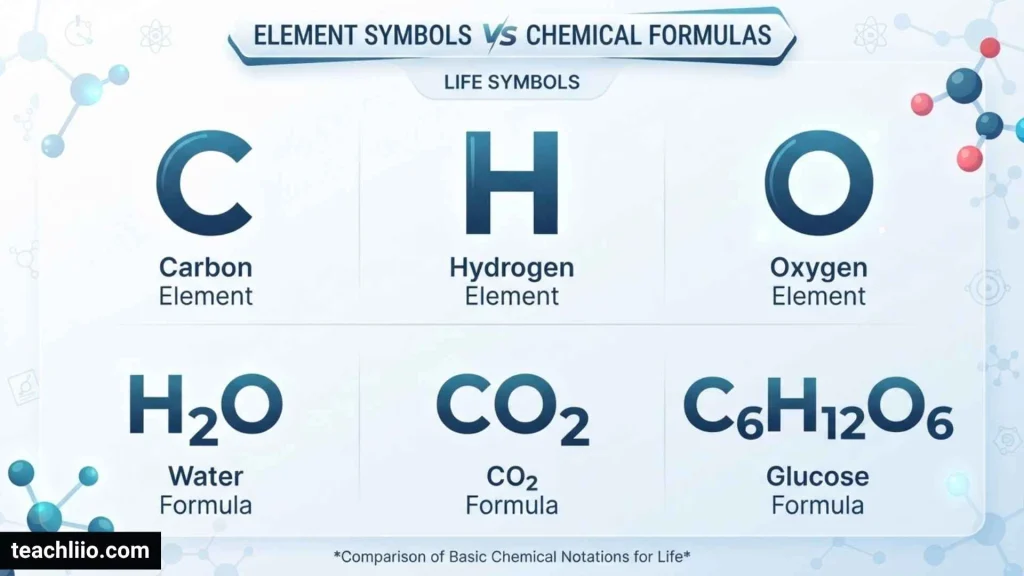
An element symbol and a chemical formula are related, but they are not the same thing.
Symbols for Individual Elements
A single symbol identifies an element.
Examples:
- H = hydrogen
- O = oxygen
- Na = sodium
- Fe = iron
Formulas for Molecules and Compounds
A chemical formula can contain several element symbols and numerical subscripts.
For example:
H₂ represents a molecule containing two hydrogen atoms.
O₂ represents a molecule containing two oxygen atoms.
H₂O represents water, containing hydrogen and oxygen.
The important point is that H and H₂ do not mean exactly the same thing. The first is the symbol for hydrogen, while the second describes a molecular form containing two hydrogen atoms.
Commonly Confused Element Symbols
Some symbols are particularly easy to mix up.
Similar-Looking Symbols
C = Carbon
Ca = Calcium
Cl = Chlorine
Co = Cobalt
Cu = Copper
These symbols all begin with C, but they represent different elements.
Other examples include:
N = Nitrogen
Na = Sodium
Ne = Neon
Ni = Nickel
Learning the second letter is therefore essential.
Capitalization Mistakes
One of the most common beginner mistakes is using two capital letters.
For example:
Co is cobalt.
The notation CO is not the correct element symbol for cobalt.
Likewise:
Na is sodium, not NA.
Cl is chlorine, not CL.
Mg is magnesium, not MG.
The first letter must be uppercase and the second letter must be lowercase.
How to Memorize Element Symbols
Memorizing element symbols becomes easier when you use patterns rather than trying to learn the entire periodic table randomly.
Start With the First 20
The first 20 elements are a practical starting point because they appear frequently in introductory chemistry.
Write the element name on one side of a card and the symbol on the other.
For example:
Oxygen → O
Then reverse it:
O → Oxygen
This trains both directions of recall.
Learn Exceptions Separately
Create a small group for symbols that do not obviously match the English name:
Na, K, Fe, Cu, Ag, Sn, Sb, Au, Hg, Pb
Practice these until they become automatic.
Practice Both Directions
Do not only memorize:
Element → Symbol
Also practice:
Symbol → Element
For example:
- Fe → Iron
- Au → Gold
- Ag → Silver
- K → Potassium
- Pb → Lead
This makes your knowledge much stronger when you encounter symbols in chemical equations or formulas.
Element Symbols by Periodic Table Groups
Element symbols become easier to understand when you recognize their positions on the periodic table.
Alkali Metals
The alkali metals occupy Group 1, excluding hydrogen from the usual metallic classification of the group.
Examples include:
- Li — Lithium
- Na — Sodium
- K — Potassium
- Rb — Rubidium
- Cs — Cesium
- Fr — Francium
Alkaline Earth Metals
Group 2 contains the alkaline earth metals:
- Be — Beryllium
- Mg — Magnesium
- Ca — Calcium
- Sr — Strontium
- Ba — Barium
- Ra — Radium
Transition Metals
Transition metals occupy much of the central region of the periodic table.
Common examples include:
- Fe — Iron
- Co — Cobalt
- Ni — Nickel
- Cu — Copper
- Zn — Zinc
- Ag — Silver
- Au — Gold
Halogens
The halogens are found in Group 17.
Examples include:
- F — Fluorine
- Cl — Chlorine
- Br — Bromine
- I — Iodine
- At — Astatine
- Ts — Tennessine
Noble Gases
The noble gases are found in Group 18.
Their symbols include:
- He — Helium
- Ne — Neon
- Ar — Argon
- Kr — Krypton
- Xe — Xenon
- Rn — Radon
- Og — Oganesson
Important Element Symbols to Know
Some elements appear particularly often in basic chemistry, biology, medicine, materials science, and everyday life.
Common Metals
Important symbols include:
- Fe — Iron
- Cu — Copper
- Al — Aluminum
- Zn — Zinc
- Ca — Calcium
- Na — Sodium
- Mg — Magnesium
- K — Potassium
- Ag — Silver
- Au — Gold
Common Nonmetals
Important nonmetal symbols include:
- H — Hydrogen
- C — Carbon
- N — Nitrogen
- O — Oxygen
- F — Fluorine
- P — Phosphorus
- S — Sulfur
- Cl — Chlorine
Common Elements in Everyday Life
Many familiar substances contain elements whose symbols are worth recognizing.
Water contains H and O.
Carbon dioxide contains C and O.
Table salt contains Na and Cl.
Iron-containing materials contain Fe.
Calcium is represented by Ca, while potassium is represented by K.
Understanding these symbols makes basic chemical formulas much easier to read.
Element Symbols Practice Questions
Testing yourself is one of the best ways to improve recall.
Name to Symbol
- What is the symbol for hydrogen?
- What is the symbol for oxygen?
- What is the symbol for calcium?
- What is the symbol for sodium?
- What is the symbol for gold?
Answers: H, O, Ca, Na, Au.
Symbol to Name
- What element is Fe?
- What element is Ag?
- What element is K?
- What element is Pb?
- What element is Cu?
Answers: Iron, silver, potassium, lead, copper.
Atomic Number Practice
- Which element has atomic number 1?
- Which element has atomic number 6?
- Which element has atomic number 8?
- Which element has atomic number 17?
- Which element has atomic number 79?
Answers: Hydrogen, carbon, oxygen, chlorine, gold.
Frequently Asked Questions
What are element symbols?
Element symbols are standardized one- or two-letter abbreviations used to identify chemical elements. Examples include H for hydrogen, O for oxygen, and Fe for iron.
How many elements are on the periodic table?
There are 118 officially recognized chemical elements, with atomic numbers ranging from 1 to 118.
What is the symbol for hydrogen?
The symbol for hydrogen is H.
What is the symbol for oxygen?
The symbol for oxygen is O.
What is the symbol for gold?
The symbol for gold is Au, which comes from the Latin word aurum.
Why is sodium Na instead of S?
Sodium is represented by Na because the symbol comes from its historical name natrium. The symbol S is already used for sulfur.
Why is potassium K?
Potassium uses K, which comes from the historical name kalium.
Why is iron Fe?
Iron uses Fe, which comes from the Latin name ferrum.
What is the difference between an element symbol and a chemical formula?
An element symbol identifies a chemical element, such as H for hydrogen. A chemical formula can show how atoms are combined, such as H₂O for water.
Do element symbols use capital letters?
The first letter of an element symbol is always uppercase. If the symbol has a second letter, that letter is lowercase. Examples include He, Na, Fe, and Cl.
What are the first 20 elements and their symbols?
The first 20 are hydrogen (H), helium (He), lithium (Li), beryllium (Be), boron (B), carbon (C), nitrogen (N), oxygen (O), fluorine (F), neon (Ne), sodium (Na), magnesium (Mg), aluminum (Al), silicon (Si), phosphorus (P), sulfur (S), chlorine (Cl), argon (Ar), potassium (K), and calcium (Ca).
How can I memorize element symbols?
Start with the first 20 elements, practice the symbols in both directions, and separately memorize unusual symbols such as Na, K, Fe, Cu, Ag, Au, Hg, and Pb.
Conclusion
Elements symbols provide a simple and universal way to identify the chemical elements. From H for hydrogen and O for oxygen to less obvious symbols such as Fe for iron and Au for gold, these abbreviations are essential for understanding chemistry.
The most effective way to learn them is to combine the complete 118-element reference with an understanding of atomic numbers, capitalization rules, periodic-table groups, and chemical formulas. Pay special attention to symbols derived from historical names because they cannot always be guessed from modern English names.
For beginners, the first 20 elements are the best place to start. Once those become familiar, gradually add the unusual symbols and practice recognizing elements from both their names and symbols.
Whether you are studying for a chemistry test, learning how to read the periodic table, or simply looking for a complete list of element symbols, understanding these basic rules makes chemical notation much easier to read and remember.

I’m Oscar Radcliffe, a British writer who enjoys uncovering the numbers hidden within ordinary questions. My work explores quantities, counts, statistics, measurements, and fascinating comparisons across different subjects. I aim to present reliable information clearly, helping readers satisfy their curiosity while discovering interesting facts they may never have considered before.
Books:
The Science of Counting
How Many? Fascinating Numbers Explained