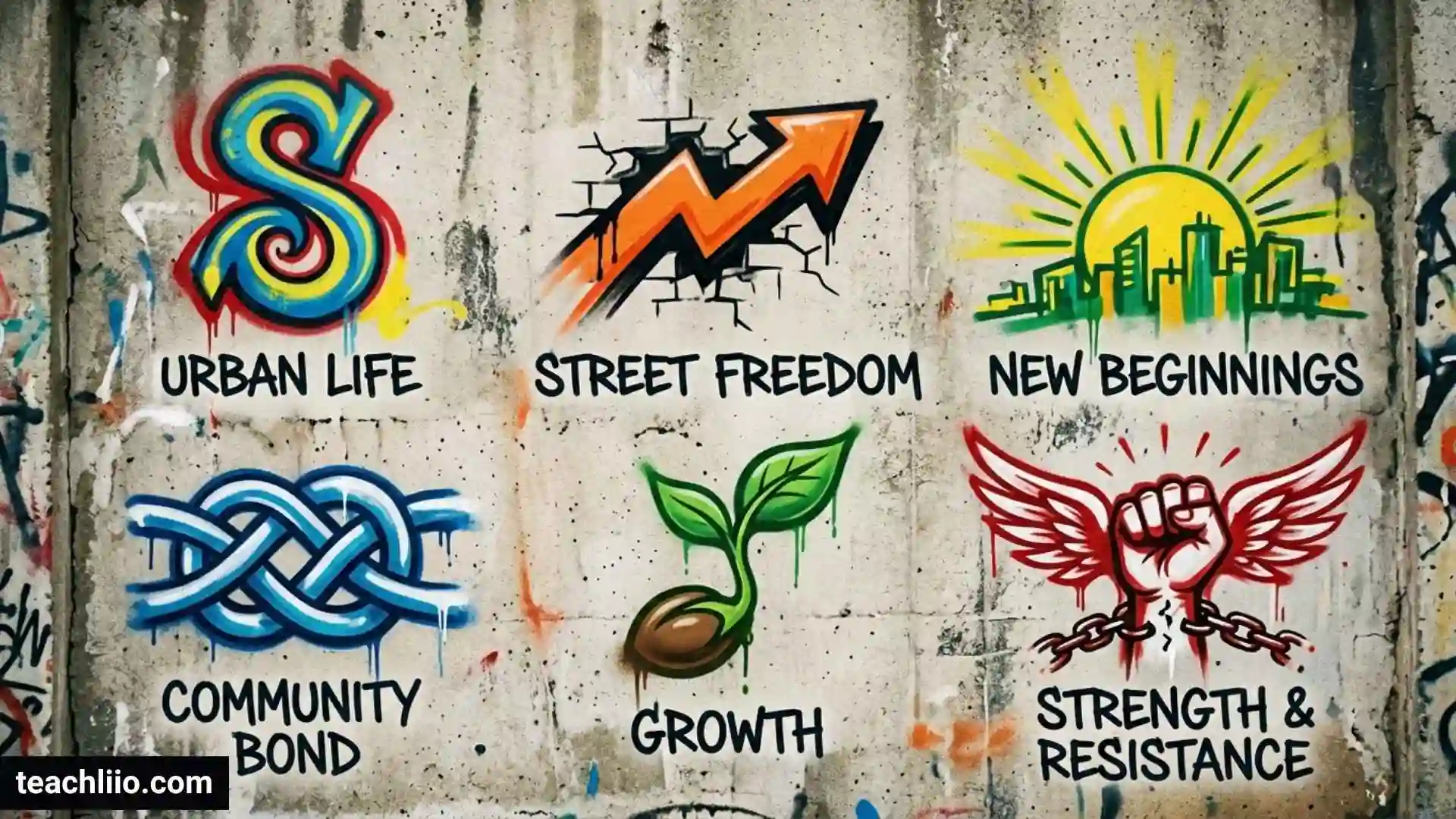
Graffiti symbols turn walls, buildings, and public spaces into visual stories. A crown above a name, an arrow extending from a letter, or an eye hidden inside an abstract design can add personality and meaning to a piece of street art. Some symbols suggest familiar ideas such as love, freedom, confidence, or remembrance, while others reflect an artist’s individual style or a particular community.
If you are searching for graffiti symbols and their meanings, you may want to understand a mark you have seen on a wall, discover ideas for your own artwork, or learn how graffiti artists communicate through shapes and lettering. This guide explores more than 25 common symbols, explains how context influences their interpretation, and distinguishes recognizable icons from specialized graffiti writing styles.
One important point: graffiti symbols do not have a universal dictionary of meanings. The same symbol may communicate different things depending on the artist, location, surrounding imagery, and cultural background.
What Are Graffiti Symbols?
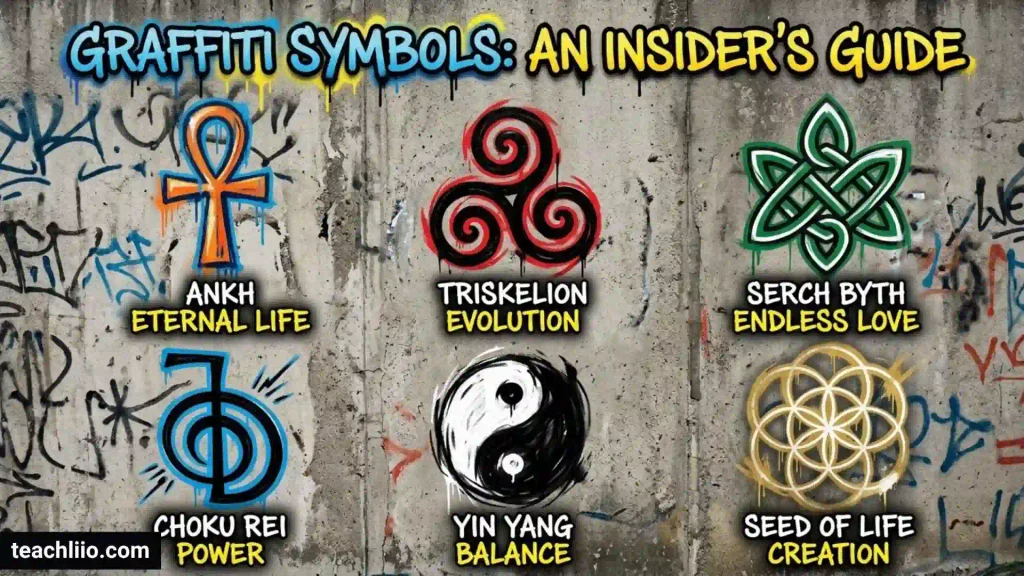
Graffiti symbols are visual marks, icons, shapes, and decorative elements used in graffiti and street art. They may appear alongside stylized names, lettering, characters, slogans, or abstract patterns.
Artists use these elements to create visual interest, express personal ideas, establish a recognizable style, or communicate messages to viewers. Some symbols have familiar associations, while others are meaningful only to the artist or people who understand their local context.
For example, a heart may suggest affection, while an arrow can create a sense of direction or movement. A crown might evoke royalty or confidence, but it can also be a simple decoration above a graffiti name.
How Are Graffiti Symbols Different From Tags?
A graffiti tag is generally a stylized signature or name used by an artist. It often features distinctive lettering, and it may include decorative marks such as stars, arrows, or underlines.
A symbol, by comparison, is a visual element that may communicate an idea or contribute to the composition. A tag can contain symbols, but the two terms are not interchangeable.
Graffiti also includes forms of writing such as throw-ups, which commonly use quickly executed, rounded lettering, and more elaborate pieces. Wildstyle is a complex lettering approach in which interlocking forms can make words difficult for unfamiliar viewers to read. These terms describe different aspects of graffiti rather than a universal system of symbols.
Quick Guide to Common Graffiti Symbols and Their Meanings
The table below provides a quick reference to recognizable symbols and their possible interpretations.
| Graffiti symbol | Common association | Important context |
| Crown | Royalty, confidence, authority | May be decorative or personal |
| Star | Recognition, creativity, achievement | Often used as an accent |
| Arrow | Movement, direction, energy | Frequently integrated into lettering |
| Heart | Love, affection, remembrance | Meaning depends on accompanying imagery |
| Halo | Spirituality, tribute, innocence | May appear in memorial artwork |
| Eye | Observation, awareness, perception | Can have personal or cultural meanings |
| Lightning bolt | Energy, speed, intensity | Often creates a dynamic visual effect |
| Skull | Mortality, danger, rebellion | Tone varies with the design |
| Butterfly | Transformation, renewal, freedom | Common in expressive murals |
| Flower | Growth, beauty, peace | May be decorative or symbolic |
| Peace sign | Peace, unity, nonviolence | Often associated with social messages |
| Circle | Wholeness, continuity, connection | Frequently used in abstract designs |
| Triangle | Structure, balance, direction | May simply be a geometric element |
| Spiral | Movement, cycles, visual rhythm | Interpretation varies widely |
| Infinity | Continuity, lasting connection | Often used in personal designs |
These associations are starting points for interpretation, not fixed definitions. Always consider the entire artwork before deciding what a symbol means.
25+ Common Graffiti Symbols and Their Meanings
1. Crown Symbol
A crown is one of the most recognizable decorative elements associated with graffiti lettering. It may suggest royalty, confidence, authority, achievement, or artistic ambition.
Artists sometimes place crowns above their names to create a bold visual identity. In some settings, crowns can have particular meanings within a graffiti community, but the symbol alone does not prove that an artist holds a specific status.
2. Star Symbol
Stars add emphasis, balance, and energy to graffiti designs. A five-pointed star can appear beside a tag, inside a letter, or around a larger illustration.
Stars may suggest recognition, creativity, ambition, or excellence. However, they are also common decorative elements and do not always communicate a deeper message.
3. Arrow Symbol
Arrows are especially useful in graffiti lettering because they create a sense of motion. They can extend from letters, connect separate shapes, or direct the viewer’s attention toward another part of a design.
An arrow may suggest progress or direction, but its most important function may simply be to make the composition feel dynamic.
4. Heart Symbol
Hearts commonly represent love, affection, friendship, and emotional connection. In street art, they may accompany names, messages, portraits, or images celebrating a community.
A heart can also communicate grief or remembrance when it appears in a memorial mural. The words and images around it help clarify the likely message.
5. Halo Symbol
A halo is a circular outline or glow placed above a head, character, or sometimes a name. It can evoke innocence, spirituality, peace, or tribute.
Some artists use halos to honor someone who has died. Others include them in fantasy-inspired or decorative compositions without intending a religious meaning.
6. Eye Symbol
Eyes can suggest awareness, observation, perception, or the idea of being watched. Artists may use them in designs exploring identity, privacy, surveillance, or the relationship between people and their surroundings.
An eye surrounded by geometric patterns may create a mysterious or surreal effect. Its precise meaning cannot be determined from the shape alone.
7. Lightning Bolt
Lightning bolts communicate visual energy through sharp angles and dramatic lines. They may suggest speed, strength, excitement, or sudden change.
Graffiti artists often use bolts around lettering or characters to make a design appear more intense. The symbol may also reference mythology, music, or popular culture.
8. Skull Symbol
Skulls can represent mortality, danger, rebellion, or transformation. Their meaning depends strongly on their artistic treatment and surroundings.
A colorful cartoon skull may feel playful, while a dark skull in a memorial or protest mural may communicate a more serious message. Avoid assuming that every skull represents violence or danger.
9. Butterfly Symbol
Butterflies are widely associated with transformation, freedom, beauty, and renewal. Their changing life cycle makes them a familiar image for personal growth.
In graffiti and street art, butterflies can introduce movement and contrast with rough urban textures. Artists may use them to communicate hope or celebrate individuality.
10. Flower Symbol
Flowers can suggest growth, peace, beauty, love, or new beginnings. Roses may evoke romance, while other flowers can communicate nature, resilience, or remembrance.
Flowers are also used to soften bold lettering and introduce organic shapes into geometric compositions. Their meaning depends on the specific flower and the surrounding artwork.
11. Peace Sign
The peace sign is a widely recognized symbol of nonviolence and social harmony. In street art, it may communicate opposition to conflict, support for unity, or a broader message of cooperation.
When combined with protest slogans or political imagery, it can become part of a more specific social statement.
12. Cross Symbol
A cross can have religious, spiritual, historical, or personal significance. In Christian imagery, it is an important religious symbol, while in other settings its interpretation may differ.
A cross in a memorial mural might express faith or remembrance. In an abstract design, it may function mainly as a geometric element. Its meaning should be interpreted in context.
13. Circle Symbol
Circles are common in graffiti because they can frame images, connect shapes, or provide a visual foundation for a design.
Depending on the composition, a circle may suggest unity, wholeness, continuity, or connection. It can also be a purely decorative outline used to balance other elements.
14. Triangle Symbol
Triangles bring structure and direction to graffiti designs. Their sharp edges can contrast with rounded lettering and curved shapes.
Some viewers may associate triangles with balance, stability, or aspiration. However, these are possible interpretations rather than universal graffiti meanings.
15. Spiral Symbol
Spirals create a sense of movement by guiding the eye inward or outward. They are useful in abstract graffiti, where rhythm and flow can matter more than literal representation.
A spiral may suggest cycles, development, or continuing motion. In other designs, it simply provides an engaging pattern.
16. Infinity Symbol
The infinity symbol resembles a sideways figure eight and is commonly associated with continuity, endless possibilities, or lasting connection.
Artists may incorporate it into graffiti alongside names, short messages, or other personal imagery. It can represent an enduring relationship, although the artist may have a different intention.
17. Diamond Symbol
Diamond shapes provide sharp outlines and geometric structure. They can frame lettering, create repeating patterns, or give a composition a jewel-like appearance.
A diamond may suggest value, individuality, strength, or ambition. Its use as decoration is equally common.
18. Music Note Symbol
Music notes can communicate rhythm, creativity, and musical identity. They often appear in murals celebrating musicians, music venues, or local cultural scenes.
When paired with lettering or portraits, music notes can help establish the theme of an artwork without requiring a long written explanation.
19. Flame Symbol
Flames introduce intensity, motion, and visual drama. They may suggest passion, energy, rebellion, destruction, or renewal.
Artists can use flames around letters or characters to emphasize movement. Their meaning depends on whether the broader design feels celebratory, confrontational, playful, or reflective.
20. Sun Symbol
The sun is often associated with life, warmth, hope, positivity, and renewal. In street art, it can create an optimistic atmosphere or provide a bright focal point.
A rising sun may suggest a new beginning, while a stylized sun with geometric rays may serve primarily as a decorative element.
21. Moon Symbol
Moons, particularly crescent moons, can introduce mystery, reflection, nighttime imagery, or a sense of change.
Artists sometimes combine moons with stars, clouds, or abstract shapes to create a dreamlike atmosphere. The symbol may also draw on personal, cultural, or spiritual associations.
22. Mask Symbol
Masks can represent identity, anonymity, performance, or concealed emotions. They may also reference theater, mythology, fantasy, or popular culture.
In graffiti, a mask can give a character a distinctive appearance or encourage viewers to question the difference between public identity and private feelings.
23. Bird Symbol
Birds are frequently associated with freedom, independence, movement, and hope. A flying bird can create a sense of escape or possibility, while a perched bird may introduce a quieter mood.
The species and setting may add further meaning. A bird in a community mural, for example, may communicate a different message from one used in an abstract composition.
24. Key Symbol
Keys can suggest discovery, access, opportunity, or hidden knowledge. They are useful in artworks exploring mystery, change, or the possibility of unlocking something new.
An old-fashioned key may create a historical atmosphere, while a simplified key can function as a recognizable graphic accent.
25. Puzzle Piece Symbol
Puzzle pieces can represent connection, belonging, complexity, or the relationship between individuals and a larger community.
In a mural celebrating cooperation, several connected pieces might suggest that different people contribute to a shared whole. In other contexts, the symbol may communicate a personal idea or simply provide an interesting shape.
26. Exclamation Mark
An exclamation mark is usually a punctuation or lettering element rather than a standalone graffiti symbol with a fixed meaning.
Artists may add one to emphasize a name, create visual rhythm, or give a design a more energetic appearance. Its function is often stylistic.
27. Underline Symbol
Underlines help emphasize graffiti lettering and can make a tag appear more grounded or prominent. Artists may extend them into curves, arrows, or decorative flourishes.
An underline is generally best understood as a lettering technique. It does not necessarily carry a separate symbolic meaning.
Graffiti Symbols vs. Tags, Throw-Ups, and Wildstyle
Understanding graffiti terminology helps readers avoid confusing an individual symbol with an entire style of graffiti writing.
Tags
Tags are stylized signatures or names. Their lettering may be simple or elaborate, and they can include personal flourishes such as arrows or stars.
A tag is not always intended to communicate a literal message to the general public. Its primary role may be to identify the artist within a particular graffiti context.
Throw-Ups
Throw-ups are generally quicker forms of graffiti writing, often featuring rounded or bubble-like letters and limited color combinations. They are different from individual icons such as hearts or crowns.
The term describes a lettering approach rather than a universal symbol category.
Pieces and Wildstyle
A graffiti piece is a more developed work of graffiti writing or art. It may combine lettering, characters, symbols, shading, and elaborate backgrounds.
Wildstyle is a complex lettering style that can feature interlocking forms, arrows, extensions, and intricate shapes. It may be difficult for viewers unfamiliar with the style to read.
Museum documentation, including MoMA’s Graffiti Taxonomy: New York by Evan Roth, demonstrates how graffiti lettering varies across artists, regions, and individual letterforms.
How to Interpret an Unfamiliar Graffiti Symbol
A mark on a wall may look mysterious, but there is no reliable universal code for decoding every graffiti symbol. A careful approach is more useful than guessing.
Look at the Complete Artwork
Examine the lettering, colors, characters, and words around the symbol. A heart in a memorial mural may suggest remembrance, while the same shape in a colorful decorative piece may simply communicate affection.
Consider the Location and Cultural Context
Graffiti can reflect local history, community identity, artistic traditions, or political concerns. A symbol may have a particular meaning in one setting and a different meaning elsewhere.
When a symbol appears connected to a specific cultural movement, use reliable sources to investigate its documented meaning.
Notice Repeated Marks and Lettering
If the same mark appears alongside a particular artist’s signature in several artworks, it may be part of that artist’s visual identity.
Repeated appearances can provide useful clues, but they do not prove a particular meaning. Avoid assigning a definitive interpretation without supporting evidence.
Distinguish Known Meanings From Speculation
Some symbols have widely recognized associations, while others are personal or decorative. Numbers, initials, and stylized letter combinations can be especially difficult to interpret without local knowledge.
A crown, star, color, or number alone does not establish gang membership or another group affiliation. Reliable identification requires appropriate context.
Cultural, Political, and Personal Meanings in Street Art
Graffiti and street art can communicate far more than decoration. Artists may use public spaces to express identity, commemorate people, question authority, celebrate local culture, or draw attention to social issues.
Personal Expression and Identity
An artist may develop recurring symbols that become part of a recognizable style. These could include a particular character, shape, signature flourish, or combination of colors.
The significance may be clear to the artist but remain open to interpretation for other viewers.
Political and Protest Art
Political graffiti can communicate resistance, solidarity, criticism, or support for a cause. It may combine recognizable emblems with slogans, portraits, or locally meaningful imagery.
The meaning of a political symbol can change across countries and historical periods. Readers should examine the artwork’s date, location, and surrounding message before interpreting it.
Memorials and Community Murals
Murals created to honor individuals or celebrate neighborhoods may incorporate hearts, flowers, birds, halos, portraits, and meaningful words.
These elements can help communicate grief, pride, belonging, or hope. The full composition often provides more information than any individual symbol.
Graffiti Symbol Ideas for Drawing and Design
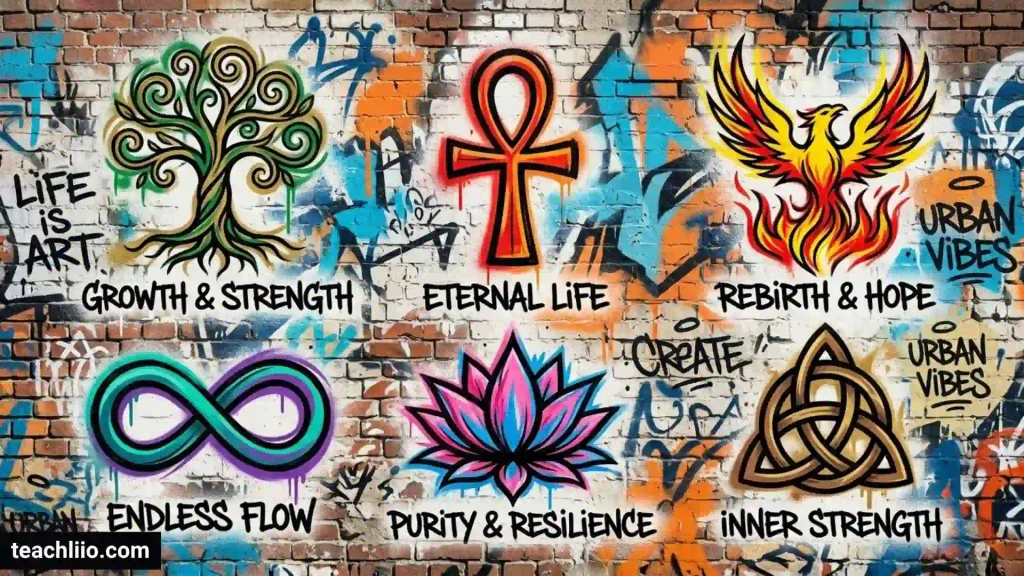
You do not need to be an experienced graffiti artist to experiment with graffiti-inspired symbols. Sketchbooks, digital illustrations, posters, canvas paintings, and authorized mural spaces are useful places to practice.
Start With Simple Shapes
Try drawing stars, arrows, circles, diamonds, and spirals. Experiment with different line thicknesses and proportions to discover how small changes affect the appearance of each symbol.
Begin with simple outlines before adding shading, highlights, or color.
Combine Symbols With Lettering
A crown above a name, a star beside a word, or an arrow extending from a letter can create a cohesive composition.
Choose elements that support the design instead of adding unrelated symbols simply to fill empty space. A consistent visual theme usually feels more intentional.
Experiment With Contrast and Color
Contrast can make a symbol easier to recognize. Try combining thick outlines with thinner interior details, or use light and dark colors to separate foreground elements from the background.
You can also explore monochrome designs, geometric patterns, or bright color combinations.
Develop an Original Style
Study different graffiti techniques to understand how artists use rhythm, spacing, shapes, and lettering. Then create your own variations instead of copying another artist’s signature.
Research culturally specific symbols before using them, especially when they carry religious, historical, or community significance. If you plan to paint in a public space, obtain permission and follow local rules.
Frequently Asked Questions
What are the most common graffiti symbols and their meanings?
Common graffiti symbols include crowns, stars, arrows, hearts, halos, eyes, skulls, flowers, and geometric shapes. They may suggest ideas such as confidence, movement, affection, remembrance, or creativity, but their meanings depend on context.
What does a crown mean in graffiti?
A crown may suggest royalty, confidence, authority, or artistic ambition. In some graffiti communities, it can have more specific associations, but it does not automatically indicate a particular rank or status.
What do arrows mean in graffiti?
Arrows often create movement and direction. They can extend from letters, connect different elements, or draw attention to a particular part of the composition.
Do graffiti symbols have secret meanings?
Some marks have specialized meanings within particular communities, but many are decorative or personal. There is no universal code that explains every graffiti symbol.
What do numbers and letters mean in graffiti?
Numbers and letters may form part of a tag, represent an artist’s chosen name, or have a context-specific meaning. Their significance cannot reliably be established without examining the complete artwork and relevant local context.
Are graffiti symbols always connected to gangs?
No. Graffiti symbols appear in personal artwork, murals, political messages, decorative designs, and graffiti writing. A single symbol or color is not sufficient evidence of gang affiliation.
What is the difference between graffiti symbols and graffiti tags?
A graffiti symbol is a visual element such as a crown, heart, or arrow. A tag is generally a stylized signature or name. An artist may combine several symbols with a tag.
Which graffiti symbols are easiest for beginners to draw?
Stars, hearts, arrows, circles, diamonds, and simple spirals are good starting points because they use recognizable shapes. Beginners can practice outlines first and gradually add lettering, color, and shading.
How can I identify an unfamiliar graffiti symbol?
Look at the surrounding lettering, imagery, location, and any repeated marks associated with the same artist. Consult reliable sources when a symbol may have a specific cultural or historical meaning, and avoid treating guesses as established facts.
Why do graffiti artists use symbols?
Artists use symbols to add visual interest, develop a recognizable style, express ideas, and communicate with viewers. Some marks carry personal or community significance, while others primarily serve an artistic purpose.
Conclusion
Graffiti symbols combine visual creativity, personal expression, and cultural communication. Crowns can evoke confidence, arrows can create movement, hearts can suggest affection, and geometric shapes can add structure to a composition. Yet no single interpretation applies to every piece of graffiti.
To understand an unfamiliar mark, examine the entire artwork, consider its location, and distinguish documented meanings from personal interpretations. If you are creating your own graffiti-inspired designs, use simple shapes as a starting point and develop a style that reflects your own ideas.
Ultimately, the most meaningful way to explore graffiti symbols is to appreciate both their visual design and the context in which artists use them.

I’m Oscar Radcliffe, a British writer who enjoys uncovering the numbers hidden within ordinary questions. My work explores quantities, counts, statistics, measurements, and fascinating comparisons across different subjects. I aim to present reliable information clearly, helping readers satisfy their curiosity while discovering interesting facts they may never have considered before.
Books:
The Science of Counting
How Many? Fascinating Numbers Explained