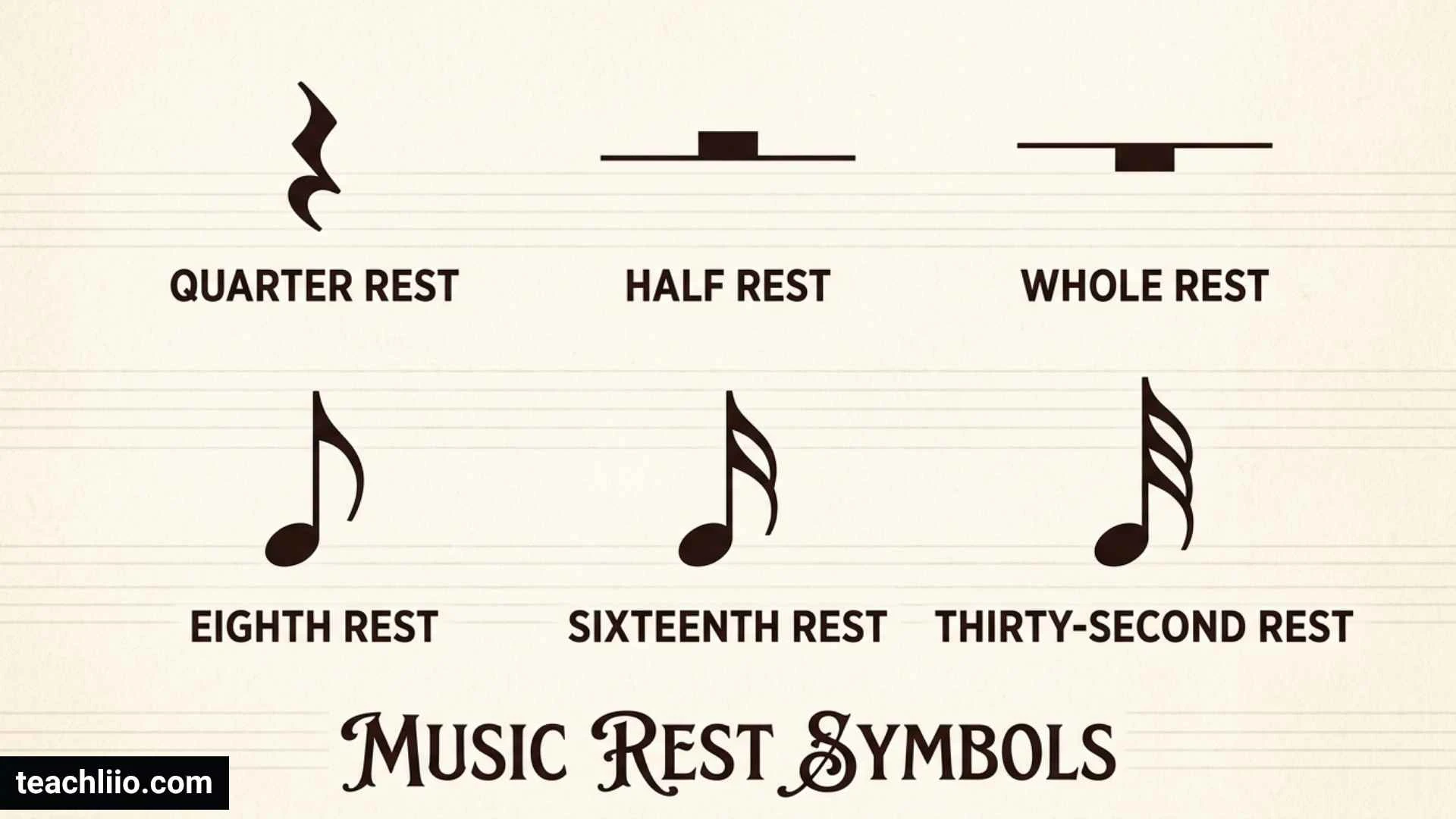
Music rest symbols are signs in written music that tell musicians when to remain silent and how long that silence should last. The main music rest symbols include the whole rest, half rest, quarter rest, eighth rest, sixteenth rest, thirty-second rest, and sixty-fourth rest. Each symbol represents a specific rhythmic value, helping musicians understand when to play, sing, or wait.
Learning music rest symbols is an essential step in reading sheet music. Whether you are a beginner learning piano, a guitar player practicing rhythms, a singer following musical notation, or a student studying music theory, understanding rests will help you perform with better timing and accuracy.
In this guide, you will learn the names and meanings of common music rest symbols, how to recognize them, how many beats they represent, how to count them in different time signatures, and how to avoid common mistakes. You will also find practical examples, exercises, and answers to frequently asked questions.
What Are Music Rest Symbols?
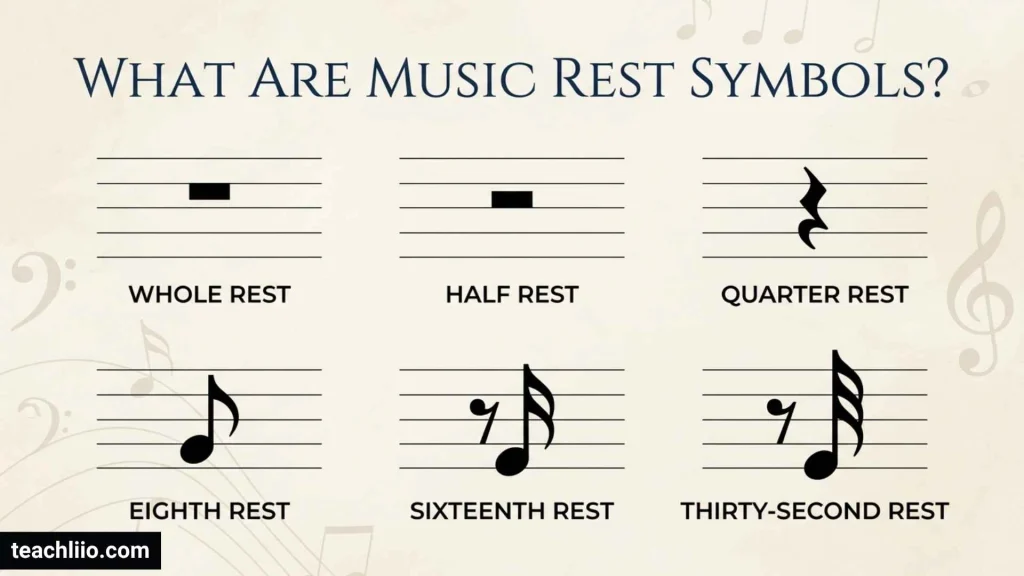
Music rest symbols are notation signs that indicate silence for a specific rhythmic duration. While musical notes tell performers when to produce sound, rests tell them when not to play or sing.
A rest does not necessarily mean that the entire performance becomes silent. In an orchestra, for example, a flute player may rest while the violins continue playing. In a song, a singer may pause briefly while the piano or guitar provides accompaniment.
Rests are an essential part of musical rhythm because they organize silence in the same way that notes organize sound.
Why Are Rests Important in Music?
Music rest symbols serve several important purposes:
- Maintain rhythm: They tell musicians exactly when a sound should stop and when the next note should begin.
- Create musical expression: Silence can build suspense, emphasize a lyric, or make a melody feel more emotional.
- Separate musical phrases: Rests provide breathing space between vocal lines and instrumental passages.
- Coordinate musicians: Performers use rests to follow the same rhythm and enter at the correct time.
- Add variety: Alternating notes and rests creates rhythmic patterns that feel more interesting than continuous sound.
Imagine a song in which every instrument plays continuously without a pause. The music could sound crowded and tiring. Carefully placed rests give listeners time to absorb a melody and help performers shape the music naturally.
What Is the Difference Between a Musical Note and a Rest?
A musical note represents a sound with a particular pitch and rhythmic value. A rest represents a period of silence with a specific rhythmic value.
For example, a quarter note and a quarter rest have the same basic duration in a given rhythmic context. The difference is that the quarter note produces sound, while the quarter rest indicates silence.
Both are counted as part of the rhythm. When you encounter a rest, you must continue counting instead of stopping the beat.
Music Rest Symbols Chart: Names and Beat Values
The quickest way to learn music rest symbols is to compare their shapes, names, and durations. The following chart uses a 4/4 time signature, where a quarter note receives one beat.
| Rest symbol | Name | Duration in 4/4 | Visual clue |
| Rectangle hanging below a staff line | Whole rest | 4 beats when filling a 4/4 measure | Hangs below the line |
| Rectangle sitting on a staff line | Half rest | 2 beats | Sits on the line |
| Zigzag-shaped symbol | Quarter rest | 1 beat | Looks like a zigzag |
| Slanted stroke with one flag | Eighth rest | 1/2 beat | One flag |
| Slanted stroke with two flags | Sixteenth rest | 1/4 beat | Two flags |
| Slanted stroke with three flags | Thirty-second rest | 1/8 beat | Three flags |
| Slanted stroke with four flags | Sixty-fourth rest | 1/16 beat | Four flags |
The descriptions above help you identify the symbols, but a proper music notation chart should display each actual symbol on a five-line staff. This is particularly useful for distinguishing whole rests from half rests.
Important: The durations in this table assume 4/4 time. A whole rest also commonly indicates silence for an entire measure, even when the measure contains a different number of beats.
How Do Rest Durations Relate to Each Other?
The durations of common rests follow a simple pattern: each successive smaller value lasts half as long as the previous one.
- A half rest lasts half as long as a whole-note value.
- A quarter rest lasts half as long as a half rest.
- An eighth rest lasts half as long as a quarter rest.
- A sixteenth rest lasts half as long as an eighth rest.
- A thirty-second rest lasts half as long as a sixteenth rest.
- A sixty-fourth rest lasts half as long as a thirty-second rest.
This relationship helps musicians understand unfamiliar rhythms. Once you know the duration of a quarter rest, for example, you can calculate the duration of an eighth or sixteenth rest without memorizing every value independently.
Types of Music Rest Symbols Explained
Each music rest symbol has a distinctive shape and rhythmic value. Learning these symbols individually will help you recognize them quickly when reading sheet music.
Whole Rest Symbol
The whole rest is a small, solid rectangle that hangs below the fourth line of a standard five-line musical staff. It is one of the most important symbols to recognize because it can indicate a long period of silence.
In terms of note value, a whole rest corresponds to a whole note. In 4/4 time, this equals four quarter-note beats. However, when used to indicate a completely silent measure, it generally fills the entire measure, regardless of the time signature.
OPEN MUSIC THEORY
+1
Example: In a 4/4 measure, count “one, two, three, four” while remaining silent for all four beats.
Half Rest Symbol
The half rest looks similar to the whole rest, but its rectangle sits on top of the middle line of the staff rather than hanging below a line.
A half rest has the duration of a half note, equivalent to two quarter-note beats in 4/4 time.
Example: Play a note on beat one, then remain silent for beats two and three before playing again on beat four. The two silent beats can be represented by a half rest.
Memory tip: Think of the half rest as a hat sitting on a shelf and the whole rest as a heavier object hanging underneath it.
Quarter Rest Symbol
The quarter rest is a distinctive zigzag-shaped symbol. Unlike whole and half rests, it does not look like a rectangle.
A quarter rest corresponds to a quarter note and lasts one quarter-note beat in 4/4 time.
Example: Count “one, two, three, four.” Clap on beats one, three, and four, but stay silent on beat two.
Quarter rests are especially useful for creating short breaks between notes and establishing clear rhythmic patterns.
Eighth Rest Symbol
An eighth rest has a slanted stroke with one flag or hook. It represents an eighth-note duration, which is half a quarter-note beat in 4/4 time.
Example: Count “one-and, two-and.” If an eighth rest occurs on the “and” after beat one, remain silent for that subdivision and enter again at the next written note.
Eighth rests appear frequently in pop, rock, jazz, and dance rhythms. They can create syncopation by placing notes between the main beats.
Sixteenth Rest Symbol
A sixteenth rest has two flags or hooks and represents a sixteenth-note duration. In 4/4 time, it lasts one-quarter of a quarter-note beat.
To understand it, divide one beat into four equal subdivisions. A sixteenth rest occupies one of those subdivisions.
Example: Count “one-e-and-a.” If the second subdivision contains a sixteenth rest, remain silent for that brief portion and continue counting the remaining subdivisions.
Sixteenth rests are useful in fast passages and detailed rhythms played on piano, guitar, drums, and other instruments.
Thirty-Second Rest Symbol
A thirty-second rest has three flags or hooks. Its duration is half that of a sixteenth rest, or one-eighth of a quarter-note beat.
This symbol appears more often in advanced notation than in simple beginner songs.
Example: A fast instrumental passage might contain a thirty-second rest between two notes, creating a very brief separation.
When practicing this rest, slow the passage down and count the subdivisions carefully before attempting it at the original tempo.
Sixty-Fourth Rest Symbol
A sixty-fourth rest has four flags or hooks and represents an extremely short silence. It lasts one-sixteenth of a quarter-note beat.
This rest is relatively uncommon in basic music notation, but it can appear in technically demanding compositions where very fine rhythmic subdivisions are necessary.
Example: A complex solo passage might use a sixty-fourth rest to separate extremely rapid notes.
For beginners, it is more important to understand the relationship between the rest values than to master advanced rhythms immediately.
How to Recognize Music Rest Symbols Quickly
The easiest way to identify rest symbols is to focus on their shape, position, and number of flags.
Whole Rest vs. Half Rest
These two symbols are frequently confused because both look like small rectangles.
| Feature | Whole rest | Half rest |
| Position | Hangs below the fourth staff line | Sits on top of the middle staff line |
| Note-value equivalent | Whole note | Half note |
| Duration in 4/4 | Four beats as a note value | Two beats |
| Memory trick | Hangs down | Sits on top |
Always check the rectangle’s position on the staff instead of relying on its size.
OPEN MUSIC THEORY
+1
How to Identify Short Rests by Their Flags
Shorter rests become easier to recognize once you understand their flags.
- One flag means an eighth rest.
- Two flags mean a sixteenth rest.
- Three flags mean a thirty-second rest.
- Four flags mean a sixty-fourth rest.
Each additional flag halves the duration of the preceding value. This pattern is the same general principle used in the hierarchy of short note values.
OPEN MUSIC THEORY
+1
How to Recognize a Quarter Rest
The quarter rest is usually the easiest symbol to distinguish from the others because it has a zigzag shape rather than a rectangular body or a group of flags.
Its exact appearance can vary slightly with the notation font, handwriting, or engraving style. Focus on its recognizable form and its position within the rhythm.
How to Count Music Rest Symbols in Different Time Signatures
A time signature tells you how beats are organized within a measure. The bottom number identifies the note value used as the notational unit, while the top number indicates how many of those units are grouped into a measure.
Rest durations must be interpreted in the context of the meter and the beat being counted.
Counting Rests in 4/4 Time
In 4/4 time, there are four quarter-note beats in a measure.
| Beat | 1 | 2 | 3 | 4 |
| Action | Clap | Stay silent | Clap | Clap |
This pattern demonstrates a quarter rest on beat two. Continue counting the beat even while remaining silent.
For an eighth rest, divide each beat into two equal parts: “one-and, two-and, three-and, four-and.” For a sixteenth rest, divide each quarter-note beat into four equal parts.
Counting Rests in 3/4 Time
In 3/4 time, a measure contains three quarter-note beats.
A half rest represents two quarter-note beats, so it can occupy beats one and two, with a quarter note or another rhythmic value on beat three.
A whole rest used for a completely silent measure occupies all three beats, rather than four.
Counting Rests in 6/8 Time
In 6/8 time, a measure contains six eighth-note units. The music is commonly felt as two main beats, each divided into three eighth notes.
You can count the subdivisions as:
“One-and-a, two-and-a.”
An eighth rest occupies one eighth-note subdivision. When counting the main beats as dotted quarter notes, it is one-third of a main beat.
This illustrates why it is important to distinguish the written duration of a rest from the way musicians feel and count the main pulse.
How to Practice Counting Rests
Use these steps to build confidence:
- Identify the time signature.
- Find the rest symbol.
- Determine its rhythmic value.
- Count the beat and any necessary subdivisions.
- Stay silent for the correct duration.
- Enter again at the exact position indicated by the next note.
Practice slowly at first. Once you can maintain the pulse accurately, increase the tempo gradually.
What Is a Dotted Rest in Music?
A dotted rest is a rest with a dot placed after its symbol. The dot adds half of the original rest’s duration, making the silence longer.
Open Music Theory
+1
Dotted Rest Examples
In 4/4 time, where a quarter note receives one beat:
| Rest | Original duration | Dotted duration |
| Half rest | 2 beats | 3 beats |
| Quarter rest | 1 beat | 1.5 beats |
| Eighth rest | 0.5 beat | 0.75 beat |
For example, a dotted quarter rest lasts one and a half beats. It can be understood as the duration of a quarter rest plus an eighth rest.
The key rule is simple: add half of the original value. You can apply this rule to any dotted rest, even when you encounter a value you have not studied before.
What Is a Multi-Measure Rest?
A multi-measure rest indicates that a musician must remain silent across several consecutive measures. Instead of writing individual rests in every measure, the score uses a condensed notation to show the length of the silent passage.
Multi-measure rests are common in orchestral, band, and ensemble music. For example, a trumpet player might have to wait through eight measures before entering.
This symbol is different from a single whole rest. A whole rest commonly represents a silent measure, while a multi-measure rest indicates a longer passage containing multiple measures.
What Is the Difference Between a Rest and a Fermata?
A rest indicates a defined duration of silence within the rhythmic structure. A fermata is a separate notation mark that tells the performer to sustain a note or rest longer than its ordinary value, according to the musical context and performance convention.
For example, a quarter rest normally lasts one quarter-note beat in 4/4 time. If a fermata is placed over a rest, the performer holds the silence longer than its usual duration.
These symbols serve different purposes: rests establish rhythmic silence, while fermatas modify the normal duration of the marked note or rest.
Common Mistakes to Avoid When Learning Music Rest Symbols
Confusing Whole Rests With Half Rests
Remember that the whole rest hangs below the staff line, while the half rest sits on top. Check their positions carefully when reading sheet music.
Stopping the Count During a Rest
A rest does not stop the musical pulse. Continue counting silently so you can enter at the correct time.
Miscounting Short Rests
Eighth and sixteenth rests require attention to subdivisions. Practice slowly and increase the tempo only when your timing is reliable.
Assuming Every Whole Rest Lasts Four Beats
A whole rest can represent an entire silent measure, even in a time signature such as 3/4. Always consider the time signature and the context.
Forgetting the Importance of Silence
Rests are part of the rhythm, not empty spaces to ignore. They help create phrasing, contrast, and musical expression.
Practice Exercises for Music Rest Symbols
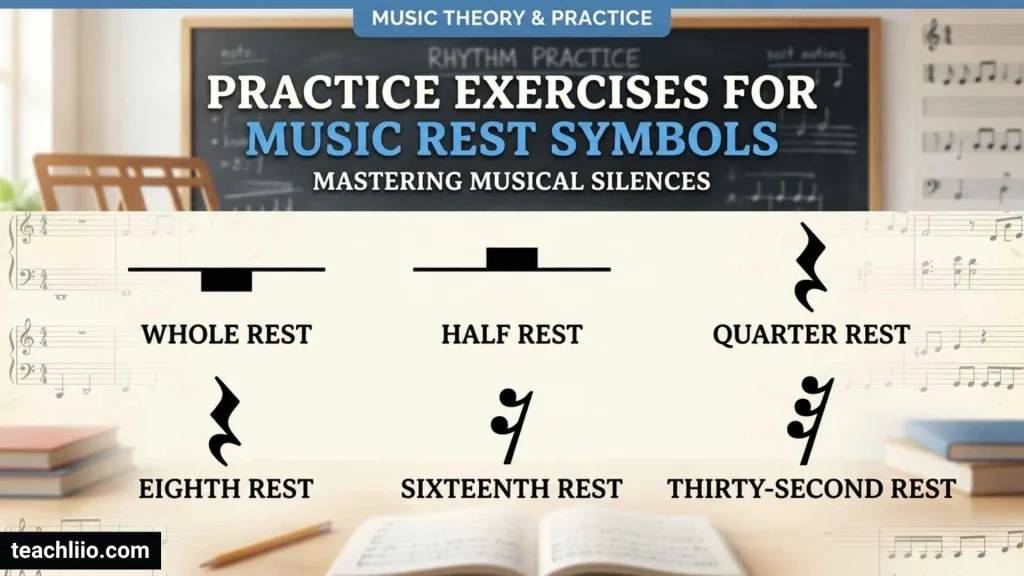
Use these exercises to test your understanding of the symbols and their rhythmic values.
Exercise 1: Identify the Symbol
Identify each rest from its description.
- A rectangle hanging below the fourth staff line.
- A rectangle sitting on the middle staff line.
- A zigzag-shaped rest lasting one beat in 4/4 time.
- A slanted symbol with one flag.
- A slanted symbol with two flags.
Answers: 1. Whole rest. 2. Half rest. 3. Quarter rest. 4. Eighth rest. 5. Sixteenth rest.
Exercise 2: Complete the Rhythm
Imagine a measure in 4/4 time with the following actions:
| Beat | 1 | 2 | 3 | 4 |
| Action | Clap | Rest | Clap | Rest |
Which rest value fills each silent beat?
Answer: Each silent beat contains a quarter rest, assuming each silence occupies exactly one quarter-note beat.
Exercise 3: Calculate the Duration
How long does each dotted rest last in 4/4 time?
- Dotted half rest: three beats.
- Dotted quarter rest: one and a half beats.
- Dotted eighth rest: three-quarters of a beat.
Exercise 4: Create Your Own Rhythm
Create a four-beat pattern that uses quarter notes and quarter rests. Clap the notes and remain silent during the rests.
Then replace one quarter rest with two eighth rests. Count the subdivisions and observe how the rhythm changes.
Repeat the exercise until you can keep a steady pulse without losing track of the silent beats.
Frequently Asked Questions
What are the main music rest symbols?
The main music rest symbols are whole, half, quarter, eighth, sixteenth, thirty-second, and sixty-fourth rests. Each represents a different rhythmic duration of silence.
How many beats does a quarter rest have?
A quarter rest lasts one quarter-note beat in 4/4 time. Its duration in seconds depends on the tempo.
Does a whole rest always mean four beats?
No. A whole rest corresponds to a whole-note value, but it is also commonly used to indicate a completely silent measure. In 3/4 time, for example, it can fill a three-beat measure.
What does an eighth rest look like?
An eighth rest resembles a slanted stroke with one flag or hook. It lasts half a quarter-note beat in 4/4 time.
What is the difference between a whole rest and a half rest?
A whole rest hangs below the fourth line of a standard staff, while a half rest sits on top of the middle line. Their note-value durations are four and two quarter-note beats, respectively, in 4/4 time.
Can a rest have a dot?
Yes. A dot adds half of the rest’s original duration. For example, a dotted quarter rest lasts one and a half quarter-note beats.
What is a multi-measure rest?
A multi-measure rest indicates silence across several consecutive measures. It is often used in ensemble scores to simplify long passages where an instrument does not play.
What are the British names for music rest symbols?
The common British terms are semibreve rest, minim rest, crotchet rest, quaver rest, semiquaver rest, demisemiquaver rest, and hemidemisemiquaver rest. These correspond to whole, half, quarter, eighth, sixteenth, thirty-second, and sixty-fourth rests.
Why are rests important when learning an instrument?
Rests help musicians maintain timing, coordinate with other performers, and play rhythms accurately. They also create space between musical phrases and contribute to a composition’s expressive character.
How can beginners memorize music rest symbols?
Start by learning the five most common values: whole, half, quarter, eighth, and sixteenth rests. Use a visual chart, compare the shapes, count their durations aloud, and practice simple rhythms. Learn the shorter advanced rests once you are comfortable with the basics.
Conclusion
Music rest symbols are an essential part of reading sheet music because they tell musicians when to remain silent and how long to wait before the next note. From the whole rest to the sixty-fourth rest, each symbol has a specific rhythmic value that helps organize musical time.
To learn them efficiently, start with the main rest symbols and memorize their shapes. Pay special attention to the difference between whole and half rests, practice counting subdivisions, and remember that the duration of a whole rest used for a silent measure depends on the time signature.
With consistent practice, you will become more confident at recognizing rests, maintaining a steady beat, and reading musical rhythms. Most importantly, remember that silence is not separate from music. It is one of the tools that gives music its rhythm, balance, and expressive power.

I’m Hugo Wetherby, a British author interested in the numbers behind everyday questions. I explore quantities, populations, measurements, records, comparisons, and surprising statistics, turning complicated information into accessible answers. I believe a simple “how many” question can lead to fascinating discoveries, and I enjoy helping readers find those answers.
Books:
How Many? A Guide to Everyday Numbers
The Great Book of Numbers and Quantities