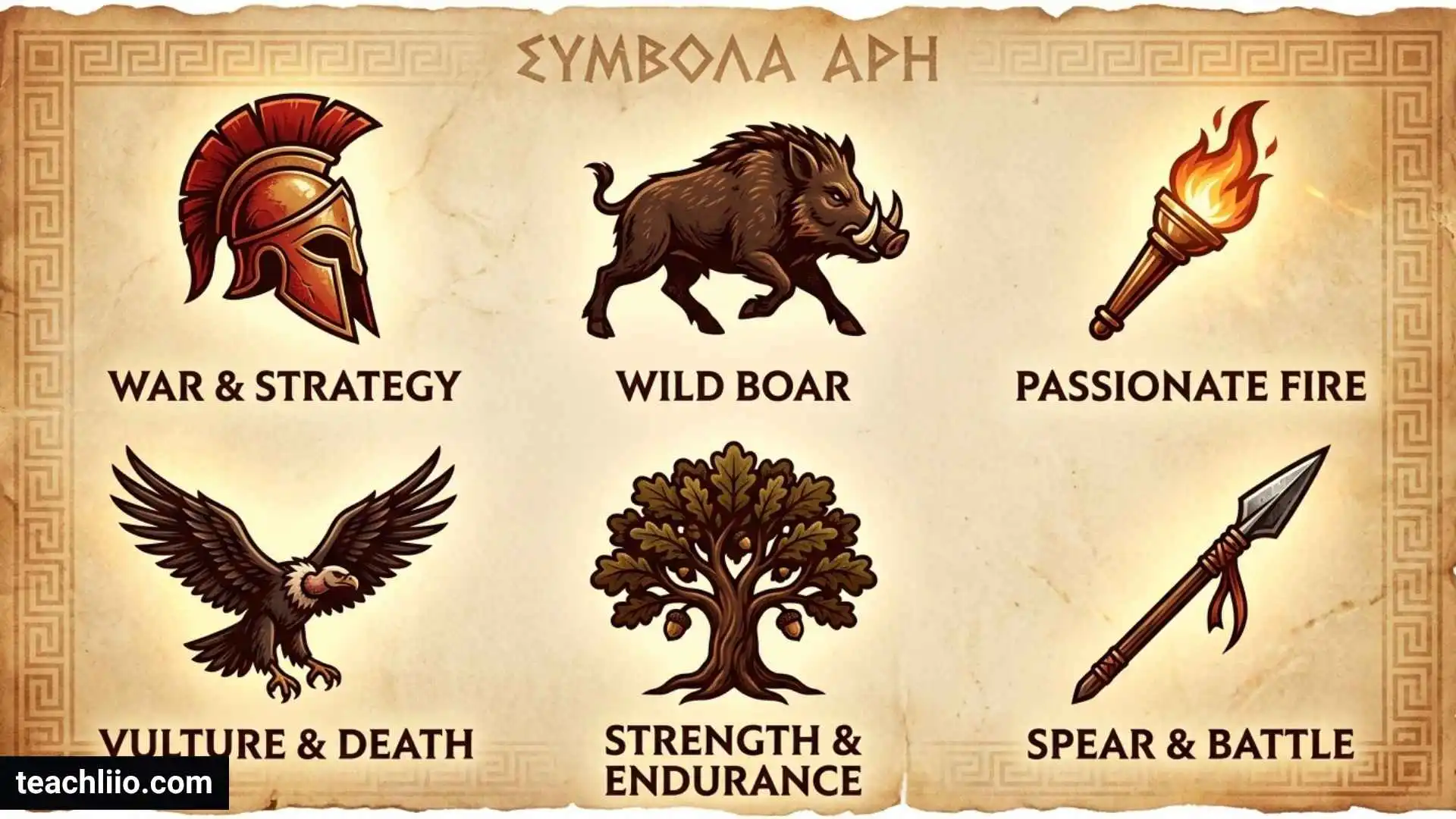
The symbols of Ares reveal the fierce and complicated nature of the Greek god of war. His most recognizable attributes include the spear, helmet, shield, sword, and armor. Ancient mythological traditions also connect Ares with animals such as the serpent, vulture, owl, and woodpecker.
Ares represented the physical force of battle, aggression, and the dangers of armed conflict. Unlike Athena, who was associated with wisdom and military strategy, Ares embodied the intensity and violence of fighting. His symbols reflect both the power of a warrior and the destruction that warfare can bring.
Whether you are researching Greek mythology, identifying Ares in ancient artwork, or exploring mythology-inspired designs, understanding these symbols can help you discover what made this god distinctive.
What Are the Main Symbols of Ares?
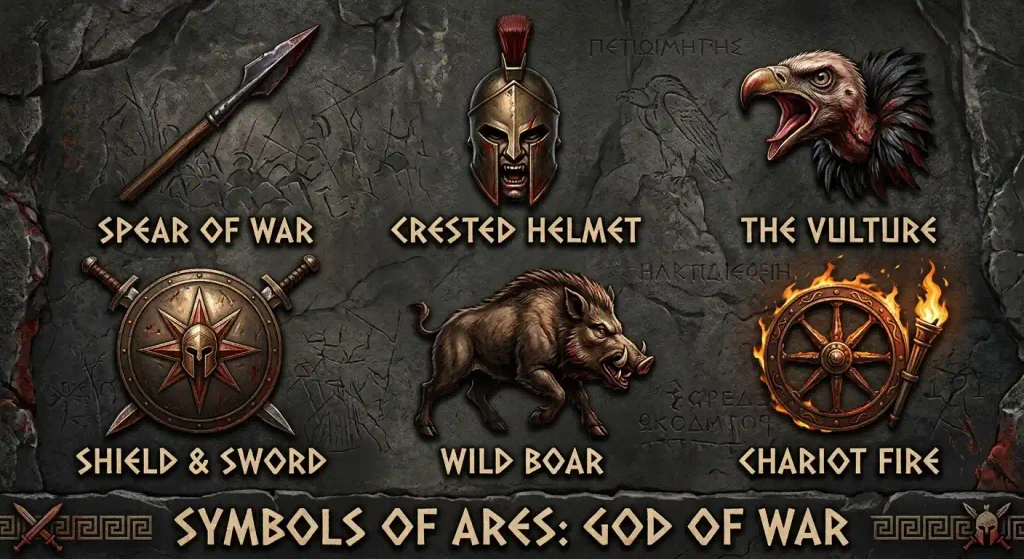
The main symbols of Ares are the helmet and spear, which identify him as an armed warrior. His shield, sword, armor, and war chariot are also important attributes. Several animals appear in traditions connected with him, although not every animal has the same level of historical evidence.
Here is a quick overview of Ares’s most important symbols and their associations.
| Symbol | Meaning or association |
| Spear | Direct combat and offensive warfare |
| Helmet | Warrior identity and battle readiness |
| Shield | Defense and protection during combat |
| Sword | Close fighting and military force |
| Armor | Preparation and protection in war |
| War chariot | Movement and power on the battlefield |
| Serpent | Sacred places and mythological guardianship |
| Vulture | Death and the aftermath of battle |
| Owl | Traditional animal association with Ares |
| Woodpecker | A bird identified with Ares in ancient traditions |
| Boar | A creature appearing in some related myths |
| Flaming torch | A less consistently documented association with destruction |
The spear and helmet are particularly useful when identifying Ares in Greek art. The serpent and certain birds provide additional mythological connections, while the boar and torch require more caution because their associations are less consistent.
Who Was Ares in Greek Mythology?
Ares was one of the twelve Olympian gods in ancient Greek mythology. He was the son of Zeus and Hera and was primarily associated with war, physical combat, and the violent side of human conflict.
Ancient Greek stories often portray Ares as powerful, passionate, and eager to fight. However, he was not always presented as an admired hero. Some myths show him experiencing defeat, pain, and humiliation, demonstrating that strength does not guarantee victory.
Ares also had a complicated relationship with the other gods. Athena, his sister, represented wisdom, military discipline, and strategic warfare. Their contrasting roles reflected different ways of understanding battle.
Ares was also associated with Aphrodite, the goddess of love and beauty. Their relationship brings together two powerful forces in Greek mythology: desire and conflict.
These characteristics explain why Ares’s symbols are closely connected with weapons, protection, physical strength, and the dangers of battle.
Weapons and Warrior Attributes of Ares
The Spear: Ares’s Primary Weapon
The spear is one of the most recognizable attributes of Ares. Ancient Greek warriors commonly used spears in battle, making this weapon a natural representation of a god associated with direct combat.
In Greek mythology and artwork, Ares is frequently portrayed as an armed warrior carrying a spear. The weapon emphasizes his active participation in fighting rather than a role focused primarily on planning military campaigns.
The spear can be understood through several associations:
- Combat: It represents direct engagement with an opponent.
- Aggression: It reflects the offensive side of warfare.
- Readiness: A raised spear suggests preparation for battle.
- Military power: It connects Ares with the weapons used by ancient Greek soldiers.
The spear is not unique to Ares, since other gods and warriors also carry one. However, it remains one of the clearest attributes associated with his traditional warrior image.
The Helmet: A Symbol of the Warrior God
The helmet is another major symbol of Ares. Ancient Greek artwork frequently depicts him wearing or carrying a warrior’s helmet, often with a crest that makes his appearance more imposing.
A helmet protected a soldier’s head and formed an important part of his battlefield equipment. In representations of Ares, it reinforces his identity as a god prepared for armed conflict.
The helmet is commonly associated with protection, military readiness, and the discipline required to enter battle.
It also helps viewers recognize Ares in classical artwork, especially when it appears alongside a spear, shield, or other military equipment. Nevertheless, a helmet alone cannot prove that a figure represents Ares because many Greek gods, heroes, and mortal soldiers wore similar equipment.
The Shield: Defense and Survival in Battle
The shield represents the defensive side of warfare. Ancient Greek soldiers relied on shields to protect themselves from weapons and, in some formations, to help defend neighboring fighters.
When Ares appears with a shield, the object complements the offensive force represented by his spear.
The shield can be associated with protection, resistance, and survival during combat. It also illustrates an important reality of warfare: a warrior must defend against attacks as well as deliver them.
Some ancient artistic representations feature decorated shields, but there is no single universal shield design that identifies Ares in every depiction. Modern illustrations may give him a particular emblem, yet such designs should not automatically be treated as historically authentic Greek symbols.
The Sword and Armor: Strength and Preparation
Ares is also depicted with the weapons and protective equipment of an ancient Greek warrior. Swords could be used during close combat, particularly when a spear was no longer practical.
Armor, meanwhile, protected parts of the body and reinforced a warrior’s appearance. It could include a breastplate, helmet, and protective coverings for the legs.
Together, the sword and armor suggest preparation, physical force, and the dangers of fighting at close range.
These attributes are not exclusive to Ares. Their importance comes from the way they contribute to his overall image as a divine warrior rather than from being individually unique objects.
The War Chariot: Power and Movement
Ares is associated with a war chariot drawn by powerful horses. In Greek mythological stories, divine chariots allow gods to travel through the battlefield and take part in conflicts involving mortals.
The chariot represents movement, speed, and the dramatic arrival of a warrior. It also distinguishes Ares from an ordinary soldier, since his participation in battle takes place within a world of supernatural powers.
Some traditions describe his horses as fire-breathing, giving the chariot an especially fearsome character.
Although the chariot is an important mythological attribute, the helmet and spear remain more practical clues for recognizing Ares in many artistic depictions.
Sacred Animals of Ares and Their Meanings
Animals connected with Ares offer additional insight into his mythology. Some appear in stories involving sacred places, while others are associated with the death and destruction of war.
It is important to distinguish animals documented in ancient traditions from those included in modern symbolic lists. Ancient Greek mythology does not provide one universally agreed list in which every animal has an identical status.
The Serpent: A Sacred Animal of Ares
The serpent is one of the most notable animals associated with Ares in Greek mythology.
An important example appears in the story of Cadmus, the legendary founder of Thebes. Cadmus encounters a dragon associated with Ares near a spring and kills it. He later sows the creature’s teeth into the ground, from which armed warriors known as the Spartoi emerge.
The story connects Ares with a sacred place, a dangerous guardian, and the extraordinary origins of warriors.
The serpent’s meaning depends on the myth in which it appears. In the story of Cadmus, it is best understood through its role as a guardian and a creature linked to the emergence of armed fighters, rather than through a single universal symbolic definition.
The Vulture: Death and the Aftermath of War
The vulture is associated with Ares in ancient mythological traditions. Its connection with dead animals makes it a powerful image of the aftermath of battle.
The vulture draws attention to the consequences of warfare rather than the glory of victory. It can remind readers that battles leave behind casualties, grief, and destruction.
This association fits the darker side of Ares’s mythology. He represents not only the courage and physical power required to fight but also the violence that makes war dangerous.
The vulture is therefore a useful animal to discuss when exploring the less heroic aspects of the god’s character.
The Owl: A Less Familiar Connection
Certain owl species, including the eagle-owl and barn owl, appear among the birds associated with Ares in ancient references.
This association should not be confused with the little owl commonly connected with Athena. Although both deities belong to Greek mythology and are involved in warfare, their animal associations are not interchangeable.
The owl’s connection with Ares is less familiar than the spear or helmet, but it demonstrates the variety of animals found in traditions surrounding the god.
The precise meaning of an owl depends on the species and the source. It is better to describe the historical association than to assign every owl a fixed meaning such as wisdom, danger, or death.
The Woodpecker: A Traditional Animal Association
The woodpecker is another bird identified with Ares in ancient mythological references.
Unlike the vulture, which is easy to associate with the aftermath of battle, the woodpecker’s symbolic meaning is less clearly explained in surviving traditions.
Its inclusion is nevertheless useful because it shows that the animals connected with Ares do not all represent the same quality. Some associations are documented without a detailed symbolic explanation.
For historical accuracy, describe the woodpecker as an animal associated with Ares rather than claiming that it universally symbolizes aggression or victory.
The Boar and Dog: What the Sources Say
The boar appears in stories connected with Ares, including some versions of the myth of Adonis. In certain retellings, a boar kills Adonis, and the animal is linked to Ares.
The details differ between versions, so the story should not be presented as proof that the boar was universally recognized as Ares’s primary sacred animal.
The dog also appears in some modern lists of animals associated with the god. However, it should not automatically be placed on the same historical footing as the serpent and the birds identified in ancient references.
Both animals may be discussed as related associations, provided their status is clearly qualified.
What Do the Symbols of Ares Mean?
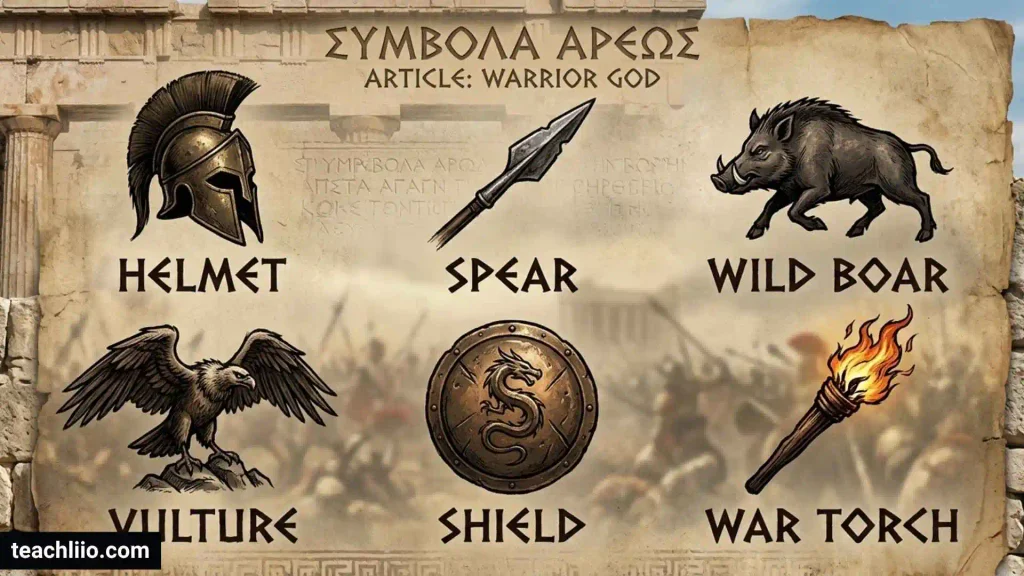
The meaning of Ares’s symbols depends on whether they are being studied in ancient Greek mythology or used in modern artistic and spiritual contexts.
Historical Meanings in Ancient Greek Mythology
In ancient traditions, Ares’s attributes primarily identify him as a god of war and connect him with the physical realities of combat.
The spear emphasizes offensive fighting, while the helmet and armor establish his warrior identity. The shield introduces the defensive side of warfare, and the chariot reflects movement across the battlefield.
His associated animals provide different mythological connections. The serpent appears in stories involving sacred places and warriors, while the vulture recalls the grim consequences of conflict.
These associations are more historically useful than assigning every symbol a broad, modern meaning without supporting evidence.
Modern Spiritual and Personal Interpretations
In contemporary art, jewelry, tattoos, and spiritual writing, people may use Ares’s imagery to express qualities such as courage, determination, strength, or the willingness to face difficult situations.
For example, someone might interpret the spear as a symbol of decisive action or the shield as a representation of personal boundaries.
These are modern interpretations, not universal beliefs established in ancient Greek religion. The distinction matters because historical evidence and personal symbolism answer different questions.
If you are choosing an Ares-inspired design, consider which aspect of his mythology interests you most. The helmet and spear are recognizable choices, while the serpent can connect a design to a specific mythological story.
How to Recognize Ares in Ancient Greek Art
Ares can be difficult to identify because his weapons and armor resemble those worn by other Greek gods, heroes, and mortal warriors.
The helmet and spear are useful starting points, especially when they appear together. A shield or armor may provide additional clues, but none of these objects is exclusive to Ares.
To identify a figure more confidently, consider the following:
- Look at the attributes: A helmet, spear, and shield may suggest Ares’s warrior identity.
- Examine the surrounding figures: Other gods or characters in the scene may help establish the subject.
- Check for inscriptions: An inscription naming a figure can provide stronger evidence than appearance alone.
- Consider the artwork’s context: The scene, period, and artistic tradition may influence how the figure is represented.
An armed male figure should not automatically be identified as Ares. Reliable identification depends on the combination of visual attributes and supporting context.
Ares vs. Athena: How Their Symbols Differ
Ares and Athena were both connected with warfare, but they represented different aspects of it.
| Feature | Ares | Athena |
| Main role | God of war and battle | Goddess of wisdom and strategic warfare |
| Recognizable attributes | Helmet, spear, shield | Owl, helmet, spear, and aegis |
| Main emphasis | Physical combat and the violence of war | Wisdom, planning, and disciplined action |
| Common artistic appearance | Armed male warrior | Armed goddess often accompanied by wisdom-related attributes |
Ares is strongly associated with the intensity of fighting, while Athena represents the importance of intelligence and strategy.
Their roles are not entirely separate, because both are connected with armed conflict. The difference lies in the qualities their mythology emphasizes.
This comparison also explains why an owl is more commonly recognized as Athena’s symbol, even though certain owl species are associated with Ares in ancient traditions.
Ares vs. Mars: Are Their Symbols the Same?

Ares was the Greek god of war, while Mars was his Roman counterpart. Roman tradition identified the two gods with each other, and their artistic attributes overlap in many depictions.
Both are associated with military equipment, including helmets, spears, and shields. However, their cultural roles were not identical.
Mars held an especially important place in Roman religion and was connected with Rome’s military identity and civic traditions. Ares, meanwhile, is often portrayed in Greek mythology as a volatile figure associated with the violence and disorder of battle.
The familiar ♂ glyph is traditionally associated with the Roman god Mars and is also used as a symbol for the male sex. Its historical origins have more than one proposed explanation, including interpretations involving a spear and shield.
It should not be presented as a uniquely established personal emblem of Ares in ancient Greek religion.
Frequently Asked Questions
What is the main symbol of Ares?
The helmet and spear are among the most recognizable symbols of Ares. The helmet identifies him as an armed warrior, while the spear reflects his connection with direct combat and offensive warfare.
What animals are sacred to Ares?
The serpent is an important animal associated with Ares, and ancient references also identify the vulture, eagle-owl, barn owl, and woodpecker. The dog and boar appear in some related accounts, but their associations should be treated more cautiously.
Why is the serpent associated with Ares?
The serpent is connected with Ares through Greek mythology, including the story of Cadmus and the dragon near Thebes. The creature is associated with a sacred place, and its teeth become the source of armed warriors known as the Spartoi.
What does Ares’s spear symbolize?
Ares’s spear represents direct combat, offensive warfare, and military force. It is one of his clearest attributes because it reflects his role as a god associated with the physical intensity of battle.
Is the ♂ symbol the original symbol of Ares?
The ♂ glyph is traditionally associated with the Roman god Mars and is used today as the male symbol. Although Mars was identified with Ares, the glyph is not securely established as an exclusive personal emblem of Ares in ancient Greek art.
How is Ares different from Athena?
Ares represents the force and intensity of battle, while Athena is associated with wisdom, military strategy, and disciplined warfare. Their contrasting roles show two different aspects of conflict in Greek mythology.
What colors are associated with Ares?
Modern artwork often depicts Ares with red, black, bronze, or gold. These colors can evoke bloodshed, weapons, and armor, but there is no single universally established ancient Greek color scheme for the god.
Conclusion
The symbols of Ares reveal the complex character of the Greek god of war. His helmet and spear are his most recognizable attributes, while the shield, sword, armor, and chariot reinforce his identity as a divine warrior.
The serpent, vulture, owl species, and woodpecker add important mythological connections, although not every animal has the same historical status. The boar and other less consistently documented associations should be treated with care.
Understanding these distinctions helps separate ancient Greek traditions from modern interpretations. Whether you are studying mythology, identifying classical artwork, or choosing a mythology-inspired design, Ares’s symbols offer a useful way to explore the courage, aggression, and destructive power associated with warfare.

I’m Hugo Wetherby, a British author interested in the numbers behind everyday questions. I explore quantities, populations, measurements, records, comparisons, and surprising statistics, turning complicated information into accessible answers. I believe a simple “how many” question can lead to fascinating discoveries, and I enjoy helping readers find those answers.
Books:
How Many? A Guide to Everyday Numbers
The Great Book of Numbers and Quantities