Grammar symbols help make written English clear, organized, and easy to understand. They include punctuation marks such as periods, commas, question marks, apostrophes, and quotation marks. Each mark has a specific purpose, whether it ends a sentence, separates ideas, shows possession, or introduces someone’s exact words.
Learning grammar symbols is useful for students, teachers, English learners, and anyone who wants to improve their writing. This guide explains the most common grammar and punctuation symbols, their names, meanings, and correct uses, with simple examples, common mistakes, and practical tips.
If you want a quick answer, start with the reference table below. You can then explore each symbol in more detail to understand when and how to use it.
What Are Grammar Symbols?
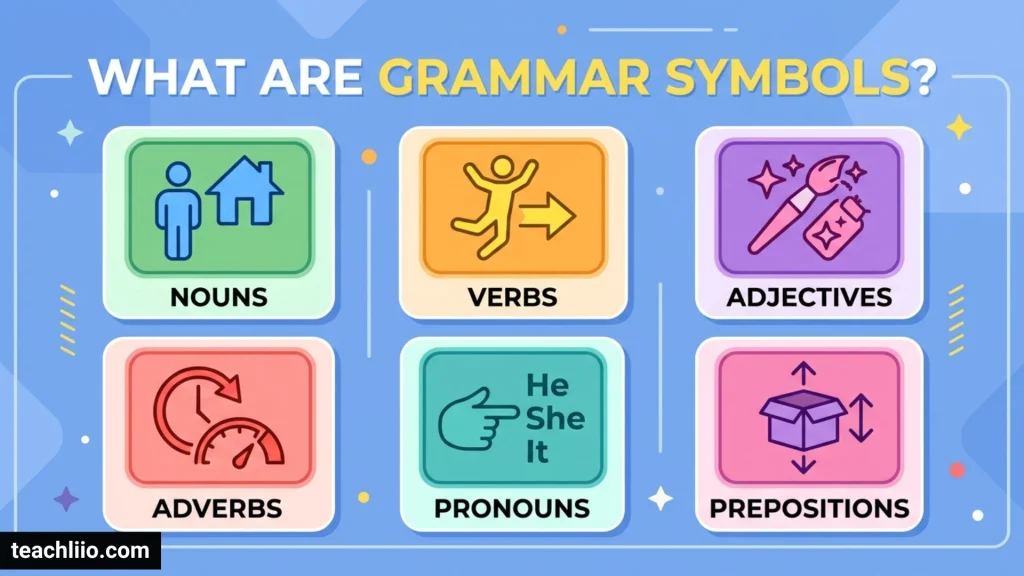
Grammar symbols are written marks that help readers understand the structure and meaning of sentences. People often use the term grammar symbols when referring to punctuation marks and other signs used in writing.
Punctuation marks show where thoughts end, how ideas connect, when a sentence asks a question, and which words belong to a quotation. Without appropriate punctuation, readers may misunderstand a sentence or struggle to follow its meaning.
Consider this example:
- Without a comma: Let’s eat Grandma!
- With a comma: Let’s eat, Grandma!
The comma changes the meaning by showing that the speaker is addressing Grandma.
It is important to understand that not every symbol used in writing is a punctuation mark. Mathematical signs, email symbols, and copyright marks have different purposes. This article focuses primarily on English punctuation and explains other common writing symbols separately.
List of Common Grammar Symbols and Their Names
The following table provides a quick reference to frequently used punctuation marks.
| Symbol | Name | Main purpose |
| . | Period or full stop | Ends a statement |
| , | Comma | Separates items and sentence elements |
| ? | Question mark | Ends a direct question |
| ! | Exclamation mark or exclamation point | Expresses strong emotion or emphasis |
| : | Colon | Introduces a list, explanation, or example |
| ; | Semicolon | Connects closely related independent clauses |
| ‘ | Apostrophe | Shows possession or omitted letters |
| ” “ | Double quotation marks | Encloses quotations or direct speech |
| ‘ ‘ | Single quotation marks | Encloses quotations in certain styles |
| ( ) | Parentheses | Adds extra information |
| [ ] | Square brackets | Adds clarification or editorial information |
| { } | Curly braces | Groups information in specialized contexts |
| – | Hyphen | Joins parts of certain words |
| – | En dash | Shows ranges or relationships |
| — | Em dash | Creates a strong break or adds emphasis |
| … | Ellipsis | Indicates omitted words or an unfinished thought |
| / | Forward slash | Separates alternatives or related items |
| \ | Backslash | Mainly used in computing and technical writing |
| * | Asterisk | Refers to a note or marks special information |
| & | Ampersand | Represents the word “and” |
| • | Bullet point | Introduces an item in a list |
The names and uses of some marks vary by writing style and region. For example, American English generally uses period and exclamation point, while British English commonly uses full stop and exclamation mark.
Common Grammar Symbols and Their Uses
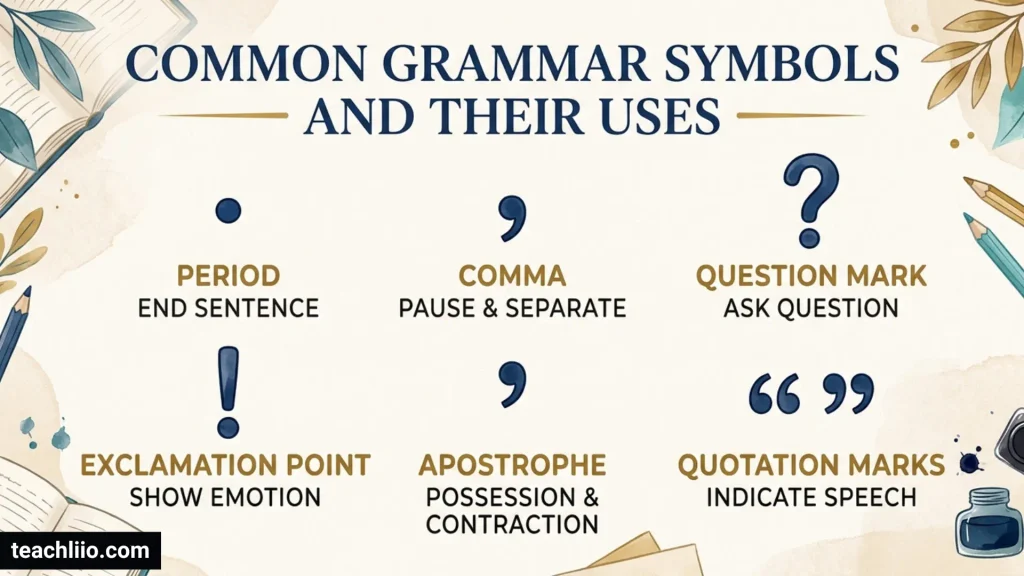
Understanding the name of a symbol is only the first step. To use it correctly, you also need to know where it belongs in a sentence and how it affects meaning.
1. Period (.)
A period, called a full stop in British English, usually appears at the end of a statement. It tells readers that a complete thought has ended.
Examples:
- My sister enjoys reading.
- We are learning English grammar.
- Please submit your assignment today.
Periods are also used in some abbreviations, although abbreviation conventions vary. Avoid placing a period at the end of every heading or list item automatically; follow the format and style of your document.
2. Comma (,)
A comma separates parts of a sentence and helps organize information. It is commonly used in lists, introductory phrases, and some clauses.
Examples:
- I bought apples, oranges, and bananas.
- After breakfast, we went for a walk.
- My cousin, who lives in London, is visiting us.
A comma can also help distinguish between direct address and the rest of a sentence.
- Correct: Thank you, Sarah.
- Incorrect for the intended meaning: Thank you Sarah.
Common mistake: Do not join two complete sentences with only a comma.
Incorrect: I was tired, I went to bed.
Correct: I was tired, so I went to bed.
You could also use a period or semicolon, depending on the relationship between the ideas.
3. Question Mark (?)
A question mark appears at the end of a direct question. It shows that the sentence asks something rather than simply stating information.
Examples:
- What is your favorite subject?
- Where did you put my notebook?
- Are you ready for the exam?
An indirect question usually ends with a period when it forms part of a statement.
- Direct question: She asked, “Where are you going?”
- Indirect question: She asked where I was going.
This distinction is useful when writing conversations, reports, emails, and school assignments.
4. Exclamation Mark (!)
An exclamation mark, also called an exclamation point, expresses excitement, surprise, urgency, or strong emotion.
Examples:
- What wonderful news!
- Congratulations on your success!
- Watch out!
It can also appear in an emphatic command, such as “Stop!” However, it is best to avoid excessive use in formal writing. Multiple exclamation marks rarely make a message more professional.
5. Colon (:)
A colon introduces information that explains, illustrates, or expands on the words before it. It is often used to introduce a list or explanation.
Examples:
- Please bring three items: a pen, a notebook, and a ruler.
- She had one goal: to finish the project.
- Remember this principle: practice improves your skills.
A useful rule is to place a colon after a complete introductory clause when the following material explains or lists something.
Incorrect: My favorite foods are: rice, pasta, and soup.
Better: My favorite foods are rice, pasta, and soup.
Also correct: I enjoy three foods: rice, pasta, and soup.
6. Semicolon (;)
A semicolon connects two closely related independent clauses. Each clause can usually stand alone as a complete sentence.
Examples:
- I wanted to go outside; it began to rain.
- Sara enjoys reading; her brother prefers drawing.
- The deadline is tomorrow; we must finish the work today.
A semicolon can also separate items in a complicated list when individual items already contain commas.
Example: The speakers came from Lahore, Pakistan; Delhi, India; and London, England.
Do not use a semicolon simply because a sentence is long. The two parts should have a meaningful relationship.
7. Apostrophe (‘)
An apostrophe has two main functions in English: showing possession and indicating omitted letters in contractions.
Showing possession:
- The girl’s bag is blue.
- The teacher’s desk is clean.
- The students’ books are on the shelf.
Forming contractions:
- Do not → don’t
- It is → it’s
- They are → they’re
- We have → we’ve
A common mistake is confusing its with it’s. The word its indicates possession, while it’s means it is or it has.
Examples:
- The cat cleaned its paws.
- It’s raining outside.
Remember that ordinary plurals do not need apostrophes. Write three books, not three book’s.
8. Quotation Marks (” ” and ‘ ‘)
Quotation marks show direct speech, quoted material, or a word being discussed as a word.
Examples:
- Maria said, “I will call you tomorrow.”
- He asked, “Have you finished your homework?”
- The word “carefully” is an adverb.
American English commonly uses double quotation marks for the main quotation and single quotation marks for a quotation inside another quotation.
Example: She asked, “Did he really say, ‘I am leaving’?”
British English conventions may differ, so use the style required by your school, publisher, or organization.
9. Parentheses ( )
Parentheses enclose extra information that is helpful but not essential to the main sentence.
Examples:
- My brother (the youngest in our family) is a teacher.
- The meeting starts at 9 a.m. (Please arrive early.)
- She moved to Karachi (a major city in Pakistan) last year.
Use parentheses when the additional information is useful but would interrupt the main sentence if written directly into it.
10. Square Brackets [ ]
Square brackets often add clarification, editorial comments, or information inside quoted material.
Examples:
- “She [the new manager] arrived early.”
- “They completed the project [on Monday],” the report stated.
Brackets can help readers understand a quotation when the original wording does not provide enough context. The added information should clarify the meaning without misrepresenting the original source.
11. Hyphen (-)
A hyphen joins parts of certain words or expressions. It often appears in compound modifiers placed before a noun.
Examples:
- A well-known author
- A part-time job
- A five-year-old child
Compare these sentences:
- She owns a small business.
- She works part-time.
Hyphenation depends on the word and its position in a sentence. Some expressions use hyphens before a noun but not after it.
12. Dashes (– and —)
Dashes are longer than hyphens and have different uses.
En dash (–): Often indicates a range or relationship.
- Read pages 12–18.
- The Lahore–Karachi route is busy.
Em dash (—): Creates a strong break, adds emphasis, or inserts extra information.
- I had one concern—the deadline was too close.
- Her answer—although unexpected—was correct.
A hyphen joins word parts, while dashes separate or connect larger elements. Using the correct mark makes writing more precise.
13. Ellipsis (…)
An ellipsis consists of three dots. It can indicate that words have been omitted from a quotation or that a thought trails off.
Examples:
- “I thought everything was ready, but …”
- The report stated that “the results … were inconclusive.”
In formal quotations, follow the required style for showing omitted material. Do not use an ellipsis as a substitute for normal punctuation whenever you are unsure how to end a sentence.
Commonly Confused Grammar Symbols
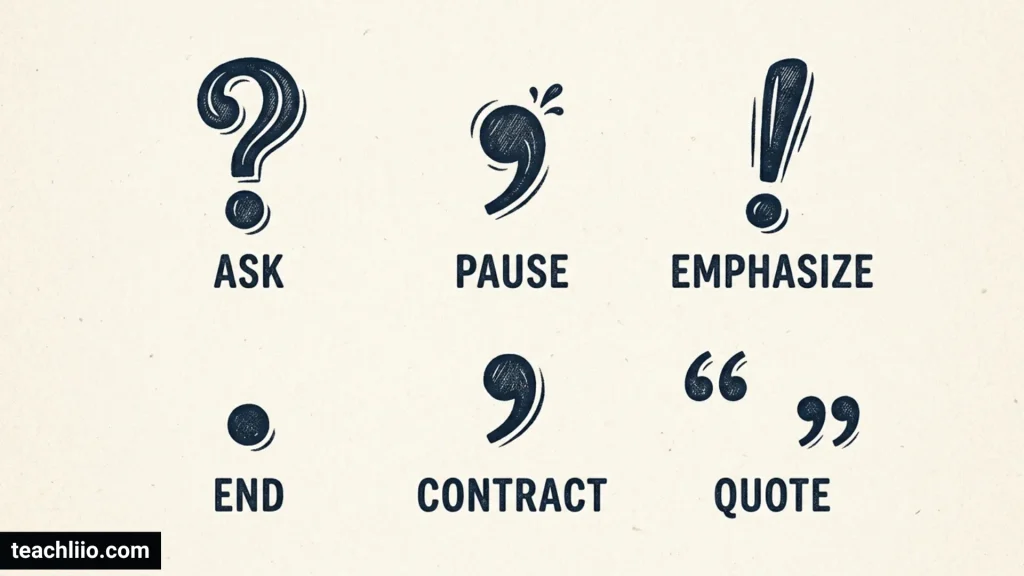
Some punctuation marks look similar or perform related functions. Knowing the differences helps prevent mistakes.
| Symbols | Main difference | Example |
| Colon : and semicolon ; | A colon introduces or explains; a semicolon connects related independent clauses | Bring these items: paper and pens. / It was late; we left. |
| Hyphen – and em dash — | A hyphen joins word parts; an em dash creates a break | well-known / She agreed—eventually. |
| Apostrophe ‘ and quotation marks ” “ | An apostrophe shows possession or omitted letters; quotation marks enclose quoted words | Sara’s bag / “Hello,” she said. |
| Period . and comma , | A period ends a statement; a comma separates parts of a sentence | I went home. I rested. / After lunch, I rested. |
| Parentheses ( ) and brackets [ ] | Parentheses enclose additional information; brackets often clarify quoted material | My friend (a doctor) arrived. / “She [the doctor] arrived.” |
How punctuation can change meaning
Punctuation does more than make sentences look organized. It can affect how readers interpret a message.
Consider these examples:
- Let’s eat, Grandma! — The speaker is addressing Grandma.
- Let’s eat Grandma! — Without the comma, the sentence suggests a very different and unintended meaning.
Another example:
- I like cooking, my family, and my pets. — A list of things the speaker likes.
- I like cooking my family and my pets. — Without the commas, the sentence becomes confusing and potentially alarming.
These examples demonstrate why punctuation should be checked carefully, even in short messages.
Other Symbols Used in Writing
Not every symbol is a grammar mark. Some symbols appear in emails, lists, mathematics, documents, and digital communication. Learning their names is useful, but they should not be confused with punctuation rules.
| Symbol | Name | Common use |
| & | Ampersand | Represents “and” in certain names and expressions |
| * | Asterisk | Points to a note or special detail |
| / | Forward slash | Separates alternatives or indicates certain relationships |
| @ | At sign | Appears in email addresses and online usernames |
| # | Hash or number sign | Used in hashtags and number references |
| • | Bullet point | Introduces an item in a list |
| % | Percent sign | Represents a percentage |
| + | Plus sign | Indicates addition |
| − | Minus sign | Indicates subtraction |
| × | Multiplication sign | Indicates multiplication |
| ÷ | Division sign | Indicates division |
| = | Equals sign | Shows equality |
| < | Less-than sign | Shows that one value is smaller than another |
| > | Greater-than sign | Shows that one value is larger than another |
| © | Copyright symbol | Appears in copyright notices |
| ® | Registered trademark symbol | Identifies a registered trademark |
When should you use these symbols?
Use the ampersand when it is part of an official name or where the style allows it. In ordinary formal sentences, spelling out and is usually clearer.
Use an asterisk when readers need to find a note or explanation. Use bullet points to organize lists, and use mathematical symbols when the context calls for mathematical notation.
The important point is to choose a symbol for its intended purpose rather than treating all signs as interchangeable punctuation.
How to Use Grammar Symbols Correctly
Good punctuation develops through practice. These simple steps can help you improve sentence structure and avoid common writing mistakes.
1. Identify the purpose of your sentence
Ask whether you are making a statement, asking a question, or expressing strong emotion.
- Statement: We finished the assignment.
- Question: Did we finish the assignment?
- Exclamation: We finally finished the assignment!
2. Check the relationship between ideas
Use commas, semicolons, and colons according to the structure of the sentence. A comma can separate items, a semicolon can connect closely related complete clauses, and a colon can introduce an explanation or list.
3. Review apostrophes carefully
Check whether the word shows possession or forms a contraction. Remember the difference between your and you’re, and between its and it’s.
4. Read your writing aloud
Reading aloud can help you notice unclear sentence boundaries and awkward phrasing. However, do not rely on pauses alone to determine punctuation. Grammar and sentence structure matter more than every pause in speech.
5. Proofread before submitting
Look for missing punctuation, unnecessary commas, incorrect apostrophes, and inconsistent quotation marks. If you are writing for school or work, follow the required style guide.
Common Grammar Symbol Mistakes to Avoid
The following examples show frequent errors and how to correct them.
| Incorrect | Correct | Reason |
| Where are you. | Where are you? | A direct question needs a question mark. |
| Its a beautiful day. | It’s a beautiful day. | “It’s” means “it is” in this sentence. |
| The girls’s bags are here. | The girls’ bags are here. | The plural possessive places the apostrophe after the s. |
| I was tired, I slept early. | I was tired, so I slept early. | A comma alone should not join these independent clauses. |
| Lets eat, Grandma! | Let’s eat, Grandma! | The contraction needs an apostrophe. |
| She is a well known writer. | She is a well-known writer. | The compound modifier is conventionally hyphenated here. |
Some punctuation choices depend on regional conventions or a specific style guide. The goal is to follow the relevant rules consistently and make your meaning clear.
Practice: Test Your Knowledge of Grammar Symbols
Try adding the correct punctuation to these sentences before checking the answers.
- Where is my notebook
- I bought apples oranges and bananas
- Its a wonderful opportunity
- Sara said I will arrive soon
- I wanted to go outside it started raining
Answer key
- Where is my notebook?
- I bought apples, oranges, and bananas.
- It’s a wonderful opportunity.
- Sara said, “I will arrive soon.”
- I wanted to go outside, but it started raining.
In the fifth sentence, a period or semicolon could also work if the writer wants to separate the two complete thoughts. The best choice depends on how the ideas are meant to connect.
Frequently Asked Questions
What are the most common grammar symbols?
The most common punctuation marks include the period, comma, question mark, exclamation mark, colon, semicolon, apostrophe, and quotation marks. These marks help organize sentences and clarify meaning.
What symbol is used to end a sentence?
A period usually ends a statement. A question mark ends a direct question, while an exclamation mark can express strong emotion, surprise, or urgency.
What is the difference between grammar symbols and punctuation marks?
Punctuation marks organize written language and clarify sentence meaning. Grammar symbols is a broader, informal term that people may use for punctuation and other writing signs, including symbols that have specialized functions.
What does an apostrophe mean?
An apostrophe indicates possession or missing letters in a contraction. For example, Mina’s book shows possession, while don’t is a contraction of do not.
What is the difference between a colon and a semicolon?
A colon commonly introduces a list, explanation, or example. A semicolon connects closely related independent clauses or separates complicated list items.
What is the difference between a hyphen and a dash?
A hyphen joins parts of words, as in well-known. An en dash often indicates a range, while an em dash creates a break or adds emphasis within a sentence.
Why are grammar symbols important?
Grammar symbols help readers understand sentence boundaries, questions, quotations, lists, and relationships between ideas. Correct punctuation makes writing easier to read and reduces misunderstandings.
Are grammar symbols the same in American and British English?
Many punctuation rules are shared, but some names and conventions differ. For example, Americans generally say period and exclamation point, while British speakers commonly use full stop and exclamation mark. Quotation and other style conventions may also vary.
How can I learn grammar symbols quickly?
Start with the period, comma, question mark, exclamation mark, apostrophe, and quotation marks. Learn each mark’s purpose, study correct and incorrect examples, and practice editing short sentences. Review the more advanced marks once you are comfortable with the basics.
Conclusion
Grammar symbols help readers understand written English by organizing sentences, separating ideas, showing possession, and identifying questions and quotations. The most useful marks to learn first are periods, commas, question marks, exclamation marks, colons, semicolons, apostrophes, and quotation marks.
Remember that recognizing a symbol is not enough; you also need to understand when it belongs in a sentence. Study the examples, practice correcting common mistakes, and proofread your writing before submitting or publishing it.
With consistent practice, you can use grammar symbols more confidently and create writing that is clear, accurate, and easy for readers to understand

I’m Arthur Ellison, a British writer with a fascination for numbers, quantities, and the questions people ask about how many. I enjoy researching facts, comparisons, measurements, and everyday statistics, presenting them in straightforward language. My goal is to make numerical information easy to understand, useful, and interesting for curious readers everywhere.
Books:
The Curious World of How Many
Numbers, Quantities and Everyday Facts