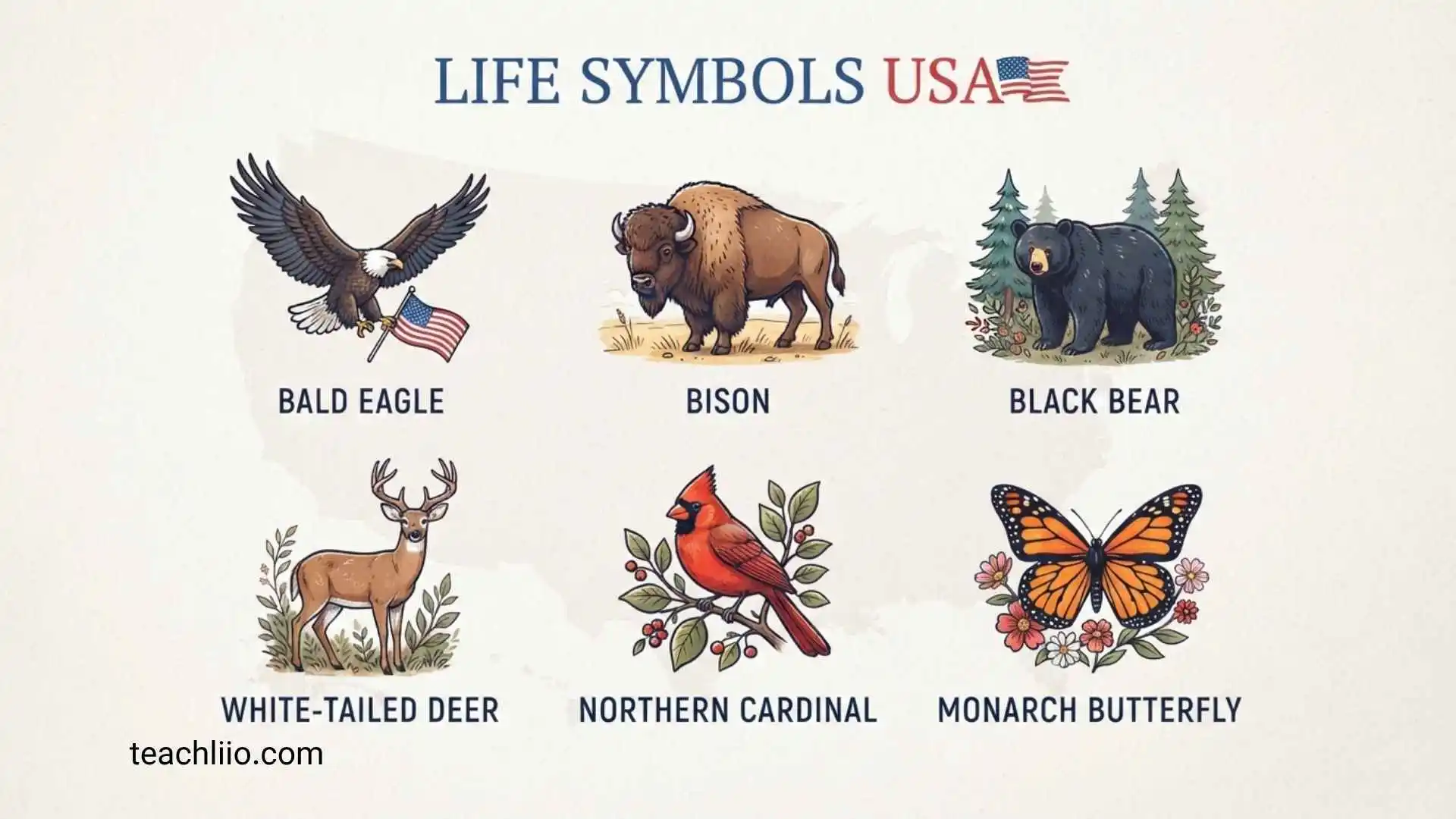
The state symbols USA uses to represent its 50 states tell fascinating stories about American history, nature, culture, and local identity. Each state has its own official emblems, and these can include a state bird, flower, tree, animal, flag, motto, song, mineral, gemstone, food, insect, reptile, fossil, or other designation.
These symbols are more than simple names on a list. A flower may represent a state’s landscape, a bird may reflect its wildlife, and a tree may connect to its forests or economic history. Some symbols are also tied to legislation, cultural traditions, agriculture, or historical events.
Because states can officially recognize many different categories, there is no single universal list containing only one symbol per state. A comprehensive look at U.S. state symbols therefore needs to explain the major categories as well as the symbols most commonly associated with each of the 50 states.
What Are State Symbols in the USA?
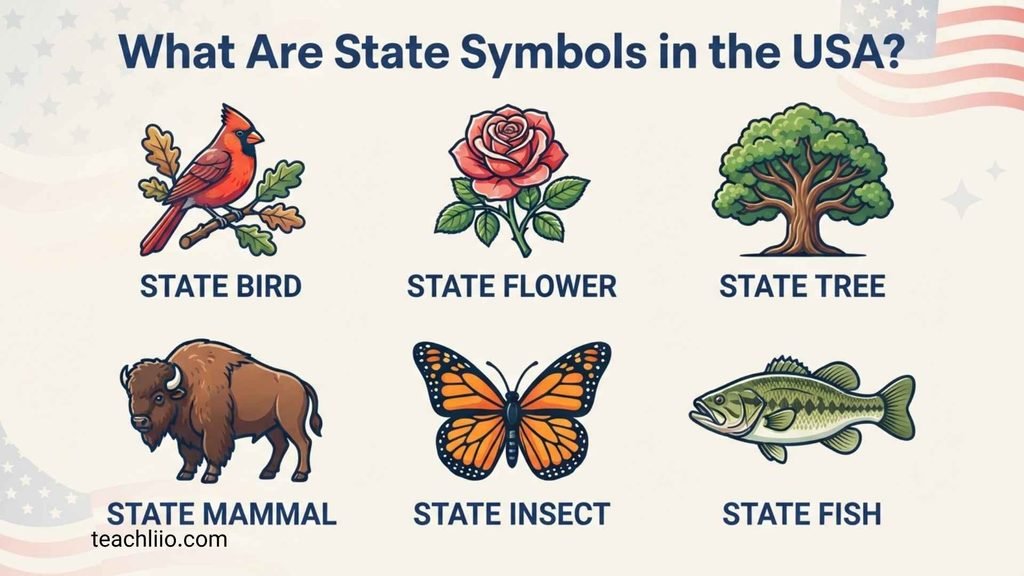
State symbols are official emblems selected or recognized by an individual state to represent something important about its natural environment, history, culture, economy, or people.
Common examples include:
- State bird
- State flower
- State tree
- State animal or mammal
- State fish
- State insect
- State reptile
- State mineral
- State gemstone
- State fossil
- State flag
- State seal
- State motto
- State song
- State food
- State fruit or agricultural product
The range is much broader than many people expect. State-symbol references include categories such as amphibians, astronomy, cultural heritage, dinosaurs and fossils, dogs, cats, fish, flags, food, gemstones, horses, insects, mammals, minerals, mottos, plants, reptiles, seals, soils, songs, sports, tartans, theaters, and trees.
How Do States Choose Their Symbols?
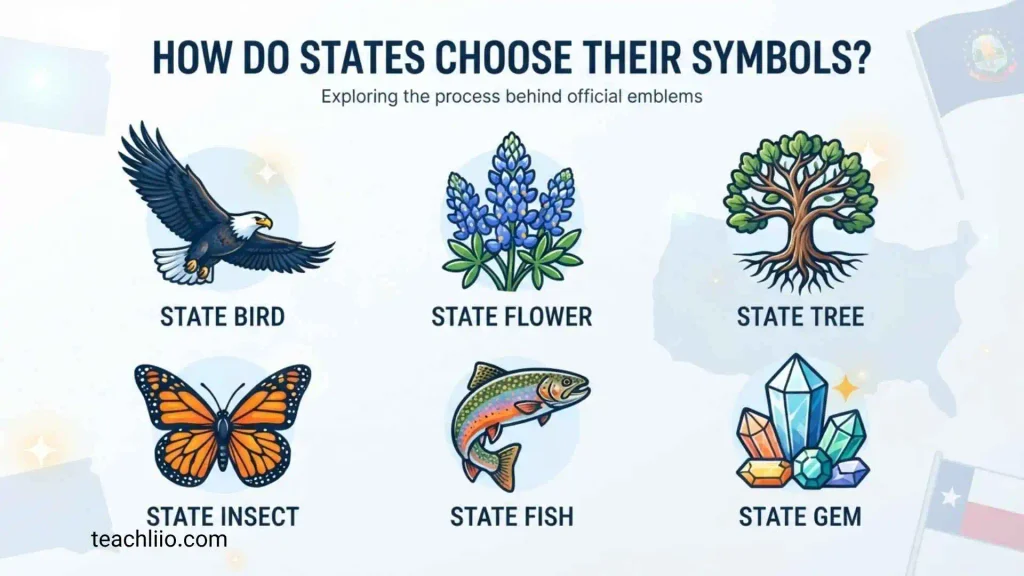
State symbols are generally established through state law, legislative action, or another formal state designation. The exact process differs from one state to another.
Some symbols were selected because they were already strongly associated with local communities. Others were chosen because they represented native wildlife, agriculture, geography, historical events, or important industries.
This means a state symbol is not necessarily the most famous object associated with a state. The distinction between an official designation and a popular association is important when researching state symbols.
Quick Guide to State Symbols for All 50 States
The following table gives a convenient overview of three widely recognized categories: the state flower, bird, and tree.
| State | State Flower | State Bird | State Tree |
| Alabama | Camellia | Yellowhammer | Southern Longleaf Pine |
| Alaska | Forget-Me-Not | Willow Ptarmigan | Sitka Spruce |
| Arizona | Saguaro Blossom | Cactus Wren | Palo Verde |
| Arkansas | Apple Blossom | Northern Mockingbird | Pine |
| California | California Poppy | California Quail | California Redwood |
| Colorado | Rocky Mountain Columbine | Lark Bunting | Colorado Blue Spruce |
| Connecticut | Mountain Laurel | American Robin | White Oak |
| Delaware | Peach Blossom | Blue Hen Chicken | American Holly |
| Florida | Orange Blossom | Northern Mockingbird | Sabal Palmetto |
| Georgia | Cherokee Rose | Brown Thrasher | Live Oak |
| Hawaii | Yellow Hibiscus | Nēnē | Kukui |
| Idaho | Syringa | Mountain Bluebird | Western White Pine |
| Illinois | Violet | Northern Cardinal | White Oak |
| Indiana | Peony | Northern Cardinal | Tulip Tree |
| Iowa | Wild Rose | Eastern Goldfinch | Bur Oak |
| Kansas | Sunflower | Western Meadowlark | Cottonwood |
| Kentucky | Goldenrod | Northern Cardinal | Tulip Tree |
| Louisiana | Magnolia | Brown Pelican | Bald Cypress |
| Maine | White Pine Cone and Tassel | Black-Capped Chickadee | Eastern White Pine |
| Maryland | Black-Eyed Susan | Baltimore Oriole | White Oak |
| Massachusetts | Mayflower | Black-Capped Chickadee | American Elm |
| Michigan | Apple Blossom | American Robin | Eastern White Pine |
| Minnesota | Pink and White Lady’s Slipper | Common Loon | Red Pine |
| Mississippi | Magnolia | Northern Mockingbird | Southern Magnolia |
| Missouri | Hawthorn | Eastern Bluebird | Flowering Dogwood |
| Montana | Bitterroot | Western Meadowlark | Ponderosa Pine |
| Nebraska | Goldenrod | Western Meadowlark | Cottonwood |
| Nevada | Sagebrush | Mountain Bluebird | Single-Leaf Pinyon |
| New Hampshire | Purple Lilac | Purple Finch | White Birch |
| New Jersey | Violet | Eastern Goldfinch | Northern Red Oak |
| New Mexico | Yucca Flower | Greater Roadrunner | Two-Needle Piñon |
| New York | Rose | Eastern Bluebird | Sugar Maple |
| North Carolina | Flowering Dogwood | Northern Cardinal | Pine |
| North Dakota | Wild Prairie Rose | Western Meadowlark | American Elm |
| Ohio | Scarlet Carnation | Northern Cardinal | Ohio Buckeye |
| Oklahoma | Oklahoma Rose | Scissor-Tailed Flycatcher | Eastern Redbud |
| Oregon | Oregon Grape | Western Meadowlark | Douglas Fir |
| Pennsylvania | Mountain Laurel | Ruffed Grouse | Eastern Hemlock |
| Rhode Island | Violet | Rhode Island Red | Red Maple |
| South Carolina | Yellow Jessamine | Carolina Wren | Sabal Palmetto |
| South Dakota | American Pasque Flower | Ring-Necked Pheasant | Black Hills Spruce |
| Tennessee | Iris | Northern Mockingbird | Tulip Poplar |
| Texas | Bluebonnet | Northern Mockingbird | Pecan |
| Utah | Sego Lily | California Gull | Blue Spruce |
| Vermont | Red Clover | Hermit Thrush | Sugar Maple |
| Virginia | American Dogwood | Cardinal | Flowering Dogwood |
| Washington | Coast Rhododendron | Willow Goldfinch | Western Hemlock |
| West Virginia | Rhododendron | Northern Cardinal | Sugar Maple |
| Wisconsin | Wood Violet | American Robin | Sugar Maple |
| Wyoming | Indian Paintbrush | Western Meadowlark | Plains Cottonwood |
This table is a starting point rather than a complete inventory of every designation. Individual states can recognize many additional symbols.
State Symbols by Category
State Birds
Birds are among the most popular state symbols because they are easy to recognize and often closely connected with local ecosystems.
The Northern Cardinal, for example, is an especially widespread state bird. It represents several states, including Illinois, Indiana, Kentucky, North Carolina, Ohio, Virginia, and West Virginia. The Western Meadowlark is another frequently selected bird, particularly across states associated with grasslands and open country.
Other memorable state birds include the Texas mockingbird, Minnesota common loon, Hawaii nēnē, New Mexico roadrunner, and South Carolina Carolina wren.
A state bird can therefore communicate both wildlife importance and regional identity.
State Flowers
State flowers often provide a colorful connection to local landscapes.
California’s California poppy is strongly associated with the state’s spring landscapes. Texas’s bluebonnet is deeply connected to Texas identity, while Hawaii’s yellow hibiscus reflects its tropical environment.
Other notable examples include the mountain laurel of Pennsylvania, flowering dogwood of North Carolina, and black-eyed Susan of Maryland.
State flowers can also reflect agriculture, native plant life, or historical traditions.
State Trees
Trees are another major category of state symbols.
The California redwood represents one of California’s most distinctive natural treasures. Oregon’s Douglas fir reflects the importance of evergreen forests, while the sugar maple is an important symbol in several northeastern states.
State trees can represent native ecosystems, forestry, natural beauty, and historical economic activity.
State Animals and Mammals
Many states have designated mammals or other animals in addition to birds.
These may include large wildlife species, domestic animals, marine animals, or animals that have particular historical importance. Because states use different categories, it is important to check whether a source means state animal, state mammal, state wild animal, or another official designation.
State Flags and Seals
A state flag is one of the most visible official symbols.
State flags often combine colors, stars, coats of arms, historical images, dates, or regional emblems. Their designs can reveal important details about a state’s history.
The history of state flags is especially interesting. The National Conference of State Legislatures notes that many states developed formal flags around the period following the 1893 World’s Columbian Exposition, although some states had earlier designs. Texas, for example, had its Lone Star flag during its period as an independent republic.
A state seal is another important emblem, generally used for official governmental purposes.
State Mottos
State mottos express an idea, value, aspiration, or historical identity associated with a state.
Some are written in English, while others use Latin or another language. A motto can provide a quick summary of how a state wants to describe itself.
Because mottos are short, they are particularly useful for understanding the historical or cultural message behind a state’s official identity.
State Songs
State songs are another category that connects symbols with culture.
A state song may celebrate a landscape, hometown, historical event, people, or shared sense of belonging. Some states also recognize official anthems, ballads, or additional musical selections.
State Minerals, Rocks, Gems, and Fossils
Geology has a major place in American state symbolism.
States may designate official:
- Minerals
- Rocks
- Gemstones
- Fossils
- Soils
These symbols can reflect mining history, distinctive geological formations, local industries, or ancient life discovered within the state.
For readers interested in geology, these categories add an entirely different dimension to the study of state symbols.
State Foods and Agricultural Symbols
Food is another surprisingly large category.
States may recognize official fruits, vegetables, beverages, crops, desserts, or other foods. These choices often reflect agricultural traditions and products for which a state is known.
Food symbols can be especially useful for understanding the relationship between geography, farming, local business, and cultural traditions.
State Symbols of All 50 States
Alabama
Alabama’s camellia is its state flower, while the yellowhammer is its state bird. The southern longleaf pine represents the state’s forest heritage. Alabama’s symbols strongly connect its identity with Southern landscapes and native wildlife.
Alaska
Alaska’s forget-me-not represents its northern environment, while the willow ptarmigan is the state bird. The Sitka spruce reflects the importance of Alaska’s forests and coastal ecosystems.
Arizona
Arizona’s saguaro blossom and cactus wren are closely connected to its desert environment. The palo verde is the state tree and is particularly well adapted to arid conditions.
Arkansas
Arkansas recognizes the apple blossom as its state flower and the northern mockingbird as its state bird. Its tree symbolism reflects the state’s extensive forest resources.
California
California’s most recognizable natural symbols include the California poppy, California quail, and California redwood. Together they represent wildflowers, native wildlife, and enormous coastal forests.
Colorado
Colorado’s Rocky Mountain columbine, lark bunting, and Colorado blue spruce reflect the state’s mountain landscapes and high-country ecosystems.
Connecticut
Connecticut’s mountain laurel, American robin, and white oak connect the state with northeastern forests, gardens, and wildlife.
Delaware
Delaware’s peach blossom, Blue Hen Chicken, and American holly reflect its agricultural history and distinctive cultural identity.
Florida
Florida’s orange blossom, northern mockingbird, and sabal palmetto represent citrus agriculture, native birdlife, and subtropical vegetation.
Georgia
Georgia is strongly associated with the Cherokee rose, brown thrasher, and live oak. The peach is also an important cultural and agricultural association.
Hawaii
Hawaii’s yellow hibiscus, nēnē, and kukui reflect the islands’ distinctive native environment and cultural heritage.
Idaho
Idaho’s syringa, mountain bluebird, and western white pine represent its wild landscapes, forests, and native wildlife.
Illinois
Illinois recognizes the violet, northern cardinal, and white oak. These symbols connect the state with its woodland and prairie environments.
Indiana
Indiana’s peony, northern cardinal, and tulip tree are its familiar floral, bird, and tree symbols.
Iowa
Iowa’s wild rose, eastern goldfinch, and bur oak reflect its prairie, agricultural, and woodland heritage.
Kansas
Kansas is famous for its sunflower, while the western meadowlark and cottonwood represent its open grasslands and plains.
Kentucky
Kentucky’s goldenrod, northern cardinal, and tulip tree are important natural symbols. The state also has numerous additional cultural and agricultural designations.
Louisiana
Louisiana’s magnolia, brown pelican, and bald cypress are particularly appropriate symbols for a state known for wetlands, waterways, and Southern landscapes.
Maine
Maine’s white pine cone and tassel, black-capped chickadee, and eastern white pine represent its forests and northern wildlife.
Maryland
Maryland’s black-eyed Susan, Baltimore oriole, and white oak connect the state with its landscapes and history.
Massachusetts
The Mayflower, black-capped chickadee, and American elm are important Massachusetts symbols with strong New England associations.
Michigan
Michigan’s apple blossom, American robin, and eastern white pine represent agriculture, wildlife, and the state’s extensive forests.
Minnesota
Minnesota’s pink and white lady’s slipper, common loon, and red pine are especially connected with its lakes, wetlands, and forests.
Mississippi
Mississippi’s magnolia, northern mockingbird, and southern magnolia reflect the state’s Southern landscape and plant heritage.
Missouri
Missouri’s hawthorn, eastern bluebird, and flowering dogwood represent its woodland and natural environments.
Montana
Montana’s bitterroot, western meadowlark, and ponderosa pine reflect its mountainous landscapes and wide-open grasslands.
Nebraska
Nebraska’s goldenrod, western meadowlark, and cottonwood fit the state’s Great Plains environment and river landscapes.
Nevada
Nevada’s sagebrush, mountain bluebird, and single-leaf pinyon reflect its dry landscapes and high-desert ecosystems.
New Hampshire
New Hampshire’s purple lilac, purple finch, and white birch represent the state’s New England scenery.
New Jersey
New Jersey’s violet, eastern goldfinch, and northern red oak are familiar symbols of its natural environment.
New Mexico
New Mexico’s yucca flower, greater roadrunner, and piñon tree are strongly associated with the state’s desert and southwestern landscape.
New York
New York’s rose, eastern bluebird, and sugar maple represent its diverse natural environment and northeastern heritage.
North Carolina
North Carolina’s flowering dogwood, northern cardinal, and pine are widely recognized state symbols.
North Dakota
North Dakota’s wild prairie rose, western meadowlark, and American elm reflect its prairie landscape and northern plains environment.
Ohio
Ohio’s scarlet carnation, northern cardinal, and Ohio buckeye are deeply connected to state identity. The buckeye is especially important because Ohio residents are commonly known as Buckeyes.
Oklahoma
Oklahoma’s Oklahoma rose, scissor-tailed flycatcher, and eastern redbud represent its plains, wildlife, and flowering landscapes.
Oregon
Oregon’s Oregon grape, western meadowlark, and Douglas fir reflect the state’s forests, open landscapes, and Pacific Northwest identity.
Pennsylvania
Pennsylvania’s mountain laurel, ruffed grouse, and eastern hemlock are symbols of its forested Appalachian landscape.
Rhode Island
Rhode Island’s violet, Rhode Island Red, and red maple connect its identity with flowers, agriculture, and northeastern forests.
South Carolina
South Carolina’s yellow jessamine, Carolina wren, and sabal palmetto reflect its warm coastal and Southern environment.
South Dakota
South Dakota’s American pasque flower, ring-necked pheasant, and Black Hills spruce represent prairie ecosystems and the distinctive Black Hills region.
Tennessee
Tennessee’s iris, northern mockingbird, and tulip poplar are important floral, bird, and tree symbols.
Texas
Texas’s bluebonnet is one of America’s most recognizable state flowers. The northern mockingbird and pecan are also important state symbols. Together, they represent Texas’s natural landscape and agricultural heritage.
Utah
Utah’s sego lily, California gull, and blue spruce reflect its distinctive mountain, desert, and Great Basin environments.
Vermont
Vermont’s red clover, hermit thrush, and sugar maple are strongly associated with its rural and forested landscape.
Virginia
Virginia’s American dogwood, cardinal, and flowering dogwood connect the state with its forests, gardens, and traditional identity.
Washington
Washington’s coast rhododendron, willow goldfinch, and western hemlock represent its Pacific Northwest environment.
West Virginia
West Virginia’s rhododendron, northern cardinal, and sugar maple reflect its Appalachian forests and natural landscape.
Wisconsin
Wisconsin’s wood violet, American robin, and sugar maple are familiar symbols of the state’s forests and northern climate.
Wyoming
Wyoming’s Indian paintbrush, western meadowlark, and plains cottonwood represent the state’s open plains, mountains, and western landscapes.
Some of the Most Unique State Symbols
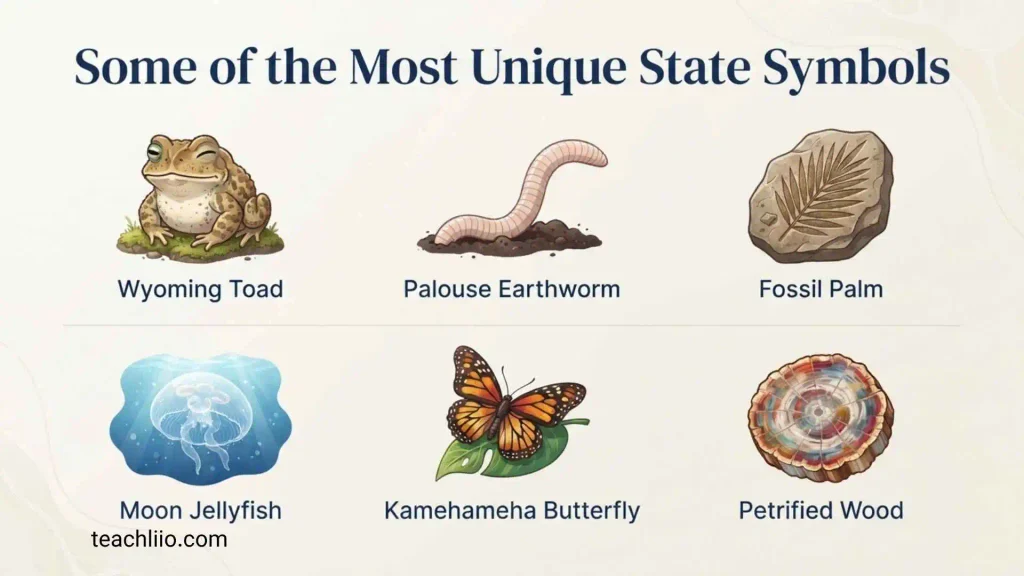
Not all state symbols are predictable flowers or birds. Some are memorable because they reflect very specific local traditions.
Hawaii’s nēnē, New Mexico’s greater roadrunner, Minnesota’s common loon, Delaware’s Blue Hen Chicken, and Rhode Island’s Rhode Island Red are good examples of symbols that immediately distinguish their states.
This variety is one reason state symbols are useful for learning American geography. Instead of memorizing state names alone, readers can associate each place with a recognizable plant, animal, landscape, or cultural tradition.
Which State Symbols Are Shared by Multiple States?
Some symbols appear in more than one state.
The Northern Cardinal is a particularly notable example, serving as the state bird of seven states. The Western Meadowlark is also used by multiple states. The Northern Mockingbird is another bird that appears on several state-symbol lists.
Shared symbols make sense because neighboring states can have similar climates and ecosystems. They also show that a species does not have to be unique to one state to become an important part of its identity.
State Symbols vs. National Symbols
State symbols should not be confused with national symbols of the United States.
| State Symbols | National Symbols |
| Represent individual states | Represent the United States |
| Can differ from state to state | Apply nationally |
| Include state birds and flowers | Include national symbols such as the bald eagle |
| Include state flags and seals | Include the U.S. flag and Great Seal |
| Often established by state governments | Often established through federal law or national tradition |
For example, the bald eagle is a national symbol, not a state bird for the entire country. The U.S. flag’s 50 stars represent the 50 states, while its 13 stripes represent the original colonies.
Why Do State Symbols Matter?
They Preserve History
State symbols can preserve memories of important industries, historical events, landscapes, and traditions.
They Celebrate Nature
Flowers, birds, trees, mammals, fish, and reptiles help highlight native wildlife and ecosystems.
They Build Local Identity
A symbol can become an easy visual or cultural shorthand for an entire state. Texas and the bluebonnet or Ohio and the buckeye are good examples.
They Support Education
State symbols are useful for students learning geography, government, history, environmental science, and American culture.
They Encourage Conservation
When a native plant or animal becomes an official symbol, it can increase public awareness of that species and its importance.
How to Research Official State Symbols Correctly
When researching a particular state symbol, look for an authoritative state source rather than relying on a random list.
The U.S. government’s USA.gov portal provides links to official state governments, making it a useful starting point for locating individual state resources.
For national symbols, USA.gov provides official information about the U.S. flag, Great Seal, bald eagle, and other national emblems.
For broad comparative research, the National Conference of State Legislatures and specialized state-symbol databases can also help identify categories and historical designations.
Frequently Asked Questions
What are the state symbols of the USA?
State symbols are official emblems chosen by individual U.S. states. They can include birds, flowers, trees, animals, flags, seals, mottos, songs, foods, minerals, gemstones, fossils, insects, reptiles, and many other categories.
How many state symbols does each state have?
There is no single fixed number. States recognize different categories and can have many official symbols. Some have designations for everything from plants and animals to foods, minerals, songs, fossils, and cultural traditions.
Does every state have a state flower?
Yes, every U.S. state has an official floral emblem or state flower designation, although the exact legal terminology can vary.
Does every state have a state bird?
Every state has a designated state bird, although some sources may use slightly different terminology when discussing official wildlife symbols.
What is the most common state bird?
The Northern Cardinal is one of the most widely shared state birds, serving as the official state bird of seven states.
What is the difference between a state symbol and a state nickname?
A state symbol is an officially recognized emblem, such as a bird, flower, tree, or motto. A state nickname is a phrase used to describe a state, such as the “Lone Star State” for Texas.
Are state symbols legally official?
Many state symbols are formally established through state legislation or another official state process. However, the legal method and terminology differ among states.
Are state flags considered state symbols?
Yes. A state flag is one of the most important official visual symbols of an individual state. State flags can contain historical imagery, colors, stars, seals, dates, and other elements that communicate state identity.
What is the national symbol of the United States?
The United States has several national symbols. The bald eagle is the national emblem, while the American flag and Great Seal are also major national symbols. The bald eagle was designated as the national emblem in 1782.
Why are state symbols important?
State symbols connect people with local history, nature, culture, agriculture, and geography. They also provide useful ways for students and visitors to learn about the differences among America’s 50 states.
Conclusion
The state symbols USA recognizes offer much more than a simple collection of birds, flowers, and trees. They form a broad record of America’s regional identity, connecting each state with its wildlife, landscapes, history, agriculture, geology, and culture.
From the bluebonnet of Texas and the California poppy to the nēnē of Hawaii and the buckeye of Ohio, these symbols make individual states easier to recognize and remember. They also demonstrate how different environments and historical experiences have shaped American identity.
For anyone researching state symbols of the USA, the most useful approach is to look beyond a single category. State birds, flowers, trees, animals, flags, mottos, songs, minerals, foods, fossils, and other official emblems together create a much richer picture of the 50 states.

I’m Hugo Wetherby, a British author interested in the numbers behind everyday questions. I explore quantities, populations, measurements, records, comparisons, and surprising statistics, turning complicated information into accessible answers. I believe a simple “how many” question can lead to fascinating discoveries, and I enjoy helping readers find those answers.
Books:
How Many? A Guide to Everyday Numbers
The Great Book of Numbers and Quantities