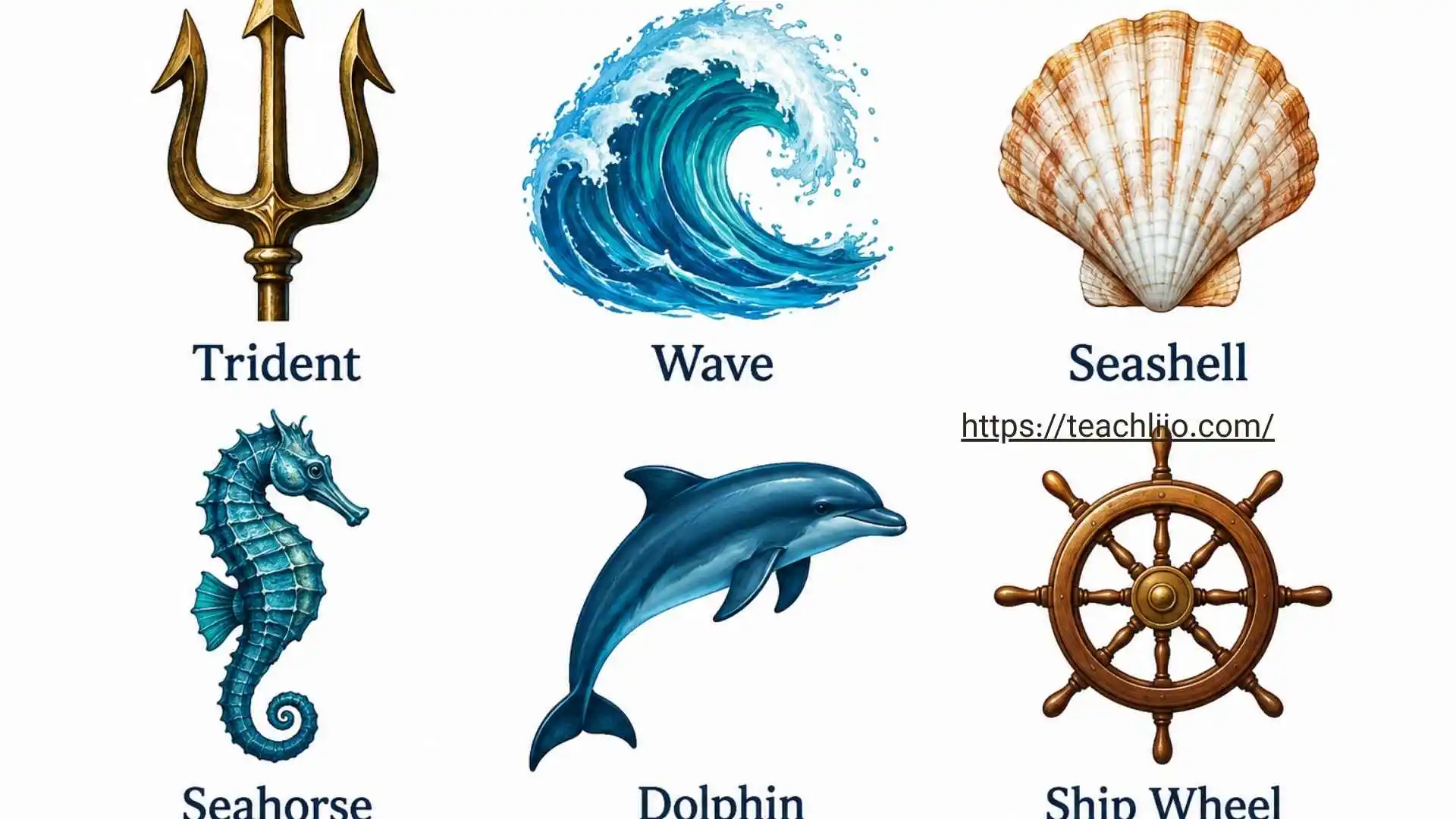
If you are wondering what are Poseidon’s symbols, the trident is his most recognizable symbol. However, Poseidon is associated with much more than a three-pronged weapon. In Greek mythology, his major symbols and attributes include the trident, sea, horse, dolphin, bull, earthquakes, chariot, hippocamp, pine tree, wild celery, and marine creatures.
These symbols reflect the many sides of Poseidon. He was not simply the Greek god of the sea. Ancient traditions also connected him with earthquakes, horses, freshwater sources, storms, and powerful natural forces.
Understanding these associations also helps when identifying Poseidon in ancient Greek art. A bearded god carrying a trident, accompanied by a dolphin or horse, or riding a sea-creature-drawn chariot is often recognizable as Poseidon.
Who Was Poseidon?
Poseidon was one of the major Olympian gods of ancient Greek mythology. He was the son of Cronus and Rhea and the brother of Zeus, Hades, Hera, Demeter, and Hestia.
After the overthrow of the Titans, mythology describes the three brothers Zeus, Poseidon, and Hades dividing the realms of the cosmos. Poseidon received authority over the sea.
But his powers were broader than the ocean alone. Ancient traditions associated him with earthquakes, horses, freshwater sources, storms, and other forces of nature.
This explains why his symbols can seem surprisingly diverse. The horse, for example, may appear unrelated to the sea until his older and wider role as a horse deity is considered.
Poseidon was also widely worshipped in ancient Greece. His important sanctuaries included the famous sanctuary at the Isthmus of Corinth, where the Isthmian Games were held in his honor.
Poseidon’s Symbols at a Glance
| Symbol or Attribute | Association with Poseidon |
| Trident | His most distinctive weapon and attribute |
| Sea | His principal divine domain |
| Horse | One of his sacred animals and an important divine association |
| Dolphin | Marine creature closely connected with his sea domain |
| Bull | Sacred animal associated with his power and worship |
| Earthquake | Connected with his title as the Earth-Shaker |
| Chariot | Frequently shown in art traveling across the sea |
| Hippocamp | Mythical fish-tailed horse that draws his chariot |
| Pine tree | Sacred plant associated with his cult and Isthmian Games |
| Wild celery | Sacred plant used in connection with the Isthmian Games |
| Fish and marine creatures | Reflect his dominion over the sea |
| Sea-covered boulder | A less common artistic attribute associated with Poseidon |
The important point is that not every item in this table is a “symbol” in exactly the same sense. Some are objects of iconography, some are sacred animals or plants, and others represent Poseidon’s divine domains.
What Was Poseidon the God Of?
Poseidon and the Sea
The sea is the most obvious domain associated with Poseidon.
Greek mythology presents him as a powerful ruler of the sea, capable of controlling or disturbing its waters. His connection with sailors, marine creatures, waves, storms, and sea journeys appears throughout ancient traditions.
This is why the trident became such an effective attribute for identifying him. It connects Poseidon visually with the sea while also presenting him as a powerful divine ruler.
Poseidon and Earthquakes
Poseidon was also known as the Earth-Shaker, an association that is sometimes overlooked when people describe him simply as a sea god.
Ancient Greeks connected him with earthquakes and other violent movements of the earth. His power therefore extended from the sea beneath or around the land to the land itself.
This dual association helps explain why Poseidon could represent both water and destruction.
Poseidon and Horses
Poseidon’s relationship with horses is one of the most interesting parts of his mythology.
He was associated with horses, horse taming, chariot racing, and equestrian traditions. He was also known by titles connected with horses, including Hippios, meaning horse-related or equine.
Some ancient traditions even described Poseidon as the creator or father of famous horses.
This makes the horse more than a decorative symbol. It represents a genuine and important aspect of Poseidon’s ancient identity.
Poseidon and Freshwater
Poseidon was not restricted to the open sea. Ancient religious traditions also connected him with springs and sources of freshwater.
This broader relationship with water is important because it shows that his divine role was not simply “ocean god.” Water in different forms could fall within his sphere of influence.
Stories about Poseidon and the creation or control of springs also appear in myths about his contests with other gods.
Poseidon’s Most Important Symbols
The Trident
The trident is Poseidon’s most famous symbol.
It is a three-pronged weapon resembling a large fishing spear. In mythology, the Cyclopes are said to have created the trident for Poseidon.
The weapon became the clearest visual representation of his authority.
Poseidon could use his trident to disturb the sea, strike the earth, break rocks, and unleash powerful natural forces. Because of this, the trident represents more than the ocean. It can be understood as an emblem of divine power over water and the forces of nature.
In ancient art, the trident is especially useful for identifying Poseidon. A mature, bearded male god holding a trident is often intended to be Poseidon, particularly when dolphins, horses, or marine imagery appear nearby.
The Sea
The sea is both a symbol and a domain of Poseidon.
Unlike an object such as the trident, the sea represents the environment over which Poseidon rules.
It can therefore symbolize his authority, unpredictability, movement, and immense natural power.
Ancient depictions frequently place Poseidon among waves, marine creatures, sea gods, and mythical creatures.
The Horse
The horse is one of Poseidon’s most important sacred animals.
His horse association appears in mythology, religious traditions, and ancient art. He was connected with horse taming and racing and was sometimes depicted riding or traveling in a horse-drawn chariot.
The horse also appears in stories involving Poseidon and other gods.
It is important not to reduce this association to a modern symbolic claim such as “horses always mean freedom.” The stronger historical point is that horses were genuinely connected with Poseidon in ancient Greek religion and mythology.
The Dolphin
The dolphin is another important animal associated with Poseidon.
As a marine creature, the dolphin naturally fits his connection with the sea. Dolphins also appear frequently in ancient Greek artistic representations of marine gods and scenes.
The dolphin is particularly useful when interpreting ancient art because it can appear alongside Poseidon, his family, and other sea-related figures.
Rather than assigning modern symbolic meanings to the dolphin, it is more accurate to emphasize its ancient connection with the marine world and Poseidon’s identity as a sea deity.
The Bull
The bull was one of Poseidon’s sacred animals.
The bull was already an animal associated with strength, sacrifice, agriculture, and religious ritual in the ancient Mediterranean world. Its connection with Poseidon appears in mythology and worship.
The famous Cretan Bull is also connected with Poseidon in mythological traditions.
Because bulls could represent tremendous physical force and could be used in religious sacrifice, the animal fits the powerful and sometimes destructive side of Poseidon.
The Chariot
Poseidon is frequently represented traveling through the sea in a magnificent chariot.
In artistic representations, the chariot may be drawn by hippocamps, creatures with the front half of a horse and the tail of a fish.
This combines two of Poseidon’s most important associations: the horse and the sea.
The chariot therefore serves as a powerful visual expression of Poseidon’s ability to move through and command the marine realm.
The Hippocamp
A hippocamp is a mythical creature with the upper body of a horse and the lower body of a fish.
These creatures are strongly associated with Poseidon’s marine imagery.
Ancient Greek and later Greco-Roman artworks show Poseidon riding or traveling in chariots pulled by hippocamps.
The creature is especially interesting because it brings together Poseidon’s two major identities. The horse represents his equine connection, while the fish-like body connects him to the sea.
The Earthquake
Earthquakes are another major attribute of Poseidon.
His title Earth-Shaker reflects the belief that the god could shake the earth with supernatural force.
This association gives Poseidon a darker and more destructive dimension. He was not only a protector of sailors or ruler of the sea. He could also represent terrifying natural events that were beyond human control.
For this reason, the earthquake should be considered one of Poseidon’s major divine attributes rather than merely a secondary mythological detail.
Springs and Salt Water
Springs, wells, and sources of water also appear in stories about Poseidon.
One famous example comes from the mythological contest between Poseidon and Athena over Attica. Poseidon struck the ground with his trident and produced a source of salt water.
The story demonstrates how Poseidon’s trident, water, and claims to territory could become connected within Greek mythology.
These traditions also help explain why Poseidon’s religious identity could extend beyond the open sea.
The Pine Tree
The pine tree is a lesser-known but historically important symbol associated with Poseidon.
The pine was connected with his sanctuary at the Isthmus of Corinth and with the Isthmian Games, which were held in his honor.
Pine wreaths were associated with victors at the games.
This makes the pine tree a useful example of why researching ancient religious practices can reveal symbols that are much less familiar than the trident.
Wild Celery
Wild celery is another overlooked plant associated with Poseidon.
Ancient traditions connect it with the Isthmian Games, and artistic representations of Poseidon sometimes show him wearing a wreath of wild celery.
This is particularly valuable for anyone researching Poseidon’s symbols because it demonstrates that his iconography was not limited to weapons and animals.
Fish and Marine Creatures
Fish and other marine creatures naturally appear in Poseidon’s artistic world.
Because Poseidon ruled the sea, artists could surround him with fish, dolphins, sea creatures, Tritons, Nereids, and other marine figures.
These creatures can help establish the setting of an artwork and reinforce Poseidon’s identity.
However, a fish by itself does not necessarily mean that an artwork depicts Poseidon. The strongest identification usually comes from a combination of attributes, especially the trident.
The Sea-Covered Boulder
One of Poseidon’s less familiar artistic attributes is a boulder covered with sea creatures.
Ancient descriptions and artistic traditions associate Poseidon with a rock or boulder decorated with marine life such as fish and other creatures.
This is not nearly as famous as the trident, but it demonstrates how varied Poseidon’s iconography could be.
For students of ancient Greek art, these unusual attributes can be especially useful when examining less familiar representations.
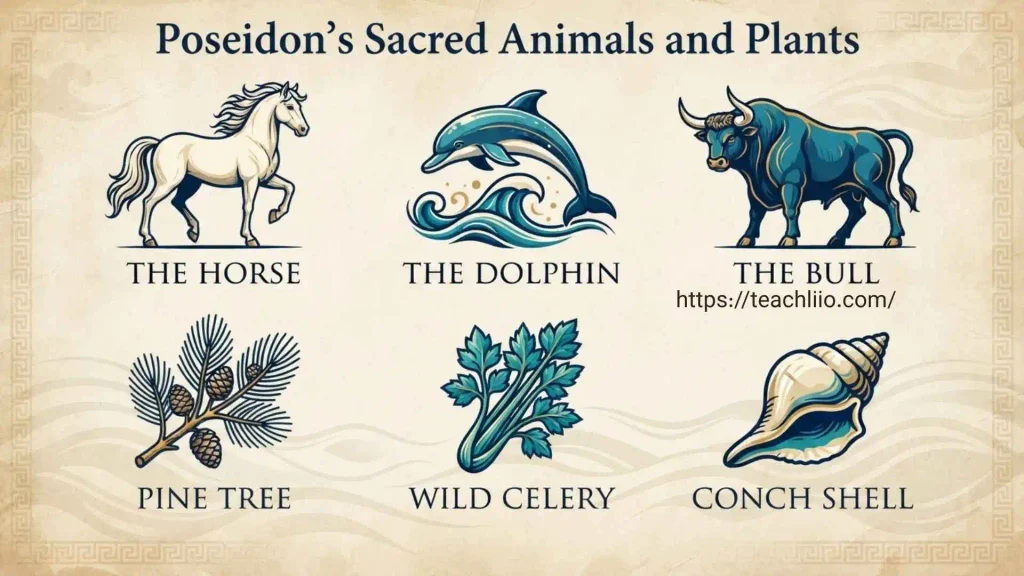
Poseidon’s Sacred Animals and Plants
Sacred Animals
The main sacred animals associated with Poseidon are:
- Horse
- Bull
- Dolphin
Fish and other marine creatures were also closely associated with him because of his sea domain.
The horse is especially important because it connects Poseidon with equestrian culture, racing, and horse mythology.
The bull reflects strength, sacrifice, and several important mythological traditions.
The dolphin represents the marine environment and frequently appears in sea-related artistic scenes.
Sacred Plants
Two plants are particularly associated with Poseidon:
- Pine
- Wild celery
Their connection is especially significant because of the Isthmian Games.
This is an example of how religious symbols can develop through worship, festivals, athletic competitions, and local traditions rather than through mythology alone.
What Do Poseidon’s Symbols Mean?
Symbols of Power
The trident is the clearest symbol of Poseidon’s authority.
It represents a divine weapon and distinguishes him from other male Olympian gods in ancient art.
The bull can also express physical strength and force, while the horse reflects Poseidon’s control over an important and powerful animal.
Symbols of the Sea
The sea, dolphin, fish, hippocamp, and marine creatures all reinforce Poseidon’s identity as a ruler of the marine world.
The hippocamp is especially distinctive because it combines a horse with a sea creature.
Symbols of Strength
Poseidon’s symbols often emphasize power rather than calmness.
The bull, horse, trident, and chariot all contribute to an image of movement and strength.
This helps explain why artistic representations of Poseidon can appear more dynamic and forceful than traditional images of Zeus.
Symbols of Destruction and Natural Forces
Earthquakes and storms reveal another side of Poseidon.
Ancient Greeks lived with natural forces they could not control. Mythology often expressed those forces through divine personalities.
Poseidon could therefore represent both the benefits and dangers of water and nature: the sea could provide travel and food, but it could also become violent and destructive.
Poseidon’s Trident and the Contest With Athena
One of the most famous stories involving Poseidon’s trident is his contest with Athena for control of Attica.
According to the myth, the gods decided that the land would belong to whichever deity provided the most useful gift.
Poseidon struck the ground with his trident and produced a source of salt water. Athena offered the olive tree.
Athena ultimately won the contest, and Athens became associated with her.
This story is important for understanding Poseidon’s symbolism because several themes come together: the trident, water, territorial power, and competition between gods.
It also shows that Poseidon’s role in Greek mythology was not limited to the sea.
How to Recognize Poseidon in Ancient Greek Art
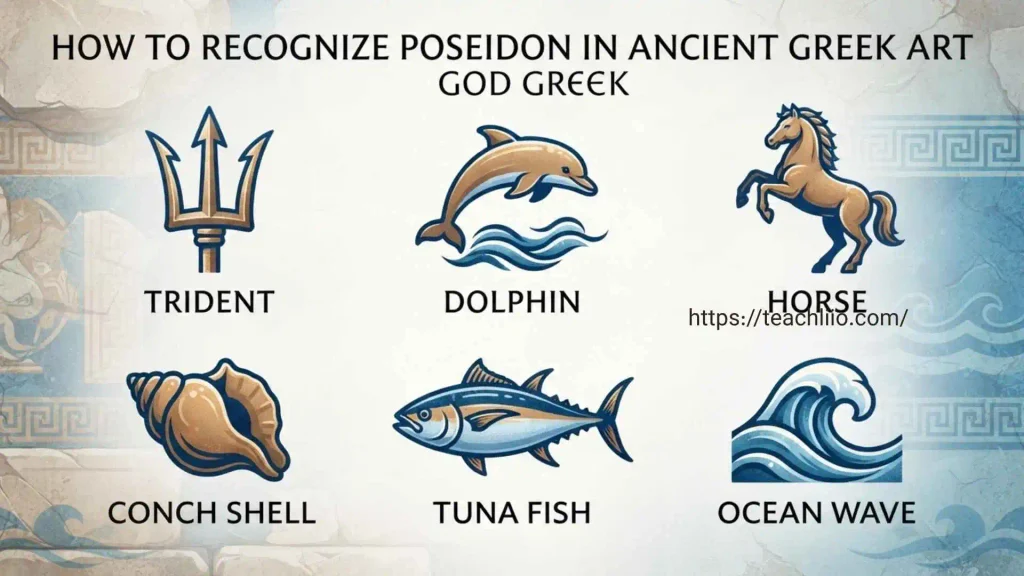
If you encounter an ancient statue, vase painting, mosaic, or relief and want to determine whether it represents Poseidon, look for several clues.
Look for the Trident
The trident is usually the strongest identifying feature.
A mature, bearded male holding a three-pronged weapon is a major clue that the figure may be Poseidon.
Look for Dolphins or Sea Creatures
Dolphins, fish, waves, and other marine imagery can strengthen the identification.
However, marine imagery alone is not enough because several Greek gods and mythological figures were connected with the sea.
Look for a Horse or Hippocamp
A horse, especially a fish-tailed hippocamp, is another strong clue.
Poseidon appears in ancient art riding hippocamps and traveling in chariots drawn by them.
Look for a Chariot
A sea-going chariot pulled by hippocamps is strongly associated with Poseidon.
When a bearded male god holds a trident while riding across the sea in such a chariot, the identification is especially clear.
Ancient artistic traditions repeatedly use these attributes to distinguish Poseidon from visually similar gods.
Poseidon’s Symbols in Ancient Greek Religion
Poseidon’s symbols were not merely decorative.
His worship existed across different parts of the Greek world, with important sanctuaries and festivals devoted to him.
The sanctuary at the Isthmus of Corinth was particularly important. The Isthmian Games were held in his honor and became one of the major athletic festivals of ancient Greece.
His worship also reflected his varied roles. He could be approached as a sea god, a god of horses, a deity connected with earthquakes, and a power associated with water sources.
This broader religious context is important because it prevents us from interpreting every symbol as if it had one fixed modern definition.
For example, the horse does not need to mean “freedom” in every context. Historically, its connection with Poseidon is better understood through his role as a horse deity and his association with horse taming and racing.
Poseidon vs. Neptune
Poseidon is the Greek god, while Neptune is the Roman counterpart with whom the Romans identified him.
As Greek mythology was adopted and adapted within Roman culture, many attributes associated with Poseidon became associated with Neptune as well.
This is why Roman mosaics and artworks may depict Neptune with a trident, hippocamps, dolphins, and a sea-going chariot.
When researching ancient mythology, it is useful to distinguish the Greek and Roman traditions even when the two gods are closely identified.
Frequently Asked Questions
What is Poseidon’s main symbol?
Poseidon’s main and most recognizable symbol is the trident. It is his distinctive divine weapon and one of the primary ways he is identified in ancient Greek art.
What are Poseidon’s sacred animals?
Poseidon’s major sacred animals are the horse, bull, and dolphin. Fish and other marine creatures are also strongly associated with him because of his connection with the sea.
What plant represents Poseidon?
The pine tree and wild celery are important plants associated with Poseidon. Both are connected with traditions surrounding his worship and the Isthmian Games.
Why does Poseidon carry a trident?
The trident is Poseidon’s divine weapon. Mythology describes it as having been made for him by the Cyclopes. It became the clearest visual representation of his power over the sea and natural forces.
Why is Poseidon associated with horses?
Poseidon had an important role as a horse deity. Ancient traditions connected him with horse taming, horse racing, chariots, and the creation or origin of horses.
Why is Poseidon called the Earth-Shaker?
Poseidon was associated with earthquakes and was known by titles referring to his ability to shake the earth. This is one reason he was viewed as a powerful and potentially destructive natural deity.
What does Poseidon’s dolphin symbolize?
The dolphin primarily reinforces Poseidon’s connection with the sea and marine life. It is also an important artistic attribute associated with Poseidon and other marine figures.
What does the bull symbolize for Poseidon?
The bull is one of Poseidon’s sacred animals and appears in important mythological and religious traditions. It can be understood in connection with strength, sacrifice, and the powerful aspects of his worship.
What is a hippocamp?
A hippocamp is a mythical creature with the upper body of a horse and the lower body of a fish. In ancient and later art, hippocamps are frequently shown drawing Poseidon’s chariot through the sea.
How can you recognize Poseidon in Greek art?
Look for a trident, mature bearded male figure, dolphin, horse, hippocamp, sea setting, or marine chariot. The trident is usually the strongest identifying attribute.
Conclusion
Poseidon’s symbols reveal that he was much more than simply the Greek god of the sea.
His trident represents divine authority and is his most recognizable attribute. The sea reflects his principal domain, while the horse reveals his important role as a horse deity. The dolphin and bull are sacred animals, while the hippocamp and chariot connect his equine and marine identities.
His association with earthquakes explains the title Earth-Shaker, while the pine tree and wild celery connect him with the religious traditions surrounding the Isthmian Games.
Together, these symbols present Poseidon as a complex god of sea, horses, earthquakes, water, strength, and unpredictable natural power.
If you are studying Greek mythology, interpreting ancient artwork, or simply looking for the meaning behind Poseidon’s symbols, the most important thing to remember is that his symbolism does not come from one single source. It developed through mythology, religious worship, sacred animals and plants, artistic traditions, and regional practices across the ancient Greek world.

I’m Hugo Wetherby, a British author interested in the numbers behind everyday questions. I explore quantities, populations, measurements, records, comparisons, and surprising statistics, turning complicated information into accessible answers. I believe a simple “how many” question can lead to fascinating discoveries, and I enjoy helping readers find those answers.
Books:
How Many? A Guide to Everyday Numbers
The Great Book of Numbers and Quantities