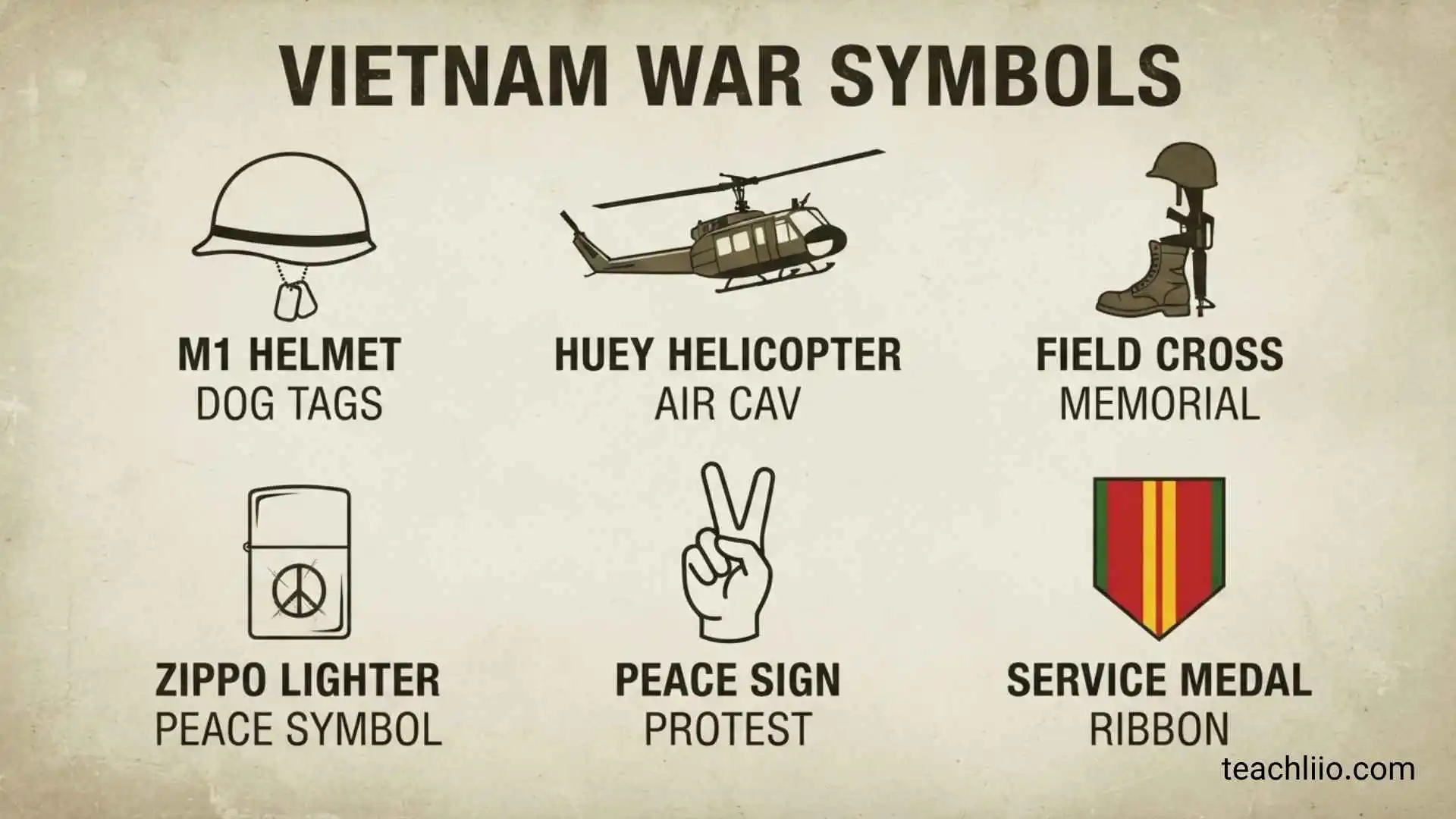
The Vietnam War is remembered through many powerful symbols connected with military service, sacrifice, protest, remembrance, loss, and political identity. However, there is no single official symbol that represents the entire Vietnam War. Instead, different symbols represent different experiences and perspectives surrounding the conflict.
Some of the best-known examples include the Vietnam Veterans Memorial, POW/MIA flag, Vietnam Service Medal, Vietnam Memorial Wall symbols, peace symbol, South Vietnamese flag, military insignia, and Huey helicopter. Others are connected with veterans, anti-war demonstrations, Vietnamese history, or the process of remembering those who served and died.
Understanding these symbols requires looking at what they represent, who used them, and how their meanings developed over time. This guide explains the most important Vietnam War symbols and separates official or institutional symbols from broader cultural images associated with the war.
Vietnam War Symbols at a Glance
| Symbol | Main Meaning |
| Vietnam Veterans Memorial | Remembrance, sacrifice, and loss |
| Vietnam Memorial Wall | Names and memory of those who died or remained missing |
| Diamond on the Wall | Confirmed or presumed death |
| Cross on the Wall | Missing in action status |
| POW/MIA Flag | Commitment to missing and unaccounted-for personnel |
| Vietnam Service Medal | Qualifying U.S. military service |
| Three Servicemen Statue | Military service, sacrifice, and veterans |
| Vietnam Women’s Memorial | Women’s service and sacrifice |
| In Memory Plaque | Veterans who later died from service-related causes |
| Peace Symbol | Anti-war activism and peace |
| South Vietnamese Flag | Republic of Vietnam and Vietnamese diaspora identity |
| Military Patches | Unit and military-service identity |
| Huey Helicopter | Vietnam-era military operations |
| POW/MIA Bracelet | Personal remembrance of missing service members |
| Protest Signs | Opposition to the war |
What Is the Main Symbol of the Vietnam War?
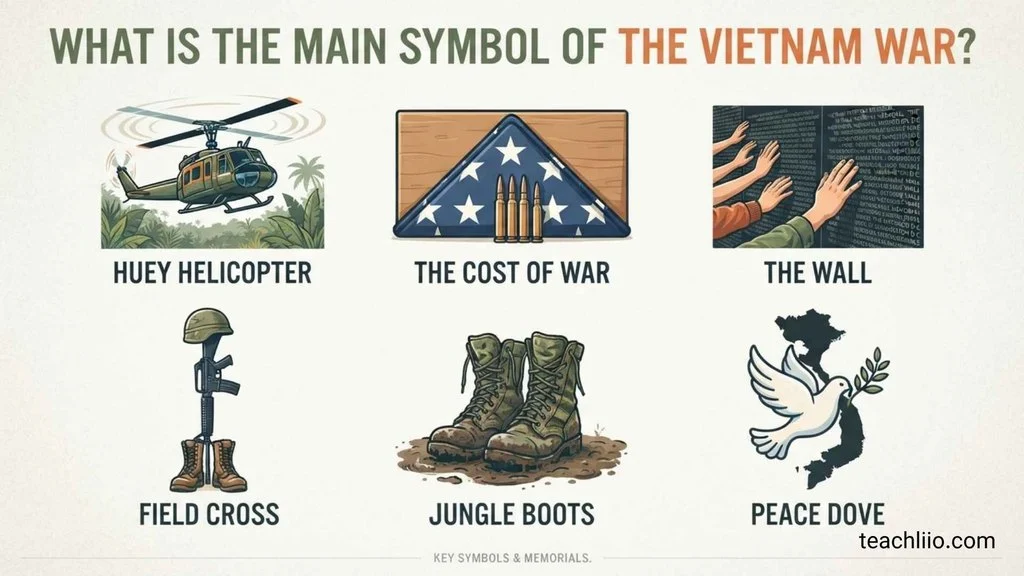
There is no single official symbol for the entire Vietnam War.
If one symbol must be identified as the most recognizable representation of remembrance, the Vietnam Veterans Memorial is one of the strongest answers. Located in Washington, D.C., the memorial honors American service members who died or remain missing from the conflict.
The memorial’s black granite Wall contains more than 58,000 names and was designed by Maya Lin. Its purpose is not to celebrate a military victory. Instead, it creates a place for remembrance, reflection, grief, and recognition of service.
The POW/MIA flag is another highly recognizable symbol, especially concerning Americans who were prisoners of war or remained missing and unaccounted for.
The important distinction is that these symbols represent different parts of the Vietnam War experience rather than one universal meaning.
Vietnam Veterans Memorial Symbols
The Vietnam Veterans Memorial is itself a major symbol, but several smaller symbols and design features within the memorial have their own meanings.
The Black Granite Wall
The Wall is the central feature of the Vietnam Veterans Memorial.
Its polished black granite surface contains the names of service members who died or were listed as missing. The reflective surface allows visitors to see themselves while looking at the names.
This creates a visual connection between the living and those being remembered.
The Wall also differs from traditional heroic war monuments. Instead of showing a commander, battlefield victory, or dramatic military scene, it focuses directly on individual names.
That makes it a symbol of personal loss as much as national history.
The V Shape of the Memorial
The Wall forms a wide V-shaped design.
One side points toward the Lincoln Memorial, while the other points toward the Washington Monument. The design gradually rises from the ground and then returns toward it.
The shape encourages visitors to walk into the memorial space rather than simply observe it from a distance.
The result is an experience centered on reflection and personal remembrance.
Why Are the Names in Chronological Order?
The names are arranged chronologically according to the dates associated with the deaths or disappearances.
This is significant because the Wall does not simply organize people alphabetically. Instead, it allows visitors to see the war as a continuing sequence of individual losses.
The earliest names and latest names meet near the center of the memorial, creating a powerful visual connection between the beginning and end of the conflict’s listed casualties.
What Do the Symbols on the Vietnam Memorial Mean?
The small symbols beside names on the Vietnam Veterans Memorial have specific meanings.
What Does the Diamond Mean?
A diamond beside a name indicates that the person’s death has been confirmed or is treated as confirmed within the Wall’s system.
It is one of the most important symbols for understanding the status of a name.
The diamond therefore represents confirmed death and remembrance.
What Does the Cross Mean?
A cross indicates that the service member was listed as missing in action.
This distinction matters because not every person listed on the Wall had the same status when the memorial was established.
The cross therefore represents uncertainty and the continuing absence of a confirmed final status.
What Happens When Remains Are Identified?
If remains of someone previously listed as missing are identified, a diamond can be superimposed over the existing cross.
This visually records a change in status while preserving the historical connection to the person’s earlier missing status.
What Happens If a Missing Service Member Returns Alive?
The memorial system provides for a circle to be placed around the cross if a person listed as missing returns alive.
This is an extremely unusual situation, but it demonstrates why the symbols were designed to communicate changing status rather than simply mark every person in the same way.
The POW/MIA Symbol and Flag
The POW/MIA symbol is one of the most recognizable Vietnam-era symbols.
POW means Prisoner of War, while MIA means Missing in Action.
The familiar black-and-white flag contains imagery associated with captivity, a watchtower, and the words “You Are Not Forgotten.”
What Does the POW/MIA Flag Represent?
The flag represents the national concern and commitment to resolving the fate of Americans who remained prisoners, missing, or unaccounted for in Southeast Asia.
It became especially important to families who did not know what had happened to their loved ones.
The National League of POW/MIA Families developed the flag during the Vietnam era, and Congress formally recognized it in 1990 as a national symbol concerning Americans still prisoner, missing, and unaccounted for in Southeast Asia.
Why Is the POW/MIA Symbol So Important?
The symbol transforms an unresolved military issue into something visible and personal.
Instead of allowing missing service members to disappear from public memory, the flag communicates that their cases remain important.
It therefore represents:
- Remembrance
- Uncertainty
- Family sacrifice
- Accountability
- Hope
- National responsibility
Its meaning has also expanded beyond Vietnam because it is used in remembrance of POW and MIA personnel from other conflicts.
Vietnam War Veteran and Military Symbols
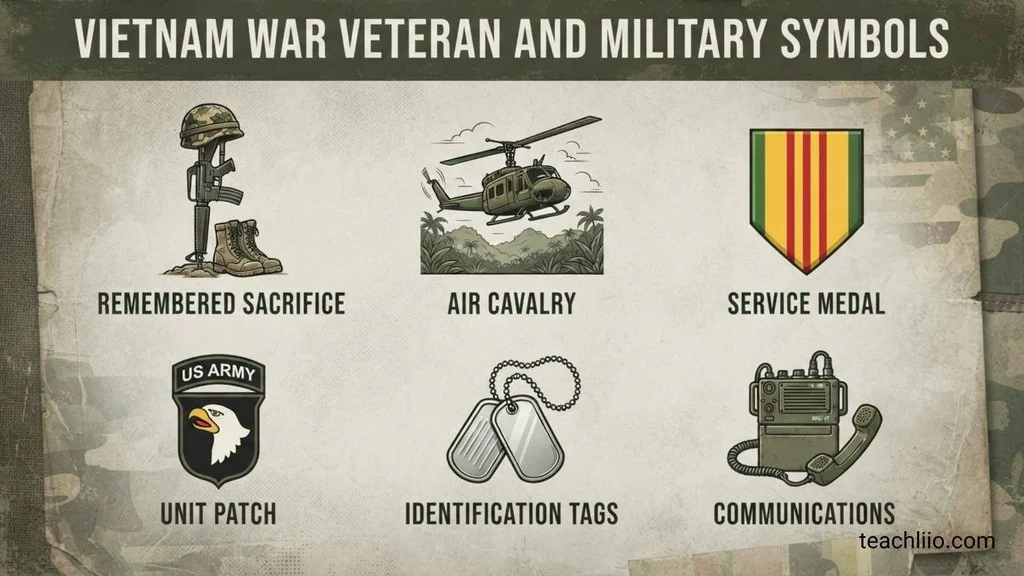
Many Vietnam War symbols are connected directly with military service.
Vietnam Service Medal
The Vietnam Service Medal is an official U.S. military decoration associated with qualifying service during the Vietnam War era.
Unlike a protest sign or cultural image, it is an institutional military symbol.
For veterans and their families, the medal can represent:
- Military duty
- Service
- Deployment
- Sacrifice
- Recognition
Its meaning is personal because it connects an individual veteran with their documented military service.
Military Unit Patches and Insignia
Military patches can be extremely meaningful Vietnam War symbols.
A patch may identify a division, regiment, brigade, squadron, or other military organization.
For a veteran, the insignia may immediately recall the people, locations, aircraft, missions, and experiences connected with that unit.
This is why military patches are often more than decorative objects. They can function as personal historical records.
POW/MIA Bracelets
POW/MIA bracelets became another powerful way for Americans to remember individual missing service members.
Many bracelets carried the name of a specific person.
Instead of representing missing service members as an anonymous group, the bracelet connected public awareness to an individual identity.
This made the symbol highly personal and helped families and supporters keep specific names in public memory.
Memorial Symbols Beyond the Wall
The Vietnam Veterans Memorial complex contains more than the famous black Wall.
The Three Servicemen Statue
The Three Servicemen statue was added to the memorial in 1984.
It depicts three American service members wearing Vietnam-era combat equipment.
The figures represent the experience of soldiers and the bonds created through military service.
The statue also adds a human form to a memorial otherwise dominated by names carved into stone.
Together, the figures and the Wall create two different approaches to remembrance: one focuses on individual names, while the other shows representative service members.
The Vietnam Women’s Memorial
The Vietnam Women’s Memorial recognizes women who served during the Vietnam era.
The sculpture depicts three women caring for a wounded soldier.
It highlights an important part of the war that can easily be overlooked when Vietnam history is discussed only through combat troops.
Women served in military hospitals, medical roles, evacuation operations, and other support positions. The memorial therefore represents compassion, professional service, sacrifice, and the human cost of war.
The In Memory Plaque
The In Memory plaque honors people who served in Vietnam and later died from causes related to their service but were not represented through the traditional Wall listing.
This is an important symbol because the consequences of war do not necessarily end when a person leaves the battlefield.
The plaque expands the idea of remembrance beyond those who died during the conflict itself.
Vietnam War Protest Symbols
The Vietnam era also produced some of the most recognizable protest imagery in modern American history.
The Peace Symbol
The peace symbol was not created specifically for the Vietnam War.
However, it became strongly associated with the anti-war movement of the 1960s and 1970s.
It appeared on:
- Protest posters
- Buttons
- Clothing
- Signs
- Campus demonstrations
- Peace literature
For many activists, the symbol represented opposition to the war and a desire for peaceful alternatives.
It is therefore best described as a cultural and protest symbol associated with the Vietnam era, rather than an official Vietnam War symbol.
Draft Cards
The military draft became one of the most controversial aspects of the Vietnam era.
Draft cards became symbolic because they represented the government’s ability to call young men into military service.
For supporters of the war, military service could represent civic duty.
For opponents, the draft could symbolize government power and personal coercion.
Public draft-card protests therefore became visual expressions of resistance.
Protest Posters and Demonstration Signs
Anti-war demonstrations produced thousands of signs and posters.
Their messages varied widely, but common themes included peace, opposition to military intervention, civil rights, political criticism, and resistance to the draft.
These materials are important historical symbols because they show that the Vietnam War was also fought through political debate and public protest at home.
Vietnamese Political and National Symbols
The Vietnam War cannot be fully understood through an American perspective alone.
Different Vietnamese communities attach different meanings to symbols connected with the conflict.
The Former South Vietnamese Flag
The former flag of the Republic of Vietnam is yellow with three horizontal red stripes.
During the war, it represented the Republic of Vietnam.
After 1975, it continued to have cultural and political significance among many Vietnamese refugees and diaspora communities.
For some people, it represents:
- South Vietnamese heritage
- Family history
- Cultural identity
- A lost homeland
- Political memory
It is therefore important to describe the flag in historical context rather than assigning it one universal modern meaning.
North Vietnamese Revolutionary Imagery
The Democratic Republic of Vietnam used communist revolutionary symbols during the conflict.
These symbols reflected the political identity of North Vietnam and the revolutionary movement.
They help demonstrate that the Vietnam War was not simply a military confrontation. It was also connected with Vietnamese nationalism, revolutionary politics, competing governments, and the wider Cold War.
Cultural Symbols of the Vietnam War
Some objects were not official symbols but became visually inseparable from the war.
The Huey Helicopter
The UH-1 Iroquois, commonly called the Huey, became one of the most recognizable images of the Vietnam War.
Helicopters were used extensively for troop movement, evacuation, supply, and other military operations.
For veterans, the sound or image of a Huey may represent an intensely personal memory.
For the wider public, the helicopter became one of the defining visual images of the conflict.
Jungle Imagery
Dense jungle, tropical vegetation, muddy terrain, and difficult weather became common visual representations of Vietnam.
Jungle imagery reflects the challenging physical environment in which many military operations occurred.
However, it is better classified as war imagery than as an official symbol.
Combat Boots and Field Equipment
Combat boots, helmets, field packs, uniforms, and other equipment are also associated with Vietnam-era military service.
Individually, these objects are not official symbols of the Vietnam War.
Their importance comes from their connection with everyday military life.
For veterans and families, such objects can become personal symbols of service and memory.
Official Symbols vs. Cultural Symbols
One of the most important distinctions when discussing Vietnam War symbols is that not every famous Vietnam-era image is an official symbol.
Official or Institutional Symbols
These include:
- Vietnam Service Medal
- POW/MIA flag
- Military insignia
- Memorial elements
- Official recognition symbols
Memorial Symbols
These include:
- Vietnam Veterans Memorial Wall
- Diamond and cross markings
- Three Servicemen statue
- Vietnam Women’s Memorial
- In Memory plaque
Cultural Symbols
These include:
- Peace symbol
- Protest posters
- Draft cards
- Huey helicopters
- Combat boots
- Jungle imagery
- POW/MIA bracelets
This distinction improves historical accuracy because it prevents the article from presenting cultural associations as though they were legally established symbols.
What Do Vietnam War Symbols Mean Today?
Vietnam War symbols continue to have different meanings depending on who is viewing them.
For veterans, a military patch or medal may represent personal service and friendships formed during the war.
For families, the POW/MIA flag may represent years of uncertainty and the hope for answers.
For anti-war activists, the peace symbol may represent resistance to military intervention.
For Vietnamese Americans, national symbols connected with the former Republic of Vietnam may represent family history and cultural identity.
For visitors to the Vietnam Veterans Memorial, the Wall may represent grief, healing, sacrifice, and remembrance.
This variety is one of the most important facts about Vietnam War symbolism: a symbol can carry different meanings for different communities without losing its historical significance.
How to Identify a Vietnam War Symbol
If you find an unfamiliar Vietnam-era symbol on a medal, photograph, patch, flag, or family keepsake, use the surrounding context.
Identify the Object
First determine whether you are looking at a:
- Medal
- Military patch
- Flag
- Memorial symbol
- Protest symbol
- Personal keepsake
Look for Words and Numbers
Letters, abbreviations, dates, unit numbers, and names can provide important clues.
For example, military abbreviations can identify a branch or organization.
Check the Colors and Design
Military insignia often use distinctive colors, shapes, and emblems.
Flags can usually be identified by their arrangement of colors and symbols.
Consider the Historical Context
Ask where the object came from and approximately when it was used.
A symbol from a soldier’s uniform may have a very different meaning from an image printed on an anti-war poster.
Avoid Assuming Every Vietnam-Era Image Is Official
This is particularly important.
A helicopter, peace sign, jungle scene, or pair of combat boots may be strongly associated with the Vietnam War without being an official symbol.
Why Are Vietnam War Symbols Important?
Vietnam War symbols remain important because they turn complicated history into recognizable visual reminders.
They help people remember:
- Those who served
- Those who died
- Those who remain missing
- Families affected by the war
- Women who served
- Veterans who returned home
- People who protested
- Communities shaped by the conflict
They also make historical discussions more personal.
A name on a memorial, a bracelet carrying a missing soldier’s name, or a military patch can connect a large historical event with one individual life.
That is why Vietnam War symbols remain relevant decades after the fighting ended.
Frequently Asked Questions
What is the main symbol of the Vietnam War?
There is no single official symbol for the entire Vietnam War. The Vietnam Veterans Memorial and POW/MIA flag are among the most recognizable symbols associated with the conflict.
What do the symbols on the Vietnam Memorial mean?
A diamond identifies a confirmed or presumed death, while a cross identifies a person listed as missing in action. If remains are later identified, a diamond can be placed over the cross.
What does the diamond mean on the Vietnam Wall?
The diamond indicates that the person’s death has been confirmed or is treated as confirmed within the memorial’s status system.
What does the cross mean on the Vietnam Memorial?
The cross indicates a service member who was listed as missing in action.
What does POW/MIA mean?
POW means Prisoner of War, while MIA means Missing in Action. The term is used for military personnel who were captured, missing, or otherwise unaccounted for.
What does the POW/MIA flag represent?
The POW/MIA flag represents national concern and commitment regarding Americans who remained prisoners, missing, or unaccounted for in Southeast Asia. It became an important symbol of remembrance and the effort to account for missing personnel.
Is the peace symbol an official Vietnam War symbol?
No. The peace symbol existed before the Vietnam War, but it became strongly associated with the anti-war movement during the Vietnam era.
What symbol represents Vietnam veterans?
There is no single universal symbol for all Vietnam veterans. The Vietnam Veterans Memorial, Vietnam Service Medal, military unit insignia, POW/MIA imagery, and veteran memorials can all represent different aspects of Vietnam veteran service and remembrance.
Why is the Huey helicopter associated with Vietnam?
The Huey became strongly associated with the Vietnam War because helicopters were extensively used for troop transport, evacuation, supply, and other military operations.
What does the South Vietnamese flag represent?
Historically, the yellow flag with three red stripes represented the Republic of Vietnam. Today, it also carries cultural and political significance for many members of Vietnamese communities outside Vietnam.
Are all Vietnam War symbols military symbols?
No. Vietnam War symbolism includes military, memorial, political, protest, cultural, and personal symbols.
Why are Vietnam War symbols still important?
They help preserve memories of military service, sacrifice, loss, protest, missing personnel, and the long-term effects of the war on veterans, families, and communities.
Conclusion
Vietnam War symbols represent far more than military conflict. They tell stories about service, sacrifice, remembrance, protest, political identity, family loss, and the difficult process of understanding a deeply divisive period in history.
The Vietnam Veterans Memorial is one of the strongest symbols of remembrance, while the diamond and cross markings on the Wall communicate specific information about the status of those listed. The POW/MIA flag represents the continuing concern for missing and unaccounted-for personnel. Military medals and insignia represent service, while the peace symbol and protest imagery reflect opposition to the war.
Other images, including the Huey helicopter, combat equipment, and jungle scenes, became cultural representations of the Vietnam experience without being official symbols.
The most useful way to understand these symbols is to ask three questions: What does the symbol represent? Who used it? And what historical context gave it meaning?
Looking at Vietnam War symbols this way turns a simple list into a deeper understanding of the people, experiences, and memories connected with one of the most consequential conflicts of the twentieth century.

I’m Oscar Radcliffe, a British writer who enjoys uncovering the numbers hidden within ordinary questions. My work explores quantities, counts, statistics, measurements, and fascinating comparisons across different subjects. I aim to present reliable information clearly, helping readers satisfy their curiosity while discovering interesting facts they may never have considered before.
Books:
The Science of Counting
How Many? Fascinating Numbers Explained