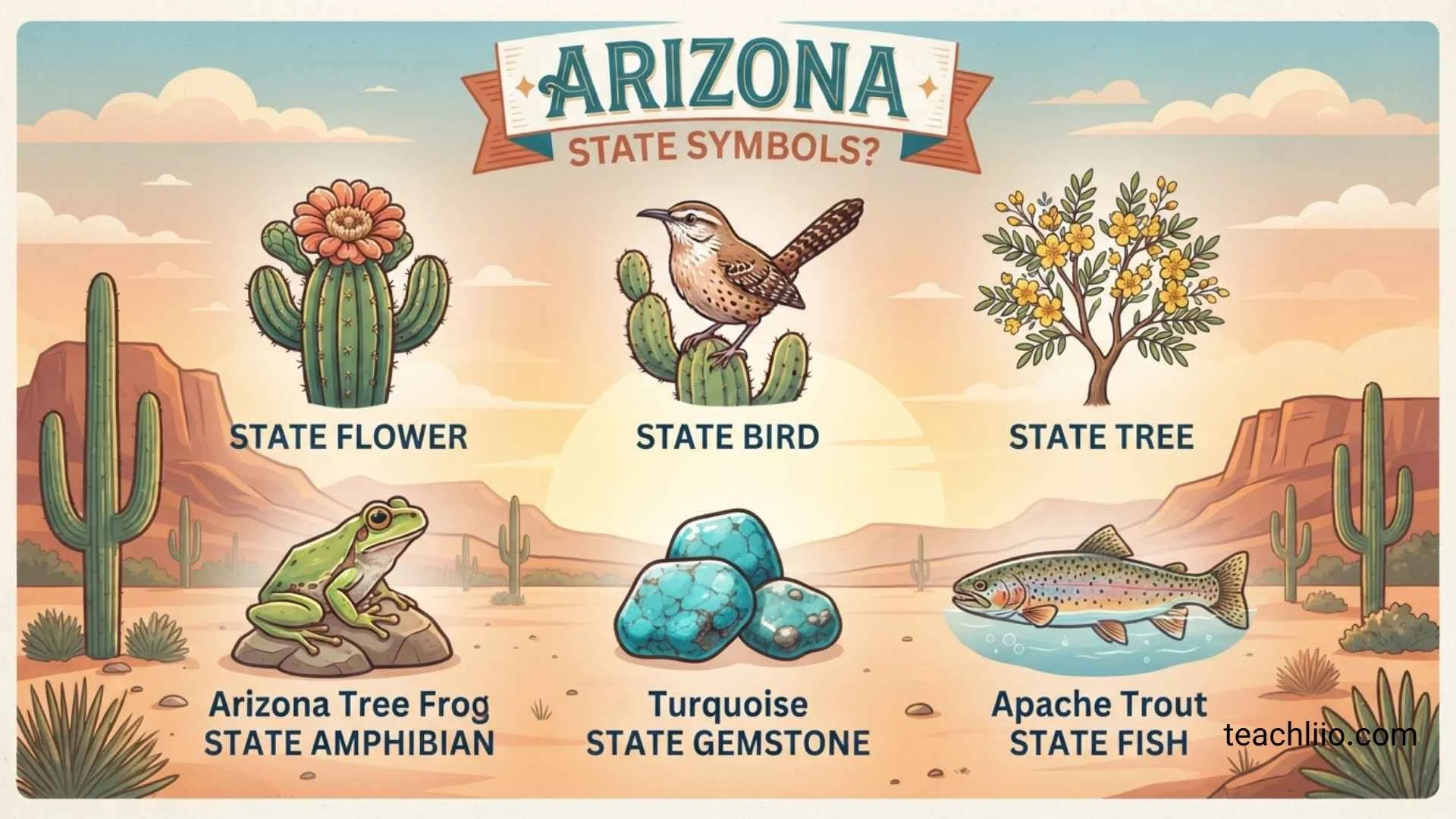
Arizona state symbols reflect the state’s desert landscape, wildlife, mining history, Western heritage, and cultural identity. From the cactus wren and saguaro blossom to turquoise, copper, petrified wood, and the Grand Canyon State nickname, each official symbol represents a different part of Arizona.
Arizona has more official symbols than many people realize. The state’s recognized emblems include a bird, flower, tree, mammal, reptile, fish, amphibian, butterfly, gemstone, fossil, metal, mineral, dinosaur, firearm, drink, neckwear, flag, nickname, and more. Arizona law also recognizes Pluto as the state’s official planet.
This guide explains the major Arizona state symbols and their meanings, including why each one was selected and how it connects to the state’s history, environment, and identity.
Arizona State Symbols at a Glance
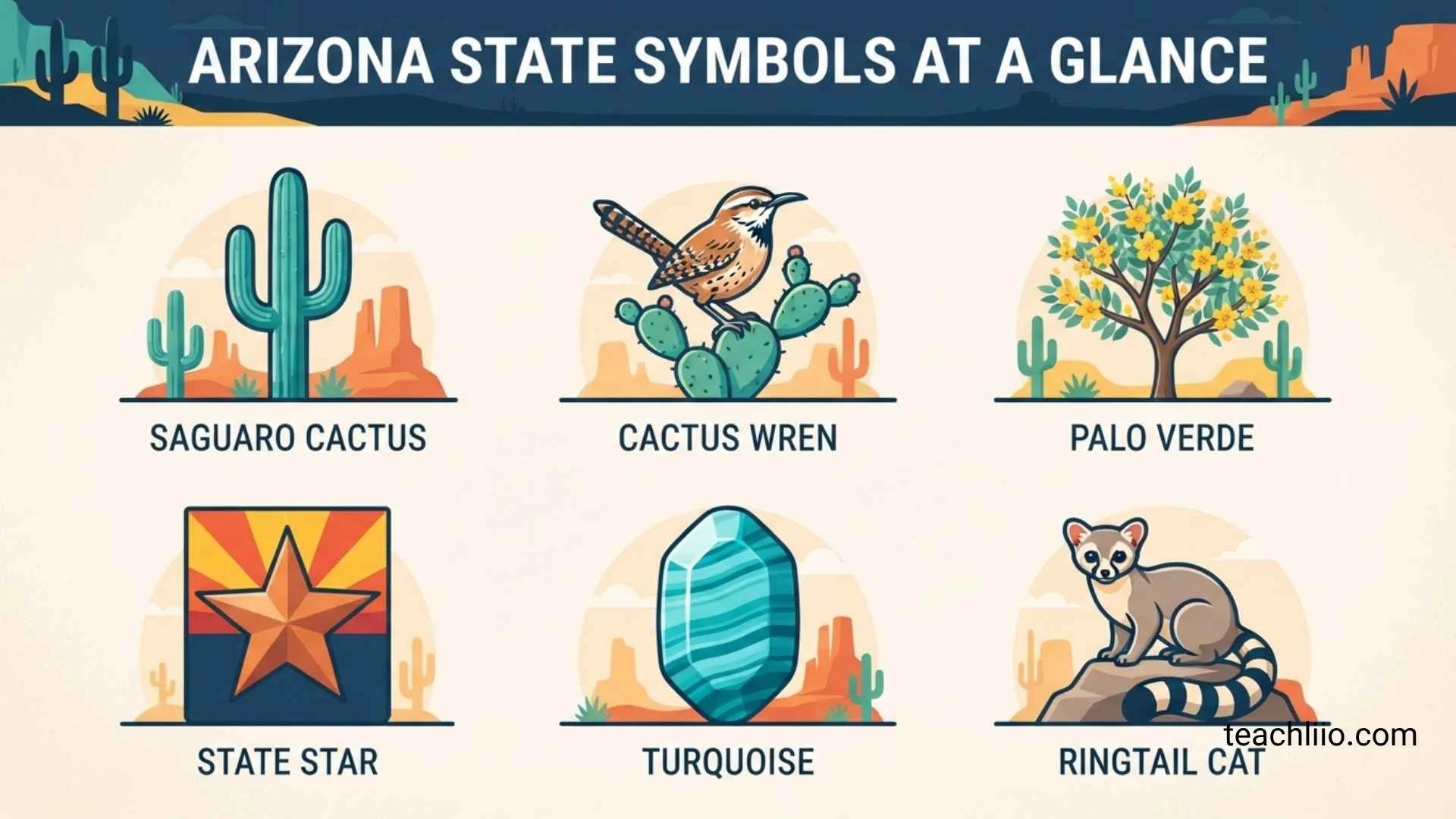
The following table provides a quick reference for Arizona’s major official symbols.
| Category | Arizona State Symbol |
| State Bird | Cactus Wren |
| State Flower | White Blossom of the Saguaro |
| State Tree | Palo Verde |
| State Mammal | Ringtail |
| State Reptile | Arizona Ridge-Nosed Rattlesnake |
| State Fish | Apache Trout |
| State Amphibian | Arizona Tree Frog |
| State Butterfly | Two-Tailed Swallowtail |
| State Gem | Turquoise |
| State Fossil | Petrified Wood |
| State Metal | Copper |
| State Mineral | Wulfenite |
| State Dinosaur | Sonorasaurus |
| State Firearm | Colt Single Action Army Revolver |
| State Drink | Lemonade |
| Official Neckwear | Bola Tie |
| State Nickname | The Grand Canyon State |
| State Planet | Pluto |
| State Colors | Blue and Gold |
| State Flag | Arizona State Flag |
| State Seal | Great Seal of Arizona |
| State Motto | Ditat Deus, “God Enriches” |
| State Anthem | “The Arizona March Song” |
Arizona’s official-symbol resources maintained by the Arizona State Library include the major animal, plant, geological, cultural, and governmental symbols listed above. Arizona Revised Statutes separately identify the state’s legal emblems and include the newer state-planet designation.
Arizona State Bird
Cactus Wren
The cactus wren is Arizona’s official state bird. Its scientific name is Campylorhynchus brunneicapillus. It is a brown, speckled bird with distinctive white markings around the eyes and chest.
The cactus wren fits Arizona especially well because it is strongly associated with the desert environment. It can build its bulky nests in and around desert vegetation, including cacti.
Unlike birds associated with forests, lakes, or colder climates, the cactus wren immediately brings to mind the warm desert landscape that makes Arizona distinctive.
Why Is the Cactus Wren Arizona’s State Bird?
The bird represents Arizona’s desert environment and its ability to thrive in a challenging landscape. It is therefore more than simply a bird found in the state; it has become part of Arizona’s visual identity.
Arizona State Flower
White Blossom of the Saguaro
Arizona’s state flower is the white blossom of the saguaro, the giant cactus that is one of the most recognizable plants of the Sonoran Desert. The Arizona State Library identifies Carnegiea gigantea as the saguaro and notes that its white blossoms appear on the tips of its arms during May and June.
The saguaro itself is an iconic Arizona plant, but the official designation specifically refers to its white blossom.
Why Is the Saguaro Blossom Important?
The blossom represents the state’s desert environment and the unique plant life found in Arizona.
Its connection to the saguaro also gives the symbol strong visual recognition. When people picture Arizona’s desert, tall saguaros are often among the first images that come to mind.
Arizona State Tree
Palo Verde
Arizona’s state tree is the palo verde, specifically Parkinsonia florida. The name palo verde means “green stick,” referring to the tree’s green appearance. It grows in Arizona’s desert and foothill environments and produces yellow flowers in late spring.
The palo verde is especially appropriate as Arizona’s state tree because it is adapted to the state’s dry environment.
Why Does the Palo Verde Represent Arizona?
The tree demonstrates how plant life can thrive in desert conditions. Its green branches and yellow spring blossoms also provide a strong contrast to the dry desert landscape.
Arizona State Animals
Arizona’s official animal symbols are divided into several categories rather than being represented by one general “state animal.”
State Mammal: Ringtail
The ringtail (Bassariscus astutus) is Arizona’s state mammal. Despite sometimes being called a “ringtail cat,” it is not actually a cat. It is related to raccoons and coatimundis. Arizona designated it as the state mammal in 1986.
The ringtail has a long, bushy tail marked by alternating bands, which helps explain its common name.
Its connection with desert and canyon environments makes it a fitting representative of Arizona’s wildlife.
State Reptile: Arizona Ridge-Nosed Rattlesnake
The Arizona ridge-nosed rattlesnake (Crotalus willardi) is the state reptile.
It is a relatively small rattlesnake, generally reaching no more than about 24 inches in length, and is associated with mountain ranges in southern and south-central Arizona, including the Huachuca, Patagonia, and Santa Rita Mountains.
Its restricted Arizona habitat makes it particularly distinctive as a state symbol.
State Fish: Apache Trout
The Apache trout is Arizona’s official state fish. It has a yellowish coloration, pinkish bands, and dark spots. It is associated with Arizona’s rivers and streams.
The Apache trout is especially meaningful because it represents Arizona’s high-country freshwater ecosystems rather than the state’s better-known desert environments.
State Amphibian: Arizona Tree Frog
The Arizona tree frog is the state’s official amphibian. The Arizona State Library identifies it as Hyla wrightorum. The small frog can be green or golden in appearance and has a dark stripe running from its nose through its eye.
Its designation reminds readers that Arizona is more than desert. The state also contains mountain forests, streams, wetlands, and other habitats that support amphibians.
State Butterfly: Two-Tailed Swallowtail
Arizona’s state butterfly is the two-tailed swallowtail (Papilio multicaudata).
It became the state butterfly in 2001. The butterfly is recognizable by the two tail-like projections on each hind wing. Arizona’s State Library describes it as a strong flyer with a yellow body and distinctive blue and red markings.
Its habitat includes canyonlands, foothills, valleys, and woodlands, giving it a connection to several Arizona ecosystems.
Arizona State Geological Symbols
Arizona’s identity is closely connected with geology and mining, so it is no surprise that several official symbols come from rocks, minerals, and ancient materials.
State Gem: Turquoise
Turquoise is Arizona’s official state gem.
The blue-green stone has a long history in Southwestern jewelry and is particularly associated with Native American artistic traditions. The Arizona State Library identifies turquoise as the state’s blue-green gemstone.
Turquoise also fits naturally with Arizona’s mining history and distinctive Southwestern visual culture.
State Fossil: Petrified Wood
Arizona’s state fossil is petrified wood, specifically Araucarioxylon arizonicum.
Petrified wood began as ancient trees. Over immense periods of time, minerals replaced much of the original organic material, leaving material that looks like wood but has become stone-like.
Large amounts of Arizona’s petrified wood are associated with the Petrified Forest in northern Arizona.
State Metal: Copper
Copper is Arizona’s official state metal.
Copper has played an important role in Arizona’s mining history and economy. It was officially designated as the state metal in 2015 after legislation supported the designation. Interestingly, the idea was promoted by students who wanted Arizona to recognize copper officially.
Copper also appears symbolically on Arizona’s flag through the large copper-colored star.
State Mineral: Wulfenite
Arizona’s official state mineral is wulfenite.
It became the state mineral in 2017 under A.R.S. § 41-860.04. The mineral is known for its distinctive crystals and is associated with lead-bearing deposits in several Arizona areas.
Wulfenite gives Arizona’s state-symbol collection another direct connection to geology and mining.
Arizona State Dinosaur
Sonorasaurus
Arizona’s official state dinosaur is Sonorasaurus, scientifically known as Sonorasaurus thompsoni.
It became Arizona’s state dinosaur on April 10, 2018. Fossils were discovered in Cochise County in 1994. The dinosaur was a large plant-eating animal that resembled a smaller version of the long-necked Brachiosaurus.
The Sonorasaurus is an especially interesting symbol because it connects modern Arizona with the state’s much older geological and prehistoric history.
Arizona State Flag
What Does the Arizona Flag Look Like?
Arizona’s flag has a blue lower half and thirteen alternating red and yellow rays across the upper half. A large copper-colored star sits in the center.
The design is one of the most recognizable state flags in the United States.
What Do the 13 Rays Mean?
The thirteen rays represent the 13 original American colonies. They also resemble the rays of a setting sun, reflecting Arizona’s western location. The red and yellow colors have historical associations with Spanish colors.
What Does the Copper Star Mean?
The copper-colored star represents Arizona’s historic connection to copper production.
The state flag was designed by Colonel Charles W. Harris in 1910 for Arizona’s National Guard rifle team, and the design was adopted by the legislature in 1917.
What Are Arizona’s State Colors?
Arizona’s official colors are blue and gold. The state flag also prominently uses red, yellow, blue, and copper, but blue and gold are recognized as the official state colors.
Arizona State Seal
What Is Shown on the Great Seal of Arizona?
Arizona’s Great Seal contains a detailed scene representing important parts of the state’s landscape and early economy.
The seal includes:
- Mountains
- A rising sun
- A reservoir and dam
- Irrigated fields
- Orchards
- Cattle
- A quartz mill
- A miner holding a pick and shovel
The Arizona State Library explains that the seal also includes the state motto and the year 1912, when Arizona entered the Union.
What Does “Ditat Deus” Mean?
Arizona’s state motto is “Ditat Deus,” a Latin phrase meaning “God Enriches.” The phrase appears on the Great Seal.
The seal therefore combines Arizona’s natural environment, agriculture, ranching, mining, and statehood history into one official emblem.
Arizona State Nickname
The Grand Canyon State
Arizona’s official nickname is The Grand Canyon State.
The name refers to the Grand Canyon, one of Arizona’s most famous natural landmarks. The Arizona State Library notes that most of the canyon lies within Grand Canyon National Park in Arizona.
The nickname is particularly appropriate because the Grand Canyon is one of the state’s most internationally recognized features.
Arizona Official Neckwear
Bola Tie
Arizona’s official neckwear is the bola tie, also spelled bolo tie.
The Arizona State Library describes it as a Western-style accessory consisting of a thin braided cord and decorative slide. It became Arizona’s official neckwear through legislation in 1971.
The bola tie represents Arizona’s Western identity and remains one of the state’s most unusual official symbols.
Arizona State Drink
Lemonade
Arizona’s official state drink is lemonade.
The designation became law in 2019 through HB 2692. The effort was led by Garrett Glover, a teenager from Gilbert who connected the idea to Arizona’s traditional “Five C’s” and noticed that citrus was not represented among the state’s official symbols.
The choice is especially fitting for a state known for hot weather and citrus production.
Arizona State Firearm
Colt Single Action Army Revolver
Arizona’s official state firearm is the Colt Single Action Army revolver.
The designation became official in 2011 through A.R.S. § 41-860.02. The Arizona State Library identifies the Colt Single Action Army as the state firearm and notes its connection to the state’s Western history.
This symbol is best understood as a historical and cultural emblem connected with Arizona’s territorial and Old West identity.
Arizona State Planet
Pluto
One of Arizona’s more unusual official symbols is Pluto, designated as the state’s official planet.
Arizona added the designation through HB 2477 in 2024. The Arizona Legislature’s current statute states that Pluto is the official state planet.
The choice has a strong Arizona connection because Pluto was discovered in 1930 by astronomer Clyde Tombaugh at Lowell Observatory in Flagstaff. Arizona’s legislative materials specifically cite that connection when discussing the designation.
Although Pluto is scientifically classified as a dwarf planet, Arizona’s law specifically uses the term state planet.
Arizona State Symbols and Their Meanings
Arizona’s symbols can be grouped into several themes.
Desert and Plant Life
The saguaro blossom and palo verde represent Arizona’s distinctive desert environment.
The cactus wren also reinforces this desert identity because it is strongly associated with Arizona’s arid landscape.
Wildlife and Natural Habitats
The ringtail, ridge-nosed rattlesnake, Apache trout, Arizona tree frog, and two-tailed swallowtail demonstrate that Arizona contains much more ecological diversity than the stereotypical desert image suggests.
The symbols represent mountains, forests, streams, canyonlands, and desert habitats.
Mining and Geology
Copper, wulfenite, turquoise, and petrified wood connect Arizona with its geology, mining history, and natural resources.
Copper’s presence on the flag makes this connection particularly visible.
Western Heritage
The bola tie and Colt Single Action Army revolver reflect Arizona’s Western cultural history.
These symbols represent a different side of the state from its wildlife and geology.
Official Arizona Symbols vs. Popular Arizona Icons
Not everything strongly associated with Arizona is officially designated as a state symbol.
For example, the Grand Canyon is an enormous part of Arizona’s identity, but it is more accurate to distinguish the landmark itself from the state’s official nickname, The Grand Canyon State.
Similarly, the saguaro cactus is one of Arizona’s most recognizable natural icons, while the official flower is specifically the white blossom of the saguaro.
This distinction matters because an article about Arizona state symbols should not present every famous Arizona object as though it were established by state law.
Arizona’s statutory list of state emblems provides the clearest framework for determining which designations are officially recognized.
Why Does Arizona Have So Many State Symbols?
State symbols serve different purposes.
Some represent Arizona’s natural environment. Others preserve historical traditions or highlight industries that shaped the state’s development.
For example:
- The cactus wren reflects desert wildlife.
- The saguaro blossom represents native desert plant life.
- The palo verde represents desert trees.
- Copper represents mining and industry.
- Turquoise reflects Southwestern geology and artistic traditions.
- Petrified wood connects Arizona with prehistoric landscapes.
- The bola tie represents Western culture.
- The Grand Canyon State nickname highlights one of Arizona’s most famous natural landmarks.
- Pluto recognizes an important connection between Arizona and astronomical discovery.
Together, these symbols create a broad picture of the state rather than relying on one image.
Arizona State Symbols for Students and Quick Study
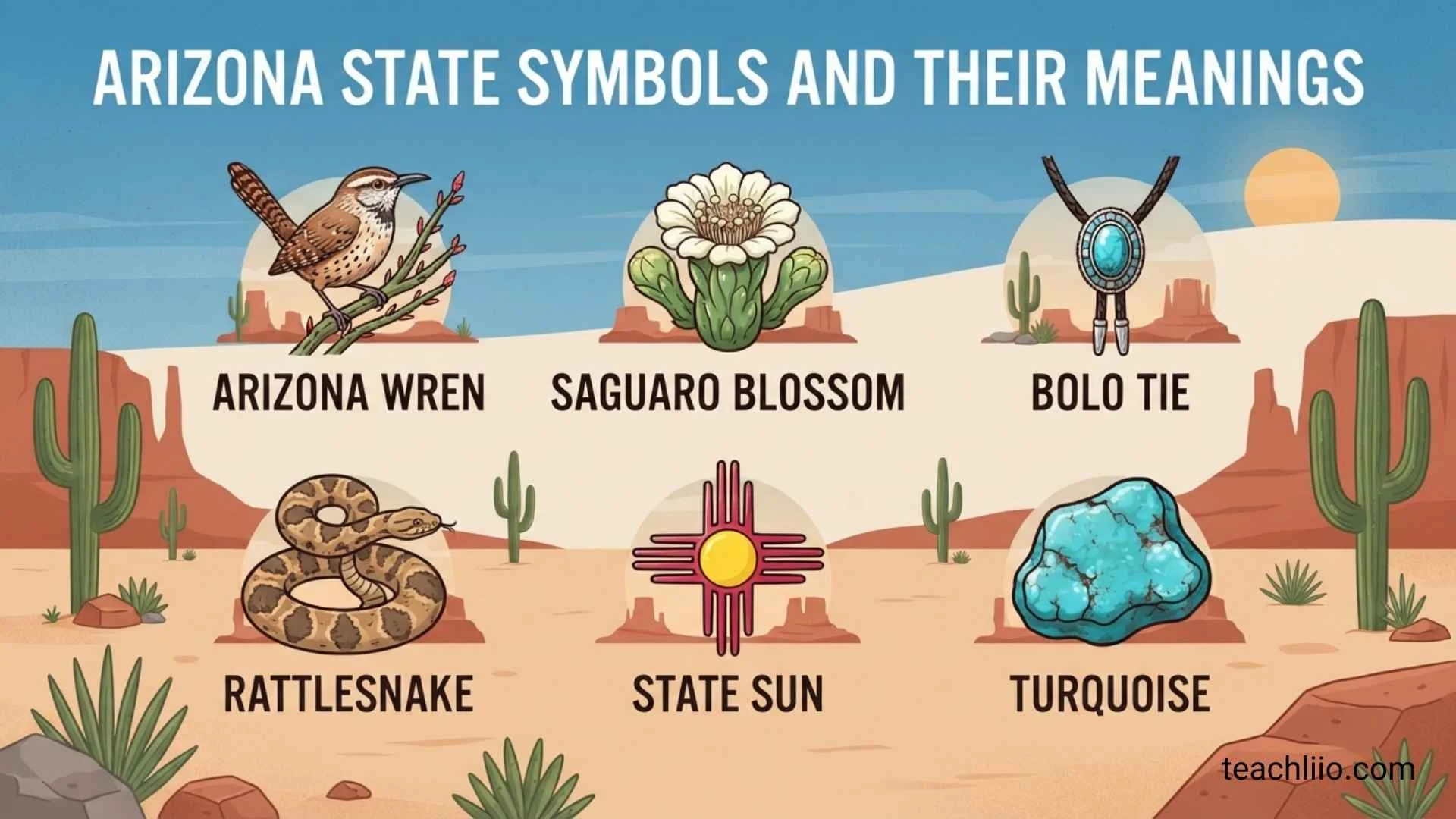
For students who need a simple way to remember the most important symbols, start with these:
Bird: Cactus Wren
Flower: Saguaro Blossom
Tree: Palo Verde
Mammal: Ringtail
Reptile: Arizona Ridge-Nosed Rattlesnake
Fish: Apache Trout
Amphibian: Arizona Tree Frog
Butterfly: Two-Tailed Swallowtail
Gem: Turquoise
Fossil: Petrified Wood
Metal: Copper
Mineral: Wulfenite
Dinosaur: Sonorasaurus
Drink: Lemonade
Neckwear: Bola Tie
Nickname: The Grand Canyon State
Planet: Pluto
Arizona’s official state-symbol resources and statutes support these designations.
Frequently Asked Questions
What are Arizona’s official state symbols?
Arizona has official symbols covering plants, animals, geology, history, culture, government, and other categories. Major examples include the cactus wren, saguaro blossom, palo verde, ringtail, turquoise, copper, petrified wood, Sonorasaurus, bola tie, lemonade, and Pluto.
What is Arizona’s state bird?
Arizona’s state bird is the cactus wren. It is a brown, speckled bird strongly associated with the state’s desert environment.
What is Arizona’s state flower?
Arizona’s state flower is the white blossom of the saguaro. The blossoms appear on the ends of the saguaro’s arms, especially during May and June.
What is Arizona’s state tree?
The palo verde is Arizona’s official state tree. Its name means “green stick,” and it is well adapted to Arizona’s desert and foothill environments.
What is Arizona’s state animal?
Arizona does not simply use one animal for every animal-related category. Its official animal symbols include the ringtail as the state mammal, Arizona ridge-nosed rattlesnake as the state reptile, Apache trout as the state fish, and Arizona tree frog as the state amphibian.
What is Arizona’s state gemstone?
Turquoise is Arizona’s state gem. The blue-green stone has a strong connection to Southwestern jewelry and Arizona’s mineral heritage.
What is Arizona’s state fossil?
Arizona’s state fossil is petrified wood, much of which is associated with the Petrified Forest in northern Arizona.
What is Arizona’s state mineral?
Wulfenite became Arizona’s official state mineral in 2017. It is known for its distinctive crystals and occurs in mineral deposits in several parts of the state.
What is Arizona’s state metal?
Arizona’s state metal is copper. It became the official state metal in 2015.
What is Arizona’s state dinosaur?
Arizona’s state dinosaur is Sonorasaurus thompsoni. It became the official state dinosaur in 2018 after fossils were discovered in Cochise County.
What is Arizona’s state drink?
Lemonade is Arizona’s official state drink. It became the state drink in 2019.
What is Arizona’s state neckwear?
The bola tie is Arizona’s official neckwear. It became an official state symbol in 1971.
What is Arizona’s state nickname?
Arizona’s official nickname is The Grand Canyon State, a reference to the Grand Canyon and its importance to Arizona’s identity.
What is Arizona’s state planet?
Pluto is Arizona’s official state planet under A.R.S. § 41-860.08. The designation was enacted in 2024, recognizing Arizona’s connection to Pluto’s discovery at Lowell Observatory in Flagstaff.
What do the symbols on the Arizona flag mean?
The Arizona flag has 13 red and yellow rays representing the original 13 colonies and resembling a setting sun. The copper-colored star represents Arizona’s copper industry, while the blue field connects with the blue of the U.S. flag.
What does Ditat Deus mean on Arizona’s state seal?
Ditat Deus is Latin for “God Enriches.” The phrase appears on Arizona’s Great Seal above imagery representing the state’s landscape and historical industries.
Why does Arizona have Pluto as a state symbol?
Arizona designated Pluto as its official state planet partly because astronomer Clyde Tombaugh discovered Pluto at Lowell Observatory in Flagstaff in 1930.
Conclusion
Arizona state symbols tell the story of a state shaped by desert landscapes, diverse wildlife, geology, mining, agriculture, Western history, and scientific discovery.
The cactus wren represents desert wildlife, the saguaro blossom represents native plant life, and the palo verde reflects the state’s desert vegetation. The ringtail, ridge-nosed rattlesnake, Apache trout, Arizona tree frog, and two-tailed swallowtail showcase Arizona’s varied ecosystems.
Geological symbols such as turquoise, petrified wood, copper, and wulfenite highlight the state’s mineral wealth and geological history. Meanwhile, the bola tie, Colt Single Action Army revolver, and lemonade provide some of the more unusual cultural symbols.
The Arizona flag and Great Seal bring many of these themes together, while the nickname The Grand Canyon State connects Arizona with its most famous natural landmark. And with Pluto officially recognized as Arizona’s state planet, the state’s symbol collection now also reflects its connection to astronomy and the discovery made at Lowell Observatory in Flagstaff.
Because official designations can change through legislation, readers should rely on current Arizona government resources when accuracy matters. The Arizona State Library and Arizona Revised Statutes provide the strongest starting points for verifying Arizona’s official state emblems.

I’m Hugo Wetherby, a British author interested in the numbers behind everyday questions. I explore quantities, populations, measurements, records, comparisons, and surprising statistics, turning complicated information into accessible answers. I believe a simple “how many” question can lead to fascinating discoveries, and I enjoy helping readers find those answers.
Books:
How Many? A Guide to Everyday Numbers
The Great Book of Numbers and Quantities