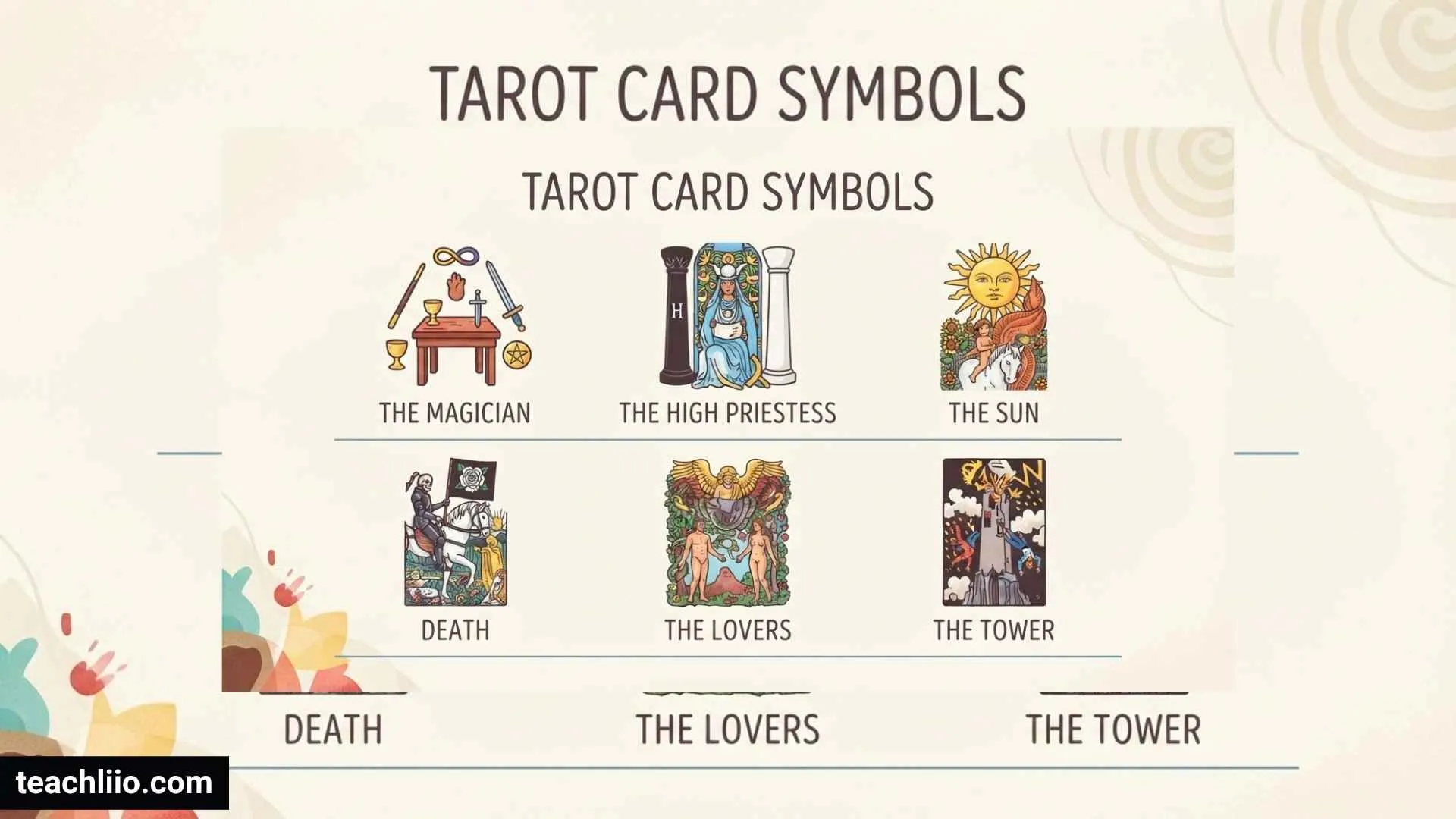
Tarot card symbols are visual clues that help explain the deeper themes of tarot cards. A moon may suggest intuition or uncertainty, a sword can represent truth or conflict, and a rose may symbolize love, beauty, or purity of intention. These images work together to create a story that helps readers explore the meaning of each card.
Whether you are learning tarot for the first time or trying to understand the details in a familiar deck, recognizing common symbols can make tarot interpretation easier. Instead of memorizing the meaning of all 78 cards, you can begin by noticing recurring objects, colors, animals, numbers, and landscapes.
This guide explores more than 35 tarot card symbols and their traditional associations. You will also learn about Major Arcana imagery, the four tarot suits, color symbolism, and practical ways to interpret the images you encounter. The examples primarily follow the Rider-Waite-Smith tradition, while recognizing that symbolism can vary between decks and readers.
What Are Tarot Card Symbols?
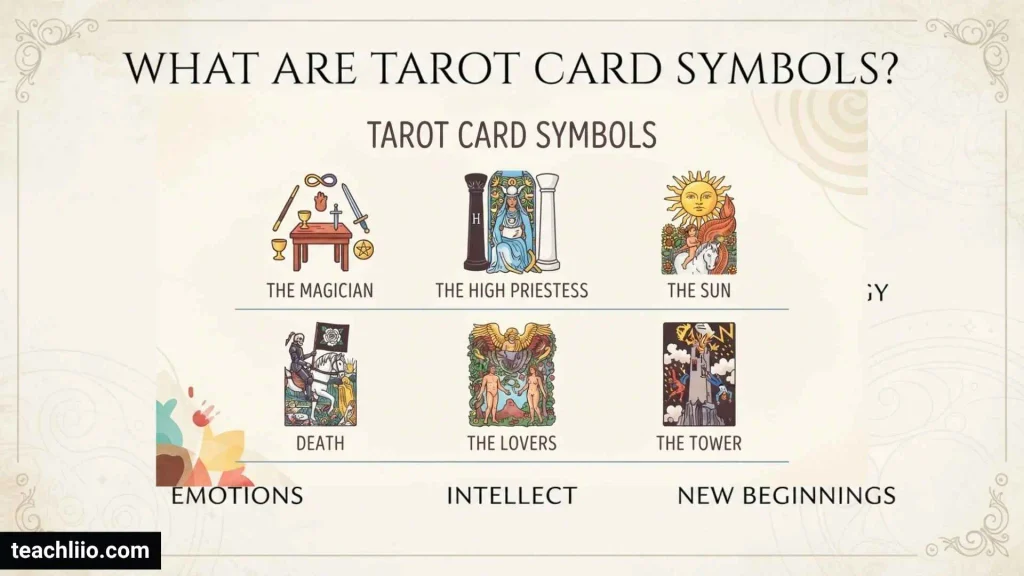
Tarot card symbols are visual elements used to communicate ideas, emotions, experiences, and themes. They can include everyday objects, natural features, animals, flowers, clothing, gestures, and celestial bodies.
For example, a cup may represent emotional experiences, while a mountain can suggest a challenge or a distant goal. A figure holding a lantern might symbolize the search for wisdom, while a winding path can represent a journey or an uncertain decision.
The Rider-Waite-Smith deck, illustrated by Pamela Colman Smith and first published in 1909, is especially well known for its detailed scenes. Arthur Edward Waite later explained the imagery and interpretations in The Pictorial Key to the Tarot. This deck is a useful starting point for beginners because many of its Minor Arcana cards contain illustrated scenes rather than only suit symbols.
However, tarot symbols do not have one universally accepted meaning. Their interpretation depends on the individual card, the surrounding imagery, the deck’s tradition, and the reader’s approach.
Common Tarot Card Symbols and Their Meanings
The following quick-reference table introduces some frequently encountered tarot symbols. These meanings are traditional associations, not fixed rules that apply to every deck or reading.
| Tarot symbol | Common meaning | Example or context |
| Sun | Vitality, clarity, optimism | The Sun |
| Moon | Intuition, dreams, uncertainty | The Moon |
| Stars | Hope, inspiration, renewal | The Star |
| White rose | Innocence, sincerity, purity | The Fool |
| Red rose | Passion, desire, vitality | Various illustrated cards |
| Water | Emotions, intuition, movement | Cups and water scenes |
| Mountains | Challenges, ambition, perspective | Background landscapes |
| Clouds | Uncertainty, inspiration, possibility | Cards with cloud imagery |
| Sword | Thought, truth, conflict | Suit of Swords |
| Cup | Emotions, relationships, intuition | Suit of Cups |
| Wand | Creativity, energy, ambition | Suit of Wands |
| Pentacle | Resources, work, stability | Suit of Pentacles |
| Infinity sign | Potential, continuity | The Magician |
| Crown | Authority, responsibility, achievement | The Emperor and court cards |
| Throne | Structure, stability, power | The Emperor |
| Pillars | Contrast, duality, balance | The High Priestess |
| Key | Access, discovery, knowledge | Deck-dependent imagery |
| Wheel | Cycles, change, turning points | Wheel of Fortune |
| Lightning | Disruption, revelation, sudden change | The Tower |
| Butterfly | Transformation, renewal | Deck-dependent imagery |
| Snake | Instinct, temptation, transformation | Context-dependent |
| Dog | Loyalty, instinct, companionship | The Fool |
| Lion | Courage, strength, self-control | Strength |
| Horse | Movement, determination, progress | The Chariot and Knight cards |
| Eagle | Perspective, vision, power | Deck-dependent imagery |
| Fish | Emotional depth, intuition, abundance | Cups imagery |
| Dove | Peace, gentleness, spiritual connection | Ace of Cups |
| Ship | Exploration, travel, transition | Three of Wands and Six of Swords |
| River | Movement, transition, emotional flow | Landscape imagery |
| Lantern | Guidance, wisdom, inner reflection | The Hermit |
| Staff | Support, direction, authority | The Hermit and other figures |
| Halo | Awareness, spiritual significance | Selected figures |
| Chain | Attachment, restriction, dependence | The Devil |
| Veil | Mystery, concealment, hidden knowledge | The High Priestess |
| Wreath | Completion, achievement, integration | The World |
| Trumpet | Awakening, announcement, renewal | Judgement |
Use this table as a starting point. The sections below explain how selected symbols work within particular cards and why their context matters.
Major Tarot Card Symbols and Their Meanings
The Major Arcana contains 22 cards, from The Fool to The World. These cards are commonly associated with significant choices, transitions, personal development, and broader life experiences.
The Fool: White Rose, Dog, and Cliff
The Fool is often associated with beginnings, curiosity, and stepping into unfamiliar territory. In the Rider-Waite-Smith illustration, several details contribute to this theme.
The white rose in the figure’s hand can suggest innocence or pure intention. The small dog may represent instinct, companionship, or a warning about the journey ahead. Meanwhile, the cliff introduces an element of risk: the figure is moving forward without a completely clear view of what lies ahead.
Together, these details suggest the excitement and uncertainty of beginning something new. The card can encourage openness while reminding readers not to ignore practical risks.
The Magician: Infinity Sign and Four Suit Symbols
The Magician stands beside a table displaying a wand, cup, sword, and pentacle. These objects represent the four Minor Arcana suits and can be interpreted as different resources or dimensions of experience.
The infinity symbol above the figure’s head is commonly associated with potential, continuity, and focused awareness. The Magician’s raised wand and downward-pointing hand also contribute to themes of directing energy and turning intention into action.
When this card appears in a reading, these symbols can prompt reflection on available skills, resources, and opportunities.
The High Priestess: Pillars, Veil, and Scroll
The High Priestess sits between two contrasting pillars, with a veil behind her. The pillars are often interpreted as opposing forces or complementary perspectives. The veil suggests that some information is hidden or not immediately accessible.
The scroll in her hand is associated with knowledge and learning. Together, these details connect the card with intuition, reflection, mystery, and the pursuit of deeper understanding.
Rather than assuming every answer is immediately available, the imagery encourages patience and careful observation.
The Empress: Wheat and Natural Imagery
The Empress is surrounded by natural elements, including vegetation and wheat. These details commonly suggest fertility, abundance, creativity, and the conditions needed for growth.
The card can encourage attention to relationships, creative projects, comfort, and the resources that support development. Its imagery emphasizes nurturing and allowing something valuable to grow over time.
The Emperor: Crown and Throne
The Emperor’s crown and throne emphasize authority, structure, and responsibility. His seated posture reinforces the idea of established power and deliberate decision-making.
These symbols can suggest the importance of boundaries, planning, and leadership. However, they can also invite questions about whether rules are providing stability or becoming unnecessarily restrictive.
The Moon: Towers, Animals, and Winding Path
The Moon contains several striking details, including two towers, a dog and a wolf, a creature emerging from the water, and a path leading into the distance.
The towers can suggest boundaries or structures that frame the unknown. The dog and wolf may represent familiar and untamed instincts, while the emerging creature reinforces the sense that something hidden is coming into awareness. The winding path adds uncertainty about what lies ahead.
Together, these elements support the card’s traditional associations with dreams, intuition, fear, and incomplete information. The Moon encourages reflection when a situation is difficult to understand clearly.
The Star: Stars and Flowing Water
The Star depicts a figure pouring water beneath a prominent star and a sky filled with smaller stars. Water connects the scene with renewal and emotional openness, while the stars suggest hope and inspiration.
The image is commonly associated with recovering confidence, finding perspective, and reconnecting with long-term aspirations after a difficult period.
The Tower: Lightning and Falling Structure
The Tower depicts lightning striking a tall structure, with figures falling from it. The lightning suggests a sudden disruption or revelation, while the collapsing building can represent an unstable belief, plan, or arrangement.
Although the scene appears destructive, its symbolic message may involve recognizing what no longer works. The card can encourage honest reassessment and rebuilding on stronger foundations.
Death: Skeletal Figure and Rising Sun
The Death card uses a skeletal figure to represent an ending or major transition. In the Rider-Waite-Smith illustration, a rising sun appears in the distance, introducing a contrasting image of continuation and renewal.
The card is commonly interpreted symbolically rather than as a literal prediction of death. Its imagery can encourage reflection on changing circumstances, releasing outdated patterns, and preparing for a new stage.
The World: Wreath and Four Corner Figures
The World features a central figure surrounded by a wreath, with four symbolic figures in the corners. The wreath is associated with completion, while the surrounding imagery suggests the integration of different dimensions of experience.
The card commonly represents achievement, fulfillment, and the closing of an important cycle. It can invite reflection on what has been learned and what may come next.
What Do the Four Tarot Suit Symbols Mean?
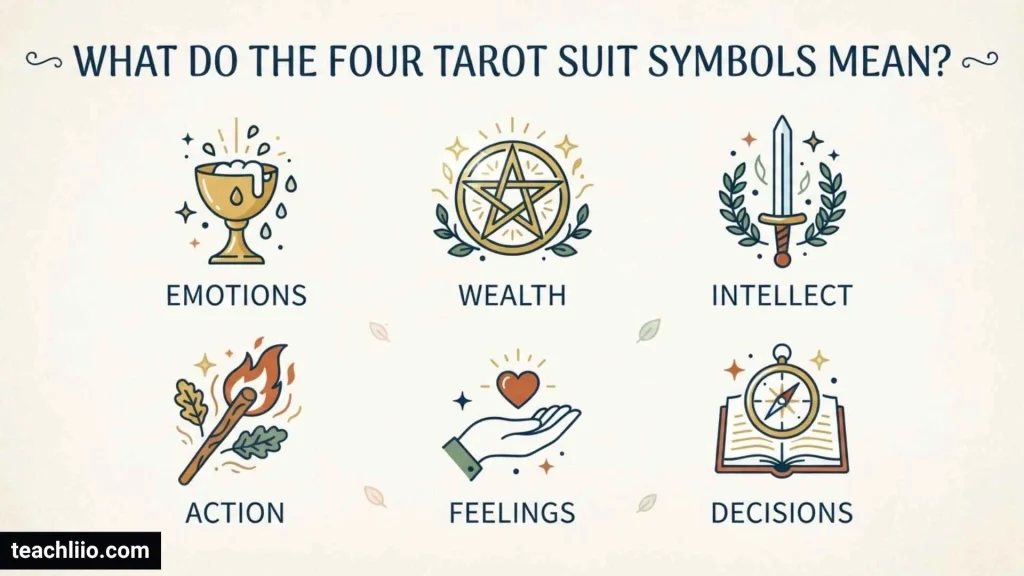
The Minor Arcana contains 56 cards divided into four suits: Wands, Cups, Swords, and Pentacles. Each suit has its own traditional associations and offers a different way to explore a situation.
Wands: Creativity and Action
Wands are associated with fire, motivation, ambition, and creative energy. They often appear in readings about projects, personal goals, enthusiasm, and new opportunities.
A growing wand may suggest potential, while a figure carrying many wands can represent responsibility or excessive demands.
Ask yourself: Where is my energy going, and what do I want to create?
Cups: Emotions and Relationships
Cups are associated with water, feelings, intuition, and emotional connection. They are especially relevant to questions about relationships, friendship, family, and personal fulfillment.
An overflowing cup may suggest emotional abundance, while spilled cups may draw attention to disappointment or neglected opportunities.
Ask yourself: What am I feeling, and what emotional needs deserve attention?
Swords: Thoughts and Communication
Swords are associated with air in the Rider-Waite-Smith tradition and commonly represent thoughts, decisions, truth, communication, and conflict.
A raised sword can suggest clarity or decisive action. Several swords in a difficult scene may emphasize tension, painful realizations, or mental struggle.
Ask yourself: What do I need to understand, communicate, or decide?
Pentacles: Work and Practical Life
Pentacles are associated with earth, material resources, work, stability, and practical development. They can relate to finances, employment, long-term planning, and the effort required to build something lasting.
A pentacle carefully held or displayed may emphasize responsibility and the value of resources. Its context determines whether the card suggests security, opportunity, or material concerns.
Ask yourself: What practical steps can help me create greater stability?
What Do Colors Mean in Tarot Cards?
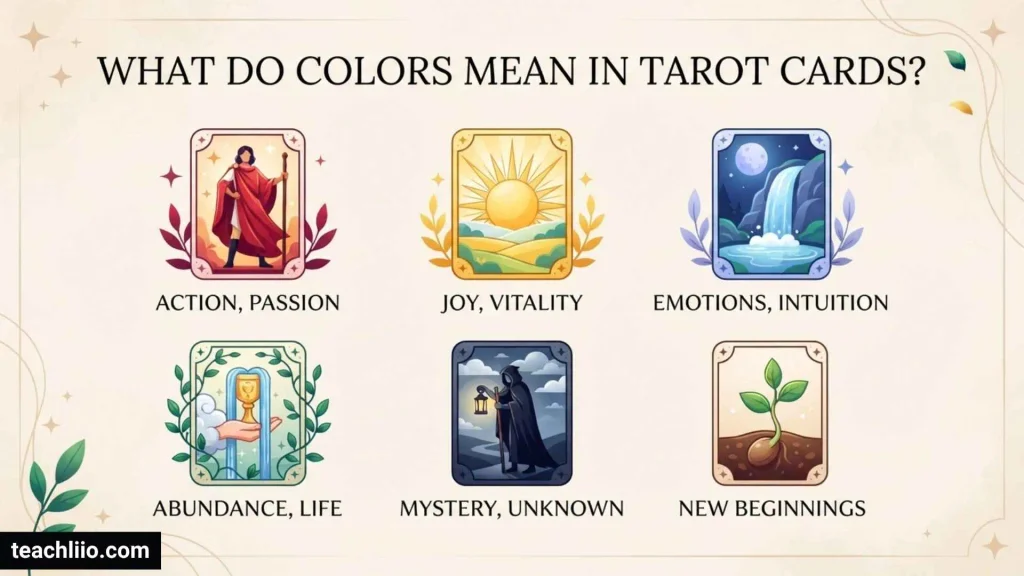
Color can reinforce a tarot card’s atmosphere and themes. However, color associations vary across decks, and no single interpretation should automatically be applied to every illustration.
Red
Red is commonly associated with passion, energy, desire, courage, and action. Red clothing or flowers may emphasize strong feelings or active involvement in a situation.
Blue
Blue often suggests calmness, reflection, intuition, or emotional depth. Its meaning depends on whether it appears in clothing, water, the sky, or another part of the illustration.
Yellow
Yellow is frequently associated with light, optimism, awareness, and vitality. A bright yellow background may reinforce a sense of clarity or possibility.
White
White can suggest innocence, purity, sincerity, or openness. The white rose in The Fool is a familiar example, although the exact interpretation depends on the broader card image.
Black
Black may evoke mystery, the unknown, endings, or hidden aspects of experience. It does not automatically mean something negative; the surrounding imagery matters.
Green
Green is often associated with nature, growth, renewal, and abundance. Vegetation in a tarot scene can reinforce themes of development or the conditions needed for something to flourish.
Gold
Gold may suggest value, illumination, achievement, or spiritual significance. In some illustrations, it also contributes to the visual emphasis on important objects or figures.
Gray
Gray can evoke ambiguity, neutrality, or a space between clear alternatives. Its effect depends on the role it plays in the scene.
The most reliable way to interpret color is to combine its common associations with the card’s established meaning and the details around it.
How to Interpret Tarot Card Symbols as a Beginner
You do not need to memorize every symbol before studying tarot. A more practical approach is to observe the image, identify its main details, and consider how they work together.
Step 1: Identify the Main Figure
Start by examining the person, animal, or object that dominates the card. Notice its posture, facial expression, direction of movement, and relationship to other figures.
A person looking toward a distant mountain creates a different impression from someone facing an immediate obstacle.
Step 2: Notice Important Objects
Look for recognizable objects such as swords, cups, flowers, lanterns, crowns, or staffs. Ask what each object may contribute to the card’s theme rather than assigning it an isolated meaning.
Step 3: Examine the Background
Mountains, rivers, buildings, clouds, and paths often help establish the scene’s atmosphere. A clear sky may create a different impression from a stormy landscape, although the card’s full meaning should guide your interpretation.
Step 4: Consider the Card’s Traditional Meaning
Consult a reliable guidebook or established reference to understand the card’s traditional interpretation. Arthur Edward Waite’s The Pictorial Key to the Tarot is a useful historical reference for the Rider-Waite-Smith tradition.
Remember that a historical interpretation is not necessarily the only possible modern interpretation.
Step 5: Connect the Image to Your Question
Consider the subject of the reading. A sword in a career reading might prompt reflection on a difficult decision, while the same symbol in a relationship reading could invite attention to communication or disagreement.
Treat these possibilities as prompts for reflection rather than guaranteed predictions.
Step 6: Interpret the Complete Image
Bring the details together to form a coherent interpretation. In The Fool, for example, the white rose, dog, and cliff combine ideas of innocence, instinct, and risk.
The complete scene offers more context than any one symbol alone.
Step 7: Keep a Tarot Journal
Record the card, the symbols you notice, the traditional interpretation, and your own observations. Over time, this practice can help you recognize recurring visual patterns and understand how different decks use symbolism.
Do Tarot Card Symbols Have the Same Meaning in Every Deck?
No. Tarot symbolism varies according to the deck’s artistic style, historical influences, and interpretive tradition.
The Rider-Waite-Smith deck contains detailed illustrated scenes, making it a useful starting point for learning visual symbolism. Other decks may use different objects, colors, cultural references, or artistic choices to communicate similar themes.
Even when two decks contain the same symbol, its meaning can change with the surrounding imagery. A bird may suggest freedom in one scene and communication or spiritual connection in another.
For this reason, use traditional associations as a foundation rather than a rigid set of rules. If you are studying a particular deck, consult its guidebook and examine how its symbols relate to the artist’s overall approach.
Frequently Asked Questions
What are the most common tarot card symbols?
Common tarot card symbols include the sun, moon, stars, roses, water, mountains, swords, cups, wands, pentacles, crowns, pillars, animals, and lanterns. Their interpretations depend on the card and the deck being used.
What does the sun symbolize in tarot?
The sun commonly represents vitality, clarity, confidence, optimism, and success. In The Sun card, its bright imagery reinforces themes of warmth, awareness, and positive energy.
What does the moon symbolize in tarot?
The moon is associated with intuition, dreams, emotions, uncertainty, and the subconscious. In The Moon card, its surrounding imagery encourages reflection when a situation feels confusing or incomplete.
What do the four tarot suit symbols represent?
Wands are associated with creativity and action, Cups with emotions and relationships, Swords with thoughts and communication, and Pentacles with work and material resources. These are traditional associations that help readers organize the Minor Arcana.
What does a white rose mean in tarot?
A white rose is commonly associated with innocence, sincerity, and purity of intention. In The Fool, it contributes to the card’s themes of openness and new beginnings.
What does the infinity symbol mean in tarot?
The infinity symbol commonly represents continuity, potential, and interconnectedness. It appears above the Magician’s head in the Rider-Waite-Smith deck and is also associated with the Strength card in that tradition.
Do tarot symbols predict the future?
Tarot readings do not provide scientifically established, guaranteed predictions. Some people use tarot as a spiritual practice, while others approach it as a tool for reflection, storytelling, or exploring possible perspectives.
How can beginners learn tarot symbols quickly?
Start with the four suits and a few recurring symbols, such as the sun, moon, stars, water, and roses. Study one card at a time, consult a guidebook, and record your observations in a journal.
Why do tarot symbols have different meanings?
A symbol’s meaning can change because of the card’s central theme, surrounding objects, artistic tradition, and the reader’s interpretive approach. The complete illustration usually provides more useful context than an isolated symbol.
What is the best tarot deck for learning symbols?
The Rider-Waite-Smith deck is a popular starting point because its illustrated scenes contain many recognizable symbolic details. However, the best deck for you is one whose imagery and guidebook you can understand and engage with comfortably.
Conclusion
Tarot card symbols provide a practical way to explore the imagery and themes found throughout a tarot deck. The sun can suggest clarity, the moon can evoke uncertainty, swords can highlight thought or conflict, and cups can bring attention to emotions and relationships. Yet the meaning of each symbol becomes clearer when you consider the complete card.
Begin by learning the four suit symbols, observing recurring objects and colors, and studying how details work together in familiar cards such as The Fool, The Magician, and The Moon. Consult reliable references, pay attention to the deck’s artistic tradition, and keep track of what you learn.
Most importantly, approach tarot symbolism with curiosity rather than rigid assumptions. By combining traditional meanings with careful observation, you can develop a more thoughtful understanding of tarot cards without needing to memorize every detail at once.

I’m Hugo Wetherby, a British author interested in the numbers behind everyday questions. I explore quantities, populations, measurements, records, comparisons, and surprising statistics, turning complicated information into accessible answers. I believe a simple “how many” question can lead to fascinating discoveries, and I enjoy helping readers find those answers.
Books:
How Many? A Guide to Everyday Numbers
The Great Book of Numbers and Quantities