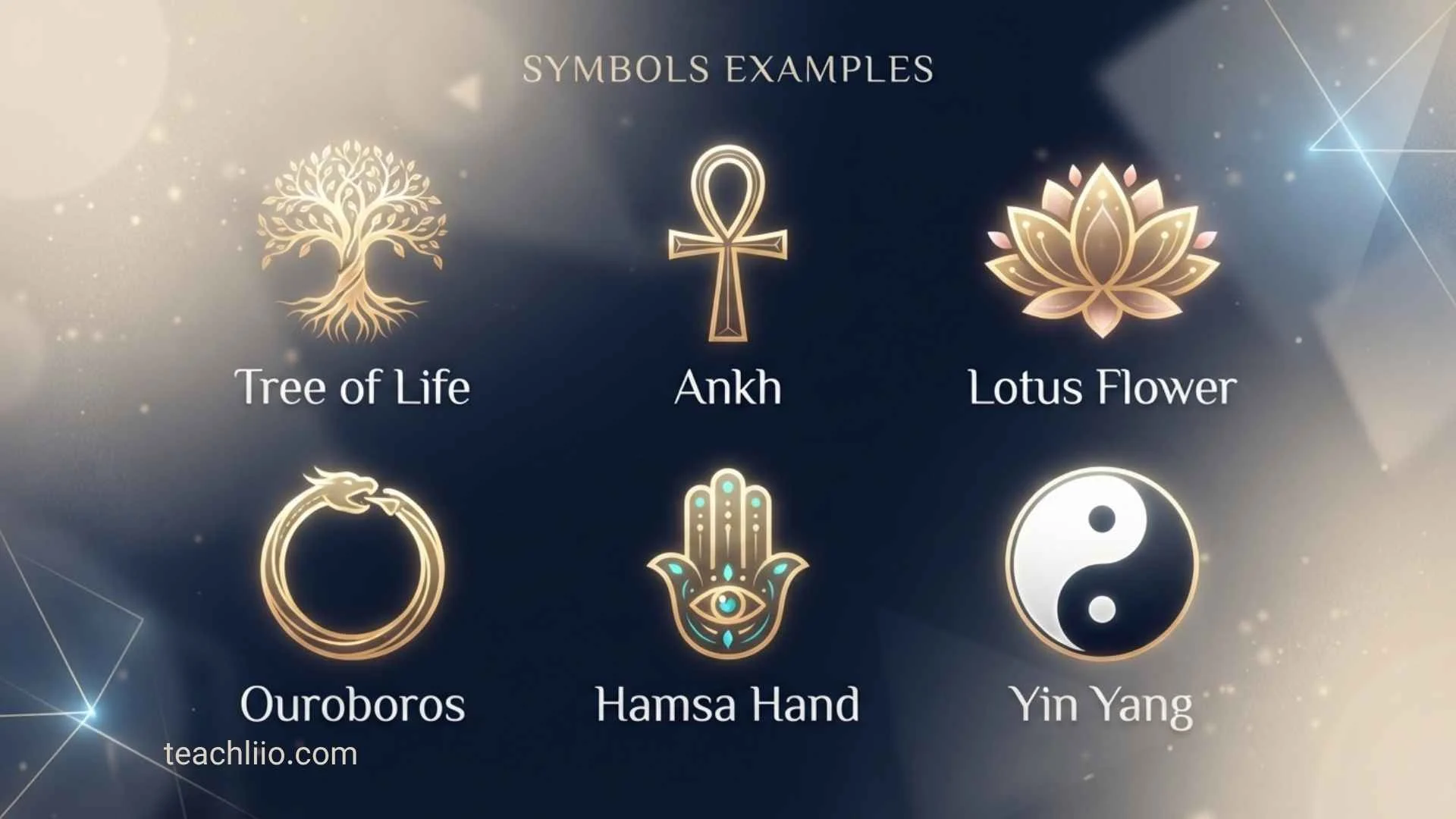
Symbols are everywhere. We see them on road signs, phones, books, websites, clothing, religious objects, mathematical equations, and even in everyday conversations. A simple heart can communicate love, while a warning triangle can tell someone to slow down or pay attention.
But what exactly is a symbol, and what do different symbols mean?
This guide explains symbols examples in a simple and practical way. You will find common symbols and their meanings, examples from literature, religious and cultural symbols, mathematical symbols, safety signs, technology symbols, keyboard characters, and more.
The most important thing to remember is that a symbol does not always have one universal meaning. Its meaning can change depending on the culture, situation, historical period, or context in which it appears.
What Is a Symbol?
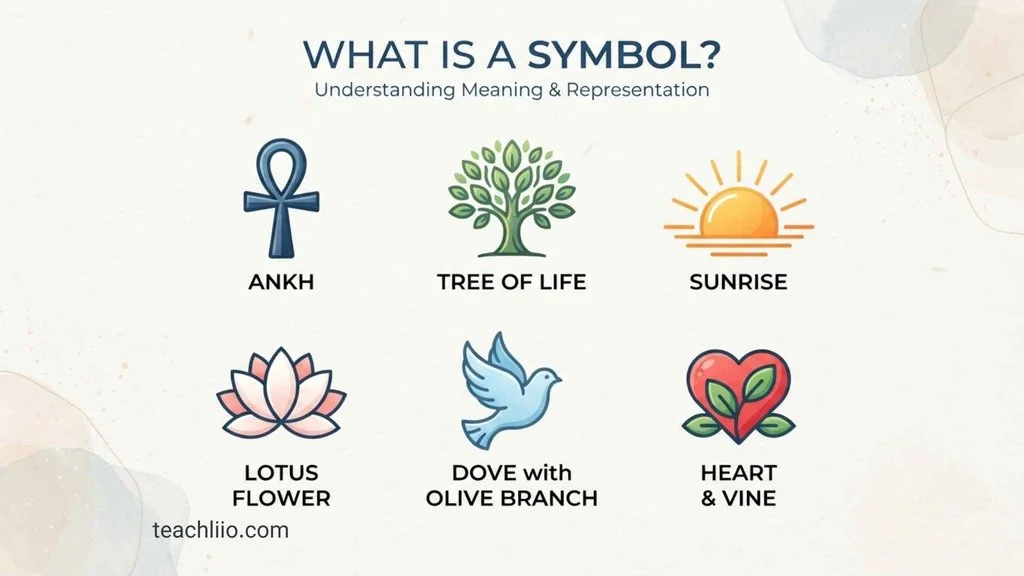
A symbol is something that represents an idea, object, action, quality, or concept beyond its most basic appearance.
For example, a heart is a physical shape, but it is commonly used to represent love or affection. A flag is a piece of fabric, but it can represent a country, community, history, or national identity.
Symbols make communication faster because they can express an idea without requiring a long explanation.
Simple Definition of a Symbol
A simple way to understand a symbol is:
A symbol is something that stands for something else.
For example:
- ❤️ represents love or affection.
- ☮ represents peace.
- ⚠ represents warning or caution.
- ♻ represents recycling.
- ⭐ can represent excellence or achievement.
- 🔒 can represent security or privacy.
The exact interpretation can change with context.
Symbol vs. Symbolism
A symbol is the thing itself, while symbolism is the use of that thing to communicate a deeper meaning.
For example, a rose is an actual flower. If a writer repeatedly uses a rose to represent love, beauty, or sacrifice, the rose is functioning symbolically.
Symbolism is particularly important in literature because writers can use ordinary objects, colors, places, characters, or actions to communicate ideas that are not directly stated.
Symbols Examples at a Glance
Here are some familiar symbols and their commonly associated meanings:
| Symbol | Common Meaning | Example Use |
| ❤️ Heart | Love, affection | Messages and cards |
| ☮ Peace sign | Peace | Posters and campaigns |
| ⚠ Warning | Caution or danger | Safety signs |
| ♻ Recycling | Recycling | Product packaging |
| ⭐ Star | Excellence or achievement | Awards and ratings |
| 🔒 Lock | Security or privacy | Websites and apps |
| → Arrow | Direction or movement | Maps and instructions |
| + Plus | Addition | Mathematics |
| % Percent | Percentage | Prices and statistics |
| © Copyright | Copyright protection | Books and websites |
| @ At sign | At/email address | Email and social media |
| 🔥 Fire | Heat, danger, energy | Warnings and digital messages |
| 🕊 Dove | Peace or hope | Art and literature |
| 👑 Crown | Royalty or authority | History and branding |
| 🔑 Key | Access or opportunity | Stories and everyday objects |
These meanings are common associations, not strict rules. A symbol can mean something different when used in another cultural, historical, technical, or literary setting.
Common Symbol Examples and Their Meanings
Some symbols appear so frequently that their meanings are quickly recognized.
Heart
The heart is one of the most recognizable symbols of love and affection.
It can represent:
- Romantic love
- Friendship
- Care
- Compassion
- Emotional connection
The heart appears in greeting cards, jewelry, social media posts, artwork, and everyday messages.
Dove
A dove is commonly associated with:
- Peace
- Hope
- Purity
- Reconciliation
Its meaning is especially common in religious artwork, memorials, literature, and peace-related imagery.
Star
A star can symbolize:
- Excellence
- Achievement
- Guidance
- Hope
- Fame
For example, stars are often used in rating systems to show quality.
Crown
A crown commonly represents:
- Royalty
- Leadership
- Authority
- Status
- Achievement
A crown may be used literally for a monarch or symbolically to suggest that someone is the best or most important in a particular field.
Key
A key can represent:
- Access
- Knowledge
- Freedom
- Opportunity
- Secrets
In everyday life, a key opens a door. In a story, however, a key might represent access to a hidden truth or a new stage of life.
Arrow
An arrow usually communicates direction or movement.
You may see arrows on:
- Road signs
- Maps
- Websites
- Instructions
- Diagrams
- Packaging
In writing and visual design, an arrow can also suggest progress, change, or a connection between two ideas.
Nature Symbol Examples
Nature provides many familiar symbols.
Tree
Trees can represent:
- Life
- Growth
- Strength
- Stability
- Family
- Connection
A family tree, for example, uses the image of a tree to represent relationships across generations.
Butterfly
A butterfly is commonly associated with:
- Transformation
- Change
- Growth
- New beginnings
Because a butterfly changes dramatically during its life cycle, it is often used as an image of personal transformation.
Sun
The sun can symbolize:
- Life
- Energy
- Hope
- Warmth
- Renewal
In a story or artwork, sunlight can also create a feeling of optimism or clarity.
Moon
The moon can have many meanings, including:
- Mystery
- Change
- Night
- Emotion
- Cycles
Its meaning depends heavily on the context in which it appears.
Rose
A rose is often associated with:
- Love
- Beauty
- Romance
- Passion
- Loss
Color can also influence its symbolic meaning. A red rose, for example, is strongly associated with romantic love in many Western contexts.
Religious and Spiritual Symbol Examples
Religious and spiritual traditions use symbols to communicate beliefs, values, stories, and ideas.
Common examples include:
- Cross — commonly associated with Christianity and Christian faith.
- Om — an important sacred symbol in several Indian religious traditions.
- Dharma wheel — associated with Buddhism and teachings of the Buddha.
- Star and crescent — widely associated with Islamic cultural and religious identity, although it is not a universal symbol of Islam.
- Star of David — an important Jewish symbol.
- Yin-yang — associated with complementary forces and balance in Chinese philosophy.
- Lotus — associated with purity, spiritual development, and renewal in several Asian traditions.
- Eye of Horus — an ancient Egyptian symbol associated with protection and well-being.
Religious symbols require particular care because their meanings are shaped by specific traditions and histories. A symbol should not be treated as having exactly the same meaning in every culture.
Mathematical Symbol Examples
Mathematics uses symbols to communicate relationships, operations, quantities, and measurements quickly.
| Symbol | Name | Meaning |
| + | Plus | Addition |
| − | Minus | Subtraction |
| × | Multiplication | Multiplication |
| ÷ | Division | Division |
| = | Equal | Shows equality |
| ≠ | Not equal | Shows inequality |
| < | Less than | Smaller value |
| > | Greater than | Larger value |
| ≤ | Less than or equal to | Comparison |
| ≥ | Greater than or equal to | Comparison |
| % | Percent | Part per hundred |
| √ | Square root | Root operation |
| π | Pi | Mathematical constant |
| ∞ | Infinity | No finite limit |
| ≈ | Approximately equal | Approximation |
For example:
8 + 4 = 12
The plus sign tells us to add, while the equal sign shows that both sides have the same value.
Mathematical symbols are different from many cultural symbols because their meanings are usually defined more precisely within mathematical conventions.
Safety and Warning Symbol Examples
Safety symbols are designed to communicate important information quickly, especially when there may not be enough space for a written explanation.
Common examples include:
Warning Triangle
A triangle with an exclamation mark commonly signals caution or a potential hazard.
Skull and Crossbones
The skull and crossbones is widely used to indicate serious toxicity or danger, particularly with hazardous substances.
Flame
A flame symbol can indicate:
- Flammable material
- Fire
- Heat
- Combustion risk
The exact meaning depends on the sign or labeling system.
Radiation Symbol
The radiation trefoil is used to identify radiation hazards or controlled radiation areas.
Biohazard Symbol
The biohazard symbol warns about biological materials that may pose a health or environmental risk.
No Smoking Symbol
A crossed-out cigarette communicates that smoking is prohibited in the indicated area.
Safety symbols should always be interpreted according to the specific sign, facility, product label, or official safety system rather than relying only on a general symbol list.
Technology and Digital Symbol Examples

Modern technology has introduced another huge group of symbols.
You probably encounter many of these every day.
Power Symbol
The power symbol indicates turning an electronic device on or off or placing it into a power state.
Wi-Fi Symbol
The familiar curved-line symbol indicates wireless network connectivity.
Bluetooth Symbol
The Bluetooth symbol indicates Bluetooth wireless technology or a Bluetooth connection.
Lock Symbol
A lock often indicates:
- Security
- Privacy
- A protected connection
- Locked content
- Account protection
Search Symbol
A magnifying glass commonly represents search.
Settings Symbol
A gear is widely used to represent settings, configuration, or preferences.
Bell Symbol
A bell often represents notifications or alerts.
Download and Upload Symbols
A downward arrow commonly indicates downloading, while an upward arrow is often used for uploading.
Trash or Delete Symbol
A trash-can icon commonly indicates deletion.
These symbols are usually designed for quick visual recognition, allowing users to understand an interface without reading a long explanation.
Keyboard and Punctuation Symbol Examples
Many people also search for symbol examples because they want to understand special characters found on keyboards, documents, websites, and social media.
| Symbol | Common Name | Common Use |
| @ | At sign | Email addresses |
| # | Hash/number sign | Hashtags and numbering |
| & | Ampersand | Means “and” |
| * | Asterisk | Notes, multiplication, emphasis |
| % | Percent sign | Percentages |
| $ | Dollar sign | Currency |
| _ | Underscore | Usernames and programming |
| – | Hyphen/minus | Words and mathematical operations |
| / | Slash | Dates, paths, alternatives |
| Backslash | Computing | |
| ~ | Tilde | Computing and language |
| + | Plus sign | Mathematics and phone dialing |
| = | Equal sign | Mathematics |
| © | Copyright | Copyright notices |
| ® | Registered trademark | Registered marks |
| ™ | Trademark | Brand identification |
Some of these characters have different names or functions depending on the field. For example, # may be called a hash, number sign, or pound sign depending on location and context.
Political and National Symbol Examples
Political and national symbols are used to represent governments, countries, political movements, parties, historical events, or national identity.
Examples include:
- National flags
- Political party logos
- Party election symbols
- National emblems
- Seals
- Political colors
- Campaign signs
A national flag can represent a country’s identity, while a political party symbol may help voters identify a party or candidate.
Political symbols are particularly context-dependent. The same animal, color, or object may represent entirely different political ideas in different countries.
Symbolism Examples in Literature
Symbols are especially important in literature because authors can use ordinary objects or events to communicate deeper themes.
A literary symbol usually has a literal role in the story while also suggesting an abstract idea. The surrounding plot and repeated use help readers determine the intended meaning.
The Green Light in The Great Gatsby
The green light is one of the best-known literary symbols.
It is associated with Gatsby’s hopes and his desire for a future with Daisy. The symbol also connects to the larger idea of an unreachable dream.
The Conch Shell in Lord of the Flies
The conch shell is commonly interpreted as representing order, authority, and civilized government.
As the story develops, its symbolic importance changes as social order breaks down.
The Scarlet Letter in The Scarlet Letter
The letter “A” begins as a public mark of shame. Its meaning develops as the story progresses, showing how a symbol can change rather than having only one fixed interpretation.
The Mockingbird in To Kill a Mockingbird
The mockingbird is associated with innocence and the idea of harming someone who has done no wrong. The symbol helps reinforce important themes in the novel.
Common Literary Symbol Examples
Other common literary symbols include:
| Symbol | Possible Meaning |
| Light | Knowledge, hope, truth |
| Darkness | Fear, ignorance, mystery |
| Storm | Conflict or emotional turmoil |
| Water | Renewal, life, change |
| Fire | Destruction, passion, transformation |
| Road | Journey or life choices |
| Mirror | Identity or self-reflection |
| Door | Opportunity or transition |
| Clock | Time or mortality |
| Chain | Restriction or connection |
These are possible interpretations, not automatic definitions. Literary meaning depends on how the author uses the symbol in the particular work.
Symbols That Can Have More Than One Meaning
One of the biggest mistakes people make when studying symbols is assuming that every symbol has one permanent meaning.
Consider a snake.
A snake can represent:
- Danger
- Temptation
- Evil
- Transformation
- Healing
- Rebirth
These meanings can appear in very different cultural, religious, or literary contexts.
A rose can represent love in one situation but grief, secrecy, beauty, or remembrance in another.
A skull may communicate danger on a product label, death in artwork, mortality in literature, or a completely different idea in a particular cultural setting.
The best way to understand a symbol is therefore to ask:
Where is it being used, who is using it, and what is happening around it?
Symbol vs. Sign vs. Icon
These terms are related, but they are not always interchangeable.
Symbol
A symbol represents an idea or concept.
Example: A heart representing love.
Sign
A sign is generally intended to communicate information, instruction, warning, or direction.
Example: A stop sign tells drivers to stop.
Icon
An icon is often a visual representation that resembles or conventionally represents something.
Example: A printer icon represents a printing function on a computer.
In everyday conversation, people often use these terms loosely. In design, communication studies, and semiotics, however, the distinctions can become more precise.
How to Understand an Unfamiliar Symbol
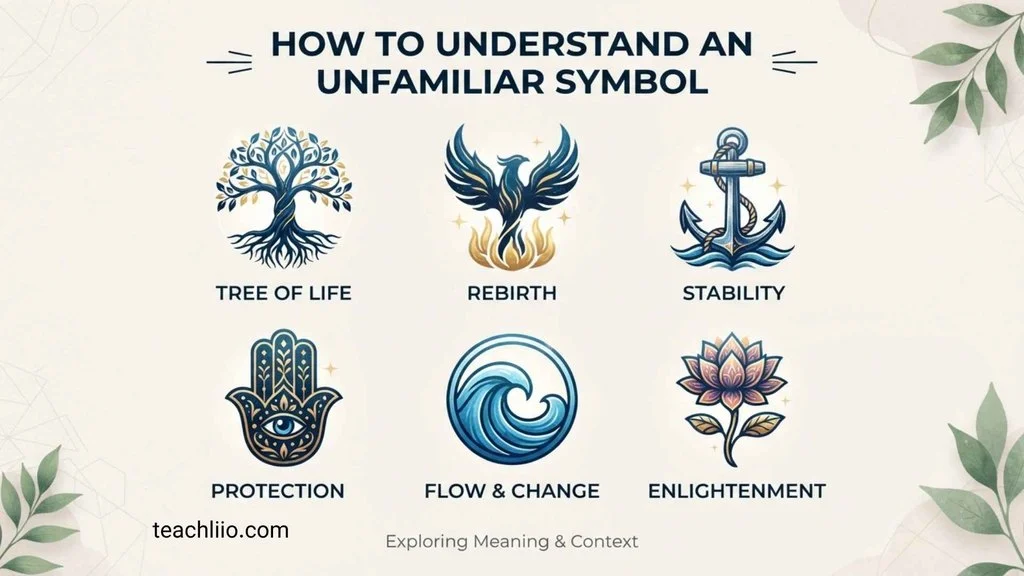
If you encounter a symbol you do not recognize, do not immediately assume its meaning.
Use these steps:
1. Look at Where It Appears
A symbol on a phone may have a technical meaning, while the same shape in a book may be symbolic.
2. Check the Surrounding Information
Words, colors, images, and nearby symbols can provide clues.
3. Consider the Context
Ask whether the symbol is being used for:
- Safety
- Religion
- Mathematics
- Technology
- Politics
- Literature
- Transportation
- Communication
4. Consider Cultural Context
A symbol can carry different meanings in different cultures and historical periods.
5. Check an Official Source for Technical Symbols
For safety labels, vehicle dashboards, medical equipment, electronics, and other technical systems, use the relevant official manual or authority rather than relying on a general symbolism list.
Why Are Symbols Important?
Symbols are important because they make communication faster, more memorable, and sometimes more emotional.
They can:
- Communicate information quickly
- Cross language barriers
- Represent complicated ideas
- Strengthen cultural identity
- Express emotions
- Support navigation
- Improve safety
- Help people use technology
- Add depth to literature
- Build brand recognition
A single visual element can sometimes communicate an idea that would otherwise require several sentences.
Easy Symbol Examples for Students
Students can start with simple examples that are easy to understand.
| Symbol | Meaning |
| ❤️ | Love |
| 🕊️ | Peace |
| 🌳 | Growth or life |
| ⭐ | Excellence |
| 👑 | Leadership or royalty |
| 🔑 | Opportunity or access |
| ⚠️ | Warning |
| ♻️ | Recycling |
| ☀️ | Light or energy |
| 🦋 | Transformation |
| 🤝 | Cooperation |
| 🏳️ | Identity or cause |
For a school assignment, students should explain both the symbol and why it represents the idea.
For example:
Butterfly → transformation: A butterfly is associated with transformation because it changes significantly during its life cycle.
This is stronger than simply writing “butterfly means change.”
How Symbols Are Used in Everyday Life
You do not need to study literature or religion to encounter symbols.
They appear in ordinary activities every day.
You might see:
- A heart in a text message
- A recycling symbol on packaging
- A Wi-Fi symbol on a phone
- A warning triangle near machinery
- A dollar sign when shopping
- An arrow showing where to go
- A lock showing website security
- A bell indicating notifications
- A magnifying glass representing search
- A flag representing a country
This shows why symbols are such an effective form of communication: people can often understand them almost instantly.
Frequently Asked Questions
What is an example of a symbol?
A heart is a simple example of a symbol because it is commonly used to represent love, affection, or care.
What are five common symbols?
Five common examples are the heart for love, dove for peace, star for achievement, warning triangle for caution, and recycling symbol for recycling.
What are examples of symbolism?
Examples include a storm representing conflict, a road representing a life journey, a rose representing love, a mirror representing self-reflection, and light representing hope or knowledge.
What are symbols used for?
Symbols are used to communicate ideas, emotions, instructions, identities, warnings, beliefs, and information quickly.
What is the difference between a symbol and an icon?
A symbol can represent an abstract idea, while an icon often provides a recognizable visual representation of a function, object, or concept. The terms can overlap in everyday usage.
Can one symbol have multiple meanings?
Yes. A symbol’s meaning can change depending on culture, historical period, religion, literature, or the situation in which it appears.
What are examples of symbols in literature?
Common literary examples include the green light in The Great Gatsby, the conch shell in Lord of the Flies, the mockingbird in To Kill a Mockingbird, and the scarlet letter in The Scarlet Letter.
Why are symbols important in literature?
Symbols allow writers to communicate themes and abstract ideas indirectly. They can add emotional depth and encourage readers to interpret a story beyond its literal events.
What are mathematical symbols?
Mathematical symbols are characters used to represent operations, relationships, values, and concepts. Examples include +, −, ×, ÷, =, <, >, %, √, and ∞.
What are safety symbols?
Safety symbols are visual signs used to communicate hazards, warnings, prohibited actions, or emergency information. Examples include warning triangles, flames, radiation symbols, biohazard symbols, and no-smoking signs.
Conclusion
Symbols are a powerful way to communicate ideas without relying entirely on words. From a simple heart representing love to a mathematical plus sign representing addition, symbols appear throughout everyday life.
The most important lesson is that symbols do not always have one fixed meaning. Their interpretation depends on context, culture, history, purpose, and the way they are used.
Understanding that difference makes it easier to interpret symbols in literature, religion, technology, mathematics, safety signs, politics, art, and everyday communication.
Whether you are a student looking for symbols examples, a writer studying symbolism, or simply trying to understand an unfamiliar sign, start by looking at the context. That is often the key to discovering what a symbol really means.

I’m Hugo Wetherby, a British author interested in the numbers behind everyday questions. I explore quantities, populations, measurements, records, comparisons, and surprising statistics, turning complicated information into accessible answers. I believe a simple “how many” question can lead to fascinating discoveries, and I enjoy helping readers find those answers.
Books:
How Many? A Guide to Everyday Numbers
The Great Book of Numbers and Quantities