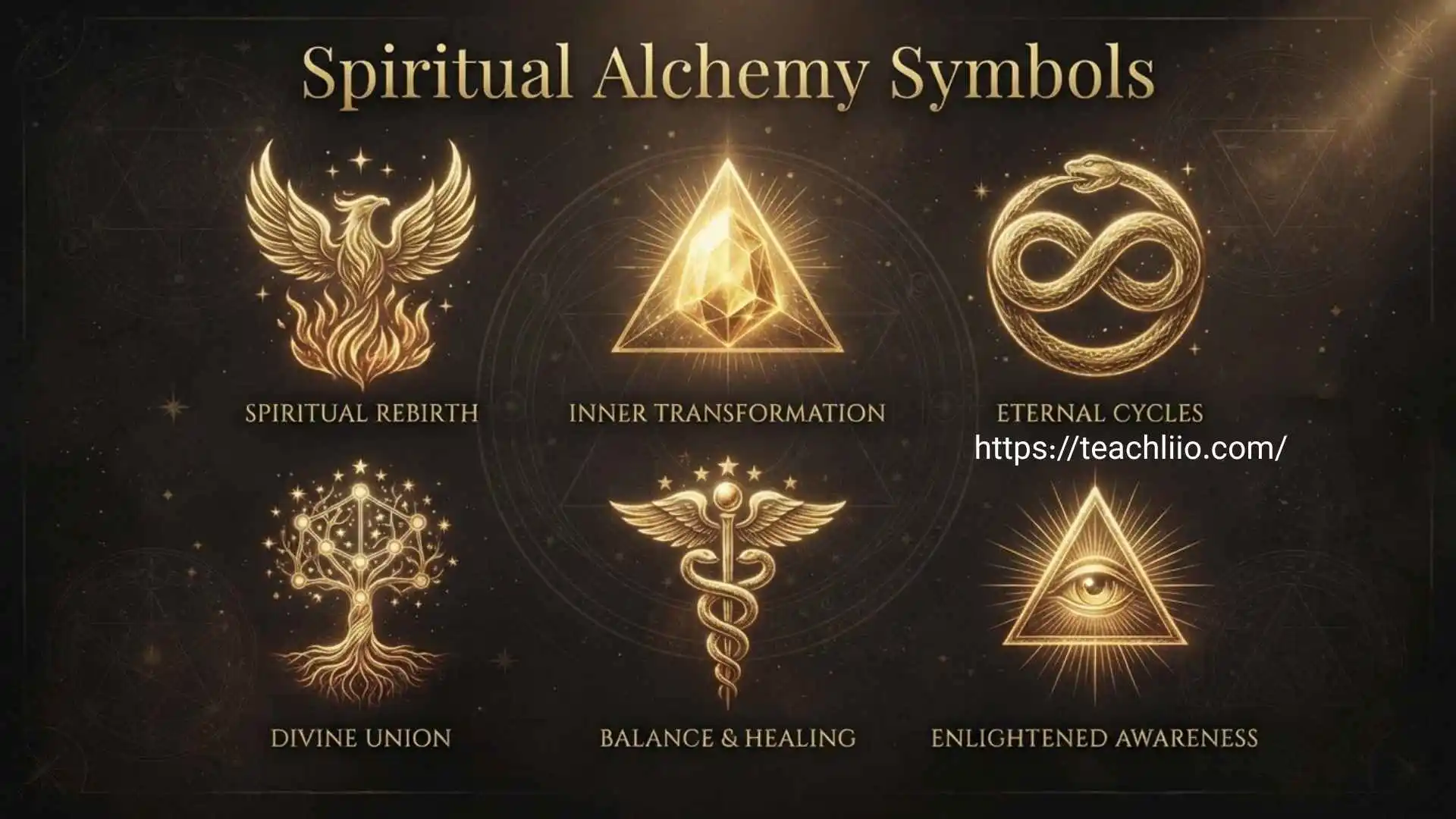
Spiritual alchemy symbols have fascinated people for centuries because they connect images of transformation, purification, death, rebirth, balance, and inner change. Symbols such as the ouroboros, philosopher’s stone, Mercury, Sulfur, Salt, Sun, Moon, and the four elements appear throughout alchemical writings and artwork.
But there is an important distinction to understand. Historical alchemy was not simply a system of spiritual self-improvement. Alchemists investigated matter, medicines, metals, laboratory processes, philosophy, religion, and the possibility of transformation. Some traditions also gave these physical processes philosophical or spiritual significance.
Today, the phrase spiritual alchemy is often used more broadly to describe inner transformation. In this modern interpretation, turning base material into gold becomes a metaphor for turning difficult experiences, unconscious patterns, or personal struggles into greater wisdom and wholeness.
This guide explores the most important spiritual alchemy symbols, their historical associations, modern spiritual interpretations, and the stages commonly connected with alchemical transformation.
What Are Spiritual Alchemy Symbols?
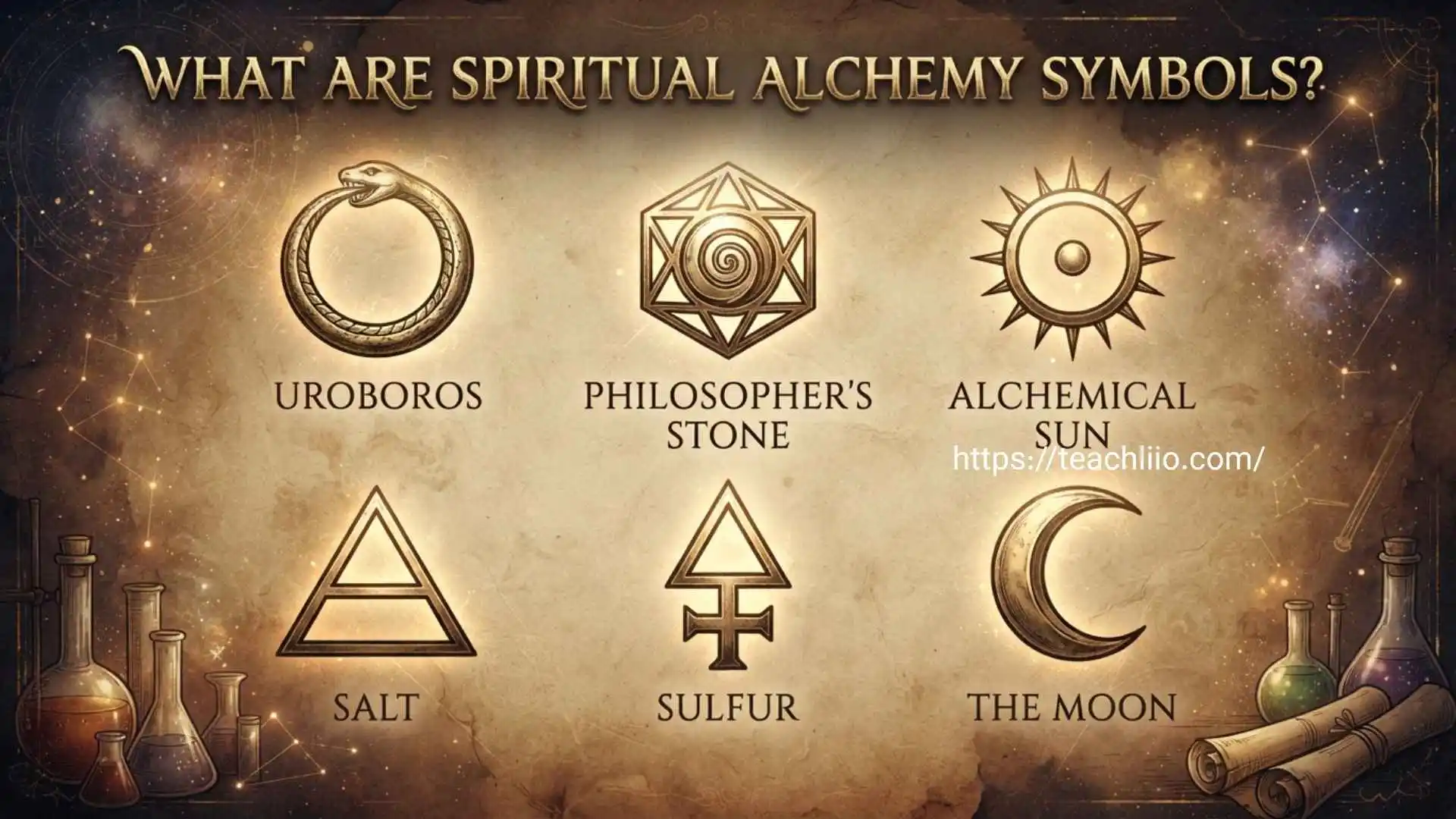
Spiritual alchemy symbols are images, signs, substances, animals, colors, and planetary associations connected with alchemical traditions and later interpretations of inner transformation.
Historically, alchemical symbols served practical and philosophical purposes. They could identify metals, substances, operations, planets, elements, and concepts. The Getty notes that alchemical symbolism was used as a systematic visual and verbal vocabulary for recording ingredients, formulas, and processes.
Modern spiritual interpretations use many of these same symbols differently.
For example:
- Gold can represent perfection, illumination, or an accomplished transformation.
- Lead can represent an unfinished or difficult state.
- Fire can symbolize purification and change.
- Water can represent dissolution, emotion, or renewal.
- The ouroboros can suggest cycles, completion, and renewal.
- The philosopher’s stone can represent the ultimate goal of transformation.
These spiritual meanings should be understood as interpretations rather than universal historical definitions.
Historical Alchemy vs. Spiritual Alchemy
Understanding this difference makes the subject much clearer.
Historical alchemy developed across different cultures and centuries. Alchemists explored substances and transformation through experimentation, philosophical speculation, religious imagery, and coded language. European alchemical traditions, for example, included attempts to understand how matter could be transformed and included the famous quest for the philosopher’s stone.
The idea of spiritual alchemy is often used today to describe the symbolic or psychological side of this tradition.
In this interpretation, the laboratory becomes a metaphor for the human experience:
Base material → purification → transformation → integration → completion
The same image may therefore have a historical alchemical meaning and a later psychological or spiritual meaning.
This distinction is especially important when discussing Carl Jung. Jung studied alchemical imagery extensively and connected alchemical symbolism with psychological transformation and individuation.
The Most Important Spiritual Alchemy Symbols
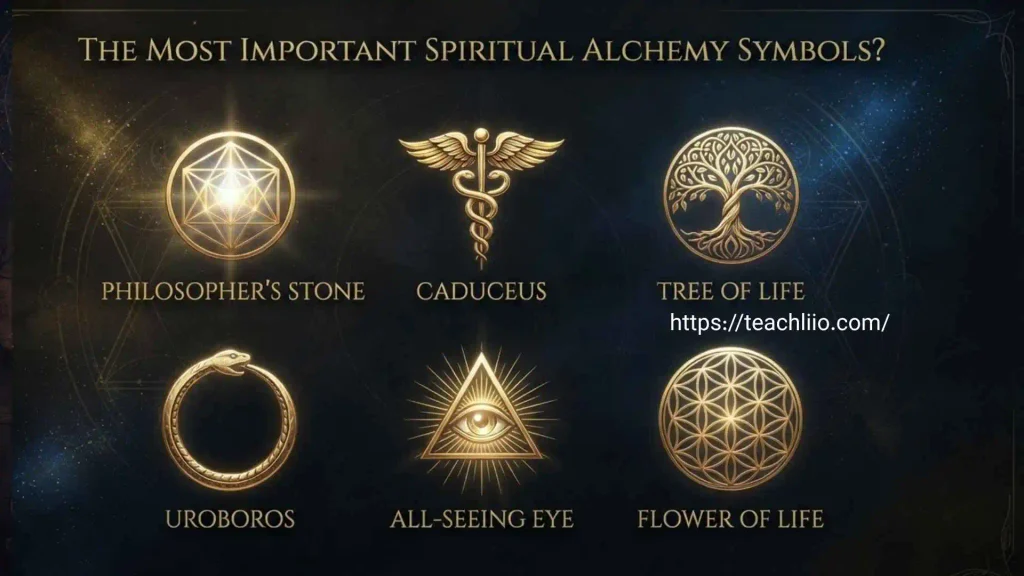
There is no single official list of “spiritual alchemy symbols.” Different texts and traditions used different images. However, several symbols are especially important when discussing alchemy and modern spiritual transformation.
1. The Ouroboros
The ouroboros is the image of a serpent or dragon eating its own tail.
It is one of the most recognizable symbols associated with alchemy.
The image creates a complete circle, making it naturally associated with ideas such as:
- Cycles
- Completion
- Renewal
- Death and rebirth
- Unity
- Infinity
- Transformation
Historical alchemical artwork used the ouroboros as a symbol for the alchemical work itself. The Metropolitan Museum’s research on alchemical imagery notes its use as a representation of the Work.
In modern spiritual interpretation, the ouroboros can represent the idea that transformation is not a straight line. A person may repeatedly confront old patterns, learn from them, release them, and begin again at a deeper level.
2. The Philosopher’s Stone
The philosopher’s stone is perhaps the most famous goal associated with Western alchemy.
Historically, it was connected with the extraordinary goal of transforming base metals into precious metals and, in some traditions, with producing an elixir associated with healing or longevity.
As a spiritual metaphor, the philosopher’s stone represents the highest stage of transformation.
It can symbolize:
- Inner perfection
- Wisdom
- Wholeness
- Self-knowledge
- Spiritual maturity
- The discovery of hidden potential
In this interpretation, the “stone” is not necessarily a physical object. It represents what a person becomes after undergoing profound transformation.
3. Mercury
Mercury has a particularly complex role in alchemical symbolism.
Historically, Mercury or quicksilver was both a substance of major importance and part of the traditional planetary-metal system. The traditional association connects Mercury with the metal mercury.
Mercury can be difficult to reduce to one simple meaning because it appears in different alchemical contexts.
Symbolically, it is often associated with:
- Change
- Fluidity
- Movement
- Adaptability
- Communication
- The connection between opposites
In modern spiritual interpretation, Mercury can represent the ability to move between different states of awareness and adapt during transformation.
4. Sulfur
Sulfur is one of the three substances in the traditional tria prima, or “three first things,” alongside Mercury and Salt.
In historical alchemy, sulfur had material and philosophical meanings that varied between authors and traditions.
In spiritual interpretations, sulfur is often connected with:
- Energy
- Passion
- Will
- Desire
- Activity
- Transformation through intensity
Its fiery associations make it a useful symbol for the force that pushes a person to change.
5. Salt
Salt completes the traditional alchemical Mercury-Sulfur-Salt triad.
The Getty identifies Mercury, Sulfur, and Salt as the tria prima in alchemical symbolism.
In modern spiritual readings, Salt is sometimes understood as a symbol of:
- Stability
- Material existence
- Grounding
- Structure
- Embodiment
- Integration
This makes Salt especially useful when thinking about spiritual growth as something that must eventually become part of everyday life.
6. The Sun
The Sun is traditionally connected with gold in the planetary-metal system of alchemy.
The Getty lists the Sun with gold, while a sixteenth-century engraving at The Metropolitan Museum of Art shows the Sun’s traditional symbol alongside the association with gold.
Spiritually, the Sun may represent:
- Illumination
- Consciousness
- Vitality
- Achievement
- Clarity
- Inner radiance
The Sun is therefore a powerful image for reaching a state in which what was hidden becomes visible.
7. The Moon
The Moon is traditionally connected with silver.
The planetary-metal system places the Moon with silver, just as the Sun is connected with gold.
In spiritual interpretations, the Moon can represent:
- Intuition
- Reflection
- Inner life
- Mystery
- The unconscious
- Cycles
The Sun and Moon together can also represent complementary forces rather than simple opposites.
8. Fire
Fire is one of the four classical elements represented in alchemical symbolism.
Fire naturally became an important alchemical image because heat was central to many laboratory operations.
Spiritually, fire can symbolize:
- Purification
- Passion
- Destruction of the old
- Energy
- Courage
- Rebirth
Fire does not simply destroy. It can also prepare something for a new state.
9. Water
Water is another of the four classical elements used in alchemical traditions.
Its physical qualities make it an intuitive symbol for:
- Flow
- Adaptation
- Emotion
- Dissolution
- Cleansing
- Renewal
In a spiritual reading, water can represent the process of allowing rigid patterns to soften before transformation takes place.
10. Air
Air represents another of the classical elements.
Its associations with breath, movement, and invisibility make it a natural metaphor for:
- Thought
- Communication
- Perspective
- Freedom
- Mental movement
- Inspiration
In spiritual alchemy, Air can therefore be interpreted as the mental dimension of transformation.
11. Earth
Earth is the fourth classical element.
Because Earth is associated with physical substance and stability, it can symbolize:
- Grounding
- Physical existence
- Stability
- Patience
- Structure
- Practical action
Spiritual transformation is not only about ideas. The symbolism of Earth reminds us that change eventually has to be expressed through real life.
12. The Alchemical Marriage
The alchemical marriage, often connected with the Latin term coniunctio, represents the union of opposing or complementary forces.
Alchemical texts and imagery frequently explored relationships between opposites. Later Jungian interpretations gave this imagery a psychological dimension, connecting the union of opposites with processes of inner integration.
Spiritually, the symbol can represent:
- Balance
- Integration
- Union
- Reconciliation
- Wholeness
- Acceptance of different parts of the self
Rather than eliminating one side, the symbolic marriage suggests bringing apparently conflicting forces into a more complete relationship.
The Seven Planetary Metals in Alchemy
One of the most recognizable alchemical systems connects seven traditional planets with seven metals.
| Planetary Symbol | Traditional Metal | Common Spiritual Interpretation |
| Sun | Gold | Illumination and completion |
| Moon | Silver | Intuition and reflection |
| Mercury | Quicksilver | Change and adaptability |
| Venus | Copper | Attraction and harmony |
| Mars | Iron | Strength and action |
| Jupiter | Tin | Expansion and growth |
| Saturn | Lead | Limitation and transformation |
The historical planetary-metal associations are documented in alchemical reference material from the Getty.
These spiritual interpretations are useful as modern symbolic readings, but they should not be confused with scientific properties or universal historical definitions.
The Metropolitan Museum also preserves artwork showing how planetary imagery and chemical symbols could be combined in early modern European visual culture.
The Three Principles: Mercury, Sulfur, and Salt
The tria prima is another major concept connected with alchemical symbolism.
Mercury
Mercury is traditionally connected with the volatile, changing, and transformative dimension of matter and alchemical thought.
As a modern metaphor, it can suggest flexibility and movement.
Sulfur
Sulfur is associated with an active, fiery, or combustible dimension within the traditional framework.
As a spiritual metaphor, it can represent desire, energy, and the force behind change.
Salt
Salt is associated with the fixed or embodied dimension in this framework.
As a modern spiritual metaphor, it can represent grounding and bringing transformation into practical life.
The three should not simply be translated into “mind, body, and spirit.” That popular simplification can obscure the complexity of historical alchemical traditions.
The Four Stages of Spiritual Alchemy
Many modern discussions describe spiritual alchemy through four color stages:
Nigredo → Albedo → Citrinitas → Rubedo
However, historical alchemical texts were diverse, and not every author presented exactly the same sequence or interpretation. The four-stage model is best treated as a useful framework rather than a universal alchemical rule.
Nigredo: The Blackening
Nigredo means “blackening.”
It is often associated with darkness, decomposition, breakdown, or the destruction of an old state.
In modern spiritual interpretation, Nigredo can represent a difficult period in which familiar beliefs or identities stop working.
It may involve:
- Confusion
- Grief
- Self-examination
- Confronting hidden patterns
- Letting go
- Psychological discomfort
The important idea is that darkness is part of the transformation rather than necessarily its final destination.
Albedo: The Whitening
Albedo means “whitening.”
In alchemical imagery, the whitening stage can represent purification or clarification. Historical sources also used visual symbols such as white roses and other imagery to represent stages of the Work.
In modern spiritual interpretation, Albedo can symbolize:
- Cleansing
- Clarity
- Understanding
- Renewal
- Forgiveness
- A fresh perspective
After confronting difficult material, a person may begin to see it differently.
Citrinitas: The Yellowing
Citrinitas means “yellowing.”
This stage is less consistently emphasized in modern discussions, but it appears in some historical accounts of alchemical transformation.
Spiritually, it is often interpreted as a movement toward:
- Awakening
- Insight
- Growing awareness
- Inner illumination
- Emerging wisdom
It can be viewed as a bridge between purification and completion.
Rubedo: The Reddening
Rubedo means “reddening.”
It is commonly presented as the culminating color stage in the four-stage framework.
Modern spiritual interpretations associate Rubedo with:
- Completion
- Integration
- Vitality
- Wholeness
- Embodied wisdom
- Transformation
Historical alchemical imagery could use the red rose and other red imagery to represent this stage.
Spiritual Meaning of Alchemy as Inner Transformation
The central metaphor behind spiritual alchemy is simple:
Transform what you have into what you can become.
Instead of imagining transformation as instant perfection, alchemical symbolism presents change as a process.
A person may begin with fear, confusion, pain, unhealthy patterns, or limited self-understanding. Through reflection and experience, those conditions can become sources of knowledge.
This does not mean difficult experiences automatically make someone wiser. Rather, the metaphor suggests that conscious reflection can change how a person understands and responds to those experiences.
Spiritual Alchemy and Jungian Psychology
The connection between alchemy and psychology became especially influential through Carl Jung.
Jung studied alchemical imagery and interpreted some alchemical processes as symbolic parallels to psychological transformation and individuation. The International Association for Analytical Psychology describes Jung’s work as examining the relationship between alchemy and the psychic process of individuation.
This created an important bridge between historical alchemy and modern psychological interpretations.
For example, Jungian readings can understand:
- Darkness as confrontation with unconscious material
- Opposites as conflicting aspects of personality
- The alchemical marriage as integration
- Gold as an image of greater wholeness
- Transformation as individuation
However, Jung’s interpretation should not be projected backward onto every historical alchemist. Historical alchemy had its own diverse intellectual, religious, and practical contexts.
Spiritual Alchemy Symbols and Their Meanings at a Glance
| Symbol | Historical Association | Modern Spiritual Interpretation |
| Ouroboros | The alchemical Work and cyclical imagery | Renewal and completion |
| Philosopher’s Stone | Goal of transmutation | Inner transformation |
| Mercury | Quicksilver and planetary metal | Adaptability and movement |
| Sulfur | Alchemical substance and tria prima | Passion and transformative energy |
| Salt | Tria prima | Grounding and embodiment |
| Sun | Gold | Illumination and vitality |
| Moon | Silver | Intuition and reflection |
| Fire | Classical element and laboratory heat | Purification and change |
| Water | Classical element | Emotional renewal and flow |
| Air | Classical element | Thought and perspective |
| Earth | Classical element | Stability and grounding |
| Coniunctio | Union of opposites | Integration and wholeness |
What Does Spiritual Alchemy Symbolize?
At its broadest level, spiritual alchemy symbolizes transformation.
But transformation can take several forms.
Transformation of the Self
A person may move from limited self-awareness toward deeper understanding.
Transformation of Pain
Difficult experiences may become opportunities for reflection rather than simply remaining sources of suffering.
Transformation of Opposites
Instead of choosing one side of an internal conflict, a person may learn to understand and integrate both.
Transformation of Awareness
Something previously unconscious or ignored may become visible and understandable.
Transformation Into Wholeness
The ultimate metaphor is not becoming someone completely different. It is becoming more integrated.
This is one reason alchemical symbolism continues to appear in literature, art, psychology, spirituality, and popular culture.
How to Use Spiritual Alchemy Symbols in Personal Reflection
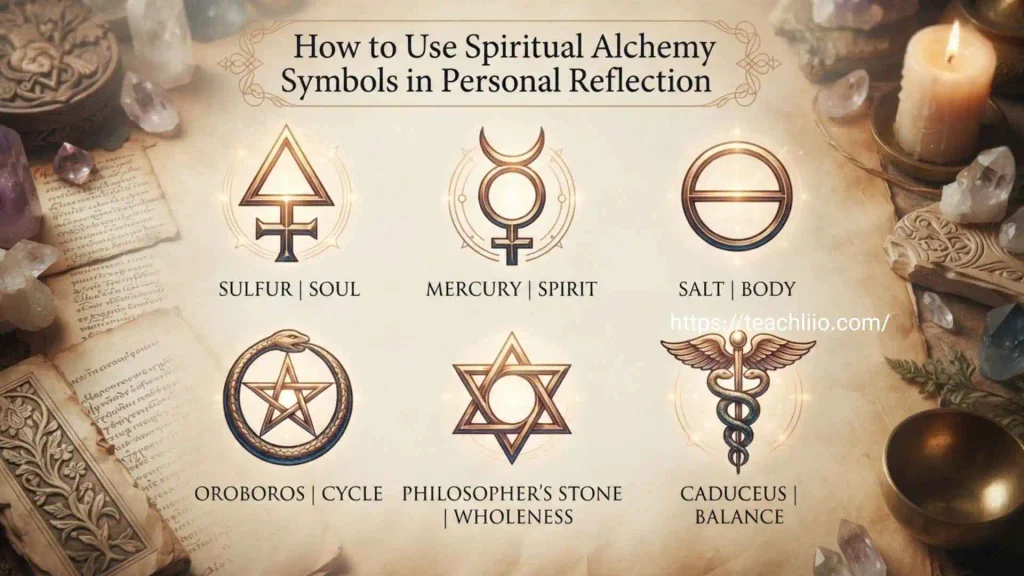
You do not have to treat alchemical symbols as supernatural objects to find them meaningful.
They can be used as prompts for reflection.
Use Nigredo for Difficult Periods
Ask:
What old belief, habit, or identity is no longer working for me?
Use Albedo for Clarity
Ask:
What have I learned after stepping back from this situation?
Use Citrinitas for Awareness
Ask:
What new understanding is beginning to emerge?
Use Rubedo for Integration
Ask:
How can I turn what I have learned into something practical in my life?
Use the Ouroboros for Cycles
Ask:
What pattern keeps returning, and what might it be trying to teach me?
Use the Philosopher’s Stone for Purpose
Ask:
What kind of person am I trying to become through my experiences?
This approach treats symbolism as a tool for reflection rather than claiming that symbols have guaranteed supernatural powers.
Common Misunderstandings About Spiritual Alchemy Symbols
Spiritual Alchemy Is Not Simply Modern Manifestation
Modern spiritual communities sometimes connect alchemy with manifestation, abundance, energy, or attraction.
Those ideas may be meaningful within particular modern belief systems, but they should not automatically be presented as the original meaning of historical alchemical symbols.
Every Symbol Does Not Have One Fixed Meaning
Alchemy developed across different periods, languages, cultures, and authors.
A symbol could change meaning depending on the text and context.
Historical Alchemy Was Not Just About Gold
Goldmaking is one of the most famous aspects of alchemy, but alchemical traditions also included medicine, laboratory experimentation, philosophy, religious ideas, and investigations into nature.
Jungian Meanings Are Not Medieval Definitions
Jung’s psychological interpretations are highly influential, but they belong to a modern psychological framework.
They should be distinguished from the meanings intended by historical alchemists.
Frequently Asked Questions
What is the most important spiritual alchemy symbol?
There is no single officially recognized “most important” symbol. The ouroboros and philosopher’s stone are among the most recognizable because they strongly represent cycles, transformation, completion, and the goal of alchemical work.
What does the ouroboros mean spiritually?
The ouroboros is commonly interpreted as a symbol of cycles, renewal, completion, infinity, and transformation. In historical alchemical imagery, it could represent the alchemical Work itself.
What does the philosopher’s stone symbolize spiritually?
In modern spiritual interpretation, the philosopher’s stone can symbolize inner transformation, wisdom, wholeness, and the realization of hidden potential. Historically, it was associated with alchemical transmutation and related goals.
What are the three principles of alchemy?
The tria prima consists of Mercury, Sulfur, and Salt. The Getty identifies these three as a central group within alchemical symbolism.
What are the four stages of spiritual alchemy?
Modern spiritual interpretations commonly describe four stages as Nigredo, Albedo, Citrinitas, and Rubedo. They are associated respectively with blackening, whitening, yellowing, and reddening. Historical alchemical traditions varied, so this should not be treated as one universally standardized system.
What does Nigredo mean spiritually?
Nigredo, or blackening, is often interpreted spiritually as a period of breakdown, confrontation, darkness, or the ending of an old state. It can represent the beginning of a deeper transformation.
What does Rubedo mean spiritually?
Rubedo, or reddening, is commonly interpreted as the completion or integration phase of transformation. It can symbolize wholeness, vitality, wisdom, and the embodiment of change.
What does Mercury symbolize in spiritual alchemy?
Mercury is historically associated with quicksilver and is part of the traditional planetary-metal system. In modern spiritual interpretations, it can represent change, adaptability, movement, and the ability to transition between states.
What does the alchemical marriage mean?
The alchemical marriage, or coniunctio, represents the union of opposing or complementary forces. In later Jungian psychology, this imagery became connected with psychological integration and the reconciliation of opposites.
Is spiritual alchemy the same as historical alchemy?
No. Historical alchemy was a broad collection of practices and ideas concerning matter, transformation, medicine, philosophy, religion, and laboratory experimentation. “Spiritual alchemy” is often a modern umbrella term for the symbolic or inner-transformation interpretation of alchemical ideas.
Is spiritual alchemy scientifically proven?
Spiritual alchemy should not be presented as a scientifically established method for changing consciousness or producing supernatural results. Its value today is primarily symbolic, philosophical, religious, psychological, artistic, or reflective depending on how it is used.
What symbol represents transformation?
Several symbols can represent transformation, but the ouroboros, philosopher’s stone, fire, and the sequence of Nigredo through Rubedo are especially useful symbols for discussing transformation.
Conclusion
Spiritual alchemy symbols provide a rich language for exploring transformation, balance, purification, struggle, renewal, and wholeness.
The ouroboros represents cycles and renewal. The philosopher’s stone represents the ultimate goal of transformation. Mercury, Sulfur, and Salt form an important historical symbolic triad, while the Sun, Moon, and planetary metals reveal the close relationship between alchemy and older cosmological traditions.
The four commonly discussed stages—Nigredo, Albedo, Citrinitas, and Rubedo—offer a useful modern framework for thinking about the movement from breakdown toward clarity and integration, even though historical alchemical texts did not always use these stages in one standardized way.
Perhaps the most useful lesson is the central metaphor itself: transformation takes time. What initially appears broken, confused, or incomplete may become the material through which greater understanding develops.
That is why spiritual alchemy continues to capture the imagination. Its symbols turn the complicated process of change into memorable images—darkness becoming light, separation becoming union, and base material becoming gold.
Spiritual Alchemy Symbols: Meanings, Origins & Spiritual Transformation
Spiritual alchemy symbols have fascinated people for centuries because they connect images of transformation, purification, death, rebirth, balance, and inner change. Symbols such as the ouroboros, philosopher’s stone, Mercury, Sulfur, Salt, Sun, Moon, and the four elements appear throughout alchemical writings and artwork.
But there is an important distinction to understand. Historical alchemy was not simply a system of spiritual self-improvement. Alchemists investigated matter, medicines, metals, laboratory processes, philosophy, religion, and the possibility of transformation. Some traditions also gave these physical processes philosophical or spiritual significance.
Today, the phrase spiritual alchemy is often used more broadly to describe inner transformation. In this modern interpretation, turning base material into gold becomes a metaphor for turning difficult experiences, unconscious patterns, or personal struggles into greater wisdom and wholeness.
This guide explores the most important spiritual alchemy symbols, their historical associations, modern spiritual interpretations, and the stages commonly connected with alchemical transformation.
What Are Spiritual Alchemy Symbols?
Spiritual alchemy symbols are images, signs, substances, animals, colors, and planetary associations connected with alchemical traditions and later interpretations of inner transformation.
Historically, alchemical symbols served practical and philosophical purposes. They could identify metals, substances, operations, planets, elements, and concepts. The Getty notes that alchemical symbolism was used as a systematic visual and verbal vocabulary for recording ingredients, formulas, and processes.
Modern spiritual interpretations use many of these same symbols differently.
For example:
- Gold can represent perfection, illumination, or an accomplished transformation.
- Lead can represent an unfinished or difficult state.
- Fire can symbolize purification and change.
- Water can represent dissolution, emotion, or renewal.
- The ouroboros can suggest cycles, completion, and renewal.
- The philosopher’s stone can represent the ultimate goal of transformation.
These spiritual meanings should be understood as interpretations rather than universal historical definitions.
Historical Alchemy vs. Spiritual Alchemy
Understanding this difference makes the subject much clearer.
Historical alchemy developed across different cultures and centuries. Alchemists explored substances and transformation through experimentation, philosophical speculation, religious imagery, and coded language. European alchemical traditions, for example, included attempts to understand how matter could be transformed and included the famous quest for the philosopher’s stone.
The idea of spiritual alchemy is often used today to describe the symbolic or psychological side of this tradition.
In this interpretation, the laboratory becomes a metaphor for the human experience:
Base material → purification → transformation → integration → completion
The same image may therefore have a historical alchemical meaning and a later psychological or spiritual meaning.
This distinction is especially important when discussing Carl Jung. Jung studied alchemical imagery extensively and connected alchemical symbolism with psychological transformation and individuation.
The Most Important Spiritual Alchemy Symbols
There is no single official list of “spiritual alchemy symbols.” Different texts and traditions used different images. However, several symbols are especially important when discussing alchemy and modern spiritual transformation.
1. The Ouroboros
The ouroboros is the image of a serpent or dragon eating its own tail.
It is one of the most recognizable symbols associated with alchemy.
The image creates a complete circle, making it naturally associated with ideas such as:
- Cycles
- Completion
- Renewal
- Death and rebirth
- Unity
- Infinity
- Transformation
Historical alchemical artwork used the ouroboros as a symbol for the alchemical work itself. The Metropolitan Museum’s research on alchemical imagery notes its use as a representation of the Work.
In modern spiritual interpretation, the ouroboros can represent the idea that transformation is not a straight line. A person may repeatedly confront old patterns, learn from them, release them, and begin again at a deeper level.
2. The Philosopher’s Stone
The philosopher’s stone is perhaps the most famous goal associated with Western alchemy.
Historically, it was connected with the extraordinary goal of transforming base metals into precious metals and, in some traditions, with producing an elixir associated with healing or longevity.
As a spiritual metaphor, the philosopher’s stone represents the highest stage of transformation.
It can symbolize:
- Inner perfection
- Wisdom
- Wholeness
- Self-knowledge
- Spiritual maturity
- The discovery of hidden potential
In this interpretation, the “stone” is not necessarily a physical object. It represents what a person becomes after undergoing profound transformation.
3. Mercury
Mercury has a particularly complex role in alchemical symbolism.
Historically, Mercury or quicksilver was both a substance of major importance and part of the traditional planetary-metal system. The traditional association connects Mercury with the metal mercury.
Mercury can be difficult to reduce to one simple meaning because it appears in different alchemical contexts.
Symbolically, it is often associated with:
- Change
- Fluidity
- Movement
- Adaptability
- Communication
- The connection between opposites
In modern spiritual interpretation, Mercury can represent the ability to move between different states of awareness and adapt during transformation.
4. Sulfur
Sulfur is one of the three substances in the traditional tria prima, or “three first things,” alongside Mercury and Salt.
In historical alchemy, sulfur had material and philosophical meanings that varied between authors and traditions.
In spiritual interpretations, sulfur is often connected with:
- Energy
- Passion
- Will
- Desire
- Activity
- Transformation through intensity
Its fiery associations make it a useful symbol for the force that pushes a person to change.
5. Salt
Salt completes the traditional alchemical Mercury-Sulfur-Salt triad.
The Getty identifies Mercury, Sulfur, and Salt as the tria prima in alchemical symbolism.
In modern spiritual readings, Salt is sometimes understood as a symbol of:
- Stability
- Material existence
- Grounding
- Structure
- Embodiment
- Integration
This makes Salt especially useful when thinking about spiritual growth as something that must eventually become part of everyday life.
6. The Sun
The Sun is traditionally connected with gold in the planetary-metal system of alchemy.
The Getty lists the Sun with gold, while a sixteenth-century engraving at The Metropolitan Museum of Art shows the Sun’s traditional symbol alongside the association with gold.
Spiritually, the Sun may represent:
- Illumination
- Consciousness
- Vitality
- Achievement
- Clarity
- Inner radiance
The Sun is therefore a powerful image for reaching a state in which what was hidden becomes visible.
7. The Moon
The Moon is traditionally connected with silver.
The planetary-metal system places the Moon with silver, just as the Sun is connected with gold.
In spiritual interpretations, the Moon can represent:
- Intuition
- Reflection
- Inner life
- Mystery
- The unconscious
- Cycles
The Sun and Moon together can also represent complementary forces rather than simple opposites.
8. Fire
Fire is one of the four classical elements represented in alchemical symbolism.
Fire naturally became an important alchemical image because heat was central to many laboratory operations.
Spiritually, fire can symbolize:
- Purification
- Passion
- Destruction of the old
- Energy
- Courage
- Rebirth
Fire does not simply destroy. It can also prepare something for a new state.
9. Water
Water is another of the four classical elements used in alchemical traditions.
Its physical qualities make it an intuitive symbol for:
- Flow
- Adaptation
- Emotion
- Dissolution
- Cleansing
- Renewal
In a spiritual reading, water can represent the process of allowing rigid patterns to soften before transformation takes place.
10. Air
Air represents another of the classical elements.
Its associations with breath, movement, and invisibility make it a natural metaphor for:
- Thought
- Communication
- Perspective
- Freedom
- Mental movement
- Inspiration
In spiritual alchemy, Air can therefore be interpreted as the mental dimension of transformation.
11. Earth
Earth is the fourth classical element.
Because Earth is associated with physical substance and stability, it can symbolize:
- Grounding
- Physical existence
- Stability
- Patience
- Structure
- Practical action
Spiritual transformation is not only about ideas. The symbolism of Earth reminds us that change eventually has to be expressed through real life.
12. The Alchemical Marriage
The alchemical marriage, often connected with the Latin term coniunctio, represents the union of opposing or complementary forces.
Alchemical texts and imagery frequently explored relationships between opposites. Later Jungian interpretations gave this imagery a psychological dimension, connecting the union of opposites with processes of inner integration.
Spiritually, the symbol can represent:
- Balance
- Integration
- Union
- Reconciliation
- Wholeness
- Acceptance of different parts of the self
Rather than eliminating one side, the symbolic marriage suggests bringing apparently conflicting forces into a more complete relationship.
The Seven Planetary Metals in Alchemy
One of the most recognizable alchemical systems connects seven traditional planets with seven metals.
| Planetary Symbol | Traditional Metal | Common Spiritual Interpretation |
| Sun | Gold | Illumination and completion |
| Moon | Silver | Intuition and reflection |
| Mercury | Quicksilver | Change and adaptability |
| Venus | Copper | Attraction and harmony |
| Mars | Iron | Strength and action |
| Jupiter | Tin | Expansion and growth |
| Saturn | Lead | Limitation and transformation |
The historical planetary-metal associations are documented in alchemical reference material from the Getty.
These spiritual interpretations are useful as modern symbolic readings, but they should not be confused with scientific properties or universal historical definitions.
The Metropolitan Museum also preserves artwork showing how planetary imagery and chemical symbols could be combined in early modern European visual culture.
The Three Principles: Mercury, Sulfur, and Salt
The tria prima is another major concept connected with alchemical symbolism.
Mercury
Mercury is traditionally connected with the volatile, changing, and transformative dimension of matter and alchemical thought.
As a modern metaphor, it can suggest flexibility and movement.
Sulfur
Sulfur is associated with an active, fiery, or combustible dimension within the traditional framework.
As a spiritual metaphor, it can represent desire, energy, and the force behind change.
Salt
Salt is associated with the fixed or embodied dimension in this framework.
As a modern spiritual metaphor, it can represent grounding and bringing transformation into practical life.
The three should not simply be translated into “mind, body, and spirit.” That popular simplification can obscure the complexity of historical alchemical traditions.
The Four Stages of Spiritual Alchemy
Many modern discussions describe spiritual alchemy through four color stages:
Nigredo → Albedo → Citrinitas → Rubedo
However, historical alchemical texts were diverse, and not every author presented exactly the same sequence or interpretation. The four-stage model is best treated as a useful framework rather than a universal alchemical rule.
Nigredo: The Blackening
Nigredo means “blackening.”
It is often associated with darkness, decomposition, breakdown, or the destruction of an old state.
In modern spiritual interpretation, Nigredo can represent a difficult period in which familiar beliefs or identities stop working.
It may involve:
- Confusion
- Grief
- Self-examination
- Confronting hidden patterns
- Letting go
- Psychological discomfort
The important idea is that darkness is part of the transformation rather than necessarily its final destination.
Albedo: The Whitening
Albedo means “whitening.”
In alchemical imagery, the whitening stage can represent purification or clarification. Historical sources also used visual symbols such as white roses and other imagery to represent stages of the Work.
In modern spiritual interpretation, Albedo can symbolize:
- Cleansing
- Clarity
- Understanding
- Renewal
- Forgiveness
- A fresh perspective
After confronting difficult material, a person may begin to see it differently.
Citrinitas: The Yellowing
Citrinitas means “yellowing.”
This stage is less consistently emphasized in modern discussions, but it appears in some historical accounts of alchemical transformation.
Spiritually, it is often interpreted as a movement toward:
- Awakening
- Insight
- Growing awareness
- Inner illumination
- Emerging wisdom
It can be viewed as a bridge between purification and completion.
Rubedo: The Reddening
Rubedo means “reddening.”
It is commonly presented as the culminating color stage in the four-stage framework.
Modern spiritual interpretations associate Rubedo with:
- Completion
- Integration
- Vitality
- Wholeness
- Embodied wisdom
- Transformation
Historical alchemical imagery could use the red rose and other red imagery to represent this stage.
Spiritual Meaning of Alchemy as Inner Transformation
The central metaphor behind spiritual alchemy is simple:
Transform what you have into what you can become.
Instead of imagining transformation as instant perfection, alchemical symbolism presents change as a process.
A person may begin with fear, confusion, pain, unhealthy patterns, or limited self-understanding. Through reflection and experience, those conditions can become sources of knowledge.
This does not mean difficult experiences automatically make someone wiser. Rather, the metaphor suggests that conscious reflection can change how a person understands and responds to those experiences.
Spiritual Alchemy and Jungian Psychology
The connection between alchemy and psychology became especially influential through Carl Jung.
Jung studied alchemical imagery and interpreted some alchemical processes as symbolic parallels to psychological transformation and individuation. The International Association for Analytical Psychology describes Jung’s work as examining the relationship between alchemy and the psychic process of individuation.
This created an important bridge between historical alchemy and modern psychological interpretations.
For example, Jungian readings can understand:
- Darkness as confrontation with unconscious material
- Opposites as conflicting aspects of personality
- The alchemical marriage as integration
- Gold as an image of greater wholeness
- Transformation as individuation
However, Jung’s interpretation should not be projected backward onto every historical alchemist. Historical alchemy had its own diverse intellectual, religious, and practical contexts.
Spiritual Alchemy Symbols and Their Meanings at a Glance
| Symbol | Historical Association | Modern Spiritual Interpretation |
| Ouroboros | The alchemical Work and cyclical imagery | Renewal and completion |
| Philosopher’s Stone | Goal of transmutation | Inner transformation |
| Mercury | Quicksilver and planetary metal | Adaptability and movement |
| Sulfur | Alchemical substance and tria prima | Passion and transformative energy |
| Salt | Tria prima | Grounding and embodiment |
| Sun | Gold | Illumination and vitality |
| Moon | Silver | Intuition and reflection |
| Fire | Classical element and laboratory heat | Purification and change |
| Water | Classical element | Emotional renewal and flow |
| Air | Classical element | Thought and perspective |
| Earth | Classical element | Stability and grounding |
| Coniunctio | Union of opposites | Integration and wholeness |
What Does Spiritual Alchemy Symbolize?
At its broadest level, spiritual alchemy symbolizes transformation.
But transformation can take several forms.
Transformation of the Self
A person may move from limited self-awareness toward deeper understanding.
Transformation of Pain
Difficult experiences may become opportunities for reflection rather than simply remaining sources of suffering.
Transformation of Opposites
Instead of choosing one side of an internal conflict, a person may learn to understand and integrate both.
Transformation of Awareness
Something previously unconscious or ignored may become visible and understandable.
Transformation Into Wholeness
The ultimate metaphor is not becoming someone completely different. It is becoming more integrated.
This is one reason alchemical symbolism continues to appear in literature, art, psychology, spirituality, and popular culture.
How to Use Spiritual Alchemy Symbols in Personal Reflection
You do not have to treat alchemical symbols as supernatural objects to find them meaningful.
They can be used as prompts for reflection.
Use Nigredo for Difficult Periods
Ask:
What old belief, habit, or identity is no longer working for me?
Use Albedo for Clarity
Ask:
What have I learned after stepping back from this situation?
Use Citrinitas for Awareness
Ask:
What new understanding is beginning to emerge?
Use Rubedo for Integration
Ask:
How can I turn what I have learned into something practical in my life?
Use the Ouroboros for Cycles
Ask:
What pattern keeps returning, and what might it be trying to teach me?
Use the Philosopher’s Stone for Purpose
Ask:
What kind of person am I trying to become through my experiences?
This approach treats symbolism as a tool for reflection rather than claiming that symbols have guaranteed supernatural powers.
Common Misunderstandings About Spiritual Alchemy Symbols
Spiritual Alchemy Is Not Simply Modern Manifestation
Modern spiritual communities sometimes connect alchemy with manifestation, abundance, energy, or attraction.
Those ideas may be meaningful within particular modern belief systems, but they should not automatically be presented as the original meaning of historical alchemical symbols.
Every Symbol Does Not Have One Fixed Meaning
Alchemy developed across different periods, languages, cultures, and authors.
A symbol could change meaning depending on the text and context.
Historical Alchemy Was Not Just About Gold
Goldmaking is one of the most famous aspects of alchemy, but alchemical traditions also included medicine, laboratory experimentation, philosophy, religious ideas, and investigations into nature.
Jungian Meanings Are Not Medieval Definitions
Jung’s psychological interpretations are highly influential, but they belong to a modern psychological framework.
They should be distinguished from the meanings intended by historical alchemists.
Frequently Asked Questions
What is the most important spiritual alchemy symbol?
There is no single officially recognized “most important” symbol. The ouroboros and philosopher’s stone are among the most recognizable because they strongly represent cycles, transformation, completion, and the goal of alchemical work.
What does the ouroboros mean spiritually?
The ouroboros is commonly interpreted as a symbol of cycles, renewal, completion, infinity, and transformation. In historical alchemical imagery, it could represent the alchemical Work itself.
What does the philosopher’s stone symbolize spiritually?
In modern spiritual interpretation, the philosopher’s stone can symbolize inner transformation, wisdom, wholeness, and the realization of hidden potential. Historically, it was associated with alchemical transmutation and related goals.
What are the three principles of alchemy?
The tria prima consists of Mercury, Sulfur, and Salt. The Getty identifies these three as a central group within alchemical symbolism.
What are the four stages of spiritual alchemy?
Modern spiritual interpretations commonly describe four stages as Nigredo, Albedo, Citrinitas, and Rubedo. They are associated respectively with blackening, whitening, yellowing, and reddening. Historical alchemical traditions varied, so this should not be treated as one universally standardized system.
What does Nigredo mean spiritually?
Nigredo, or blackening, is often interpreted spiritually as a period of breakdown, confrontation, darkness, or the ending of an old state. It can represent the beginning of a deeper transformation.
What does Rubedo mean spiritually?
Rubedo, or reddening, is commonly interpreted as the completion or integration phase of transformation. It can symbolize wholeness, vitality, wisdom, and the embodiment of change.
What does Mercury symbolize in spiritual alchemy?
Mercury is historically associated with quicksilver and is part of the traditional planetary-metal system. In modern spiritual interpretations, it can represent change, adaptability, movement, and the ability to transition between states.
What does the alchemical marriage mean?
The alchemical marriage, or coniunctio, represents the union of opposing or complementary forces. In later Jungian psychology, this imagery became connected with psychological integration and the reconciliation of opposites.
Is spiritual alchemy the same as historical alchemy?
No. Historical alchemy was a broad collection of practices and ideas concerning matter, transformation, medicine, philosophy, religion, and laboratory experimentation. “Spiritual alchemy” is often a modern umbrella term for the symbolic or inner-transformation interpretation of alchemical ideas.
Is spiritual alchemy scientifically proven?
Spiritual alchemy should not be presented as a scientifically established method for changing consciousness or producing supernatural results. Its value today is primarily symbolic, philosophical, religious, psychological, artistic, or reflective depending on how it is used.
What symbol represents transformation?
Several symbols can represent transformation, but the ouroboros, philosopher’s stone, fire, and the sequence of Nigredo through Rubedo are especially useful symbols for discussing transformation.
Conclusion
Spiritual alchemy symbols provide a rich language for exploring transformation, balance, purification, struggle, renewal, and wholeness.
The ouroboros represents cycles and renewal. The philosopher’s stone represents the ultimate goal of transformation. Mercury, Sulfur, and Salt form an important historical symbolic triad, while the Sun, Moon, and planetary metals reveal the close relationship between alchemy and older cosmological traditions.
The four commonly discussed stages—Nigredo, Albedo, Citrinitas, and Rubedo—offer a useful modern framework for thinking about the movement from breakdown toward clarity and integration, even though historical alchemical texts did not always use these stages in one standardized way.
Perhaps the most useful lesson is the central metaphor itself: transformation takes time. What initially appears broken, confused, or incomplete may become the material through which greater understanding develops.
That is why spiritual alchemy continues to capture the imagination. Its symbols turn the complicated process of change into memorable images—darkness becoming light, separation becoming union, and base material becoming gold.

I’m Hugo Wetherby, a British author interested in the numbers behind everyday questions. I explore quantities, populations, measurements, records, comparisons, and surprising statistics, turning complicated information into accessible answers. I believe a simple “how many” question can lead to fascinating discoveries, and I enjoy helping readers find those answers.
Books:
How Many? A Guide to Everyday Numbers
The Great Book of Numbers and Quantities