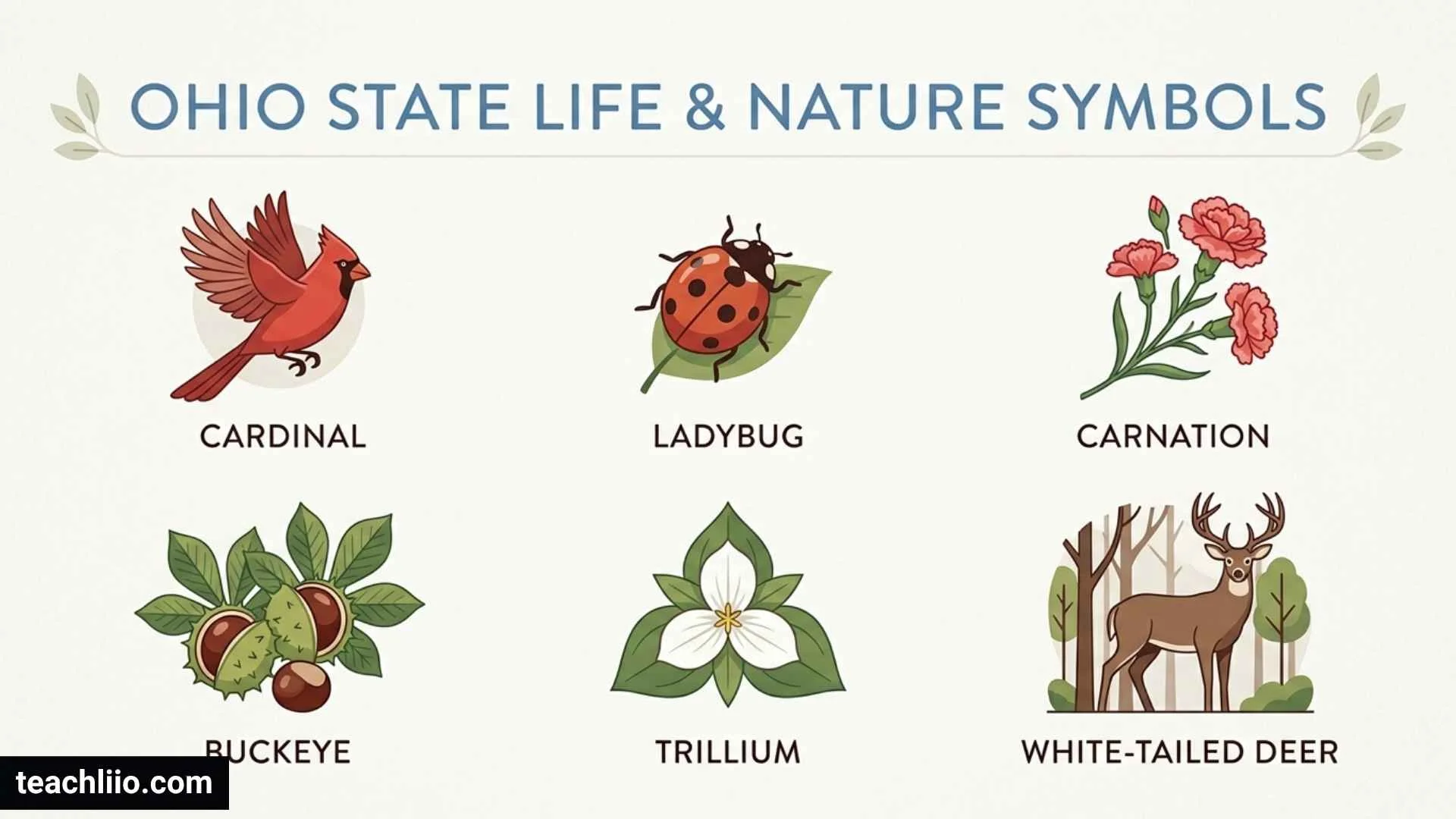
Ohio is known for its rich history, natural beauty, aviation achievements, and strong cultural identity. Many of these qualities are represented by official state symbols. From the famous buckeye tree and northern cardinal to the distinctive state flag and historic Wright Flyer III, each symbol tells a story about Ohio’s people, landscape, and heritage.
If you are researching Ohio state symbols for school, a project, a trivia quiz, or general knowledge, this guide explains the major symbols, what they represent, and why they matter.
What Are the Official State Symbols of Ohio?
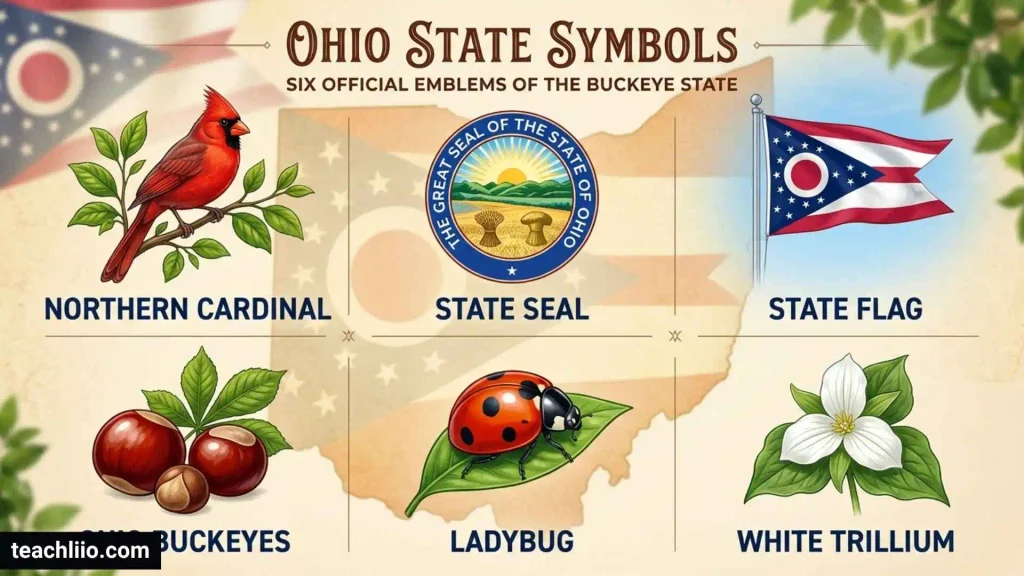
Ohio state symbols are official objects, plants, animals, fossils, songs, and other designations that represent the state’s identity. Some are connected to Ohio’s natural environment, while others recognize its history, scientific achievements, and cultural traditions.
The Ohio General Assembly has established many of these designations through laws and legislative resolutions. Not every designation has the same legal status, so it is useful to distinguish between symbols established in state law and those recognized through other official actions.
Some of Ohio’s best-known symbols include:
- State nickname: The Buckeye State
- State flag: Ohio’s distinctive swallowtail burgee
- State motto: With God, All Things Are Possible
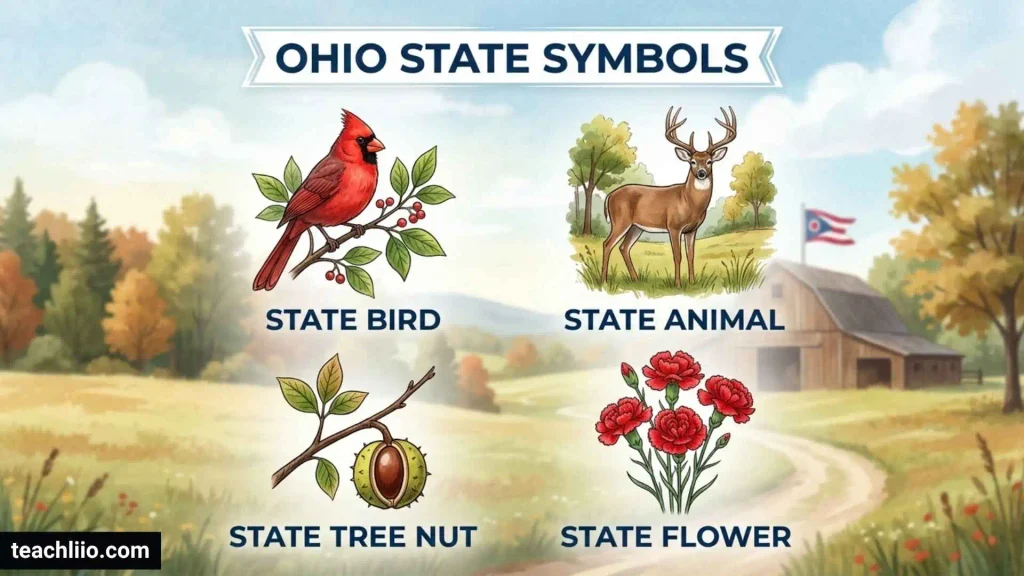
- State bird: Northern cardinal
- State flower: Scarlet carnation
- State tree: Ohio buckeye
- State insect: Ladybug
- State animal: White-tailed deer
- State wildflower: Large-flowered white trillium
- State gemstone: Ohio flint
- State song: Beautiful Ohio
- State airplane: 1905 Wright Flyer III
- State beverage: Tomato juice
- State native fruit: Pawpaw
These symbols represent different parts of Ohio’s character, from its natural resources to its role in the development of aviation.
Ohio State Flag and Its Meaning
Ohio’s state flag is one of its most recognizable symbols. Unlike the rectangular flags used by most U.S. states, Ohio’s flag has a swallowtail shape, with a pointed, forked end. Its unusual design makes it easy to identify.
The flag was adopted in 1902 and is often called a burgee because of its distinctive shape.
What Do the Colors and Shapes Represent?
The flag contains red and white stripes, a blue triangular field, white stars, and a red circle surrounded by a white ring.
Each feature has a symbolic meaning:
- Red and white stripes: The three red stripes and two white stripes represent Ohio’s roads and waterways.
- Blue triangle: The blue field represents Ohio’s hills and valleys.
- Seventeen stars: The stars recognize Ohio as the seventeenth state to join the United States.
- Thirteen stars around the circle: These represent the original thirteen states.
- Four additional stars: These bring the total to seventeen.
- Red circle and white ring: Together, they form an image associated with the letter O and Ohio’s buckeye nickname.
The flag combines geography, American history, and state identity in a compact design.
Why Is Ohio’s Flag Different From Other State Flags?
Most state flags are rectangular, but Ohio chose a swallowtail design. Its shape reflects the traditional style of a military or nautical burgee.
The distinctive design also gives Ohio a flag that is recognizable from a distance. Its colors and symbols connect the state to the United States while highlighting Ohio’s own history.
Ohio State Motto and Slogan
Ohio’s motto and slogan both express pride in the state, but they serve different purposes.
What Is Ohio’s Official State Motto?
Ohio’s official motto is “With God, All Things Are Possible.”
The motto was adopted in 1959. It expresses a message of faith, hope, and the possibility of overcoming challenges. The phrase is often associated with perseverance and the belief that difficult goals can be achieved.
Because the motto includes religious language, it also reflects the historical and cultural context in which Ohio selected it.
What Is Ohio’s State Slogan?
Ohio is widely associated with the slogan “Ohio, The Heart of It All.”
The slogan emphasizes Ohio’s central location in the United States and its connections to transportation, business, industry, and travel. Ohio has long served as an important link between different parts of the country.
Unlike the official state motto, the slogan is primarily used to promote the state and communicate its identity to residents, visitors, and businesses.
Ohio State Seal and Coat of Arms
Ohio’s state seal and coat of arms are official symbols used to represent the authority and identity of the state government. They feature imagery connected to Ohio’s landscape, agriculture, and history.
What Does the Ohio State Seal Represent?
The state seal includes a landscape associated with Ohio’s natural environment. Its imagery features a rising sun, mountains or hills, a river, and agricultural elements.
The rising sun symbolizes a new beginning and the promise of progress. The landscape reflects Ohio’s geography, while agricultural imagery recognizes the importance of farming to the state’s development.
The seal is used on official government documents and in other settings where the state needs to identify its authority.
Why Is the Coat of Arms Important?
Ohio’s coat of arms shares important imagery with the state’s seal. It represents the state’s heritage and the connection between its natural resources and its development.
Official emblems such as the seal and coat of arms help distinguish state government documents and institutions. They also provide a visual reminder of the history and landscape that helped shape Ohio.
Ohio State Animal Symbols
Ohio’s animal symbols recognize some of the creatures associated with the state’s forests, wetlands, fields, and other habitats. These designations also help introduce people to the wildlife that lives in the region.
What Is Ohio’s State Bird?
The northern cardinal is Ohio’s official state bird.
The cardinal is easy to recognize because of its bright red plumage, prominent crest, and distinctive song. Adult males are usually brilliant red, while females have more subdued brownish feathers with reddish accents.
Cardinals live in a variety of habitats, including woodland edges, gardens, parks, and residential neighborhoods. They can be seen throughout Ohio in every season.
The bird became an official state symbol in 1933 according to historical state references, while the state statute formally designates the cardinal as Ohio’s bird.
Its striking appearance and familiar song make it a popular symbol of Ohio’s natural environment.
What Is Ohio’s State Animal?
Ohio’s official state animal is the white-tailed deer.
White-tailed deer are common across Ohio, where they inhabit forests, fields, grasslands, and areas near farms and residential communities. They are known for the white underside of their tails, which becomes especially visible when they raise their tails while moving away from danger.
The species is important to Ohio’s wildlife heritage and outdoor recreation. Deer watching and regulated hunting are also part of the state’s outdoor traditions.
The white-tailed deer received its official state designation in 1988.
What Is Ohio’s State Insect?
Ohio’s state insect is the ladybug, also called a lady beetle.
Ladybugs are small beetles often recognized by their rounded bodies and colorful markings. Many have red or orange wing covers with black spots, although their appearance varies by species.
They are beneficial insects because many feed on aphids and other small pests that damage plants. This makes them valuable to gardens and agricultural environments.
Ohio selected the ladybug as its state insect in 1975. The designation also reflects the importance of teaching children about insects and the natural world.
What Is Ohio’s State Reptile?
Ohio’s state reptile is the black racer snake.
The black racer is a fast-moving, nonvenomous snake that occurs in parts of Ohio. Adults are generally dark in color, with slender bodies that help them move quickly through grasslands, woodland edges, and open habitats.
Black racers help maintain ecological balance by feeding on various small animals. They generally prefer to escape when disturbed rather than confront people.
Ohio designated the black racer as its state reptile in 1995.
What Is Ohio’s State Amphibian?
Ohio’s official state amphibian is the spotted salamander.
This amphibian has a dark body marked with bright yellow spots. It lives in woodland habitats and depends on suitable freshwater breeding sites, especially temporary woodland pools.
Spotted salamanders spend much of their lives hidden beneath logs, leaves, or underground. During the breeding season, adults may migrate to ponds and pools to reproduce.
The spotted salamander represents Ohio’s amphibian diversity and the importance of protecting wetlands and forest habitats.
What Is Ohio’s State Frog?
Ohio’s state frog is the American bullfrog.
The American bullfrog is one of the largest frogs found in North America. It usually lives in ponds, lakes, marshes, and other permanent freshwater environments.
Bullfrogs are recognized by their large bodies, powerful hind legs, and deep, resonant calls. Their presence is associated with Ohio’s aquatic habitats.
Ohio designated the American bullfrog as its state frog in 2010. The bullfrog and spotted salamander represent different groups of amphibians found within the state.
Ohio State Plant and Flower Symbols
Ohio’s plant symbols reflect its forests, gardens, wildflower habitats, and agricultural traditions. Some are valued for their beauty, while others are important because of their historical or economic connections.
What Is Ohio’s State Flower?
Ohio’s official state flower is the scarlet carnation.
The scarlet carnation is known for its rich red color and ruffled petals. It is commonly associated with affection, admiration, and remembrance.
The flower’s connection to Ohio includes its association with William McKinley, who often wore a red carnation. McKinley was born in Ohio and later became president of the United States.
Ohio adopted the scarlet carnation as its state flower in 1904. The designation connects the state’s floral identity with an important figure in its political history.
What Is Ohio’s State Tree?
Ohio’s state tree is the Ohio buckeye, scientifically known as Aesculus glabra.
The buckeye is a deciduous tree native to parts of the central and eastern United States. It produces distinctive nuts with dark brown surfaces and lighter circular markings that resemble the eye of a deer.
The tree is especially important to Ohio’s identity because the nickname “Buckeye State” comes from it. Buckeye imagery appears in sports, local traditions, souvenirs, and community celebrations.
The Ohio buckeye is also valued for its role in native ecosystems, although its nuts and other parts should not be treated as edible.
What Is Ohio’s State Wildflower?
Ohio’s official state wildflower is the large-flowered white trillium.
This woodland wildflower produces three broad leaves and a flower with three prominent white petals. As the flower ages, its petals may develop pinkish tones.
Large-flowered white trilliums bloom in spring, particularly in wooded areas where the soil and moisture conditions are suitable. They are a familiar sign of the changing seasons in eastern North American forests.
Ohio’s designation recognizes the beauty and ecological importance of native wildflowers. As with other woodland plants, protecting natural habitats helps maintain healthy populations.
Why Is the Buckeye So Important to Ohio?
The buckeye has become more than a botanical symbol. It is a central part of Ohio’s identity.
Residents may use buckeye imagery in school traditions, sporting events, decorations, and local products. The name is also strongly associated with Ohio State University’s athletic teams, known as the Buckeyes.
This connection helps explain why the buckeye is one of the state’s most familiar symbols, even to people who do not know the details of its official designation.
Ohio State Fruit and Beverage Symbols
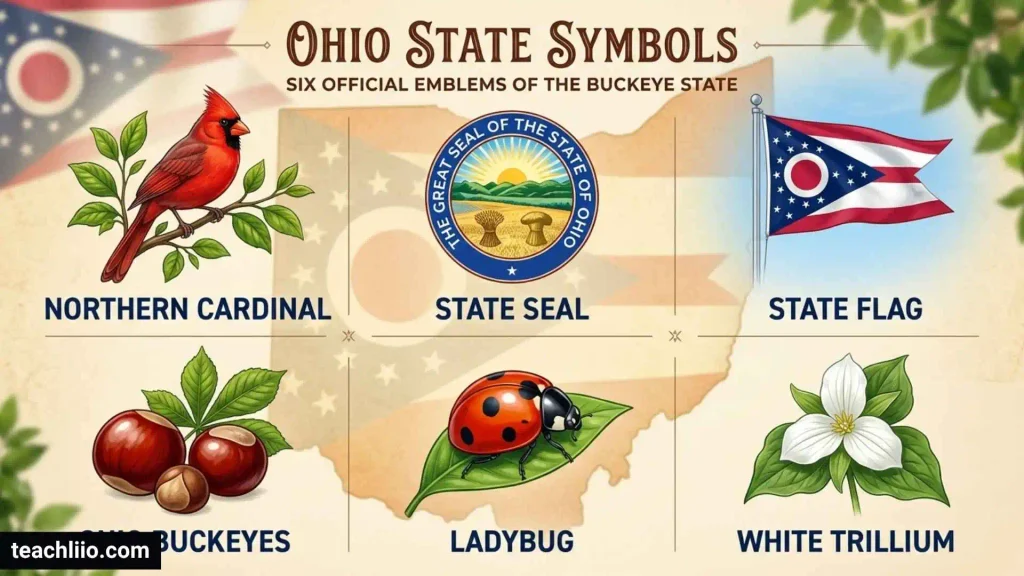
Ohio’s fruit and beverage designations connect the state’s identity with its food traditions and agricultural history.
What Is Ohio’s State Fruit?
Ohio recognizes the tomato as its state fruit.
Although tomatoes are commonly treated as vegetables in cooking, they are botanically fruits because they develop from a flower and contain seeds.
Tomatoes are widely used in Ohio gardens and farms. They can be eaten fresh or processed into sauces, soups, and other foods.
The tomato received its state designation in 2009. Its selection reflects the importance of agriculture and food production to Ohio communities.
What Is Ohio’s State Native Fruit?
Ohio’s designated state native fruit is the pawpaw.
The pawpaw is a fruit produced by a small tree native to eastern North America. Its greenish fruit contains soft flesh that is often described as having a sweet, custard-like texture.
Pawpaw trees grow in suitable woodland environments, particularly where moisture and shade are available. The fruit has a long history of use by Indigenous peoples and other communities in regions where the tree grows.
Ohio’s recognition of the pawpaw highlights a native plant with a distinctive flavor and a connection to regional food traditions.
What Is Ohio’s State Beverage?
Ohio’s official state beverage is tomato juice.
Tomato juice is made from ripe tomatoes and is commonly consumed on its own or used as an ingredient in soups, sauces, and mixed drinks.
Ohio designated tomato juice as its state beverage in 1965. The choice reflects the state’s agricultural connections and the importance of tomato production and processing.
Although tomato juice may seem like an unusual choice for a state beverage, it is a distinctive part of Ohio’s official list of symbols.
Ohio State Geological and Fossil Symbols
Ohio’s geological symbols recognize the rocks, minerals, and prehistoric animals that help tell the story of the region’s natural history.
These designations are especially interesting to students, fossil collectors, geology enthusiasts, and people studying ancient life.
What Is Ohio’s State Gemstone?
Ohio’s state gemstone is Ohio flint.
Flint is a hard, fine-grained rock that can produce sharp edges when fractured. For thousands of years, people used flint to make tools, points, and other objects.
Ohio flint is especially associated with Flint Ridge, a geological area known for its colorful deposits. The material was valued by Indigenous peoples, who obtained and traded it over long distances.
Ohio designated flint as its state gemstone in 1965. Its importance comes from both its geological characteristics and its archaeological history.
What Is Ohio’s State Invertebrate Fossil?
Ohio’s state invertebrate fossil is Isotelus, a genus of trilobites.
Trilobites were marine animals that lived long before dinosaurs appeared. Their hard outer coverings fossilized well, allowing scientists to study their body structures and evolutionary history.
Isotelus fossils are particularly associated with Ohio’s Ordovician-age rocks. They provide evidence that ancient seas once covered areas that are now part of the state.
The designation helps highlight Ohio’s importance to paleontology and its record of prehistoric marine life.
What Is Ohio’s State Fossil Fish?
Ohio recognizes Dunkleosteus terrelli as its state fossil fish.
Dunkleosteus was a large armored fish that lived during the Devonian Period, hundreds of millions of years ago. It had heavy bony plates covering the front of its body and powerful jaws adapted for capturing prey.
Fossils of this prehistoric fish are associated with ancient marine environments that existed in the region. Its remains help scientists understand the diversity of early jawed vertebrates.
Dunkleosteus is one of Ohio’s most striking prehistoric symbols because it represents a time when the state’s geological environment was very different from what it is today.
Ohio State Historical and Cultural Symbols
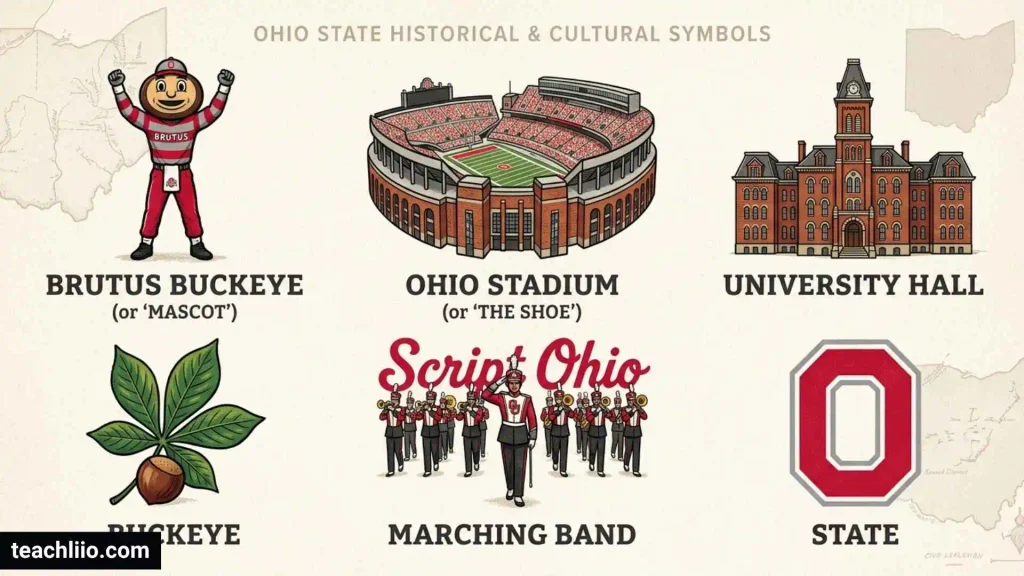
Not every state symbol comes from the natural world. Ohio also recognizes objects, places, traditions, and achievements connected to its cultural and historical development.
What Is Ohio’s State Song?
Ohio’s official state song is “Beautiful Ohio.”
The song celebrates the beauty of Ohio’s landscape and expresses affection for the state. It has been associated with Ohio for generations and is used in settings where state pride and tradition are celebrated.
The current statutory designation recognizes “Beautiful Ohio” as the official state song.
Its lyrics and melody reflect a traditional style of state song, emphasizing the natural beauty and emotional connection that residents may feel toward their home.
Is “Hang On Sloopy” an Official Ohio State Song?
“Hang On Sloopy” has a special place in Ohio popular culture.
The song became closely associated with Ohio State University and its football traditions. It is frequently heard at sporting events and has become a recognizable part of the state’s modern musical identity.
Ohio recognized “Hang On Sloopy” as its official state rock song through a legislative resolution in 1985. A resolution-based designation is different from a provision formally codified in the Ohio Revised Code, so the exact legal status should be checked against the current state record before publication.
The song’s popularity shows how music can become part of a state’s identity beyond its traditional official symbols.
What Is Ohio’s State Airplane?
Ohio’s state airplane is the 1905 Wright Flyer III.
The Wright brothers, Orville and Wilbur Wright, were aviation pioneers whose work helped establish powered flight. Their experiments and developments were closely connected to Dayton, Ohio, and the nearby region.
The Wright Flyer III was an important step in the development of practical airplanes. Its design reflected improvements in control and stability compared with earlier experimental aircraft.
Ohio officially designated the 1905 Wright Flyer III as its state airplane in 2025. The designation recognizes the state’s role in the history of aviation and its connection to the Wright brothers.
What Is Ohio’s State Artifact?
Ohio recognizes the Adena Pipe as its state artifact.
The Adena Pipe is associated with the Adena culture, an Indigenous cultural tradition that flourished in parts of the Ohio Valley during the Woodland period.
Artifacts from this period provide evidence of artistic skill, ceremonial practices, and the social lives of ancient communities. The Adena Pipe is significant because it represents Ohio’s deep Indigenous history, which extends far beyond the period of European settlement.
Its recognition encourages people to learn about the region’s earlier inhabitants and the archaeological evidence they left behind.
What Is Ohio’s State Prehistoric Monument?
The Newark Earthworks are recognized as Ohio’s state prehistoric monument.
The Newark Earthworks are an extensive collection of ancient geometric earthworks built by Indigenous peoples. Their large-scale design demonstrates sophisticated planning, construction knowledge, and an understanding of landscape.
The earthworks served important purposes for the communities that created them. Researchers continue to study their form, use, and cultural significance.
This designation highlights Ohio’s role in preserving major archaeological sites and recognizing the achievements of Indigenous societies.
What Is Ohio’s State Bicentennial Bridge?
Ohio recognizes Blaine Hill Bridge as its state bicentennial bridge.
Historic bridges help explain how people traveled, moved goods, and connected communities before modern highways and infrastructure developed.
Blaine Hill Bridge is associated with Ohio’s transportation heritage. Its recognition draws attention to the importance of preserving historic structures and understanding how engineering has changed over time.
Does Ohio Have a State Architectural Symbol?
Ohio recognizes the barn as a state architectural symbol.
Barns are familiar features of rural Ohio landscapes. They reflect the state’s agricultural history and the practical building traditions that supported farming communities.
Barn designs vary according to period, region, purpose, and available materials. Their structures often reveal how farmers stored crops, housed animals, and organized daily work.
Recognizing the barn as an architectural symbol celebrates the role of agriculture in Ohio’s development and the visual character of its countryside.
What Is Ohio’s Official Soap Box Derby Designation?
Ohio recognizes the All-American Soap Box Derby as an official gravity-racing program.
Soap box derby racing involves small, unpowered vehicles that travel downhill using gravity. The activity encourages participants to learn about design, construction, teamwork, and competition.
The All-American Soap Box Derby has a long association with Akron, Ohio, where the event developed into a nationally recognized youth racing tradition.
Its designation highlights Ohio’s contribution to community sports and educational activities for young people.
Why Are Ohio State Symbols Important?
State symbols are more than names on an official list. They provide a way to understand the state’s environment, culture, and history.
They Represent Ohio’s Natural Environment
The cardinal, white-tailed deer, buckeye tree, trillium, and other natural symbols introduce people to species and habitats found in Ohio.
They can also encourage interest in conservation, native plants, wildlife, and healthy ecosystems.
They Preserve Historical Traditions
Symbols such as the scarlet carnation, Adena Pipe, and Newark Earthworks connect modern Ohio with important parts of its past.
They help people recognize that the state’s history includes Indigenous societies, agriculture, political leaders, scientific achievements, and changing communities.
They Support Education
Ohio state symbols are useful in classrooms, school assignments, history projects, and trivia activities.
Learning the symbols can help students explore biology, geology, geography, government, and cultural history through familiar examples.
They Build a Shared Identity
State symbols give residents common references that can be celebrated in schools, sports, festivals, and community events.
The buckeye, for example, is widely recognized throughout Ohio. Other symbols, such as the state flag and state song, represent the state in official and ceremonial settings.
Together, these symbols help express what makes Ohio distinctive.
Frequently Asked Questions
What Is Ohio Best Known for as a State Symbol?
Ohio is especially well known for the buckeye tree and its nickname, the Buckeye State. The northern cardinal, scarlet carnation, and distinctive swallowtail state flag are also widely recognized.
What Is Ohio’s Official State Bird?
Ohio’s official state bird is the northern cardinal. It is known for the male’s bright red plumage, prominent crest, and clear song.
What Is Ohio’s State Flower?
Ohio’s state flower is the scarlet carnation. It was adopted in 1904 and is associated with the state’s history and former president William McKinley.
What Is Ohio’s State Tree?
Ohio’s state tree is the Ohio buckeye, scientifically known as Aesculus glabra. It gives the state its familiar nickname, the Buckeye State.
What Is Ohio’s State Animal?
Ohio’s official state animal is the white-tailed deer. It is common in many of the state’s forests, fields, and other habitats.
What Is Ohio’s State Insect?
Ohio’s state insect is the ladybug, which was designated in 1975. Ladybugs are beneficial beetles because many species feed on plant pests.
What Is Ohio’s State Gemstone?
Ohio’s state gemstone is Ohio flint. The rock is known for its geological properties and its historical use in making tools and other objects.
What Is Ohio’s State Motto?
Ohio’s official motto is “With God, All Things Are Possible.” It was adopted in 1959.
What Is Ohio’s Official State Song?
Ohio’s official state song is “Beautiful Ohio.” The state also recognized “Hang On Sloopy” as its state rock song through a legislative resolution.
What Is Ohio’s State Airplane?
Ohio’s state airplane is the 1905 Wright Flyer III. The designation recognizes the Wright brothers’ contributions to aviation and their connection to Ohio.
What Is Ohio’s State Fruit?
Ohio recognizes the tomato as its state fruit and the pawpaw as its state native fruit. The tomato is botanically a fruit even though it is commonly treated as a vegetable in cooking.
What Is Ohio’s State Beverage?
Ohio’s official state beverage is tomato juice. It received this designation in 1965.
How Many State Symbols Does Ohio Have?
Ohio has numerous official symbols and designations, including plants, animals, geological features, songs, historical objects, and cultural traditions. The total depends on which categories are included and whether symbols established through resolutions are counted alongside those specifically codified in state law.
Conclusion
Ohio state symbols tell a wide-ranging story about the state’s natural environment, cultural traditions, historical achievements, and community identity. The buckeye tree explains the state’s famous nickname, the cardinal represents its wildlife, and the scarlet carnation connects floral symbolism with political history. Other designations, including Ohio flint, the Adena Pipe, the Newark Earthworks, and the Wright Flyer III, reveal the region’s geological and historical significance.
Whether you are preparing a school assignment, studying state trivia, or exploring Ohio’s heritage, these symbols provide a useful starting point for understanding what makes the Buckeye State unique. Each one represents a different part of Ohio’s story, linking its past with the people and communities that shape it today.

I’m Hugo Wetherby, a British author interested in the numbers behind everyday questions. I explore quantities, populations, measurements, records, comparisons, and surprising statistics, turning complicated information into accessible answers. I believe a simple “how many” question can lead to fascinating discoveries, and I enjoy helping readers find those answers.
Books:
How Many? A Guide to Everyday Numbers
The Great Book of Numbers and Quantities