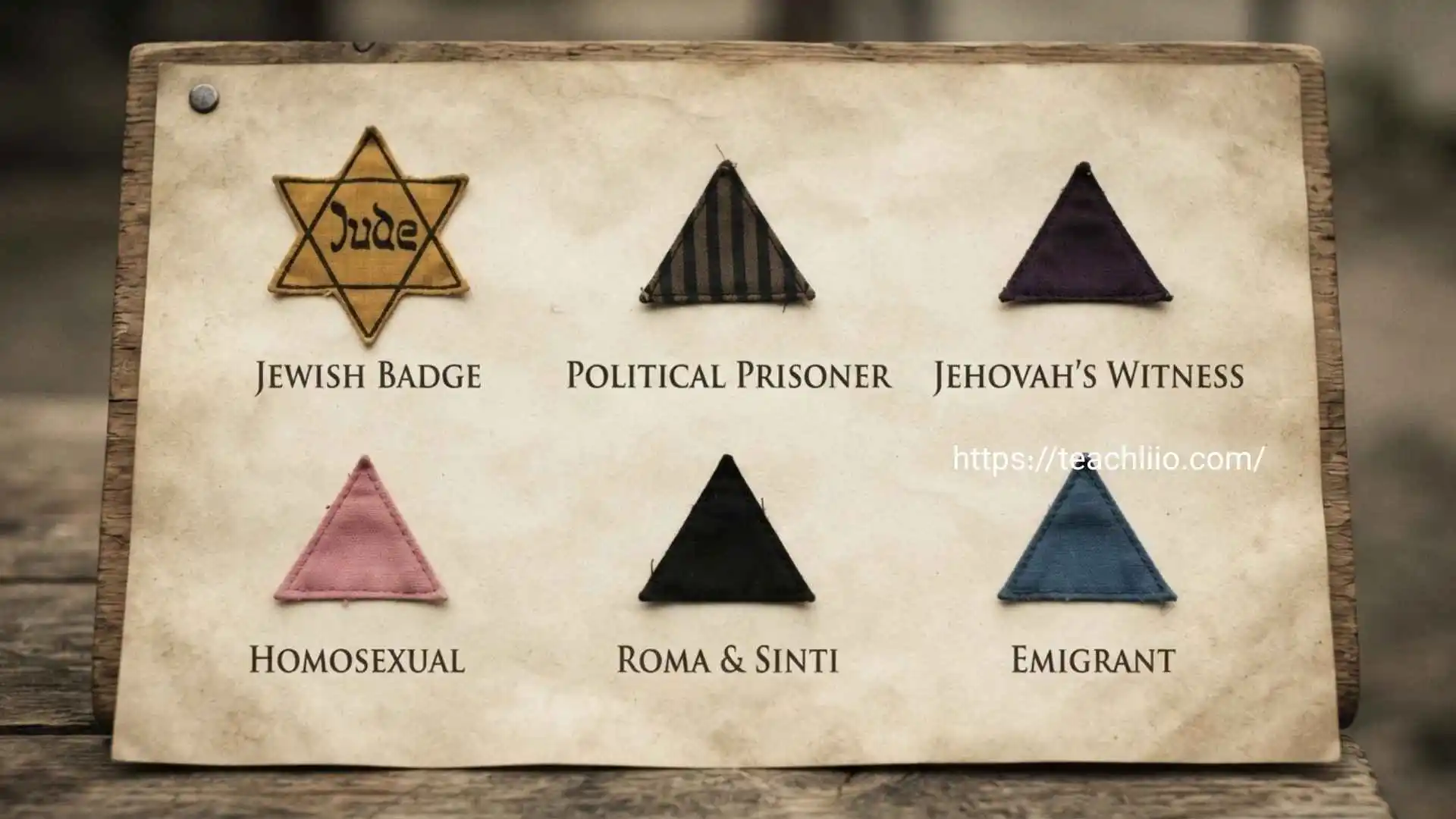
The symbols of the Holocaust help us understand a history that can be difficult to comprehend through numbers and dates alone. Some symbols were imposed by Nazi Germany to identify, isolate, and persecute victims. Others are objects, places, or images that later became powerful reminders of deportation, imprisonment, murder, loss, and remembrance.
There is no single official symbol of the Holocaust. Among the most recognizable are the yellow Jewish badge, Nazi swastika, concentration-camp prisoner markings, barbed wire, deportation trains, Auschwitz-Birkenau, prisoner numbers, shoes, suitcases, and candles used in remembrance.
It is important to understand these symbols in context. The Star of David, for example, existed as a Jewish symbol long before the Holocaust. Nazi authorities appropriated it for a completely different and oppressive purpose. Likewise, candles and memorial stones were not Nazi symbols; they became associated with remembrance after the Holocaust.
This guide explains the history and meaning behind the most important Holocaust-related symbols and distinguishes symbols of Nazi persecution from symbols of Holocaust remembrance.
What Are the Symbols of the Holocaust?
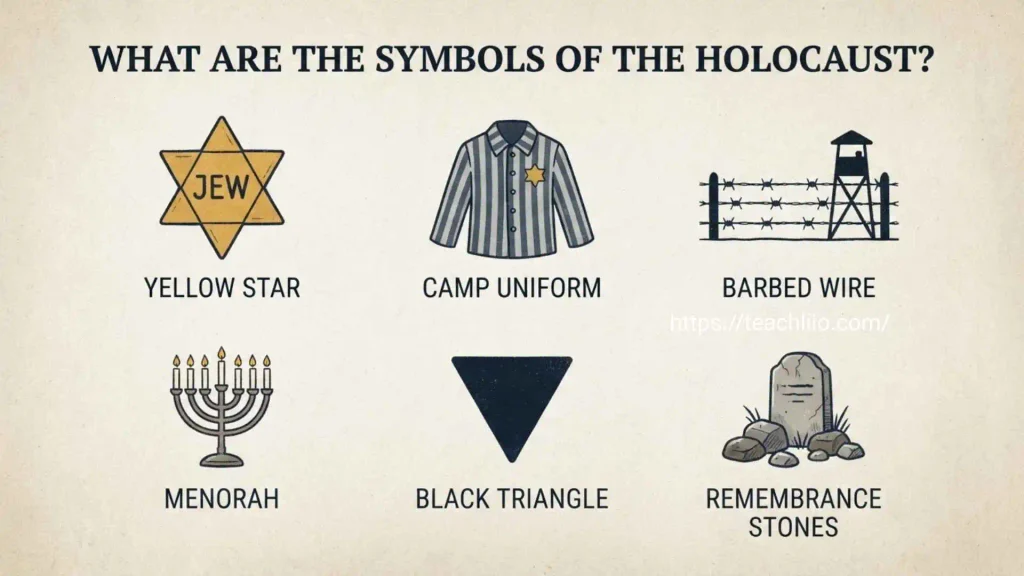
Holocaust symbols are images, markings, objects, places, or memorial traditions that help represent aspects of the Holocaust.
They can be divided into four main groups:
- Symbols imposed by Nazi authorities to identify or classify victims.
- Objects and places associated with persecution, deportation, imprisonment, and mass murder.
- Symbols representing the loss of individual lives and identity.
- Modern remembrance symbols used to honor victims and educate future generations.
This distinction matters because not every object associated with the Holocaust was actually a symbol during the Nazi period.
For example, the yellow badge was a forced Nazi identification measure, while a memorial candle is a later expression of remembrance.
Quick Guide to Holocaust Symbols
| Symbol or image | What it represents |
| Yellow Jewish badge | Forced identification, discrimination, segregation, and persecution of Jews |
| Star of David used on Nazi badges | Nazi appropriation of an existing Jewish symbol for persecution |
| Nazi swastika | Nazi ideology, dictatorship, racism, antisemitism, and persecution |
| Concentration-camp triangles | Nazi classification and identification of prisoners |
| Red triangle | Political prisoners |
| Green triangle | Prisoners classified as criminals |
| Pink triangle | Men imprisoned under Nazi persecution for homosexuality |
| Purple triangle | Jehovah’s Witness prisoners |
| Black triangle | People classified by Nazis as “asocial” |
| Brown triangle | Roma prisoners in some camps |
| Prisoner numbers | Loss of identity and bureaucratic control |
| Barbed wire | Confinement and imprisonment |
| Railway tracks | Deportation and forced transportation |
| Deportation railway cars | Forced removal and mass deportation |
| Auschwitz-Birkenau | Mass murder and the Nazi camp system |
| Camp gates | Entry into a system of imprisonment and persecution |
| Shoes | Individual lives and the human cost of mass murder |
| Suitcases | Displacement, deception, and loss |
| Victim names | Restoring individuality and memory |
| Candles | Mourning and remembrance |
| Memorial stones | Memory, permanence, and honoring the dead |
Symbols Used by Nazi Germany to Persecute Victims
1. The Yellow Jewish Badge
The yellow Jewish badge is one of the most recognizable symbols connected with Nazi persecution.
Nazi authorities revived and systematically expanded the use of identifying badges between 1939 and 1945. Different territories used different designs and requirements. In German-occupied Poland, for example, Jewish people were forced to wear identifying marks beginning in 1939. In September 1941, Jews aged six and older in the German Reich and certain annexed territories were required to wear a yellow Star of David badge containing the word “Jew” in German or the local language.
The badge served several purposes. It publicly stigmatized Jews, separated them from the surrounding population, made their movements easier to monitor, and facilitated further persecution and deportation.
The important point is that the badge was not simply a religious symbol. It was a tool imposed by Nazi authorities as part of a larger system of persecution.
2. The Star of David
The Star of David is a longstanding Jewish symbol and should not be confused with a symbol created by Nazi Germany.
The Nazis appropriated the six-pointed star and incorporated it into forced Jewish identification badges. This transformed an existing Jewish symbol into an instrument of humiliation, segregation, and persecution.
The history of the Jewish badge itself extends much further back than the Nazi period. Various authorities in Europe and the Middle East had previously imposed identifying marks on Jewish communities, although the designs and circumstances differed considerably.
Therefore, it is more accurate to say:
The Star of David is a Jewish symbol that the Nazis appropriated for persecution; it was not invented by the Nazis.
3. The Nazi Swastika
The swastika became the central emblem of Nazi Germany and the Nazi Party.
However, the symbol has a history thousands of years older than Nazism and has been used in different cultures and religions with meanings unrelated to Nazi ideology.
The Nazi regime appropriated the symbol and connected it with its racist worldview, antisemitism, nationalism, dictatorship, and political movement.
In Holocaust history, the Nazi swastika therefore represents the regime responsible for systematic persecution and mass murder.
Its older cultural and religious meanings should not be confused with its specific use by Nazi Germany.
Concentration-Camp Prisoner Badges
4. Colored Triangle System
One of the most distinctive visual features of Nazi concentration camps was the system of colored triangular prisoner badges.
Beginning in 1937–1938, the SS developed a system in which sewn-on badges identified the category under which a prisoner had been imprisoned. The exact system varied somewhat between camps.
The badges allowed guards and camp officials to identify prisoners quickly.
This system is important because it demonstrates how Nazi authorities turned human beings into administrative categories.
5. Red Triangle
The red triangle was primarily associated with political prisoners.
People imprisoned for political reasons could include communists, socialists, and other opponents or perceived enemies of the Nazi regime.
The red triangle therefore represents political repression and the imprisonment of people whom the Nazis considered political threats.
6. Green Triangle
The green triangle was used primarily for prisoners whom Nazi authorities classified as criminals.
The classification was created by the Nazi camp system and should not be understood as an objective description of each person’s character or circumstances.
It represents the broader system through which the camp administration categorized prisoners.
7. Pink Triangle
The pink triangle was used to identify men imprisoned under Nazi persecution for homosexuality.
The Nazis criminalized male homosexual behavior and persecuted men they accused of violating these laws.
The pink triangle was originally a badge imposed by the Nazi camp system. After World War II, the image was later reclaimed by LGBTQ+ communities as a symbol of remembrance and resistance.
This makes the pink triangle an especially interesting example of how the meaning of a symbol can change over time.
8. Purple Triangle
The purple triangle was used for Jehovah’s Witness prisoners.
Jehovah’s Witnesses faced Nazi persecution because of their religious beliefs and refusal to conform to certain demands of the Nazi state.
The symbol therefore represents religious persecution and the punishment of people for refusing to surrender their convictions.
9. Black Triangle
The black triangle was associated with prisoners classified by Nazi authorities as “asocial.”
This was a broad and discriminatory category rather than a scientifically meaningful description of people.
The Nazis used the classification against people they regarded as social outsiders, including some people accused of prostitution, people without stable employment or housing, and others who failed to conform to Nazi social expectations. Some Roma were also classified using black triangles in certain camps, while brown triangles were used for Roma in others.
The black triangle therefore represents the arbitrary and oppressive nature of Nazi social classification.
10. Brown Triangle
In some concentration camps, brown triangles were used to identify Roma prisoners.
The classification system was not identical in every camp, and Roma prisoners could be marked differently in different contexts.
This is one reason historical explanations of camp badges should include a warning that the meaning and application of markings could vary by camp and period.
11. Yellow Concentration-Camp Badges
Jewish prisoners in concentration camps were commonly identified through yellow markings.
In the camp system, two yellow triangles could be arranged to form a Star of David. If a Jewish prisoner was also placed into another category, different colored triangles could be combined.
For example, a Jewish political prisoner could receive a combination involving yellow and red triangles.
This is an important distinction from the yellow badge Jews were required to wear outside the camps.
12. Prisoner Numbers
Prisoner numbers are another powerful representation of Nazi attempts to control and dehumanize prisoners.
At Auschwitz, prisoners were assigned registration numbers, and the camp became unique among Nazi concentration camps for permanently tattooing numbers on many prisoners. The practice began with Soviet prisoners of war and was later expanded to other groups.
A number could replace a person’s name in everyday camp administration.
For modern readers, prisoner numbers can therefore symbolize the attempt to reduce individuals to entries in a bureaucratic system.
At the same time, historical research has shown that these numbers can help researchers identify individual prisoners and reconstruct their stories.
That creates an important contrast: a system designed to dehumanize people can later become evidence that helps restore their identities.
Objects and Images Associated With the Holocaust
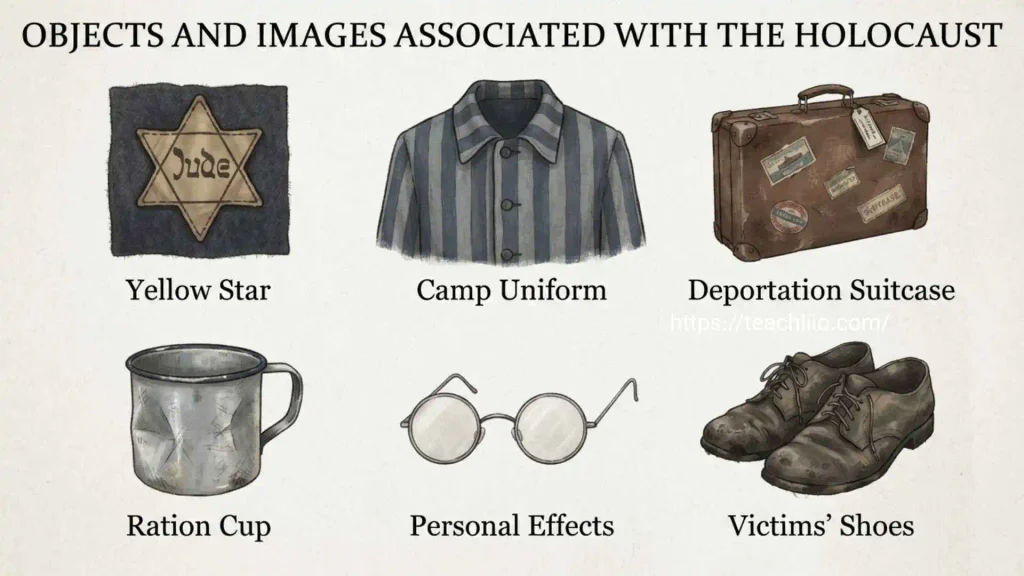
Not every object in this section was officially used as a symbol during the Holocaust. These objects became powerful representations because they survive as evidence of what happened.
13. Barbed Wire
Barbed wire is one of the most recognizable images associated with Nazi concentration camps.
Fences separated prisoners from the outside world and reinforced the physical boundaries of the camp.
Today, barbed wire can symbolize:
- imprisonment,
- isolation,
- loss of freedom,
- fear,
- forced separation,
- and the barriers surrounding camp prisoners.
Its power comes partly from its simplicity. A fence can communicate confinement without requiring a long explanation.
14. Railway Tracks
Railway tracks symbolize the deportation of victims.
Trains were used to transport Jewish people and other persecuted groups to ghettos, concentration camps, forced-labor camps, and killing centers.
A railway track can therefore represent more than transportation. In Holocaust memorial settings, it can evoke forced removal from homes, separation from families, uncertainty, and the machinery of mass persecution.
15. Deportation Railway Cars
Freight and railway cars have become important Holocaust memorial objects.
Many deportees were transported under extremely harsh and overcrowded conditions.
A preserved railway car can help visitors understand that deportation was not an abstract process. People were physically removed from their homes and transported across occupied Europe.
The object therefore represents forced displacement and deportation.
16. Auschwitz-Birkenau
Auschwitz-Birkenau is one of the most recognizable historical sites associated with the Holocaust.
The name has become a powerful representation of Nazi mass murder because the Auschwitz complex was a major site of imprisonment, forced labor, and systematic killing.
It is important, however, to remember that the Holocaust did not happen only at Auschwitz.
Nazi Germany and its collaborators murdered Jews across Europe through shootings, killing centers, ghettos, starvation, forced labor, deportation, and other forms of persecution.
Auschwitz is therefore best understood as a major historical site that has also become a symbol of the Holocaust’s enormous scale.
17. Concentration-Camp Gates
The entrances to former concentration camps are powerful visual reminders of the camp system.
Auschwitz I is particularly associated with its entrance gate and the cynical German phrase “Arbeit macht frei,” commonly translated as “Work sets you free.”
The phrase did not represent genuine freedom for prisoners. Instead, it formed part of the deceptive and brutal environment of the camp.
Today, the gate is a historical artifact and a reminder of the contradiction between Nazi propaganda and the reality experienced by prisoners.
18. Shoes
Shoes are among the most emotionally powerful objects displayed in Holocaust museums.
A pair of shoes immediately suggests an individual person.
This is important because Holocaust history can sometimes be reduced to enormous statistics. Personal objects restore a sense of individuality.
A collection of shoes can therefore represent:
- people who were murdered,
- families that were destroyed,
- lives interrupted,
- possessions taken from victims,
- and the enormous human cost behind historical numbers.
19. Suitcases
Suitcases can symbolize displacement, loss, uncertainty, and the destruction of ordinary life.
People who were deported sometimes brought luggage because they were given misleading information about their destination or believed they might need personal belongings.
Today, suitcases in museums can help visitors imagine the sudden transformation from ordinary life to forced deportation.
A suitcase represents something familiar—a journey—but in the Holocaust context, that journey was often forced and catastrophic.
20. Victims’ Names
Names are among the most meaningful elements of Holocaust remembrance.
The Nazis attempted to categorize people through badges, numbers, documents, and administrative records.
Memorial projects that preserve victims’ names do something fundamentally different: they emphasize individuality.
A name can represent a person’s existence, family, identity, and place in society.
This is why memorials frequently display names rather than only statistics.
Symbols of Holocaust Remembrance
The following symbols should be understood differently from Nazi identification badges. They are primarily associated with remembrance, mourning, education, and honoring victims.
21. Candles
A candle is commonly used as a symbol of remembrance.
Lighting a candle can represent:
- mourning,
- memory,
- respect,
- hope,
- and the continuation of remembrance.
Candles are not a Nazi Holocaust symbol. They are a later memorial tradition used to honor those who died.
22. Memorial Stones
Stones can represent permanence and remembrance.
Within Jewish traditions, placing a stone at a grave is a familiar practice of remembering the deceased.
In Holocaust remembrance, stones can therefore carry an additional meaning: the memory of people who were murdered should remain present rather than disappear.
23. Memorial Names and Photographs
Photographs and names are particularly powerful because they restore individuality.
A photograph can show that a victim had a face, family, childhood, occupation, personality, and ordinary life before persecution destroyed it.
This approach changes the way people understand Holocaust history.
Instead of thinking only about millions of victims, readers and museum visitors can encounter individual stories.
24. Butterfly Imagery
The butterfly sometimes appears in Holocaust education and remembrance, particularly in connection with children.
Its association is partly connected with Pavel Friedmann’s poem “The Butterfly,” written while he was imprisoned in Theresienstadt. Friedmann was later murdered at Auschwitz.
Because of this history, butterfly imagery can represent childhood, freedom, beauty, loss, and the desire for a world without persecution.
However, unlike the yellow badge or prisoner triangles, the butterfly was not a standardized Nazi symbol.
Why Did the Nazis Use Identification Symbols?
One of the most important questions about Holocaust symbols is why the Nazis needed visible markings when prisoners were already confined.
The answer is that the markings served administrative and social purposes.
The concentration-camp badge system allowed guards to quickly identify the category assigned to a prisoner. It also reinforced divisions among prisoners and made Nazi classifications visible.
The Jewish badge served a different but related purpose outside the camps.
It made Jews publicly identifiable and helped Nazi authorities segregate, monitor, and control them. The US Holocaust Memorial Museum describes the badge as part of the broader process leading toward deportation and mass murder.
The larger lesson is that persecution often begins by turning a group into a visible “other.”
Identification can become a mechanism for exclusion when it is imposed by an oppressive authority.
What Is the Most Important Symbol of the Holocaust?
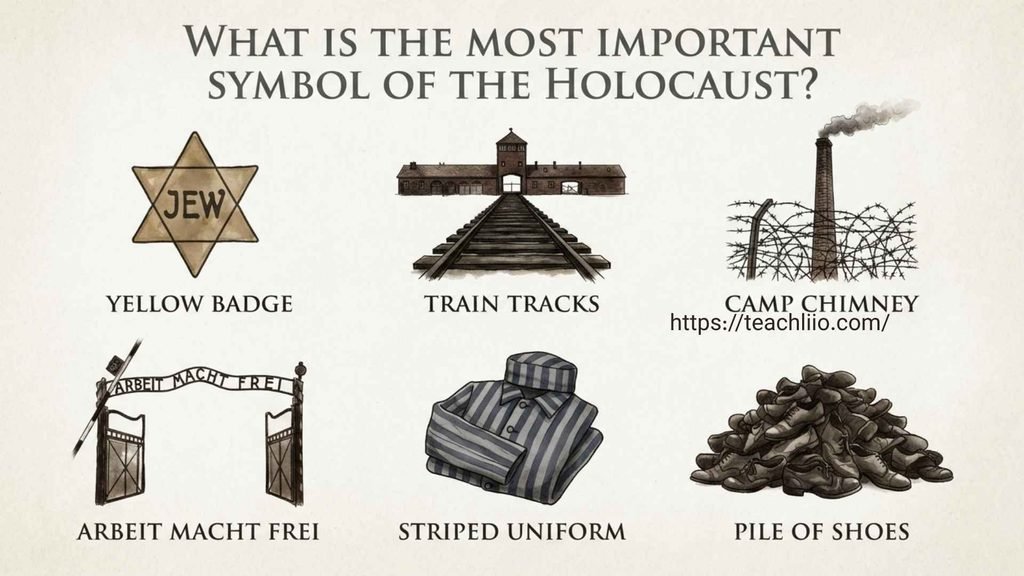
There is no single official symbol of the Holocaust.
If one symbol must be identified as especially recognizable, the yellow Jewish badge featuring the Star of David is among the most important because it directly represents the systematic identification and persecution of European Jews by Nazi authorities.
However, other symbols represent different aspects of Holocaust history.
- The yellow badge represents persecution and forced identification.
- Prisoner triangles represent classification inside concentration camps.
- The Nazi swastika represents the regime and ideology behind the persecution.
- Prisoner numbers represent bureaucratic dehumanization.
- Barbed wire represents imprisonment.
- Railway cars represent deportation.
- Auschwitz-Birkenau represents mass murder on an enormous scale.
- Shoes and suitcases represent individual lives and displacement.
- Candles and memorial stones represent remembrance.
Together, these symbols provide a much fuller picture than any single image could.
Holocaust Symbols vs. Jewish Symbols
This distinction is essential.
A Jewish symbol has a history and meaning within Jewish culture and religion.
A Holocaust symbol may be an object or image associated with Nazi persecution or later remembrance.
The Star of David is the clearest example.
The Star of David existed as a Jewish symbol long before the Holocaust. Nazi authorities appropriated it and forced Jews to wear versions of it as identification.
Therefore, describing the Star of David itself as a “Nazi symbol” is historically inaccurate.
The same principle applies to other symbols whose meanings have changed over time.
Common Misconceptions About Holocaust Symbols
Was the Star of David invented by the Nazis?
No.
It is a longstanding Jewish symbol. Nazi authorities appropriated it for forced identification and persecution.
Was every yellow star identical?
No.
Badge designs and requirements differed according to location and period. The Nazi regime imposed different forms of Jewish identification across occupied territories.
Did every concentration camp use exactly the same prisoner-badge system?
No.
The basic classification system was widespread, but details varied between camps and periods.
Did every Holocaust victim wear a concentration-camp triangle?
No.
The triangle system was associated with the concentration-camp prisoner system. It should not be treated as a universal identification mark for every Holocaust victim.
Is the pink triangle originally an LGBTQ+ symbol?
No.
Its original use in the Nazi concentration-camp system was a persecutory classification for men accused of homosexuality. It was later reclaimed by LGBTQ+ communities.
Is a candle a Nazi Holocaust symbol?
No.
Candles are primarily associated with later remembrance and mourning.
Is Auschwitz the same thing as the Holocaust?
No.
Auschwitz was one major site of Nazi persecution and mass murder. The Holocaust occurred across many locations and involved a much broader system of persecution and killing.
Why Holocaust Symbols Still Matter Today
Holocaust symbols remain important because historical memory can become abstract when people encounter only dates and statistics.
A yellow badge shows how discrimination can be made visible.
A prisoner number shows how bureaucracy can strip away individuality.
A railway car shows how deportation became a physical reality.
A pair of shoes shows that every victim was an individual human being.
A memorial candle shows that remembrance continues after the people themselves are gone.
These symbols therefore help connect historical facts with human experiences.
They also provide opportunities for education. When used responsibly, they can encourage people to ask important questions about antisemitism, racism, propaganda, discrimination, authoritarianism, human rights, and the consequences of treating groups of people as less than human.
How to Use Holocaust Symbols Respectfully
Because the Holocaust involves genocide and immense human suffering, these symbols should be used carefully.
Provide historical context
Do not display a symbol without explaining what it meant and who used it.
Avoid turning tragedy into decoration
Holocaust imagery should not be used simply because it looks dramatic or visually striking.
Distinguish Nazi symbols from remembrance symbols
A yellow badge imposed by Nazi authorities has a different historical meaning from a candle lit at a memorial ceremony.
Avoid misleading comparisons
Historical symbols should not be casually equated with unrelated modern situations without explaining the differences.
Focus on individual human stories
Names, photographs, letters, testimonies, and personal possessions can help prevent victims from becoming anonymous statistics.
Frequently Asked Questions About Holocaust Symbols
What are the main symbols of the Holocaust?
Important Holocaust-related symbols include the yellow Jewish badge, Nazi swastika, concentration-camp prisoner badges, prisoner numbers, barbed wire, railway tracks, deportation cars, Auschwitz-Birkenau, shoes, suitcases, victim names, candles, and memorial stones.
What did the yellow star mean during the Holocaust?
The yellow star or yellow Jewish badge was a forced identification mark used by Nazi authorities and their collaborators in different territories. It helped stigmatize, segregate, monitor, and control Jews and facilitated further persecution and deportation.
What did the colored triangles mean in concentration camps?
The colored triangles were part of a prisoner-classification system. For example, red generally identified political prisoners, green prisoners classified as criminals, pink men imprisoned for homosexuality, and purple Jehovah’s Witnesses. The exact system could vary between camps.
What did the pink triangle mean?
The pink triangle was used by Nazi concentration camps to identify men imprisoned under Nazi persecution for homosexuality. The symbol was later reclaimed by LGBTQ+ communities as a symbol of remembrance and resistance.
Why are shoes associated with the Holocaust?
Shoes are preserved in Holocaust museums because they were among the personal belongings taken from victims. They help communicate the individuality and human cost behind the enormous number of Holocaust victims.
Why are railway tracks a Holocaust symbol?
Railways were used extensively to deport people to ghettos, camps, and killing centers. Railway imagery can therefore symbolize forced removal, deportation, and the destruction of people’s ordinary lives.
What does Auschwitz symbolize?
Auschwitz-Birkenau has become a major symbol of the Holocaust because it was a central site of imprisonment, forced labor, and mass murder. It represents only one part of the much larger Holocaust.
Is there one official Holocaust symbol?
No. There is no single official symbol representing the entire Holocaust. Different symbols represent different aspects of persecution, imprisonment, deportation, murder, loss, and remembrance.
Is the Star of David a Holocaust symbol?
The Star of David is fundamentally a Jewish symbol that existed long before the Holocaust. During the Nazi era, authorities appropriated it for forced identification and persecution. In Holocaust history, it is therefore important to distinguish the original Jewish symbol from the Nazi-imposed yellow badge.
Final Thoughts
The symbols of the Holocaust tell different parts of the same history.
The yellow Jewish badge reveals how persecution could begin with forced identification. Colored prisoner triangles show how Nazi authorities classified people inside concentration camps. Prisoner numbers reveal the dehumanizing power of bureaucracy. Barbed wire represents confinement, while railway tracks and deportation cars represent forced removal.
Shoes and suitcases bring the story back to individual human beings. Auschwitz-Birkenau reminds us of the scale of Nazi mass murder. Names, candles, stones, and memorial imagery represent the continuing responsibility to remember.
Perhaps the most important lesson is that these symbols should never be viewed in isolation. Their meaning comes from the history surrounding them.
Understanding that history helps us distinguish Jewish symbols from Nazi symbols, persecution symbols from remembrance symbols, and historical evidence from later memorial imagery.
Most importantly, learning what these symbols represent keeps the experiences of victims and survivors from becoming distant statistics. It allows future generations to remember what happened, understand how persecution developed, and recognize the human consequences of hatred and dehumanization.

I’m Oscar Radcliffe, a British writer who enjoys uncovering the numbers hidden within ordinary questions. My work explores quantities, counts, statistics, measurements, and fascinating comparisons across different subjects. I aim to present reliable information clearly, helping readers satisfy their curiosity while discovering interesting facts they may never have considered before.
Books:
The Science of Counting
How Many? Fascinating Numbers Explained