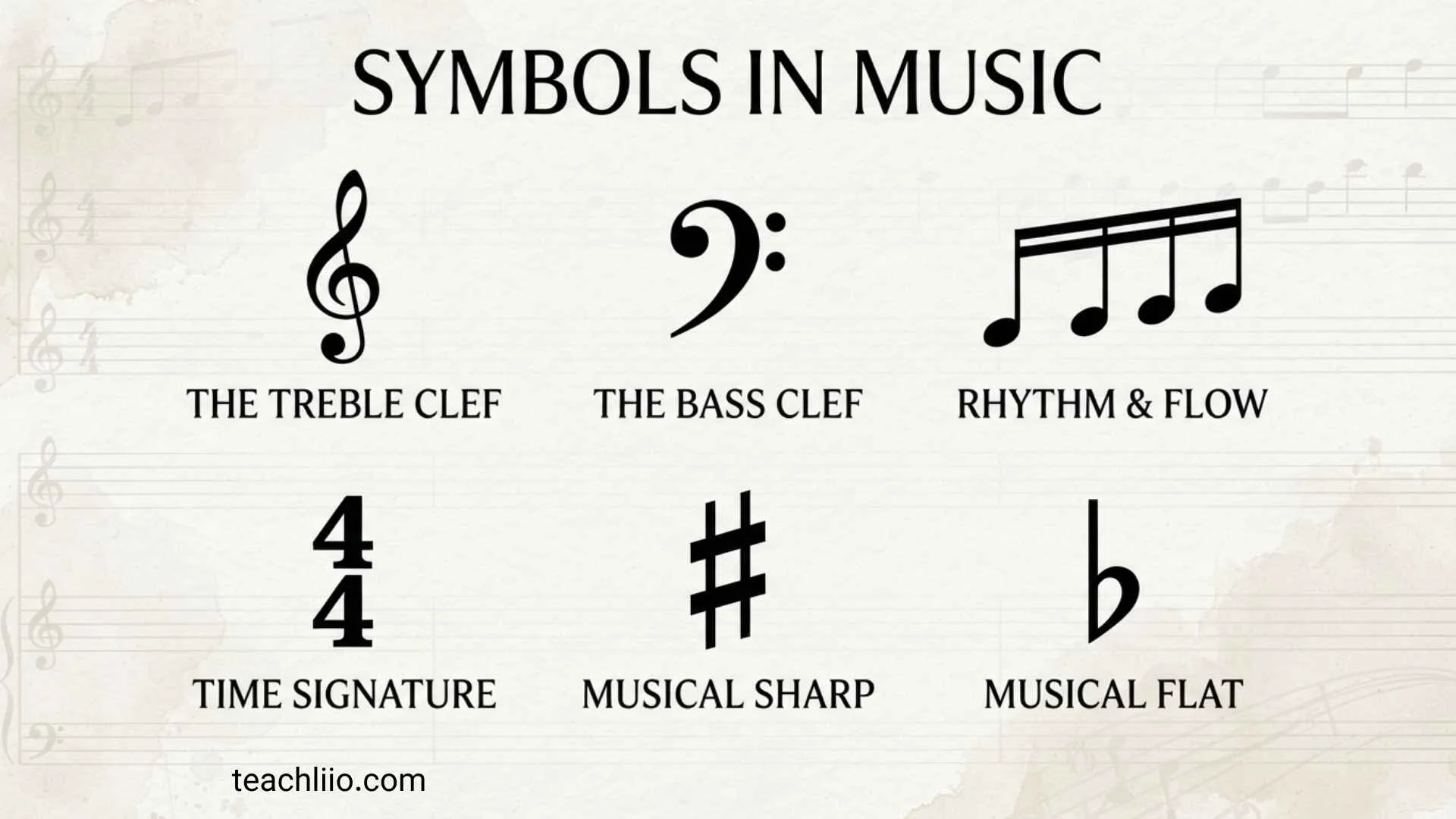
Music can communicate a melody, rhythm, speed, volume, and emotion without using ordinary sentences. Musicians understand this information through a system of written signs called music notation. These symbols tell performers what notes to play, how long to hold them, when to stay silent, how loudly to perform, and how to shape each phrase.
If you are learning to read sheet music, the number of symbols can seem confusing at first. A sharp sign, treble clef, quarter note, rest, crescendo, or repeat mark may look like a small detail, but each one gives the performer important information.
This guide explains the most common symbols in music and their meanings in a beginner-friendly way. You will learn about notes, rests, clefs, accidentals, key signatures, time signatures, dynamics, articulation, tempo markings, ornaments, and navigation symbols. You will also learn how these symbols work together when reading real sheet music.
Music Symbols and Their Meanings at a Glance
Before exploring each category in detail, this quick reference table can help you identify common musical symbols.
| Symbol | Name | Basic Meaning |
| 𝄞 | Treble Clef | Establishes the pitch reference for higher-register notation |
| 𝄢 | Bass Clef | Establishes the pitch reference for lower-register notation |
| 𝄡 | Alto Clef | A C clef commonly used for viola |
| ♩ | Quarter Note | A common note value used as a beat reference |
| 𝅗𝅥 | Half Note | Lasts twice the duration of a quarter note in common simple-meter examples |
| 𝅝 | Whole Note | Lasts four quarter-note beats in 4/4 |
| ♪ | Eighth Note | Half the duration of a quarter note in common simple-meter examples |
| ♯ | Sharp | Raises a pitch by a semitone |
| ♭ | Flat | Lowers a pitch by a semitone |
| ♮ | Natural | Cancels an applicable sharp or flat |
| 𝄽 | Quarter Rest | Indicates a quarter-note-length silence |
| p | Piano | Soft |
| pp | Pianissimo | Very soft |
| f | Forte | Loud |
| ff | Fortissimo | Very loud |
| < | Crescendo | Gradually louder |
| > | Diminuendo | Gradually softer when used as a hairpin |
| • | Staccato | Short or detached articulation |
| — | Tenuto | Sustain or give the note its full written value |
| ^ | Accent | Gives a note emphasis |
| 𝄐 | Fermata | Hold longer than the written value |
| 𝄆 𝄇 | Repeat Signs | Repeat a marked section |
| ∶𝄆 | Segno/Navigation Mark | Used with navigation instructions |
| Coda | Coda | Indicates a later section of the music |
| Fine | Fine | Indicates the end of a piece or section |
The exact appearance of some symbols can vary depending on the notation software, typeface, musical tradition, or historical period.
What Are Symbols in Music?
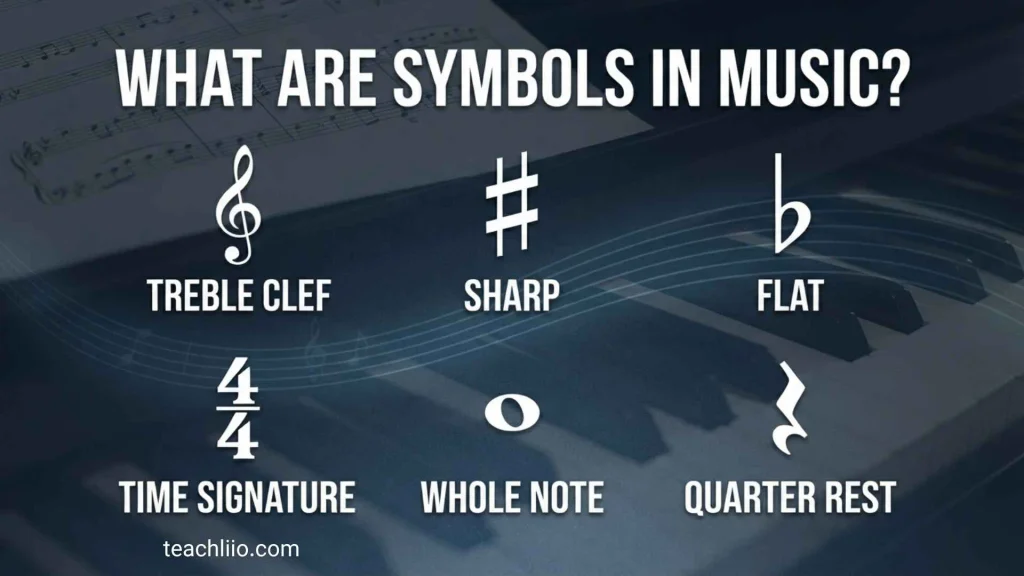
Symbols in music are written marks that communicate instructions about musical sound and performance. Together, they form part of the language of written music.
A musical symbol can tell you about:
- Pitch
- Rhythm
- Duration
- Silence
- Tempo
- Loudness
- Articulation
- Expression
- Repetition
- Musical navigation
- Ornamentation
For example, a note tells you that a sound should occur, while a rest tells you that silence should occur for a particular duration. A clef establishes the pitch relationship of the staff, while a dynamic marking indicates how loudly or softly the music should be played.
How Musical Symbols Communicate Information
Think of sheet music as a set of instructions.
Notes tell you what sounds to produce.
Rests tell you when not to produce a sound.
Clefs help identify pitch.
Time signatures organize beats into measures.
Key signatures and accidentals modify pitch.
Dynamics indicate changes in loudness.
Articulation marks explain how notes should be performed.
Tempo markings indicate speed.
Repeat and navigation symbols tell you where to move through the score.
Understanding these categories makes music notation much easier than trying to memorize symbols individually.
Why Music Uses Symbols
Written music needs a compact way to preserve information.
Imagine trying to describe an entire melody using ordinary sentences. You would need to explain every pitch, duration, pause, volume change, and performance instruction separately.
Music notation allows much of that information to appear together on a page.
This is why a single measure can contain notes, rests, accidentals, dynamics, articulation marks, and other symbols at the same time.
Basic Music Symbols for Beginners
If you are completely new to sheet music, start with the staff and clefs before learning advanced markings.
The Staff
A musical staff consists of five horizontal lines and four spaces. Notes are placed on or between these lines and spaces to show different pitches.
The staff itself does not tell you everything. You need a clef to establish how the lines and spaces correspond to pitches.
This makes the staff one of the foundations of traditional written music.
Treble Clef
The treble clef, also called the G clef, is commonly used for higher-register musical parts.
It is frequently encountered in:
- Piano music
- Violin music
- Flute music
- Guitar notation
- Many vocal parts
The name G clef comes from the way the symbol identifies the position of the note G on the staff.
Bass Clef
The bass clef, also called the F clef, is commonly used for lower-register music.
It is frequently used for:
- Left-hand piano parts
- Bass guitar
- Cello
- Double bass
- Bass vocal parts
The two dots surrounding the relevant staff line help identify the F position.
Alto and Tenor Clefs
Alto and tenor clefs belong to the family of C clefs.
A C clef identifies the position of middle C. Its placement on the staff determines which line represents that pitch.
The alto clef is especially associated with the viola. Tenor clef can appear in higher passages for instruments such as cello, bassoon, and trombone.
These clefs are less common for beginners than treble and bass clefs, but understanding them becomes useful when reading more advanced music.
Music Note Symbols and Their Values
Notes communicate both pitch and duration. Their appearance changes according to how long they are intended to last.
Whole Note
A whole note is an open oval without a stem.
In a common 4/4 example, it occupies four quarter-note beats.
Its actual duration depends on the musical context, so it is more accurate to think of note values as relationships rather than fixed amounts of time.
Half Note
A half note has an open notehead with a stem.
In 4/4, a half note occupies two quarter-note beats.
Two half notes can therefore fill the same rhythmic space as one whole note.
Quarter Note
A quarter note has a filled notehead and a stem.
In a common 4/4 example, it represents one quarter-note beat.
Quarter notes are especially important when learning basic rhythm because many introductory exercises use them as the reference value.
Eighth Note
An eighth note has a filled notehead and stem with one flag when written individually.
Two eighth notes are commonly connected with a beam.
An eighth note has half the duration of a quarter note in a simple-meter context where the quarter note is the beat unit.
Sixteenth Note
A sixteenth note has a filled notehead, a stem, and two flags when written individually.
Several sixteenth notes can be connected with beams.
A sixteenth note is half the duration of an eighth note and one-quarter of a quarter note in the same basic context.
Dotted Notes
A dot placed after a note increases its duration by half of the note’s original value.
For example, a dotted quarter note lasts as long as a quarter note plus an eighth note.
This is an important symbol because the dot changes the rhythmic value without changing the basic notehead.
Ties
A tie is a curved line connecting two notes of the same pitch.
It combines their durations into one sustained sound.
This is different from a slur. A tie combines note values, while a slur generally indicates that notes should be performed smoothly as a phrase.
Rest Symbols in Music
A rest represents silence for a specified rhythmic duration.
Rests are just as important as notes because rhythm depends on both sound and silence.
Whole and Half Rests
Whole and half rests have different positions on the staff and represent different durations.
In a 4/4 context:
- A whole rest generally represents a full measure of silence.
- A half rest represents two quarter-note beats.
The meaning of a whole rest can also depend on the meter and notation context, so beginners should distinguish between the whole-rest symbol and the idea of “four beats” in every possible situation.
Quarter Rest
A quarter rest represents a silence corresponding to a quarter-note value in the relevant rhythmic context.
Its shape is one of the most distinctive symbols beginners learn.
Eighth and Sixteenth Rests
Eighth rests and sixteenth rests represent shorter periods of silence.
Like their note counterparts, they can be combined rhythmically to create more complex patterns.
Learning rests alongside notes makes rhythm much easier to read because you begin to see a measure as a combination of sound and silence.
Rhythm and Time Signature Symbols
Rhythm symbols tell you how long sounds and silences last, while the time signature organizes those rhythmic values into measures.
What Is a Time Signature?
A time signature appears near the beginning of a piece or section, after the clef and key signature in standard notation.
It normally contains two numbers.
The top number tells you how many beats or beat units are grouped in each measure.
The bottom number tells you which note value serves as the notational basis for the beat.
For example, 4/4 commonly indicates four quarter-note beats per measure.
Common Time Signatures
Common examples include:
- 2/4 — often associated with two quarter-note beats per measure
- 3/4 — three quarter-note beats per measure
- 4/4 — four quarter-note beats per measure
- 6/8 — six eighth-note units per measure, commonly felt in two larger beats
Different time signatures create different rhythmic feels and patterns.
Common Time and Cut Time
The symbol C can represent common time, traditionally corresponding to 4/4.
A C with a vertical line through it is commonly used for cut time, corresponding to 2/2.
These symbols are shortcuts for familiar time-signature concepts.
Key Signature vs. Time Signature
These two concepts are easy to confuse.
A key signature tells you which pitches are consistently raised or lowered according to the key.
A time signature tells you how beats are organized into measures.
In simple terms:
Key signature = pitch organization.
Time signature = beat organization.
Sharp, Flat, Natural, and Other Accidentals
Accidentals modify the pitch of individual notes or, depending on their use, establish pitch alterations within a passage.
Sharp Symbol
The sharp sign (♯) raises a note by a semitone in the applicable context.
For example, placing a sharp before C produces C-sharp.
The exact effect and duration of an accidental depend on its position and the notation rules being used.
Flat Symbol
The flat sign (♭) lowers a note by a semitone.
For example, placing a flat before B produces B-flat.
Flats can appear in key signatures or as accidentals attached to individual notes.
Natural Symbol
The natural sign (♮) cancels a previously applicable sharp or flat.
It restores the note to its natural pitch within the relevant notation context.
Double Sharp
A double sharp raises a pitch by two semitones.
It is used in certain keys and harmonic situations where the theoretical spelling of the note matters.
Double Flat
A double flat lowers a pitch by two semitones.
Like the double sharp, it is more common in advanced music theory than in beginner-level music.
Key Signature Symbols
A key signature appears at the beginning of a staff after the clef and before the time signature in standard notation.
It establishes a pattern of sharps or flats associated with the key.
Major and Minor Keys
Key signatures can be associated with major and minor tonalities.
The same key signature can correspond to a major key and its relative minor.
For example, the key signature with no sharps or flats can correspond to C major or A minor, depending on the tonal context.
This is why a key signature alone does not always tell you the complete harmonic story.
How Key Signatures Work
Instead of writing the same accidental repeatedly, a composer can place the relevant sharps or flats in the key signature.
This makes the score cleaner and easier to read.
An individual accidental can still appear later to temporarily alter a pitch.
Dynamic Symbols in Music
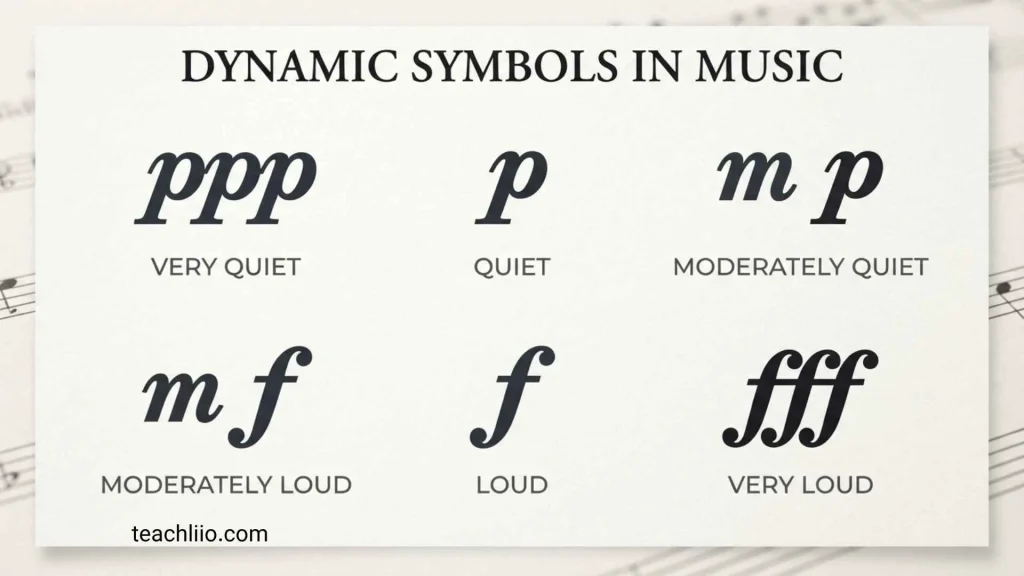
Dynamics tell performers how soft, loud, or gradually changing the volume or intensity of a passage should be.
Piano and Forte
Two of the most important dynamic markings are:
- p — piano: soft
- f — forte: loud
These markings do not mean that the performer should play a particular note. Instead, they describe the desired dynamic level.
Mezzo Dynamics
The letter m means “mezzo,” or moderately.
Common examples include:
- mp — mezzo-piano: moderately soft
- mf — mezzo-forte: moderately loud
These markings provide levels between piano and forte.
Very Soft and Very Loud Dynamics
Additional markings include:
- pp — pianissimo: very soft
- ppp — very, very soft
- ff — fortissimo: very loud
- fff — extremely loud
The precise performance level is relative to the style, instrument, ensemble, and musical context.
Crescendo and Diminuendo
A crescendo means to gradually become louder.
It may be written as cresc. or shown using an opening hairpin:
<
A diminuendo or decrescendo means to gradually become softer.
It can be written as dim., decresc., or represented by a closing hairpin:
>
The direction and surrounding notation determine the intended change.
Articulation Symbols
Articulation markings tell performers how notes should be attacked, connected, separated, or emphasized.
Staccato
A small dot above or below a note commonly indicates staccato.
Staccato tells the performer to play the note in a short, detached manner.
The exact length depends on musical context and performance style.
Legato
Legato means that notes should be connected smoothly.
A slur is often used to indicate a legato phrase, although slurs can have more specific interpretive functions depending on the instrument and musical style.
Tenuto
A horizontal line above or below a note commonly indicates tenuto.
It generally asks the performer to sustain the note for its written value, often with attention to its full weight.
Accent
An accent mark indicates that a note should receive emphasis.
It can make a particular note stand out from surrounding notes.
Marcato
Marcato indicates a strongly marked or emphasized performance.
Its exact execution can depend on the instrument, period, and musical context.
Fermata
A fermata tells the performer to hold a note, chord, or rest longer than its written value.
The exact length is not fixed by the symbol itself. The performer or conductor determines the duration according to context.
Tempo Symbols and Markings
Tempo describes the speed or pace of music.
Common Tempo Terms
Common Italian tempo terms include:
- Largo — very slow and broad
- Adagio — slow
- Andante — moderate, often associated with a walking pace
- Moderato — moderate
- Allegro — fast or lively
- Vivace — lively and brisk
- Presto — very fast
These words provide general tempo guidance rather than always specifying one exact number.
Metronome Markings
A metronome marking can provide a numerical tempo reference.
For example:
♩ = 80
means that the quarter-note value is assigned a tempo of 80 beats per minute.
This gives performers a more precise starting point than a general word such as Allegro.
Tempo and dynamics should not be confused. Tempo describes speed, while dynamics describe loudness or intensity.
Musical Expression and Phrasing Symbols
Some marks explain how musical ideas should be shaped.
Slurs
A slur is a curved line connecting two or more notes.
Its meaning depends partly on the instrument and context, but it commonly indicates that notes should be played smoothly as a connected phrase.
For singers and wind players, it can also relate to phrasing and articulation.
Breath Marks
A breath mark tells a singer or wind player where a brief breath or phrase separation may occur.
It is particularly useful in vocal and wind-instrument notation.
Caesura
A caesura indicates a noticeable break or pause in the music.
It is sometimes described as a “railroad tracks” symbol because of its visual appearance.
The length of the pause depends on the musical context.
Repeat and Navigation Symbols
Music can contain repeated sections, and composers use special symbols to prevent them from having to write the same passage multiple times.
Repeat Sign
A repeat sign is usually represented by two vertical lines with dots.
It tells the performer to repeat a section between the relevant repeat markings.
First and Second Endings
First and second endings allow a repeated section to finish differently on subsequent passes.
For example:
- Play the first ending the first time.
- Return to the repeat.
- Skip the first ending.
- Continue through the second ending.
This is a useful way to save space in written music.
D.C.
D.C. stands for Da Capo, meaning “from the beginning.”
When you see an instruction such as D.C. al Fine, you return to the beginning and continue until reaching the word Fine.
D.S.
D.S. stands for Dal Segno, meaning “from the sign.”
The performer returns to the designated segno symbol and continues according to the instruction.
Coda, Segno, and Fine
A coda marks a separate concluding section.
A segno is a navigation symbol that tells the performer where to return when an instruction such as D.S. is used.
Fine indicates the end of the piece or a designated stopping point.
These symbols may look unfamiliar at first, but they are essentially a navigation system for the score.
Ornament Symbols in Music
Ornaments add decorative or expressive detail to a musical line.
Trill
A trill indicates a rapid alternation between a written note and a neighboring pitch.
The exact execution depends on the musical style and historical context.
Mordent
A mordent is an ornament involving a rapid movement from the main note to a neighboring note and back.
There are different forms, including upper and lower variants.
Turn
A turn is a decorative figure that moves around the main note using neighboring pitches.
Its exact realization can vary according to style and period.
Grace Notes
Grace notes are small notes placed before a principal note.
They are generally performed quickly as an ornament, with their exact rhythmic treatment depending on the notation and style.
Music Symbols by Function
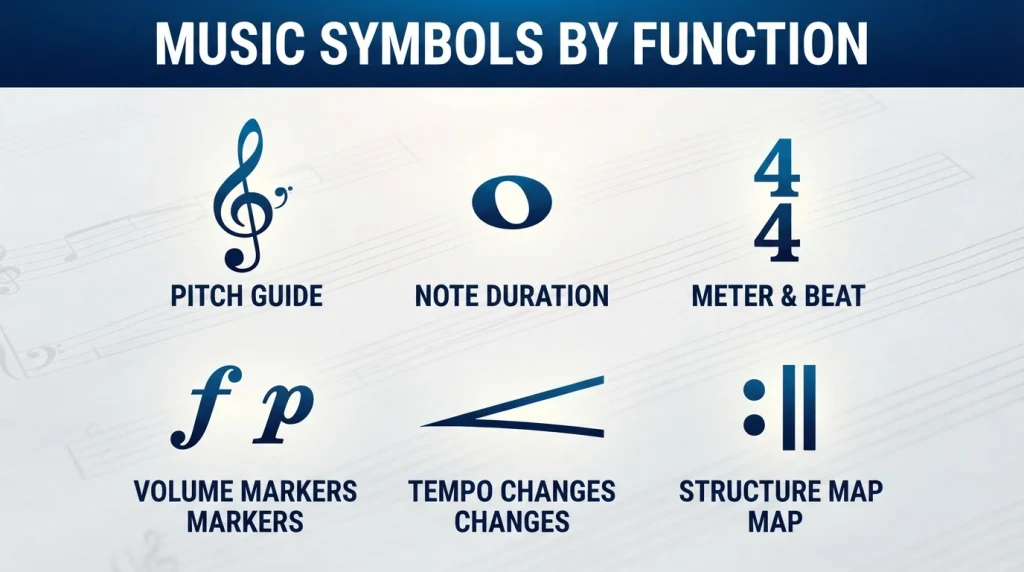
Grouping symbols according to their purpose makes them much easier to remember.
Symbols for Pitch
Pitch-related notation includes:
- Clefs
- Notes
- Sharps
- Flats
- Naturals
- Double sharps
- Double flats
- Key signatures
These symbols help establish which pitches are being performed.
Symbols for Rhythm
Rhythm-related symbols include:
- Note values
- Rests
- Dots
- Ties
- Time signatures
- Beams
Together, they organize the timing of sounds and silences.
Symbols for Dynamics
Dynamic markings include:
- p
- pp
- mp
- mf
- f
- ff
- Crescendo
- Diminuendo
They tell performers how the intensity or loudness should change.
Symbols for Articulation
Articulation symbols include:
- Staccato
- Legato markings
- Tenuto
- Accent
- Marcato
- Fermata
These help shape the character of individual notes and phrases.
Symbols for Navigation
Navigation symbols include:
- Repeat signs
- First and second endings
- D.C.
- D.S.
- Coda
- Segno
- Fine
They tell performers how to move through the score.
How to Learn Music Symbols as a Beginner
Trying to memorize every symbol at once can make music notation feel harder than it needs to be.
A structured approach is more effective.
Learn the Most Common Symbols First
Start with:
- Staff
- Treble clef
- Bass clef
- Whole, half, quarter, and eighth notes
- Basic rests
- Time signatures
- Sharps and flats
- Naturals
- Basic dynamics
- Staccato and legato
- Common tempo markings
- Repeat signs
Once these become familiar, you can move into more advanced notation.
Practice With Real Sheet Music
Don’t study symbols only as isolated pictures.
Take a simple piece of sheet music and identify:
- The clef
- The key signature
- The time signature
- The notes
- The rests
- The dynamics
- The articulation marks
- Any repeat symbols
This helps you understand how symbols work together.
Learn Symbols by Function
Instead of memorizing random symbols, group them.
For example:
Pitch: clefs, sharps, flats, naturals
Rhythm: notes, rests, ties, dots
Volume: piano, forte, crescendo
Performance: staccato, legato, accents
Navigation: repeats, D.C., D.S., coda
This approach gives each symbol a logical place in your memory.
Frequently Asked Questions
What are the basic symbols in music?
The basic symbols include the staff, clefs, notes, rests, time signatures, key signatures, accidentals, dynamics, articulation marks, tempo markings, and repeat signs.
What does a sharp symbol mean in music?
A sharp raises the affected pitch by a semitone within the applicable notation context.
What does a flat symbol mean in music?
A flat lowers the affected pitch by a semitone within the applicable notation context.
What does a natural symbol mean?
A natural cancels an applicable sharp or flat and returns the pitch to its natural form within the relevant notation context.
What does the treble clef mean?
The treble clef, or G clef, establishes the pitch reference used for notes in higher-register notation.
What does the bass clef mean?
The bass clef, or F clef, establishes the pitch reference used for lower-register notation.
What does a rest mean in music?
A rest represents silence for a specific rhythmic duration. Different rest symbols correspond to different rhythmic values.
What do P and F mean in music?
P stands for piano and means soft. F stands for forte and means loud.
What does a crescendo mean?
A crescendo means that the music should gradually become louder.
What does a diminuendo mean?
A diminuendo means that the music should gradually become softer.
What does staccato mean?
Staccato indicates a short, detached style of articulation. A note marked staccato is generally separated from the following note.
What does a fermata mean?
A fermata tells the performer to hold a note, chord, or rest longer than its written duration. The exact length depends on context.
What does a repeat sign mean?
A repeat sign tells the performer to go back and repeat a designated section of music.
What does D.C. mean in music?
D.C. means Da Capo, or “from the beginning.” The performer returns to the beginning of the piece or section.
What does D.S. mean in music?
D.S. means Dal Segno, or “from the sign.” The performer returns to the designated segno symbol.
What is the difference between a key signature and a time signature?
A key signature establishes a pattern of sharps or flats associated with the key, while a time signature organizes beats into measures.
What is the difference between a tie and a slur?
A tie connects notes of the same pitch and combines their durations. A slur connects notes to indicate smooth phrasing or connected articulation.
What is the easiest way to learn music symbols?
Start with basic clefs, notes, rests, time signatures, and accidentals. Then learn dynamics, articulation, tempo, and navigation markings. Practicing with actual sheet music helps reinforce the symbols in context.
Conclusion
Learning the symbols in music is one of the first major steps toward reading and understanding sheet music. These symbols may look complicated when viewed all at once, but each category has a clear purpose.
Notes and rests organize sound and silence. Clefs establish pitch references. Accidentals and key signatures affect pitch. Time signatures organize rhythm. Dynamics control loudness and expression. Articulation markings explain how notes should be shaped, while tempo markings indicate speed. Repeat and navigation symbols help performers move through longer pieces without unnecessary repetition.
The easiest way to master musical symbols is to learn them by function instead of memorizing an enormous list. Start with the basics, practice identifying symbols in real music, and gradually add more advanced notation.
Once these marks become familiar, a sheet of music stops looking like a collection of strange symbols and starts working like what it really is: a detailed visual language for turning written instructions into music.

I’m Oscar Radcliffe, a British writer who enjoys uncovering the numbers hidden within ordinary questions. My work explores quantities, counts, statistics, measurements, and fascinating comparisons across different subjects. I aim to present reliable information clearly, helping readers satisfy their curiosity while discovering interesting facts they may never have considered before.
Books:
The Science of Counting
How Many? Fascinating Numbers Explained