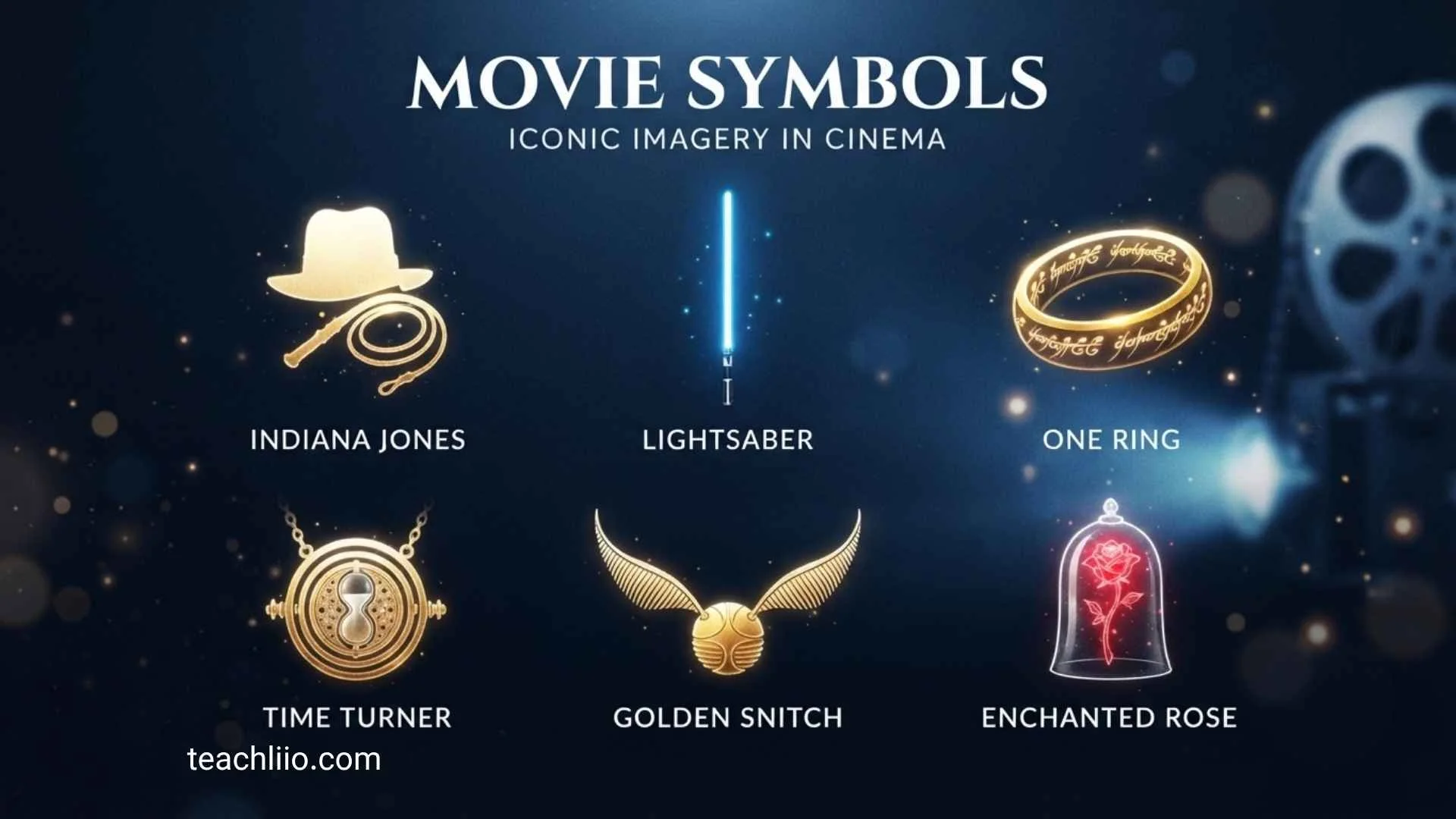
Movies tell stories through more than dialogue and action. A director can use a mirror, key, road, color, animal, storm, photograph, or even a simple doorway to communicate an idea without explaining it directly. These visual and storytelling elements are commonly known as movie symbols.
Movie symbolism can represent ideas such as love, freedom, fear, identity, death, hope, transformation, power, or isolation. Sometimes a symbol appears only once, while other symbols become recurring motifs that develop new meaning as the story progresses.
Understanding symbols in movies can make films more interesting because you begin to notice details that might otherwise seem ordinary. However, there is an important rule: a symbol does not always have one fixed meaning. Its meaning depends on the story, character, genre, culture, and context.
This guide explains more than 50 common movie symbols and their possible meanings. It also explores color symbolism, famous examples, the difference between symbols and motifs, and practical ways to identify symbolism while watching a movie.
Movie Symbols and Their Meanings at a Glance
The following table provides a quick reference to common symbols found in movies. These meanings are common associations, not universal rules.
| Movie Symbol | Common Meaning | Possible Context |
| Mirror | Identity and self-reflection | A character questioning who they are |
| Key | Access, freedom, secrets | Unlocking an opportunity or hidden truth |
| Door | Opportunity or transition | Entering a new stage of life |
| Window | Freedom, separation, observation | Looking at a life outside one’s reach |
| Clock | Time, pressure, mortality | A deadline or fear of aging |
| Road | Journey and change | A character searching for a new life |
| Water | Renewal, emotion, transformation | Rebirth or emotional struggle |
| Fire | Destruction, passion, rebirth | Change through conflict |
| Photograph | Memory and the past | Remembering someone or something lost |
| Flower | Beauty, life, growth | A character’s development |
| Cage | Restriction or imprisonment | Physical or emotional control |
| Shadow | Fear, secrecy, hidden identity | A character hiding something |
| Bridge | Transition or connection | Moving from one stage to another |
| Rain | Sadness, cleansing, renewal | Emotional release |
| Storm | Conflict or emotional turmoil | Trouble approaching |
| Light | Hope, truth, revelation | Discovering an important truth |
| Darkness | Fear, mystery, uncertainty | The unknown or hidden danger |
| Bird | Freedom or escape | Desire to break free |
| Butterfly | Transformation | Major personal change |
| Snake | Danger, temptation, betrayal | A threatening person or situation |
| Crown | Power or authority | Leadership and status |
| Ring | Commitment, power, eternity | Marriage, loyalty, or possession |
| Book | Knowledge or hidden truth | Discovering information |
| Mask | Deception or identity | Hiding one’s true self |
| Mirror image | Duality | Two sides of a character |
| Empty chair | Absence and loss | Someone who is no longer present |
These interpretations become meaningful when supported by the movie’s story and filmmaking choices.
What Are Movie Symbols?
Movie symbols are objects, colors, characters, settings, sounds, actions, or repeated images that communicate an idea beyond their literal purpose.
For example, a key may literally open a door. But if a character repeatedly carries a key while trying to escape an oppressive situation, the key may also represent freedom or control.
Symbolism allows filmmakers to communicate ideas visually rather than explaining everything through dialogue.
What Symbolism Means in Film
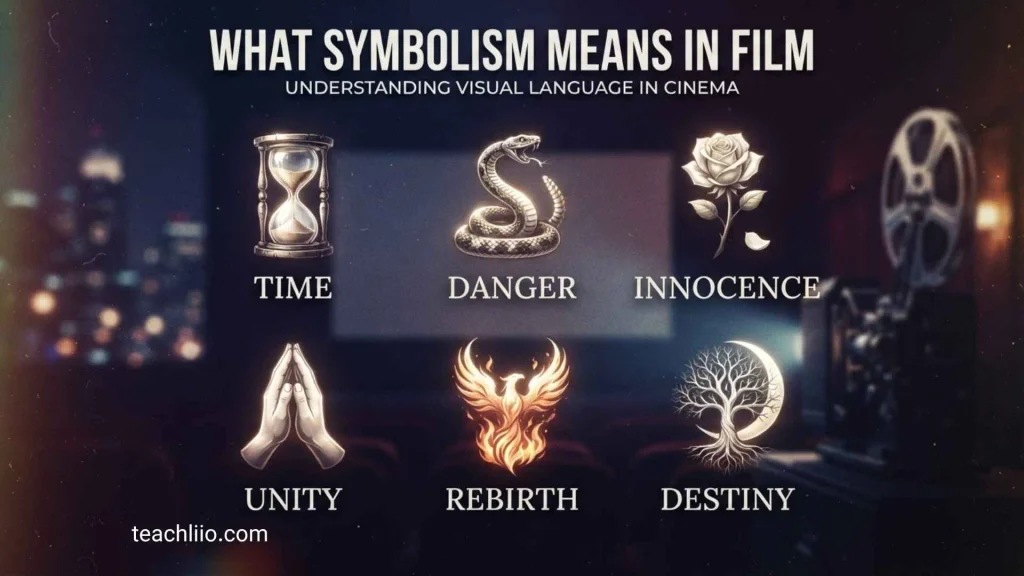
Symbolism in film is the use of something visible, audible, or recurring to suggest a deeper concept.
A director might show:
- A locked door to suggest restriction.
- A broken mirror to suggest fractured identity.
- A long road to suggest a personal journey.
- Rain during an emotional scene to reinforce sadness.
- Sunrise after a difficult period to suggest hope.
- A photograph to connect a character with the past.
The important part is context. A locked door in one movie might represent imprisonment, while in another it could simply be a locked door.
Why Filmmakers Use Symbols
Filmmakers use symbols because visual storytelling can communicate complex ideas quickly.
A carefully chosen image can:
- Reinforce a theme.
- Reveal character development.
- Create emotional associations.
- Foreshadow future events.
- Connect separate scenes.
- Make an ending more meaningful.
- Communicate information without dialogue.
- Give audiences something to interpret.
Symbolism can also encourage viewers to think about a movie after it ends.
Common Symbols in Movies and What They Mean
Many objects appear repeatedly in movies because they have strong visual and emotional associations.
Mirrors
Mirrors are commonly associated with identity, self-reflection, appearance, and duality.
A character looking into a mirror may be confronting their identity or questioning how others see them.
A cracked mirror can suggest a fractured personality, damaged identity, conflict, or a life that has become unstable.
However, a mirror can also have a simple practical purpose. Its symbolic meaning becomes stronger when the movie repeatedly emphasizes it.
Keys
A key can represent access, freedom, secrets, control, or opportunity.
A character receiving a key may gain access to a new place or a new part of their life.
A lost key can represent lost control or a missed opportunity.
When a key repeatedly appears during important scenes, its symbolic importance may extend beyond its literal function.
Doors
Doors often symbolize choices, transitions, opportunities, boundaries, and the unknown.
An open door may suggest opportunity.
A closed door can represent rejection, restriction, secrecy, or something that remains inaccessible.
A character choosing whether to walk through a door can visually represent an important decision.
Windows
Windows can represent freedom, observation, separation, or a desire for something beyond reach.
A character looking through a window may be physically separated from the outside world.
Windows can also allow a filmmaker to show the difference between a character’s private life and the world around them.
Clocks
Clocks frequently symbolize time, urgency, mortality, pressure, or aging.
A ticking clock can create suspense by reminding the audience that a character has limited time.
A stopped clock can suggest a moment frozen in memory or a life that has emotionally stopped progressing.
Roads
Roads commonly represent journeys, freedom, change, uncertainty, and personal growth.
A character traveling down a road may literally be moving toward a destination while also undergoing an internal transformation.
A road with no obvious destination can suggest uncertainty about the future.
Water
Water is one of the most flexible symbols in cinema.
It can represent:
- Renewal
- Rebirth
- Emotional change
- Cleansing
- Danger
- Memory
- Transformation
A calm ocean and a violent storm at sea can therefore create completely different meanings.
Fire
Fire can symbolize destruction, passion, anger, purification, transformation, or rebirth.
A fire destroying something may represent the end of an old life.
A fire used to provide warmth may suggest comfort and community.
The same symbol can therefore have opposite meanings depending on the scene.
Photographs
Photographs often represent memory, identity, relationships, history, or loss.
A character holding an old photograph may be emotionally connected to someone or something from the past.
A photograph can also reveal information that a character has forgotten or deliberately hidden.
Flowers
Flowers commonly symbolize beauty, life, growth, love, youth, and mortality.
A blooming flower may suggest new beginnings.
A dying flower can represent loss, aging, or the end of a relationship.
Cages
A cage is a direct visual representation of restriction and imprisonment.
However, the imprisonment does not need to be physical.
A character might be trapped by:
- Fear
- Family expectations
- Social pressure
- Addiction
- A relationship
- Their own choices
This makes cages useful symbols for psychological conflict.
Shadows
Shadows can represent fear, secrecy, hidden identity, guilt, or an unknown side of a character.
Filmmakers can use lighting and shadows to reveal or conceal information.
A character standing partly in shadow may visually communicate an internal conflict without dialogue.
Color Symbols in Movies
Color is one of the most powerful visual tools available to filmmakers.
However, colors do not have one universal meaning. Their interpretation can change according to culture, genre, story, character, and scene.
Red
Red can represent:
- Love
- Passion
- Anger
- Danger
- Violence
- Power
- Urgency
A romantic film might use red to emphasize passion, while a thriller might use the same color to create a sense of danger.
Blue
Blue is often associated with:
- Calm
- Sadness
- Isolation
- Distance
- Coldness
- Reflection
A filmmaker may use blue lighting to make a scene feel emotionally distant or lonely.
Green
Green can suggest:
- Nature
- Growth
- Envy
- Illness
- Renewal
- Artificiality
Its meaning depends heavily on the visual context.
Yellow
Yellow may suggest:
- Happiness
- Energy
- Warmth
- Caution
- Nostalgia
- Uneasiness
Bright yellow and sickly yellow can create very different emotional impressions.
White
White can represent:
- Innocence
- Purity
- Peace
- Emptiness
- Sterility
- New beginnings
Cultural context is particularly important when interpreting white.
Black
Black commonly carries associations with:
- Mystery
- Death
- Power
- Fear
- Grief
- The unknown
But black can also communicate elegance, simplicity, or authority.
Purple
Purple can suggest:
- Royalty
- Mystery
- Spirituality
- Individuality
- Luxury
It is often useful when a filmmaker wants a character or environment to feel unusual or distinctive.
Orange
Orange can communicate:
- Warmth
- Energy
- Comfort
- Nostalgia
- Change
Orange lighting can make a scene feel intimate and warm, while a strong orange environment can create a more unsettling effect depending on the movie.
Symbols Found in Nature and Settings
Filmmakers can turn entire environments into symbolic elements.
Rain and Storms
Rain can represent sadness, cleansing, emotional release, or renewal.
A storm may symbolize conflict, chaos, fear, or a major change approaching.
But weather is not automatically symbolic. It becomes more significant when the filmmaker repeatedly connects it with emotional or narrative events.
Sunlight
Sunlight can symbolize:
- Hope
- Truth
- Life
- Freedom
- Discovery
A character stepping into sunlight after spending time in darkness can create a strong visual contrast.
Forests
Forests can represent:
- Mystery
- Isolation
- Fear
- Discovery
- Getting lost
- The unknown
A forest can therefore be both a physical location and a representation of a character’s uncertain journey.
Mountains
Mountains can symbolize:
- Challenges
- Ambition
- Achievement
- Isolation
- Personal growth
Climbing a mountain can work as a visual metaphor for overcoming difficulties.
Deserts
Deserts can represent:
- Loneliness
- Emptiness
- Survival
- Isolation
- Spiritual searching
Their meaning depends on how the character interacts with the environment.
Bridges
Bridges commonly represent transition, connection, reconciliation, or moving from one stage to another.
Crossing a bridge can visually suggest that a character is leaving one part of their life behind.
Animals as Movie Symbols
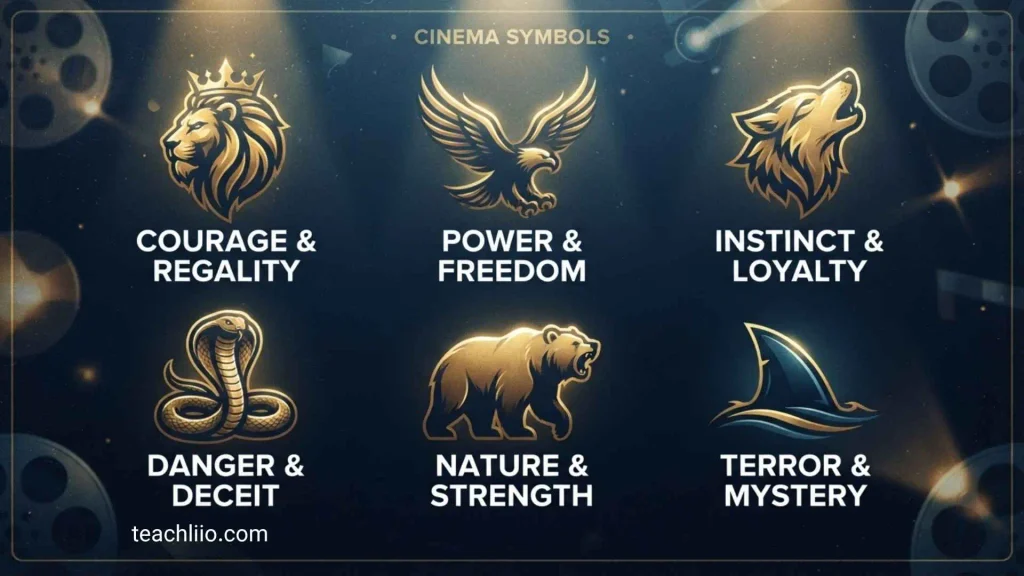
Animals can carry symbolic meanings because audiences already associate them with certain characteristics.
Birds
Birds commonly symbolize freedom, escape, movement, or hope.
A bird trapped in a cage can create an especially clear contrast between freedom and restriction.
Snakes
Snakes may symbolize:
- Danger
- Temptation
- Betrayal
- Transformation
- Fear
Their meaning varies considerably across cultures and stories.
Wolves
Wolves can represent:
- Independence
- Loyalty
- Instinct
- Danger
- The wilderness
A filmmaker may use a wolf differently depending on whether the story presents nature as threatening or empowering.
Dogs
Dogs often represent:
- Loyalty
- Friendship
- Protection
- Companionship
- Family
Because dogs are strongly connected with human relationships, their presence can also increase the emotional impact of loss.
Butterflies
Butterflies are commonly associated with transformation, change, rebirth, and personal growth.
They can be particularly effective in coming-of-age or character-transformation stories.
Objects as Symbols in Famous Movies
Famous films demonstrate how a simple object or image can become strongly associated with a story’s central ideas.
The Green Light in The Great Gatsby
The green light in The Great Gatsby is associated with Gatsby’s longing and his hopes for a future that remains just beyond his reach.
Its importance comes from the way the story repeatedly connects the light with desire, distance, and the future.
The One Ring in The Lord of the Rings
The One Ring is more than an object of power.
It is connected with temptation, corruption, control, and the dangerous attraction of power.
Its meaning develops through the characters who desire, possess, resist, or sacrifice for it.
The Sunken Place in Get Out
The Sunken Place in Get Out functions as a powerful visual representation of helplessness and loss of control.
Its symbolic impact comes from the contrast between being able to observe what is happening and being unable to control one’s own body or circumstances.
The Spinning Top in Inception
The spinning top in Inception is connected with questions about reality, perception, and certainty.
Its importance comes from the uncertainty surrounding what characters can know and what audiences can know.
The Ruby Slippers in The Wizard of Oz
The ruby slippers become associated with home, protection, and the ability to return.
They also connect Dorothy’s physical journey with her emotional understanding of what home means.
The Shark in Jaws
The shark in Jaws represents more than an animal threat.
Its limited visibility and repeated presence help create fear of an unseen danger.
The symbol works partly because the audience often anticipates the threat before seeing it clearly.
Symbol vs. Motif vs. Metaphor
These three concepts are related but should not be treated as identical.
| Term | Meaning | Example |
| Symbol | An element representing a larger idea | A key representing freedom |
| Motif | A recurring element that develops meaning | Repeated mirrors representing identity |
| Metaphor | A comparison used to express an idea | A journey representing personal growth |
What Is a Symbol?
A symbol can be a single object, image, action, sound, or visual element that suggests an idea beyond its literal role.
What Is a Motif?
A motif is usually a recurring element.
For example, one mirror may be a symbol, but repeated mirrors appearing whenever a character struggles with identity can become a motif.
What Is a Visual Metaphor?
A visual metaphor uses an image or situation to express an abstract idea.
For example, a character physically trapped inside a cage could visually represent psychological or social restriction.
How to Identify Symbols in a Movie
You do not need to be a film expert to identify symbolism.
Look for Repetition
If an object, color, sound, or image keeps appearing, ask why.
Repetition is one of the strongest clues that something may have greater significance.
Notice What the Camera Emphasizes
Pay attention when the camera gives unusual attention to an object.
A close-up, lingering shot, unusual framing, or repeated visual composition can indicate importance.
However, camera emphasis alone does not prove symbolism.
Connect Symbols to Character Development
Ask whether the meaning of an object changes as the character changes.
For example, a key might initially represent imprisonment but later become a symbol of freedom.
Consider the Ending
Endings often change how audiences understand earlier images.
An object that seemed ordinary in the first half of a movie may become meaningful after the final reveal.
Avoid Overinterpreting
Not every object has a secret meaning.
A coffee cup may simply be a coffee cup.
Strong interpretations usually have evidence from repetition, dialogue, character development, visual emphasis, plot structure, or other filmmaking choices.
Are Movie Symbols Always Intentional?
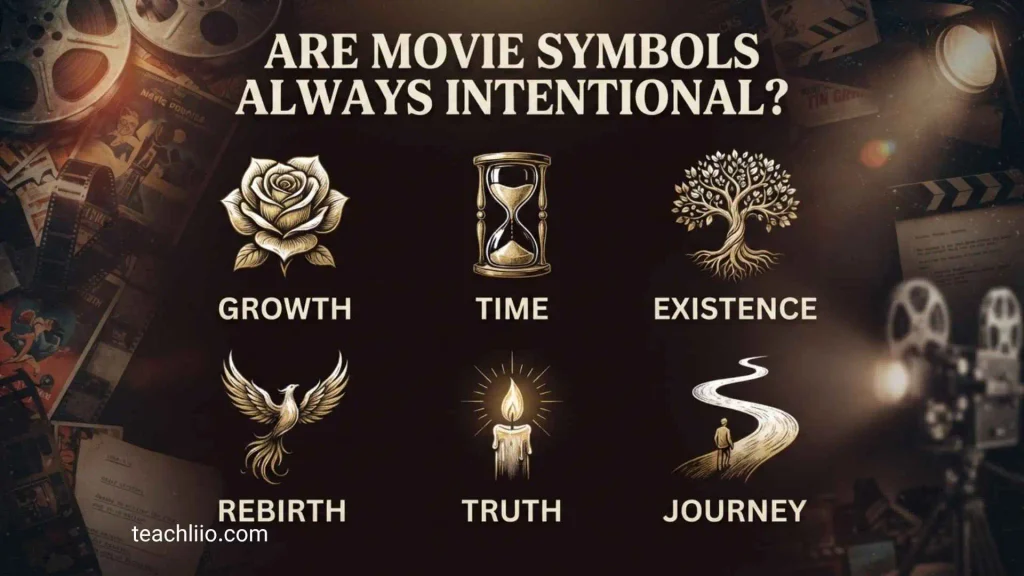
Not necessarily.
Filmmakers may intentionally design symbols and motifs, but viewers can also notice patterns and develop interpretations that were not explicitly stated by the creators.
A useful way to judge an interpretation is to look for evidence.
If an image appears repeatedly, receives unusual visual emphasis, connects with the central theme, and changes meaning alongside a character, there is stronger support for interpreting it as symbolic.
If an interpretation depends on one ordinary background object with no connection to the story, it may be an overinterpretation.
This distinction helps viewers enjoy symbolism without assuming that every detail was secretly planned.
How Movie Symbolism Changes by Genre
Genre affects how audiences understand symbols.
Horror
Horror movies frequently use darkness, mirrors, shadows, blood, dolls, abandoned houses, storms, and confined spaces to create associations with fear and uncertainty.
Romance
Romantic movies may use letters, photographs, flowers, rain, rings, roads, and shared locations to represent love, memory, separation, or commitment.
Science Fiction
Science fiction often uses technology, artificial environments, mirrors, machines, doors, artificial light, and repeated geometric imagery to explore identity, control, humanity, and reality.
Drama
Drama frequently uses ordinary objects and locations to represent family relationships, memory, loss, personal identity, or social pressure.
Superhero Movies
Superhero films often use costumes, symbols, masks, weapons, logos, colors, and objects to represent identity, responsibility, power, or belonging.
Animation
Animated movies can use exaggerated colors, objects, animals, weather, and environments because visual symbolism is especially effective when the world itself can be designed from scratch.
How Culture Changes the Meaning of Movie Symbols
A symbol does not necessarily mean the same thing to every audience.
Colors, animals, numbers, clothing, gestures, religious imagery, and objects can have different cultural associations.
For example, a color associated with celebration in one culture may have a connection with mourning in another.
This means viewers should consider:
- The movie’s cultural setting.
- The characters’ backgrounds.
- The time period.
- Religious or historical context.
- The genre.
- The filmmaker’s visual choices.
Understanding context prevents overly simple interpretations.
How to Analyze Movie Symbols Like a Student
If you are writing a film review, essay, or school assignment, avoid simply saying:
“The mirror symbolizes identity.”
Instead, build an explanation.
Start with the literal element.
Then identify its repeated use or visual emphasis.
Next, connect it to a character, theme, or conflict.
Finally, explain how that connection supports your interpretation.
A simple formula is:
What appears → how it is used → what it connects to → what it may represent
For example:
Mirror → repeatedly shown during moments of self-doubt → connected to the character’s changing identity → may represent the character’s struggle to understand themselves.
This approach produces a much stronger analysis than simply listing symbolic meanings.
Frequently Asked Questions
What are movie symbols?
Movie symbols are objects, colors, characters, settings, sounds, actions, or repeated images that can represent ideas beyond their literal meaning.
What is symbolism in a movie?
Symbolism in a movie is the use of visual, narrative, or auditory elements to communicate deeper ideas, themes, emotions, or character development.
What are common symbols in movies?
Common movie symbols include mirrors, keys, doors, windows, clocks, roads, water, fire, photographs, flowers, cages, shadows, bridges, storms, and light.
What does a mirror symbolize in a movie?
A mirror can symbolize identity, self-reflection, appearance, duality, or a character’s struggle with how they see themselves. Its meaning depends on the movie’s context.
What does water symbolize in movies?
Water can represent renewal, cleansing, transformation, emotion, memory, danger, or rebirth. Its meaning changes depending on how the filmmaker uses it.
What does red symbolize in movies?
Red can represent love, passion, danger, anger, violence, power, or urgency. It does not have one universal meaning.
Why do filmmakers use symbolism?
Filmmakers use symbolism to communicate ideas visually, reinforce themes, develop characters, create emotional connections, foreshadow events, and give audiences deeper ways to interpret a story.
Is everything in a movie symbolic?
No. Not every object or visual detail is symbolic. Strong symbolic interpretations usually have support from repetition, visual emphasis, dialogue, character development, plot, or themes.
What is the difference between a symbol and a motif?
A symbol can represent an idea, while a motif is a recurring symbol, image, sound, or element that develops significance throughout a movie.
Can the same movie symbol have different meanings?
Yes. A symbol’s meaning can change according to the story, character, scene, genre, culture, and surrounding visual details.
Conclusion
Movie symbols give filmmakers a powerful way to communicate ideas without explaining everything through dialogue. A key can suggest freedom, a mirror can raise questions about identity, a road can represent a journey, and a storm can reflect conflict. Colors, animals, objects, locations, sounds, and repeated images can all become meaningful parts of a film’s visual language.
The most important thing to remember is that movie symbols do not have fixed meanings. Red does not always mean danger, water does not always mean renewal, and a mirror does not always represent identity. Meaning comes from context and from the way an element is used throughout the story.
When watching a movie, look for repetition, visual emphasis, changes in meaning, connections to characters, and relationships with the movie’s central themes. These clues can help you distinguish genuine symbolism from ordinary background details.
Once you learn to recognize these patterns, movies become more than stories you watch. They become visual experiences that can communicate ideas through images, colors, objects, environments, and recurring motifs.
Heading verification: The article contains exactly one H1 heading, used only for the article title. All major sections use H2, all subsections use H3, and no heading level is skipped. The structure is ready for direct use in WordPress Gutenberg.

I’m Hugo Wetherby, a British author interested in the numbers behind everyday questions. I explore quantities, populations, measurements, records, comparisons, and surprising statistics, turning complicated information into accessible answers. I believe a simple “how many” question can lead to fascinating discoveries, and I enjoy helping readers find those answers.
Books:
How Many? A Guide to Everyday Numbers
The Great Book of Numbers and Quantities