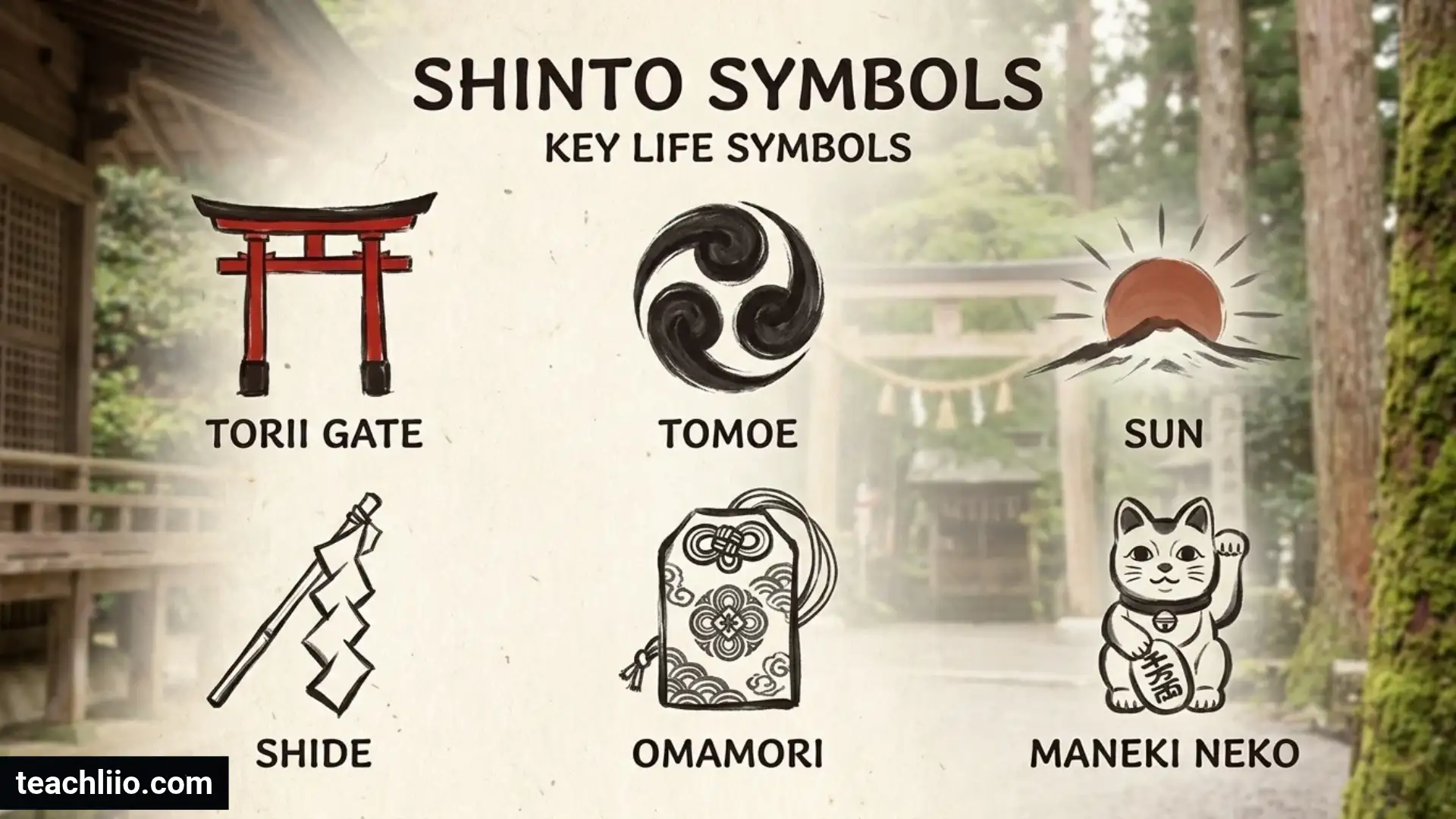
Shinto symbols offer a fascinating window into Japan’s ancient spiritual traditions, mythology, and deep connection with nature. From the famous red torii gate to sacred mirrors, protective fox figures, and traditional straw ropes, these symbols represent important ideas about purity, protection, spiritual presence, and respect for the natural world.
Shinto is Japan’s indigenous religious tradition. It centers on the worship of kami, a Japanese term for sacred spirits or divine presences associated with nature, places, ancestors, and other aspects of life. Unlike religions with one central emblem, Shinto uses various sacred objects, shrine structures, ritual tools, and natural elements to express its beliefs.
Some Shinto symbols mark the entrance to sacred spaces, while others are used in purification ceremonies, prayers, festivals, and household traditions. Each has its own cultural background and purpose.
In this guide, you will discover 20 important Shinto symbols and their meanings, explore the Three Sacred Treasures of Japan, learn about their connection with Japanese mythology, and understand how these symbols appear in everyday religious practices.
What Are Shinto Symbols?
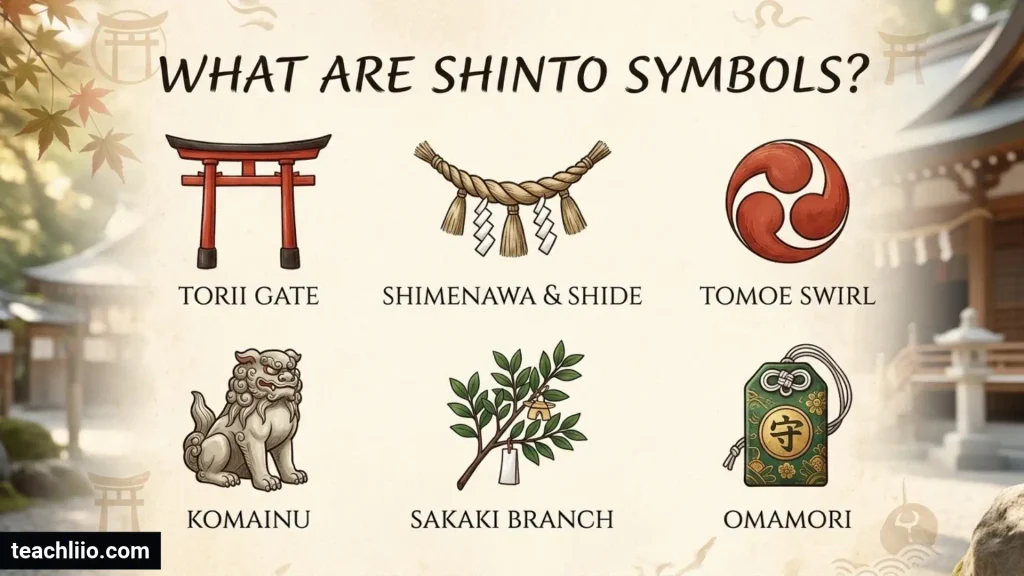
Shinto symbols are objects, designs, natural elements, and architectural features connected with Shinto beliefs and traditions. They help people recognize sacred places, understand religious practices, and express respect for kami.
Shinto does not have one official symbol that represents every shrine or follower. Instead, different objects have different meanings and uses. For example, a torii gate marks a shrine entrance, a shimenawa rope identifies a sacred boundary, and a gohei is used in religious ceremonies.
Understanding Kami in Shinto
Kami are central to Shinto beliefs. They are sacred presences that may be associated with mountains, rivers, waterfalls, trees, natural forces, ancestors, and certain historical figures.
Kami should not always be understood as gods in the same way as figures in other religious traditions. The concept is broader and includes different forms of sacred existence.
Some natural objects, such as unusually old trees and large rocks, may be treated as sacred because of their association with kami. Certain objects used in rituals can also serve as places or vessels associated with a kami’s presence.
Why Are Symbols Important in Shinto Religion?
Shinto symbols help people express religious ideas through physical objects and traditional practices.
They serve several purposes:
- Sacred identification: Torii gates and shimenawa mark places associated with sacred activity.
- Purification: Gohei, shide, and water purification facilities are used in different rituals.
- Protection: Guardian figures and protective charms are associated with safeguarding people and sacred places.
- Worship: Mirrors, offerings, and ceremonial objects have important roles in shrine traditions.
- Cultural preservation: Ancient objects and mythological treasures connect modern Japanese culture with its historical traditions.
20 Important Shinto Symbols and Their Meanings
The following symbols and sacred objects represent different aspects of Japanese religious culture. Some are architectural features, others are ceremonial tools, and several are sacred treasures or traditional offerings.
1. Torii Gate – Gateway to the Sacred World
Meaning: Sacred entrance, spiritual boundaries, and respect.
The torii gate is probably the most recognizable symbol associated with Shinto. It usually stands at the entrance to a Japanese shrine and marks the transition from ordinary surroundings to sacred grounds.
A torii gate reminds visitors that they are entering a place associated with kami. Passing through it is a simple but meaningful part of visiting many Shinto shrines.
Traditional torii gates come in different architectural styles. Some are painted bright vermilion, while others are made from natural wood or stone.
The number and placement of gates also vary. Large shrines may have several torii along their approach paths, marking different areas within the shrine grounds.
Symbolism: The torii represents the entrance to a sacred space and the distinction between everyday surroundings and shrine grounds.
2. Shimenawa – The Sacred Straw Rope
Meaning: Sacred boundaries, purity, and spiritual protection.
Shimenawa is a traditional rope made from twisted straw, commonly rice straw. It is placed around sacred trees, rocks, shrine structures, and other objects associated with kami.
Its main purpose is to identify something as sacred or distinguish it from ordinary surroundings. It can also mark a space where special religious practices take place.
You will often see white zigzag-shaped paper strips hanging from shimenawa. These are called shide and are frequently used in shrine ceremonies.
Some famous Japanese shrines display particularly large shimenawa ropes, making them recognizable features of traditional religious architecture.
Symbolism: Shimenawa represents sacred boundaries and the identification of spiritually important places or objects.
3. Shide – White Zigzag Paper Streamers
Meaning: Ritual purity and sacred identification.
Shide are folded white paper streamers with a distinctive zigzag shape. They are commonly attached to shimenawa ropes and used in different Shinto ceremonies.
Their white appearance is associated with ritual purity. They help identify sacred objects and spaces and can be seen around shrine structures, sacred trees, and ceremonial equipment.
Shide are also attached to purification wands called gohei, which are used by Shinto priests during certain rituals.
Although their shape looks simple, these paper streamers are an important part of traditional Japanese religious decoration and ceremonial practice.
Symbolism: Shide represent ritual purity and help identify objects or locations associated with sacred activity.
4. Yata no Kagami – The Sacred Mirror
Meaning: Truth, reflection, and divine significance.
Yata no Kagami is the sacred mirror associated with Amaterasu, the Shinto sun goddess. It is one of Japan’s Three Sacred Treasures and has a central place in Japanese mythology.
According to the traditional story, Amaterasu once withdrew into a heavenly cave, leaving the world in darkness. Other kami arranged a gathering outside the cave and used a mirror as part of their plan to attract her attention and bring her back into the world.
The mirror became an important sacred treasure and is connected with the traditional imperial heritage of Japan.
Mirrors also appear as sacred objects at Shinto shrines, where they may represent the presence of kami.
Symbolism: Yata no Kagami is associated with divine light, reflection, and sacred authority.
5. Magatama – The Curved Sacred Jewel
Meaning: Sacred power, spiritual significance, and ancient heritage.
Magatama are curved, comma-shaped beads that have been used in Japan since ancient times. They were traditionally made from materials such as jade, stone, and other precious substances.
Their distinctive shape makes them recognizable in Japanese archaeological collections and traditional artwork.
The Yasakani no Magatama is one of Japan’s Three Sacred Treasures. It is connected with the mythology of Amaterasu and the traditional imperial heritage of Japan.
Magatama beads also appeared in ancient jewelry and ceremonial objects. Their historical use is broader than modern decorative interpretations, so they should not be assigned one universal spiritual meaning.
Symbolism: Magatama represents an important connection with ancient Japanese heritage and sacred traditions.
6. Kusanagi no Tsurugi – The Sacred Sword
Meaning: Courage, protection, and imperial authority.
Kusanagi no Tsurugi is the legendary sword included among Japan’s Three Sacred Treasures.
According to Japanese mythology, the storm deity Susanoo discovered the sword inside the body of an eight-headed serpent known as Yamata no Orochi. He later presented it to Amaterasu.
The sword became associated with the traditional imperial lineage and is deeply connected with Japanese mythology.
It is also known through the earlier name Ame-no-Murakumo-no-Tsurugi. The sword is traditionally associated with Atsuta Shrine in Japan, although the sacred object itself is not available for ordinary public viewing.
Symbolism: Kusanagi represents courage, protection, and the sacred authority associated with Japanese imperial tradition.
7. Sakaki – The Sacred Evergreen Tree
Meaning: Nature, sacred offerings, and spiritual connection.
Sakaki is an evergreen tree native to parts of East Asia and widely associated with Shinto ceremonies in Japan.
Its branches are used in religious offerings and certain purification rituals. Because the tree remains green throughout the year, it is also a natural feature of traditional shrine practices.
Shinto priests and worshippers may present sakaki branches during ceremonies as a respectful offering to kami.
A prepared sakaki branch used as a ceremonial offering is called tamagushi.
It is important to distinguish sakaki from the broader idea of a sacred tree. Other trees may also be regarded as sacred in different shrine traditions.
Symbolism: Sakaki represents the relationship between nature, religious offerings, and sacred traditions.
8. Tomoe – The Traditional Japanese Swirling Design
Meaning: Movement, continuity, and traditional identity.
Tomoe is a traditional Japanese decorative pattern made from one or more curved, comma-shaped forms arranged in a circular design.
One well-known variation is mitsudomoe, which contains three swirling shapes.
The design appears in Japanese family crests, shrine decorations, traditional artwork, and architectural details.
Its exact meaning depends on the context in which it appears. It is sometimes interpreted through ideas of movement, cycles, or interconnected forces, but it should not be treated as a universal symbol with one fixed Shinto meaning.
Symbolism: Tomoe represents a distinctive element of Japanese visual culture and is often associated with traditional decorative and religious designs.
9. Suzu – The Sacred Bell
Meaning: Prayer, ritual sound, and spiritual attention.
Suzu is the Japanese word for a bell. Bells are commonly found at Shinto shrines and may be used during worship and ceremonies.
Visitors at some shrines ring a large bell before offering prayers. This action announces their presence and forms part of the traditional worship experience.
Smaller bells can also appear in ceremonial objects and decorative arrangements.
The use of bells varies between shrines. Their sound is an important part of the atmosphere of many Japanese religious sites.
Symbolism: Suzu represents ritual sound, prayer, and attention during religious worship.
10. Gohei – The Purification Wand
Meaning: Ritual offerings, purification, and sacred activity.
Gohei is a ceremonial wand made from a wooden or bamboo handle with folded paper streamers attached to it.
The streamers are often shaped like shide and may be white, gold, silver, or multicolored.
Shinto priests use gohei in certain ceremonies and purification practices. Historically, the objects also developed from traditional offerings presented to kami.
A gohei may be displayed near a shrine’s sacred area or used during rituals involving purification.
It is different from an ordinary decorative stick because it has a specific ceremonial role.
Symbolism: Gohei represents sacred offerings and ritual purification.
11. Komainu – The Guardian Lion-Dogs
Meaning: Protection, guardianship, and strength.
Komainu are guardian statues commonly placed near the entrances of Shinto shrines. They generally resemble lion-like dogs and are displayed in pairs.
One figure traditionally has its mouth open, while the other has its mouth closed. These forms are commonly associated with the sounds A and Un, which together represent the beginning and ending of a sacred expression.
Komainu are usually carved from stone, although other materials may also be used.
Their purpose is to symbolically guard the shrine and identify its entrance as a special religious location.
Symbolism: Komainu represent guardianship and the protection of sacred places.
12. Kitsune – The Sacred Fox
Meaning: Association with Inari, prosperity, and guardianship.
Kitsune means fox in Japanese. Foxes have a particularly strong association with Inari, a kami connected with rice, agriculture, prosperity, and other aspects of life.
At Inari shrines, visitors commonly see pairs of fox statues near entrances and shrine buildings.
Some fox figures hold objects in their mouths, such as keys, jewels, or scrolls. These objects have different associations within Inari traditions.
Foxes are often regarded as messengers of Inari rather than kami themselves. This distinction is important for understanding their religious and cultural role.
Fushimi Inari Taisha in Kyoto is especially famous for its numerous torii gates and fox imagery.
Symbolism: Kitsune represents the traditional messenger relationship with Inari and is associated with prosperity and guardianship.
13. Omamori – The Protective Amulet
Meaning: Protection, blessings, and good fortune.
Omamori are small protective charms commonly obtained from Japanese shrines and Buddhist temples.
They usually come in colorful fabric pouches containing a sacred inscription or object. Different charms are associated with different wishes.
Some are intended for good health, safe travel, academic success, relationships, or protection against misfortune.
People may carry omamori in their bags, keep them in vehicles, or place them somewhere meaningful at home.
They are traditionally treated with respect because of their religious significance.
Symbolism: Omamori represents blessings, protection, and personal hopes.
14. Ema – The Wooden Wish Tablet
Meaning: Wishes, gratitude, and devotion.
Ema are small wooden tablets on which visitors write prayers, wishes, or messages of gratitude.
After writing a message, people hang their ema at a designated location within the shrine.
Common wishes include good health, family happiness, academic success, career progress, and safe journeys.
The tradition is connected with older practices of offering horses to kami. Over time, wooden tablets featuring horse images became an alternative form of offering.
Modern ema come in many shapes and designs. Some feature animals, seasonal decorations, shrine emblems, or other cultural images.
Symbolism: Ema represents personal wishes, gratitude, and communication through religious offerings.
15. Ofuda – The Sacred Household Talisman
Meaning: Household blessings and spiritual protection.
Ofuda are sacred talismans issued by Shinto shrines. They are usually made from paper or wood and feature the name of a shrine or an inscription associated with a kami.
Many Japanese households place ofuda in a special home altar called a kamidana.
This creates a dedicated place for expressing respect and making offerings. Families may also use ofuda as part of their traditional household religious practices.
Different shrines provide different types of ofuda, depending on their religious traditions.
Symbolism: Ofuda represents shrine blessings and the traditional wish for protection and harmony at home.
16. Temizuya – The Purification Water Basin
Meaning: Cleansing and preparation for worship.
Temizuya is a water basin found at many Shinto shrines. Visitors use it to perform a traditional purification practice before approaching the main worship area.
The water is commonly provided with a ladle called a hishaku.
Visitors traditionally rinse their left hand, right hand, and mouth according to the shrine’s instructions. The practice is intended to prepare them respectfully for worship.
Not every shrine has the same arrangement, and purification facilities may differ in appearance.
Temizuya is a shrine feature rather than a symbolic emblem, but it is an important part of the visitor experience.
Symbolism: Temizuya represents physical and ritual preparation before entering a sacred worship area.
17. Omikuji – The Japanese Fortune-Telling Paper
Meaning: Guidance, fortune, and reflection.
Omikuji are small paper fortunes available at many Japanese shrines and temples.
Visitors typically draw a paper slip that contains a prediction or guidance about different areas of life. It may discuss health, relationships, travel, work, or general fortune.
Some omikuji predict good fortune, while others offer warnings or advice.
People may take their fortune home or tie it to a designated rack or tree at the religious site, depending on local customs.
Omikuji are not exclusive to Shinto because they are also found at Buddhist temples.
Symbolism: Omikuji represents the search for guidance and reflection about future possibilities.
18. Tamagushi – The Sacred Branch Offering
Meaning: Respect, devotion, and ceremonial offering.
Tamagushi is a ceremonial offering made from a sakaki branch, usually prepared with folded paper streamers.
It is presented to kami during certain Shinto ceremonies as an expression of respect and devotion.
The offering is often placed at a designated location during the ritual. Worshippers may also perform prescribed gestures while presenting it.
Tamagushi is different from sakaki itself. Sakaki is the tree or branch, while tamagushi refers to the prepared ceremonial offering.
Symbolism: Tamagushi represents devotion and the act of presenting a sacred offering.
19. Mikoshi – The Portable Shrine
Meaning: Festival traditions and the presence of kami.
Mikoshi is a portable shrine used during traditional Japanese festivals called matsuri.
During certain celebrations, participants carry the mikoshi through streets and neighborhoods. The practice is associated with the movement of a kami from the shrine as part of the festival tradition.
Mikoshi can be decorated with elaborate roofs, ornaments, and traditional details.
Different communities have their own customs surrounding these processions. The events often bring residents together and help preserve local religious and cultural traditions.
Symbolism: Mikoshi represents community participation, festival worship, and the ceremonial presence of kami.
20. Kamidana – The Household Shrine
Meaning: Household worship, respect, and blessings.
Kamidana is a small household shrine traditionally found in some Japanese homes and other settings.
It provides a dedicated place for religious objects and offerings associated with kami.
Families may place an ofuda inside or near the kamidana and offer items such as rice, water, or salt according to their traditions.
The arrangement and daily practices vary between households.
Unlike a torii gate or sacred mirror, a kamidana is not a single symbol. It is a small religious space that supports household worship.
Symbolism: Kamidana represents the presence of Shinto traditions within everyday household life.
The Three Sacred Treasures of Japan
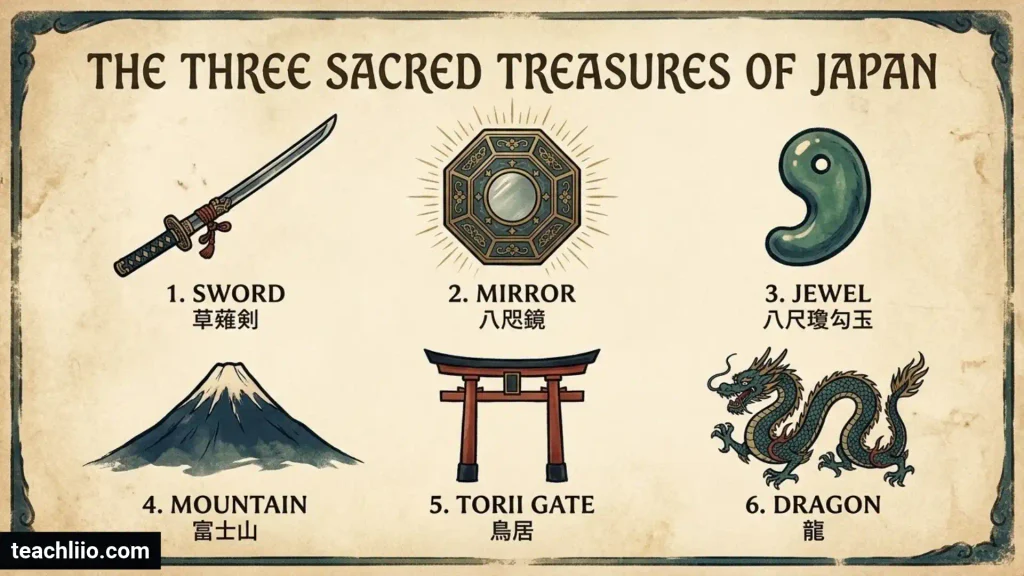
The Three Sacred Treasures of Japan are known as Sanshu no Shinki. They are deeply connected with Japanese mythology, the sun goddess Amaterasu, and the traditional imperial heritage of Japan.
According to Japanese tradition, Amaterasu entrusted these treasures to her grandson Ninigi-no-Mikoto before his descent to earth.
The three treasures are the sacred mirror, sacred jewel, and sacred sword.
1. Yata no Kagami – The Sacred Mirror
The mirror is associated with Amaterasu and the story of the heavenly cave. It is traditionally connected with divine light, reflection, and sacred authority.
2. Yasakani no Magatama – The Sacred Jewel
The jewel is a curved magatama bead associated with the imperial regalia and ancient Japanese traditions. It represents the sacred heritage passed through the traditional imperial line.
3. Kusanagi no Tsurugi – The Sacred Sword
The sword is associated with Susanoo’s victory over the legendary serpent Yamata no Orochi. It represents an important part of Japanese mythology and imperial tradition.
Together, these three objects are regarded as symbols of the Japanese imperial throne. Their historical and religious significance extends beyond ordinary decorative objects.
Japanese Mythology Behind Shinto Symbols
Japanese mythology helps explain why several Shinto objects are considered sacred and why they remain important in Japanese culture.
Amaterasu and the Heavenly Cave
Amaterasu is the Shinto sun goddess and one of the most important figures in Japanese mythology.
According to the traditional story, she withdrew into a heavenly cave after becoming upset with her brother Susanoo. Her absence caused darkness throughout the world.
The other kami gathered outside the cave and arranged a ceremony to attract her attention. A mirror played an important role in this story.
When Amaterasu became curious about the activity outside, she came out of the cave, restoring light to the world.
This story explains the important mythological connection between Amaterasu and the sacred mirror.
Susanoo and the Legendary Serpent
Susanoo is known as the storm deity in Japanese mythology.
One famous story describes how he encountered an eight-headed serpent called Yamata no Orochi. After defeating the creature, he discovered a legendary sword within its body.
The sword later became known as Kusanagi no Tsurugi and became one of Japan’s Three Sacred Treasures.
Inari and the Fox Messengers
Inari is a kami associated with rice, agriculture, prosperity, and business success.
Foxes are traditionally connected with Inari as messengers. This explains why fox statues are commonly found at Inari shrines.
Their presence is especially noticeable at Fushimi Inari Taisha, where visitors encounter fox imagery throughout the shrine grounds.
Colors and Their Uses in Shinto Traditions
Colors appear throughout Japanese shrine architecture, ceremonial clothing, and religious decorations. However, their meanings are not always fixed, and they should not be treated as universal rules of Shinto belief.
Red or Vermilion
Vermilion is one of the most recognizable colors associated with Japanese shrines. It appears on many torii gates and shrine buildings.
Its use creates a distinctive visual identity and is often connected with traditional ideas of protection and vitality in Japanese culture.
White
White is commonly seen in ritual paper streamers, ceremonial clothing, and purification-related decorations.
It has a strong association with cleanliness and ritual purity.
Green
Green is closely connected with the natural environment. Sacred forests, evergreen trees, and natural landscapes have important places in Shinto traditions.
Sakaki branches are one example of how natural materials are used in religious ceremonies.
Gold
Gold appears in precious objects, decorative artwork, and traditional religious treasures.
It can suggest value and honor in Japanese artistic contexts, but it does not have one universal religious meaning throughout Shinto.
How Shinto Symbols Are Used in Everyday Japanese Religious Practices
Shinto symbols are not limited to ancient stories or historical objects. Many remain part of modern Japanese religious and cultural life.
Shrine Visits and Prayer
Visitors commonly approach a shrine through a torii gate and follow the local customs before offering prayers.
Depending on the shrine, worshippers may clap their hands, bow, and make a small offering.
Purification Ceremonies
Purification is an important part of many Shinto traditions.
Water basins, gohei, and other ceremonial objects are used in different practices to prepare people and places for religious activities.
Festival Celebrations
During matsuri, communities may use mikoshi, bells, ceremonial decorations, and traditional performances.
These events connect religious practices with local history and community identity.
Household Religious Traditions
Some Japanese families maintain kamidana in their homes and display ofuda received from shrines.
These practices provide a dedicated place for prayers, offerings, and expressions of respect.
Shinto Symbols vs. Buddhist Symbols: What Is the Difference?
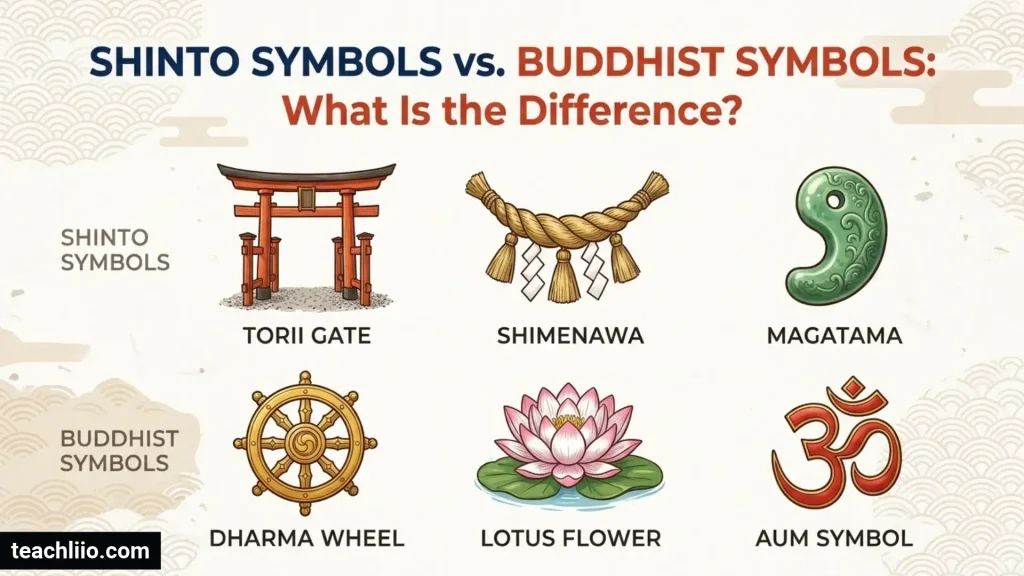
Shinto and Buddhism have influenced Japanese culture for centuries. Although they sometimes share cultural spaces and religious practices, they have different origins and traditions.
| Feature | Shinto | Buddhism |
| Main focus | Kami and sacred traditions | Buddhist teachings and enlightenment |
| Common religious site | Jinja (shrine) | Tera (temple) |
| Recognizable entrance | Torii gate | Sanmon gate |
| Common objects | Shimenawa, gohei, sacred mirrors | Buddha statues, sutras, prayer beads |
| Religious practices | Purification, offerings, festivals | Meditation, chanting, offerings |
| Sacred figures | Kami | Buddhas and bodhisattvas |
Why Are Torii Gates Associated With Shinto?
Torii gates are traditional shrine gateways that mark the approach to sacred grounds.
They are one of the easiest ways to recognize a Shinto shrine, although some historical religious sites may reflect influences from both Shinto and Buddhism.
Why Are Buddha Statues Associated With Buddhism?
Buddha statues represent figures and teachings within Buddhist traditions. They are commonly found in temples and other Buddhist religious settings.
Traditional Shinto worship originally emphasized sacred natural places and objects rather than anthropomorphic images of deities.
How Did Shinto and Buddhism Influence Each Other?
Buddhism arrived in Japan during the sixth century and gradually became an important part of Japanese religious life.
Over time, Shinto and Buddhist traditions influenced each other. In many historical settings, kami and Buddhist figures were understood through connected religious ideas.
Today, the two traditions remain distinct, but their historical interaction has shaped Japanese art, architecture, festivals, and cultural practices.
How to Recognize Shinto Symbols at a Japanese Shrine
If you visit a Shinto shrine in Japan, you may encounter several of these objects together.
- Torii gate: Usually marks the entrance or approach to shrine grounds.
- Shimenawa: Identifies sacred objects or spaces.
- Shide: White zigzag paper streamers attached to ropes or ceremonial objects.
- Temizuya: A water basin used for purification.
- Komainu: Guardian statues near shrine entrances.
- Kitsune: Fox figures commonly associated with Inari shrines.
- Suzu: Bells used during certain worship practices.
- Ema: Wooden tablets displayed at designated areas.
- Omamori: Protective charms available at many shrines.
- Ofuda: Sacred talismans issued by shrines.
Not every shrine displays all these objects. Local traditions, architectural styles, and religious practices can differ.
When visiting, follow posted instructions and avoid touching or moving sacred objects without permission.
Frequently Asked Questions
What Is the Most Recognized Shinto Symbol?
The torii gate is the most widely recognized symbol associated with Shinto. It marks the entrance to sacred shrine grounds and represents the boundary between ordinary surroundings and a sacred space.
What Are the Three Main Symbols of Shinto?
The Three Sacred Treasures of Japan are the Yata no Kagami mirror, Yasakani no Magatama jewel, and Kusanagi no Tsurugi sword. They are associated with Japanese mythology and imperial tradition.
What Is the Japanese Symbol for Purity?
Shide, the white zigzag paper streamers used in Shinto rituals, are commonly associated with ritual purity. Purification practices involving water and ceremonial objects are also important in Shinto.
What Does the Torii Gate Represent?
A torii gate represents the entrance to a sacred area associated with kami. It separates shrine grounds from ordinary surroundings and marks a place where visitors should show respect.
What Is the Difference Between Torii and Shimenawa?
A torii is a traditional gateway that marks the entrance to shrine grounds. Shimenawa is a sacred straw rope used to identify or mark a sacred object or location.
Are Foxes Sacred in Shinto?
Foxes are strongly associated with Inari and are traditionally regarded as messengers of this kami. Their statues are commonly displayed at Inari shrines, but foxes should not automatically be described as kami themselves.
What Is the Shinto Symbol for Protection?
There is no single universal Shinto symbol for protection. Omamori charms, guardian statues, and certain shrine traditions are associated with blessings and protection.
What Is the Sacred Mirror in Shinto?
Yata no Kagami is the sacred mirror associated with Amaterasu. It is one of Japan’s Three Sacred Treasures and is connected with Japanese mythology and imperial tradition.
What Is a Shinto Sacred Object Called?
The terminology depends on the object and its function. Sacred objects may be called shinbutsu or shrine treasures in particular contexts, while yorishiro refers to an object or place that serves as a focus for the presence of kami.
What Is the Difference Between a Shinto Shrine and a Buddhist Temple?
A Shinto shrine is a place dedicated to kami, while a Buddhist temple is associated with Buddhist teachings and worship. Torii gates are commonly found at Shinto shrines, whereas Buddhist temples often have sanmon gates and Buddha statues.
Conclusion
Shinto symbols provide a fascinating connection to Japan’s ancient mythology, spiritual traditions, and respect for nature. From the famous torii gate and sacred shimenawa rope to the sacred mirror, magatama jewel, and legendary sword, each object has its own historical or cultural significance.
Some symbols identify sacred spaces, others support purification ceremonies, and several are connected with protection, offerings, festivals, and household worship.
Understanding these symbols also helps explain the important role of kami in Japanese religious life and the relationship between Shinto and Japan’s cultural history.
Whether you are exploring Japanese mythology, researching religious traditions, or learning about the meanings of sacred symbols, these 20 examples offer a useful starting point for understanding Shinto and its lasting influence on Japanese culture.
