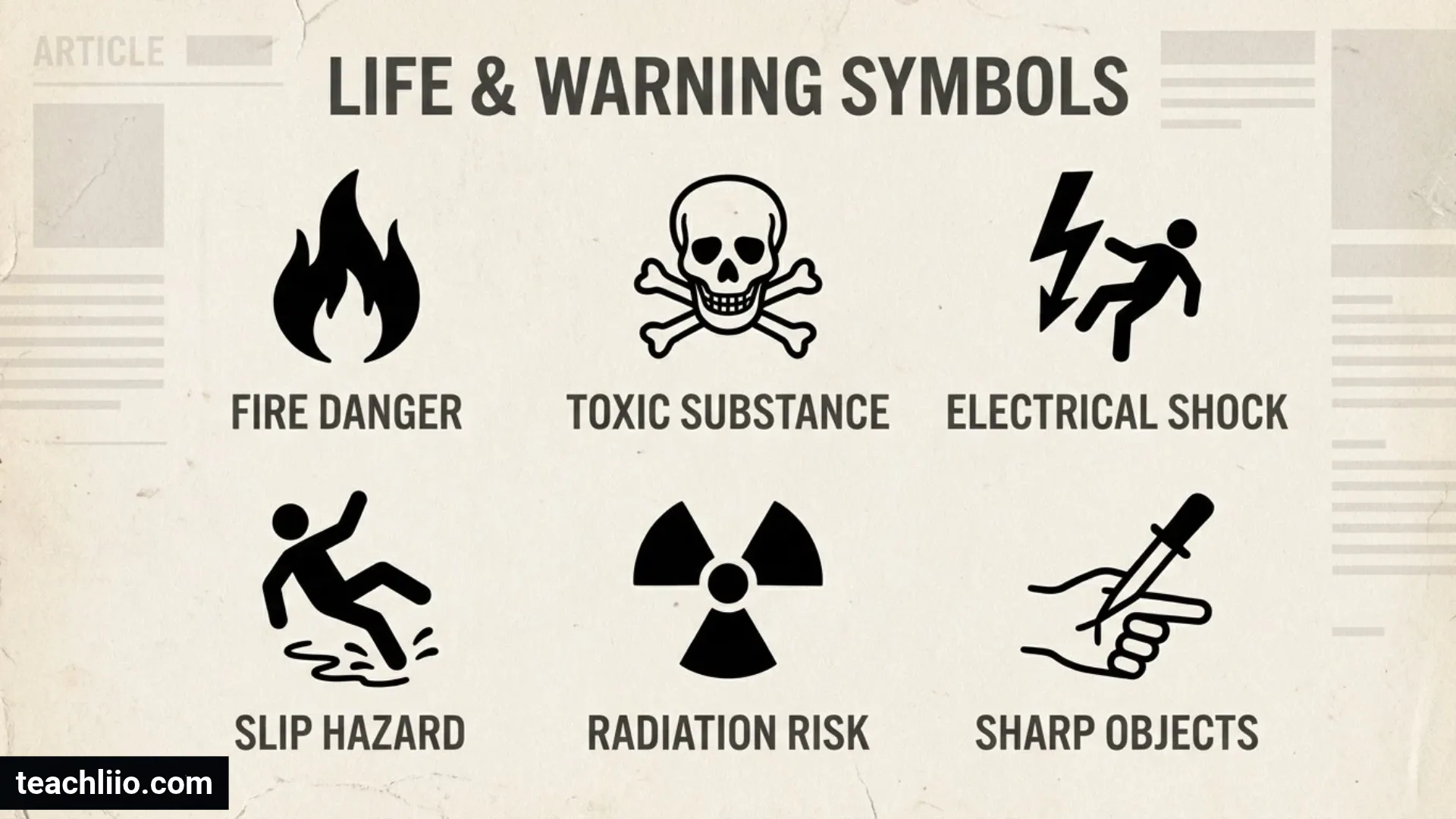
Warning symbols are visual signs that alert people to possible dangers before an accident happens. You can find them on roads, electrical equipment, chemical containers, workplace walls, household products, and public buildings. They help people recognize hazards such as electric shock, fire, toxic substances, radiation, slippery surfaces, and moving machinery.
Understanding warning symbols is important because each sign communicates a specific safety message. A yellow triangle with a lightning bolt warns about electricity, while a red diamond with a flame identifies certain flammable chemical hazards. Although these signs may look similar, they can belong to different safety systems and have different meanings.
This guide explains common warning symbols, their names, meanings, appearances, and typical uses. It also covers chemical hazard pictograms, workplace and road signs, safety colors, and practical steps to take when you encounter an unfamiliar symbol.
What Are Warning Symbols?
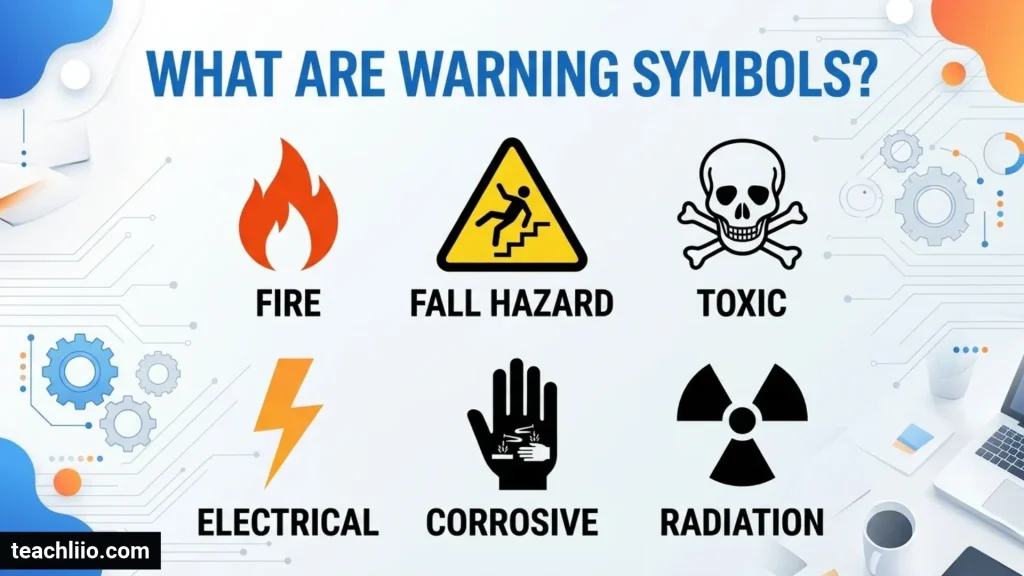
Warning symbols are pictures or signs designed to alert people to a potential hazard. They communicate safety information quickly, often without relying on written language. This makes them useful in workplaces and public places where people may speak different languages.
A warning symbol usually identifies a risk rather than giving a complete set of instructions. For example, an electrical warning sign tells you that an electrical hazard may be present. You must still follow the site’s safety procedures to avoid injury.
Common places where warning symbols appear include:
- Factories, warehouses, and construction sites
- Hospitals, laboratories, and medical facilities
- Roads, highways, and railway crossings
- Electrical rooms and power installations
- Chemical containers and cleaning products
- Public buildings, schools, and transport facilities
- Household appliances and industrial equipment
Why Are Warning Symbols Important?
Warning symbols help people notice hazards before they approach or handle something dangerous. They can reduce accidents when they are correctly displayed, understood, and followed.
Their main purposes include:
- Preventing injuries: They alert people to risks such as falling objects, hot surfaces, and moving machinery.
- Improving workplace safety: They help workers recognize hazards in factories, laboratories, and construction areas.
- Communicating across languages: A recognizable pictogram can communicate a basic warning without a long explanation.
- Protecting property: Signs can help prevent damage caused by fires, chemicals, electricity, and unsafe equipment use.
- Supporting emergency awareness: Safety signs help people recognize restricted areas and locate emergency facilities.
Common Warning Symbols and Their Meanings
The following warning symbols are among the most recognizable signs used in workplaces, public facilities, industrial environments, and everyday settings. Their appearance and official use can depend on the applicable standard.
1. General Warning Symbol
Meaning: A potential hazard is present, but the exact danger may need additional explanation.
Where it appears: Factories, laboratories, equipment rooms, and restricted work areas.
What to do: Read any accompanying message and identify the nearby hazard before proceeding. In ISO 7010, this is identified as W001; it should be accompanied by a warning message.
2. Electrical Hazard Warning Symbol
Meaning: There may be dangerous electrical energy or a risk of electric shock.
Where it appears: Electrical panels, substations, power equipment, and industrial machinery.
What to do: Stay away from exposed electrical parts. Do not open electrical equipment unless you are qualified and authorized.
3. Explosive Material Warning Symbol
Meaning: Explosive substances or materials may be present. Heat, impact, friction, or another trigger could cause an explosion, depending on the material.
Where it appears: Specialized industrial facilities, controlled storage areas, and hazardous-material locations.
What to do: Do not touch or move suspicious materials. Follow the site’s restricted-access and emergency procedures.
4. Radioactive Material Warning Symbol
Meaning: Ionizing radiation may be present.
Where it appears: Radiography rooms, nuclear facilities, research laboratories, and controlled medical areas.
What to do: Respect restricted-area signs and follow instructions from radiation safety personnel.
5. Laser Beam Warning Symbol
Meaning: Laser equipment may produce a beam that can injure the eyes or skin.
Where it appears: Medical equipment, research laboratories, manufacturing systems, and optical installations.
What to do: Never look directly into a laser beam. Follow the equipment’s safety instructions and access restrictions.
6. Non-Ionizing Radiation Warning Symbol
Meaning: Equipment may produce non-ionizing radiation, such as certain electromagnetic fields or radiofrequency energy.
Where it appears: Specialized industrial equipment, research facilities, and some technical installations.
What to do: Follow posted exposure precautions and maintain the required distance.
7. Magnetic Field Warning Symbol
Meaning: A strong magnetic field may be present. It may affect certain medical implants and attract ferromagnetic objects.
Where it appears: MRI facilities, magnetic equipment rooms, and industrial installations.
What to do: Follow entry restrictions and disclose relevant implanted medical devices to the responsible medical or safety personnel.
8. Floor-Level Obstacle Warning Symbol
Meaning: An obstacle at floor level could cause someone to trip or stumble.
Where it appears: Warehouses, factories, workshops, and areas with raised flooring or equipment.
What to do: Watch your step and use a clear walking route.
9. Fall or Drop Hazard Symbol
Meaning: A person could fall from a height or into a lower area.
Where it appears: Platforms, stairways, loading areas, construction sites, and elevated walkways.
What to do: Stay behind barriers and use required fall-protection equipment where applicable.
10. Biological Hazard Warning Symbol
Meaning: Biological materials may pose a risk to human health. These can include infectious samples or contaminated materials.
Where it appears: Hospitals, laboratories, research centers, and biological waste storage areas.
What to do: Do not handle contaminated materials without proper training and protective equipment.
11. Low Temperature Warning Symbol
Meaning: Extremely cold conditions or freezing surfaces may be present.
Where it appears: Cold-storage rooms, refrigeration facilities, and industrial freezing areas.
What to do: Follow cold-exposure precautions and use suitable protective equipment.
12. Slippery Surface Warning Symbol
Meaning: A floor or other surface may cause someone to slip because of water, oil, ice, or another substance.
Where it appears: Kitchens, public buildings, factories, bathrooms, and outdoor walkways.
What to do: Walk carefully, use an alternative route if necessary, and report unmarked slippery areas.
13. Forklift and Industrial Vehicle Warning Symbol
Meaning: Forklifts or other industrial vehicles may be moving nearby.
Where it appears: Warehouses, loading docks, factories, and distribution centers.
What to do: Use marked pedestrian routes and never walk behind a moving industrial vehicle without confirming it is safe.
14. Overhead Load Warning Symbol
Meaning: Heavy materials may be suspended or lifted above the area.
Where it appears: Construction sites, cranes, factories, and loading zones.
What to do: Never stand or walk beneath a suspended load.
15. Toxic Material Warning Symbol
Meaning: A toxic substance may cause serious poisoning through swallowing, inhalation, or other exposure routes.
Where it appears: Chemical storage areas, laboratories, and hazardous-material containers.
What to do: Avoid contact and follow the product label and safety data sheet.
16. Hot Surface Warning Symbol
Meaning: A surface may be hot enough to cause burns.
Where it appears: Ovens, boilers, industrial machines, heating equipment, and cooking appliances.
What to do: Avoid touching the surface and allow equipment to cool when instructed.
17. Automatic Start-Up Warning Symbol
Meaning: A machine may start automatically without someone manually switching it on at that moment.
Where it appears: Automated production lines, conveyor systems, and industrial machinery.
What to do: Keep clear of moving components and follow approved isolation procedures before maintenance.
18. Corrosive Substance Warning Symbol
Meaning: A substance may damage skin, eyes, or metals.
Where it appears: Chemical laboratories, cleaning-product storage, and industrial processing areas.
What to do: Avoid direct contact and use the protective equipment specified for the substance.
These examples include registered ISO-style warning signs. ISO 7010 provides standardized safety pictograms, but its scope does not cover road, rail, maritime, or air-traffic signs that are governed by their own rules.
GHS Chemical Warning Symbols and Their Meanings
The Globally Harmonized System of Classification and Labelling of Chemicals (GHS) uses nine pictograms to communicate chemical hazards. They usually appear as black symbols inside red diamond-shaped borders on a white background.
These pictograms help users identify physical, health, and environmental hazards. A chemical label may also include a signal word, hazard statements, and precautionary instructions.
19. Exploding Bomb — GHS01
This pictogram identifies certain explosive substances, self-reactive materials, and organic peroxides.
Precaution: Avoid impact, friction, heat, or other conditions identified on the product label.
20. Flame — GHS02
It identifies flammable substances and certain materials that may ignite easily, including some pyrophoric and self-heating substances.
Precaution: Keep the product away from ignition sources and follow its storage instructions.
21. Flame Over Circle — GHS03
This symbol identifies oxidizing gases, liquids, or solids. Such substances can cause or intensify a fire.
Precaution: Keep oxidizers away from incompatible materials and combustible substances.
22. Gas Cylinder — GHS04
It identifies gases under pressure, including compressed, liquefied, and refrigerated liquefied gases.
Precaution: Protect containers from heat and physical damage. Follow the supplier’s handling instructions.
23. Corrosion — GHS05
This pictogram warns about substances that can cause severe skin burns, serious eye damage, or corrosion of metals.
Precaution: Avoid contact and use the protective equipment listed on the label or safety data sheet.
24. Skull and Crossbones — GHS06
It identifies chemicals associated with acute toxicity that can be fatal or toxic after certain forms of exposure.
Precaution: Never taste, inhale, or directly handle the material. Follow the specified exposure controls.
25. Exclamation Mark — GHS07
This pictogram can indicate skin or eye irritation, skin sensitization, harmful acute toxicity, or certain other health effects.
Precaution: Avoid unnecessary exposure and follow the label’s first-aid and handling instructions.
26. Serious Health Hazard — GHS08
It can identify hazards such as carcinogenicity, respiratory sensitization, reproductive toxicity, or certain organ effects.
Precaution: Read the full hazard statements and safety data sheet before using the substance.
27. Environmental Hazard — GHS09
This pictogram indicates that a substance may be hazardous to aquatic life or the aquatic environment.
Precaution: Prevent uncontrolled release into drains, waterways, and soil. Follow local disposal rules.
Important distinction: GHS pictograms do not replace the full chemical label. In the United States, OSHA requires eight GHS pictograms under its Hazard Communication Standard; the environmental pictogram is not required by OSHA’s standard because environmental hazards fall outside its jurisdiction. Requirements can differ in other countries.
Workplace and Industrial Warning Symbols
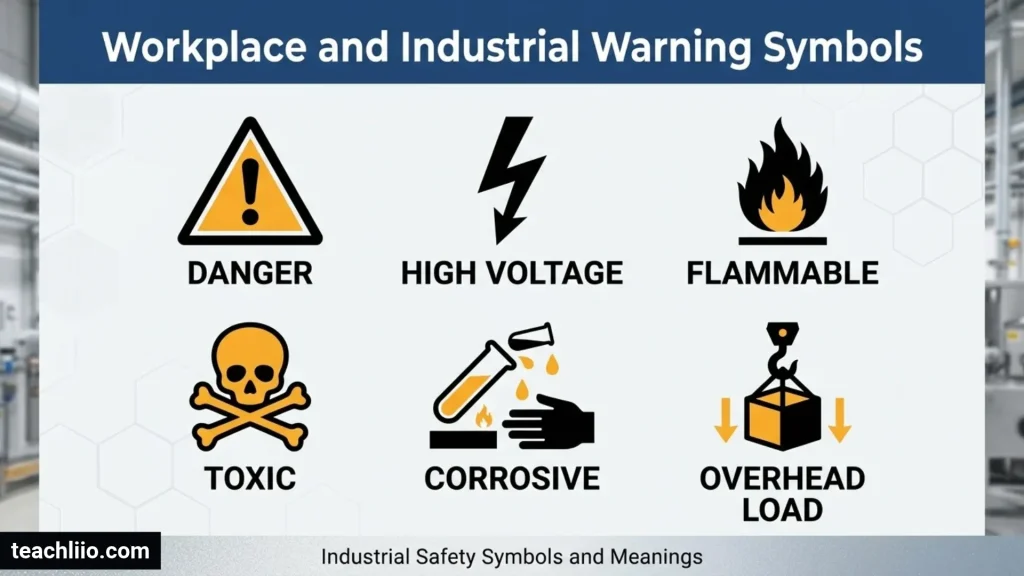
Workplaces use warning signs to identify hazards connected with equipment, movement, materials, and working conditions. In addition to the symbols already explained, these examples are useful to recognize.
28. Crushing Hazard
Warns that a person could be trapped or squeezed between moving machine parts or heavy objects. It is common near presses, lifting platforms, and automated equipment.
29. Hand-Crushing Hazard
Identifies a specific risk of crushing fingers or hands. Keep hands outside marked danger zones and never bypass machine guards.
30. Counter-Rotating Rollers
Warns about rollers moving in opposite directions that could pull in clothing, gloves, or body parts. Keep clear of the rollers during operation.
31. Asphyxiating Atmosphere
Warns that an area may contain an atmosphere that cannot safely support breathing, such as one with insufficient oxygen or certain hazardous gases. Never enter a confined or restricted space without the required assessment and authorization.
32. Arc Flash Hazard
Indicates the risk of an electrical arc flash, which can produce intense heat, light, and pressure. Only properly trained and authorized personnel should work on equipment under the relevant electrical safety procedures.
33. Battery Charging Hazard
Warns about possible risks associated with battery charging, such as electrical hazards, heat, or hazardous gases, depending on the battery type and charging environment.
34. Barbed Wire Warning
Alerts people to sharp barbed wire that can cause cuts or puncture injuries. Do not climb over or touch the barrier.
35. Deep Water Warning
Indicates a risk of drowning or entering water that may be deeper than expected. Keep away from restricted edges and follow water-safety instructions.
36. Animal Hazard Warning
Warns that animals may be present in the area. The specific pictogram may identify livestock, dogs, or potentially dangerous wildlife.
37. High Surf or Large Waves
Warns about dangerous sea conditions, powerful waves, or rough water. Stay outside restricted coastal areas and follow local warnings.
38. Incoming Tide Warning
Alerts people that rising tides may cut off routes or cover areas that were previously accessible. Check local tide information and leave exposed areas when instructed.
Road Warning Symbols and Their Meanings
Road warning signs alert drivers and other road users to hazards ahead. Their colors, shapes, and exact designs vary between countries. In some systems, warning signs are triangular; in others, they may use yellow diamond-shaped designs.
39. Sharp Turn Ahead
Warns that the road bends sharply. Reduce speed and stay within your lane.
40. Winding Road
Indicates a series of bends ahead. Adjust your speed before entering the winding section.
41. Slippery Road
Warns that road grip may be reduced by rain, ice, oil, or loose material. Avoid sudden braking or steering.
42. Pedestrian Crossing
Alerts drivers that pedestrians may cross ahead. Slow down and give way where required.
43. Children Crossing
Warns that children may be near or crossing the road, often close to schools and playgrounds. Drive carefully and watch for unexpected movement.
44. Animal Crossing
Indicates that animals may enter the road. Slow down, especially in rural or wildlife areas.
45. Road Works Ahead
Warns that construction or maintenance is taking place. Watch for workers, temporary signs, barriers, and changed lanes.
46. Traffic Signals Ahead
Alerts drivers that traffic lights are approaching. Prepare to slow down and obey the signals.
47. Railway Crossing
Warns that railway tracks cross the road ahead. Obey warning lights, barriers, and crossing instructions.
48. Two-Way Traffic
Indicates that traffic may travel in both directions ahead. Keep to the correct side of the road and watch for oncoming vehicles.
49. Steep Hill
Warns of a steep uphill or downhill section. Adjust speed and use appropriate driving techniques.
50. Falling Rocks
Indicates that rocks or other debris may fall onto the roadway. Drive carefully and avoid stopping in exposed areas.
51. Road Narrows
Warns that the available road width decreases ahead. Be prepared for reduced space and possible oncoming traffic.
52. Roundabout Ahead
Alerts drivers that a roundabout is approaching. Reduce speed and follow the applicable right-of-way rules.
53. Junction Ahead
Warns that another road joins or crosses the road ahead. Watch for vehicles entering from other directions.
54. Traffic Merging
Indicates that vehicles may join the road from another lane or route. Be alert and adjust your position safely.
55. Uneven Road
Warns that the road surface may contain bumps, dips, or other irregularities. Reduce speed if necessary.
The examples above are general descriptions, not a substitute for a country’s official traffic-sign handbook. Traffic signs must be interpreted according to local road rules.
Warning Symbols for Homes and Public Places
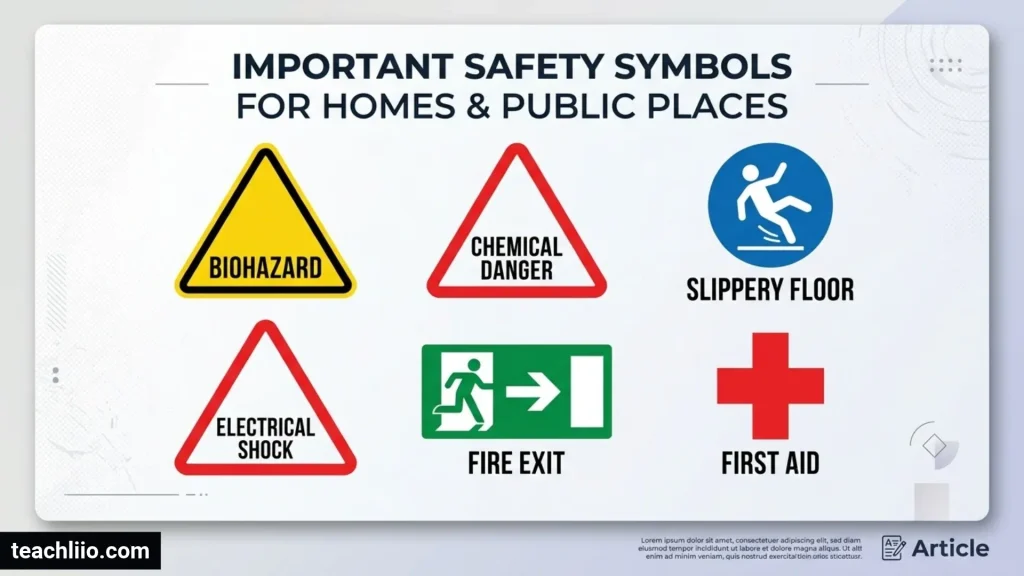
Warning signs also appear in everyday environments. They help people recognize hazards around appliances, buildings, pools, and public facilities.
56. High Temperature Warning
Alerts people to hot equipment or surfaces that may cause burns. Common examples include ovens, heaters, and industrial cooking equipment.
57. Hot Water Warning
Indicates that water may be hot enough to cause scalding. Check the temperature before use, especially in public facilities.
58. Wet Floor Warning
Warns that a floor may be slippery after cleaning, spills, or rain. Walk carefully and avoid the area when possible.
59. Low Ceiling Warning
Indicates a low overhead structure that could cause someone to hit their head. Watch your head when entering.
60. Trip Hazard Warning
Alerts people to cables, raised surfaces, or obstacles that could cause a fall. Keep walkways clear.
61. Swimming Pool Depth Warning
Shows the depth of a pool or warns about water conditions. Check depth information before entering and never dive into water unless it is marked safe for diving.
62. Do Not Touch Warning
Indicates that touching an object or surface may be unsafe or prohibited. The reason could be heat, electricity, contamination, or moving parts.
63. Keep Children Away Warning
Reminds people that a product, machine, or area may be dangerous for children. Store hazardous products securely and follow the manufacturer’s instructions.
64. Fragile Material Warning
Alerts people that an item can break if dropped, struck, or handled roughly. This symbol is commonly used on packaging and shipping containers.
65. Heavy Object Warning
Indicates that an object may be difficult to lift or move safely. Use appropriate lifting equipment or assistance when needed.
66. Sharp Edge Warning
Warns about blades, metal edges, glass, or other sharp surfaces that may cause cuts. Handle the object using suitable precautions.
Warning Sign Colors and Shapes Explained
The color and shape of a safety sign provide an important clue about its purpose. However, the exact design depends on the safety system being used.
| Color or shape | Common purpose | Example |
| Yellow triangle | Warning about a hazard | Electrical danger |
| Red diamond | GHS chemical hazard pictogram | Flammable material |
| Red circle with diagonal line | Prohibited action | No smoking |
| Blue circle | Mandatory action | Wear eye protection |
| Green rectangle or square | Emergency or safe-condition information | Emergency exit |
| Red rectangle or square | Fire equipment information | Fire extinguisher |
Why Are Warning Signs Often Yellow and Black?
Yellow and black create strong visual contrast, helping warning signs stand out in many environments. A yellow triangle with a black border and pictogram is a familiar design for workplace hazard warnings.
However, not every yellow-and-black sign belongs to the same standard. Always consider the pictogram, accompanying text, and location.
Why Do Chemical Warning Symbols Use Red Diamonds?
GHS chemical hazard pictograms use a red diamond-shaped border around a black symbol on a white background. This consistent design helps people recognize chemical hazards on product labels.
The symbol communicates the type of hazard, while the written label provides additional details about its severity and the precautions required.
ISO 7010 Warning Symbol Codes
ISO 7010 provides registered safety signs for communicating hazards and safety information. Its warning signs use codes beginning with the letter W. These codes help identify particular signs in technical and safety references.
Here are some examples:
| ISO reference | Meaning |
| W001 | General warning |
| W002 | Explosive material |
| W003 | Radioactive material or ionizing radiation |
| W004 | Laser beam |
| W005 | Non-ionizing radiation |
| W006 | Magnetic field |
| W007 | Floor-level obstacle |
| W008 | Drop or fall |
| W009 | Biological hazard |
| W010 | Low temperature |
| W011 | Slippery surface |
| W012 | Electricity |
| W014 | Forklift trucks and industrial vehicles |
| W015 | Overhead load |
| W016 | Toxic material |
| W017 | Hot surface |
| W018 | Automatic start-up |
| W019 | Crushing |
| W023 | Corrosive substance |
These are reference codes, not extra symbols. For example, W012 identifies the electricity warning sign; it does not represent a separate electrical hazard from the lightning-bolt pictogram. Check the current applicable edition and amendments before using codes in workplace documentation.
Warning Symbols vs. Other Safety Signs
Not every safety sign is a warning symbol. Different categories communicate different instructions.
| Sign category | What it communicates | Example |
| Warning | A hazard may be present | Electrical danger |
| Prohibition | An action is not allowed | No smoking |
| Mandatory | An action is required | Wear a helmet |
| Emergency information | Where to find safety facilities or exits | Emergency exit |
| Fire safety | Where fire equipment is located | Fire extinguisher |
A warning sign tells you to be careful around a potential hazard. A mandatory sign tells you what action you must take. A prohibition sign tells you what not to do.
What Is the Difference Between Danger and Warning?
The words “Danger” and “Warning” do not have one universal meaning across every safety system.
Under GHS chemical labeling, both are signal words used to communicate relative hazard severity. “Danger” is generally used for more severe hazard categories, while “Warning” is generally used for less severe categories when a signal word is required.
Under workplace sign rules, the words may have specific meanings established by local regulations. Always interpret them within the relevant standard.
What Should You Do When You See a Warning Symbol?
Recognizing a sign is only the first step. You also need to respond appropriately.
- Stop and identify the symbol: Look at its shape, color, and pictogram.
- Read the accompanying message: Written instructions may explain the exact hazard.
- Check the surrounding area: Look for equipment, substances, or conditions connected with the warning.
- Keep a safe distance: Do not touch unfamiliar materials or enter restricted areas.
- Follow safety instructions: Use the required protective equipment and follow workplace procedures.
- Ask for guidance: If you do not understand the sign, ask a trained or authorized person.
- Report missing or damaged signs: A warning that cannot be seen or understood may fail to protect people.
Never assume an unfamiliar warning sign is harmless. If you cannot identify the risk, avoid the area until you receive reliable guidance.
Frequently Asked Questions
What Are the Most Common Warning Symbols?
Some widely recognized warning symbols include general warning, electrical hazard, flammable material, toxic material, biological hazard, radiation, corrosive substance, slippery surface, hot surface, and falling objects.
What Does a Yellow Triangle With an Exclamation Mark Mean?
It usually indicates a general warning. A possible hazard is present, but the exact danger may require an additional message or explanation.
What Are the Nine GHS Chemical Warning Symbols?
The nine GHS pictograms are exploding bomb, flame, flame over circle, gas cylinder, corrosion, skull and crossbones, exclamation mark, health hazard, and environmental hazard.
What Does a Red Diamond Warning Symbol Mean?
On chemical labels, a red diamond containing a black pictogram generally indicates a GHS hazard. The specific pictogram identifies the type of chemical risk.
What Is the Difference Between a Warning Symbol and a Hazard Symbol?
The terms are sometimes used interchangeably. Generally, a hazard symbol is the pictogram representing a particular risk, while a warning sign is the complete sign used to alert people to that risk.
Are Warning Symbols the Same Around the World?
Not always. Some workplace and chemical pictograms follow international standards, but traffic signs and other specialized warnings can differ between countries. Local regulations determine which signs must be used.
What Does the Skull and Crossbones Warning Symbol Mean?
It indicates acute toxicity. A chemical carrying this pictogram may cause serious poisoning or death after certain types of exposure.
Why Are Warning Symbols Important in the Workplace?
They help workers and visitors recognize hazards involving electricity, machinery, chemicals, radiation, and other dangerous conditions. Correctly placed signs support workplace safety procedures and hazard awareness.
Where Can I Find Official Warning Symbols?
ISO 7010 provides registered safety signs for many workplaces and public environments. The United Nations GHS resources and chemical product labels explain chemical hazard pictograms. Government traffic-sign manuals provide road-sign information for individual countries.
Conclusion
Warning symbols help people recognize hazards before accidents occur. From electrical danger and toxic chemicals to slippery floors and road hazards, each sign communicates an important safety message.
Learning their names, appearances, and meanings makes it easier to identify risks at home, at work, and in public places. Remember that workplace warning signs, GHS chemical pictograms, and road traffic signs belong to different systems, so their designs and meanings should not be confused.
The safest approach is simple: recognize the symbol, read its instructions, and follow the precautions required for the situation.

I’m Arthur Ellison, a British writer with a fascination for numbers, quantities, and the questions people ask about how many. I enjoy researching facts, comparisons, measurements, and everyday statistics, presenting them in straightforward language. My goal is to make numerical information easy to understand, useful, and interesting for curious readers everywhere.
Books:
The Curious World of How Many
Numbers, Quantities and Everyday Facts