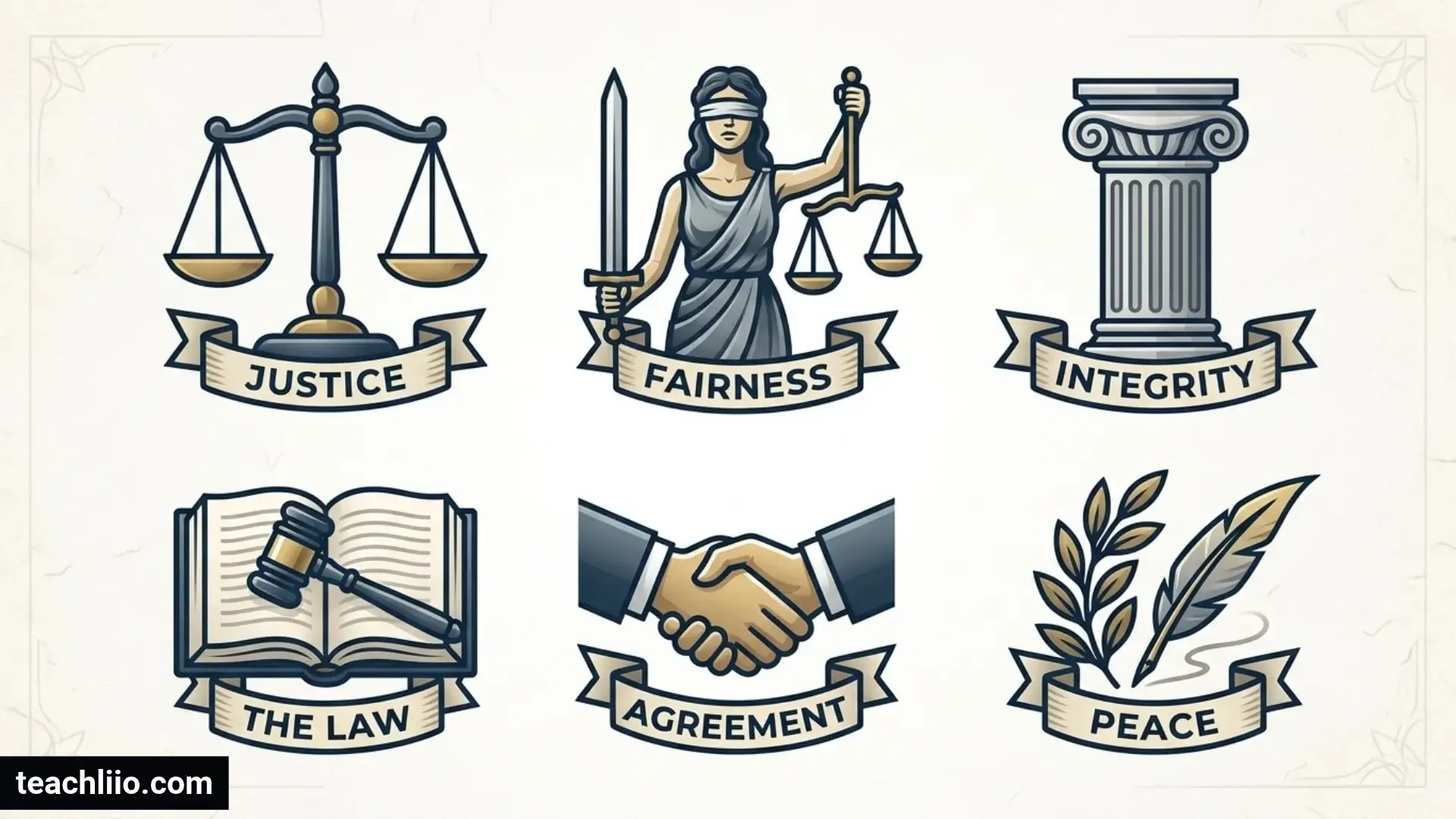
Law symbols represent some of the most important values in society, including fairness, equality, authority, protection, and accountability. From the familiar scales of justice to Lady Justice, the judge’s gavel, and ancient symbols of law, each image communicates an idea about how justice should work.
These symbols appear in courthouses, law firm logos, legal books, government buildings, educational materials, and official documents. Some have existed for centuries, while others are modern characters used to identify legal sections, paragraphs, and intellectual property rights.
If you are searching for law symbols and their meanings, you may want to understand what they represent, discover their historical origins, or find symbols you can copy and paste into your work.
This complete guide explores more than 25 traditional, historical, courtroom, and professional law symbols. It also includes useful legal characters, their meanings, practical applications, and explanations to help you distinguish between similar symbols.
What Are Law Symbols?
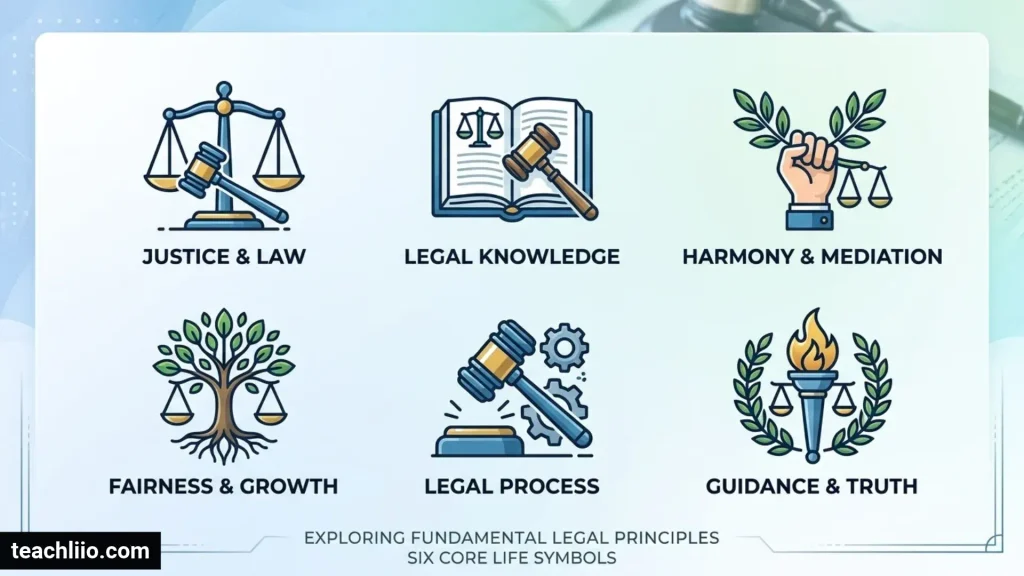
Law symbols are visual images, objects, signs, and special characters associated with justice, legal authority, courts, and the practice of law. They communicate important legal ideas in a recognizable form, often without requiring lengthy explanations.
For example, the scales of justice represent fairness because they suggest that evidence and arguments should be carefully weighed before a decision is made. Lady Justice represents impartiality and the responsible administration of law, while a judge’s gavel is commonly associated with courtroom authority.
Law symbols can be divided into five main categories.
- Traditional justice symbols: Scales of justice, Lady Justice, swords, and blindfolds.
- Courtroom and judicial symbols: Gavels, judicial robes, court seals, and courthouse buildings.
- Legal profession symbols: Briefcases, law books, fountain pens, and legal documents.
- Historical and cultural symbols: Greek Themis, Roman Justitia, Egyptian Ma’at, and Roman fasces.
- Legal text symbols: Section signs, paragraph signs, copyright marks, and trademark characters.
It is important to understand that not every symbol in these categories is an official legal emblem. Some are traditional representations, while others are general images associated with legal work and professional responsibility.
25+ Law Symbols and Their Meanings
The following law symbols represent different aspects of the legal system. Some communicate fairness and equality, while others represent judicial authority, legal knowledge, historical traditions, and professional services.
Traditional Symbols of Justice
Traditional justice symbols are among the most recognizable images associated with courts and legal institutions. They often communicate the principles of fairness, impartiality, truth, and the enforcement of laws.
1. Scales of Justice ⚖️
Golden equal-arm scales of justice on a white background
Meaning: Fairness, equality, balance, and impartial judgment.
The scales of justice are among the most widely recognized symbols of law. They represent the idea that every side of a legal dispute should receive fair consideration before a decision is reached.
The two sides of the scales symbolize opposing arguments, claims, or pieces of evidence. Their balance communicates that justice should not favor one person simply because of wealth, influence, or social position.
Historically, the idea of weighing matters to determine justice has connections with ancient Egyptian, Greek, and Roman traditions. In modern legal imagery, the scales are frequently associated with impartial courts and fair decision-making.
Where they are used: Courthouse emblems, law firm logos, legal websites, educational materials, and justice-related illustrations.
2. Lady Justice
SVA LAW | Abogados Fintech y Tecnología en México
Meaning: Impartiality, fairness, equality, and judicial responsibility.
Lady Justice is a symbolic female figure representing the ideal administration of justice. She is traditionally depicted wearing a flowing robe and holding scales and a sword. Some representations also show her wearing a blindfold.
Her image developed through classical traditions associated with Greek Themis and Roman Justitia. These figures became important representations of law, order, and justice.
Each part of Lady Justice’s appearance communicates a different principle:
- Scales: Represent balanced judgment and fairness.
- Sword: Represents authority and the power to enforce legal decisions.
- Blindfold: Represents impartiality and freedom from prejudice.
- Robe: Represents dignity, responsibility, and the seriousness of judicial work.
Lady Justice is commonly displayed outside courthouses, on judicial seals, and in legal artwork.
3. Blindfold of Justice
Law and Justice symbols on dark background
Meaning: Impartiality, equality, and freedom from favoritism.
The blindfold is one of the most recognizable features of Lady Justice. It communicates the principle that decisions should be based on facts, evidence, and applicable laws rather than personal preferences.
It suggests that people should receive equal treatment regardless of their appearance, financial position, family background, or influence.
Interestingly, the blindfold was not present in every early representation of justice. Its meaning developed through later artistic traditions, where it became a visual expression of impartiality.
4. Sword of Justice ⚔️
Meaning: Legal authority, enforcement, strength, and protection.
The sword of justice represents the authority of the legal system to uphold laws and protect society. It is often shown in the hand of Lady Justice.
Its sharp edge communicates that laws must be supported by the ability to enforce legal decisions. It can also represent the consequences of unlawful behavior and the responsibility of institutions to maintain public order.
The sword is not intended to suggest violence as the purpose of justice. Instead, it symbolizes lawful authority and the power to protect rights.
5. Judge’s Gavel 🔨
Meaning: Judicial authority, order, and formal decisions.
A gavel is a small wooden hammer traditionally associated with judges and people presiding over formal meetings. It is one of the most familiar objects in courtroom imagery.
In popular representations, a judge striking a gavel signals that a proceeding is beginning, ending, or being brought to order.
However, the gavel is not used by judges in every country. For example, it is not a standard courtroom instrument in England and Wales.
Despite these differences, it remains a recognizable symbol of judicial authority, discipline, and formal proceedings.
6. Book of Judgment
Meaning: Legal principles, written decisions, and judicial knowledge.
A book of judgment represents the written knowledge and principles used to guide legal decisions. It can symbolize statutes, court judgments, constitutional rules, and legal interpretations.
It also represents the responsibility of judges and legal professionals to understand the law before making important decisions.
In legal illustrations, an open book often communicates transparency, learning, and access to justice.
7. Tablets of Law
Meaning: Written rules, fundamental principles, and legal obligations.
Tablets of law represent the recording of rules that guide a community or society. They are associated with ancient legal traditions and the idea that laws should be preserved in a lasting written form.
The tablets are especially recognizable in religious and historical imagery involving the Ten Commandments. However, the broader idea of inscribed laws also connects with ancient civilizations that recorded legal rules on stone and other durable materials.
In legal artwork, tablets can symbolize the foundation of a legal system and the importance of established rules.
8. Legal Scroll 📜
Magna Carta at 800 – the Dublin connection – The Irish Times
Meaning: Legal records, written agreements, and historical laws.
A legal scroll represents the recording and preservation of important information. Before modern printing and digital documents, scrolls were used to preserve religious, governmental, and legal writings.
Today, scroll imagery is commonly used in illustrations of historical laws, constitutional traditions, official records, and legal education.
It communicates the importance of documentation and preserving information that may have legal significance.
Courtroom and Judicial Symbols
Courtroom symbols represent the people, institutions, and objects involved in administering justice. They communicate authority, responsibility, professionalism, and the formal nature of legal proceedings.
9. Courthouse Building 🏛️
The Hidden Economic Penalty of Low Social Trust | Science Array
Meaning: Judicial institutions, law, and the administration of justice.
A courthouse represents the official place where legal matters are heard and judicial decisions are made.
Its architecture often includes large entrances, symmetrical designs, and classical columns. These features communicate stability, dignity, and institutional authority.
Courthouses also represent the public role of the justice system, where people can bring disputes, seek legal remedies, and participate in formal proceedings.
10. Courthouse Columns
Meaning: Stability, tradition, strength, and institutional dignity.
Columns are common features of traditional courthouse architecture. Their appearance is inspired by ancient Greek and Roman buildings, whose architectural styles influenced many modern government institutions.
They symbolize strength and continuity, suggesting that the legal system should provide a stable foundation for society.
Columns can also represent the lasting nature of legal principles and the responsibility of institutions to maintain public confidence.
11. Judicial Robe
The Symbolism Of The Judge’s Robe – Judicial Shop
Meaning: Judicial dignity, responsibility, and authority.
A judicial robe is formal clothing worn by judges in many legal systems. It distinguishes judicial officers from other courtroom participants and represents the official nature of their position.
The robe also communicates that a judge is expected to act according to legal duties rather than personal interests.
Its color, design, and ceremonial importance differ between countries and courts.
12. Official Court Seal
Meaning: Authenticity, institutional identity, and official authority.
A court seal is an emblem used to identify a particular judicial institution or authority. It may appear on official documents, court records, certificates, and institutional publications.
The design can include scales, national emblems, shields, inscriptions, or other traditional imagery.
A seal helps distinguish official institutional material from ordinary documents, although its legal effect depends on the applicable rules.
13. Legal Mace
Parliament of WA Web – MacePuzzle
Meaning: Institutional authority, tradition, and formal order.
A ceremonial mace is an ornamental staff used in some legislative, judicial, and institutional settings.
It represents the authority of an institution and the formal power of the office associated with it.
Maces have historical connections with royal and governmental authority. Their use differs across countries and organizations, and they are not standard courtroom objects everywhere.
14. Courtroom Bar
Renters Rights Information Sheet 2026: Serve + Prove It
Meaning: Courtroom procedure, professional boundaries, and legal representation.
The courtroom bar refers to the physical boundary separating certain areas of a courtroom from the public seating area.
The term also has a professional meaning. In several legal traditions, the bar refers to the community of qualified legal practitioners.
This makes the bar a useful symbol of courtroom organization and the legal profession.
15. Witness Stand
Val-d’Ornain | Faits divers. Poursuivi par la justice pour être dans une voiture volée
Meaning: Testimony, evidence, and the pursuit of truth.
The witness stand is the place where witnesses provide testimony during certain court proceedings.
It represents the importance of firsthand information, statements, and evidence when examining a legal dispute.
Witness testimony is one of several forms of evidence that courts may consider. Its reliability and relevance depend on the circumstances and applicable rules.
Symbols Representing the Legal Profession
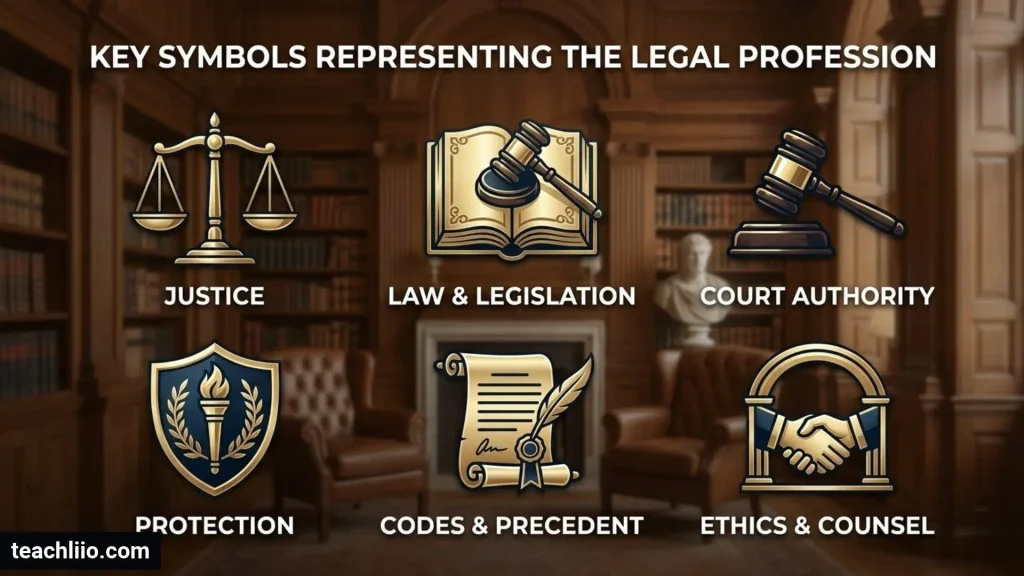
Legal profession symbols represent the work of lawyers, legal consultants, researchers, and other people involved in legal services. They often communicate knowledge, professional responsibility, agreements, and the protection of clients’ rights.
16. Legal Briefcase 💼
Men’s Luxury Leather Laptop Briefcase | The PaoloL | 25-Year Warranty
Meaning: Professionalism, legal work, and responsibility.
A briefcase is commonly associated with lawyers and other professionals who handle important documents, contracts, and case files. It represents preparation, organization, and the responsibilities involved in legal practice.
Although it is not an official legal emblem, it is a recognizable visual symbol for legal services and professional representation.
17. Fountain Pen 🖋️
Law, notary, attorney background theme
Meaning: Legal writing, signatures, and formal agreements.
A fountain pen represents the written side of legal work. Lawyers and legal professionals prepare contracts, agreements, letters, and other documents that may have important legal consequences.
It can also symbolize the importance of carefully written terms and properly documented decisions.
18. Handshake 🤝
Business Valuation Calculator | Windsor Drake
Meaning: Agreement, cooperation, negotiation, and trust.
A handshake represents mutual understanding between two or more parties. In legal settings, it can symbolize negotiations, settlements, business agreements, and peaceful dispute resolution.
However, a handshake does not automatically establish an enforceable contract. Contract validity depends on the relevant legal requirements and circumstances.
19. Legal Shield 🛡️
Legal Protection 3D Icons – Free Download in PNG, glTF
Meaning: Protection, security, and the defense of legal rights.
A shield is a traditional image of protection. In legal artwork, it represents the role of laws and institutions in protecting individuals against unlawful actions.
It is commonly used in legal branding to communicate safety, reliability, responsibility, and trust.
20. Judicial Chain of Office
Lietuvos Aukščiausiasis Teismas kviečia visuomenę apsilankyti unikalioje parodoje – Lietuvos teismai
Meaning: Public responsibility, institutional dignity, and official authority.
A chain of office is a ceremonial object worn by certain public officials during formal occasions.
Its medallion may carry an institutional emblem or other official design. In places where judicial or civic officers use such chains, they represent the responsibilities associated with public office.
Historical and Cultural Symbols of Law
Many legal symbols developed through ancient civilizations, religious traditions, and historical ideas about fairness and government. Understanding these origins helps explain why certain images remain popular in modern legal institutions.
21. Egyptian Ma’at Feather
Ma’at: The Heart of Ancient Egyptian Order and Balance – Discoveries Egyptian Imports
Meaning: Truth, balance, order, and justice.
Ma’at was an important concept in ancient Egyptian religion and society. It represented truth, balance, harmony, and proper order.
The feather of Ma’at is particularly famous because of its role in the ancient Egyptian judgment of the dead. In the traditional scene, the deceased person’s heart was weighed against the feather to determine whether they had lived a morally balanced life.
This ancient imagery provides an important historical connection between weighing, truth, and justice. It is a cultural symbol of moral judgment rather than a modern courtroom emblem.
22. Greek Themis
Meaning: Divine order, fairness, law, and social responsibility.
Themis was a figure in ancient Greek mythology associated with divine order, law, and established customs.
She represents the idea that society needs rules and shared principles to maintain harmony. Her image is closely connected with the historical development of justice symbolism.
Themis is often associated with Lady Justice, although the two figures belong to different cultural traditions and should not be treated as exactly identical.
23. Roman Justitia
Political application outdoor marble goddess status lady justice
Meaning: Justice, fairness, and lawful judgment.
Justitia was the Roman personification of justice. Her name is the source of the modern word “justice” in several languages.
She is commonly represented with scales and sometimes a sword. Later artistic traditions also depicted her wearing a blindfold.
Her image influenced the appearance of many modern legal emblems, especially in European and American judicial architecture.
24. Roman Fasces
CLASS NOTES: The Meier Museum and the Jewel of the Lungotevere (Roman Architecture)
Meaning: Authority, public power, and unity.
The fasces was an ancient Roman symbol consisting of a bundle of wooden rods, sometimes containing an axe.
It was carried by attendants accompanying certain Roman magistrates and represented their public authority and power.
Its historical meaning is complex. The symbol was later adopted by fascist movements, so its use today can carry political associations beyond its ancient Roman origins. It should therefore be explained carefully rather than presented as a universally positive symbol of law.
25. Olive Branch 🕊️
Meaning: Peace, reconciliation, and peaceful resolution.
The olive branch has long been associated with peace in ancient Mediterranean traditions.
In legal contexts, it can represent mediation, negotiation, reconciliation, and the peaceful settlement of disagreements.
Unlike a sword or gavel, it does not represent judicial authority. Instead, it communicates the idea that some disputes can be resolved through cooperation rather than confrontation.
26. Torch of Justice
Lámpara de pie antigua Art Decó Escultura femenina de tamaño natural en venta en 1stDibs España
Meaning: Knowledge, truth, awareness, and enlightenment.
A torch is commonly used as a symbol of knowledge and the search for truth. In legal illustrations, it can represent the importance of evidence, careful investigation, and informed decisions.
It is a general symbolic image rather than a universally recognized official emblem of the legal profession.
Legal Symbols Copy and Paste
Legal characters are useful for people who write contracts, prepare academic assignments, research legislation, or create legal websites. Unlike traditional images of justice, these symbols have specific typographic uses.
Here are some important legal symbols you can copy and paste.
| Symbol | Name | Unicode | Common use |
| § | Section sign | U+00A7 | Referring to legal sections |
| ¶ | Paragraph sign | U+00B6 | Identifying paragraphs |
| ⚖ | Scales of justice | U+2696 | Justice representation |
| © | Copyright | U+00A9 | Copyright notices |
| ™ | Trademark | U+2122 | Trademark claims |
| ® | Registered trademark | U+00AE | Registered marks |
| ℠ | Service mark | U+2120 | Service identification |
| ℗ | Sound recording copyright | U+2117 | Sound recording rights |
| № | Numero sign | U+2116 | Number references |
| † | Dagger | U+2020 | Footnotes and references |
| ‡ | Double dagger | U+2021 | Additional references |
Unicode values identify individual characters. Their appearance may vary depending on the font, application, and operating system.
Section Sign (§)
The section sign is used to identify a particular section of a law, regulation, or legal document.
For example:
- § 10 means Section 10.
- § 25 means Section 25.
- §§ 10–15 refers to multiple sections.
Copy symbol: §
Paragraph Sign (¶)
The paragraph sign, also known as the pilcrow, identifies a paragraph in a written document.
It is useful when referring to specific passages in legal decisions, contracts, and academic writing.
Copy symbol: ¶
Copyright Symbol (©)
The copyright symbol identifies a copyright notice associated with an original creative work, such as a photograph, article, book, or illustration.
Copy symbol: ©
Copyright protection generally arises automatically when an eligible original work is created and fixed in a tangible form, although specific rules differ between countries.
Trademark Symbol (™)
The trademark symbol indicates that a business or individual is claiming a word, name, phrase, or design as a trademark.
Copy symbol: ™
It does not necessarily mean that the mark has been officially registered.
Registered Trademark Symbol (®)
The registered trademark symbol indicates that a trademark has been registered with the appropriate authority.
Copy symbol: ®
Its use is subject to applicable registration and legal requirements. A business should not use this mark merely because it has applied for registration.
Service Mark Symbol (℠)
The service mark symbol is used to identify a mark associated with services rather than physical products.
Copy symbol: ℠
It can be relevant to businesses offering professional services, consulting, education, and other service-based activities.
Sound Recording Copyright Symbol (℗)
The phonogram copyright symbol identifies rights associated with sound recordings.
Copy symbol: ℗
It is commonly associated with recorded music and other audio productions rather than general written legal documents.
How to Use Legal Symbols in Documents and Websites
Knowing a symbol’s meaning is only part of the process. You may also need to insert it into Microsoft Word, Google Docs, or a website.
Using Legal Symbols in Microsoft Word
You can insert many special legal characters through Word’s symbol menu.
- Open your Word document.
- Select the Insert tab.
- Choose Symbol and then More Symbols.
- Find the character you need.
- Select Insert.
You can also use Unicode conversion in supported Word environments. For example, typing 00A7 followed by Alt+X can produce §.
Using Legal Symbols in Google Docs
To insert a special character in Google Docs:
- Open your document.
- Select Insert.
- Choose Special characters.
- Search for the symbol by name or browse the available characters.
- Select the character to insert it.
Using Legal Symbols on Websites
Web developers can use Unicode characters directly or HTML entities.
Examples:
| Symbol | HTML entity |
| § | § |
| ¶ | ¶ |
| © | © |
| ™ | ™ |
| ® | ® |
These entities allow browsers to display the corresponding characters in HTML documents.
Difference Between Law Symbols and Justice Symbols
Law symbols and justice symbols are closely related, but they do not mean exactly the same thing.
Law symbols represent the wider legal system, including legal rules, courts, lawyers, official documents, and professional responsibilities.
Justice symbols focus more specifically on fairness, equality, impartiality, and the proper treatment of people.
| Law symbols | Justice symbols |
| Law books | Scales of justice |
| Legal briefcase | Lady Justice |
| Section sign (§) | Blindfold of justice |
| Court seal | Sword of justice |
| Legal documents | Balanced scales |
| Judicial robe | Symbols of fairness |
Some symbols belong to both categories. For example, the scales of justice are a traditional justice symbol and are also widely used to represent the legal profession.
Most Recognized Symbols of Justice
Although many images are associated with law, a few have become especially recognizable around the world.
Here are five important symbols and the principles they represent:
- Scales of Justice: Fairness, equality, and balanced decisions.
- Lady Justice: Impartiality and the administration of justice.
- Blindfold: Freedom from prejudice and favoritism.
- Sword of Justice: Legal authority and enforcement.
- Gavel: Judicial authority and courtroom order.
These symbols are frequently used in legal illustrations, courthouse architecture, educational resources, and professional branding.
Frequently Asked Questions
What Is the Main Symbol of Law?
The scales of justice are among the most recognized symbols of law. They represent fairness, equality, and impartiality. Their balanced design communicates the importance of considering evidence and arguments before reaching a legal decision.
What Does the Scales of Justice Symbol Mean?
The scales of justice represent fairness and balanced judgment. Each side symbolizes different arguments or claims in a dispute. Their balance communicates that legal decisions should be based on evidence and applicable laws rather than personal influence or favoritism.
Why Does Lady Justice Wear a Blindfold?
Lady Justice wears a blindfold to symbolize impartiality. It represents the principle that justice should not be influenced by someone’s wealth, appearance, background, or social position. Instead, legal decisions should be based on evidence and the law.
What Does the Sword Represent in Law?
The sword represents legal authority, enforcement, and protection. It communicates that the legal system needs the power to uphold laws, protect people’s rights, and maintain public order.
What Is the Legal Section Symbol?
The legal section symbol is §. It is used to identify a particular section of legislation, regulations, or legal documents. For example, § 12 refers to Section 12, while §§ 12–15 refers to multiple sections.
What Is the Difference Between § and ¶?
The § symbol is called the section sign and identifies a section of a legal document. The ¶ symbol is called the pilcrow and identifies a paragraph. Both are useful for locating specific passages in legal writing.
What Symbols Represent Lawyers?
Common symbols representing lawyers include scales of justice, law books, briefcases, Lady Justice, and fountain pens. These images communicate legal knowledge, professional responsibility, fairness, and the protection of clients’ rights.
Are Law Symbols the Same in Every Country?
No. Some symbols, such as Lady Justice and the scales of justice, are widely recognized internationally. However, their use and interpretation can differ between countries. For example, gavels are strongly associated with American courtroom imagery but are not standard instruments in every legal system.
What Is the Oldest Symbol Associated With Justice?
There is no single universally accepted oldest justice symbol. Ancient Egyptian Ma’at imagery, particularly the feather associated with truth and judgment, is among the oldest historically documented representations connected with justice. Ancient Greek and Roman traditions also contributed important symbols of law and fairness.
What Is the Difference Between the Trademark and Copyright Symbols?
The copyright symbol © identifies copyright claims associated with creative works, such as books, photographs, and articles. The trademark symbol ™ indicates a claimed trademark, while ® identifies an appropriately registered trademark. These symbols serve different purposes under intellectual property law.
Conclusion
Law symbols communicate some of society’s most important principles, including fairness, equality, authority, protection, and responsibility. From the scales of justice and Lady Justice to ancient symbols such as Themis, Justitia, and Ma’at, each image provides a different perspective on how people understand law and justice.
Some symbols represent the authority of courts, while others communicate the responsibilities of lawyers or the importance of written legal rules. Special characters such as §, ¶, ©, ™, and ® also make legal communication more organized and practical.
Whether you are a law student, legal professional, researcher, designer, or simply curious about legal symbolism, understanding these symbols can help you recognize their meanings and use them appropriately.
Ultimately, law symbols are more than decorative images. They represent the principles, traditions, and responsibilities that help legal systems protect rights, resolve disputes, and promote fairness in society.

I’m Arthur Ellison, a British writer with a fascination for numbers, quantities, and the questions people ask about how many. I enjoy researching facts, comparisons, measurements, and everyday statistics, presenting them in straightforward language. My goal is to make numerical information easy to understand, useful, and interesting for curious readers everywhere.
Books:
The Curious World of How Many
Numbers, Quantities and Everyday Facts