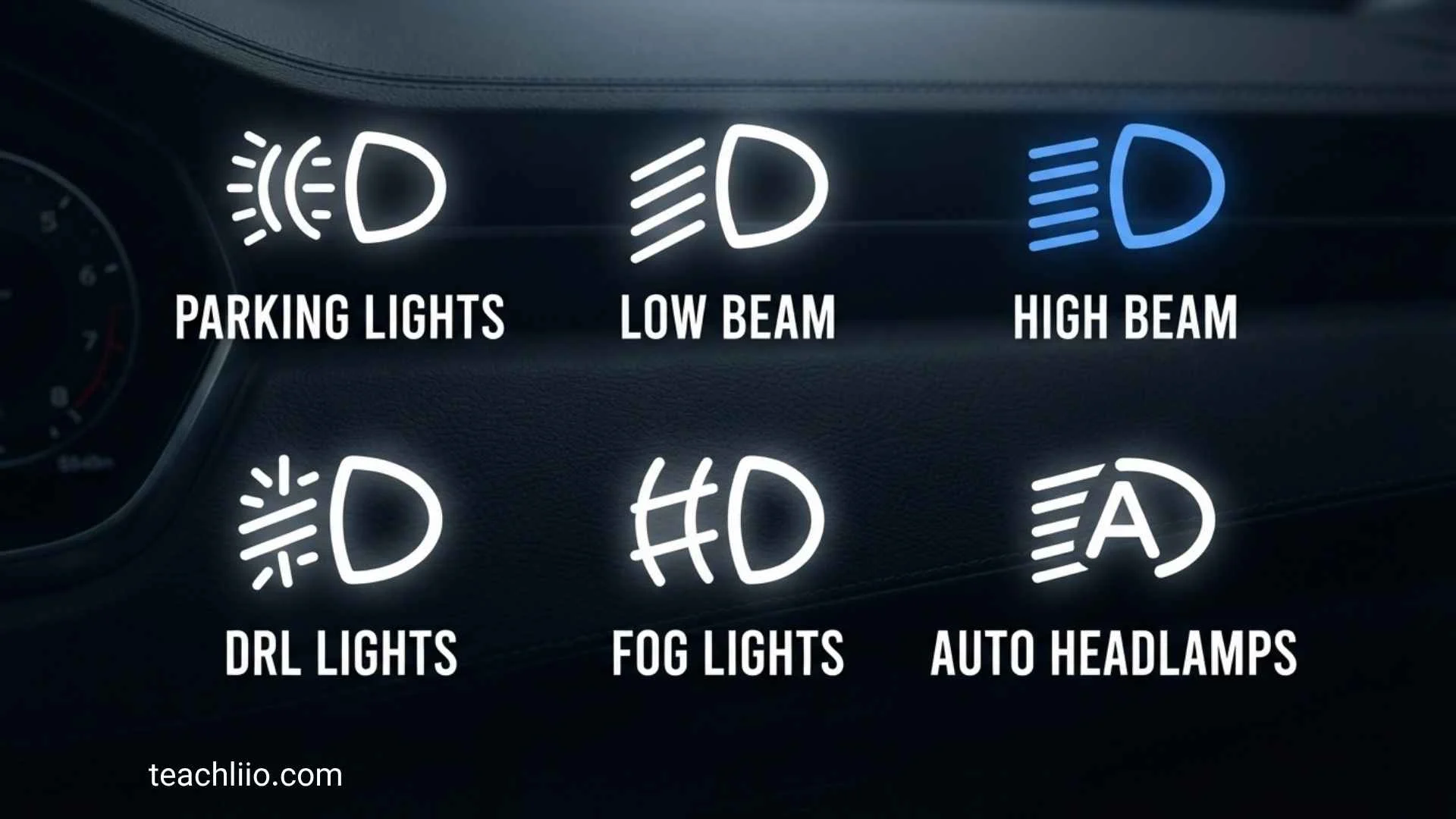
Car headlight symbols help drivers understand which lighting function is active and whether a vehicle’s lighting system needs attention. If you have ever noticed a blue, green, white, or amber headlight icon on your dashboard and wondered what it means, you are not alone.
Some symbols are simple indicators. They tell you that your low beams, high beams, fog lights, parking lights, or daytime running lights are switched on. Others can indicate a lighting fault that needs checking.
The easiest way to understand these symbols is to look at three things: the shape of the icon, the direction of its light rays, and its color. However, symbols can vary between vehicle manufacturers, so your owner’s manual remains the final reference for your specific car.
This guide explains the most common car headlight symbols and meanings, shows how to tell similar icons apart, explains what different colors usually indicate, and covers what you should do when a headlight warning appears.
What Do Car Headlight Symbols Mean?
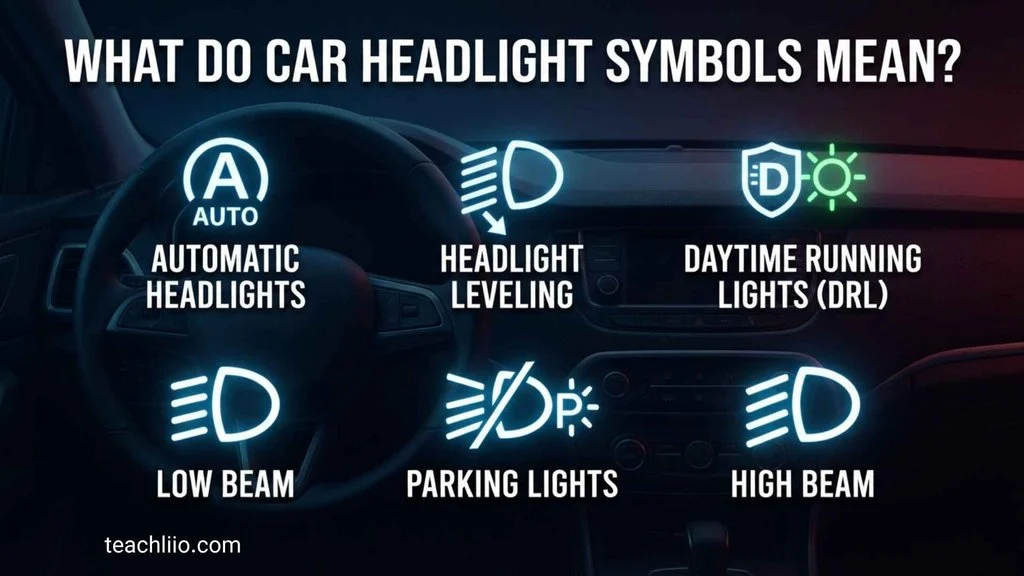
Car headlight symbols are icons used on the dashboard, instrument cluster, or headlight control switch to communicate information about the vehicle’s exterior lighting.
Common symbols represent:
- Low beam headlights
- High beam headlights
- Front fog lights
- Rear fog lights
- Parking or position lights
- Daytime running lights
- Automatic headlights
- Automatic high beams
- Headlight leveling
- Exterior light faults
Some symbols simply confirm that a feature is operating. Others can warn you that a bulb, lamp, or lighting system may have a problem.
The exact design is not identical on every vehicle. Modern cars can also have additional symbols for adaptive headlights, automatic lighting, LED systems, and other advanced features.
Car Headlight Symbols at a Glance
A quick-reference chart can help you identify the most common symbols before looking at their individual meanings.
| Headlight Symbol | Common Color | What It Usually Means |
| Low beam | Green or white | Dipped headlights are active |
| High beam | Blue | Main/high beams are active |
| Front fog light | Green or white | Front fog lights are active |
| Rear fog light | Amber or yellow | Rear fog light is active |
| Parking lights | Green or white | Position or parking lights are active |
| Daytime running lights | White or green | DRLs are active |
| Automatic headlights | White or green | Automatic lighting mode is active |
| Automatic high beam | Varies | Automatic high-beam function is active |
| Headlight leveling | Varies | Headlight beam adjustment is active |
| Exterior light fault | Amber/yellow | A lighting problem may have been detected |
These colors are common conventions rather than universal rules. Always check your vehicle’s manual if an unfamiliar icon appears.
Low Beam Headlight Symbol
The low beam symbol is one of the most common car headlight symbols you will see.
It usually looks like a headlamp with several rays pointing downward. The indicator is commonly green, although some vehicles may use white or another design.
What Does the Low Beam Symbol Mean?
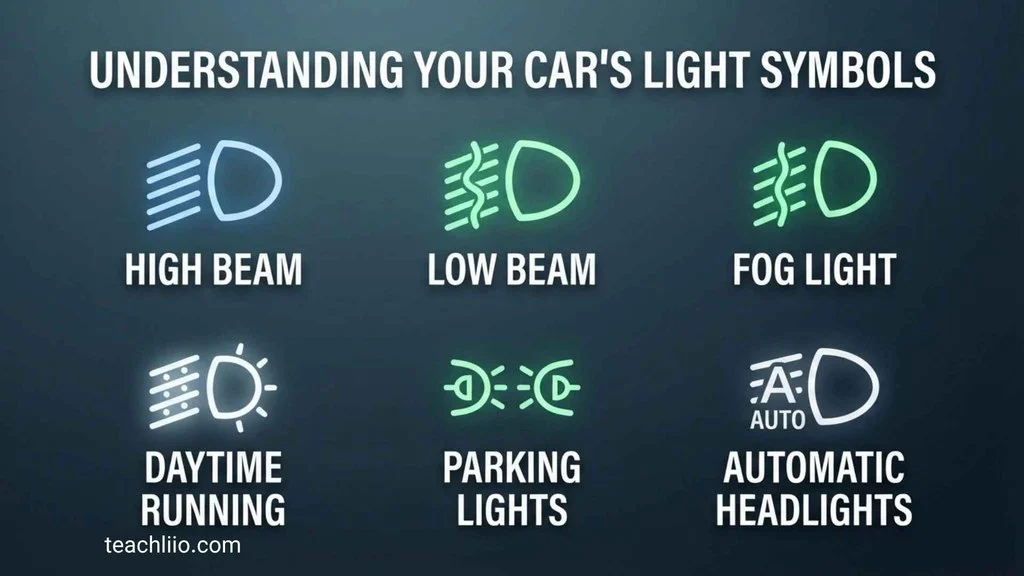
The low beam symbol means that your normal dipped headlights are switched on.
Low beams are designed to illuminate the road ahead while keeping the light directed low enough to reduce glare for other road users.
They are commonly used during:
- Night driving
- Driving through tunnels
- Poor visibility
- Dark or poorly lit roads
- Conditions where high beams could affect other drivers
If you see the low beam indicator while driving at night, it normally means your regular headlights are operating.
How Can You Recognize the Low Beam Symbol?
Look for a headlight icon with rays angled downward.
A useful memory trick is:
Downward rays usually mean low beam.
The symbol may look slightly different depending on the make and model, but the downward direction of the rays is a helpful clue.
High Beam Headlight Symbol
The high beam symbol is generally one of the easiest dashboard lighting icons to recognize because it is commonly blue.
It usually shows a headlamp with several straight rays pointing forward.
What Does the Blue Headlight Symbol Mean?
A blue headlight symbol usually means that your high beams, also called main beams, are active.
High beams provide longer-range illumination than normal low beams. They are intended for darker roads when using them will not dazzle other road users.
If you see the blue indicator, remember to check your surroundings. If another vehicle approaches or you are following a vehicle closely, you will generally need to switch back to low beam.
How Can You Recognize the High Beam Symbol?
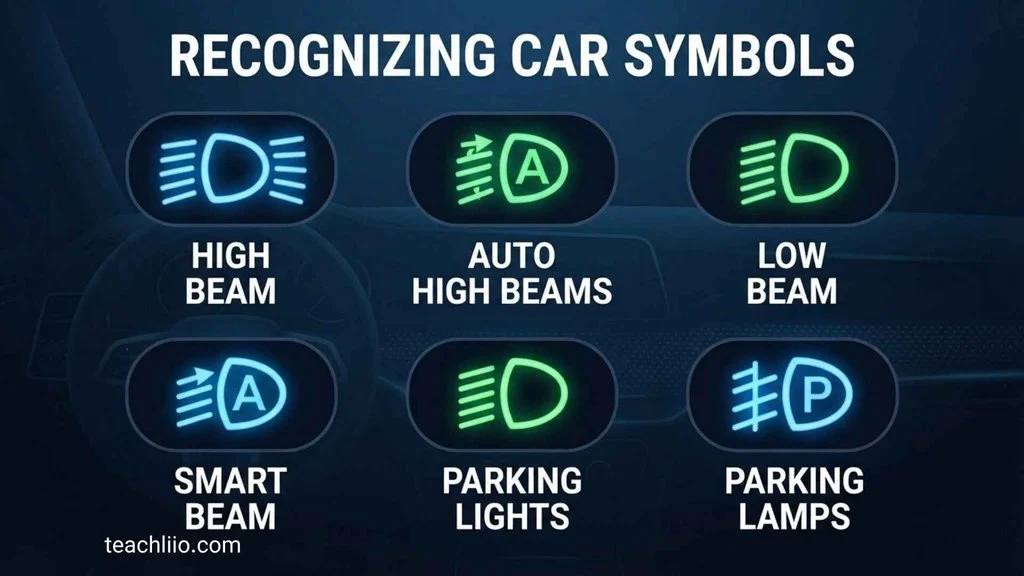
The easiest clues are:
- Usually blue
- Headlight shape
- Rays pointing straight forward
- Brighter long-distance lighting is active
The color makes the high beam indicator particularly useful because it can remind you that your brighter headlights are still switched on.
High Beam vs. Low Beam Symbols
High beam and low beam symbols can look similar, especially when you are unfamiliar with dashboard icons.
| Feature | Low Beam | High Beam |
| Common color | Green or white | Blue |
| Ray direction | Usually downward | Usually straight forward |
| Purpose | Normal road illumination | Longer-distance illumination |
| Typical use | Regular night driving | Dark roads with no nearby traffic |
| Around other vehicles | Usually appropriate | Usually switch to low beam |
The most useful visual distinction is the direction of the rays.
If the rays point downward, think low beam. If they point straight ahead, think high beam.
Front Fog Light Symbol
The front fog light symbol normally resembles a headlamp with several rays and a wavy vertical line passing through them.
The symbol is often green or white.
What Does the Front Fog Symbol Mean?
It indicates that the vehicle’s front fog lights are switched on.
Front fog lights are designed to provide a broad, relatively low beam that can be useful during seriously reduced visibility.
Depending on local laws and conditions, they may be used during situations such as:
- Dense fog
- Heavy mist
- Certain severe weather conditions
- Other situations involving significantly reduced visibility
Fog lights are not simply extra headlights for normal clear-weather driving.
How Do You Recognize the Front Fog Symbol?
A common visual clue is:
Headlamp + downward rays + wavy line.
The exact design can vary, but the wavy line helps distinguish a fog-light symbol from the standard low-beam indicator.
Rear Fog Light Symbol
The rear fog light symbol can look almost identical to the front fog symbol, which is why many drivers confuse the two.
The main difference is the direction of the symbol.
What Does the Rear Fog Symbol Mean?
It indicates that the rear fog light is switched on.
Rear fog lights are designed to make your vehicle more visible to drivers behind you when visibility is very poor.
They are much brighter than ordinary rear lights, so they should generally be switched off when the conditions no longer require them.
How Do You Recognize the Rear Fog Symbol?
A common distinction is:
- Front fog symbol generally points toward the left.
- Rear fog symbol generally points toward the right.
- Both commonly include a wavy line.
- Rear fog indicators are often amber or yellow.
The exact design can vary between manufacturers.
Front Fog vs. Rear Fog Symbols
If you cannot remember which fog-light symbol is which, compare the direction of the rays.
| Feature | Front Fog | Rear Fog |
| Typical direction | Left-facing | Right-facing |
| Common color | Green or white | Amber/yellow |
| Purpose | Helps illuminate the area ahead | Helps vehicles behind see you |
| Main concern | Visibility ahead | Vehicle visibility from behind |
The direction is one of the fastest ways to distinguish these two similar symbols.
Parking Light Symbol
Parking lights are also called position lights or sidelights in some regions.
The symbol varies between manufacturers, but it commonly represents small lamps or light rays on both sides of a vehicle.
What Does the Parking Light Symbol Mean?
It generally indicates that the vehicle’s position or parking lights are active.
These lights help other road users see the vehicle but are not designed to provide the same road illumination as normal headlights.
The correct use of parking lights depends on the vehicle and local traffic regulations.
Daytime Running Light Symbol
Daytime running lights, commonly called DRLs, are designed primarily to make a moving vehicle more visible during daylight.
They are found on many newer vehicles and may activate automatically when the vehicle starts or begins moving.
Are Daytime Running Lights the Same as Headlights?
No.
DRLs are primarily intended to improve vehicle visibility during the day. They are not necessarily a replacement for normal headlights when driving at night or in conditions that require full exterior lighting.
On some vehicles, the DRLs may also operate differently from the headlights and rear lights.
If visibility becomes poor, use the appropriate lighting setting for the conditions rather than assuming that daytime running lights are sufficient.
Automatic Headlight Symbol
Many modern vehicles have an AUTO setting that allows the car to control certain exterior lights automatically.
The symbol may include a headlight icon combined with an “A” or another manufacturer-specific marking.
What Does AUTO Mean on Headlights?
AUTO usually means that the vehicle can automatically control its headlights or exterior lighting based on information from sensors and the vehicle’s lighting system.
The exact behavior depends on the car.
An automatic system may switch the headlights on when it detects darkness, such as when entering a tunnel or when daylight fades.
Can You Always Rely on Automatic Headlights?
Automatic headlights are convenient, but drivers should still pay attention to road and weather conditions.
Heavy rain, fog, tunnels, dusk, and unusual visibility conditions may require you to confirm that the appropriate lights are actually operating.
Automatic High Beam Symbol
Some vehicles have automatic high-beam technology that can switch between high and low beams based on detected traffic and surrounding conditions.
What Does Automatic High Beam Do?
The system is designed to reduce the need for constant manual switching between high and low beams.
Depending on the vehicle, sensors or cameras may detect:
- Oncoming vehicles
- Vehicles ahead
- Street lighting
- Other environmental conditions
The exact system differs by manufacturer.
An automatic high-beam symbol does not necessarily mean the high beams are currently shining continuously. It may indicate that the automatic function has been enabled.
Headlight Leveling Symbol
Some vehicles have a headlight-leveling or beam-adjustment system.
The symbol may show a headlamp combined with arrows pointing upward or downward.
What Does Headlight Leveling Do?
Headlight leveling helps keep the beam aimed at an appropriate height.
This can be important because vehicle loading can change the angle of the body. For example, placing substantial weight in the rear of a vehicle can affect the direction of the headlights.
Some cars adjust the beam automatically, while others provide a manual adjustment.
Is a Headlight Leveling Symbol a Warning?
Not necessarily.
An icon may simply show that a leveling function is available or active. If the vehicle displays a specific fault warning related to headlight leveling, however, the system may need inspection.
Headlight Fault Symbol
Not every headlight-related icon simply tells you that a light is switched on.
Some vehicles have warning indicators for exterior-light or headlight faults.
What Can Cause a Headlight Warning?
Possible causes include:
- A burned-out bulb
- A failed LED unit
- An exterior light that is not operating
- A wiring problem
- A lighting-control issue
- A headlight leveling fault
- Another problem detected by the vehicle’s lighting system
The exact meaning depends on the vehicle.
What Should You Do If a Headlight Warning Appears?
Start by checking the vehicle’s exterior lights.
Check:
- Low beams
- High beams
- Parking lights
- Brake lights
- Turn signals
- Fog lights, if fitted
- Rear lights
If a light is not working, follow the vehicle manufacturer’s recommended repair procedure. If the warning remains or the problem is not obvious, consult the owner’s manual or have the vehicle inspected.
What Do Headlight Symbol Colors Mean?
The color of a dashboard icon can provide a useful clue, but it should not be used by itself to identify a symbol.
Green Headlight Symbols
Green commonly indicates that a lighting function is active.
For example, a green indicator may show that low beams or certain fog lights are operating.
Blue Headlight Symbols
Blue is commonly associated with high beams.
When the blue indicator appears, it usually means your high beams are active.
White Headlight Symbols
Some modern vehicles use white indicators for lighting functions or system status.
The exact meaning depends on the manufacturer and symbol.
Amber or Yellow Headlight Symbols
Amber or yellow can indicate a warning or a particular lighting function.
For example, a rear fog-light indicator may use amber, while an amber lamp-fault symbol may indicate that a lighting problem needs attention.
Therefore, amber does not automatically mean the same thing on every car.
Red Headlight-Related Warnings
Red indicators generally deserve more immediate attention, but the meaning depends on the specific icon.
Never assume what a red symbol means based on color alone. Identify the actual symbol and consult the vehicle manual.
Find a Headlight Symbol by Its Appearance
Sometimes drivers do not know the name of the symbol. They only know what it looks like.
This section can make identification much easier.
Blue Headlight Symbol
Usually indicates high beams.
Green Headlight Symbol
Often indicates an active lighting function such as low beams or certain fog lights.
Headlight With Downward Rays
Usually associated with low beams.
Headlight With Straight Rays
Usually associated with high beams.
Headlight With a Wavy Line
Usually associated with fog lights.
Headlight With an A
May indicate automatic headlights or automatic high beams, depending on the vehicle.
Headlight With Up and Down Arrows
May indicate headlight leveling or beam adjustment.
Amber Lamp Symbol
May indicate a warning or a lighting function such as a rear fog light, depending on the exact icon.
This appearance-based approach is particularly useful when someone is searching for a symbol they have just seen on their dashboard.
Dashboard Headlight Symbols vs. Headlight Switch Symbols
The phrase “car headlight symbols” can refer to two different groups of icons.
Dashboard Indicators
These appear in the instrument cluster while driving.
They may tell you that:
- Low beams are active
- High beams are active
- Fog lights are active
- Automatic lighting is enabled
- A lighting fault has been detected
Headlight Switch Symbols
These appear on the physical control used to select lighting functions.
You may see markings for:
- Off
- Parking lights
- Low beams
- AUTO
- Front fog lights
- Rear fog lights
The switch tells you what setting you are selecting, while the dashboard indicator often tells you what is currently active.
This distinction can prevent confusion when searching for a symbol’s meaning.
Common Headlight Switch Symbols
Headlight controls vary considerably between cars, but several markings are common.
OFF Symbol
This indicates that the main exterior lighting system is switched off, although some automatic or daytime lighting may still operate depending on the vehicle.
Parking Light Position
This activates the vehicle’s position or parking lights.
Low Beam Position
This activates the normal headlights used for road illumination.
AUTO Position
This allows the vehicle to manage certain exterior lights automatically.
Fog Light Controls
These activate front or rear fog lights where fitted.
Always check the specific vehicle instructions because switch layouts differ.
Can You Drive With a Headlight Symbol On?
It depends on what the symbol means.
If It Is a Normal Indicator
A green, blue, or white lighting indicator may simply confirm that a lighting function is active.
For example, seeing the blue high-beam indicator does not necessarily mean the car has a mechanical fault. It tells you the high beams are on.
If It Is a Fault Warning
A warning indicator may require attention.
If a headlight or exterior-light fault is displayed, check whether any lights have stopped working and consult the owner’s manual.
If You Do Not Recognize the Symbol
Do not guess.
Look up the exact symbol in the vehicle’s owner’s manual or manufacturer’s documentation.
This is particularly important because modern cars can have manufacturer-specific lighting systems.
Why Do Headlight Symbols Differ Between Cars?
There is no guarantee that every vehicle will display exactly the same symbol in exactly the same color.
Differences can occur because of:
- Vehicle manufacturer
- Model
- Model year
- Country or market
- Lighting technology
- Optional equipment
- Advanced driver-assistance systems
A basic car may have only a few lighting indicators, while a newer vehicle with adaptive LED headlights can have several additional symbols.
Why Your Owner’s Manual Matters
A general guide can help you identify common symbols, but your owner’s manual provides the most accurate information for your specific vehicle.
If a symbol does not match the examples shown here, use the manual rather than assuming that a similar-looking icon has exactly the same meaning.
Modern Headlight Technology and Symbols
Modern vehicles can use much more advanced lighting systems than traditional halogen headlights.
Adaptive Headlights
Adaptive lighting systems can change the direction or distribution of the beam according to driving conditions.
Some systems respond to steering input, speed, road conditions, or detected traffic.
Matrix LED Headlights
Matrix-style lighting systems can control different portions of the beam independently.
This can allow a vehicle to maintain more illumination while reducing glare toward detected road users.
Automatic Beam Control
Automatic beam systems can switch between different lighting modes based on sensors and cameras.
The symbols used for these functions differ between manufacturers.
Headlight Leveling Systems
These systems help maintain an appropriate beam height when vehicle load or other conditions change.
Because these technologies vary significantly, the owner’s manual is especially important for interpreting advanced lighting indicators.
Common Mistakes Drivers Make With Headlight Symbols
Understanding the icons is only half the job. Drivers also need to know how to respond to them.
Leaving High Beams On
One of the most common mistakes is forgetting that the high beams are active.
The blue indicator is a useful reminder.
If you see the blue icon while approaching or following another vehicle, check whether you need to switch back to low beam.
Using Fog Lights Without a Need
Fog lights are intended for situations where they provide a useful visibility benefit.
Using them unnecessarily can create additional glare and may not comply with local road rules.
Confusing Front and Rear Fog Lights
The two symbols can look similar.
Check the direction of the icon and the color used by your vehicle.
Assuming Every Amber Icon Means a Fault
Some amber symbols are warnings, but other amber indicators can represent a specific lighting function.
Identify the complete symbol before deciding that something has failed.
Assuming DRLs Are Full Headlights
Daytime running lights are primarily designed to improve daytime visibility.
Do not assume that DRLs provide the same function as normal headlights in darkness or poor visibility.
What Should You Do When an Unfamiliar Headlight Symbol Appears?
If you suddenly see a symbol you do not recognize, avoid guessing.
Follow these steps:
- Look at the color.
Blue, green, white, and amber can provide an initial clue. - Look at the shape.
Check whether it resembles a headlamp, fog lamp, arrows, an “A,” or another icon. - Check the direction of the rays.
Downward rays commonly indicate low beam, while straight rays commonly indicate high beam. - Check your light controls.
You may have accidentally activated a high beam, fog light, or automatic function. - Check the owner’s manual.
This is the most reliable source for your particular vehicle. - Inspect the exterior lights if a fault is indicated.
A failed bulb or lamp may be the reason for a warning. - Get professional assistance if necessary.
If the warning persists or a critical light is not working, have the vehicle inspected.
Frequently Asked Questions
What do car headlight symbols mean?
Car headlight symbols indicate which exterior lighting function is active or alert the driver to a possible lighting problem. Common symbols include low beam, high beam, fog lights, parking lights, daytime running lights, automatic lighting, and lamp faults.
What does the blue headlight symbol mean?
The blue headlight symbol usually indicates that the high beams are active. If other road users could be dazzled, switch back to low beams.
What does the green headlight symbol mean?
A green headlight symbol commonly indicates that a lighting function is active, such as low beams or certain fog lights. The exact meaning depends on the vehicle.
Which symbol is the high beam?
The high-beam symbol is commonly blue and shows a headlamp with straight rays pointing forward.
Which symbol is the low beam?
The low-beam symbol usually shows a headlamp with rays angled downward. It is commonly green or white.
What does the fog light symbol look like?
A fog-light symbol generally looks like a headlamp with rays and a wavy line crossing them. Front and rear fog symbols usually face opposite directions.
What is the difference between front and rear fog light symbols?
The front fog symbol generally points toward the left, while the rear fog symbol generally points toward the right. The exact design and colors vary by vehicle.
What does the A mean on a headlight symbol?
An “A” may indicate an automatic lighting function, such as automatic headlights or automatic high beams. The exact meaning depends on the vehicle.
What does a headlight symbol with arrows mean?
A headlight with upward or downward arrows may represent headlight leveling or beam adjustment. Some vehicles use similar symbols for an automatic leveling system or a lighting-system fault.
Why is my headlight warning light on?
A headlight warning can indicate a failed bulb, exterior-light problem, wiring issue, headlight leveling problem, or another lighting-system fault. Check the exterior lights and consult your owner’s manual.
Can I drive with the blue headlight symbol on?
The blue symbol normally means the high beams are active, not that there is a fault. However, you should switch to low beams when high beams could dazzle other drivers.
Are car headlight symbols universal?
Many vehicles use similar conventions, but symbols, colors, and functions can vary between manufacturers, models, years, and markets. Always check your owner’s manual for your specific vehicle.
Are daytime running lights the same as low beams?
No. Daytime running lights are primarily intended to make the vehicle more visible during daylight. Low beams are designed to illuminate the road and are used when normal headlights are required.
Why do my headlights turn on automatically?
Your vehicle may have an automatic lighting system that uses sensors to detect changes in ambient light or other conditions. The exact operation depends on the vehicle.
Conclusion
Understanding car headlight symbols becomes much easier when you learn to recognize the icon’s shape, color, and direction of its light rays.
The most important symbols to remember are the low beam, high beam, front fog, rear fog, parking light, daytime running light, automatic headlight, and headlight fault symbols.
The blue high-beam indicator is usually easy to recognize, while downward-facing rays commonly point to low beams. Fog-light symbols usually include a wavy line, and front and rear fog symbols can often be distinguished by their direction.
However, no general guide can replace your vehicle’s owner’s manual. Manufacturers can use different colors, designs, and advanced lighting systems.
The best approach is simple: identify the symbol, understand whether it is an active indicator or a warning, determine what lighting function is operating, and take the appropriate action. Once you become familiar with these common patterns, dashboard headlight symbols become much easier to understand.

I’m Hugo Wetherby, a British author interested in the numbers behind everyday questions. I explore quantities, populations, measurements, records, comparisons, and surprising statistics, turning complicated information into accessible answers. I believe a simple “how many” question can lead to fascinating discoveries, and I enjoy helping readers find those answers.
Books:
How Many? A Guide to Everyday Numbers
The Great Book of Numbers and Quantities