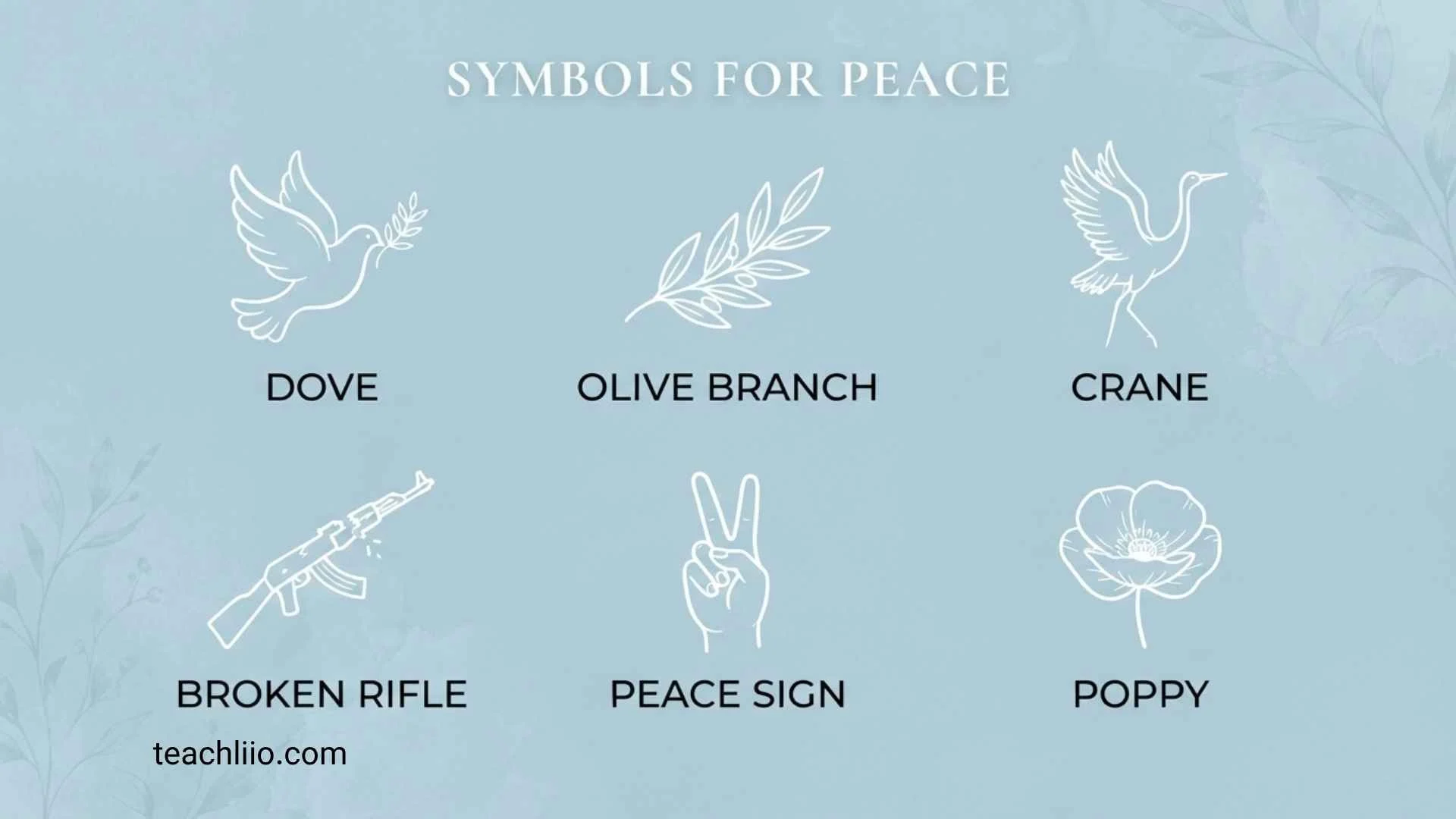
Peace is an idea people have represented through birds, plants, gestures, colors, religious symbols, and modern movement designs for centuries. But not every symbol connected with peace means exactly the same thing. Some represent the end of conflict, while others communicate reconciliation, hope, spiritual calm, balance, or opposition to war.
If you are searching for symbols for peace, the most familiar examples include the dove, olive branch, peace sign, white flag, white poppy, broken rifle, and peace crane. Other symbols, such as the lotus, Om, and yin-yang, are more closely connected with inner peace, spirituality, or harmony.
Understanding the history behind each symbol makes its meaning much clearer. It also helps distinguish well-established peace symbols from images that have a more general association with hope, love, balance, or tranquility.
What Are Symbols for Peace?
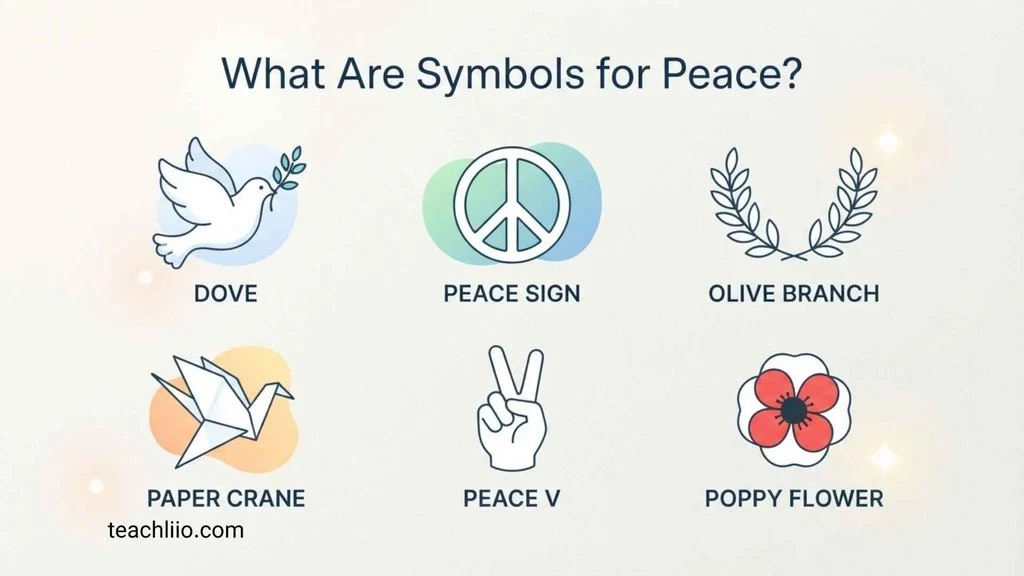
Symbols for peace are images, objects, gestures, or signs used to communicate ideas such as nonviolence, reconciliation, harmony, calmness, cooperation, and the end of conflict.
Some have ancient cultural or religious roots. Others were created during modern peace and disarmament movements.
For example, the familiar peace sign was designed in 1958 by British artist Gerald Holtom for the Campaign for Nuclear Disarmament. Its original meaning was specifically connected with nuclear disarmament before becoming a much broader symbol of peace and anti-war movements.
The dove and olive branch have much older symbolic traditions. The combination became especially influential through the biblical story of Noah and later appeared in Christian and secular peace imagery. Picasso’s famous La Colombe also helped establish the dove as a modern peace emblem after World War II.
Quick Guide to the Most Recognized Peace Symbols
| Symbol | Main Meaning | Symbol Type |
| Dove | Peace, hope, reconciliation | Traditional |
| Olive branch | Reconciliation and peace | Ancient/traditional |
| Peace sign | Peace and nuclear disarmament | Modern |
| White flag | Truce or cessation of fighting | Conflict-related |
| White poppy | Pacifism and opposition to war | Anti-war |
| Broken rifle | Opposition to armed conflict | Anti-war |
| Peace crane | Hope, healing, and remembrance | Modern/cultural |
| Rainbow | Hope and harmony | Context-dependent |
| V sign | Peace or victory | Gesture |
| Lotus | Inner peace and spiritual growth | Spiritual |
| Om | Spiritual stillness and wholeness | Religious |
| Yin-yang | Balance and harmony | Philosophical |
| Handshake | Agreement and reconciliation | Social |
| Peace bell | Unity and remembrance | Ceremonial |
| Joined hands | Cooperation and solidarity | Modern |
This distinction is important because these symbols do not all have identical historical meanings. A peace sign is connected to a specific modern movement, while a lotus is more closely associated with spiritual ideas in particular traditions.
25 Symbols for Peace and What They Mean
1. Dove
The dove is one of the most recognizable animals associated with peace.
Its symbolism has several layers. In the biblical story of Noah, a dove returns with an olive leaf after the flood, signaling that the waters are receding and that land and renewed life are possible. The dove also appears in Christian symbolism and has been associated with gentleness and peace.
In the 20th century, Pablo Picasso’s La Colombe became an important peace image after being selected as an emblem connected with the 1949 World Peace Congress.
Meaning: Peace, hope, gentleness, reconciliation, and renewal.
2. Olive Branch
The olive branch is one of the strongest traditional symbols of reconciliation.
Its history reaches into ancient Mediterranean cultures, while its association with peace was reinforced by biblical imagery. The phrase “extend an olive branch” still means to offer reconciliation or seek a peaceful resolution.
The olive branch also appears in national and international symbolism, including the emblem of the United Nations.
Meaning: Peace, reconciliation, goodwill, and the end of conflict.
3. Peace Sign
The familiar ☮ peace sign is a modern symbol rather than an ancient one.
Gerald Holtom designed it in 1958 for Britain’s Campaign for Nuclear Disarmament. The design incorporates semaphore signals representing the letters N and D for “nuclear disarmament.”
The symbol later spread internationally and became associated with broader peace and anti-war movements, particularly during the 1960s.
Meaning: Peace, nonviolence, nuclear disarmament, and opposition to war.
4. White Flag
A white flag is widely recognized as a signal connected with truce, surrender, or a desire to stop fighting.
Its meaning is different from the peace sign. Instead of representing peace as a broad ideal, the white flag is associated with communication during conflict and a willingness to halt hostilities.
Meaning: Truce, negotiation, surrender, and cessation of fighting.
5. White Poppy
The white poppy has been used as a symbol of pacifism and opposition to war.
It provides an important alternative to simply treating every poppy as a generic peace symbol. Its modern symbolism focuses particularly on rejecting war and encouraging peaceful solutions.
Meaning: Pacifism, remembrance, nonviolence, and opposition to war.
6. Broken Rifle
The broken rifle is a direct anti-war image.
Rather than using a peaceful animal or plant, it shows a weapon that has been rendered unusable. Its symbolism therefore communicates resistance to militarism and armed violence.
Historical examples of the broken-rifle image predate the founding of War Resisters’ International in 1921, including its appearance in an antimilitarist publication in the Netherlands in 1909.
Meaning: Anti-war activism, disarmament, and rejection of violence.
7. Peace Crane
The paper crane has become strongly associated with peace and remembrance in Japan and internationally.
Its modern peace symbolism is closely connected with Sadako Sasaki, a Hiroshima survivor whose story became associated with folding paper cranes while she was suffering from leukemia following the atomic bombing. The crane consequently became a powerful image of hope, healing, remembrance, and the desire to prevent another nuclear catastrophe.
Meaning: Hope, healing, remembrance, longevity, and peace after catastrophe.
8. Rainbow
The rainbow can represent hope, renewal, unity, and harmony.
Its interpretation depends on context. In biblical symbolism, the rainbow is associated with a promise following the flood. In modern culture, it can also represent inclusion, diversity, and peaceful coexistence.
For that reason, it is better described as a peace-related symbol rather than claiming that peace is its only meaning.
Meaning: Hope, renewal, unity, harmony, and coexistence.
9. V Sign
The V sign ✌ can represent victory or peace depending on the context and how it is displayed.
It became strongly associated with peace movements during the 1960s, although its history also includes its earlier use as a victory gesture.
Meaning: Peace, victory, solidarity, or resistance, depending on context.
10. Peace Flag
A peace flag uses visual design to communicate a desire for peace and nonviolence.
There is not one single universal peace flag used in every country or movement. Different organizations and peace campaigns have used different designs.
Meaning: Peace activism, nonviolence, cooperation, and opposition to war.
11. Lotus Flower
The lotus flower is better understood as a symbol of spiritual development and inner peace than as a direct symbol of political peace.
Because the lotus grows from muddy water and rises above the surface, it is often used as an image of purity, resilience, transformation, and spiritual growth in several Asian traditions.
Meaning: Inner peace, purity, spiritual growth, resilience, and enlightenment.
12. Om or Aum
Om (Aum) is a sacred symbol and sound in Hindu traditions and also has significance in other Indian religious and spiritual traditions.
It is associated with meditation, consciousness, spiritual practice, and wholeness. Therefore, it can represent inner peace, but it should not be treated as simply another version of the modern Western peace sign.
Because Om is sacred, it is important to understand its religious context before using it as decoration.
Meaning: Spiritual awareness, meditation, wholeness, and inner stillness.
13. Yin-Yang
The yin-yang symbol is associated with balance and complementary forces in Chinese philosophy, particularly Taoist thought.
It represents interconnected opposites rather than the absence of conflict. The symbol suggests that seemingly opposite forces can exist together within a larger system of balance.
Meaning: Balance, harmony, interconnectedness, and equilibrium.
14. Handshake
A handshake can represent agreement, trust, cooperation, and reconciliation.
When two people shake hands after disagreement, the gesture can communicate that they are willing to move toward cooperation instead of continuing a dispute.
Meaning: Agreement, trust, reconciliation, cooperation, and friendship.
15. Joined Hands
Joined hands are a visual representation of people working together.
The image can communicate solidarity between individuals, communities, or nations. It is especially useful when the intended message is not merely “stop fighting,” but “work together.”
Meaning: Unity, cooperation, solidarity, friendship, and harmony.
16. Peace Bell
A peace bell can represent remembrance, reflection, unity, and a shared commitment to peace.
Bells have long been used to bring communities together for ceremonies or important events. A peace bell transforms that communal act into a symbolic call for reflection and peaceful coexistence.
Meaning: Remembrance, unity, reflection, and peace.
17. Laurel Wreath
The laurel wreath has ancient associations with victory, honor, and achievement.
It is not exclusively a peace symbol. However, because historical imagery sometimes connects victory, diplomacy, and peaceful resolution, the laurel can appear in broader collections of peace-related symbolism.
Meaning: Victory, honor, achievement, and, in some contexts, peaceful resolution.
18. Tree of Life
The Tree of Life appears in many cultures and belief systems, with meanings that vary considerably.
Common themes include growth, connection, continuity, family, and the relationship between different parts of existence.
Its connection to peace is therefore primarily symbolic rather than a universal historical definition.
Meaning: Growth, connection, stability, harmony, and continuity.
19. Sun
The sun can represent light, hope, warmth, life, and renewal.
A rising sun is particularly powerful as a metaphor for a peaceful new beginning after a difficult period.
It is not a universally established peace symbol, but it can work effectively in art or personal symbolism when the intended message is hope for a better future.
Meaning: Hope, renewal, life, light, and new beginnings.
20. Dove With an Olive Branch
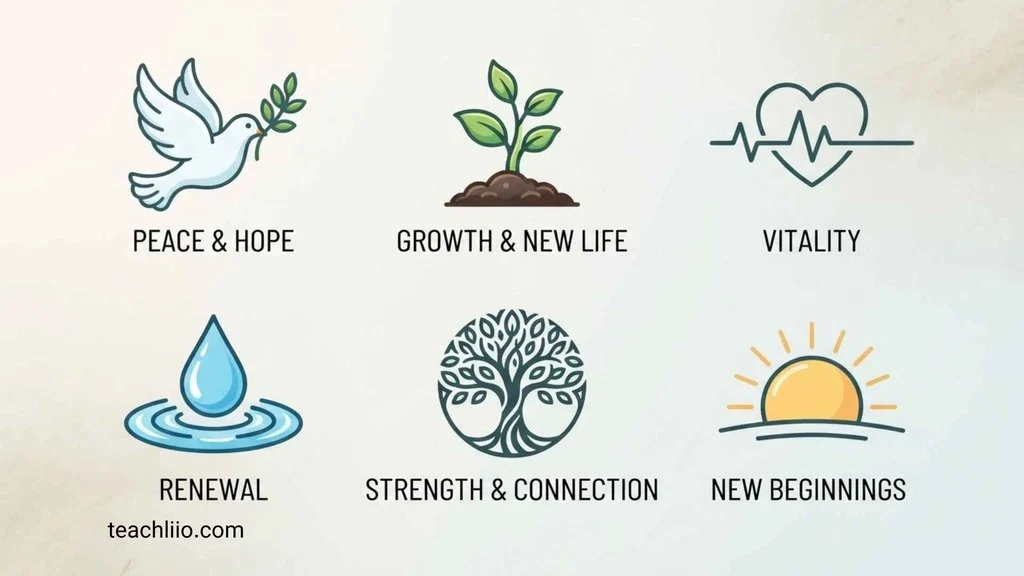
Combining a dove and olive branch creates one of the clearest visual expressions of peace.
The two elements complement one another. The dove contributes the image of gentleness and peacefulness, while the olive branch carries a longstanding association with reconciliation and peace.
Together, they communicate a powerful message of peaceful resolution and hope.
Meaning: Peace, reconciliation, hope, and renewed relationships.
21. White Rose
The white rose can represent purity, innocence, remembrance, and peace depending on the cultural setting.
Unlike the dove or olive branch, it does not have one universally established meaning as a peace symbol. Its peaceful associations are often connected with the broader symbolism of white flowers.
Meaning: Purity, remembrance, innocence, and peaceful intentions.
22. Open Hands
Open hands can communicate openness, trust, generosity, and nonviolence.
An open palm can visually suggest that a person is not holding a weapon and is willing to communicate.
The meaning can change across cultures and contexts, so the image should be considered carefully when used in international communication.
Meaning: Openness, trust, generosity, communication, and nonviolence.
23. Heart
The heart is primarily a symbol of love, affection, and compassion.
When combined with peace imagery, however, it can represent love as a foundation for peaceful relationships.
A heart with an olive branch or peace sign can therefore communicate a combined message of love and peace.
Meaning: Love, compassion, kindness, friendship, and peaceful relationships.
24. Water
Calm water is often used as a metaphor for emotional peace and tranquility.
Unlike the dove or peace sign, water is not a single historically standardized peace emblem. Its meaning is primarily artistic and personal.
Still, a quiet lake, gentle waves, or flowing water can strongly communicate calmness and freedom from turmoil.
Meaning: Calmness, renewal, tranquility, emotional balance, and cleansing.
25. Globe or Earth
The globe can represent the idea of peace among people and nations around the world.
It is especially useful when the intended message is world peace rather than personal tranquility.
When paired with a dove, olive branch, or peace sign, the globe can communicate a desire for peaceful coexistence across national borders.
Meaning: Global unity, world peace, international cooperation, and shared humanity.
Ancient vs. Modern Symbols for Peace
Not all peace symbols have the same historical age.
The olive branch and dove have roots in older religious and cultural traditions, while the peace sign emerged during the Cold War in response to concerns about nuclear weapons.
The broken rifle also developed within modern antimilitarist movements. Historical evidence places its use in antimilitarist publications before World War I.
This distinction matters because it prevents an article from presenting every symbol as though it originated from one universal ancient tradition.
Symbols for World Peace
If your goal is to represent world peace, the strongest choices are symbols with broad recognition.
Dove and Olive Branch
This combination communicates peace and reconciliation and has become widely recognizable internationally.
Peace Sign
The peace sign is especially appropriate when the message involves peace movements, nonviolence, or disarmament.
Globe
A globe emphasizes the worldwide scope of the message.
Peace Crane
The paper crane adds themes of remembrance, healing, and hope for a world without nuclear destruction.
Symbols for Inner Peace
Someone searching for a symbol of inner peace may be looking for something different from a traditional anti-war symbol.
Lotus
The lotus is associated with spiritual growth, purity, and rising above difficult circumstances.
Om
Om is associated with sacred sound, meditation, and spiritual practice.
Yin-Yang
The yin-yang can represent balance between complementary forces.
Calm Water
Water works well as a personal metaphor for emotional stillness and tranquility.
These symbols should be described in their proper cultural context rather than presented as interchangeable universal peace signs.
Symbols for Peace and Harmony
Peace and harmony overlap, but they are not identical concepts.
Peace can refer to the absence or resolution of conflict, while harmony often emphasizes people or forces existing cooperatively.
Symbols such as the yin-yang, joined hands, handshake, Tree of Life, rainbow, and olive branch can therefore work well when the intended message is harmony.
The yin-yang is particularly useful when the message concerns balance rather than the end of a specific conflict.
Symbols for Peace and Love
Some readers search for a symbol that combines peace and love.
The most useful combinations include:
- Dove and olive branch
- Peace sign and heart
- Heart and olive branch
- Rainbow
- Joined hands
- Dove
The heart contributes compassion and affection, while traditional peace symbols provide the stronger historical association with reconciliation or nonviolence.
Why Is a Dove a Symbol of Peace?
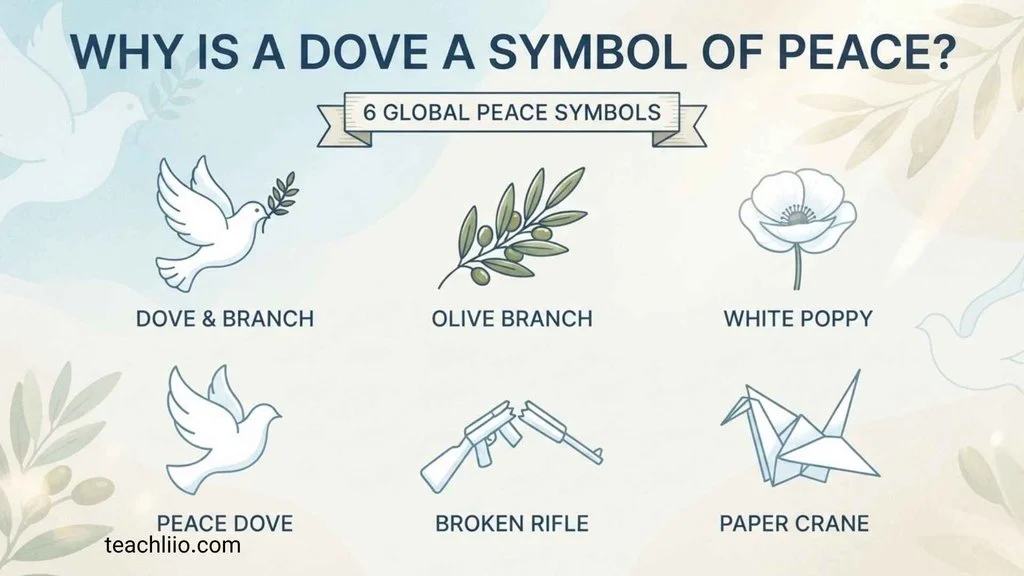
The dove became associated with peace through a combination of religious, cultural, artistic, and modern political symbolism.
The biblical story of Noah connects a returning dove with an olive leaf and the possibility of renewed life after the flood. Christian symbolism later strengthened the dove’s association with peace and the Holy Spirit.
In the 20th century, Picasso’s La Colombe gave the dove renewed visibility as a peace emblem.
Today, the dove remains one of the most recognizable peace-related images.
Why Does an Olive Branch Represent Peace?
The olive branch has a long history of association with peace and reconciliation.
Ancient Mediterranean traditions gave the olive significant cultural importance, while biblical imagery connected the olive branch with the dove and the end of the flood.
Over time, the olive branch became a visual metaphor for offering reconciliation. Modern political and diplomatic symbolism continues to use it in this sense.
That is why the phrase “extend an olive branch” means to make a peaceful gesture toward someone after disagreement.
What Does the Peace Sign Mean?
The modern peace sign was designed in 1958 by Gerald Holtom for the British Campaign for Nuclear Disarmament.
Holtom used semaphore representations of the letters N and D, standing for nuclear disarmament. The symbol was created for a specific campaign but eventually developed a much broader meaning as it spread through international peace and anti-war movements.
This history makes the peace sign different from older symbols such as the dove and olive branch.
Do Peace Symbols Have the Same Meaning Everywhere?
No. Symbolism can change according to culture, religion, geography, historical period, and social context.
A symbol that represents spiritual calm in one tradition may have a different meaning elsewhere. Even gestures can change meaning between countries.
For example, the V sign can mean peace in one setting and victory in another. Religious symbols such as Om should also be understood within their original traditions rather than being reduced to generic decorative symbols.
This cultural variation is one reason it is useful to research a symbol’s history before using it in a tattoo, logo, artwork, educational project, or public campaign.
How to Choose a Peace Symbol
The right symbol depends on the specific message you want to communicate.
For world peace
Consider the dove, olive branch, peace sign, globe, or peace crane.
For reconciliation
The olive branch, handshake, or joined hands can communicate cooperation and renewed relationships.
For opposition to war
The peace sign, white poppy, or broken rifle can express anti-war or disarmament ideas.
For inner peace
The lotus, Om, yin-yang, or calm water may better fit a message about personal tranquility.
For hope after hardship
The peace crane, rainbow, dove, or rising sun can communicate renewal and hope.
Before using a religious or culturally significant symbol, learn its original meaning and context. A design can be visually attractive while still carrying a meaning that differs from what the user intended.
Frequently Asked Questions
What is the most recognized symbol for peace?
The dove, olive branch, and modern peace sign are among the most widely recognized symbols associated with peace. Each has a different historical background and should not be treated as having exactly the same meaning.
What animal symbolizes peace?
The dove is one of the most widely recognized animals associated with peace, hope, gentleness, and reconciliation. Its symbolism has religious and modern cultural roots.
What flower symbolizes peace?
The olive branch is a longstanding plant symbol of peace and reconciliation, while the white poppy is associated particularly with pacifism and opposition to war. The lotus is more closely connected with spiritual peace and purity in relevant traditions.
What symbolizes inner peace?
The lotus, Om, yin-yang, and calm water can represent inner peace, balance, meditation, or tranquility. Their meanings come from different cultural or symbolic traditions.
What symbolizes peace and love?
A dove, heart, olive branch, peace sign, or combination of these symbols can communicate peace and love. The heart adds the idea of compassion, while the dove and olive branch have stronger established peace associations.
What symbolizes peace after war?
The olive branch, white flag, broken rifle, white poppy, and peace crane can represent different aspects of peace after conflict, including reconciliation, truce, anti-war sentiment, remembrance, and healing.
Is the peace sign an ancient symbol?
No. The familiar modern peace sign was designed in 1958 by Gerald Holtom for the Campaign for Nuclear Disarmament. It later became a broader international symbol of peace and anti-war activism.
Why is the olive branch a symbol of peace?
The olive branch has longstanding associations with peace and reconciliation in Mediterranean and religious traditions. Its connection with the dove in the biblical flood story further strengthened its association with renewal and peaceful resolution.
Why is a paper crane a symbol of peace?
The paper crane became strongly associated with peace through the story of Sadako Sasaki and Hiroshima. Her story helped transform the origami crane into an international symbol of hope, remembrance, healing, and the desire to prevent future nuclear destruction.
What symbol represents world peace?
There is no single symbol that everyone uses exclusively for world peace. The dove, olive branch, peace sign, globe, and peace crane are among the images commonly used to communicate broader ideas of global peace and cooperation.
Conclusion
Symbols for peace come from many different cultures, religions, historical periods, and social movements. The dove and olive branch represent some of the most familiar traditional imagery, while the peace sign has a specific modern history rooted in nuclear disarmament. The broken rifle and white poppy communicate opposition to war, while the peace crane carries a powerful message of remembrance and hope.
Other symbols, including the lotus, Om, and yin-yang, are more closely related to inner peace, spirituality, balance, or harmony. They can be meaningful choices, but their cultural contexts should be respected.
The most useful way to understand peace symbolism is to look beyond the picture itself. Ask what kind of peace it represents: the end of war, reconciliation, world peace, inner calm, healing, hope, or harmony. Once that distinction is clear, it becomes much easier to choose a symbol that communicates the message you actually intend.

I’m Oscar Radcliffe, a British writer who enjoys uncovering the numbers hidden within ordinary questions. My work explores quantities, counts, statistics, measurements, and fascinating comparisons across different subjects. I aim to present reliable information clearly, helping readers satisfy their curiosity while discovering interesting facts they may never have considered before.
Books:
The Science of Counting
How Many? Fascinating Numbers Explained