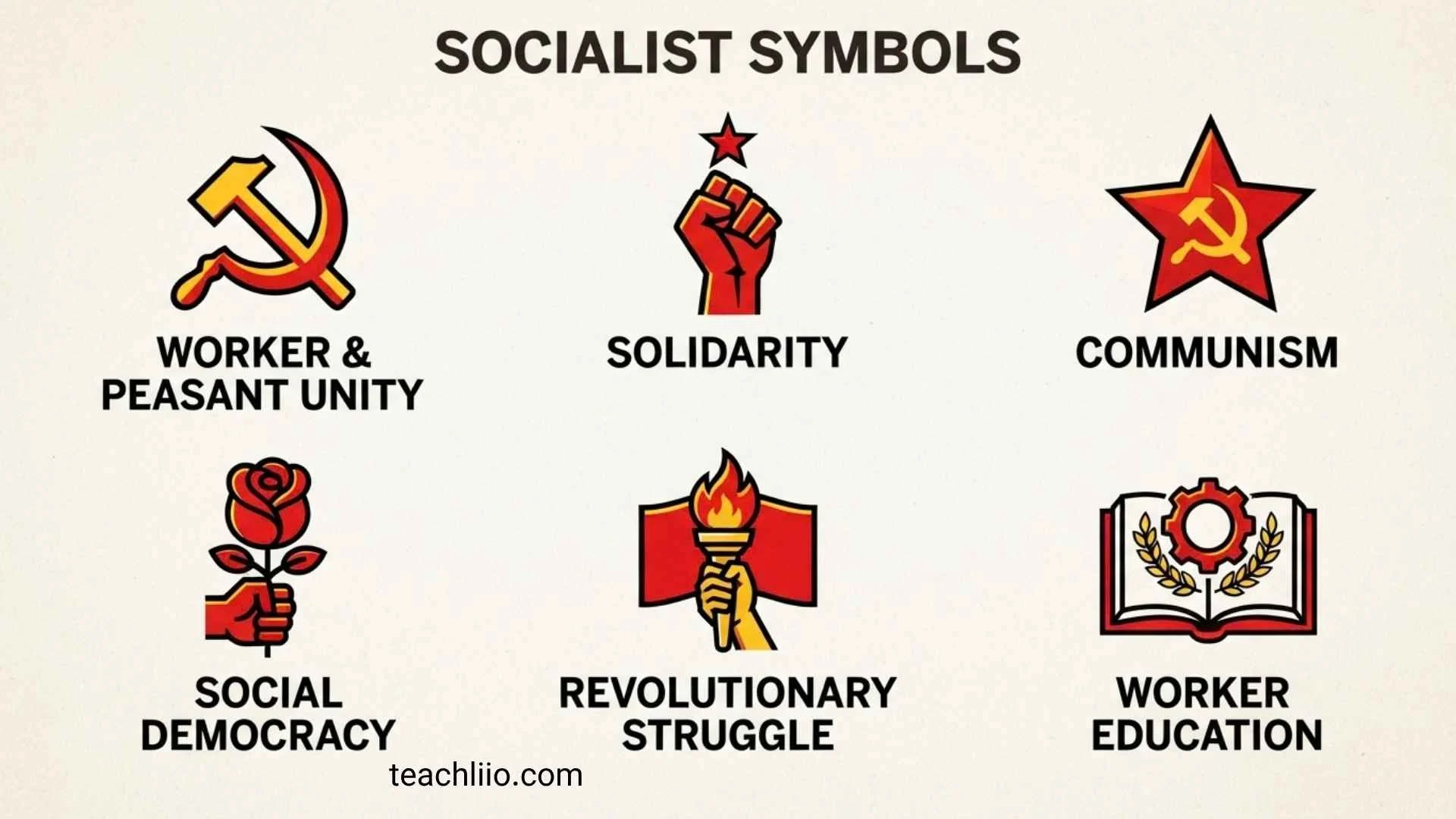
Socialist symbols have appeared in political movements, labor organizations, revolutionary campaigns, party emblems, flags, posters, books, monuments, and state heraldry for more than a century. Some are instantly recognizable, such as the red flag and hammer and sickle, while others, including the red rose, raised fist, gear, and wheat, have broader or more context-dependent meanings.
Understanding these symbols can be confusing because socialist, communist, labor, social-democratic, and Soviet symbols are not always interchangeable. A symbol may have been used by several movements while carrying a different meaning in each historical setting.
This guide explains the most important socialist symbols, what they traditionally represent, where they came from, and how to distinguish broadly socialist imagery from symbols more specifically associated with communism or particular historical states.
What Are Socialist Symbols?
Socialist symbols are visual images, colors, objects, and designs that have been used to represent socialist ideas, political organizations, workers’ movements, or particular socialist states and parties.
Some symbols have broad political associations. Others developed within specific historical movements.
Common examples include:
- Red flag
- Hammer and sickle
- Red star
- Red rose
- Raised fist
- Fist and rose
- Wheat and grain
- Gear or cogwheel
- Rising sun
- Industrial tools
- Books and educational imagery
These symbols do not all have one universal meaning. Their interpretation can change according to the country, organization, time period, and surrounding imagery.
Socialist Symbols and Meanings at a Glance
| Symbol | Common association | Typical meaning |
| Red flag | Socialism and labor movements | Revolution, workers, solidarity |
| Hammer and sickle | Communist and Soviet traditions | Industrial workers and agricultural workers |
| Red star | Communist and some socialist traditions | Revolutionary or political identity |
| Red rose | Socialist and social-democratic traditions | Socialism, democracy, solidarity |
| Raised fist | Labor and political movements | Solidarity, resistance, collective action |
| Fist and rose | Socialist/social-democratic movements | Political solidarity and socialist identity |
| Wheat | Socialist heraldry | Agriculture, workers, abundance |
| Gear | Industrial movements | Industry and workers |
| Rising sun | Socialist state imagery | New future or transformation |
| Tools | Workers’ movements | Labor and productive work |
| Book | Some socialist emblems | Education and knowledge |
This table is a starting point rather than a fixed dictionary. Political symbols often acquire additional meanings through historical use.
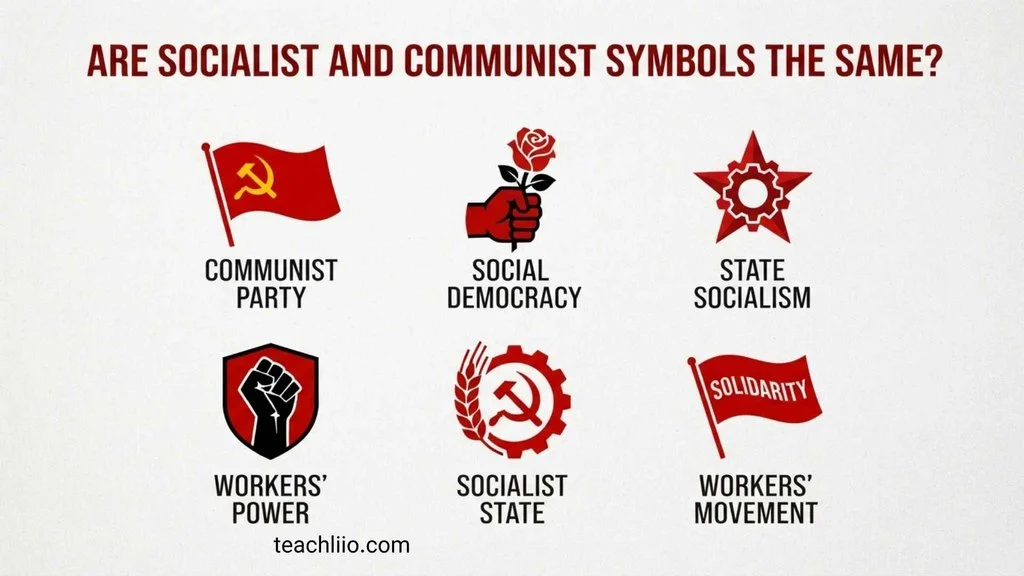
Are Socialist and Communist Symbols the Same?
Socialism and communism have overlapping histories, but the terms are not identical.
Some symbols are strongly associated with communist movements because of their use by communist parties and communist states. Others have been used much more broadly by socialist, labor, and social-democratic organizations.
The hammer and sickle, for example, became especially associated with Soviet communism and international communist movements. The red flag, on the other hand, has a broader history involving socialist and labor movements as well as communism.
The red rose has also been widely associated with socialist and social-democratic parties, particularly in democratic political traditions.
This distinction matters because simply labeling every red political symbol “communist” or “socialist” can remove important historical context.
A Simple Way to Understand the Difference
Think of socialist symbolism as a broad category containing several traditions.
Some symbols are:
- Broadly socialist
- Specifically communist
- Connected with social democracy
- Associated with labor movements
- Linked to revolutionary movements
- Connected with particular socialist states
The same symbol can sometimes appear in more than one category.
The Red Flag
The red flag is one of the oldest and most recognizable symbols associated with socialist and revolutionary politics.
Red became strongly connected with radical political movements during the nineteenth century. Socialist and labor movements later adopted the color as a powerful representation of workers, political struggle, and solidarity.
Unlike some symbols that originated with a particular state, the red flag developed across multiple political movements and countries.
What Does the Red Flag Mean?
The meaning of a red flag depends on its historical context.
In socialist and labor traditions, it can represent:
- Workers
- Solidarity
- Revolution
- Collective action
- Political struggle
- Social change
The color red also became associated with the sacrifices and struggles of workers and revolutionary movements.
Is the Red Flag Socialist or Communist?
It can be both, depending on the context.
Socialist organizations used red flags before the Soviet Union existed, and communist movements later adopted the same color extensively.
Therefore, it is more accurate to describe the red flag as a broad left-wing, socialist, labor, and revolutionary symbol rather than assigning it exclusively to communism.
Hammer and Sickle ☭
The hammer and sickle is perhaps the most recognizable political symbol associated with communist and Soviet history.
The two tools represent different forms of labor.
What Does the Hammer Represent?
The hammer traditionally represents industrial workers.
It can symbolize:
- Factories
- Industry
- Skilled labor
- Industrial workers
- Productive work
What Does the Sickle Represent?
The sickle is an agricultural tool traditionally associated with farming and agricultural workers.
Its symbolism therefore connects the countryside and agricultural labor with the industrial working class.
What Does the Hammer and Sickle Mean Together?
Together, the crossed hammer and sickle came to represent an alliance between industrial workers and agricultural workers.
The symbol became especially important after the Russian Revolution and was incorporated into the imagery of the Soviet Union.
Because of this history, the hammer and sickle is more specifically associated with communist and Soviet traditions than some other socialist symbols.
Hammer and Sickle Copy and Paste
For readers looking for the Unicode character:
☭
This symbol is commonly recognized as the hammer and sickle.
Its appearance and meaning can vary by font and context, but the character is useful when searching, writing, or discussing communist and socialist symbolism.
The Red Star
The red star is another major symbol associated with communist political movements and Soviet history.
The five-pointed star became strongly connected with revolutionary and communist imagery during the twentieth century.
It appeared on military uniforms, flags, monuments, buildings, documents, and state emblems.
What Does the Red Star Represent?
Its meaning has varied across movements and countries.
Common associations include:
- Revolution
- Communist political identity
- Military power
- Socialist state symbolism
- International revolutionary movements
The five-pointed shape has also received different interpretations in different traditions, so it is better not to claim that every red star has exactly the same meaning.
A red star by itself should also not automatically be classified as communist. Context is essential.
The Red Rose
The red rose provides an important contrast to the hammer and sickle.
It became a prominent symbol among socialist and social-democratic movements, especially in Europe.
The rose often presents socialism through a different visual language from Soviet revolutionary imagery.
Instead of emphasizing tools, factories, or revolution, the rose can communicate ideas such as:
- Solidarity
- Social justice
- Democracy
- Peaceful political change
- Equality
- Socialism
Because socialist and social-democratic parties in different countries have used rose imagery, the symbol is particularly useful when explaining the diversity within the broader socialist tradition.
Why Is the Rose a Socialist Symbol?
The rose became popular because it offered a recognizable, flexible political emblem that could represent social change without relying on the more militarized imagery associated with revolutionary symbols.
Different parties have used different designs and combinations, so there is no single universal socialist rose.
The Raised Fist
The raised fist is a powerful symbol of solidarity, resistance, collective action, and political struggle.
It has been used by labor organizations and socialist movements, but it is not exclusive to socialism.
Different political and social movements have adopted versions of the raised fist.
What Does the Raised Fist Mean?
Depending on context, it can communicate:
- Solidarity
- Resistance
- Unity
- Strength
- Protest
- Collective action
- Defiance
Because the symbol appears in many movements, a raised fist alone does not prove that an organization is socialist.
The surrounding colors, words, symbols, and historical setting provide important clues.
The Fist and Rose
The fist and rose combines two recognizable political symbols.
The fist communicates collective action or solidarity, while the rose connects the design with socialist and social-democratic traditions.
Variations of the symbol have been adopted by socialist and social-democratic organizations in different countries.
It is therefore especially useful when discussing the distinction between revolutionary communist imagery and democratic socialist or social-democratic symbolism.
The exact meaning depends on the organization using it.
Wheat and Grain
Wheat and other agricultural plants appear frequently in socialist-style emblems.
This imagery is closely connected with agriculture, farming, food production, and rural workers.
What Does Wheat Symbolize?

Depending on the emblem, wheat can represent:
- Agriculture
- Harvest
- Food production
- Rural workers
- Prosperity
- Abundance
- Productive labor
Wheat is often arranged in wreaths around shields, stars, tools, or other political imagery.
This helps explain why many historical socialist state emblems contain large amounts of agricultural imagery.
Gear and Cogwheel
The gear or cogwheel is strongly associated with industry and mechanical work.
It became particularly useful in political imagery because it immediately communicates ideas about:
- Factories
- Machinery
- Industrialization
- Engineers
- Industrial workers
- Production
When combined with wheat or agricultural imagery, a gear can represent the relationship between industrial and agricultural production.
This is one reason gears frequently appear in socialist-style state emblems.
Rising Sun
The rising sun appears in several socialist and revolutionary heraldic traditions.
A rising sun naturally communicates the idea of something new beginning.
In socialist-style imagery, it can suggest:
- A new era
- Progress
- A new political future
- Social transformation
- Modernization
- Hope
However, the rising sun is not exclusively socialist. It appears in many national and cultural symbols unrelated to socialism.
Its political meaning therefore depends heavily on the other elements surrounding it.
Tools and Industrial Symbols
Socialist movements have frequently used tools to represent labor.
Common examples include:
- Hammer
- Sickle
- Hoe
- Pickaxe
- Gear
- Industrial machinery
These objects turn ordinary working tools into visual representations of workers and production.
Why Are Tools So Common?
Workers and productive labor were central themes in many socialist political traditions.
Showing tools in an emblem allowed designers to represent workers visually without relying entirely on written explanations.
A hammer could communicate industrial labor, while agricultural tools could represent farming communities.
When multiple tools appear together, they can symbolize cooperation between different sections of the working population.
Books and Education
Books sometimes appear in socialist-style state emblems and political imagery.
They can represent:
- Education
- Literacy
- Knowledge
- Intellectual work
- Public learning
- Social development
Not every book symbol is socialist, of course. Books have universal associations with education.
But when combined with red stars, wheat, industrial machinery, or other socialist-style imagery, they can become part of a broader political emblem.
Symbols Used in Socialist State Emblems
Socialist states often developed elaborate official emblems containing several symbols at once.
Rather than relying on one image, these designs could combine agriculture, industry, education, national identity, and political ideology.
Common elements included:
- Red stars
- Wheat
- Gear wheels
- Agricultural tools
- Industrial buildings
- Rising suns
- Books
- Ribbons
- National plants
- Flags
These designs were not identical from country to country.
Why Did Socialist Emblems Use So Many Symbols?
A state emblem could function like a visual summary.
One part might represent agriculture.
Another might represent industry.
A star might represent political ideology.
A rising sun might communicate a new future.
A book could represent education.
A national plant could connect the political system with local identity.
This combination made socialist heraldry highly recognizable.
Why Socialist Symbols Differ Between Countries
There is no single universal socialist symbol system.
Different countries and organizations adapted socialist imagery to local traditions.
For example, agricultural countries might emphasize rice, wheat, cotton, or other crops. Industrial societies might emphasize factories, gears, machinery, or mining tools.
National plants, animals, landscapes, and cultural objects could also be incorporated into socialist emblems.
This is why two socialist-era emblems can look similar in structure while containing completely different local imagery.
Historical vs. Modern Socialist Symbols
It is useful to distinguish symbols associated with historical socialist states from symbols still used by political parties and movements.
The hammer and sickle is strongly connected with the Soviet Union and twentieth-century communist movements.
The red flag has a much broader historical and contemporary use.
The red rose has remained particularly relevant in socialist and social-democratic political traditions.
The raised fist appears across many contemporary movements, including but not limited to socialist politics.
Therefore, the age and political context of a symbol matter.
A symbol used on a Soviet government building does not necessarily have exactly the same meaning when a modern organization uses a similar image.
How to Identify a Socialist Symbol
If you see an unfamiliar political emblem, look for combinations rather than one isolated feature.
Look for the Color Red
Red is strongly associated with socialist, communist, labor, and revolutionary movements.
But red alone does not prove that a symbol is socialist.
Look for the Hammer and Sickle
The crossed hammer and sickle are a particularly strong clue toward communist or Soviet political symbolism.
Look for a Red Star
A red five-pointed star can indicate communist or socialist political traditions, especially when combined with other revolutionary imagery.
Look for a Rose
A rose, especially a red rose used in political branding, can point toward socialist or social-democratic traditions.
Look for Agricultural and Industrial Imagery
Wheat, grain, gears, factories, and tools often indicate themes involving workers, agriculture, production, or modernization.
Examine the Entire Emblem
The most reliable method is to examine the complete design.
A single star, gear, fist, or red color can have many meanings. Several symbols appearing together provide much stronger evidence about the tradition behind an emblem.
Socialist Symbols Copy and Paste
Readers sometimes search for socialist symbols that they can copy and use in digital text.
Here are a few commonly encountered characters:
Hammer and sickle: ☭
Raised fist: ✊
Star: ★
The hammer and sickle character has a specific political association. The fist and star are more general symbols whose meanings depend heavily on context.
For articles, usernames, discussions, or educational material, it is better to understand the meaning of a symbol before using it.
Why Do Socialist Symbols Matter?
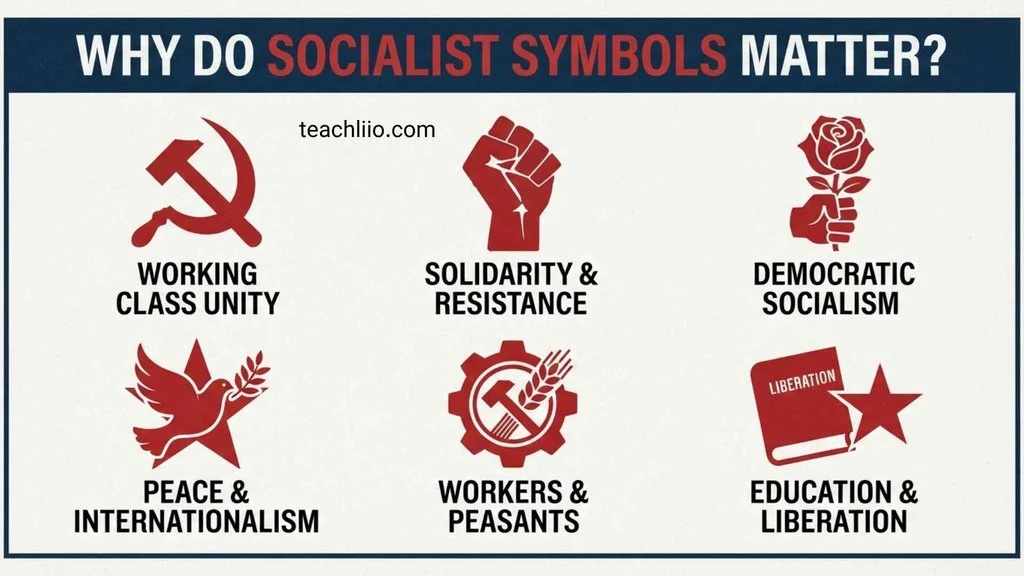
Political symbols make complex ideas easier to recognize.
A red flag can communicate political identity without words. A hammer and sickle can immediately connect an image with Soviet or communist history. A rose can signal a different socialist or social-democratic tradition.
These symbols also preserve historical memories.
They appear in photographs, monuments, political posters, flags, books, museums, archives, and historical documents.
Studying them therefore helps people understand not only graphic design but also the history of political movements and the societies in which those movements developed.
Frequently Asked Questions
What is the main symbol of socialism?
There is no single symbol that represents every socialist tradition worldwide. The red flag is one of the broadest historical symbols associated with socialism, while the red rose is particularly associated with socialist and social-democratic traditions.
What does the hammer and sickle mean?
The hammer traditionally represents industrial workers, while the sickle represents agricultural workers. Together they came to symbolize the unity of these groups and became strongly associated with Soviet and communist movements.
Is the hammer and sickle socialist or communist?
It has roots in broader socialist symbolism but became especially associated with communist movements and the Soviet Union. Its modern interpretation therefore often depends on historical and political context.
Why is red associated with socialism?
Red became associated with revolutionary and workers’ movements during the nineteenth century and was widely adopted by socialist organizations. Communist movements later made extensive use of the same color.
What does the red star symbolize?
The red star is strongly associated with communist and Soviet political traditions and can also appear in broader socialist imagery. Its exact meaning depends on its historical and political context.
What does the socialist rose mean?
The red rose has been used by socialist and social-democratic movements to represent ideas such as solidarity, social justice, democracy, and political change.
Is the raised fist a socialist symbol?
The raised fist has been used by socialist and labor movements, but it is not exclusively socialist. It also appears in many other political and social movements as a symbol of solidarity, resistance, and collective action.
What is the fist and rose symbol?
The fist and rose combines imagery associated with solidarity and collective action with the socialist or social-democratic tradition of the red rose. Different organizations have used their own versions.
What does the symbol ☭ mean?
The character ☭ represents the hammer and sickle. It is commonly associated with communist and Soviet political symbolism.
What do gears represent in socialist symbols?
Gears or cogwheels generally represent industry, machinery, production, and industrial workers. They are especially common in socialist-style state emblems.
What does wheat represent in socialist emblems?
Wheat and other crops can represent agriculture, farming, food production, workers, prosperity, or abundance. Their exact meaning depends on the emblem.
Why do socialist emblems use a rising sun?
A rising sun can represent a new era, progress, transformation, modernization, or hope. It is not exclusively socialist and also appears in many non-socialist symbols.
Are socialist and communist symbols the same?
No. They overlap historically, but some symbols are more strongly associated with communist movements, while others have been used by socialist, social-democratic, labor, or broader left-wing organizations.
Are socialist symbols still used today?
Yes. Some symbols continue to appear in political parties, labor movements, demonstrations, historical organizations, publications, and cultural contexts. Their meaning depends on who uses them and the circumstances.
Conclusion
Socialist symbols form a broad visual language built around ideas of workers, agriculture, industry, solidarity, political change, and social transformation.
The red flag has one of the broadest associations with socialist and labor movements. The hammer and sickle became particularly connected with Soviet and communist traditions. The red star carries strong communist and revolutionary associations, while the red rose has been especially important to socialist and social-democratic movements.
Other imagery, including the raised fist, fist and rose, wheat, gears, tools, books, and rising sun, adds further layers of meaning.
The most important point is that no political symbol should be interpreted in isolation. Its meaning can change according to the organization, country, historical period, and surrounding imagery.
Understanding that context makes it easier to identify socialist symbols accurately while also recognizing the important differences between socialism, communism, social democracy, labor movements, and historical socialist states.

I’m Oscar Radcliffe, a British writer who enjoys uncovering the numbers hidden within ordinary questions. My work explores quantities, counts, statistics, measurements, and fascinating comparisons across different subjects. I aim to present reliable information clearly, helping readers satisfy their curiosity while discovering interesting facts they may never have considered before.
Books:
The Science of Counting
How Many? Fascinating Numbers Explained