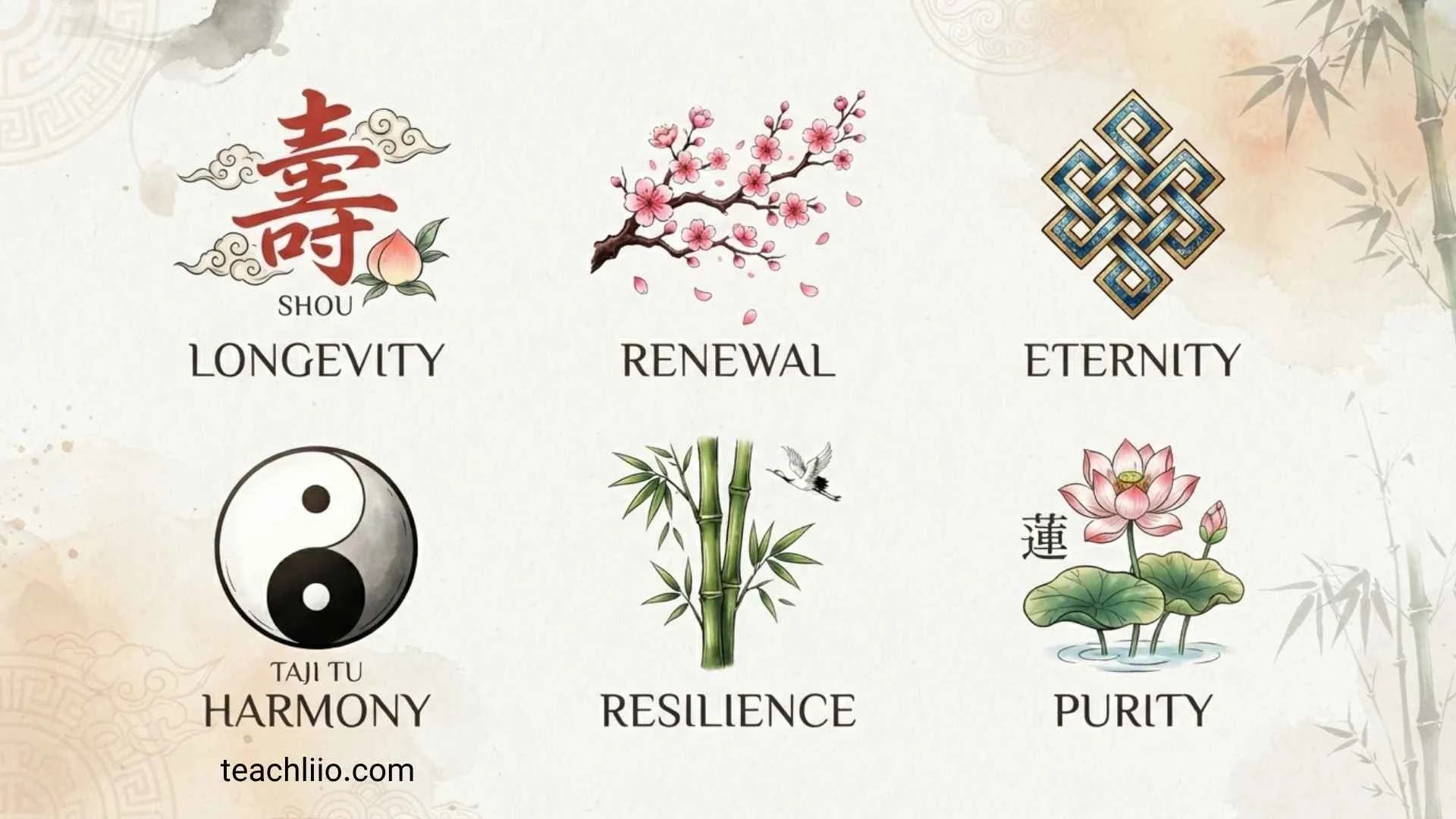
Asian symbols tell stories about religion, nature, philosophy, history, family, luck, protection, and everyday life. From the lotus and Dharma wheel to the Chinese dragon, Japanese crane, Indian Om symbol, and Buddhist endless knot, these images have appeared in temples, paintings, clothing, architecture, jewelry, ceremonies, and traditional artwork.
However, there is no single meaning for all Asian symbols. Asia includes many different countries, religions, languages, and cultural traditions. A symbol that represents longevity in one tradition may have a different meaning somewhere else.
This guide explores more than 50 important Asian symbols and explains their cultural or religious associations in clear language. It also shows how symbols differ between China, Japan, India, Korea, Southeast Asia, and Buddhist traditions.
What Are Asian Symbols?
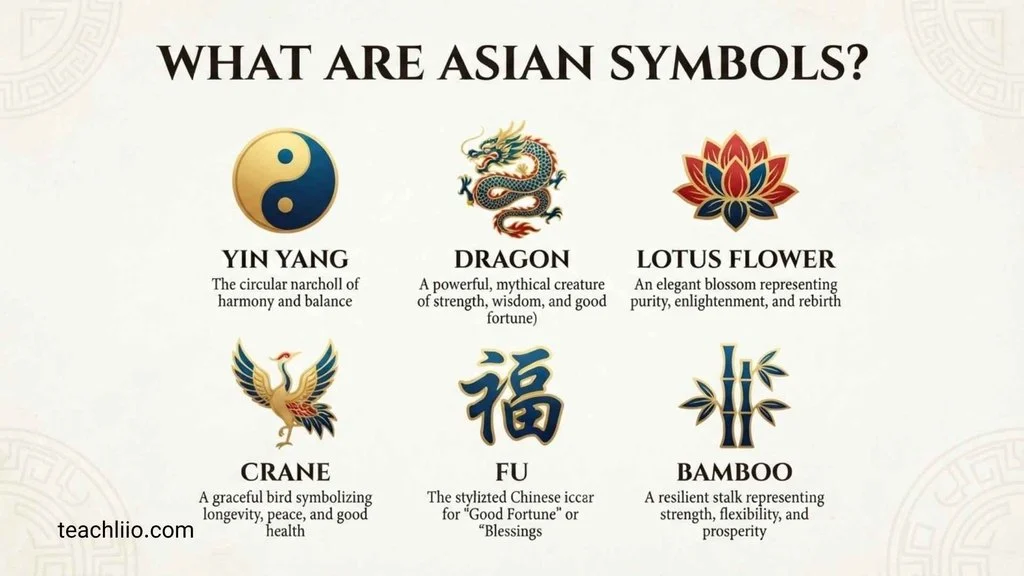
Asian symbols are recognizable images, objects, patterns, gestures, or designs that carry cultural, religious, historical, or philosophical meaning in Asian societies.
Some are connected with particular religions. Others developed through folklore, literature, art, royal traditions, festivals, or everyday customs.
Common examples include:
- Lotus
- Dragon
- Yin-yang
- Om
- Dharma wheel
- Mandala
- Crane
- Elephant
- Cherry blossom
- Phoenix
- Koi fish
- Bamboo
- Peony
- Naga
- Endless knot
- Bodhi tree
These symbols can appear in paintings, sculptures, temples, textiles, ceramics, architecture, jewelry, tattoos, and modern graphic design.
It is important to remember that Asian symbolism is not one unified system. Different cultures can use the same animal, plant, or shape in different ways.
Asian Symbols and Their Meanings at a Glance
Here is a quick overview of some widely recognized symbols:
| Symbol | Common Cultural Association | Common Meaning |
| Lotus | South and Southeast Asia | Purity, spiritual growth |
| Dragon | East and Southeast Asia | Power, protection, authority |
| Yin-yang | Chinese philosophy | Complementary forces, balance |
| Om | Hindu traditions | Sacred sound, spiritual reality |
| Dharma wheel | Buddhism | Buddha’s teachings and Dharma |
| Mandala | Hindu and Buddhist traditions | Sacred order, spiritual cosmos |
| Crane | East Asia | Longevity, good fortune |
| Elephant | South and Southeast Asia | Strength, wisdom, auspiciousness |
| Cherry blossom | Japan | Beauty and impermanence |
| Phoenix/Fenghuang | Chinese tradition | Harmony, virtue, renewal |
| Koi/fish | East Asia | Prosperity, abundance, perseverance |
| Bamboo | East Asian art | Resilience, flexibility |
| Peony | Chinese traditions | Prosperity, beauty, honor |
| Naga | South and Southeast Asia | Serpent power, protection, sacred nature |
| Endless knot | Buddhist traditions | Interconnection, continuity |
| Bodhi tree | Buddhism | Enlightenment and awakening |
These are broad associations rather than universal definitions. Meaning can change according to the country, religion, historical period, and artistic context.
East Asian Symbols
East Asia contains some of the world’s best-known traditions of symbolic art. China, Japan, and Korea each developed distinctive visual languages, although their traditions also influenced one another.
Chinese Dragon
The Chinese dragon is one of the most recognizable symbols in Chinese culture.
It has traditionally been associated with power, authority, protection, rain, water, and auspicious forces. Unlike the fire-breathing dragon common in many modern Western fantasy stories, the traditional Chinese dragon has a much broader cultural and symbolic history.
Dragons appear in Chinese art, architecture, textiles, imperial imagery, celebrations, and folklore.
Yin-Yang
The yin-yang symbol, often called taijitu, is associated with Chinese philosophical traditions, especially Daoist thought.
Its two contrasting but interconnected parts are commonly used to express complementary forces. The symbol does not simply mean “good versus evil.” Instead, its design emphasizes relationships, balance, transformation, and the way apparently opposite forces can exist together.
Chinese Phoenix or Fenghuang
The fenghuang is a legendary bird in Chinese tradition.
It is often associated with harmony, virtue, prosperity, and auspiciousness. It should not automatically be equated with the Western phoenix, because the two developed within different cultural traditions.
The fenghuang appears in Chinese decorative art, textiles, ceramics, and historical imagery.
Crane
Cranes are important motifs in East Asian art.
In Chinese art, cranes have been associated with longevity and auspicious wishes. Images of cranes with pine trees are particularly associated with longevity.
The crane also became an important symbol in Japanese art and culture, where it is frequently connected with long life and good fortune.
Koi and Fish
Fish imagery appears frequently in Chinese and Japanese art.
In Chinese symbolism, fish can be connected with abundance and prosperity, partly through linguistic associations. Koi are also prominent in Japanese visual culture and can suggest perseverance, strength, and determination in modern interpretations.
The exact symbolism depends on the species, setting, color, and cultural context.
Bamboo
Bamboo is a recurring motif in East Asian art, especially Chinese painting.
Its ability to bend without easily breaking makes it a useful image for qualities such as resilience and flexibility.
Bamboo also became important in painting and literary culture, where artists used natural subjects to express broader ideas about character and life.
Peony
The peony has a long history in Chinese art and decorative traditions.
It is often associated with beauty, prosperity, honor, and abundance. Peonies appear in paintings, textiles, ceramics, and decorative objects.
Like many Asian floral symbols, the peony can carry several meanings rather than one fixed definition.
South Asian Symbols
South Asia includes diverse cultural and religious traditions, particularly those associated with Hinduism, Buddhism, Jainism, Sikhism, and regional folk practices.
Om
Om, also written as Aum, is one of the best-known sacred symbols associated with Hindu traditions.
It represents a sacred sound and has deep philosophical and spiritual associations. It is used in religious practice, meditation, recitation, and sacred texts.
Because Om is specifically rooted in particular Indian religious traditions, it is more accurate to describe it as a Hindu and Indian religious symbol rather than simply calling it a universal “Asian symbol.”
Lotus
The lotus is one of the most important symbolic plants across several Asian religious and artistic traditions.
In Hindu traditions, lotus imagery is strongly connected with purity and divine imagery. Hindu deities are frequently represented seated or standing on lotus flowers.
In Buddhist art, the lotus can represent purity and spiritual development because it grows from muddy water while producing a clean flower.
The lotus therefore provides a good example of how one natural object can acquire related but distinct meanings across cultures.
Mandala
A mandala is a geometric design used in several South Asian and Buddhist traditions.
The word comes from Sanskrit and broadly relates to a circle or sacred arrangement.
Mandalas can represent an ordered cosmos, spiritual space, meditation, or a symbolic map of religious ideas.
Their appearance varies considerably depending on the religious and artistic tradition.
Elephant
The elephant is an important cultural and religious image across South and Southeast Asia.
It can represent strength, wisdom, royal power, fertility, prosperity, or good fortune depending on the tradition.
In Hinduism, the elephant-headed deity Ganesha is widely associated with wisdom, learning, beginnings, and the removal of obstacles.
Peacock
The peacock is a recurring subject in South Asian art.
Its beauty and distinctive feathers have made it an important decorative and symbolic image. In different Indian religious and artistic contexts, the peacock can be associated with beauty, royalty, spirituality, and divine figures.
Dharma Wheel
The Dharma wheel, or dharmachakra, is one of the most important Buddhist symbols.
The wheel represents the Buddha’s teachings and the Dharma. Its turning is traditionally connected with the Buddha teaching and spreading the Dharma.
Different representations use different numbers of spokes, but the eight-spoked wheel is particularly important because of its connection with the Noble Eightfold Path.
Southeast Asian Symbols
Southeast Asian symbolism reflects interactions among indigenous traditions, Hinduism, Buddhism, Islam, and other cultural influences.
Naga
The naga is a serpent or serpent-like supernatural being found in South and Southeast Asian religious traditions.
Nagas appear in Hindu and Buddhist mythology and are especially prominent in the art and architecture of countries such as Cambodia, Thailand, Laos, and Myanmar.
They can be associated with water, fertility, protection, sacred places, and supernatural power.
Lotus in Southeast Asia
Lotus imagery is common in Buddhist art throughout Southeast Asia.
It may appear in temples, sculptures, paintings, decorative patterns, and religious objects.
Its association with purity and spiritual development makes it particularly suitable for Buddhist artistic traditions.
Temple Animal Motifs
Animals such as elephants, lions, serpents, birds, and mythical creatures frequently appear in Southeast Asian temple architecture.
Their meanings vary by country and religious tradition, so identifying the specific temple and cultural setting is important.
Buddhist Symbols Across Asia
Buddhism spread from South Asia into Central, East, and Southeast Asia. As it moved across regions, Buddhist symbols were adapted into different artistic and cultural traditions.
Dharma Wheel
The Dharma wheel represents Buddhist teachings and is one of the central symbols of Buddhism.
Lotus
The lotus is commonly connected with purity and spiritual awakening.
Endless Knot
The endless knot is one of the Eight Auspicious Symbols in Tibetan and Himalayan Buddhist traditions.
Its interwoven structure can suggest interconnectedness and continuity.
Bodhi Tree
The Bodhi tree is associated with the Buddha’s enlightenment.
According to Buddhist tradition, Siddhartha Gautama attained enlightenment while meditating beneath a tree identified with the sacred fig or Bodhi tree.
Conch Shell
The conch is another important Buddhist symbol.
In Buddhist contexts, the white conch can be associated with the spreading of the Dharma and the sound of Buddhist teachings.
Parasol
The parasol appears among the Eight Auspicious Symbols.
Historically, the parasol also had associations with status and protection. Within Buddhist symbolism, it can represent spiritual protection and dignity.
Two Golden Fish
The pair of fish is another traditional Buddhist auspicious symbol.
It can be associated with freedom, abundance, and the ability to move through the difficulties of existence.
Victory Banner
The victory banner is traditionally associated with victory over obstacles and the triumph of Buddhist teachings.
Together, these symbols form a recognizable visual vocabulary in Tibetan Buddhist art and other Buddhist traditions across Asia.
Japanese Symbols and Their Meanings
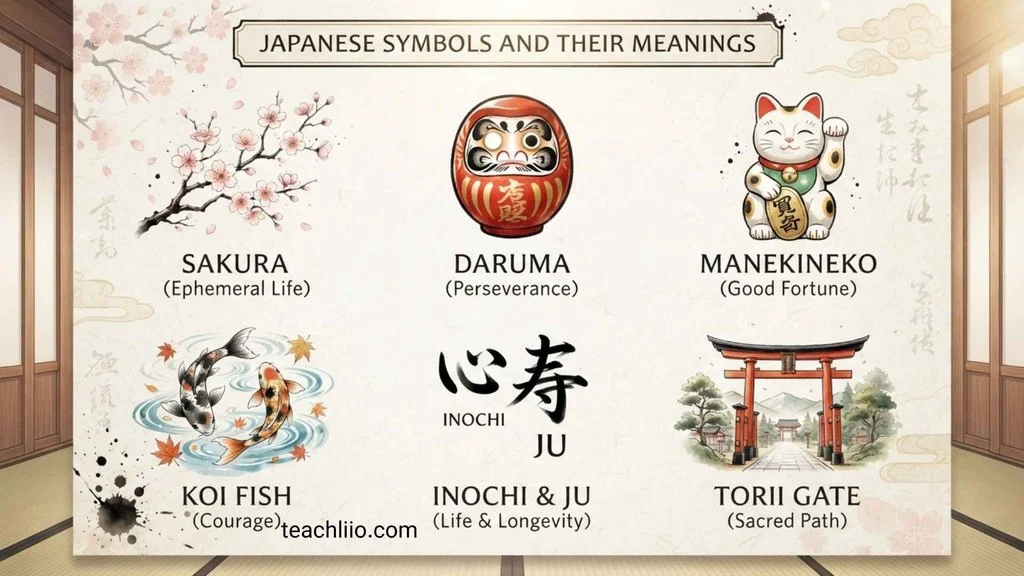
Japan has developed a distinctive symbolic vocabulary influenced by Shinto, Buddhism, court traditions, literature, nature, and Japanese aesthetics.
Cherry Blossom
The cherry blossom, or sakura, is one of Japan’s most recognizable cultural images.
Its short flowering period has made it a powerful symbol of beauty and the temporary nature of life.
Cherry blossoms are celebrated widely in Japanese culture, particularly during the spring flowering season.
Koi Fish
Koi are common in Japanese gardens, artwork, tattoos, textiles, and decorative traditions.
They are often associated with perseverance and determination, especially in modern symbolic interpretations.
Torii Gate
The torii is a recognizable feature of Shinto shrine architecture.
It marks the entrance to a sacred space and helps distinguish the shrine area from ordinary surroundings.
Although it is often treated as a simple “Japanese symbol,” its specific meaning is connected to Shinto religious practice.
Enso
The enso is a circular brushstroke associated with Zen Buddhism.
Its appearance can vary greatly. Depending on the context, it can suggest ideas related to emptiness, simplicity, completeness, or the moment of expression.
It is also widely used in modern art and design.
Asian Symbols of Good Luck and Prosperity
Luck symbolism is especially prominent in several Asian cultural traditions.
Examples include:
- Fish
- Peony
- Peach
- Crane
- Elephant
- Dragon
- Lucky knots
- Auspicious clouds
- Double fish
- Certain numbers and written characters
In Chinese decorative traditions, for example, objects and animals can gain auspicious meanings through linguistic wordplay, folklore, historical associations, and visual conventions.
The meaning is therefore often more specific than simply saying an object “means luck.”
Peach
The peach is traditionally associated with longevity in Chinese cultural symbolism.
Auspicious Clouds
Cloud motifs can represent good fortune and heavenly or auspicious forces in Chinese art.
Chinese Knot
Decorative Chinese knots can carry auspicious meanings and are commonly used in celebrations, decorations, and traditional crafts.
Asian Symbols of Protection
Protection is another important theme in Asian religious and cultural imagery.
Symbols associated with protection can include:
- Dragons
- Naga figures
- Guardian lions
- Buddhist protective emblems
- Temple guardians
- Sacred animals
- Religious amulets
However, a symbol should not automatically be described as providing supernatural protection.
A more accurate explanation is that the image has traditionally been used or interpreted as protective within a particular religious or cultural context.
Asian Symbols of Strength, Peace, and Longevity
Different symbols can express qualities that readers often search for individually.
Strength
Common examples include:
- Dragon
- Tiger
- Elephant
- Koi
Peace and Harmony
Examples include:
- Lotus
- Dove imagery in some modern contexts
- Yin-yang
- Certain Buddhist motifs
- Harmonious natural imagery
Longevity
Common traditional examples include:
- Crane
- Pine tree
- Peach
- Tortoise
- Deer in some Chinese artistic contexts
These associations should always be connected to their particular traditions rather than presented as universal Asian definitions.
Religious vs. Cultural Asian Symbols
One of the easiest ways to misunderstand Asian symbolism is to place every symbol into the category of religion.
Some symbols are explicitly religious.
Examples include:
- Om
- Dharma wheel
- Buddhist mandala
- Bodhi tree
- Buddhist endless knot
Others are mainly cultural, artistic, historical, or folkloric.
Examples include:
- Cherry blossom
- Bamboo
- Chinese knot
- Koi
- Peony
- Crane
There can also be overlap. A lotus may be both a religious symbol and an artistic motif.
This is why the most accurate explanation identifies the specific tradition and context.
Why Asian Symbols Have Different Meanings
There is no universal Asian dictionary of symbols.
Meaning can change because of:
- Country
- Religion
- Language
- Historical period
- Local folklore
- Artistic tradition
- Color
- Placement
- Combination with another symbol
- Intended use
For example, a lotus used in a Buddhist temple may have a different emphasis from a lotus used as a decorative pattern on a piece of clothing.
The same animal can also acquire different meanings in different societies.
This is why statements such as “all Asians believe this symbol means X” should be avoided.
How to Identify an Asian Symbol
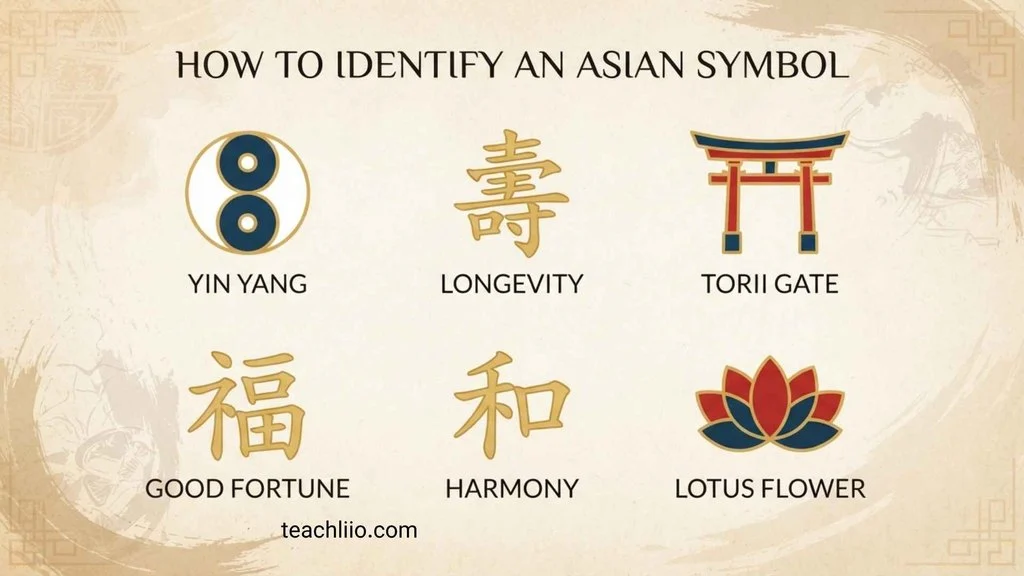
If you encounter an unfamiliar Asian symbol, use context rather than guessing from its appearance.
Identify the Main Image
First determine whether the symbol is an:
- Animal
- Plant
- Geometric shape
- Religious object
- Character
- Architectural feature
- Mythological creature
Determine the Cultural Setting
Ask where the symbol appears.
Is it from:
- China?
- Japan?
- India?
- Korea?
- Tibet?
- Thailand?
- Cambodia?
- Nepal?
- Indonesia?
Location can narrow down possible interpretations.
Check for Religious Context
A temple, shrine, Buddhist object, Hindu deity, or religious manuscript can provide important clues.
Look at Surrounding Symbols
Symbols often appear in groups.
A lotus combined with Buddhist imagery, for example, provides a different context from a lotus used purely as a decorative flower.
Consider the Historical Period
A symbol used during an ancient dynasty may have a different meaning from the same image in modern popular culture.
Avoid One-Word Definitions
Instead of saying:
“This symbol means luck.”
A more accurate explanation is:
“This symbol has traditionally been associated with good fortune in certain cultural contexts.”
That wording recognizes the complexity of symbolism.
Asian Symbols in Art, Jewelry, Tattoos, and Design
Asian symbols are widely used in modern art, jewelry, clothing, tattoos, home décor, logos, and graphic design.
This creates an important distinction between traditional meaning and modern use.
A person may choose a lotus tattoo because they associate it with personal growth, even though the lotus has much deeper religious and historical meanings in Hindu and Buddhist traditions.
Similarly, someone may use a dragon design simply because they admire its appearance without intending a specific cultural message.
Before using a religious or culturally significant symbol, it is useful to understand its original context.
This helps avoid accidentally using an image in a way that conflicts with its traditional meaning.
Frequently Asked Questions
What are the most famous Asian symbols?
Some widely recognized Asian symbols include the lotus, Chinese dragon, yin-yang, Om, Dharma wheel, mandala, cherry blossom, crane, elephant, koi, bamboo, phoenix, and Buddhist endless knot.
What is the most important symbol in Asian culture?
There is no single symbol that is most important across all of Asia. Different cultures and religions have their own important symbols. The lotus, Om, Dharma wheel, dragon, and yin-yang are prominent examples, but their importance comes from different traditions.
What are Asian symbols of good luck?
Examples include fish, cranes, dragons, peonies, peaches, elephants, Chinese knots, and auspicious cloud motifs. Their meanings depend on the cultural tradition in which they are used.
What Asian symbol represents peace?
Several Asian symbols can be connected with harmony or peace, including the lotus and yin-yang in appropriate contexts. The exact meaning depends on the tradition and use.
What Asian symbol represents strength?
Dragons, elephants, tigers, and koi are among the animals commonly associated with strength or perseverance in different Asian traditions.
What does the lotus symbolize in Asia?
The lotus has different meanings across Asian traditions. In Hindu and Buddhist contexts, it is strongly associated with purity, spiritual development, and sacred imagery.
What does the dragon symbolize in Asian culture?
The meaning varies by culture. In Chinese traditions, the dragon has been associated with power, authority, water, rain, protection, and auspicious forces.
What does yin-yang mean?
The yin-yang symbol represents complementary forces and their relationship within Chinese philosophical traditions. It is associated particularly with Daoist thought and ideas of balance and transformation.
What does Om symbolize?
Om or Aum is a sacred sound and symbol deeply associated with Hindu religious and philosophical traditions. It is used in practices such as chanting, meditation, and prayer.
What does the Buddhist wheel represent?
The Dharma wheel represents the Buddha’s teachings and the Dharma. Its turning is associated with the Buddha teaching and spreading those teachings.
What does the Japanese crane symbolize?
The crane is commonly associated with longevity and good fortune in Japanese culture, although its meaning can vary depending on the artistic and cultural setting.
What does the elephant symbolize in Asian cultures?
Elephants can represent strength, wisdom, prosperity, royal power, or auspiciousness. Their meaning varies among South and Southeast Asian traditions.
What does the Chinese phoenix represent?
The Chinese fenghuang is associated with qualities such as harmony, virtue, prosperity, and auspiciousness. It is a distinct cultural tradition and should not simply be equated with the Western phoenix.
Are Asian symbols religious?
Some are religious, while others are cultural, artistic, historical, or folkloric. Om and the Dharma wheel have strong religious associations, while symbols such as bamboo, cherry blossoms, and peonies can have broader cultural and artistic uses.
Are Chinese and Japanese symbols the same?
No. Chinese and Japanese cultures have influenced each other historically, and some symbols appear in both traditions, but their meanings, forms, and uses can differ.
What are the Eight Auspicious Symbols of Buddhism?
The Eight Auspicious Symbols commonly include the parasol, two golden fish, treasure vase, lotus, conch shell, endless knot, victory banner, and Dharma wheel. Their representation can vary across Buddhist traditions.
Conclusion
Asian symbols represent an enormous range of cultural, religious, artistic, and historical traditions. The lotus can express purity and spiritual development, the Dharma wheel represents Buddhist teachings, Om has deep Hindu significance, the yin-yang reflects complementary forces in Chinese philosophy, and the dragon carries powerful associations in East Asian traditions.
Other symbols tell different stories. The Japanese cherry blossom can evoke beauty and impermanence, the crane is associated with longevity, bamboo suggests resilience in East Asian artistic traditions, and the elephant carries important religious and cultural associations across South and Southeast Asia.
The most important thing to remember is that Asia is not one culture and Asian symbols do not have one universal meaning. The country, religion, historical period, artwork, and surrounding symbols all matter.
Understanding that context turns a simple list of symbols into a more accurate and useful guide to Asian art, culture, and symbolism.

I’m Oscar Radcliffe, a British writer who enjoys uncovering the numbers hidden within ordinary questions. My work explores quantities, counts, statistics, measurements, and fascinating comparisons across different subjects. I aim to present reliable information clearly, helping readers satisfy their curiosity while discovering interesting facts they may never have considered before.
Books:
The Science of Counting
How Many? Fascinating Numbers Explained