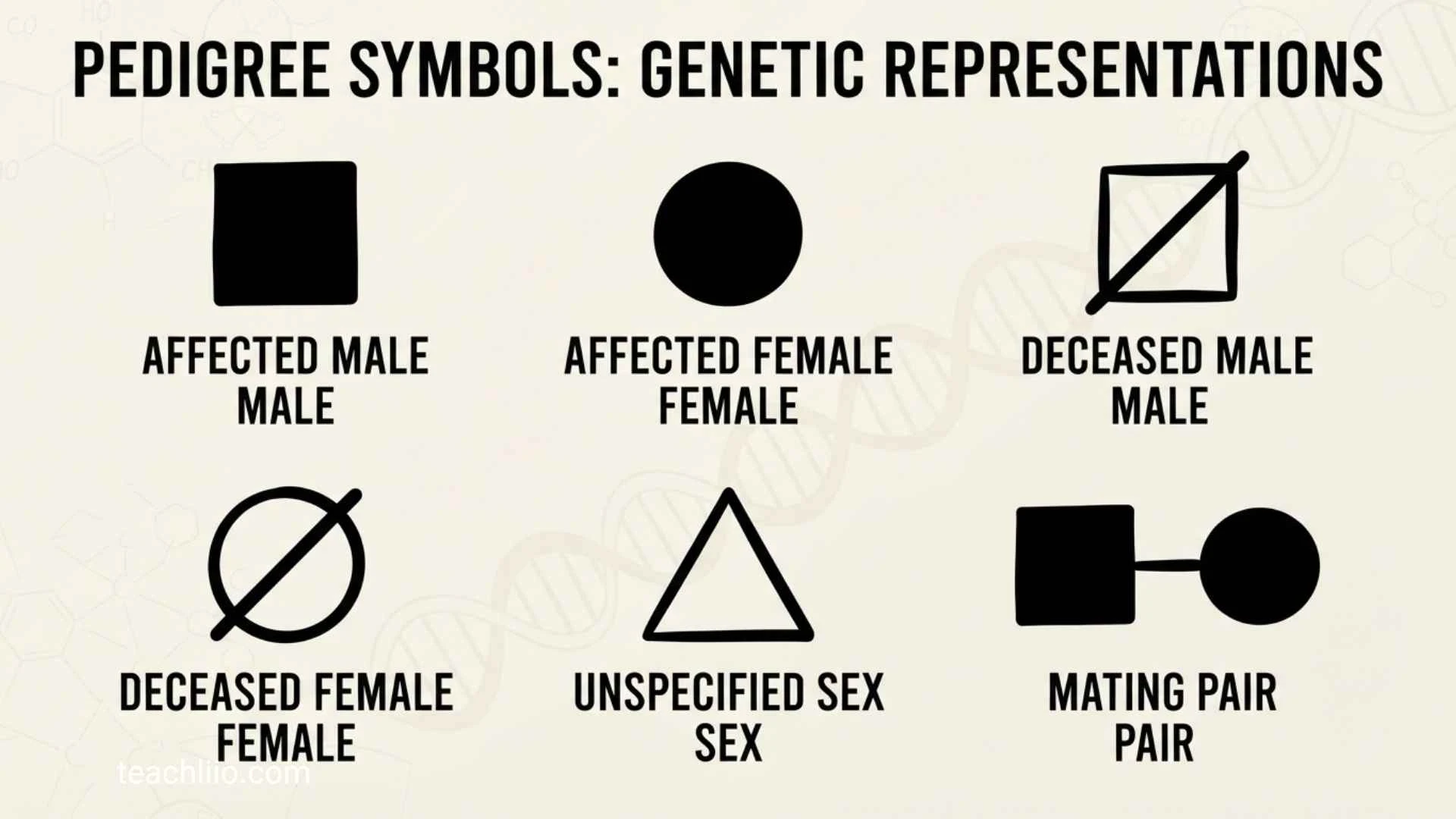
Understanding pedigree symbols makes it much easier to read a genetic family chart. A pedigree is more than a simple family tree. It uses standardized shapes, lines, shading, numbers, and other markings to show family relationships and information about inherited traits or health conditions.
A square, circle, shaded symbol, horizontal line, or vertical line can each communicate something different. Once you understand these basic conventions, you can follow several generations of a family and look for patterns that may suggest how a trait is inherited.
This guide explains the most common pedigree symbols, how to read a pedigree chart, what carrier and affected symbols mean, how generations are numbered, and how pedigrees are used in genetics and genetic counseling.
What Are Pedigree Symbols?
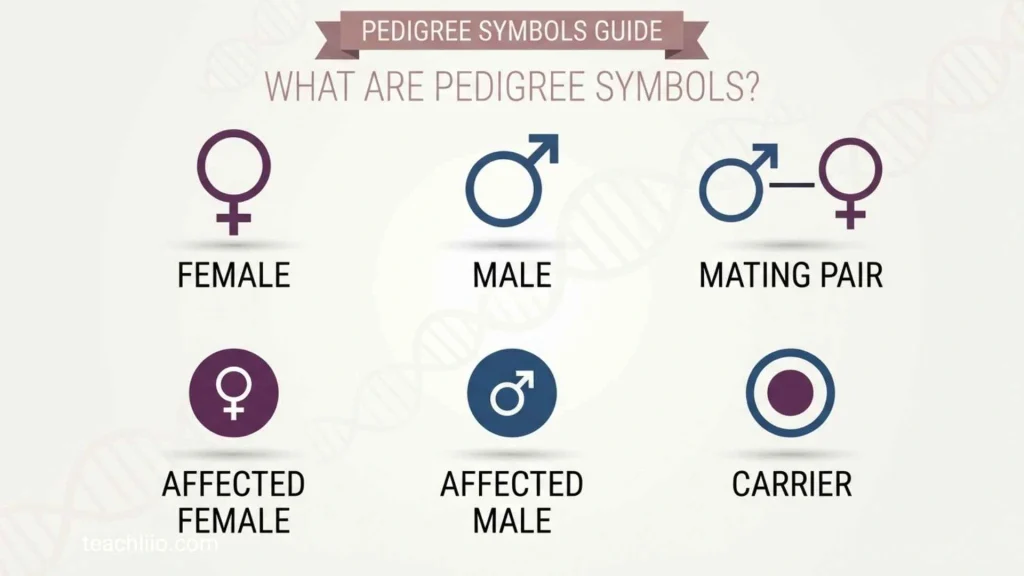
Pedigree symbols are standardized shapes and markings used to represent people, relationships, genetic conditions, and other information in a pedigree chart.
A pedigree chart presents a family’s history in a visual format. Unlike an ordinary family tree, a genetic pedigree can show whether particular relatives are affected by a condition, whether someone may be a carrier, and how a trait appears across generations.
Common symbols include squares, circles, diamonds, shaded shapes, horizontal relationship lines, and vertical lines connecting parents with children.
Why Are Pedigree Symbols Important?
Pedigree symbols make complicated family information easier to understand at a glance.
Instead of writing a long description such as “the mother has the condition, the father does not, and they have three children,” a pedigree can communicate much of that information through symbols and connecting lines.
Standardized notation also helps students, researchers, healthcare professionals, and genetic counselors interpret a pedigree consistently.
However, not every chart uses every possible symbol. In particular, medical pedigrees can contain additional annotations and may define shading or other markings in a legend. Always check the key provided with a specific pedigree.
Common Pedigree Symbols and Their Meanings
The easiest way to learn pedigree symbols is to understand the basic shapes first. These symbols represent individuals, while the lines show relationships between them.
Square Symbol
A square commonly represents a male or man in traditional pedigree diagrams.
For example, if a pedigree contains a square connected to a circle, the two symbols may represent partners.
In contemporary clinical nomenclature, pedigree symbols are used to represent gender, and the exact conventions can include additional annotations when relevant.
Circle Symbol
A circle commonly represents a female or woman in traditional pedigree diagrams.
A circle can appear alone when representing an individual or can be connected to another symbol to show a relationship.
As with the square, the precise interpretation of a clinical pedigree should be based on the chart’s legend and the conventions being used.
Diamond Symbol
A diamond is commonly used when sex or gender is unknown or unspecified in traditional pedigree notation.
Diamonds may also have specialized uses in contemporary clinical pedigree practice. The meaning should therefore be checked against the chart legend.
A diamond should not automatically be interpreted as a particular biological sex.
Shaded Symbol
A completely shaded square or circle commonly represents an individual who is affected by the condition or trait being studied.
For example, if a pedigree is examining a particular inherited disorder and one person’s symbol is filled in, that person may be affected.
The exact meaning of shading should always be confirmed from the pedigree’s legend, particularly in clinical charts where different fill patterns may represent different clinical information.
Unshaded Symbol
An unshaded symbol commonly represents an individual who is unaffected by the specific condition or trait being examined.
For example, an unshaded circle may represent a woman who does not have the condition being tracked.
“Unaffected” does not necessarily mean the person has no health conditions. It only refers to the particular trait or condition represented by the pedigree.
Half-Shaded or Partially Shaded Symbol
Partial shading may be used in some educational pedigree diagrams to indicate a carrier or another intermediate status.
However, this is one area where readers should be careful. Carrier notation is not completely universal, and modern clinical recommendations have revised how carriers of recessive conditions are represented.
The safest approach is to read the chart’s legend before assigning a meaning to a partial fill.
Symbol With a Diagonal Line
A diagonal line through an individual’s symbol commonly indicates that the person is deceased.
The person’s other information can still be included in the pedigree because their relationship to other family members may be important when studying inheritance.
A deceased person’s symbol does not automatically indicate that the person died from the genetic condition being studied.
Arrow or Proband Indicator
An arrow or similar pointer can identify the proband, sometimes called the consultand.
The proband is the individual through whom a family comes to medical or genetic attention or the person who is the focus of a particular pedigree.
The arrow does not mean that the person is necessarily affected. Its purpose is to identify the person of interest in the family history.
Pedigree Lines and Relationship Symbols
Shapes identify individuals, but lines explain how those individuals are related.
Understanding these lines is just as important as learning the symbols.
Horizontal Line Between Partners
A horizontal line connecting two individual symbols commonly represents a reproductive or partner relationship.
For example, a square connected to a circle by a horizontal line can represent two partners.
Vertical Line From Parents to Children
A vertical line descending from a parental relationship line connects the parents to their children.
This allows the reader to follow the family from one generation to the next.
Sibling Line
When several children belong to the same parental relationship, a horizontal sibling line can connect their individual vertical lines.
This helps show that the children share the same parents.
For example, three children may appear below one parental relationship, each connected to the same sibling line.
Multiple Relationship Lines
Some pedigrees contain additional relationship information, including relationships between relatives or other family structures.
These details can become complicated in large pedigrees, which is why a clear legend and consistent notation are important.
How to Read a Pedigree Chart
Reading a pedigree becomes much easier when you follow a consistent process.
Start With the Legend
Before interpreting any symbol, look for the chart’s legend or key.
The legend explains what shading, patterns, abbreviations, and special markings mean. This is especially important for clinical pedigrees.
Do not assume that every fill pattern has the same meaning on every chart.
Identify the Generations
Pedigree generations are commonly labeled with Roman numerals such as I, II, and III.
Generation I is generally the oldest generation shown. Generation II is the next generation, followed by Generation III and so forth.
This creates a simple way to describe where people appear in a family.
Identify Individuals Within Each Generation
People within a generation can be numbered from left to right using Arabic numerals.
For example, II-3 generally means the third individual shown in Generation II.
This numbering system is useful when genetics questions refer to a particular person without repeatedly describing their position in the chart.
Follow the Relationship Lines
Next, trace the horizontal and vertical lines.
Start with a parental relationship, then follow the line downward to the children. From those children, continue to the next generation.
This prevents a common mistake: assuming that symbols positioned close together are automatically siblings or partners.
Look for the Trait or Condition
Once you understand the family structure, examine the shading or other markings.
Ask:
- Which individuals are affected?
- Which individuals are unaffected?
- Are affected people found in multiple generations?
- Are males and females affected?
- Are unaffected parents producing affected children?
- Does the trait appear to pass from one generation to another?
These observations can help identify possible inheritance patterns.
Pedigree Symbols and Inheritance Patterns
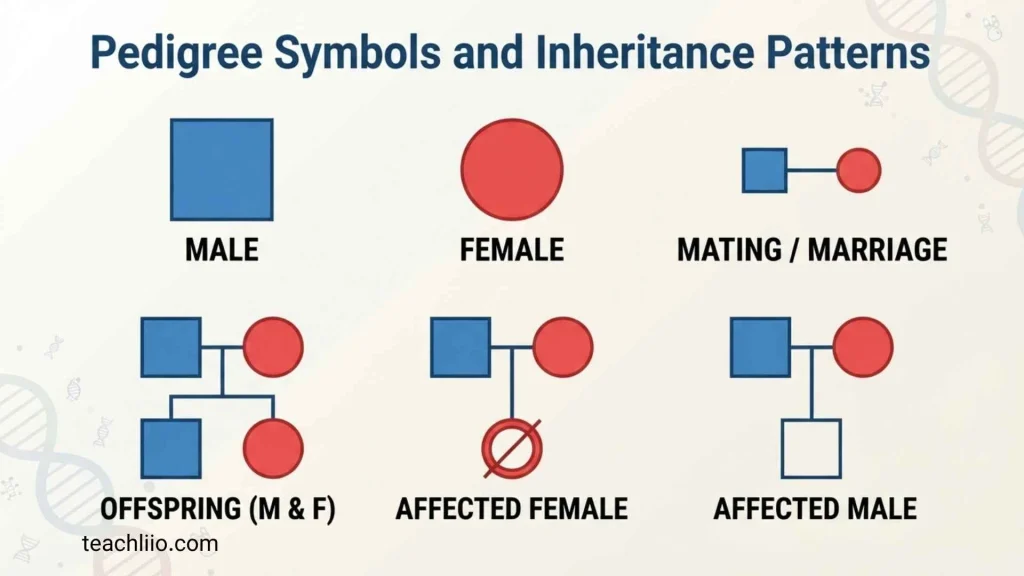
Pedigree symbols help display family information, while inheritance patterns describe how a genetic trait may pass through a family.
A pedigree alone does not automatically establish a diagnosis or prove a particular genetic mechanism. It provides information that can be analyzed alongside other evidence.
Autosomal Dominant Pattern
In a simplified autosomal dominant pedigree, an affected person may appear in multiple consecutive generations.
Both males and females can be affected because autosomal genes are not located on the sex chromosomes.
An affected parent may have affected children, although the exact pattern depends on the genetic variant and the parents’ genotypes.
Autosomal Recessive Pattern
Autosomal recessive conditions can sometimes appear unexpectedly in a family.
For example, two unaffected carrier parents may have a child who is affected.
This can make a recessive condition appear to skip generations.
X-Linked Pattern
X-linked traits involve genes located on the X chromosome.
Their pedigree patterns can differ between males and females because individuals typically have different combinations of sex chromosomes.
When studying an X-linked condition, pay close attention to which relatives are affected and how the condition appears through maternal and paternal lines.
Y-Linked Pattern
Y-linked traits involve genes on the Y chromosome.
Because the Y chromosome is typically passed from father to son, a Y-linked pattern can show transmission through male relatives.
Not every condition affecting males is Y-linked. The pedigree pattern must be considered alongside genetic information.
Carrier vs. Affected Individual
One of the most common sources of confusion is the difference between a carrier and an affected person.
What Is an Affected Individual?
An affected individual has the condition or trait being studied.
In a basic pedigree, this person is often represented with a filled or shaded symbol.
The meaning of “affected” is specific to the condition being investigated.
What Is a Carrier?
A carrier can have a genetic variant associated with a recessive condition without showing the condition itself.
For example, a person carrying one disease-associated recessive variant may not have the disorder but can potentially pass the variant to a child.
Carrier notation can vary, particularly between classroom diagrams and clinical pedigrees. Modern professional guidance recommends defining the meaning of shading or other markings in the pedigree legend.
Generation Numbers and Pedigree Notation
Generation and individual numbers make large pedigrees easier to discuss.
Roman Numerals for Generations
Roman numerals identify generations.
A simple example might look like:
- I = first generation
- II = second generation
- III = third generation
- IV = fourth generation
The oldest generation shown is usually placed at the top.
Arabic Numbers for Individuals
Arabic numerals identify individuals within each generation.
If Generation II contains five individuals, they may be numbered II-1 through II-5.
This makes it possible to refer to one person precisely without repeatedly describing their position.
What Does II-3 Mean?
II-3 generally means the third individual in the second generation.
The exact numbering should be confirmed by looking at the chart because conventions and layouts can vary.
Advanced and Medical Pedigree Symbols
Medical pedigrees can contain considerably more information than a basic classroom genetics diagram.
Proband or Consultand
The proband is commonly identified with an arrow or another clear indicator.
This person is the individual through whom the family is being evaluated or the person who prompted the pedigree.
Age and Other Information
Clinical pedigrees may include information such as age, year of birth, year of death, test results, or other relevant clinical details.
The 2022 National Society of Genetic Counselors practice resource recommends that clinical pedigree legends define relevant clinical information and describes placing information such as age, evaluation results, and pedigree numbers below or near the individual’s symbol.
Adoption and Reproductive History
More detailed pedigrees can document adoption and aspects of reproductive history.
Assisted reproductive technology can also require specialized notation. These situations demonstrate why a medical pedigree can be substantially more detailed than a basic family tree.
Gender, Sex, and Clinical Annotations
Modern pedigree standards have also addressed how pedigrees represent gender and sex-related information.
The National Society of Genetic Counselors’ 2022 practice resource recommends using symbols to represent gender and using annotations when clinically relevant information about sex assigned at birth or other characteristics needs to be recorded.
Because these conventions are more specialized, a clinical pedigree should be interpreted according to its stated legend and professional context.
Pedigree Chart vs. Family Tree
A pedigree and a family tree may look similar, but they serve different purposes.
What Is a Family Tree?
A family tree primarily focuses on family relationships and ancestry.
It may include parents, grandparents, children, siblings, spouses, and other relatives.
What Is a Genetic Pedigree?
A genetic pedigree adds information that can help investigate inheritance and family health history.
It can show affected individuals, carriers, relationship patterns, generations, and other information relevant to genetic analysis.
In simple terms, a family tree mainly answers “Who is related to whom?”
A genetic pedigree can also help answer “How does a particular trait or condition appear within this family?”
Common Mistakes When Reading Pedigree Symbols
Even basic pedigrees can become confusing if the symbols are interpreted incorrectly.
Mistake 1: Assuming Every Shaded Symbol Means the Same Thing
Shading often identifies affected individuals, but the chart’s legend has priority.
Always check what the fill pattern means.
Mistake 2: Confusing a Carrier With an Affected Person
A carrier may not have the condition being studied.
Do not automatically treat a carrier as affected.
Mistake 3: Ignoring Relationship Lines
The placement of symbols alone is not enough to determine family relationships.
Follow the connecting lines.
Mistake 4: Assuming Death Caused by the Genetic Condition
A diagonal line can indicate that an individual is deceased, but it does not by itself establish the cause of death.
Mistake 5: Treating a Pedigree as a Diagnosis
A pedigree can reveal patterns that may be relevant to genetic risk, but it does not by itself diagnose a disease.
Clinical interpretation may require genetic testing, medical records, physical findings, and professional genetic counseling.
Mistake 6: Assuming All Pedigrees Use Identical Symbols
Basic educational diagrams are often simplified.
Clinical pedigrees can contain specialized symbols, annotations, and legends. Always check the source and context.
How to Study Pedigree Symbols More Easily
If you are learning genetics, memorizing every symbol at once can be overwhelming.
Learn Shapes First
Start with the basic individual symbols:
- Square
- Circle
- Diamond
Then learn what shading and other markings add to those shapes.
Learn Lines Second
Next, practice identifying:
- Partner relationships
- Parent-child connections
- Sibling relationships
- Generational movement
Practice With Small Pedigrees
Begin with a pedigree containing two or three generations.
Identify each person before trying to determine an inheritance pattern.
Use a Consistent Checklist
When reading a pedigree, ask:
- What does the legend say?
- How many generations are shown?
- Who are the parents?
- Which individuals are siblings?
- Which people are affected?
- Are any individuals identified as carriers?
- Who is the proband?
- What inheritance pattern might the family history suggest?
- What information is still unknown?
This method makes complicated pedigrees much easier to interpret.
Why Standardized Pedigree Symbols Matter
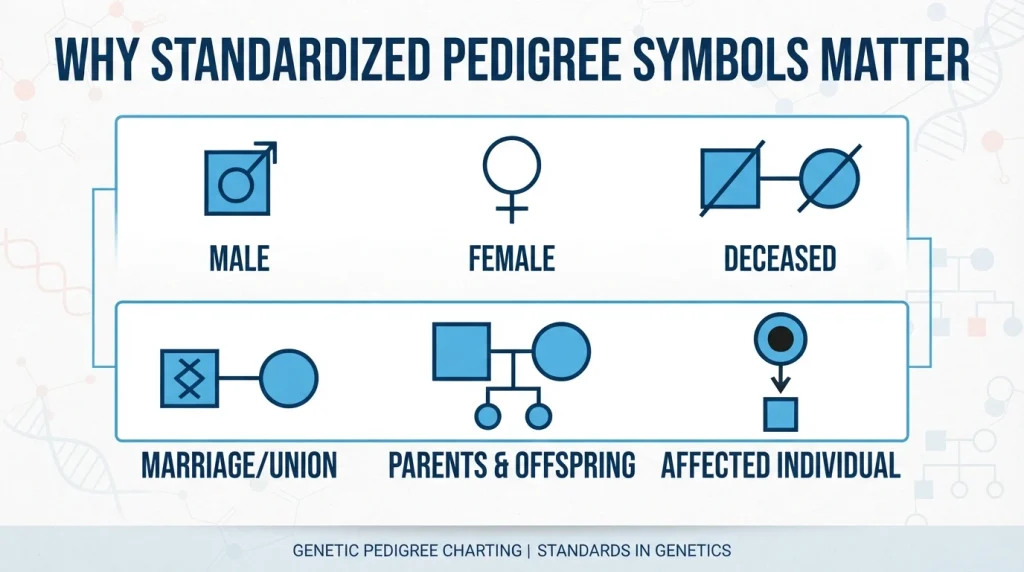
Standardized symbols create a common visual language for communicating family and genetic information.
The National Society of Genetic Counselors has published pedigree nomenclature recommendations and later revised them to address issues including gender representation and carrier notation. Its 2022 practice resource emphasizes using a clear legend and recording clinically relevant information consistently.
Standardization is particularly useful when a pedigree is shared among healthcare professionals, researchers, educators, or genetic counselors.
At the same time, standardization does not mean every chart will look exactly the same. The purpose of a legend is to remove ambiguity and explain how that particular pedigree should be interpreted.
Frequently Asked Questions
What does a square mean in a pedigree?
A square traditionally represents a male or man in a pedigree. In modern clinical nomenclature, the meaning should be interpreted according to the pedigree’s conventions and legend.
What does a circle mean in a pedigree?
A circle traditionally represents a female or woman. Clinical pedigree standards can include additional annotations when needed.
What does a shaded circle or square mean?
A shaded symbol commonly represents an individual affected by the condition or trait being studied. Always check the pedigree legend because fill patterns can have different meanings.
What does an unshaded symbol mean?
An unshaded symbol commonly represents an individual who is unaffected by the particular condition being investigated.
What does a line through a pedigree symbol mean?
A diagonal line through a symbol commonly indicates that the individual is deceased. It does not by itself identify the cause of death.
What does an arrow mean in a pedigree?
An arrow commonly identifies the proband or consultand, meaning the individual who is the focus of the family genetic evaluation.
How are carriers shown in a pedigree?
Carrier notation can vary. Some educational diagrams use partial shading or other markings, while contemporary clinical recommendations may use different conventions. The chart’s legend should define the carrier symbol.
What do Roman numerals mean in a pedigree?
Roman numerals usually identify generations. For example, I can represent the first generation, II the second, and III the third.
What does II-3 mean in a pedigree?
II-3 generally means the third individual in the second generation.
What is the difference between a pedigree and a family tree?
A family tree mainly displays family relationships and ancestry. A pedigree can also record information about inherited traits, health conditions, carriers, and other genetic information.
Can pedigree symbols prove an inherited disorder?
No. A pedigree can reveal a pattern that may be consistent with a particular inheritance mechanism, but it does not by itself prove a diagnosis or genetic cause.
Why should I check the pedigree legend?
The legend explains the specific meanings of shading, patterns, abbreviations, and specialized symbols used in that chart. This is especially important for medical pedigrees.
Conclusion
Pedigree symbols turn complicated family and genetic information into a visual format that can be easier to follow.
The most important symbols to learn first are the square, circle, and diamond, followed by shaded and unshaded symbols. After that, focus on relationship lines, generations, individual numbering, and special markings such as a deceased-individual line or proband arrow.
The key is not simply memorizing symbols. You also need to understand how the symbols work together. A pedigree can show who is related to whom, which individuals have a particular trait, and how that trait appears across generations.
For schoolwork, start with the basic conventions. For medical or clinical pedigrees, always read the legend and consider the specific professional standards being used. When genetic risk or a medical condition is involved, a pedigree should be treated as part of a broader assessment rather than as a diagnosis by itself.

I’m Oscar Radcliffe, a British writer who enjoys uncovering the numbers hidden within ordinary questions. My work explores quantities, counts, statistics, measurements, and fascinating comparisons across different subjects. I aim to present reliable information clearly, helping readers satisfy their curiosity while discovering interesting facts they may never have considered before.
Books:
The Science of Counting
How Many? Fascinating Numbers Explained