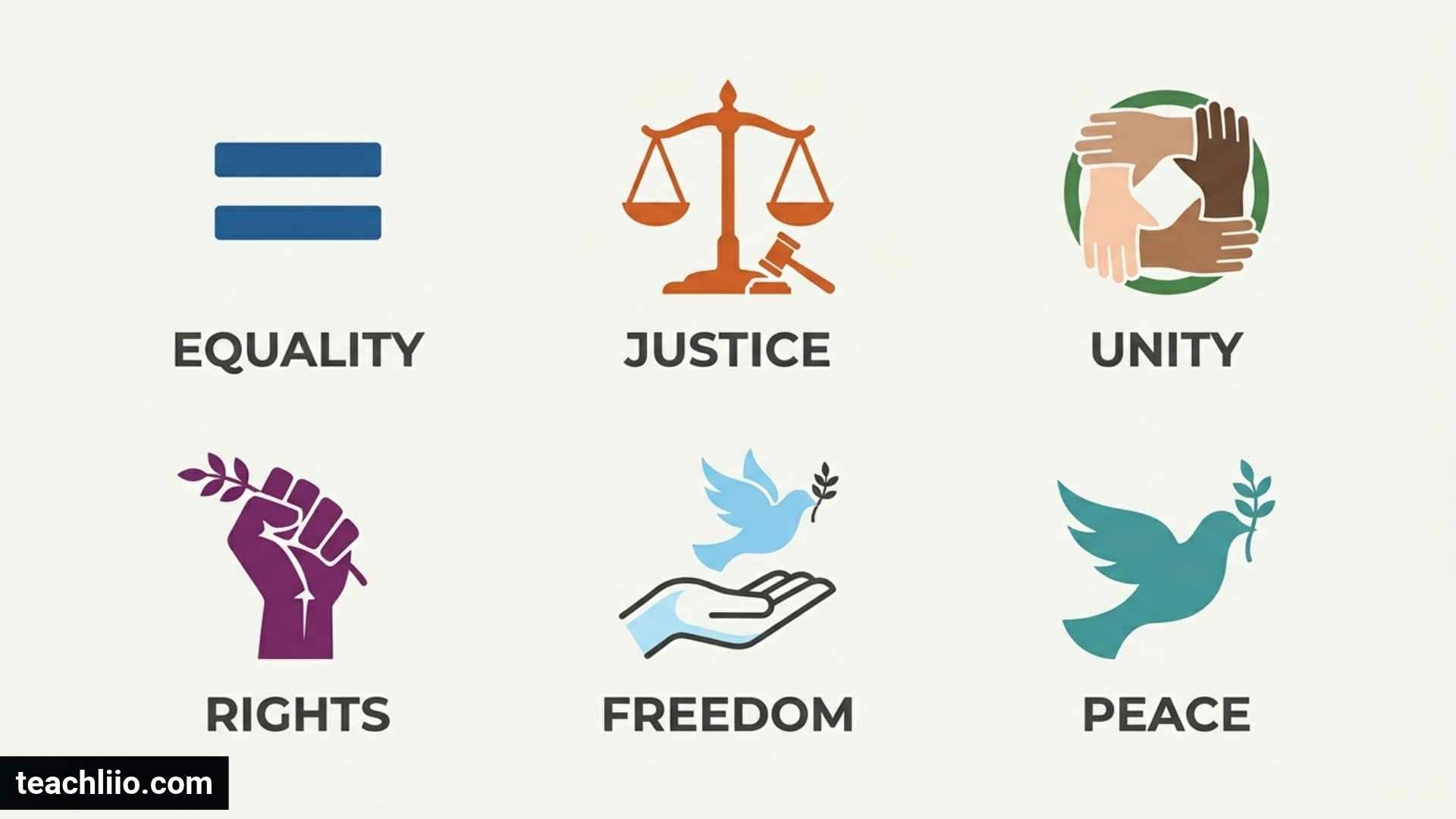
Symbols of equality communicate an important message: every person deserves dignity, respect, fair treatment, and equal opportunities. From the simple equal sign to the scales of justice and the rainbow Pride flag, these symbols help people express ideas about human rights, fairness, inclusion, and freedom from discrimination.
Some symbols have a well-established historical or institutional meaning. Others are visual designs commonly used to represent unity, cooperation, or equal opportunities. Understanding the difference helps you choose the right symbol for a school project, poster, presentation, awareness campaign, or personal design.
In this guide, you will discover 15 symbols of equality, what they mean, how they are used, and which ones best represent gender equality, racial justice, LGBTQ+ inclusion, disability rights, equal pay, and fairness.
What Are Symbols of Equality?
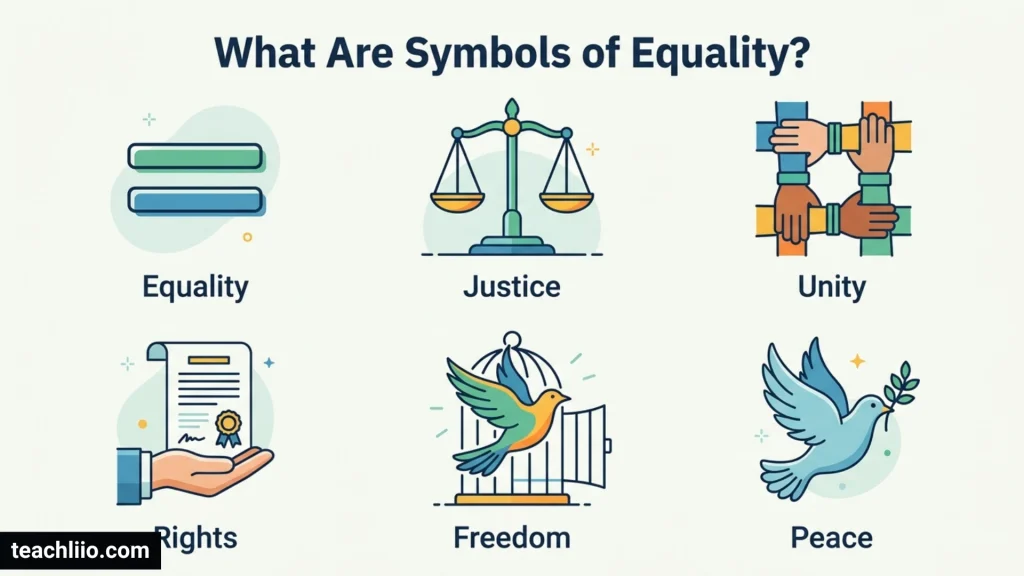
Symbols of equality are signs, images, flags, or emblems that represent equal rights, fair treatment, inclusion, and the belief that people should not face discrimination because of who they are.
The equal sign is a simple symbol of equal value. The scales of justice represent fairness and impartial decisions. The gender equality symbol communicates equal rights across genders, while the rainbow Pride flag represents LGBTQ+ pride, community, and inclusion.
However, not every image associated with equality is an official or universally recognized emblem. A handshake or circle of people, for example, may represent cooperation or belonging in a particular design. Its meaning depends on the context.
15 Symbols of Equality and Their Meanings
1. The Equal Sign (=)
Meaning: Equal value, equal rights, and fairness
The equal sign is one of the clearest visual representations of equality. In mathematics, it indicates that two expressions have the same value. In social contexts, it can represent the principle that people deserve equal rights, opportunities, and respect.
For example, an equal sign on a human rights poster may communicate that people should receive fair treatment regardless of race, gender, disability, religion, or background.
The symbol is simple, adaptable, and easy to recognize. It can also be combined with other imagery to express specific ideas, such as equal pay, equal education, or gender equality.
Best use: General equality posters, classroom assignments, human rights campaigns, and educational graphics.
2. The Gender Equality Symbol
Meaning: Equal rights and opportunities for all genders
The gender equality symbol often combines traditional gender-related imagery with an equals sign. Designs vary, but the central message is that gender should not determine a person’s access to opportunities, rights, or fair treatment.
It is used in campaigns addressing gender discrimination, workplace barriers, unequal representation, and access to education. It can also communicate the importance of respecting people’s dignity and participation in public life.
The United Nations Sustainable Development Goal 5 focuses specifically on achieving gender equality and empowering women and girls. Its official icon is a recognizable design associated with that global objective.
Best use: Women’s rights campaigns, gender equality projects, educational presentations, and workplace inclusion materials.
3. The Scales of Justice
Meaning: Fairness, impartiality, and equality before the law
The scales of justice are a long-established symbol of legal fairness. Balanced scales suggest that evidence should be weighed carefully and that decisions should not be unfairly influenced by wealth, power, prejudice, or social status.
In discussions about equality, the symbol represents the ideal that everyone deserves fair consideration under the law.
However, the scales represent a principle rather than proof that every legal system treats people equally. The symbol is most appropriate when the subject involves justice, legal rights, accountability, or impartial decision-making.
Best use: Law-related assignments, human rights presentations, court-related materials, and campaigns for fair treatment.
4. The Raised Fist
Meaning: Solidarity, resistance, strength, and collective action
The raised fist is a recognizable symbol used by social movements seeking change. It has appeared in labor activism, civil rights struggles, anti-racist movements, and campaigns against oppression.
Its message is one of collective strength. A raised fist can communicate that people are standing together to challenge unfair treatment and demand change.
The symbol has been adopted by different movements throughout history, so its exact meaning depends on the context in which it appears. It is more closely associated with resistance and solidarity than with equality alone.
Best use: Social justice posters, civil rights education, activism materials, and campaigns against discrimination.
5. The Rainbow Pride Flag
Meaning: LGBTQ+ pride, diversity, visibility, and inclusion
The rainbow Pride flag is one of the most recognizable symbols associated with LGBTQ+ communities. Artist and activist Gilbert Baker created the original flag in 1978 for San Francisco’s Gay Freedom Day celebrations.
The original design had eight stripes. The familiar six-color version developed later and became widely recognized as a symbol of pride, community, and diversity.
The flag is frequently displayed during Pride events and in campaigns supporting equal rights for LGBTQ+ people. Variations, including the Progress Pride flag and intersex-inclusive designs, also highlight the importance of representing communities whose experiences may be overlooked.
Best use: LGBTQ+ awareness, Pride events, inclusion campaigns, and projects about equal rights and representation.
For more historical context, see the Smithsonian National Museum of American History’s article on the origins of the Pride flag.
6. The Venus Symbol (♀)
Meaning: Women and femininity
The Venus symbol consists of a circle with a small cross beneath it. It has historically been used to represent women and femininity and is widely recognized in scientific, cultural, and social contexts.
In equality campaigns, it may appear alongside an equal sign or other imagery to communicate women’s rights, equal opportunities, and opposition to gender discrimination.
On its own, however, the Venus symbol primarily identifies women or femininity. It does not automatically represent equality between all genders.
Best use: Women’s rights projects, discussions about women’s representation, and gender-related educational materials.
7. The Transgender Symbol (⚧)
Meaning: Transgender visibility, identity, and inclusion
The transgender symbol combines traditional gender-related elements with a gender-neutral element. It is commonly used to represent transgender identity and, in some contexts, broader gender diversity.
In equality campaigns, it can communicate the importance of respecting people’s identities and ensuring fair access to education, employment, healthcare, and public services.
The symbol is not simply a general sign for every type of equality. Its meaning is more specific, making it particularly useful for projects about transgender visibility, dignity, and inclusion.
Best use: Transgender awareness, inclusion resources, and educational materials about gender identity.
8. Interlocking Gender Symbols
Meaning: Gender-related identities, relationships, and diversity
Interlocking gender symbols combine traditional symbols associated with men and women. Different versions have been used to communicate relationships, sexual orientation, and gender-related identities.
Some designs may be used in broader conversations about gender diversity, but their meanings are not interchangeable. A particular arrangement can have a specific identity-related meaning.
Before using one in a poster or publication, check what the exact design represents. If your purpose is to communicate equality generally, the equal sign or a recognized gender equality icon may be clearer.
Best use: Projects specifically discussing gender identities, relationships, or LGBTQ+ history.
9. The United Nations Sustainable Development Goal 5 Icon
Meaning: Gender equality and the empowerment of women and girls
The United Nations Sustainable Development Goal 5 icon is an official symbol associated with the global effort to achieve gender equality and empower women and girls.
The design incorporates gender-related imagery and an equals sign. It appears in educational materials and campaigns connected with the Sustainable Development Goals.
Goal 5 addresses discrimination, violence, participation in leadership, and other barriers that prevent women and girls from enjoying equal rights and opportunities.
Unlike a general illustration of fairness, this icon has a specific institutional connection. When reproducing it for an official or professional project, follow the relevant United Nations branding guidance.
Best use: School reports, development projects, gender equality presentations, and materials about the Sustainable Development Goals.
10. The Broken Chain
Meaning: Freedom from oppression and unjust restrictions
A broken chain is a visual metaphor for liberation. It suggests that a restriction has been overcome or that people are no longer held back by an oppressive system.
In human rights contexts, the image may represent freedom from unjust laws, forced labor, exclusion, or other forms of oppression.
The broken chain is not a single official symbol of equality, but it can communicate an important part of the equality message: people should not be denied their basic rights through unfair restrictions.
Best use: Human rights posters, freedom-themed projects, historical displays, and campaigns against oppression.
11. The Equal Pay Symbol
Meaning: Fair compensation and equal pay for equal work
Equal-pay imagery often combines an equal sign with money-related elements, such as coins, currency symbols, or a paycheck. Some designs also include workplace imagery to make the message more specific.
The concept is commonly associated with efforts to eliminate discriminatory differences in compensation. Discussions may focus on gender-based pay differences, although fair compensation can involve other forms of discrimination as well.
There is no single universally recognized equal-pay emblem. A simple, clearly labeled design can still communicate the message effectively.
Best use: Workplace equality campaigns, human resources presentations, and projects about fair compensation.
12. The Equal Education Symbol
Meaning: Equal access to learning and educational opportunities
Books, school buildings, and equal signs are often combined in educational graphics to communicate the principle of equal access to education.
These designs may represent the idea that children and adults should have opportunities to learn regardless of their gender, disability, income, location, or social background.
Unlike the Pride flag or the official Sustainable Development Goal icons, an equal-education graphic is generally an illustrative design rather than one universal emblem. Its meaning becomes clear when paired with a caption about educational access.
Best use: School assignments, education awareness campaigns, and presentations about equal learning opportunities.
13. The Accessibility Symbol
Meaning: Accessibility, participation, and inclusion
The familiar wheelchair symbol is widely used to identify accessible spaces and services. It is particularly associated with wheelchair access, accessible parking, and facilities designed for people with mobility disabilities.
Although it is not a universal symbol of equality, it is relevant to equality because access to buildings, transportation, communication, education, and public services affects people’s ability to participate fully in society.
The United Nations Convention on the Rights of Persons with Disabilities identifies accessibility, non-discrimination, inclusion, and equality of opportunity as important principles. It also emphasizes removing barriers that prevent people with disabilities from participating in everyday life.
Accessibility imagery should be used accurately. Disability is diverse, and a wheelchair symbol does not represent every disability or every accessibility need.
Best use: Accessibility information, disability inclusion projects, and campaigns promoting equal participation.
14. The Handshake
Meaning: Cooperation, mutual respect, and agreement
A handshake is commonly understood as a sign of agreement, cooperation, trust, or mutual respect. In equality-focused artwork, it can represent people from different backgrounds working together as partners.
For example, a poster showing two people shaking hands may communicate cooperation across cultural, social, or economic differences.
A handshake is a general visual metaphor, not an established equality emblem on its own. Its message depends on the surrounding design and text.
Best use: Community inclusion campaigns, teamwork presentations, and materials about cooperation and mutual respect.
15. The Circle of People
Meaning: Unity, belonging, and shared humanity
A circle of people from different backgrounds can represent a community in which everyone has a place. The circular arrangement suggests connection and participation rather than separation.
Designers often use this concept to communicate inclusion, diversity, and collective responsibility. Different colors, clothing, or silhouettes may show that people can belong to the same community without losing their individual identities.
A plain circle is not universally recognized as a formal symbol of equality. It works best as an illustrative design accompanied by a clear message about belonging or equal participation.
Best use: Community posters, school projects, diversity presentations, and inclusion campaigns.
Quick Reference: Symbols of Equality and Their Meanings
Use this table to find the most suitable symbol for your topic.
| Symbol | Main meaning | Best topic |
| Equal sign (=) | Equal value and rights | General equality |
| Gender equality symbol | Equal rights across genders | Gender equality |
| Scales of justice | Fairness under the law | Justice and legal rights |
| Raised fist | Resistance and solidarity | Social justice |
| Rainbow Pride flag | LGBTQ+ pride and inclusion | LGBTQ+ rights |
| Venus symbol (♀) | Women and femininity | Women’s rights |
| Transgender symbol (⚧) | Transgender visibility | Gender identity |
| Interlocking gender symbols | Gender-related identities | Gender diversity |
| UN SDG 5 icon | Gender equality | Sustainable development |
| Broken chain | Freedom from oppression | Human rights |
| Equal-pay imagery | Fair compensation | Workplace equality |
| Equal-education imagery | Access to learning | Education rights |
| Accessibility symbol | Access and participation | Disability inclusion |
| Handshake | Cooperation and respect | Community inclusion |
| Circle of people | Unity and belonging | Diversity and inclusion |
Symbols of Racial Equality and Social Justice
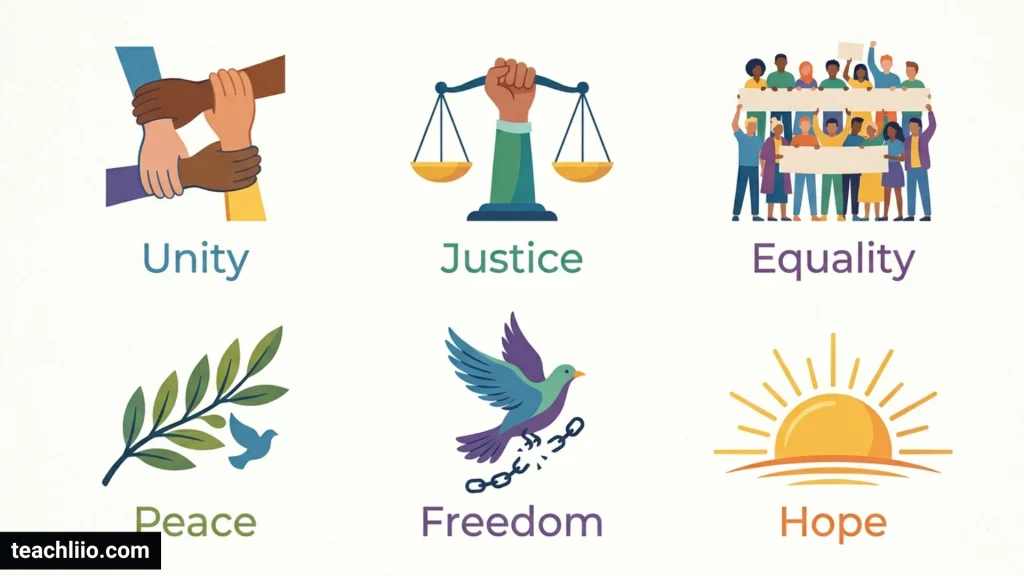
Racial equality means that people should have equal rights and fair opportunities regardless of race or ethnicity. Social justice is a broader concept that includes addressing unfair barriers and discrimination across society.
There is no single symbol universally used to represent every racial equality movement. The equal sign can communicate equal rights across racial groups, while the raised fist has a documented history of use in various resistance and civil rights movements.
For a racial equality poster, choose imagery that matches the specific message. If the subject is equal rights, an equal sign may be suitable. If the subject is resistance to discrimination, the raised fist may be more appropriate.
Historical context matters. Avoid suggesting that one symbol represents every community or movement, and explain the meaning of any design you use.
Equality vs. Equity: What Is the Difference?
Equality and equity are related, but they are not identical.
Equality generally means that people have equal rights and opportunities. Equity recognizes that people may face different barriers and may need different forms of support to access those opportunities fairly.
For example, giving every student the same printed textbook may appear equal. Providing an accessible digital or braille version for a student who needs it can help make the learning opportunity equitable.
Both ideas are relevant to inclusion. Equality describes the goal of fair rights and opportunities, while equity can involve addressing barriers that prevent people from accessing them.
Why Are Symbols of Equality Important?
They Raise Awareness
Symbols can make complex ideas easier to recognize. A simple equal sign or a clearly labeled equality icon can help introduce topics such as discrimination, human rights, and fair treatment.
They Build Solidarity
Shared symbols can show that people support a common goal. Pride flags, for example, can communicate community and visibility, while the raised fist can express solidarity with a movement.
They Support Education
Teachers and students can use symbols to explain concepts such as gender equality, legal fairness, disability inclusion, and equal opportunities. Visual examples can make abstract ideas easier to discuss.
They Encourage Action
A symbol can draw attention to a problem, but lasting equality requires more than imagery. Fair laws, accessible services, inclusive schools, and nondiscriminatory workplaces help turn principles into practice.
How to Choose the Right Symbol of Equality
The best symbol depends on the message you want to communicate.
- For general equality: Use the equal sign.
- For legal fairness: Choose the scales of justice.
- For gender equality: Use a recognized gender equality design or the UN Sustainable Development Goal 5 icon.
- For LGBTQ+ inclusion: Consider the rainbow Pride flag or a specific Pride flag that accurately represents the community.
- For social justice and resistance: The raised fist may be appropriate when its historical context fits the topic.
- For freedom from oppression: A broken chain can represent liberation.
- For equal pay: Use a clear equal-pay graphic with a caption.
- For disability inclusion: Choose accessibility imagery that matches the access need being discussed.
- For unity and belonging: A circle of people can work as a general visual metaphor.
Before publishing a symbol, check its meaning, cultural context, and any specific usage requirements. If the symbol is not universally recognized, explain what it represents rather than presenting its meaning as an established fact.
Frequently Asked Questions
What is the main symbol of equality?
The equal sign (=) is one of the simplest and most recognizable symbols of equality. It can represent equal value, equal rights, and fair treatment. Its meaning depends on the context in which it is used.
What symbol represents equal rights?
The equal sign is a clear general symbol for equal rights. The scales of justice may be more suitable when the subject concerns fairness under the law, while other symbols can communicate specific equality movements.
What is the symbol for gender equality?
Gender equality is often represented by a gender-related symbol combined with an equals sign. The United Nations Sustainable Development Goal 5 icon is also an established symbol associated with achieving gender equality and empowering women and girls.
What symbol represents racial equality?
There is no single universally recognized symbol for racial equality. The equal sign can communicate equal rights, while the raised fist has been used in different civil rights and anti-racist movements to express resistance and solidarity.
Does the rainbow flag represent equality?
The rainbow Pride flag primarily represents LGBTQ+ pride, community, and diversity. It is often displayed to communicate support for inclusion and equal rights, but it has a specific connection to LGBTQ+ identity and history.
What do the scales of justice symbolize?
The scales of justice represent fairness, impartiality, and the careful consideration of evidence. They are often used to express the ideal that everyone deserves fair treatment under the law.
What is a simple symbol of equality for a school project?
The equal sign is a strong choice for a general equality project because it is easy to draw and understand. For more specific topics, students can use the scales of justice for legal fairness, a gender equality icon for gender rights, or an accessibility symbol for disability inclusion.
Is there one symbol that represents equality for everyone?
No single symbol represents every form of equality. Different symbols communicate different ideas, including equal rights, gender equality, racial justice, LGBTQ+ inclusion, disability access, and fair compensation. The best choice depends on the topic and audience.
Conclusion
Symbols of equality help communicate the values of fairness, dignity, inclusion, and equal rights. The equal sign offers a simple message of equal value, the scales of justice represent impartial treatment, the raised fist communicates solidarity, and the rainbow Pride flag represents LGBTQ+ pride and community.
Other designs can help explain equal pay, educational access, disability inclusion, and shared belonging. However, it is important to distinguish widely recognized symbols from general visual metaphors and to consider the history and context of each design.
Choose a symbol that matches your message, explain its meaning clearly, and remember that symbols are only one part of creating a fairer society. Real equality also depends on respecting people’s rights, removing barriers, and ensuring that everyone has a fair opportunity to participate.

I’m Hugo Wetherby, a British author interested in the numbers behind everyday questions. I explore quantities, populations, measurements, records, comparisons, and surprising statistics, turning complicated information into accessible answers. I believe a simple “how many” question can lead to fascinating discoveries, and I enjoy helping readers find those answers.
Books:
How Many? A Guide to Everyday Numbers
The Great Book of Numbers and Quantities