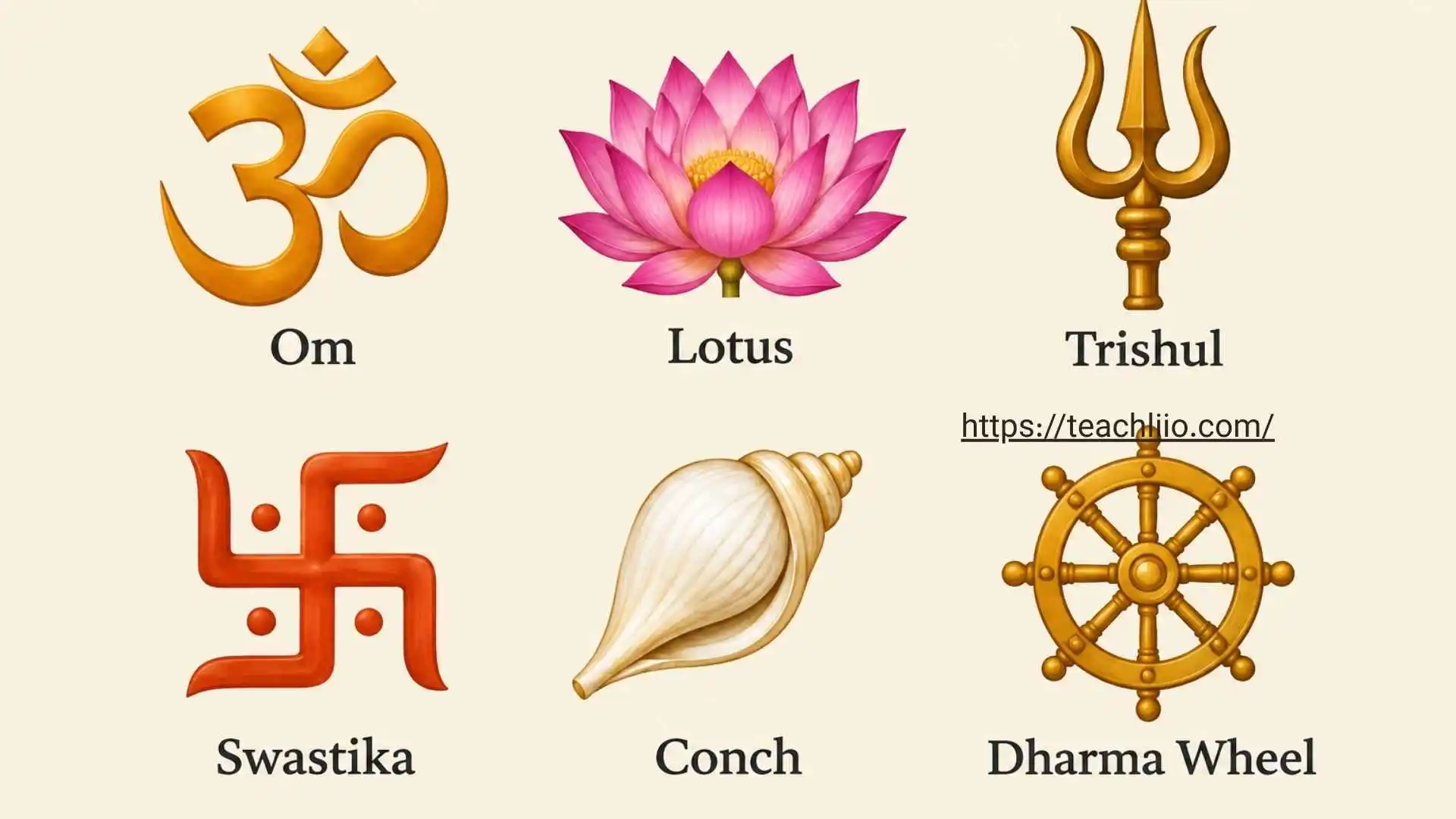
Hinduism has one of the world’s richest traditions of religious symbolism. Sacred symbols appear in temples, homes, prayer spaces, festivals, artwork, jewelry, clothing, and daily rituals. They can represent ideas such as divinity, purity, protection, prosperity, consciousness, devotion, creation, and spiritual growth.
However, Hindu symbols are not simply a collection of pictures with one fixed meaning. Their significance can change according to the deity, religious tradition, scripture, ritual, region, and context in which they are used.
In this guide to Hindu symbols and meanings, you’ll discover the significance of important symbols such as Om, the Swastika, Lotus, Trishula, Shankha, Chakra, Tilaka, Bindi, Sri Yantra, Kalasha, Nandi, Rudraksha, Damaru, Garuda, and the Diya. You’ll also learn where these symbols are used, which deities they are associated with, and how to understand them respectfully.
What Are Hindu Symbols?
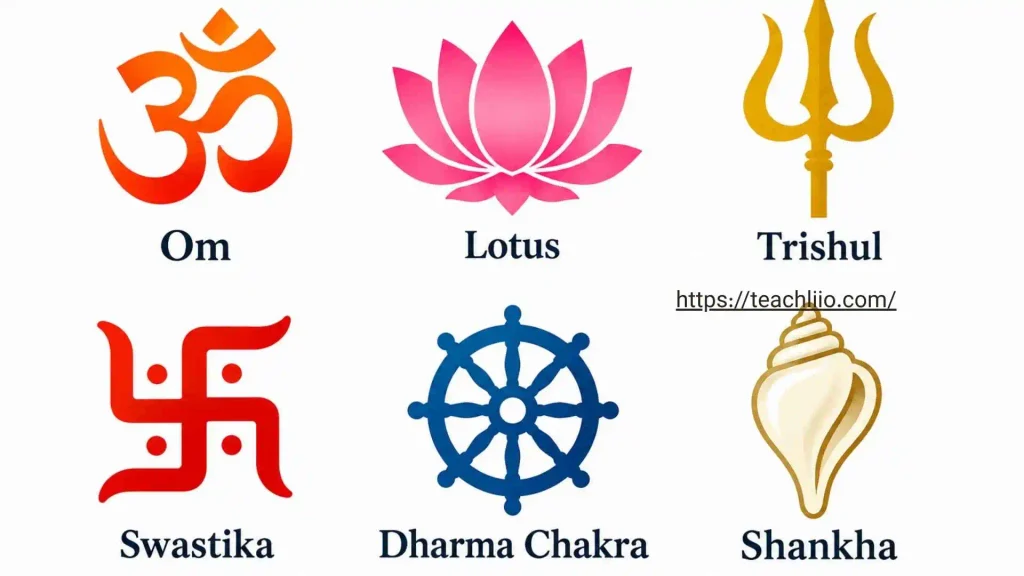
Hindu symbols are visual, written, or ritual representations connected with Hindu religious beliefs and practices. They can communicate spiritual concepts that may otherwise be difficult to express in words.
Some symbols are associated with particular deities. Others have a broader place across Hindu traditions.
For example, Om is widely recognized as a sacred syllable associated with spiritual reality and meditation, while the Trishula is strongly associated with Shiva. The Shankha, or conch, is particularly prominent in Vaishnava traditions and the iconography of Vishnu.
Symbols can also have several layers of meaning. A lotus, for example, may represent purity and spiritual unfolding while also appearing as an attribute of particular deities.
This is why understanding the context of a Hindu symbol is often just as important as knowing its basic definition.
Most Important Hindu Symbols and Their Meanings
1. Om (Aum)
Om, also written as Aum (ॐ), is one of the best-known sacred symbols associated with Hinduism.
Om is connected with sacred sound, meditation, and ultimate reality. It is commonly recited during prayer, meditation, yoga, and other spiritual practices.
The symbol is often understood through the sound itself as well as its written form. In philosophical traditions, Om has been associated with the totality of existence and different states of consciousness.
It is important not to reduce Om to simply meaning “God” or “the universe.” Its interpretation is broader and can vary among Hindu philosophical traditions.
Common associations: sacred sound, consciousness, meditation, ultimate reality, spiritual practice.
2. Hindu Swastika (Swastik)
The Swastika is an ancient auspicious symbol that has been used in Hindu religious and cultural traditions for a very long time.
In Hindu contexts, it is commonly associated with auspiciousness, well-being, good fortune, prosperity, and positive beginnings. It may appear during religious ceremonies, weddings, festivals, on household entrances, and on objects used for worship.
The word is derived from Sanskrit and is traditionally connected with ideas of well-being or good fortune.
The symbol requires historical context because the Nazi regime appropriated a similar form of the swastika in the 20th century and gave it a radically different political meaning. That history should not be confused with the symbol’s much older use in Hinduism and other Asian religious traditions.
Common associations: auspiciousness, prosperity, well-being, good fortune, positive beginnings.
3. Lotus (Padma)
The lotus, known as Padma in Sanskrit, is one of the most recognizable symbols in Hindu religious art.
Because the lotus grows from muddy water while producing a clean and beautiful flower, it is commonly associated with purity, spiritual development, beauty, and transcendence.
The lotus is also connected with several Hindu deities. Lakshmi, the goddess associated with prosperity and abundance, is frequently depicted with or upon a lotus. Brahma is also traditionally represented in association with a lotus.
The symbol can therefore communicate both a general spiritual idea and a specific religious association depending on its context.
Common associations: purity, beauty, spiritual growth, prosperity, transcendence.
4. Trishula
The Trishula, or trident, is one of the most recognizable symbols associated with Shiva.
Its three prongs have been interpreted in different ways within Hindu thought. Depending on the tradition and explanation, they may be associated with concepts such as the three gunas, different aspects of existence, or the powers of creation, preservation, and transformation.
The central idea is not simply physical strength. The Trishula is deeply connected with Shiva’s divine power and role as a deity associated with transformation.
It is commonly seen in Shiva temples, religious artwork, statues, and devotional objects.
Common associations: Shiva, divine power, transformation, spiritual strength.
5. Shankha (Conch Shell)
The Shankha is a sacred conch shell strongly associated with Vishnu and Vaishnava traditions.
The sound produced by a conch can be used in Hindu ritual to mark sacred occasions and create a ceremonial atmosphere. In religious iconography, Vishnu is traditionally depicted holding a conch among his divine attributes.
The Shankha can therefore represent sacred sound, auspiciousness, and the presence of the divine.
Conches may also be used during puja and other religious ceremonies.
Common associations: Vishnu, sacred sound, auspiciousness, ritual, purification.
6. Sudarshana Chakra
The Sudarshana Chakra is the divine discus associated especially with Vishnu.
In Hindu iconography, it represents one of Vishnu’s powerful divine attributes. It is often understood in connection with protection, divine authority, and the restoration of cosmic order.
The word chakra means “wheel” or “disc,” and the Sudarshana Chakra is much more than an ordinary weapon in religious symbolism.
Its meaning is connected with Vishnu’s role as a protector and preserver.
Common associations: Vishnu, protection, divine power, cosmic order.
7. Tilaka
A Tilaka is a mark worn on the forehead in various Hindu traditions.
Its appearance can differ considerably depending on religious lineage, region, ceremony, and personal practice. Some forms consist of lines, dots, or other designs made with substances such as sandalwood paste, sacred ash, or other traditional materials.
A Tilaka can communicate religious affiliation, devotion, ritual participation, or spiritual identity.
Different Hindu traditions use different styles. For example, Shaiva traditions commonly use sacred ash, while Vaishnava traditions have their own distinctive forehead markings.
Common associations: devotion, religious identity, ritual, spiritual practice.
8. Bindi
The Bindi is a dot or decorative mark traditionally worn on the forehead, particularly by women in South Asian cultures.
Its meaning and use have changed across time and communities. In some contexts, it has religious or cultural significance; in modern life, it can also be worn as a cultural or decorative accessory.
The Bindi should not automatically be treated as identical to the Tilaka. Although both may appear on the forehead, their uses, histories, and meanings can differ.
Common associations: cultural identity, tradition, religious symbolism in some contexts, decoration.
9. Sri Yantra
The Sri Yantra, also called Sri Chakra, is a complex geometric diagram associated particularly with Shakta traditions and the worship of the Divine Mother.
It consists of interlocking triangles arranged around a central point known as the bindu.
The geometry is used as a focus for meditation and ritual. Its layered structure is interpreted in different ways within traditions that use it, including relationships between the divine feminine, consciousness, and the cosmos.
Because Sri Yantra belongs to a specialized ritual and philosophical context, its meaning should not be reduced to a generic symbol of “good luck.”
Common associations: Divine Mother, meditation, sacred geometry, consciousness, spiritual practice.
10. Kalasha
The Kalasha is a sacred vessel commonly used in Hindu rituals.
It may be filled with water and decorated with leaves and a coconut or other auspicious elements. The vessel is often associated with abundance, fertility, auspiciousness, and the presence of sacred energy.
Kalashas appear in ceremonies, puja arrangements, weddings, temple rituals, and festival observances.
Its meaning comes not simply from the physical pot but from the ritual role it plays.
Common associations: abundance, auspiciousness, fertility, sacred presence, ritual.
11. Nandi
Nandi, the sacred bull, is closely associated with Shiva.
In many Shiva temples, a statue of Nandi is positioned facing the main shrine of Shiva. Nandi is understood as Shiva’s vehicle (vahana) and is also connected with devotion and service.
For devotees, Nandi can represent qualities such as strength, loyalty, patience, and unwavering devotion.
The presence of Nandi outside a Shiva temple can therefore provide an important clue about the temple’s religious association.
Common associations: Shiva, devotion, strength, loyalty, patience.
12. Rudraksha
Rudraksha refers to the seeds traditionally associated with the Rudraksha tree and widely used in Hindu devotional practices, especially those connected with Shiva.
Rudraksha beads are commonly arranged into malas and used during prayer, meditation, or chanting.
Traditional beliefs attribute spiritual significance to these beads, although specific claims about their powers vary considerably between traditions and modern sources.
Their strongest religious significance comes from their role in devotional practice and their association with Shiva.
Common associations: Shiva, devotion, meditation, prayer, spiritual practice.
13. Damaru
The Damaru is a small hourglass-shaped drum traditionally associated with Shiva.
In religious imagery, Shiva is often depicted holding a Damaru. Its sound can symbolize sacred vibration, rhythm, and the creative power of sound.
The Damaru is particularly important in representations of Shiva as Nataraja, the cosmic dancer.
Rather than viewing it simply as a musical instrument, Hindu symbolism places it within a larger understanding of creation, rhythm, and divine activity.
Common associations: Shiva, sound, rhythm, creation, cosmic dance.
14. Garuda
Garuda is a powerful divine bird-like figure and the traditional vehicle of Vishnu.
Garuda is commonly associated with strength, speed, protection, and divine power. He appears in Hindu mythology and religious artwork and also has significance in other South and Southeast Asian traditions.
When Garuda appears alongside Vishnu, the relationship helps identify the religious context of the artwork.
Common associations: Vishnu, protection, strength, speed, divine service.
15. Diya
A Diya, or traditional oil lamp, is an important element in many Hindu religious ceremonies.
Lighting a lamp is commonly associated with light overcoming darkness, knowledge overcoming ignorance, and the presence of auspiciousness.
Diyas are especially prominent during festivals such as Diwali, but they are also used in everyday puja and temple worship.
The lamp’s meaning can therefore be both practical and deeply symbolic.
Common associations: light, knowledge, auspiciousness, spiritual awareness.
Hindu Symbols and the Deities They Represent
Many Hindu symbols can help identify the deity or religious tradition represented in an image.
| Symbol | Strong Association | Common Symbolic Ideas |
| Om | Broad Hindu traditions | Sacred sound, consciousness |
| Trishula | Shiva | Divine power, transformation |
| Damaru | Shiva | Sound, rhythm, creation |
| Nandi | Shiva | Devotion, strength |
| Shankha | Vishnu | Sacred sound, auspiciousness |
| Sudarshana Chakra | Vishnu | Protection, divine authority |
| Garuda | Vishnu | Strength, protection |
| Lotus | Several deities | Purity, beauty, spiritual growth |
| Sri Yantra | Shakta traditions | Divine feminine, meditation |
| Kalasha | Ritual traditions | Abundance, auspiciousness |
This table is a starting point rather than a complete religious classification. Hindu iconography is extensive, and the same object can have different meanings depending on the setting.
Hindu Symbols of Protection, Prosperity, and Spirituality
Hindu symbolism covers many different aspects of religious life.
Symbols Associated With Protection
The Sudarshana Chakra is strongly connected with Vishnu’s protective role. Garuda is also associated with divine strength and protection.
Other protective imagery appears throughout Hindu traditions, often connected with particular deities, mantras, rituals, or sacred objects.
Symbols Associated With Prosperity
The lotus, Kalasha, and Swastika can appear in contexts connected with auspiciousness and prosperity.
The lotus is especially associated with Lakshmi, while the Kalasha frequently appears in ceremonies where abundance and auspicious beginnings are emphasized.
Symbols Associated With Spirituality
Om is particularly important in meditation and philosophical traditions.
The Sri Yantra is another important symbol for contemplative and ritual practices, especially within Shakta traditions.
The Diya offers another simple but powerful image: light representing knowledge and spiritual awareness.
Where Are Hindu Symbols Used?
Hindu symbols can be encountered in many parts of religious and cultural life.
Hindu Temples
Temple architecture, statues, carvings, flags, and ritual objects often contain symbolic imagery.
A visitor may encounter symbols connected with Shiva, Vishnu, Devi, Ganesha, or other deities.
Home Worship
Many Hindu households maintain a dedicated area for prayer. Sacred symbols may be placed there alongside images or statues of deities, lamps, flowers, and ritual vessels.
Festivals and Ceremonies
Symbols are especially visible during religious festivals, weddings, housewarming ceremonies, and other auspicious occasions.
Swastikas, Kalashas, Diyas, rangoli designs, and other sacred imagery may be incorporated into ceremonies.
Jewelry and Personal Items
Some Hindu symbols appear on pendants, bracelets, clothing, artwork, and other personal objects.
However, the fact that a symbol is sold as jewelry does not mean its religious meaning has disappeared. Understanding its traditional context is important.
Do Hindu Symbols Have the Same Meaning Everywhere?
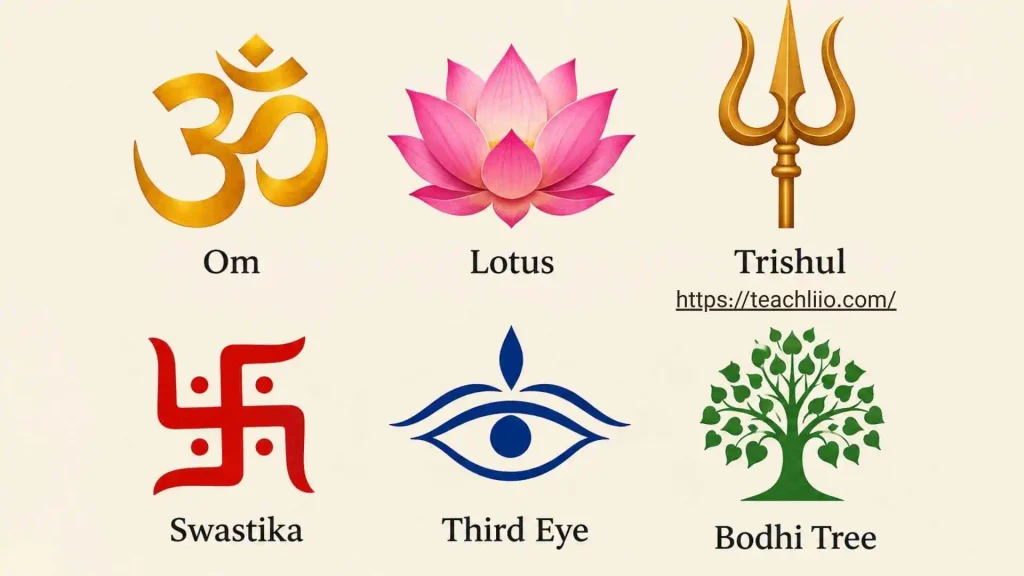
No. Hinduism contains many traditions, philosophical schools, regional practices, and forms of worship.
A symbol may have:
- A broad religious meaning
- A specific connection with one deity
- A particular interpretation within a philosophical school
- A ritual meaning
- A regional cultural meaning
- A modern decorative interpretation
For this reason, statements such as “this symbol always means exactly this one thing” can be misleading.
A better approach is to explain the most widely recognized meaning while acknowledging important variations.
This is particularly useful when interpreting symbols found in artwork or religious ceremonies.
Hindu Swastika vs. the Nazi Symbol: Why Context Matters
The swastika is an especially important example of why historical context matters.
The symbol existed in South Asian religious and cultural traditions long before its adoption by the Nazi movement. In Hindu contexts, it has traditionally been associated with auspiciousness, prosperity, well-being, and positive beginnings.
The Nazi regime appropriated the symbol during the 20th century and used it as a political emblem connected with racist and genocidal ideology.
Therefore, seeing a swastika in a Hindu temple, wedding ceremony, or traditional religious setting should be understood within its Hindu cultural and religious context.
At the same time, historical awareness is essential because the symbol has acquired a very different association in many parts of the modern Western world.
Bindi vs. Tilaka: What’s the Difference?
The terms Bindi and Tilaka are sometimes used interchangeably in casual explanations, but they are not necessarily the same thing.
A Bindi is commonly understood as a forehead dot or mark that can have cultural, social, religious, or decorative significance depending on context.
A Tilaka is more directly associated with religious marking and can take many forms. Different Hindu traditions use distinctive Tilaka designs to express devotion or religious affiliation.
The meaning of either mark depends on the individual, community, tradition, and situation.
Therefore, it is better to avoid assuming that every forehead mark has one universal meaning.
How to Interpret Hindu Symbols Respectfully
Learning the meaning of a Hindu symbol is more valuable when the symbol is understood within its living religious tradition.
Look at the Context
Ask where the symbol appears.
Is it in a temple, a wedding ceremony, a home shrine, religious artwork, jewelry, or a festival?
The setting can provide important clues.
Consider the Associated Deity
A Trishula beside an image of Shiva has a different context from a geometric symbol used during a meditation practice.
Looking at surrounding imagery can help identify the intended meaning.
Avoid Oversimplification
Hindu symbols can have several layers of interpretation. A short definition may be useful, but it should not be presented as the only possible interpretation.
Distinguish Tradition From Modern Claims
Some websites make extraordinary claims about the supernatural or scientific powers of religious symbols.
Such claims should not automatically be presented as established fact. A responsible article should distinguish traditional beliefs from historical evidence and modern interpretations.
Frequently Asked Questions
What is the most important Hindu symbol?
There is no single symbol that can universally be called the most important for every Hindu tradition. Om is among the most widely recognized sacred symbols and has major significance in Hindu religious and philosophical traditions, but different communities place different emphasis on different symbols.
What does Om mean in Hinduism?
Om, or Aum, is a sacred syllable associated with sound, consciousness, meditation, and ultimate reality. Its interpretation varies across Hindu philosophical traditions.
What does the Hindu Swastika symbolize?
In Hindu contexts, the Swastika is traditionally associated with auspiciousness, well-being, prosperity, good fortune, and positive beginnings.
Why is the lotus important in Hinduism?
The lotus is commonly associated with purity, beauty, spiritual growth, and transcendence. It also has important associations with deities such as Lakshmi and Brahma.
What does the Trishula represent?
The Trishula is strongly associated with Shiva. Its three prongs have received several interpretations within Hindu traditions, including associations with different threefold aspects of existence and divine power.
What does the conch shell mean in Hinduism?
The Shankha, or conch, is strongly associated with Vishnu and Vaishnava traditions. It can represent sacred sound, auspiciousness, and ritual significance.
What is the difference between a Bindi and a Tilaka?
A Bindi is generally a forehead dot or mark with cultural, religious, social, or decorative uses, while a Tilaka is more specifically associated with religious marking in various Hindu traditions. Their appearance and meaning can vary.
Which Hindu symbols represent prosperity?
The lotus, Kalasha, and Swastika can be associated with auspiciousness or prosperity in different Hindu contexts. The lotus has a particularly strong association with Lakshmi.
Which Hindu symbols represent protection?
Protection can be represented through several deities and symbols. The Sudarshana Chakra and Garuda, for example, have strong associations with Vishnu and divine protection.
Are all Hindu symbols religious?
Not necessarily. Some symbols have strong religious meanings but may also be used as cultural or decorative elements. Their significance depends heavily on the context and the person or community using them.
Can one Hindu symbol have multiple meanings?
Yes. Many Hindu symbols have multiple layers of meaning. Their interpretation can depend on religious tradition, deity, scripture, ritual, philosophical school, region, and context.
Conclusion
Hindu symbols are more than decorative images. They provide visual ways of expressing ideas about divinity, consciousness, purity, devotion, protection, prosperity, transformation, and spiritual growth.
From Om and the lotus to the Trishula, Shankha, Chakra, Swastika, Tilaka, Sri Yantra, Kalasha, Nandi, Rudraksha, Damaru, Garuda, and Diya, each symbol has a story and a context. Some are broadly recognized across Hindu traditions, while others have especially strong connections with particular deities or schools of practice.
The most important thing to remember is that Hinduism is diverse. A symbol does not always have one universal definition. Understanding where it is used, which deity or tradition it relates to, and how practitioners understand it provides a much more accurate picture.
When approached with historical awareness and cultural respect, Hindu symbols offer a fascinating window into one of the world’s oldest and most diverse religious traditions.

I’m Oscar Radcliffe, a British writer who enjoys uncovering the numbers hidden within ordinary questions. My work explores quantities, counts, statistics, measurements, and fascinating comparisons across different subjects. I aim to present reliable information clearly, helping readers satisfy their curiosity while discovering interesting facts they may never have considered before.
Books:
The Science of Counting
How Many? Fascinating Numbers Explained