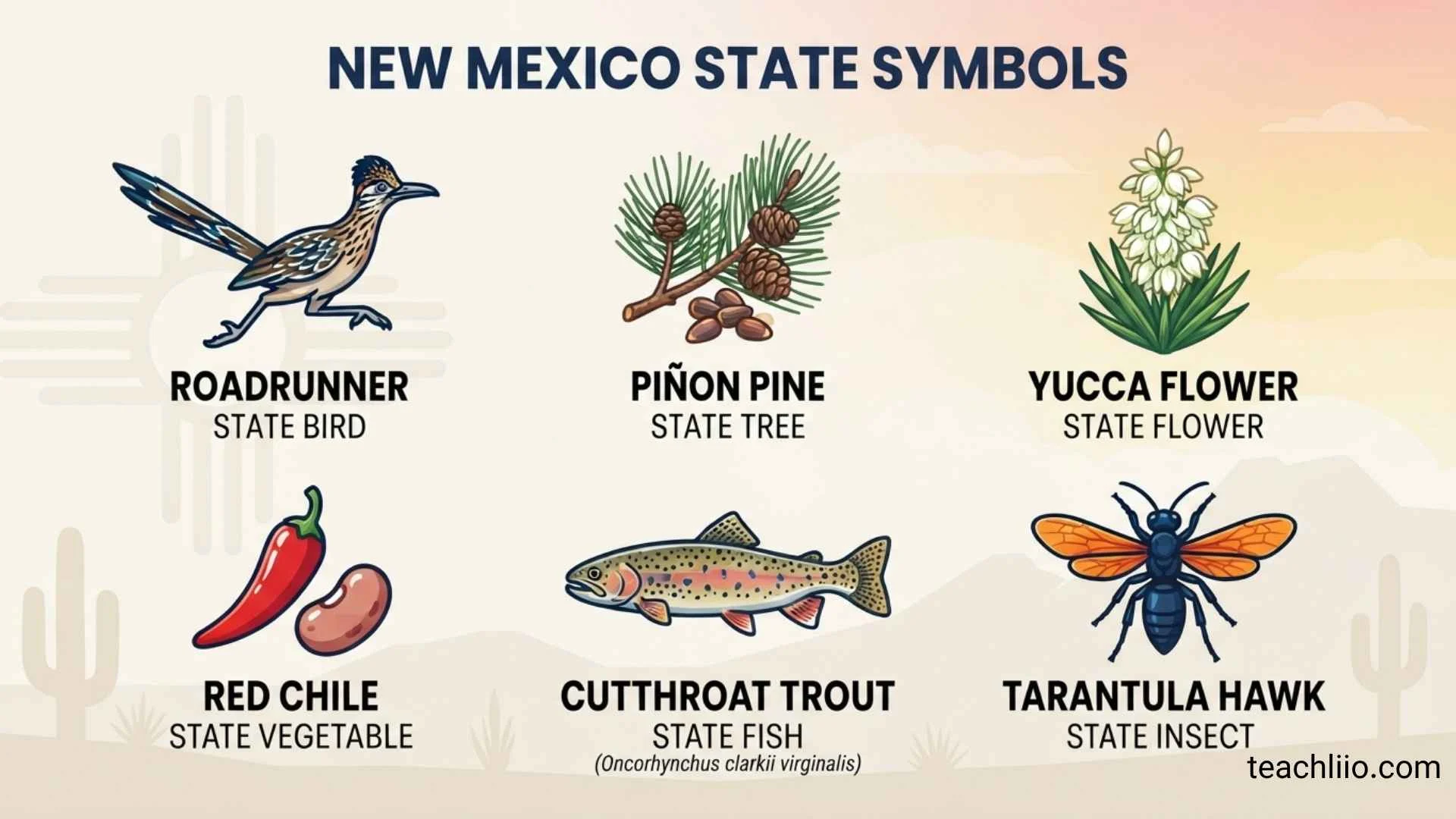
New Mexico state symbols reflect far more than the state’s famous desert landscapes. They represent Indigenous heritage, Spanish and Mexican history, wildlife, food traditions, art, music, agriculture, and the distinctive identity of the Southwest.
Some symbols are familiar, such as the New Mexico state flag, the roadrunner, yucca, and turquoise. Others are much more unusual. New Mexico officially recognizes symbols connected to its aroma, guitar, train, necklace, bolo tie, cookie, cowboy music, and even its state question: “Red or green?”
This guide explains the major official New Mexico state symbols, what they mean, when they were adopted, and why they matter. It also separates official state symbols from popular New Mexico icons that are culturally important but do not necessarily have official designation.
New Mexico State Symbols at a Glance
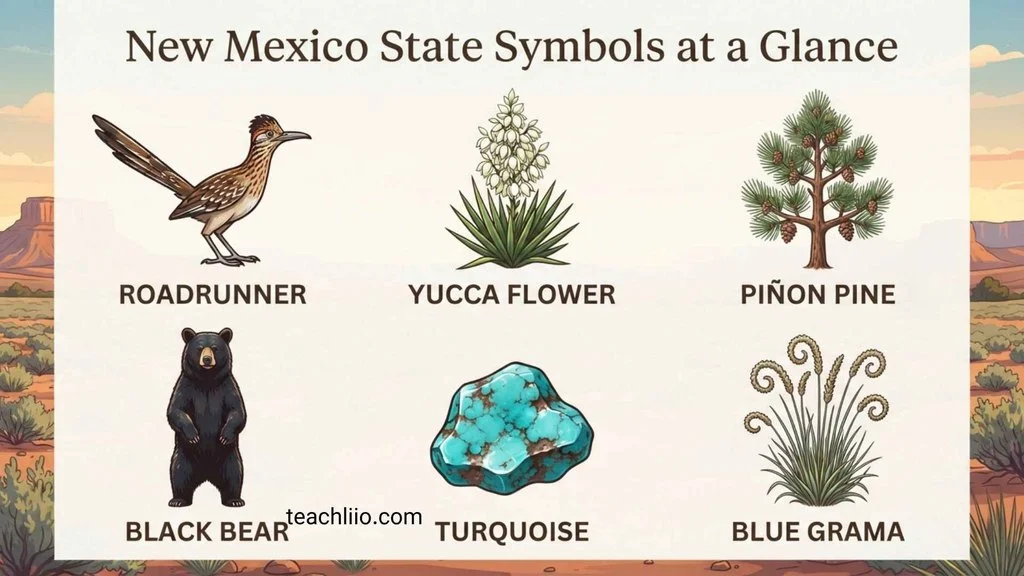
New Mexico has one of the most diverse collections of official state symbols in the United States. The state recognizes symbols from nature, culture, food, history, transportation, music, literature, and everyday life.
| Category | Official New Mexico Symbol |
| State Flag | Zia symbol on red and yellow |
| State Seal | Great Seal of New Mexico |
| State Bird | Greater Roadrunner |
| State Flower | Yucca |
| State Tree | Piñon |
| State Mammal | American Black Bear |
| State Fish | Rio Grande Cutthroat Trout |
| State Reptile | New Mexico Whiptail |
| State Amphibian | New Mexico Spadefoot |
| State Butterfly | Sandia Hairstreak |
| State Insect | Tarantula Hawk Wasp |
| State Fossil | Coelophysis |
| State Gem | Turquoise |
| State Grass | Blue Grama |
| State Vegetables | Chile and Pinto Beans |
| State Cookie | Biscochito |
| State Aroma | Green Chile Roasting |
| State Question | “Red or green?” |
| State Nickname | Land of Enchantment |
| State Slogan | Everybody Is Somebody in New Mexico |
| State Train | Cumbres & Toltec Scenic Railroad |
| State Guitar | New Mexico Sunrise |
| State Bolo Tie | New Mexico State Bolo Tie |
| State Necklace | Native American Squash Blossom Necklace |
The official list also includes cultural designations such as state songs, poems, folklorist, cowboy song, aircraft, and state capitol.
New Mexico State Flag and the Zia Symbol
The New Mexico state flag is one of the most recognizable state flags in America. Its simple design features a red Zia sun symbol against a yellow background.
The current flag was adopted in 1925 and was designed by Dr. Harry Mera. His wife, Reba Mera, helped create the winning design.
What Does the Zia Symbol Mean?
The Zia symbol comes from a design associated with Zia Pueblo and is based on the importance of the number four in Zia beliefs.
The four groups of rays extend from the central circle in the four directions. The number four is associated with important parts of life and the natural world.
These include concepts such as:
- Four directions
- Four seasons
- Four times of day
- Four stages of life
The symbol therefore communicates balance, continuity, and the interconnected nature of life.
What Do the Four Rays Represent?
The four rays make the Zia symbol visually distinctive, but their meaning is more important than their appearance.
The design connects the physical world with ideas about time, direction, age, and the relationship between people and nature. This is one reason the Zia symbol has become such a powerful representation of New Mexico.
It is important to recognize that the symbol has a specific Indigenous cultural connection rather than treating it simply as a decorative Southwestern design.
Why Are the New Mexico Flag Colors Red and Yellow?
The flag uses red and yellow partly to reflect New Mexico’s Spanish heritage. These colors were associated with the Spanish flag of the period of Queen Isabella of Castile.
The combination also gives the flag a strong visual identity while placing New Mexico’s Indigenous-inspired Zia design within a broader historical context.
New Mexico State Seal
The Great Seal of New Mexico is another important symbol of the state’s identity and history.
The seal contains two eagles. One is the American bald eagle, while the other is the Mexican eagle. Together, they represent the transition of the region from Mexican territory to part of the United States.
What Do the Two Eagles Mean?
The smaller Mexican eagle is protected by the larger American eagle.
This arrangement symbolizes New Mexico’s historical relationship with Mexico and its later status as a U.S. state. Rather than erasing the earlier history, the seal visually acknowledges the territory’s changing political identity.
What Does “Crescit Eundo” Mean?
The Latin phrase “Crescit Eundo” appears on the seal.
It means “It grows as it goes.”
The phrase suggests progress, development, and increasing strength. It remains one of the most recognizable expressions associated with New Mexico.
Why Does the Seal Say 1912?
The date 1912 refers to the year New Mexico became the 47th state of the United States.
The present form of the Great Seal was adopted after statehood, with the current design approved in 1913.
New Mexico State Bird
Greater Roadrunner
The Greater Roadrunner became New Mexico’s official state bird in 1949.
This bird is particularly appropriate for New Mexico because it is well adapted to the state’s dry environments. Roadrunners are fast-running birds that can survive in landscapes where water may be limited.
The bird is also deeply connected with Southwestern imagery and is easily recognized by its long legs, distinctive crest, and ground-running behavior.
For many people, the roadrunner represents New Mexico’s rugged desert character.
New Mexico State Flower
Yucca
The yucca became New Mexico’s official state flower in 1927.
Yucca plants are strongly associated with the Southwest and can survive in dry environments. Their ability to grow in harsh conditions makes them a fitting representation of New Mexico’s landscape.
Several yucca species occur in the state, including the soaptree yucca.
The flower is not simply attractive; it also reflects the relationship between plants, climate, and Southwestern culture.
New Mexico State Tree
Piñon Tree
The piñon, or nut pine, is New Mexico’s official state tree.
The piñon is especially important because its nuts have long been used as food and its presence is closely connected with the state’s natural landscapes.
The tree represents resilience and the distinctive woodland environments found across parts of New Mexico.
Its cultural importance extends beyond botany because piñon nuts remain a recognizable part of Southwestern food traditions.
New Mexico State Animal and Wildlife Symbols
New Mexico’s wildlife symbols show how closely the state’s identity is connected to its diverse ecosystems.
American Black Bear
The American Black Bear is New Mexico’s official state mammal.
The species is found in forested mountain areas of the state and has become particularly famous through the story of Smokey Bear.
Smokey was a real bear cub rescued after a major wildfire in the Lincoln National Forest near Capitan, New Mexico. His story eventually helped turn him into an internationally recognized symbol of wildfire prevention.
Rio Grande Cutthroat Trout
The Rio Grande Cutthroat Trout is New Mexico’s state fish.
It is native to cold mountain streams and lakes and is an important part of New Mexico’s aquatic ecosystems.
Its designation also highlights the importance of protecting high-elevation waterways and native fish populations.
New Mexico Whiptail
The New Mexico Whiptail is the state’s official reptile.
This lizard is especially interesting because it is an all-female species in which reproduction occurs without males. It is found in various habitats across the state.
The whiptail became an official state symbol in 2003.
New Mexico Spadefoot
The New Mexico Spadefoot is the official state amphibian.
It is adapted to dry conditions and can survive in environments where permanent water is scarce. Temporary rain-filled pools can become important breeding sites.
Its designation demonstrates that New Mexico’s official wildlife symbols are not limited to large or famous animals.
Sandia Hairstreak
The Sandia Hairstreak is New Mexico’s state butterfly.
This small butterfly is associated with dry, rocky environments and can be found in parts of the state’s characteristic landscape.
Although it may be less familiar to visitors than the roadrunner or black bear, it represents New Mexico’s smaller and often overlooked wildlife.
Tarantula Hawk Wasp
The Tarantula Hawk Wasp is the official state insect.
Its large size and striking appearance make it one of New Mexico’s most memorable insects. The designation followed a student-centered effort that helped bring attention to this unusual Southwestern species.
The tarantula hawk is also known for its relationship with tarantulas, which are used as prey for its reproductive cycle.
New Mexico State Geological Symbols
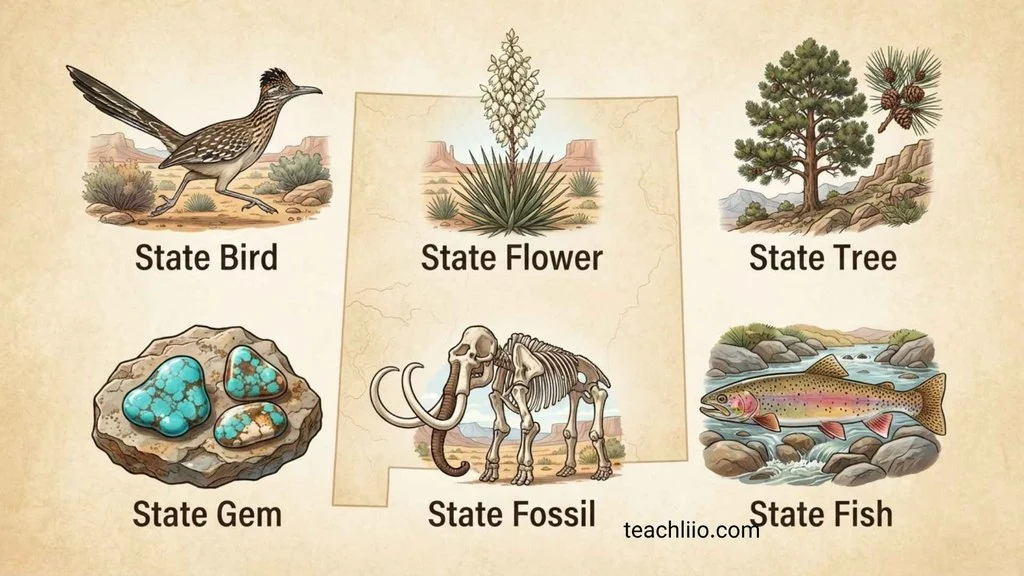
New Mexico’s geology and paleontology are also represented by official symbols.
Turquoise
Turquoise is New Mexico’s official state gem.
The blue-green stone has a long history in Indigenous Southwestern cultures and later became strongly associated with New Mexican silver jewelry and regional art.
Its color also fits the visual identity of the Southwest, where turquoise jewelry has become an important cultural and artistic tradition.
Coelophysis
Coelophysis is New Mexico’s official state fossil.
This small, early dinosaur is especially important to New Mexico’s paleontological history. Fossils discovered in the state have helped scientists understand early dinosaur evolution.
Its designation connects New Mexico’s modern identity with a prehistoric landscape that existed millions of years ago.
Blue Grama
Blue Grama is the official state grass.
It is widespread throughout New Mexico and occurs in all 33 counties. The grass is also important as forage for livestock and wildlife.
As a native grass adapted to dry conditions, it represents the state’s grassland ecosystems particularly well.
New Mexico State Food Symbols
Food is one of the strongest parts of New Mexico’s cultural identity.
Chile and Pinto Beans
New Mexico officially recognizes chile and pinto beans as its state vegetables.
The two foods are closely connected with New Mexican cuisine. Chile provides the distinctive flavor and heat associated with many regional dishes, while pinto beans are a common staple.
Rather than choosing one over the other, the state recognizes both.
Biscochito
The biscochito, sometimes spelled bizcochito, is New Mexico’s official state cookie.
It was designated in 1989 and became the first official state cookie in the United States.
The cookie has Spanish colonial roots and is traditionally associated with celebrations, holidays, and family traditions.
What Is New Mexico’s State Question?
New Mexico’s official state question is:
“Red or green?”
It refers to the choice between red chile and green chile.
For visitors, the question can sound surprising, but for New Mexicans it represents a genuine part of the state’s food culture.
What Is the State Answer to “Red or Green?”
If you cannot decide, New Mexico offers another famous response:
“Red and green or Christmas.”
This means you can order both red and green chile.
The phrase has become one of the most recognizable expressions of New Mexican food culture.
New Mexico’s Unusual State Symbols
New Mexico stands out because its official symbols go far beyond the usual bird, flower, tree, and animal.
State Aroma
New Mexico’s official state aroma is the smell of green chile roasting in the fall.
This unusual designation reflects how deeply chile is connected with everyday life and regional identity.
The symbol became official in 2023, making New Mexico the first state to formally designate an official aroma.
State Aircraft
New Mexico recognizes the hot-air balloon as its state aircraft.
This designation fits the state’s strong connection with ballooning and the annual Albuquerque International Balloon Fiesta.
State Guitar
The official state guitar is “New Mexico Sunrise.”
The instrument was created by Pimentel and Sons and incorporates New Mexico-inspired decorative elements.
It represents the state’s connection with music, craftsmanship, and Southwestern artistic traditions.
State Train
The Cumbres & Toltec Scenic Railroad is New Mexico’s official state train.
The historic narrow-gauge railroad runs between Chama, New Mexico, and Antonito, Colorado.
It preserves an important part of the region’s railroad history while also serving as a major heritage attraction.
State Necklace
The Native American Squash Blossom Necklace is New Mexico’s official state necklace.
The necklace typically includes silver blossom-shaped beads and the distinctive Naja pendant.
Its designation recognizes the importance of Native American jewelry traditions in New Mexico.
State Bolo Tie
The bolo tie is New Mexico’s official state tie.
It was officially designated in 2007.
The bolo tie is strongly associated with Southwestern clothing and has become one of the region’s most recognizable fashion symbols.
New Mexico State Nickname and Slogan
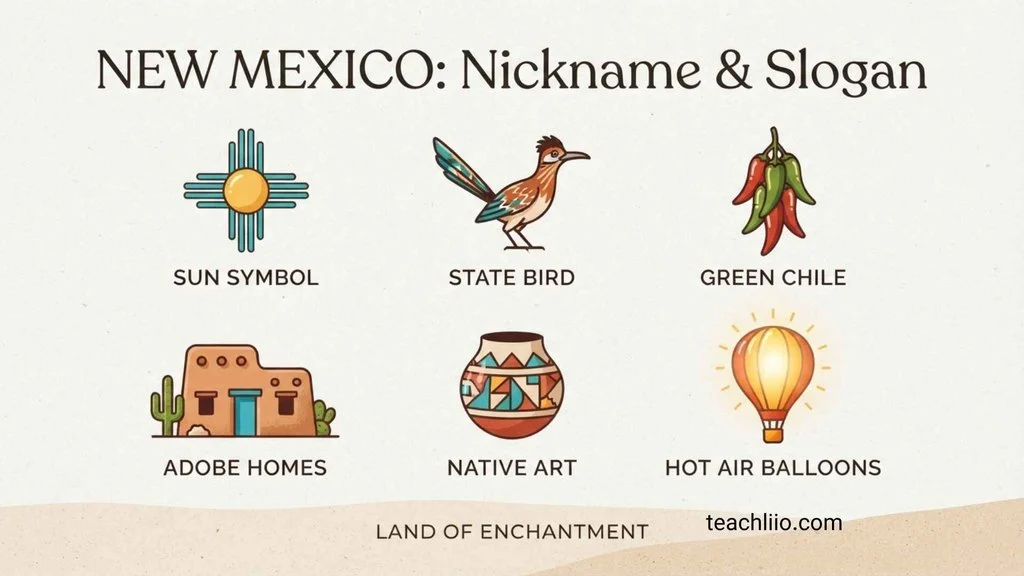
Land of Enchantment
New Mexico’s official nickname is “The Land of Enchantment.”
The phrase captures the state’s combination of dramatic landscapes, history, culture, art, and Southwestern atmosphere.
It became an official state nickname in 1999, although the phrase had been associated with New Mexico for decades before that.
Everybody Is Somebody in New Mexico
New Mexico’s official state slogan is:
“Everybody Is Somebody in New Mexico.”
The slogan emphasizes community, inclusion, and the idea that every individual has value.
It was adopted in 1975.
New Mexico State Songs, Poems, and Cultural Symbols
New Mexico’s official symbols also include creative works and cultural roles.
State Song
“O Fair New Mexico” is New Mexico’s official state song. It was written by Elizabeth Garrett and became official in 1917.
Spanish-Language State Song
New Mexico also recognizes “Así Es Nuevo Mexico” as an official Spanish-language state song.
This reflects the state’s deep Spanish-language and Hispanic cultural heritage.
State Ballad
“Land of Enchantment,” written by Michael Martin Murphey, was designated as the state ballad in 1989.
State Cowboy Song
“Under the New Mexico Skies,” written by Syd Masters, is the official state cowboy song.
It was designated in 2009 and reflects New Mexico’s ranching and Western traditions.
State Poems
New Mexico recognizes official poems, including “A Nuevo Mexico” by Luis Tafoya as its Spanish state poem.
These literary symbols help represent the state’s bilingual and multicultural identity.
State Folklorist
New Mexico also recognizes a state folklorist, a designation that highlights the importance of preserving traditional stories, customs, music, crafts, and community traditions.
The current official state-symbol listing identifies Claude Stephenson as the state folklorist.
New Mexico State Capitol
The New Mexico State Capitol is another official state symbol.
Often called the Roundhouse, the building is notable for its circular design and its use of the Zia-inspired sun motif.
The current capitol was dedicated in 1966 and reflects New Mexico’s combination of modern government and regional architectural identity.
Official New Mexico Symbols vs. Popular Icons
Not everything strongly associated with New Mexico is an official state symbol.
For example, people commonly associate the state with:
- Adobe architecture
- Hot-air balloons
- Desert landscapes
- Saguaro-like Southwestern imagery
- Native American pottery
- Route 66
- Santa Fe
- Albuquerque
- Green chile
- Turquoise jewelry
- Smokey Bear
Some of these have official connections, while others are simply powerful cultural or tourism icons.
This distinction matters when researching New Mexico state symbols for a school assignment or factual article. A popular symbol should not automatically be described as an officially designated state symbol.
New Mexico State Symbols for Students
If you need New Mexico symbols for a school project, start with the most recognizable examples:
- Flag: Zia symbol on red and yellow
- Bird: Greater Roadrunner
- Flower: Yucca
- Tree: Piñon
- Mammal: American Black Bear
- Fish: Rio Grande Cutthroat Trout
- Reptile: New Mexico Whiptail
- Amphibian: New Mexico Spadefoot
- Gem: Turquoise
- Fossil: Coelophysis
- Insect: Tarantula Hawk Wasp
- Butterfly: Sandia Hairstreak
- Grass: Blue Grama
- Vegetables: Chile and Pinto Beans
- Cookie: Biscochito
- Nickname: Land of Enchantment
- Question: “Red or green?”
- Slogan: Everybody Is Somebody in New Mexico
For a classroom presentation, explaining why each symbol represents New Mexico is usually more useful than simply memorizing the names.
Most Famous New Mexico State Symbols
Some symbols are especially recognizable outside New Mexico.
The Zia flag, Greater Roadrunner, turquoise, green chile, yucca, piñon, and Smokey Bear connection are among the strongest examples.
The state flag is particularly powerful because it combines Indigenous cultural influence with New Mexico’s Spanish historical heritage in a simple design.
Food symbols are also extremely recognizable because chile has become a defining part of New Mexican cuisine.
Most Unusual New Mexico State Symbols
If you are looking for symbols that make New Mexico different from other states, these are especially interesting:
- Official state aroma: green chile roasting
- State question: “Red or green?”
- State guitar: New Mexico Sunrise
- State train: Cumbres & Toltec Scenic Railroad
- State necklace: Native American Squash Blossom Necklace
- State bolo tie
- State cowboy song
- State folklorist
These unusual designations show that New Mexico defines its identity through everyday culture as well as nature and history.
Why New Mexico State Symbols Matter
New Mexico’s official symbols tell a larger story.
Its wildlife symbols represent desert, mountain, grassland, and aquatic ecosystems. Its food symbols reflect centuries of culinary development. Its flag and seal connect Indigenous, Spanish, Mexican, and American history.
Its music, poetry, jewelry, architecture, and transportation symbols show that state identity is not limited to government or geography.
Together, these symbols present New Mexico as a place where different historical and cultural influences continue to exist alongside one another.
Frequently Asked Questions
What is the most famous symbol of New Mexico?
The New Mexico state flag and its Zia sun symbol are among the state’s most recognizable official symbols. The roadrunner, turquoise, and green chile are also strongly associated with New Mexico.
What does the Zia symbol mean?
The Zia symbol is associated with Zia Pueblo and uses groups of four rays extending from a central circle. The number four has important meaning within Zia cultural traditions.
What is New Mexico’s state bird?
The Greater Roadrunner is New Mexico’s official state bird. It became the state bird in 1949.
What is New Mexico’s state flower?
The yucca is New Mexico’s official state flower. It was adopted in 1927.
What is New Mexico’s state tree?
The piñon, or nut pine, is New Mexico’s official state tree.
What is New Mexico’s state animal?
The American Black Bear is the official state mammal. It is also connected with the famous story of Smokey Bear, the wildfire-prevention symbol.
What is New Mexico’s state fish?
The Rio Grande Cutthroat Trout is the official state fish.
What is New Mexico’s state gem?
Turquoise is New Mexico’s official state gem and has a long connection with Southwestern and Native American jewelry traditions.
What is New Mexico’s state fossil?
Coelophysis is New Mexico’s official state fossil. It was an early dinosaur that lived millions of years ago.
What is New Mexico’s state cookie?
The biscochito is New Mexico’s official state cookie. It was designated in 1989.
What is New Mexico’s state question?
New Mexico’s official state question is “Red or green?”, referring to the choice between red and green chile.
What is the official answer to “Red or green?”
The famous answer is “Red and green or Christmas,” meaning that both red and green chile can be ordered together.
What is New Mexico’s official nickname?
New Mexico’s official nickname is “The Land of Enchantment.”
What is New Mexico’s state slogan?
The official state slogan is “Everybody Is Somebody in New Mexico.”
Does New Mexico have an official state aroma?
Yes. New Mexico’s official state aroma is the smell of green chile roasting in the fall.
Why does New Mexico have so many unusual state symbols?
New Mexico uses official symbols to represent many parts of its identity, including food, music, art, wildlife, history, transportation, literature, and cultural traditions. This produces a much broader collection than the traditional bird-flower-tree combination found in many states.
Conclusion
New Mexico state symbols provide a fascinating snapshot of the state’s identity. The Zia flag represents an important Indigenous cultural connection, while the Great Seal reflects New Mexico’s transition from Mexican territory to American statehood.
The roadrunner, yucca, piñon, black bear, trout, whiptail, spadefoot, butterfly, and tarantula hawk highlight the state’s wildlife and natural environments. Turquoise, Coelophysis, and blue grama add geological and ecological depth.
Then there are the symbols that make New Mexico especially distinctive: green chile as an official aroma, “Red or green?” as the state question, the biscochito, the bolo tie, the squash blossom necklace, the state guitar, and the historic state train.
Taken together, these symbols show that New Mexico’s identity comes from many layers—Indigenous heritage, Spanish and Mexican history, American statehood, nature, food, art, music, and everyday traditions. That is what makes the state’s official symbols more than a simple list: they are a compact way to understand the character and history of New Mexico.

I’m Oscar Radcliffe, a British writer who enjoys uncovering the numbers hidden within ordinary questions. My work explores quantities, counts, statistics, measurements, and fascinating comparisons across different subjects. I aim to present reliable information clearly, helping readers satisfy their curiosity while discovering interesting facts they may never have considered before.
Books:
The Science of Counting
How Many? Fascinating Numbers Explained