Ares is one of the most recognizable gods of ancient Greek mythology, but his symbols are more interesting than simply calling him the “god of war.” He represents the violent, physical, emotional, and chaotic side of warfare, and his imagery reflects that role.
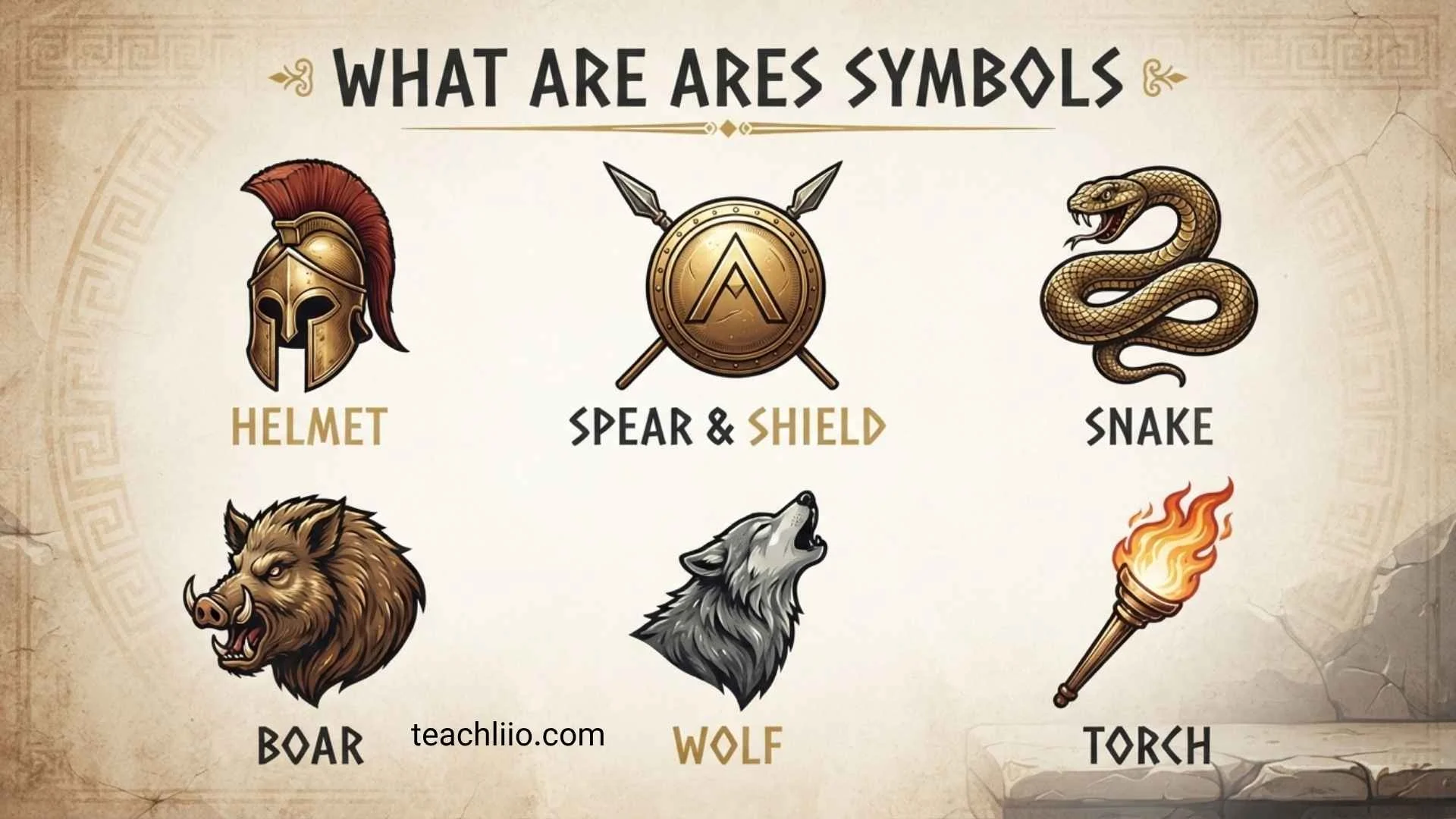
So, what are Ares symbols? His best-known symbols and attributes include the helmet and spear, while the shield, sword, armor, and war chariot are also strongly connected with his identity as a warrior. Ancient traditions also associate Ares with several animals and birds, particularly the serpent, vulture, owls, and woodpecker.
Understanding these symbols can reveal how ancient Greeks imagined war, courage, aggression, fear, and battlefield violence. It also helps explain an important distinction between Ares and Athena, another Greek deity closely connected with warfare.
This guide explores the major Ares symbols and meanings, his weapons and warrior attributes, sacred animals, ancient artistic representations, and how his symbolism differs from that of Athena and the Roman god Mars.
What Are Ares Symbols?
The most important symbols associated with Ares are his helmet and spear. His shield, armor, and sword are also important attributes that identify him as a warrior.
Unlike some Greek gods who have an instantly recognizable object or plant, Ares is often represented through a collection of military equipment. Ancient artists commonly portrayed him as an armed warrior, although his exact appearance could vary.
Here are the major symbols and attributes associated with Ares:
| Symbol or Attribute | What It Represents |
| Helmet | Warrior identity and readiness for battle |
| Spear | Combat, aggression, and offensive warfare |
| Shield | Defense and military conflict |
| Sword | Close combat and martial power |
| Armor | Protection and the identity of a warrior |
| Chariot | Movement, power, and battle |
| Serpent | A sacred animal connected with Ares |
| Vulture | Battlefield death and the aftermath of war |
| Owl | War omens and conflict |
| Woodpecker | A less familiar bird associated with Ares |
| Warhorse | His role as a chariot-driving warrior |
It is useful to distinguish symbols from attributes. The helmet and spear are among Ares’s clearest identifying symbols, while objects such as the shield and sword are broader elements of Greek warrior equipment.
What Does Ares Symbolize?
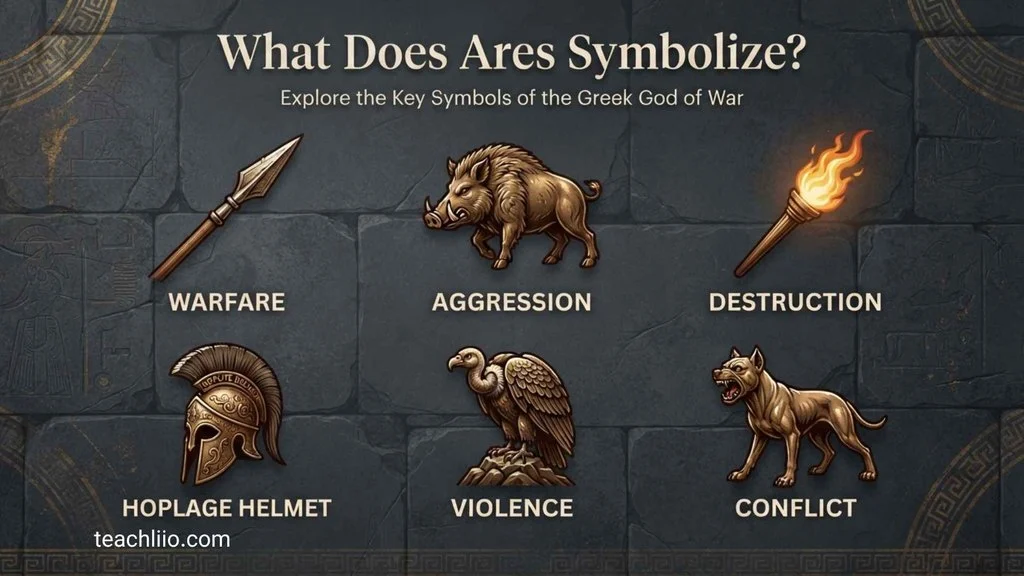
Ares symbolizes the more violent and physical side of warfare.
He is associated with battle, aggression, courage, fighting strength, anger, violence, fear, and the destructive consequences of conflict. This makes his symbolism different from the modern idea of war as simply strategy or military organization.
Ares represents the experience of being caught in the fight itself.
His symbolism can therefore be understood through several ideas:
- War: His central domain.
- Aggression: The impulse to attack and fight.
- Courage: The bravery required to enter combat.
- Violence: The destructive side of warfare.
- Fear: The emotional terror created by battle.
- Strength: Physical and martial power.
- Conflict: The struggle between opposing forces.
- Bloodshed: The human cost of warfare.
- Battlefield chaos: The confusion and intensity of combat.
Ancient sources also connect Ares with courage and fighting strength while recognizing the fear, cowardice, death, and destruction that can accompany war.
This is why reducing Ares to simply “the god of war” misses an important part of his mythology.
Ares Spear Symbol and Meaning
The spear is one of Ares’s most recognizable symbols.
In Greek warfare, the spear was a fundamental weapon, making it a natural attribute for a deity whose identity centered on battle. Ancient literary descriptions repeatedly present Ares carrying or using a spear during combat.
What Does Ares’s Spear Represent?
Ares’s spear can represent:
- Offensive warfare
- Physical strength
- Aggression
- Combat readiness
- Martial skill
- Direct confrontation
- The dangerous nature of battle
The spear is especially meaningful because it places Ares directly inside the action of warfare. It is not merely a ceremonial object; it is an image of the warrior prepared to fight.
In artistic representations, the spear helps viewers recognize Ares as a martial figure. His connection with the spear also distinguishes him from gods whose primary attributes have nothing to do with battlefield combat.
Ares Helmet Symbol and Meaning
The warrior’s helmet is arguably Ares’s most distinctive visual attribute.
Ancient representations frequently show Ares wearing or holding a helmet. Theoi identifies the peaked warrior’s helmet as his main attribute, and descriptions of Ares repeatedly emphasize his armed appearance.
What Does Ares’s Helmet Represent?
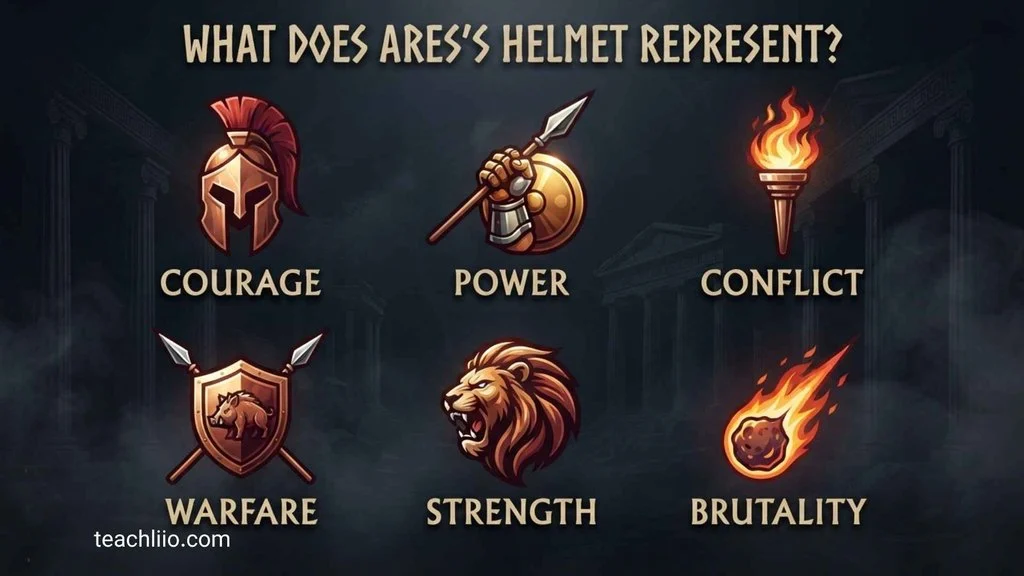
The helmet can symbolize:
- A warrior’s identity
- Readiness for combat
- Military power
- Protection
- Discipline within battle
- The dangers of warfare
A helmet also changes the appearance of the person wearing it. Instead of looking like an ordinary civilian, the figure becomes visibly prepared for conflict.
This symbolism is especially important in ancient Greek art, where military equipment helped identify warriors and heroic figures. Greek helmets were part of the broader set of offensive and defensive equipment used by soldiers.
Ares Shield and Sword
The shield and sword are also closely associated with Ares, although they should be understood as warrior attributes rather than automatically treating every piece of military equipment as an exclusive Ares symbol.
Ares is commonly depicted with a shield, spear, helmet, and armor, while a sword can also appear in his imagery.
What Does Ares’s Shield Represent?
The shield represents the defensive side of warfare.
It can symbolize:
- Protection
- Military defense
- Combat
- Courage under attack
- The organized side of battle
Interestingly, ancient representations did not necessarily use one unique “Ares shield design.” Theoi notes that shields associated with Ares could carry generic decorative emblems rather than a symbol exclusive to the god.
What Does Ares’s Sword Represent?
The sword represents close-range combat and the physical reality of fighting.
It can symbolize:
- Martial strength
- Personal combat
- Aggression
- Violence
- The warrior’s willingness to fight at close range
The spear and sword therefore complement each other: the spear emphasizes the armed warrior in battle, while the sword evokes close combat.
Ares Armor and Warrior Attributes
Ares is frequently represented wearing the equipment of a Greek warrior.
His armor can include:
- Helmet
- Breastplate
- Shield
- Spear
- Greaves
- War belt
- Sword
Ancient descriptions portray his armor as brilliant and formidable, emphasizing his supernatural warrior identity.
Why Is Armor a Symbol of Ares?
Armor represents preparation for battle.
It also communicates that Ares is not a passive observer of warfare. He is imagined as a participant who enters combat fully equipped.
In symbolic terms, his armor can represent:
protection + strength + readiness + military identity
This is why Ares is often easier to recognize when shown as an armed warrior rather than through a single object.
Ares Chariot and Its Meaning
The war chariot is another important part of Ares’s imagery.
Ancient sources describe Ares as driving a chariot pulled by four extraordinary horses. Theoi records the horses’ names as Aithon, Phlogios, Konabos, and Phobos.
What Does Ares’s Chariot Symbolize?
The chariot can represent:
- Rapid movement into battle
- Military power
- Destruction
- Command
- Battlefield mobility
- The force of a charging army
The chariot also strengthens Ares’s image as a god who actively enters warfare.
Rather than simply representing the idea of conflict, the chariot makes the symbolism dynamic: Ares is moving toward the battlefield.
Ares Sacred Animals and Their Meanings
Animals are another important part of Ares’s symbolism, but this is an area where careful wording matters.
The most consistently identified sacred animal is the serpent. Ancient traditions also connect Ares with several birds, especially the vulture, eagle-owl, barn owl, and woodpecker.
Some modern lists also include the dog and boar, but these should not automatically be presented as equivalent to Ares’s most clearly documented sacred animals.
Why Is the Serpent Associated With Ares?
The serpent is particularly important in Ares mythology.
Theoi identifies the serpent as Ares’s sacred animal and connects serpents with several of his sacred places and myths.
The association can be understood through Ares’s mythology involving dangerous guardian serpents and dragons.
The serpent therefore represents more than ordinary aggression. It can evoke:
- Danger
- Hidden power
- Protection
- Ferocity
- The threatening side of nature
Ares’s connection with serpent imagery also appears in artistic representations where a serpent can be shown with him or incorporated into his shield imagery.
Why Is the Vulture Associated With Ares?
The vulture has a particularly dark connection to warfare.
Vultures are associated with battlefields because they feed on the bodies of the dead. Ancient sources therefore connected the bird with war, death, and ill omens.
This makes the vulture an especially meaningful symbol of the consequences of war.
Rather than representing victory, it can represent what remains after the fighting has ended.
The symbolism can be summarized as:
battle → death → battlefield aftermath
That connection makes the vulture different from the spear or helmet. The weapon represents the act of fighting, while the vulture represents one of war’s consequences.
Are Owls Symbols of Ares?
Yes, some owl species are associated with Ares.
Theoi identifies the barn owl and eagle-owl among birds associated with the god and notes their connection with omens of war and sedition.
This point is worth explaining because readers may confuse Ares’s owls with Athena’s famous owl.
The owl most strongly associated with Athena is a different species from the owls listed in Ares traditions.
So it is inaccurate to assume that every Greek mythological owl automatically belongs to Athena.
Why Is the Woodpecker Associated With Ares?
The woodpecker is one of the lesser-known Ares associations.
Theoi identifies it as a bird associated with Ares and describes it as a favorable omen in one ancient mythological tradition.
This makes the woodpecker an interesting example of why Ares’s symbolism cannot be reduced entirely to violence and destruction.
Not every creature associated with Ares carries the same negative meaning.
Is the Dog a Symbol of Ares?
The dog is sometimes included in modern lists of Ares symbols, but it deserves more cautious treatment than the serpent, vulture, or certain owls.
Dogs can appear in broader Greek associations with warfare, guardianship, aggression, and the battlefield. However, the strongest mythology references do not place the dog on exactly the same footing as Ares’s clearly identified sacred serpent and sacred birds.
For an accurate article, it is better to describe the dog as an associated animal in some traditions or modern summaries rather than declaring it universally “the sacred animal of Ares.”
This distinction helps separate well-attested ancient associations from simplified modern symbol lists.
Is the Boar a Symbol of Ares?
The boar is another association that requires context.
The boar appears in myths involving Ares, including the story of Adonis, in which Ares is said in one tradition to transform into a boar.
Because of this and other mythological connections, the boar sometimes appears on modern lists of Ares symbols.
However, it is better not to present the boar as though ancient sources consistently identified it as Ares’s primary sacred animal.
The serpent and certain birds have clearer documentation as sacred animals.
Ares Symbols in Greek Mythology
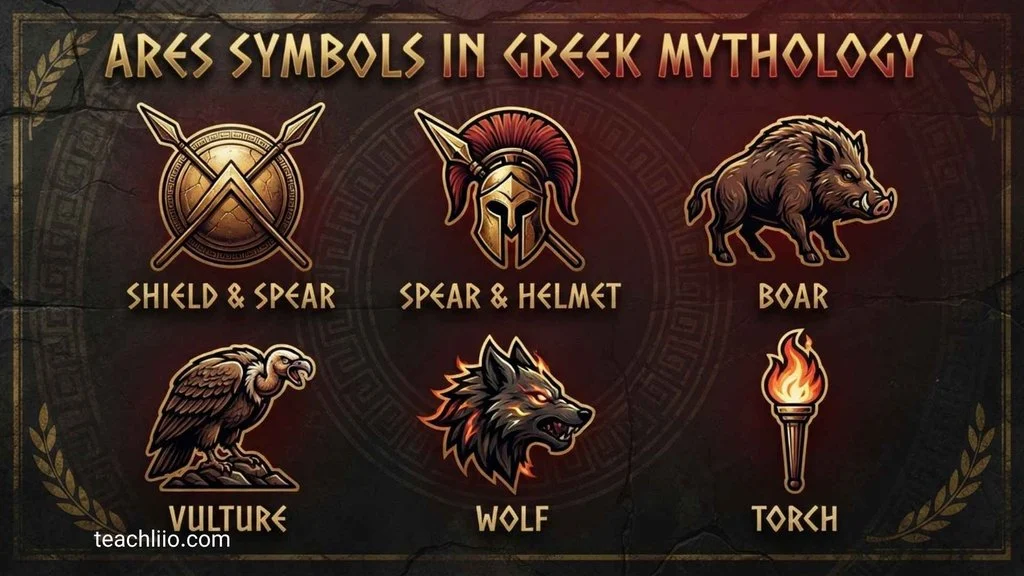
Ares’s symbols make more sense when viewed within his broader role in Greek mythology.
He is associated with war, but mythology does not present warfare as one simple concept.
Ares embodies:
- Physical fighting
- Aggression
- Courage
- Anger
- Violence
- Fear
- Conflict
- Battlefield destruction
His children Phobos and Deimos are particularly important to this symbolism because their names are associated with fear and terror. They are frequently connected with Ares in war imagery and mythology.
This gives Ares’s symbolism an emotional dimension.
The spear represents the weapon.
The helmet represents the warrior.
The chariot represents movement into battle.
The vulture represents the battlefield’s aftermath.
Phobos and Deimos represent fear and terror.
Together, these elements create a much fuller picture of what Ares represents.
Ares vs Athena: How Their Symbols Differ
Ares and Athena are both associated with warfare, but they represent different aspects of it.
Ares is associated more strongly with the violent and physical side of combat, while Athena is traditionally connected with strategy, wisdom, military skill, and disciplined warfare.
| Ares | Athena |
| Physical combat | Strategy |
| Aggression | Tactical intelligence |
| Violence | Discipline |
| Battlefield fury | Military planning |
| Helmet and spear | Helmet and spear |
| Serpent and war birds | Little owl and other attributes |
| Fear and conflict | Wisdom and counsel |
This distinction is one of the most useful ways to understand Ares.
The two gods can both appear with warrior equipment, but their mythological personalities and functions are different.
Athena’s military symbolism is generally connected with intelligence and strategy, while Ares represents the more uncontrolled and violent dimension of fighting.
That contrast is why Ares and Athena can appear together in Greek art while still representing different approaches to warfare.
Ares vs Mars: Are They the Same God?
Ares is the Greek god, while Mars is his Roman counterpart.
The two are commonly identified with one another, but their cultural roles were not completely identical.
Ares was strongly associated with the violent and chaotic side of battle. Mars became an especially important figure in Roman religion and was closely connected with Rome’s military identity.
The Roman name for Ares is Mars, which is also why the planet Mars became connected with the Roman war god and, by extension, the Greek Ares. Theoi identifies Mars as Ares’s Roman counterpart.
Why Are Ares and Mars Often Confused?
The confusion happens because Roman mythology frequently identified Greek gods with Roman counterparts.
However, cultural context matters.
Calling Ares simply “Mars” can hide differences between Greek and Roman religious traditions. It is more accurate to say that Mars is the Roman counterpart of Ares rather than treating the two traditions as completely interchangeable.
Ares Symbols in Ancient Greek Art
Ancient Greek artists often depicted Ares as a warrior, but identifying him is not always straightforward.
He may appear as:
- A mature bearded warrior
- A youthful warrior
- A helmeted figure
- A spear-bearing warrior
- An armored figure
- A shield-bearing warrior
- A figure connected with a chariot
Theoi notes that Ares can be difficult to identify in ancient art because many of his attributes are ordinary pieces of Greek warrior equipment.
This is an important point.
A helmet and spear do not automatically prove that an ancient artwork depicts Ares. The same equipment could belong to a mortal soldier, hero, or another mythological warrior.
Why Is Ares Sometimes Difficult to Identify?
The answer is simple: his appearance is not completely unique.
Unlike a deity with a very unusual object or animal, Ares often looks like the idealized Greek warrior.
Context therefore becomes important.
Artists and viewers could use:
- surrounding figures
- inscriptions
- mythological scenes
- specific attributes
- narrative context
to identify the figure.
What Do Ares’s Symbols Represent Today?
Modern interpretations often use Ares symbols to represent strength, courage, combat, aggression, masculinity, rebellion, and warrior energy.
However, modern symbolic interpretations should not automatically be presented as ancient Greek beliefs.
For example, someone today might use a spear as a symbol of determination or a helmet as a symbol of protection. Those meanings can be inspired by Ares, but they are modern interpretations rather than necessarily being direct ancient religious meanings.
This distinction is useful when writing about mythology because it prevents modern symbolism from being confused with historical evidence.
What Is the Most Important Symbol of Ares?
The helmet is often treated as Ares’s principal identifying attribute, while the spear is another defining symbol of his warrior identity. Theoi specifically identifies the helmet as his main attribute and lists the spear among his standard attributes.
If you need one simple visual symbol for Ares, a helmeted warrior holding a spear is a strong representation.
That combination communicates his identity much more clearly than a generic sword or shield alone.
Ares Symbols vs Ares Attributes: What’s the Difference?
The terms “symbol” and “attribute” are often used interchangeably online, but they can be separated for clarity.
A symbol is an object, animal, or image that represents a broader idea.
An attribute is an identifying object or feature commonly shown with a particular deity.
For Ares:
Primary symbols and attributes:
- Helmet
- Spear
Other warrior attributes:
- Shield
- Sword
- Armor
- Greaves
- Chariot
Sacred animals and birds:
- Serpent
- Vulture
- Eagle-owl
- Barn owl
- Woodpecker
This classification is more accurate than putting every associated object into one undifferentiated list.
Frequently Asked Questions
What are the main symbols of Ares?
The main symbols and attributes of Ares include the helmet and spear, along with the shield, sword, armor, and war chariot. His sacred animal is the serpent, while several birds are also associated with him.
What does Ares symbolize?
Ares symbolizes warfare, physical combat, aggression, courage, violence, anger, fear, and the destructive side of battle. His mythology focuses strongly on the intense and violent aspects of conflict.
What animal represents Ares?
The serpent is the clearest sacred animal associated with Ares. The vulture, eagle-owl, barn owl, and woodpecker are also associated with him in ancient traditions.
Is the boar a symbol of Ares?
The boar is associated with Ares in certain myths and later symbolic lists, including traditions surrounding the story of Adonis. However, it is better to describe the boar as an association rather than Ares’s primary sacred animal.
Why is the vulture associated with Ares?
The vulture is associated with Ares because of its connection with battlefields and the bodies of the dead. It therefore represents the darker consequences of warfare.
Why is the serpent sacred to Ares?
The serpent is associated with Ares through mythology involving dangerous guardian serpents and sacred places connected with the god. It is specifically identified as his sacred animal in major mythology references.
What does Ares’s spear symbolize?
Ares’s spear represents direct combat, offensive warfare, aggression, and the physical power of the warrior. It is one of his defining attributes in ancient literature and art.
What does Ares’s helmet symbolize?
The helmet represents the warrior, military readiness, protection, and preparation for combat. It is considered one of Ares’s most important identifying attributes.
What does Ares’s shield represent?
The shield represents the defensive side of warfare, protection, military combat, and the equipment of a Greek warrior. It is an important attribute of Ares, although shield designs were not necessarily unique to him.
Is the owl a symbol of Ares?
Certain owl species, including the eagle-owl and barn owl, are associated with Ares in ancient traditions. They should not be confused with Athena’s famous owl, which belongs to a different species.
Is the dog sacred to Ares?
The dog appears in some modern lists of Ares associations, but the ancient evidence is less direct than it is for the serpent, vulture, certain owls, and woodpecker. It is therefore better described as an associated animal rather than Ares’s primary sacred animal.
Is Ares the same as Mars?
Ares is the Greek god of war, while Mars is his Roman counterpart. The two are closely identified, but their roles developed within different Greek and Roman religious traditions.
How is Ares different from Athena?
Ares is strongly associated with the violent and physical side of warfare, while Athena is more closely associated with strategy, wisdom, military planning, and disciplined combat.
Conclusion
The symbols of Ares reveal much more about Greek ideas of warfare than a simple list of weapons can show.
His helmet and spear are among his clearest identifying attributes. His shield, sword, armor, and chariot reinforce his image as a powerful warrior. His sacred serpent and associated birds—including the vulture, eagle-owl, barn owl, and woodpecker—add another layer to his mythology.
The deeper meaning becomes clearer when these symbols are considered together. The helmet represents the warrior, the spear represents direct combat, the shield represents defense, the chariot represents movement into battle, and the vulture reflects the grim aftermath of warfare.
Ares also becomes easier to understand when compared with Athena. Both are connected with war, but Ares represents its violent and physical dimension, while Athena is more closely associated with strategy and disciplined military wisdom.
Most importantly, not every object or animal found in a modern Ares-symbol list has the same historical status. Separating primary attributes, warrior equipment, sacred animals, and later associations creates a more accurate picture of this complex Greek god.

I’m Hugo Wetherby, a British author interested in the numbers behind everyday questions. I explore quantities, populations, measurements, records, comparisons, and surprising statistics, turning complicated information into accessible answers. I believe a simple “how many” question can lead to fascinating discoveries, and I enjoy helping readers find those answers.
Books:
How Many? A Guide to Everyday Numbers
The Great Book of Numbers and Quantities