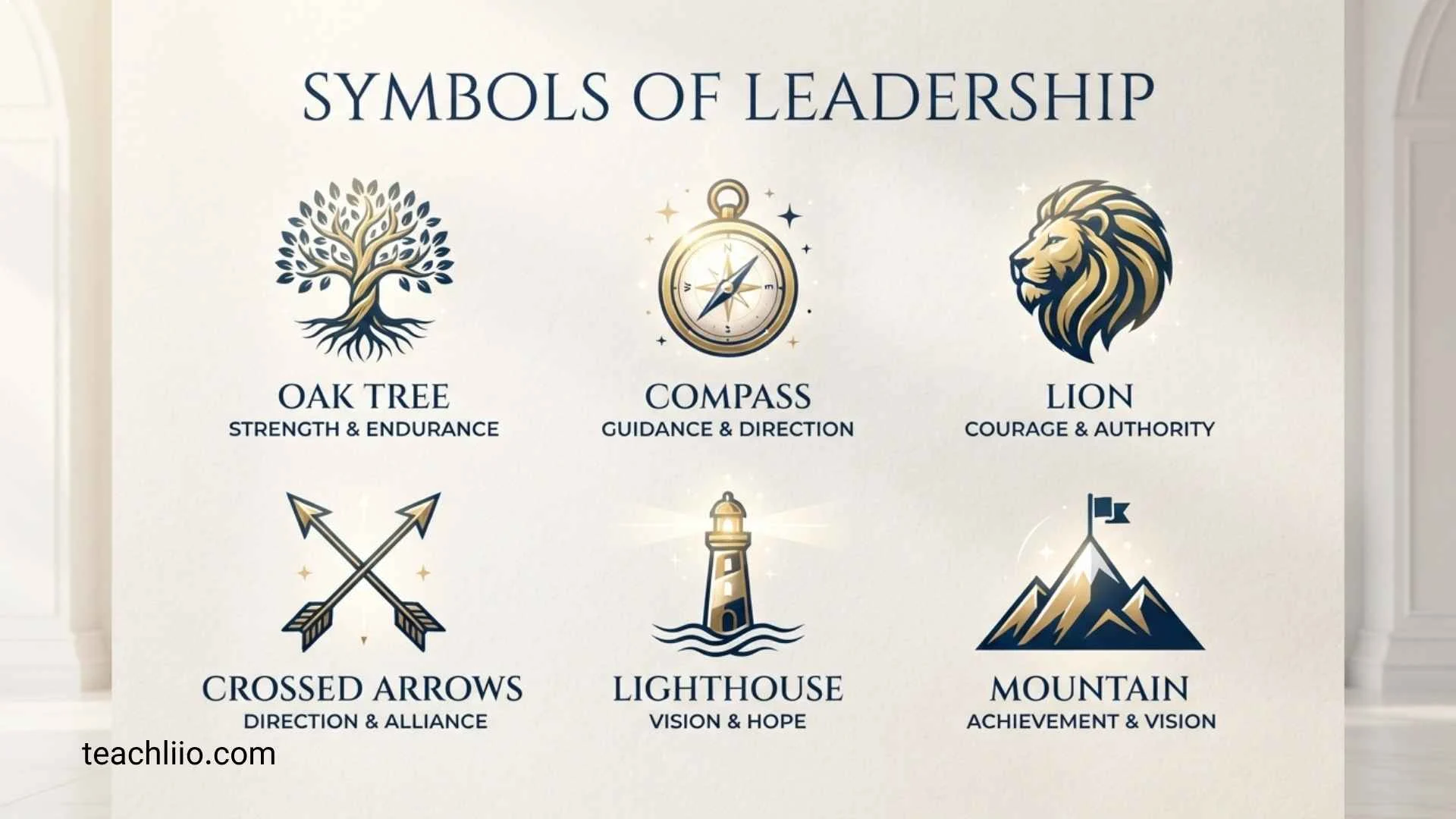
Leadership has been represented through symbols for thousands of years. A crown can suggest authority, an eagle can represent vision, a compass can communicate direction, and an oak tree can symbolize strength and endurance. These images help people express leadership qualities without using many words.
But not every symbol has one universal meaning. A symbol’s interpretation can change depending on its culture, historical period, religion, organization, or modern context. A crown, for example, traditionally represents sovereignty and royal authority, while a modern designer might use it to suggest achievement or responsibility.
The most useful way to understand symbols of leadership is to look beyond simple lists. Each symbol can communicate a particular leadership quality, such as courage, wisdom, guidance, protection, stability, service, or vision.
This guide explores the most recognizable leadership symbols, explains their common meanings and historical associations, and shows how they can be used in modern business, education, organizations, and personal expression.
What Are Symbols of Leadership?
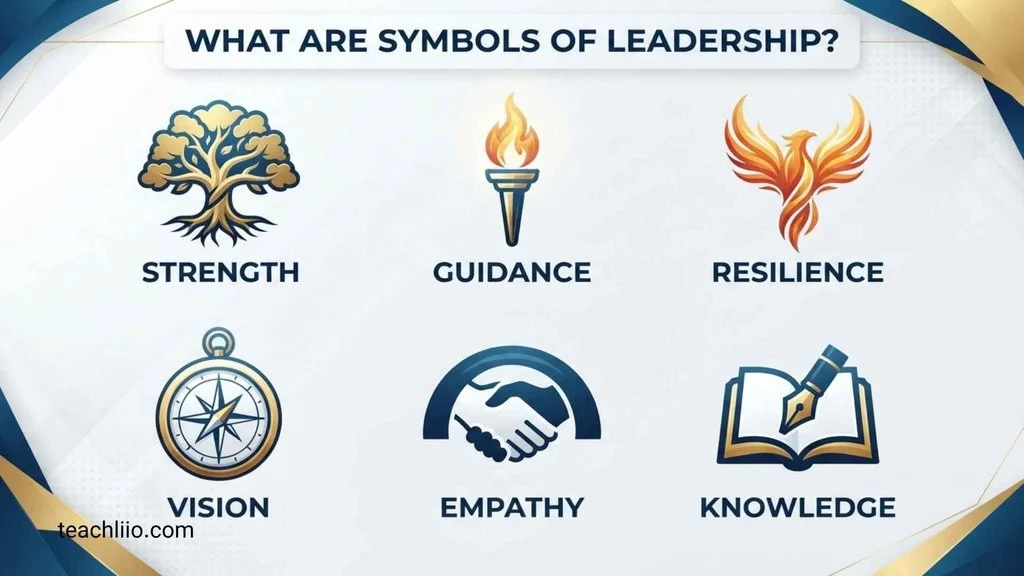
Symbols of leadership are objects, animals, natural elements, shapes, buildings, or images that communicate ideas associated with leading others.
Leadership symbolism can represent different qualities, including:
- Authority
- Courage
- Wisdom
- Vision
- Guidance
- Responsibility
- Protection
- Stability
- Service
- Resilience
- Unity
- Achievement
Some symbols have documented historical connections with rulers, governments, military leaders, or religious institutions. Others have developed through cultural traditions or modern visual design.
This distinction is important. A symbol can be historically associated with leadership without being an official symbol of leadership everywhere.
For example, a crown has a strong historical relationship with monarchy and sovereignty. A compass does not traditionally represent political authority, but it has become a useful metaphor for leadership because it suggests direction and guidance.
Leadership Symbols and Their Meanings
Different symbols communicate different aspects of leadership. The following examples are among the most recognizable.
Crown
The crown is one of the oldest and clearest symbols associated with authority and rulership.
Historically, crowns were worn by kings, queens, emperors, and other rulers. They helped communicate rank, sovereignty, and political status.
In a modern leadership context, the crown can also represent:
- Responsibility
- Achievement
- Authority
- Recognition
- Excellence
However, the traditional meaning is more closely connected with rulership and sovereignty than with modern leadership itself.
For a business or personal design, a crown may suggest that someone has reached a position of responsibility or distinction.
Lion
The lion is frequently used to symbolize courage, strength, confidence, and authority.
Lion imagery has appeared in heraldry, royal traditions, coats of arms, flags, sculptures, and institutional emblems in many parts of the world.
Its association with leadership comes partly from the qualities people traditionally attribute to the animal. A lion can visually communicate courage and command.
In leadership symbolism, the lion can represent:
- Courage
- Confidence
- Strength
- Authority
- Protection
- Determination
It is important, however, not to confuse leadership with dominance. A lion can symbolize authority, but effective leadership also involves responsibility and judgment.
Eagle
The eagle is another powerful leadership symbol found in many cultural and political traditions.
Because an eagle flies high and has strong visual associations with height and perspective, it is often used metaphorically to represent vision, freedom, ambition, and a broad view.
Eagle imagery has also appeared in state emblems and heraldic traditions, where it can communicate sovereignty or authority.
As a leadership symbol, the eagle can represent:
- Vision
- Perspective
- Freedom
- Ambition
- Strength
- Strategic thinking
For a modern organization, an eagle may communicate the idea of looking beyond immediate problems and focusing on a larger goal.
Compass
The compass is one of the strongest symbols for guidance and direction.
Unlike a crown or scepter, the compass is not primarily a symbol of authority. Its leadership meaning comes from the idea of helping someone find the right direction.
A compass can represent:
- Vision
- Direction
- Purpose
- Decision-making
- Guidance
- Staying on course
This makes it particularly appropriate for educational organizations, coaching programs, leadership development, and businesses that want to emphasize strategic direction.
Torch
The torch is commonly associated with light, knowledge, learning, and inspiration.
A leader who carries a symbolic torch can be understood as someone who helps others see a path forward.
The torch can therefore represent:
- Knowledge
- Inspiration
- Hope
- Guidance
- Enlightenment
- Passing knowledge to others
The image is especially suitable for schools, universities, mentorship programs, and organizations focused on education or personal development.
Scepter
A scepter is a ceremonial staff traditionally associated with rulers.
In historical contexts, it has represented sovereignty, authority, and the right to rule.
As a leadership symbol, the scepter is most closely connected with formal authority rather than collaborative leadership.
Its symbolism can include:
- Authority
- Command
- Sovereignty
- Responsibility
- Institutional power
Because of this history, a scepter works particularly well when discussing royal, ceremonial, or historical leadership.
Throne
The throne represents the position from which a ruler governs.
Unlike a crown, which is worn, a throne represents the institutional position of authority itself.
Historically, thrones have been associated with:
- Rulership
- Status
- Authority
- Governance
- Institutional power
In modern symbolic language, a throne may represent reaching a position of influence, but it can also suggest hierarchy and status rather than service-oriented leadership.
Shield
A shield is strongly associated with protection.
In historical warfare and heraldry, shields protected individuals and displayed identifying symbols. This created an enduring association between the shield and defense.
In leadership symbolism, the shield can represent:
- Protection
- Responsibility
- Security
- Loyalty
- Courage
- Defending others
This makes it especially useful for organizations such as schools, security institutions, community groups, and teams that emphasize responsibility and protection.
Oak Tree
The oak tree is a traditional symbol of strength, endurance, stability, and longevity in many cultural contexts.
An oak takes many years to mature, which makes it a natural metaphor for long-term growth and resilience.
As a leadership symbol, the oak can represent:
- Stability
- Strength
- Endurance
- Wisdom
- Growth
- Strong foundations
The oak is particularly useful when the message is about leadership that develops gradually and creates something lasting.
Mountain
A mountain can symbolize ambition, achievement, resilience, and overcoming challenges.
Climbing a mountain requires persistence, preparation, and the ability to continue despite obstacles.
For this reason, mountain imagery is often used in leadership and motivational contexts.
It can represent:
- Ambition
- Achievement
- Persistence
- Challenge
- Resilience
- Long-term goals
A mountain is particularly effective when leadership is being presented as a journey rather than simply a position of authority.
Lighthouse
The lighthouse is a strong metaphor for guidance and safety.
A lighthouse does not control ships. Instead, it provides a visible point of reference that helps people navigate difficult conditions.
That makes it an excellent metaphor for a leadership style based on guidance rather than domination.
It can represent:
- Direction
- Guidance
- Safety
- Clarity
- Hope
- Steady leadership
The lighthouse is especially relevant to mentors, educators, counselors, and community leaders.
Star
Stars have traditionally been used as symbols of direction, aspiration, excellence, and hope.
A star can represent a destination or an ideal that people want to reach.
In leadership symbolism, it may communicate:
- Vision
- Aspiration
- Excellence
- Inspiration
- Achievement
- Hope
A star is particularly useful for branding when an organization wants to communicate ambition and high standards.
Phoenix
The phoenix is a legendary bird associated with renewal and rebirth.
Its symbolism is particularly relevant to leadership during periods of change.
A phoenix can represent:
- Resilience
- Transformation
- Renewal
- Recovery
- Reinvention
- New beginnings
This makes the phoenix especially appropriate for organizations experiencing major changes or individuals who want to symbolize overcoming a difficult period.
Elephant
The elephant can represent wisdom, patience, memory, strength, and social connection.
Its symbolism varies across cultures, so it should not be treated as having one universal meaning.
In leadership contexts, the elephant can be used to communicate a style based on:
- Wisdom
- Patience
- Stability
- Strength
- Loyalty
- Community
This is particularly different from the aggressive image sometimes associated with the lion. The elephant can suggest leadership through experience and steady judgment.
Owl
The owl is widely associated with wisdom and knowledge.
Its connection with wisdom appears in several cultural and literary traditions, making it a familiar symbol in educational contexts.
As a leadership symbol, the owl can represent:
- Wisdom
- Observation
- Knowledge
- Careful judgment
- Learning
- Awareness
An owl may therefore be a suitable symbol for teachers, researchers, advisors, and organizations focused on learning.
Wolf
The wolf can symbolize loyalty, cooperation, independence, strategy, and group connection, depending on the cultural context.
Modern popular culture sometimes presents wolves through the idea of the pack. However, leadership interpretations based on simplified “alpha wolf” ideas should not be treated as established scientific leadership theory.
As a symbolic image, the wolf can instead communicate:
- Loyalty
- Teamwork
- Strategy
- Protection
- Independence
- Group identity
The exact interpretation depends on how the symbol is used.
Horse
The horse is often associated with strength, movement, freedom, endurance, and partnership.
Throughout history, horses have played important roles in transportation, warfare, agriculture, communication, and sport.
As a leadership symbol, the horse can represent:
- Strength
- Progress
- Freedom
- Energy
- Endurance
- Forward movement
It works particularly well when the message focuses on momentum and moving toward a goal.
Bridge
A bridge is a powerful symbol of connection.
It joins two places that would otherwise be separated, making it a natural metaphor for leaders who bring people, groups, or ideas together.
A bridge can represent:
- Unity
- Communication
- Collaboration
- Connection
- Problem-solving
- Reconciliation
This makes the bridge especially suitable for community leadership and team-building contexts.
Anchor
The anchor represents stability and staying grounded.
Because an anchor helps hold a vessel in position, it has become a familiar metaphor for security and reliability.
In leadership, it can symbolize:
- Stability
- Reliability
- Responsibility
- Patience
- Security
- Consistency
The anchor is useful for describing leaders who provide calm direction during uncertain periods.
Laurel Wreath
The laurel wreath has historical associations with honor, achievement, victory, and recognition.
In ancient Mediterranean traditions, laurel was associated with Apollo and was used in crowns of honor for certain achievements.
In modern leadership symbolism, the laurel wreath can represent:
- Achievement
- Excellence
- Recognition
- Victory
- Honor
- Success
Unlike the compass or lighthouse, the laurel emphasizes accomplishment rather than guidance.
Symbols of Leadership by Quality
One of the easiest ways to choose a leadership symbol is to start with the quality you want it to communicate.
Symbols of Authority
If the focus is authority or formal power, traditional symbols include:
- Crown
- Scepter
- Throne
- Eagle
- Lion
These symbols are especially connected with historical rulership, sovereignty, and institutional authority.
Symbols of Courage
For courage and bravery, common symbolic choices include:
- Lion
- Shield
- Mountain
- Eagle
- Horse
These images can communicate the willingness to face difficulty and act with confidence.
Symbols of Wisdom
Leadership based on knowledge and judgment can be represented by:
- Owl
- Elephant
- Oak tree
- Torch
- Book
These symbols work especially well in education, mentoring, and professional development.
Symbols of Vision
Visionary leadership can be represented by:
- Eagle
- Star
- Lighthouse
- Compass
- Rising sun
These symbols suggest seeing a destination, identifying a path, or helping others move toward a future goal.
Symbols of Guidance
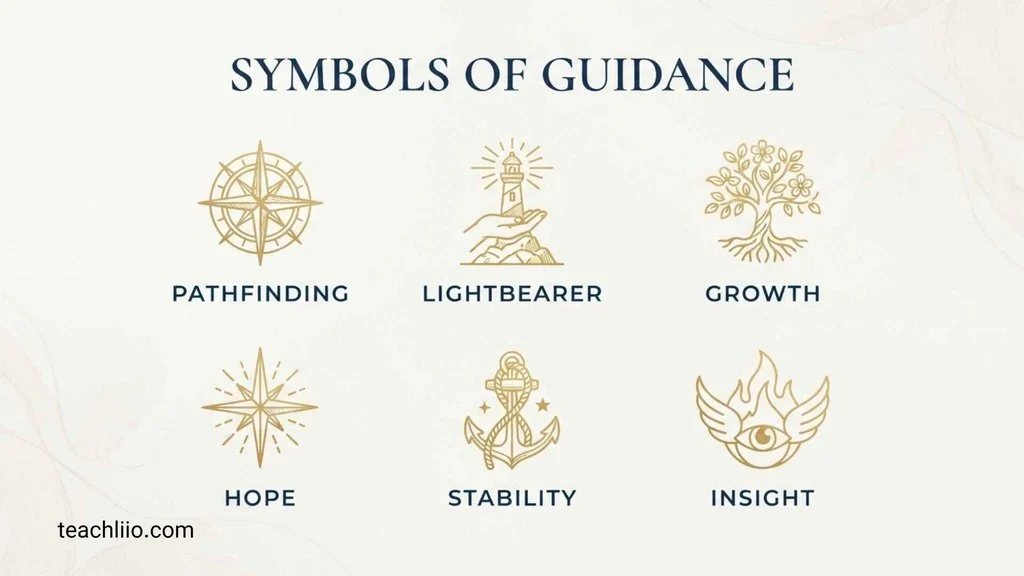
The strongest metaphors for guidance include:
- Compass
- Lighthouse
- Torch
- North Star
- Shepherd’s staff
These symbols focus less on controlling people and more on helping them find direction.
Symbols of Strength
Strength can be represented by:
- Lion
- Oak tree
- Mountain
- Elephant
- Bear
- Shield
The type of strength matters. A mountain may suggest endurance, while a shield suggests protective strength.
Symbols of Stability
For dependable leadership, consider:
- Oak tree
- Anchor
- Mountain
- Lighthouse
- Elephant
These symbols communicate steadiness and resilience rather than rapid movement.
Symbols of Service
Leadership is not always about power. It can also mean helping others.
Symbols that can communicate service include:
- Open hand
- Bridge
- Torch
- Lighthouse
- Shepherd’s staff
These images can work well for community organizations, nonprofit groups, schools, and mentoring programs.
Symbols of Resilience
For overcoming challenges and adapting to change, strong symbolic choices include:
- Phoenix
- Mountain
- Oak tree
- Rising sun
- Butterfly
The phoenix emphasizes renewal, while the oak emphasizes long-term endurance.
Animal Symbols of Leadership
Animals are among the most recognizable sources of leadership symbolism because people have historically used animal characteristics as metaphors for human qualities.
Lion and Eagle
The lion commonly suggests courage, authority, and strength, while the eagle often suggests vision, perspective, freedom, and power.
Together, they can represent different sides of leadership: the courage to act and the ability to see the bigger picture.
Elephant and Owl
The elephant can represent patience, wisdom, and social strength, while the owl is more strongly associated with knowledge and observation.
These symbols can suit leadership based on experience and thoughtful decision-making.
Wolf and Horse
The wolf can represent loyalty, teamwork, and strategy, while the horse can suggest energy, movement, endurance, and freedom.
Their meanings demonstrate why there is no single “leadership animal.” Different animals communicate different qualities.
Historical Symbols of Leadership
Leadership symbolism has changed considerably across history.
Royal Symbols
Crowns, scepters, thrones, robes, and royal staffs have historically helped communicate the status and authority of rulers.
These symbols were often part of ceremonies designed to make political authority visible.
They are useful when studying monarchy and sovereignty, but they do not necessarily represent modern democratic leadership.
Military Symbols
Shields, swords, standards, medals, and certain animals have appeared in military traditions.
These symbols can represent courage, protection, service, loyalty, or command.
Their meanings should always be considered in their historical context because military symbols can have different interpretations across countries and time periods.
Religious and Ceremonial Symbols
Leadership within religious traditions has also been represented through staffs, robes, crowns, keys, books, light, and other ceremonial objects.
The meaning of these symbols varies significantly between religions and institutions.
They should therefore be explained within their specific cultural or religious context rather than treated as universal symbols.
Political and Institutional Symbols
Flags, seals, coats of arms, official buildings, and emblems can communicate institutional authority.
A government seal, for example, can represent the authority of an institution rather than the personality of an individual leader.
Symbols of Leadership Across Cultures
There is no single symbol that means exactly the same thing in every society.
European Traditions
European leadership symbolism has frequently included crowns, heraldic animals, coats of arms, scepters, shields, and royal regalia.
These traditions often connect leadership with sovereignty, inheritance, military authority, and political institutions.
Ancient Egyptian Traditions
Ancient Egyptian rulers used elaborate crowns, staffs, ceremonial objects, and other visual elements to communicate kingship and divine authority.
These symbols belonged to a specific religious and political worldview and should be understood within that historical context.
East Asian Traditions
Leadership symbolism in East Asian cultures includes a wide range of animals, objects, colors, and natural imagery.
The dragon, for example, has held important associations with imperial authority in Chinese history.
This demonstrates why a symbol’s meaning cannot always be transferred directly from one culture to another.
Indigenous and Local Traditions
Many Indigenous societies have their own leadership symbols connected with community, ancestry, animals, land, ceremony, and responsibility.
These traditions are highly diverse. It is therefore better to discuss specific communities and documented traditions rather than treating Indigenous symbolism as one universal category.
Leadership Symbols in Modern Business and Organizations
Modern organizations often use symbolism differently from historical rulers.
A company may choose a compass to communicate direction, an eagle to suggest vision, or a bridge to represent collaboration.
Common modern leadership themes include:
- Vision
- Innovation
- Trust
- Growth
- Responsibility
- Teamwork
- Service
- Stability
- Transformation
For example, a compass may be appropriate for a strategy consultancy because it communicates direction. A bridge may work for a company focused on connecting customers or communities.
The key is to choose a symbol that matches the organization’s actual values instead of selecting an image simply because it looks powerful.
Symbols of Leadership in Education
Educational leadership often focuses on knowledge, guidance, growth, and opportunity.
Symbols that work well in this context include:
- Torch
- Owl
- Compass
- Lighthouse
- Open book
- Star
- Tree
A torch can represent knowledge being passed from one generation to another. A compass can represent helping students find direction, while a tree can represent learning and long-term growth.
Symbols of Female Leadership
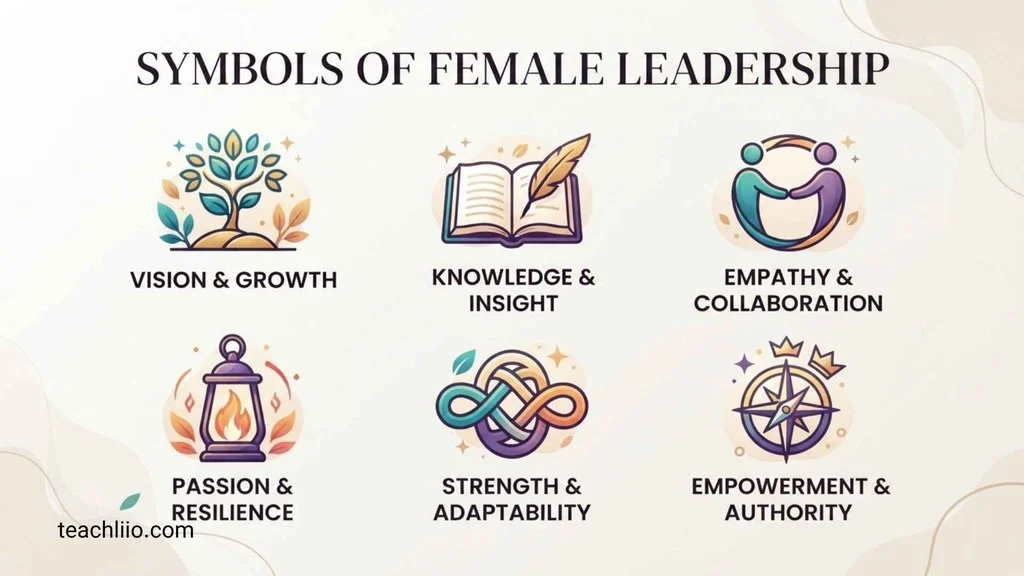
There is no single symbol that universally represents female leadership.
Instead, different symbols can communicate qualities often associated with leadership regardless of gender.
Examples include:
- Lioness — courage and protection
- Owl — wisdom
- Torch — knowledge and inspiration
- Oak tree — resilience and stability
- Star — aspiration
- Shield — protection and responsibility
- Bridge — connection and collaboration
These should be viewed as symbolic interpretations rather than inherently female meanings.
A strong representation of female leadership can emphasize competence, courage, vision, resilience, service, and influence without relying on stereotypes.
Leadership vs. Authority: What Is the Difference?
Leadership and authority overlap, but they are not identical.
Authority generally refers to recognized power or the right to make decisions.
Leadership is broader. It can involve influencing, guiding, motivating, serving, organizing, and helping others move toward a shared objective.
This distinction explains why different symbols communicate different ideas.
| Symbol | Traditional Association | Leadership Interpretation |
| Crown | Sovereignty | Responsibility and achievement |
| Scepter | Authority | Decision-making |
| Compass | Navigation | Guidance |
| Torch | Light | Knowledge and inspiration |
| Shield | Protection | Responsibility |
| Bridge | Connection | Collaboration |
| Oak | Endurance | Stability |
| Mountain | Height and challenge | Ambition |
| Lighthouse | Navigation | Guidance and clarity |
| Phoenix | Renewal | Resilience and transformation |
A crown may communicate authority more strongly than service, while a bridge may communicate collaboration more strongly than power.
How to Choose a Symbol of Leadership
The best leadership symbol depends on the message you want to communicate.
For a Business Logo
Choose a symbol that reflects the organization’s values.
A compass can suggest direction, an oak can suggest stability, and a bridge can suggest connection.
For a School Project
Choose a symbol that is easy to explain and connect it to a specific leadership quality.
A torch, compass, lion, eagle, or oak tree can work well because each has a clear symbolic interpretation.
For a Leadership Presentation
Consider using several symbols rather than relying on one.
For example:
- Compass for vision
- Shield for responsibility
- Bridge for teamwork
- Torch for knowledge
- Mountain for ambition
This creates a more complete picture of leadership.
For Personal Symbolism
Think about the quality you want the symbol to represent.
If you value resilience, the phoenix or oak may fit. If guidance matters most, a compass or lighthouse may be more appropriate.
The strongest personal symbol is one whose meaning connects with your own goals rather than simply being considered powerful or attractive.
Frequently Asked Questions
What is the most common symbol of leadership?
There is no single universal symbol of leadership. Common examples include the crown, lion, eagle, compass, torch, oak tree, and lighthouse. Each represents a different aspect of leadership, such as authority, courage, vision, guidance, or stability.
What animal represents leadership?
The lion and eagle are two of the most commonly used animal symbols associated with leadership. The lion often represents courage and authority, while the eagle can represent vision, freedom, and perspective. Other animals, such as elephants, owls, wolves, and horses, can represent different leadership qualities.
What symbolizes a strong leader?
Symbols such as the lion, oak tree, mountain, eagle, and shield can represent different forms of leadership strength. The appropriate choice depends on whether strength means courage, endurance, vision, protection, or stability.
What symbol represents authority and leadership?
The crown, scepter, throne, and eagle are traditionally associated with authority and rulership. A crown is particularly connected with sovereignty, while a scepter represents ceremonial authority.
What symbolizes wisdom in leadership?
The owl, elephant, oak tree, and torch can symbolize wisdom and thoughtful leadership. The owl is especially associated with knowledge and observation, while the elephant can represent patience and experience.
What symbolizes guidance?
The compass and lighthouse are two strong symbols of guidance. A compass suggests direction and purpose, while a lighthouse suggests helping others navigate difficult conditions.
What symbolizes courage and leadership?
The lion, shield, eagle, horse, and mountain can all represent courage in different ways. The lion emphasizes bravery and authority, while the mountain emphasizes persistence when facing challenges.
What tree symbolizes leadership?
The oak tree is often associated with strength, endurance, stability, and longevity. These qualities make it a useful metaphor for leadership that is built over time.
What color represents leadership?
There is no single universal leadership color. Different cultures and organizations associate colors with different qualities. Blue may be used to communicate trust or stability, gold can suggest achievement or prestige, and red may suggest energy or courage. Color meanings should always be considered within their cultural and design context.
What is a symbol of female leadership?
There is no universally recognized symbol specifically for female leadership. Symbols such as the lioness, torch, oak, owl, star, and bridge can be used to communicate qualities such as courage, wisdom, inspiration, resilience, and collaboration.
What symbolizes leadership and strength?
The lion, eagle, oak tree, mountain, elephant, and shield can all represent leadership combined with strength. Their meanings differ, so the choice should depend on whether the desired message is courage, endurance, protection, wisdom, or authority.
What represents leadership in business?
Modern businesses often use symbols such as the compass, eagle, bridge, mountain, torch, and oak tree to communicate direction, vision, teamwork, achievement, knowledge, and stability.
What represents leadership in education?
The torch, owl, compass, lighthouse, open book, tree, and star can represent educational leadership. They communicate knowledge, guidance, growth, learning, and aspiration.
What symbol represents a good leader?
There is no single symbol that defines a good leader. A compass can represent guidance, a bridge can represent collaboration, a shield can represent responsibility, and a torch can represent knowledge. Together, these qualities provide a broader picture of effective leadership.
Conclusion
Symbols of leadership can communicate powerful ideas about authority, courage, wisdom, vision, guidance, protection, stability, service, and resilience. From the traditional crown and scepter to the modern compass and lighthouse, each symbol tells a different story about what leadership can mean.
Animals are also important in leadership symbolism. The lion can suggest courage and authority, the eagle can communicate vision and perspective, the owl can represent wisdom, and the elephant can suggest patience and experience. Natural symbols such as the oak, mountain, star, and phoenix add ideas of endurance, ambition, aspiration, and transformation.
The most important point is that symbolism is not universal. Meanings change across cultures, historical periods, religions, organizations, and personal experiences. A crown may represent sovereignty in one context and achievement in another. A wolf may suggest loyalty and teamwork to one audience while carrying a different meaning elsewhere.
For this reason, the best leadership symbol is not necessarily the one that looks the most powerful. It is the one that clearly communicates the quality you want people to understand. Whether the goal is to express vision, courage, wisdom, guidance, responsibility, or service, the right symbol can turn an abstract leadership idea into a memorable visual message.

I’m Oscar Radcliffe, a British writer who enjoys uncovering the numbers hidden within ordinary questions. My work explores quantities, counts, statistics, measurements, and fascinating comparisons across different subjects. I aim to present reliable information clearly, helping readers satisfy their curiosity while discovering interesting facts they may never have considered before.
Books:
The Science of Counting
How Many? Fascinating Numbers Explained