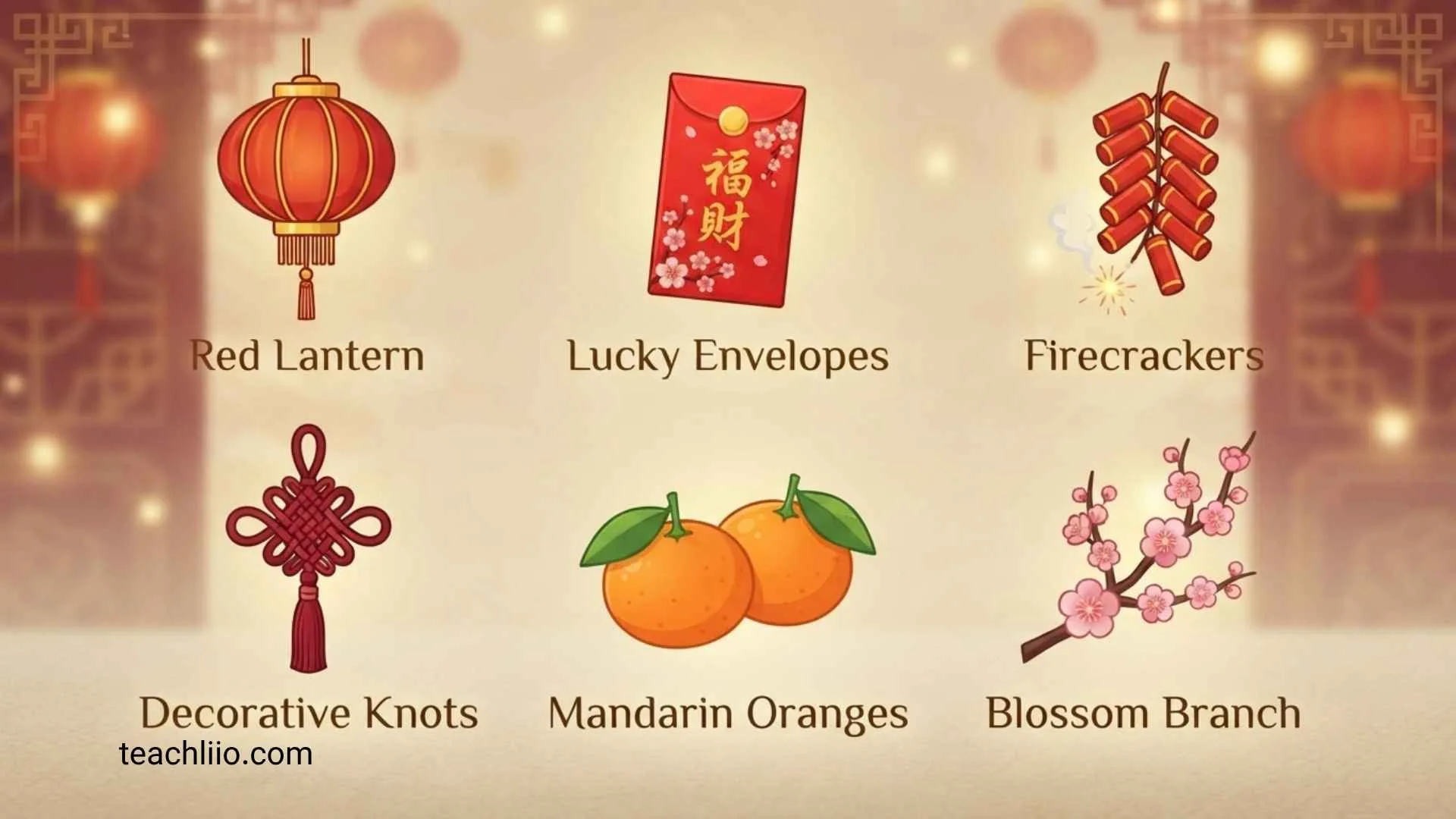
Lunar New Year is a time of family gatherings, festive meals, colorful decorations, traditional performances, and hopes for a happy year ahead. One of the most interesting parts of the celebration is the use of symbols. Colors, animals, flowers, foods, written characters, gifts, and decorations can all carry special meanings.
Common Lunar New Year symbols include red envelopes, lanterns, dragons, lions, zodiac animals, fish, dumplings, oranges, flowers, spring couplets, and the Chinese character 福 (fú), which is associated with good fortune or blessings.
However, Lunar New Year is not a single tradition shared identically by every culture. Chinese Spring Festival, Korean Seollal, Vietnamese Tết, and other celebrations have their own customs and symbolic foods. Understanding those differences makes the meaning behind Lunar New Year symbols much clearer.
What Are Lunar New Year Symbols?
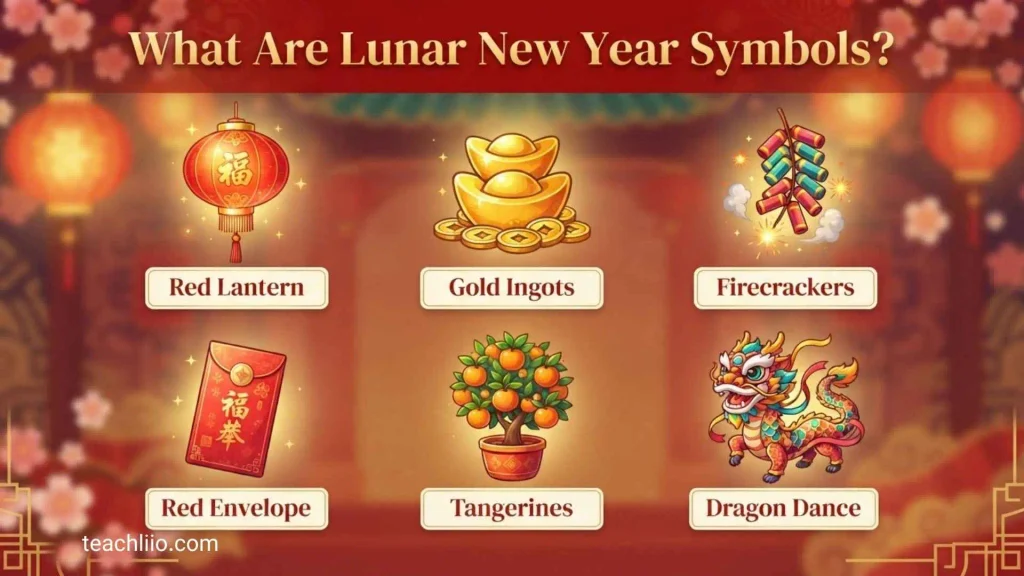
Lunar New Year symbols are objects, colors, foods, animals, flowers, characters, and traditions that carry cultural or traditional meanings during New Year celebrations.
Many symbols express wishes for:
- Good luck
- Happiness
- Wealth
- Prosperity
- Longevity
- Family unity
- Protection
- Health
- Growth
- Renewal
- A successful year ahead
Some meanings come from the appearance of an object. Others developed through language, folklore, history, seasonal changes, or traditional stories.
For example, dumplings can resemble old Chinese money, while fish is associated with abundance partly because of a Chinese wordplay connection. This is why learning the background behind a symbol can be more useful than simply memorizing what it represents.
Quick Guide to Lunar New Year Symbols
| Symbol | Common Meaning | Type |
| Red | Happiness and auspiciousness | Color |
| Red envelope | Blessings and lucky money | Gift |
| Lantern | Celebration and tradition | Decoration |
| Dragon | Power and good fortune | Animal |
| Lion | Protection and celebration | Performance |
| Fish | Abundance and surplus | Food |
| Dumplings | Wealth and prosperity | Food |
| Long noodles | Longevity | Food |
| Nian gao | Growth and progress | Food |
| Tangyuan | Family togetherness | Food |
| Oranges | Good luck and prosperity | Fruit |
| Plum blossom | Renewal and resilience | Flower |
| 福 (Fú) | Fortune and blessing | Character |
| Spring couplets | Good wishes | Decoration |
| Chinese knot | Connection and continuity | Decoration |
| Zodiac animals | Yearly symbolism | Calendar |
| Kumquat | Wealth and prosperity | Plant/Fruit |
| Gold | Wealth and success | Color |
25 Important Lunar New Year Symbols and Their Meanings
1. Red Color
Red is one of the most recognizable colors of Chinese New Year celebrations. It appears on lanterns, envelopes, banners, paper cuttings, clothing, decorations, and gift packaging.
In Chinese cultural contexts, red is strongly associated with celebration, happiness, and auspiciousness. Its bright appearance also helps create the lively atmosphere associated with the festival.
Red does not have one universal meaning in every Lunar New Year culture, but it is especially prominent in Chinese New Year traditions.
2. Red Envelopes
Red envelopes are commonly known as hongbao in Mandarin. They are traditionally used to give money during Chinese New Year celebrations.
The money is only part of the tradition. The envelope itself represents a wish for good fortune, blessings, and prosperity.
Adults may give red envelopes to children and younger relatives, while customs can vary between families and communities. Modern versions can also be exchanged digitally.
3. Lanterns
Lanterns are among the most recognizable Lunar New Year decorations.
In Chinese Spring Festival traditions, lanterns are especially connected with the Lantern Festival, which occurs on the fifteenth day of the traditional celebration. Lantern displays create a bright and festive atmosphere and can represent celebration, hope, and continuity.
Traditional lanterns may be round, colorful, decorated with characters, or designed around animals and flowers.
4. Dragon
The dragon is an important symbol in Chinese culture and one of the most famous images associated with Lunar New Year.
Dragon dances are performed during many Chinese New Year celebrations. The dragon can also appear on decorations, clothing, artwork, greeting cards, and festival displays.
In the Chinese zodiac, the dragon is one of the 12 animals and is traditionally associated with qualities such as power and good fortune.
5. Lion
The lion is closely associated with the traditional lion dance.
Although the lion and dragon are sometimes confused, they are different cultural symbols and performances. Lion dances generally involve performers operating an elaborate lion costume, often accompanied by drums, cymbals, and other instruments.
Lion dances are widely recognized as festive performances and can be connected with protection, celebration, and the welcoming of positive fortune.
6. Chinese Zodiac Animals
The Chinese zodiac consists of 12 animals arranged in a repeating cycle:
- Rat
- Ox
- Tiger
- Rabbit
- Dragon
- Snake
- Horse
- Goat
- Monkey
- Rooster
- Dog
- Pig
Each animal is traditionally associated with a particular year. The system also includes a cycle involving five elements.
People often use zodiac animals in decorations, greeting cards, clothing, artwork, gifts, and festival displays.
It is important to remember that zodiac traditions are not identical throughout Asia. Different cultures can use different animals or systems.
7. Fish
Fish is one of the most important symbolic foods in Chinese New Year traditions.
A whole fish is commonly associated with abundance and having more than enough for the coming year.
There is also an important Chinese linguistic connection. The Mandarin word for fish, yú, sounds like a word associated with surplus or remainder. This kind of wordplay is one reason language is so important to traditional New Year symbolism.
8. Dumplings
Dumplings, or jiaozi, are a popular New Year food in many Chinese communities.
Their traditional shape can resemble ancient Chinese money ingots, which is why they are often connected with wealth and prosperity.
Preparing dumplings can also become a family activity. Relatives gather around the kitchen table, prepare the filling and wrappers, and share the finished meal together.
9. Long Noodles
Long noodles are traditionally associated with longevity.
The symbolism comes partly from their length: the long noodle becomes a visual expression of the wish for a long and happy life.
Because of this symbolism, some people avoid cutting the noodles when serving them during celebratory meals.
10. Nian Gao
Nian gao, a type of glutinous rice cake, is strongly associated with Chinese New Year.
Its name allows for traditional wordplay connected with the idea of reaching a higher level or having a better year.
As a result, nian gao can express hopes for growth, progress, improvement, and success.
11. Tangyuan
Tangyuan are round glutinous rice balls commonly associated with the Lantern Festival.
Their round shape can represent togetherness, completeness, and family unity.
Families may enjoy them during the later part of the Chinese New Year period, making the food closely connected with reunion and celebration.
12. Spring Rolls
Spring rolls are another food associated with Lunar New Year celebrations in Chinese communities.
Their golden color and shape can resemble traditional gold bars, creating a connection with wealth and prosperity.
Their name also connects naturally with the arrival of spring, making them particularly appropriate for a festival associated with seasonal renewal.
13. Oranges and Tangerines
Oranges and tangerines are popular New Year fruits.
Their bright color makes them visually festive, while traditional Chinese word associations contribute to their auspicious reputation.
They may be served during family meals, displayed in homes, or given as gifts.
14. Kumquats
Kumquat plants and fruits are especially associated with prosperity in some Chinese New Year traditions.
Their golden-orange color can evoke gold, while linguistic associations have also contributed to their symbolic meaning.
Potted kumquat trees may therefore appear as seasonal decorations or gifts.
15. Plum Blossoms
The plum blossom is an important symbol in Chinese art and culture.
It can bloom during cold weather, sometimes while snow remains on the ground. This makes it a natural symbol of resilience, endurance, renewal, and the arrival of spring.
Plum blossoms are particularly appropriate for the Spring Festival because the holiday is connected with the beginning of a new agricultural season.
16. Peach Blossoms
Peach blossoms are another flower commonly associated with Chinese New Year decorations.
Their bright pink appearance brings a sense of spring and renewal. In Chinese cultural traditions, peach imagery has also been connected with vitality and positive wishes.
Their precise symbolism can vary according to the region and context.
17. Peonies
The peony has a long history in Chinese art and culture and is commonly associated with beauty, richness, and prosperity.
During festive periods, peony imagery may appear in paintings, decorations, textiles, and other artwork.
It is especially useful as a Lunar New Year symbol when the theme is abundance and prosperity.
18. 福 (Fú)
The Chinese character 福, pronounced fú, is strongly associated with good fortune, blessings, and happiness.
It is often displayed during Chinese New Year on red paper, decorations, banners, and household objects.
One interesting tradition involves placing the character upside down. This is connected with Chinese wordplay involving the idea of something “arriving.” The practice is a cultural tradition rather than a rule followed by every household.
19. Spring Couplets
Spring couplets, known as chūnlián, are red strips of paper containing written wishes.
They are commonly placed around doors during Chinese New Year.
The messages can express hopes for prosperity, peace, happiness, success, or other positive outcomes. They combine decoration with language, turning the entrance of a home into a visible New Year blessing.
20. Chinese Knots
Chinese decorative knots are made by tying cord into intricate patterns.
They can represent connection, continuity, unity, and good wishes. Red is particularly common in festive versions.
Because they can be hung on doors, walls, windows, or other spaces, Chinese knots are both decorative objects and examples of traditional symbolic design.
21. Gold
Gold frequently appears alongside red in Lunar New Year decorations.
Its association with wealth, precious materials, and prosperity makes it a natural color for festive artwork and packaging.
Gold may appear on envelopes, lanterns, clothing, banners, ornaments, and decorative characters.
22. Firecrackers
Firecrackers have a long history in Chinese New Year traditions.
Traditional stories connect loud noises and firecrackers with frightening away harmful forces. Today, the use of fireworks and firecrackers depends on local laws, safety considerations, and environmental rules.
As a symbol, they remain strongly connected with the excitement and noise of New Year celebrations.
23. New Year Paintings
Traditional New Year paintings, often called nianhua, can feature gods, animals, flowers, children, landscapes, and other auspicious subjects.
These images were historically used to decorate homes and communicate positive wishes.
They show that Lunar New Year symbolism is not limited to foods and colors. Art itself can become a way of expressing hopes for protection, prosperity, happiness, and family well-being.
24. Bamboo
Bamboo has important symbolic associations in Chinese culture.
Its ability to bend without easily breaking makes it a traditional image of flexibility, resilience, and strength.
Although bamboo is not exclusively a Lunar New Year symbol, it can appear in seasonal artwork and decorations representing desirable qualities.
25. Spring
Spring itself is an important symbol of renewal.
Chinese Lunar New Year is also known as the Spring Festival, and the holiday traditionally marks the beginning of a new agricultural season.
That is why flowers, fresh foods, new decorations, and other images of growth are so common during the celebration.
How Do Lunar New Year Symbols Get Their Meanings?
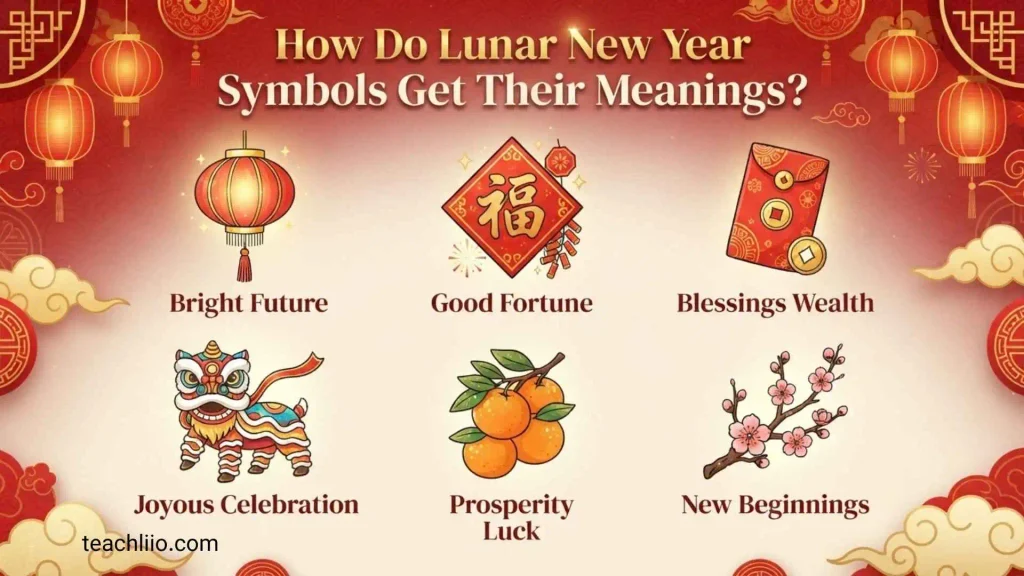
Understanding this question makes the entire topic easier.
Wordplay and Homophones
Language is one of the most important sources of symbolism.
For example, fish is connected with abundance through a Chinese sound association between yú for fish and a word associated with surplus.
This is why translating the name of a food literally may not reveal its full cultural meaning.
Shape and Appearance
Some symbols are meaningful because of what they look like.
Dumplings can resemble traditional Chinese money, while spring rolls can resemble gold bars.
The visual similarity creates an association with wealth.
Color
Red is strongly associated with happiness, celebration, and auspiciousness in Chinese New Year traditions. Gold can suggest wealth and prosperity.
Colors therefore work as a quick visual language during the holiday.
Nature and Seasons
Flowers and plants can gain symbolic importance from their natural characteristics.
Plum blossoms are a good example because they can flower in difficult winter conditions and therefore suggest resilience and renewal.
Folklore and Traditional Stories
Some traditions are connected with stories passed through generations.
The use of firecrackers, for example, is traditionally connected with stories about frightening away harmful forces. Such stories should be described as folklore or traditional accounts rather than presented as documented historical events.
Lunar New Year Foods and Their Symbolic Meanings
Food is one of the strongest parts of Lunar New Year symbolism.
Fish — Abundance
A whole fish is traditionally associated with abundance or surplus.
Dumplings — Wealth
Their shape can resemble ancient money ingots, making dumplings a traditional symbol of prosperity.
Long Noodles — Longevity
Their length makes them a natural symbol of long life and happiness.
Nian Gao — Progress
Glutinous rice cake is associated with improvement and moving upward in life.
Tangyuan — Family Unity
Their round shape can represent togetherness and completeness.
Spring Rolls — Wealth
Their golden appearance can evoke gold and prosperity.
Whole Chicken — Family Reunion
A whole chicken can represent family togetherness and completeness in traditional Chinese New Year meals.
Oranges and Tangerines — Good Fortune
Their bright appearance and traditional linguistic associations make them popular festive fruits.
The exact foods served can vary greatly by region and family. There is no single menu that represents every Lunar New Year celebration.
Lunar New Year Symbols for Different Wishes
Symbols of Luck
Common examples include:
- Red envelopes
- Red decorations
- 福
- Oranges
- Lanterns
Symbols of Wealth
Common examples include:
- Dumplings
- Fish
- Spring rolls
- Gold
- Kumquats
Symbols of Longevity
Examples include:
- Long noodles
- Certain traditional plants
- Longevity-themed artwork
- Foods and decorations associated with long life
Symbols of Family Unity
Examples include:
- Reunion dinner
- Tangyuan
- Whole chicken
- Family gift exchanges
Symbols of Renewal
Examples include:
- Plum blossoms
- Spring
- New Year paintings
- Fresh flowers
- New decorations
Lunar New Year Symbols by Culture
Lunar New Year should not be treated as a single identical celebration across Asia.
Chinese Spring Festival
In China, Lunar New Year is commonly called the Spring Festival. Traditional Chinese celebrations include reunion dinners, red decorations, door couplets, paper cuttings, lanterns, symbolic foods, and the Chinese zodiac.
The traditional Chinese celebration extends over 15 days and concludes with the Lantern Festival.
Vietnamese Tết
Vietnamese Lunar New Year is known as Tết.
Vietnamese traditions have their own foods, decorations, flowers, family customs, and symbolic practices. For example, peach blossoms and yellow apricot blossoms can be prominent seasonal decorations in different parts of Vietnam.
Vietnamese zodiac traditions also differ from the Chinese zodiac in some respects.
Therefore, a symbol that is common in Chinese Spring Festival traditions should not automatically be described as a universal Vietnamese Tết tradition.
Korean Seollal
In Korea, Lunar New Year is called Seollal.
Family gatherings, respect for elders, traditional clothing, ancestral rituals, bowing, gifts, and special foods are important parts of the celebration.
One well-known food is tteokguk, a rice cake soup traditionally eaten during Seollal. The meal is connected with beginning the new year and, traditionally, becoming a year older.
Other Lunar New Year Celebrations
Lunar New Year is also celebrated by communities in Taiwan, Singapore, Malaysia, Mongolia, and many diaspora communities around the world.
Local traditions can combine older customs with modern community practices.
This is why “Lunar New Year symbols” should be understood as a broad category rather than one fixed list.
What Is the Lunar New Year Zodiac Animal in 2026?
In the Chinese zodiac, 2026 is the Year of the Horse.
The Chinese Lunar New Year begins on February 17, 2026. The horse is therefore an especially visible symbol in Chinese New Year decorations, artwork, cards, and cultural displays during this year.
The zodiac animal should be treated as part of the Chinese zodiac tradition. Other Lunar New Year cultures can use different zodiac systems or interpret the holiday differently.
Chinese New Year vs. Lunar New Year
The terms are related, but they are not exactly interchangeable.
Chinese New Year generally refers specifically to the Chinese Spring Festival.
Lunar New Year is a broader term that can refer to New Year celebrations observed by different cultures using lunar or lunisolar calendars.
Chinese Spring Festival is one of the world’s best-known Lunar New Year celebrations, but Korean Seollal and Vietnamese Tết have their own traditions and meanings.
Using the broader term correctly helps avoid treating different cultures as if they all celebrate the holiday in exactly the same way.
How Are Lunar New Year Symbols Used Today?
Modern Lunar New Year symbols can be found in many places.
They appear on:
- Greeting cards
- Festival posters
- Home decorations
- Restaurant displays
- Clothing
- Gift boxes
- School projects
- Public art
- Social media graphics
- Community festivals
- Lantern displays
- Traditional performances
Some designs are highly modern, while others closely follow traditional artwork.
A dragon printed on a contemporary greeting card and a traditional dragon dance may look very different, but both can connect modern celebrations with older cultural traditions.
Why Do Lunar New Year Symbols Matter?
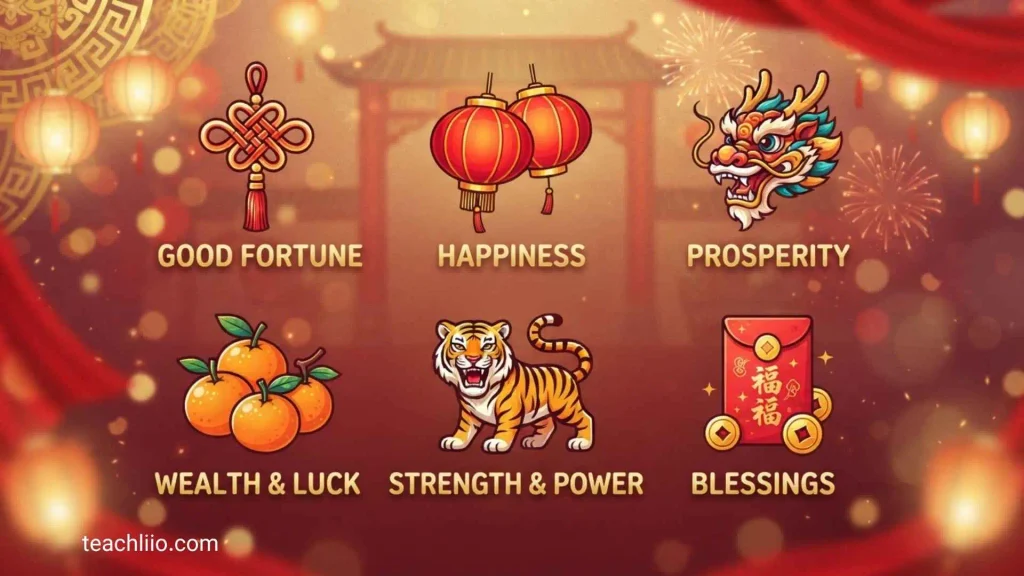
Symbols make cultural traditions easier to see, remember, and share.
A red envelope can turn a simple gift into a blessing. A family dinner can express togetherness. A fish can represent hopes for abundance. A plum blossom can suggest resilience and renewal. A lantern can connect a celebration with the final stage of the traditional Chinese New Year period.
These meanings also help families pass cultural knowledge between generations.
For children, symbols can provide an accessible way to learn about language, art, history, food, family traditions, and cultural identity.
Frequently Asked Questions
What are the main Lunar New Year symbols?
The most recognizable symbols include red decorations, red envelopes, lanterns, dragons, lions, zodiac animals, fish, dumplings, long noodles, oranges, flowers, spring couplets, Chinese knots, and auspicious characters such as 福.
What does red symbolize during Lunar New Year?
In Chinese New Year traditions, red is strongly associated with happiness, celebration, and auspiciousness. It is commonly used for envelopes, lanterns, paper decorations, banners, and clothing.
What does the dragon symbolize during Lunar New Year?
The dragon is an important Chinese cultural symbol traditionally associated with power, good fortune, and other positive qualities. It is also one of the 12 Chinese zodiac animals.
What does the lion symbolize?
The lion is particularly associated with lion dance performances. In festive contexts, the performance can represent celebration, protection, and welcoming positive fortune.
Why are red envelopes given during Lunar New Year?
Red envelopes, or hongbao, are traditionally used to give money and express blessings and good wishes. Customs surrounding who gives and receives them vary among families and communities.
What food symbolizes wealth during Lunar New Year?
Dumplings are commonly associated with wealth because their traditional shape can resemble ancient Chinese money ingots. Spring rolls and other foods can also carry prosperity symbolism.
What food symbolizes longevity?
Long noodles are traditionally associated with longevity because of their length. They are commonly included among symbolic New Year foods.
What does fish symbolize during Lunar New Year?
Whole fish is traditionally associated with abundance or surplus in Chinese New Year meals. The symbolism is also connected with Chinese linguistic wordplay.
What does the Chinese character 福 mean?
福, pronounced fú, is associated with good fortune, blessings, and happiness. It is frequently displayed during Chinese New Year.
Why are lanterns used during Lunar New Year?
Lanterns are important festive decorations and are particularly associated with the Lantern Festival, which traditionally concludes the 15-day Chinese Spring Festival period.
What flowers symbolize Lunar New Year?
Plum blossoms are an important Chinese symbol of resilience and renewal. Peach blossoms, peonies, and other flowers can also appear in New Year decorations, although meanings vary by cultural and regional context.
Are Lunar New Year symbols the same in China, Korea, and Vietnam?
No. Chinese Spring Festival, Korean Seollal, Vietnamese Tết, and other Lunar New Year celebrations have different foods, rituals, decorations, and symbolic traditions.
What is the Lunar New Year animal for 2026?
In the Chinese zodiac, 2026 is the Year of the Horse, beginning February 17, 2026.
Is Lunar New Year only celebrated by Chinese people?
No. Lunar New Year is celebrated by many communities and cultures, including Chinese, Korean, Vietnamese, and other Asian communities. Customs differ depending on the culture and family.
Conclusion
Lunar New Year symbols provide a colorful way to understand the hopes, traditions, and cultural values connected with the start of a new year.
From red envelopes and lanterns to dragons, lions, fish, dumplings, long noodles, plum blossoms, spring couplets, and the 福 character, each symbol can carry a particular cultural meaning. Some represent wealth or abundance, while others express wishes for longevity, family unity, happiness, protection, or renewal.
Food is especially important because traditional dishes often combine taste with symbolism. Dumplings can represent wealth, fish can express abundance, long noodles can suggest longevity, and tangyuan can represent togetherness.
At the same time, there is no universal list that applies identically to every Lunar New Year celebration. Chinese Spring Festival, Vietnamese Tết, Korean Seollal, and other traditions have their own customs and meanings.
The most meaningful way to understand Lunar New Year symbols is therefore to look beyond the decoration itself. Each color, food, flower, animal, character, and tradition can tell a story about family, language, history, seasonal renewal, and hopes for the future.

I’m Hugo Wetherby, a British author interested in the numbers behind everyday questions. I explore quantities, populations, measurements, records, comparisons, and surprising statistics, turning complicated information into accessible answers. I believe a simple “how many” question can lead to fascinating discoveries, and I enjoy helping readers find those answers.
Books:
How Many? A Guide to Everyday Numbers
The Great Book of Numbers and Quantities