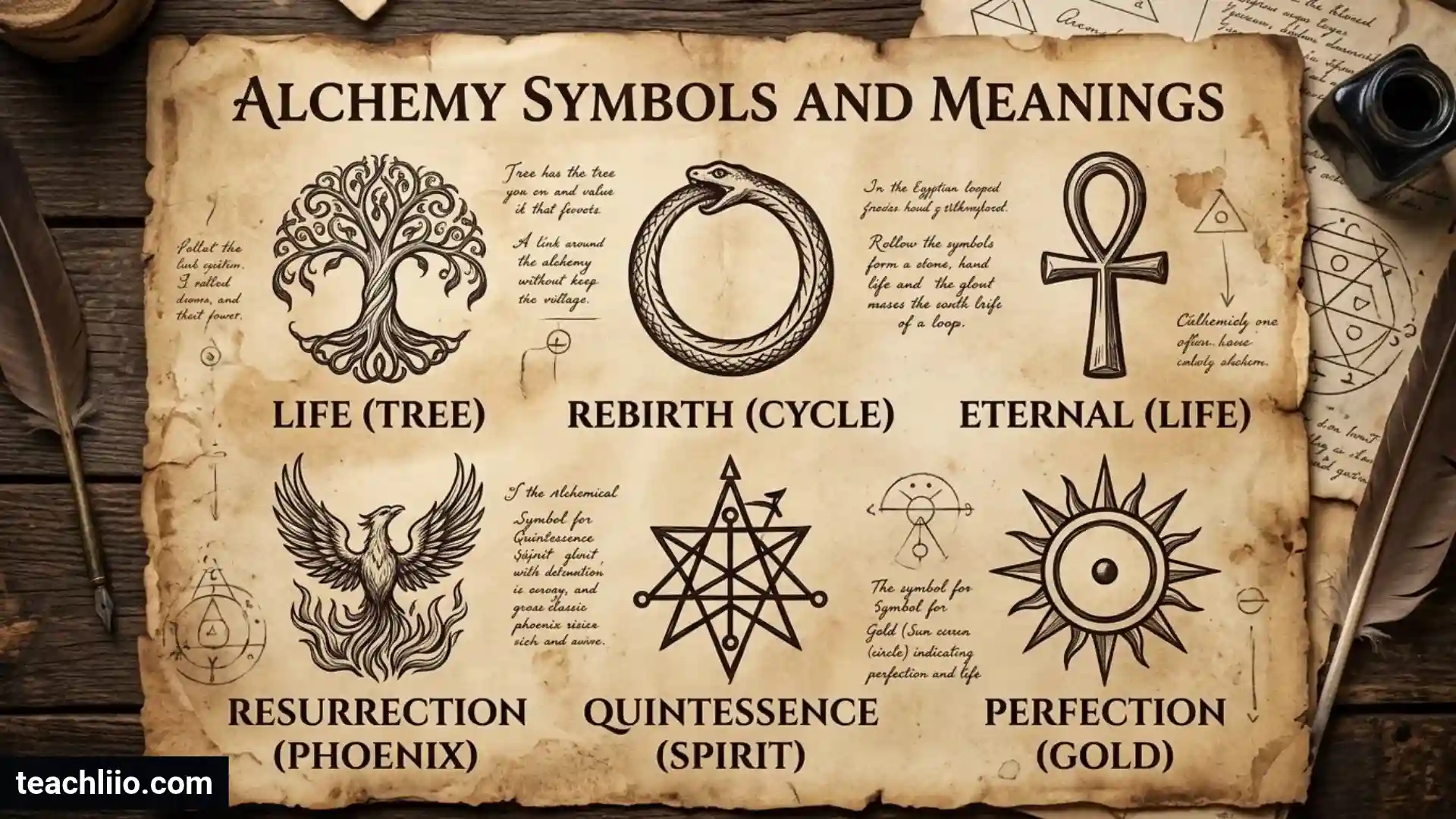
Alchemy symbols and meanings have fascinated people for centuries. From mysterious elemental signs and planetary metals to the famous Philosopher’s Stone and Ouroboros, these ancient symbols reveal how early thinkers explored matter, nature, science, and transformation. Alchemists used special signs to identify substances, record laboratory experiments, and communicate complex philosophical ideas.
Whether you are researching ancient alchemy, looking for meaningful symbols, exploring spiritual transformation, or simply curious about historical signs, understanding these symbols can help you discover an important part of scientific and cultural history.
Some of the most recognizable alchemy symbols represent the four classical elements: fire, water, air, and earth. Others identify the three fundamental principles of Western alchemy: sulfur, mercury, and salt. There are also seven planetary metals associated with the Sun, Moon, and five classical planets.
In this guide, you will discover more than 40 alchemical symbols, substances, and symbolic images, including their names, historical associations, and meanings. You will also learn how alchemists used these signs and why they remain popular in modern art, jewelry, tattoos, and spiritual interpretations.
What Are Alchemy Symbols?
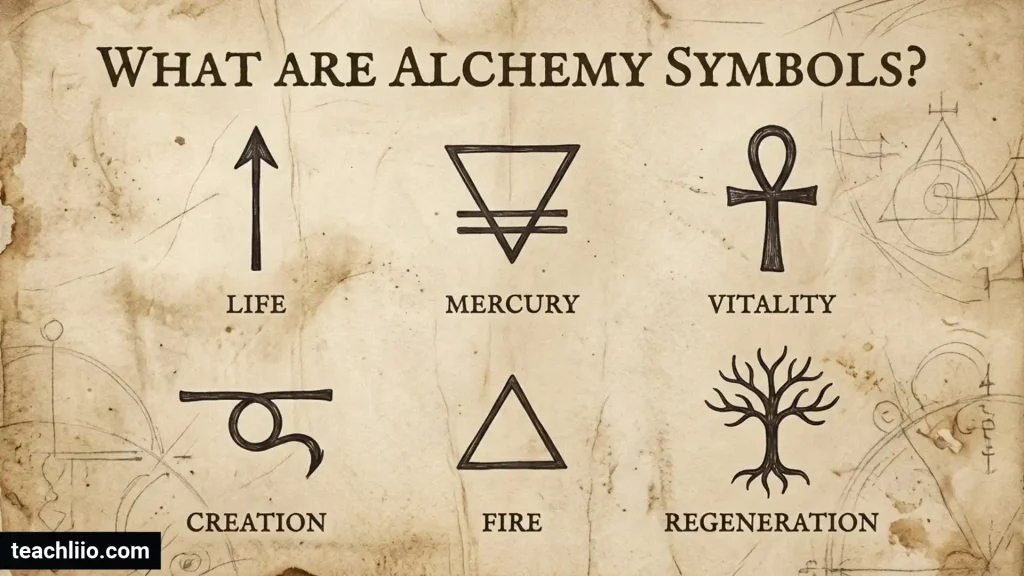
Alchemy symbols are historical signs, glyphs, and images used to represent chemical substances, metals, minerals, elements, laboratory equipment, and experimental processes. They appeared in ancient and medieval manuscripts, illustrated books, scientific notes, and philosophical diagrams.
Alchemy developed through several cultural traditions, including those of ancient Egypt, the Greek-speaking world, the Islamic world, and medieval Europe. Its practitioners explored different subjects, such as metalworking, medicine, mineral preparation, and the transformation of materials.
In Western alchemy, symbols helped practitioners identify substances without repeatedly writing their full names. For example, the Sun sign (☉) was associated with gold, while the Moon sign (☽) represented silver. Other signs described laboratory materials and operations.
Alchemy symbols also had philosophical importance. The transformation of ordinary metals into gold became a powerful representation of perfection and change. Some alchemists connected physical experiments with ideas about spiritual development and the search for wisdom.
However, alchemical symbols did not always have universal meanings. Their appearance and interpretation could change according to the author, manuscript, historical period, and alchemical tradition.
Complete Alchemy Symbols and Meanings Chart
The following chart introduces some of the best-known historical alchemical glyphs and traditional planetary signs.
| Symbol | Name | Traditional association |
| 🜀 | Quintessence | Fifth element |
| 🜁 | Air | Movement and breath |
| 🜂 | Fire | Heat and transformation |
| 🜃 | Earth | Solid matter |
| 🜄 | Water | Fluidity and dissolution |
| 🜍 | Sulfur | Active principle |
| ☿ | Mercury | Quicksilver and change |
| 🜔 | Salt | Fixed and material principle |
| ☉ | Sun | Gold |
| ☽ | Moon | Silver |
| ♀ | Venus | Copper |
| ♂ | Mars | Iron |
| ♃ | Jupiter | Tin |
| ♄ | Saturn | Lead |
| 🜅 | Aqua Fortis | Nitric acid |
| 🜆 | Aqua Regia | Acid mixture |
| 🜈 | Aqua Vitae | Distilled spirit |
| 🜓 | Cinnabar | Mercury sulfide |
| 🜖 | Vitriol | Sulfate-related substances |
| 🜕 | Nitre | Nitrate-related material |
| 🜫 | Antimony Ore | Stibnite |
| 🜩 | Tin Ore | Tin-bearing mineral |
| 🜪 | Lead Ore | Lead-bearing mineral |
| 🜚 | Gold | Gold |
| 🜛 | Silver | Silver |
| 🜞 | Crocus of Iron | Prepared iron compound |
| 🜠 | Copper Ore | Copper-bearing mineral |
| 🜨 | Verdigris | Copper corrosion product |
| 🝞 | Sublimation | Sublimation process |
| 🝟 | Precipitation | Formation of a precipitate |
| 🝠 | Distillation | Distilling |
| 🝡 | Dissolution | Dissolving |
| 🝣 | Purification | Purifying |
| 🝤 | Putrefaction | Decomposition |
| 🝥 | Crucible | Heating vessel |
| 🝪 | Alembic | Distillation apparatus |
| 🝫 | Bath of Mary | Gentle heating apparatus |
| 🝭 | Retort | Laboratory vessel |
These are selected examples from historical alchemical notation documented in the Unicode Alchemical Symbols chart. Some symbols refer to specific substances or apparatus rather than broad philosophical meanings. Their historical uses could also vary.
The Four Elemental Alchemy Symbols and Their Meanings
The four classical elements were fundamental to Western alchemical philosophy. Influenced by ancient Greek natural philosophy, alchemists used fire, water, air, and earth to describe different qualities of the physical world.
1. Fire Symbol (🜂)
Meaning: Energy, heat, activity, and transformation.
Fire is represented by an upward-pointing triangle. It was traditionally associated with heat and active qualities.
In practical alchemy, fire was essential for heating, melting, and changing materials. Alchemists used furnaces and other heating equipment during various experiments.
Its symbolic associations include passion, courage, creativity, purification, and change.
Fire can also represent the beginning of a transformation because heat can alter the properties of different substances.
2. Water Symbol (🜄)
Meaning: Fluidity, cooling, dissolution, and cleansing.
Water is represented by a downward-pointing triangle. It was traditionally connected with coolness, moisture, and fluid substances.
Alchemists used water in processes such as washing, dissolving, and preparing materials.
Its symbolic associations include renewal, flexibility, emotional reflection, and purification.
3. Air Symbol (🜁)
Meaning: Breath, movement, communication, and intellect.
Air is represented by an upward-pointing triangle crossed by a horizontal line.
It was associated with breath, movement, and invisible forces in the natural world.
Its symbolic interpretations include freedom, knowledge, imagination, and communication.
4. Earth Symbol (🜃)
Meaning: Stability, solid matter, physical existence, and endurance.
Earth is represented by a downward-pointing triangle crossed by a horizontal line.
It symbolized the material world and solid substances.
Its associations include stability, nature, strength, growth, and security.
5. Quintessence Symbol (🜀)
Meaning: The fifth element or essential nature of the heavens.
Quintessence, also called the fifth element or ether in certain philosophical traditions, was considered distinct from the four earthly elements.
In Aristotelian natural philosophy, it was associated with the celestial realm.
The quintessence symbol represents the idea of an additional fundamental principle beyond earth, water, air, and fire. It should not be confused with a modern chemical element.
The Three Fundamental Principles of Alchemy
The Tria Prima, meaning the three primary principles, was an important concept in Western alchemy, particularly associated with the alchemical tradition of Paracelsus.
These principles were sulfur, mercury, and salt. They represented philosophical qualities of matter rather than simply the modern chemical substances.
6. Sulfur Symbol (🜍)
Meaning: Activity, combustibility, and the active principle.
Sulfur represented the active or combustible principle in the Tria Prima.
Alchemists used it to explain qualities associated with burning, heat, and activity.
Its philosophical associations include energy, action, passion, and transformation.
7. Mercury Symbol (☿)
Meaning: Fluidity, volatility, movement, and adaptability.
Mercury represented the fluid and changeable principle. It was also the name of the metallic substance known as quicksilver.
The same sign was associated with the planet Mercury and the Roman god Mercury.
Its traditional associations include movement, flexibility, communication, and the relationship between different forms of matter.
8. Salt Symbol (🜔)
Meaning: Stability, structure, preservation, and the fixed principle.
Salt represented the fixed or material principle in the Tria Prima.
It was associated with the qualities that gave substances stability and physical form.
Its philosophical associations include structure, endurance, preservation, and groundedness.
Together, sulfur, mercury, and salt formed an important framework for explaining the behavior and nature of matter in Western alchemical philosophy.
Seven Planetary Metal Symbols and Their Meanings
One of the most recognizable systems in Western alchemy connected seven metals with seven celestial bodies known in classical antiquity.
These associations combined alchemical ideas with astrology and traditional planetary symbolism.
9. Sun Symbol (☉) – Gold
Meaning: Perfection, purity, achievement, and enlightenment.
Gold was associated with the Sun because of its bright appearance and resistance to tarnishing.
The historical alchemical glyph for gold is 🜚, while ☉ is its familiar planetary sign.
Gold represented the highest degree of metallic perfection in many Western alchemical traditions.
10. Moon Symbol (☽) – Silver
Meaning: Reflection, purity, and lunar symbolism.
Silver was associated with the Moon because of its bright, reflective appearance.
Its alchemical glyph is 🜛, while ☽ is the traditional lunar sign.
Silver was often connected with reflection, receptivity, and the complementary relationship between the Moon and Sun.
11. Mercury Symbol (☿) – Quicksilver
Meaning: Change, fluidity, and adaptability.
Quicksilver is the traditional name for metallic mercury.
It was associated with the planet Mercury because of the historical relationship between astrology and alchemy.
The metal’s unusual liquid state at ordinary room temperature made it particularly important in alchemical experiments.
12. Venus Symbol (♀) – Copper
Meaning: Beauty, harmony, and attraction.
Copper was associated with Venus, the Roman goddess of love and beauty.
The sign ♀ represents Venus and traditionally corresponds to copper.
Copper was an important material in historical metalworking and alchemical experiments.
13. Mars Symbol (♂) – Iron
Meaning: Strength, courage, and action.
Iron was associated with Mars, the Roman god of war.
The connection reflected the importance of iron in weapons, armor, and tools.
The symbol ♂ represents Mars and its traditional metallic association.
14. Jupiter Symbol (♃) – Tin
Meaning: Growth, authority, and expansion.
Tin was associated with Jupiter, the largest planet visible to the naked eye in classical astronomy.
The sign ♃ represents Jupiter and its corresponding metal.
In traditional symbolic interpretations, Jupiter was connected with prosperity, wisdom, and authority.
15. Saturn Symbol (♄) – Lead
Meaning: Time, discipline, heaviness, and endurance.
Lead was associated with Saturn, a planet traditionally connected with age, limitation, and time.
The sign ♄ represents Saturn and its metallic association.
In alchemical philosophy, lead often represented an imperfect starting material that could be transformed through the Great Work.
Other Historical Alchemical Symbols and Their Meanings
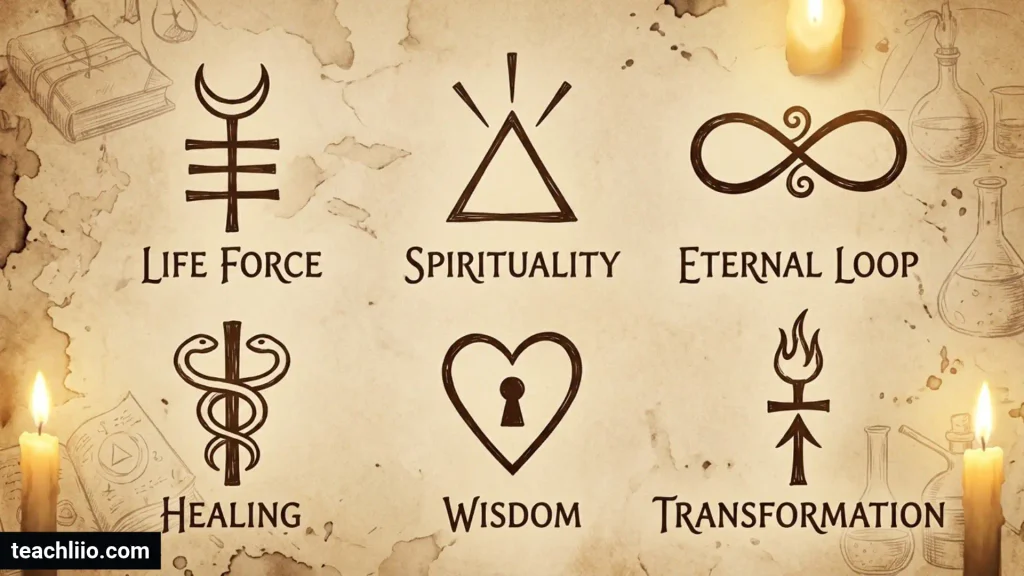
Alchemical manuscripts included many additional signs for acids, minerals, salts, and laboratory ingredients. These symbols show that alchemy involved practical experimentation as well as philosophy.
16. Aqua Fortis (🜅)
Meaning: Nitric acid.
Aqua Fortis means strong water. It was the historical name for nitric acid, an important substance in metalworking and alchemical experiments.
17. Aqua Regia (🜆)
Meaning: A powerful acid mixture.
Aqua Regia means royal water. It refers to a mixture of nitric acid and hydrochloric acid capable of dissolving gold under suitable conditions.
Its historical importance came from its unusual ability to dissolve a metal traditionally regarded as highly resistant.
18. Aqua Vitae (🜈)
Meaning: Water of life or distilled spirit.
Aqua Vitae was a historical term for distilled alcohol or spirit of wine.
It appeared in various medieval and early modern preparations and writings.
19. Cinnabar (🜓)
Meaning: Mercury sulfide.
Cinnabar is a naturally occurring mineral consisting mainly of mercury sulfide. It was historically important as a source of mercury and a red pigment.
20. Vitriol (🜖)
Meaning: A historical category of sulfate-related substances.
Vitriol was a name used for several mineral substances, including certain metal sulfates.
It played an important role in alchemical recipes and chemical preparations.
21. Nitre (🜕)
Meaning: Nitrate-related material.
Nitre was historically associated with naturally occurring nitrate salts, especially saltpeter.
It appeared in various laboratory and technical preparations.
22. Antimony Ore (🜫)
Meaning: Stibnite, a mineral containing antimony sulfide.
Antimony-bearing minerals were important in historical alchemy and metallurgy.
The symbol 🜫 is specifically identified as the alchemical symbol for antimony ore.
23. Tin Ore (🜩)
Meaning: A mineral associated with tin.
Tin was traditionally linked with Jupiter. Its ore and processed forms also appeared in alchemical notation.
24. Lead Ore (🜪)
Meaning: A mineral associated with lead.
Lead was connected with Saturn and was frequently discussed in alchemical theories of metallic transformation.
25. Gold (🜚)
Meaning: Perfection and metallic excellence.
The specific glyph 🜚 represents gold in the historical alchemical symbol collection.
It is distinct from the more familiar Sun sign, ☉, although both are historically associated.
26. Silver (🜛)
Meaning: Purity and lunar association.
The glyph 🜛 specifically represents silver, while the Moon sign ☽ is its planetary equivalent.
27. Iron Ore (🜜)
Meaning: Iron-bearing mineral.
Iron was associated with Mars. The specific glyph 🜜 is identified as an alchemical symbol for iron ore.
28. Copper Ore (🜠)
Meaning: Copper-bearing mineral.
Copper was traditionally associated with Venus. The glyph 🜠 specifically refers to copper ore, not every form of copper.
29. Verdigris (🜨)
Meaning: A green copper corrosion product.
Verdigris is a green material historically produced through the corrosion of copper.
It was used as a pigment and appeared in historical recipes and alchemical notation.
Famous Alchemical Images and Their Meanings
Not every famous alchemical image has a standardized glyph. Some are elaborate illustrations that communicate philosophical ideas, stages of transformation, and relationships between opposing forces.
30. Philosopher’s Stone
Meaning: Perfection, transformation, and the Great Work.
The Philosopher’s Stone is one of the most famous concepts in Western alchemy.
It was traditionally described as a substance capable of transforming base metals into gold. Some traditions also connected it with an elixir of life.
Its modern symbolic interpretation often represents the search for wisdom, personal improvement, and the achievement of something extraordinary.
There is no single universally accepted historical glyph for the Philosopher’s Stone.
31. Ouroboros
Meaning: Eternity, renewal, and the cycle of transformation.
The Ouroboros depicts a serpent or dragon eating its own tail.
It appeared in several ancient traditions and later became an important image in alchemical manuscripts.
Its circular form represents continuity, unity, and the relationship between beginnings and endings.
32. Rebis
Meaning: Unity and the integration of opposites.
Rebis is a symbolic figure frequently depicted with two heads or a combined masculine and feminine form.
It represents the union of complementary principles, often illustrated through the Sun and Moon.
In alchemical philosophy, it can symbolize the achievement of balance and completeness.
33. Phoenix
Meaning: Rebirth, renewal, and purification.
The phoenix is a mythical bird associated with rising from its ashes.
In alchemical imagery, it can represent a substance emerging from destruction in a transformed state.
Today, it is commonly interpreted as a symbol of resilience and new beginnings.
34. Green Lion
Meaning: Raw matter and chemical transformation.
The green lion is a distinctive image in Western alchemical artwork.
Its meaning depends on the manuscript and context. In some traditions, it is connected with particular substances and processes involved in metallic transformation.
It should not be interpreted as having one universal meaning.
35. Dragon
Meaning: Hidden power, dangerous forces, and transformation.
Dragons appear in many alchemical illustrations and can represent powerful or difficult-to-control substances.
A dragon biting its own tail may also represent the Ouroboros.
36. Eagle
Meaning: Volatility, elevation, and transformation.
Eagles are often associated with upward movement and the transformation of substances.
In some alchemical imagery, an eagle represents volatilization, a process in which a material becomes vapor.
37. Sun and Moon Together
Meaning: Duality, harmony, and the union of opposites.
The Sun and Moon frequently appear together in alchemical illustrations.
Their combination represents the relationship between gold and silver, as well as complementary philosophical principles.
Some illustrations depict them as a symbolic marriage that contributes to the completion of the Great Work.
Alchemy Symbols for Chemical Processes
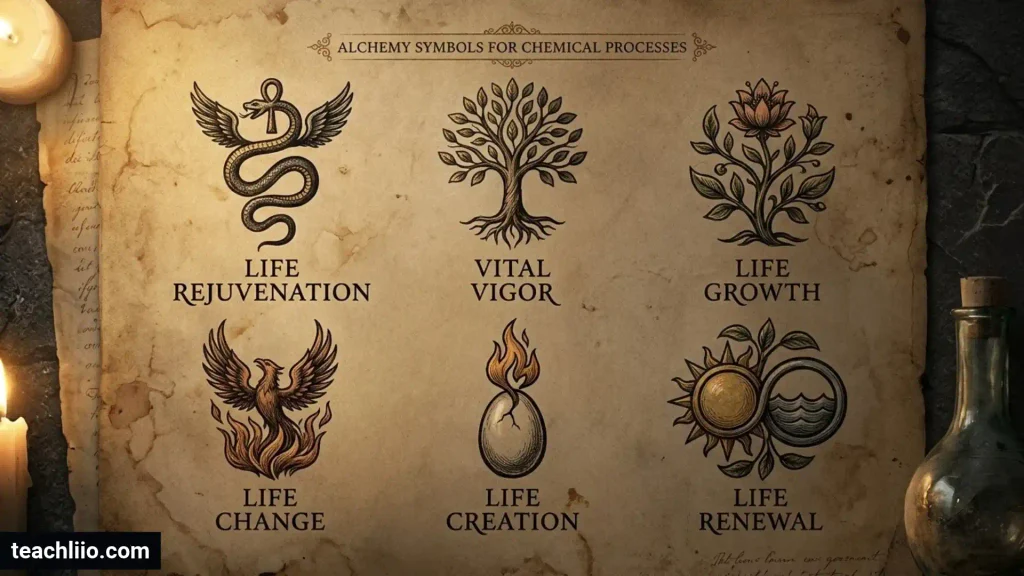
Historical alchemists used specialized signs to describe practical operations. These processes were important because they allowed practitioners to separate, prepare, heat, and transform materials.
The following examples include actual Unicode alchemical glyphs where available.
38. Sublimation (🝞)
Meaning: Converting a substance directly from solid to vapor.
Sublimation was used to separate and purify certain materials.
In symbolic interpretations, it can represent rising from a lower state toward a higher one.
39. Precipitation (🝟)
Meaning: Forming a solid from a solution.
Precipitation occurs when a dissolved substance forms an insoluble solid.
It was useful in historical chemical preparations and purification.
40. Distillation (🝠)
Meaning: Separating substances through vaporization and condensation.
Distillation involves heating a mixture to produce vapor and then cooling that vapor to collect a liquid.
It was important in preparing distilled substances and separating components of mixtures.
41. Dissolution (🝡)
Meaning: Breaking down a substance in a liquid.
Dissolution was used to prepare materials for additional experiments.
In modern symbolic interpretations, it can represent letting go of old structures and beginning a new process.
42. Purification (🝣)
Meaning: Removing unwanted substances or impurities.
Purification was an important part of alchemical practice.
It involved preparing materials to make them more suitable for further operations.
43. Putrefaction (🝤)
Meaning: Decomposition and breakdown.
Putrefaction refers to the decomposition of organic matter or substances.
In philosophical interpretations, it can symbolize the breakdown of an existing state before renewal.
44. Crucible (🝥)
Meaning: A vessel used for intense heating.
A crucible was an essential piece of laboratory equipment used for heating and melting materials.
Its importance in alchemy makes it a recognizable sign of practical experimentation.
45. Alembic (🝪)
Meaning: Equipment used for distillation.
An alembic is a historical distillation apparatus used to heat substances and collect condensed vapor.
It appeared in many historical alchemical laboratories.
46. Retort (🝭)
Meaning: A vessel used in chemical and distillation operations.
A retort is a vessel with a curved neck that allowed vapor to pass into another container during certain experiments.
It was an important part of historical laboratory equipment.
The Four Stages of Alchemical Transformation
Some Western alchemical traditions describe the Great Work through stages associated with colors. These stages are known as Nigredo, Albedo, Citrinitas, and Rubedo.
Not every alchemical author used exactly the same sequence, but the four-stage model became influential in later interpretations.
Nigredo: Blackening
Meaning: Breakdown, darkness, and decomposition.
Nigredo represents the breaking down of an existing substance.
In modern philosophical interpretations, it can symbolize confronting difficulties and recognizing the need for change.
Albedo: Whitening
Meaning: Purification and clarity.
Albedo represents a stage of purification and separation from unwanted material.
Symbolically, it can represent reflection, understanding, and renewal.
Citrinitas: Yellowing
Meaning: Illumination and awakening.
Citrinitas is associated with yellow or golden imagery.
In later interpretations, it can represent growing awareness, wisdom, and intellectual development.
Rubedo: Reddening
Meaning: Completion and integration.
Rubedo is associated with the final stage of the Great Work.
It represents the achievement of a transformed and perfected state in many Western alchemical descriptions.
Spiritual Meanings of Alchemy Symbols
Although alchemy developed partly through practical experiments, its images and philosophical ideas also attracted spiritual interpretations.
Modern readers often use alchemical symbolism as a way to understand personal growth, balance, and self-discovery.
Transformation and Personal Growth
The transformation of ordinary metal into gold has become a metaphor for personal improvement.
It can represent learning from mistakes, developing new abilities, and becoming more confident through experience.
Balance Between Opposites
The Rebis and Sun-and-Moon imagery represent the union of different qualities.
Modern interpretations often connect these images with balancing logic and emotion, strength and sensitivity, or action and patience.
Purification and Renewal
Fire, water, and the phoenix can represent the process of releasing unwanted habits and creating opportunities for new beginnings.
These interpretations are symbolic rather than scientific claims.
Wisdom and Self-Discovery
The Philosopher’s Stone is frequently interpreted as a representation of the search for wisdom and deeper understanding.
Its symbolism can encourage reflection and the pursuit of meaningful personal goals.
Why Did Ancient Alchemists Use Symbols?
Alchemists used symbols for several practical and intellectual reasons.
First, symbols made laboratory notes more concise. A single sign could identify a metal, mineral, ingredient, or operation without repeatedly writing its complete name.
Second, symbols helped organize complicated experimental instructions. They could be used alongside written recipes, diagrams, and illustrations.
Third, alchemical symbols belonged to specialized scholarly and practical traditions. Practitioners familiar with a particular notation system could understand information more quickly.
Finally, symbols helped express philosophical ideas that were difficult to describe using ordinary language.
Some alchemical writings also used obscure imagery and specialized terminology, but it would be inaccurate to assume that every symbol was deliberately created to hide knowledge.
History and Origins of Alchemical Symbols
Alchemy developed over many centuries, with influences from different cultures and intellectual traditions.
Ancient Egyptian and Greek Influences
Early alchemical traditions developed through metalworking, medicine, practical crafts, and philosophical discussions about matter.
Greek natural philosophy contributed the four-element model of earth, water, air, and fire. Later traditions incorporated these ideas into alchemical explanations of the physical world.
Islamic Contributions
Scholars working in the medieval Islamic world contributed to the development of alchemical knowledge, laboratory methods, mineral studies, and the transmission of earlier writings.
Arabic-language scientific traditions also influenced the development of medieval European alchemy.
Medieval and Renaissance Europe
During the medieval and Renaissance periods, alchemical symbols became increasingly visible in manuscripts, laboratory records, and illustrated books.
The relationship between planets and metals became an important part of Western alchemical notation.
Alchemical illustrations also used animals, human figures, vessels, and symbolic scenes to explain complicated ideas.
The Development of Modern Chemistry
As experimental chemistry developed, many older alchemical theories were replaced by more systematic scientific explanations.
However, some alchemical symbols remained in scientific and technical writing into the eighteenth century.
Today, historians examine alchemical manuscripts to understand the development of chemistry, medicine, metallurgy, and scientific communication.
How to Use Alchemy Symbols in Modern Life
Alchemy symbols remain popular in creative projects, decorative objects, and modern interpretations of ancient philosophy.
Alchemy Symbol Tattoos
The Ouroboros, elemental signs, planetary metals, and Philosopher’s Stone imagery are popular choices for symbolic tattoos.
People may select them to represent transformation, personal strength, balance, or renewal.
Before choosing a design, check its historical identity and meaning because different alchemical signs can look similar.
Jewelry and Accessories
Alchemical signs can be used in rings, necklaces, bracelets, and pendants.
For example, the Sun can represent achievement, the Moon can represent reflection, and the Ouroboros can represent continuity.
Art and Creative Designs
Artists often incorporate alchemical imagery into illustrations, fantasy artwork, book covers, and decorative designs.
Combining elemental glyphs, planetary symbols, and historical laboratory imagery can create artwork inspired by the history of alchemy.
Frequently Asked Questions About Alchemy Symbols and Meanings
What Are the Four Main Alchemy Symbols?
The four main elemental alchemy symbols are fire (🜂), water (🜄), air (🜁), and earth (🜃). They represent the four classical elements used in ancient natural philosophy and Western alchemical traditions.
What Is the Most Famous Alchemy Symbol?
The Philosopher’s Stone is one of the most famous alchemical concepts. The Ouroboros is another widely recognized image representing eternity, continuity, and transformation.
What Does the Ouroboros Mean in Alchemy?
The Ouroboros is a serpent or dragon eating its own tail. It represents eternity, unity, renewal, and the continuous cycle of creation and destruction.
What Are the Three Principles of Alchemy?
The three principles, known as the Tria Prima, are sulfur, mercury, and salt. They represented active, fluid, and fixed principles in Western alchemical philosophy.
What Is the Alchemy Symbol for Gold?
Gold has a specific historical alchemical glyph, 🜚. It is also associated with the Sun sign, ☉, which traditionally represents gold in planetary alchemy.
What Does the Mercury Symbol Mean?
The symbol ☿ represents Mercury and its association with quicksilver. It is also connected with the planet Mercury and traditionally symbolizes movement and change.
What Does the Alchemy Symbol for Fire Mean?
The fire symbol (🜂) is an upward-pointing triangle. It represents heat, activity, energy, and transformation in the classical elemental system.
What Is Quintessence in Alchemy?
Quintessence is the fifth element in certain philosophical traditions. It was considered distinct from earth, water, air, and fire and was associated with the celestial realm.
Are Alchemy Symbols Connected to Astrology?
Yes. Western alchemy shared important associations with traditional astrology. Seven metals were linked with seven celestial bodies: gold with the Sun, silver with the Moon, and the other five metals with Mercury, Venus, Mars, Jupiter, and Saturn.
Are Alchemy Symbols Still Used Today?
Yes. Alchemical symbols appear in historical research, art, jewelry, tattoos, literature, and modern symbolic interpretations. They are also included in the Unicode Alchemical Symbols character collection.
What Is the Difference Between Alchemy and Modern Chemistry?
Alchemy combined practical experiments with philosophical and sometimes spiritual ideas about matter. Modern chemistry is an experimental science based on systematic testing, measurable evidence, and established chemical theories.
Conclusion
Alchemy symbols offer a fascinating look into how ancient and medieval thinkers understood nature, matter, and transformation. From the four elemental signs and three fundamental principles to the seven planetary metals and specialized laboratory glyphs, these symbols preserve an important part of scientific and cultural history.
Some signs represented actual materials and experimental operations, while other images communicated philosophical ideas about perfection, balance, and renewal.
Whether you are interested in historical research, ancient chemistry, spiritual interpretations, or creative designs, learning about alchemical symbols can help you appreciate the traditions behind these mysterious signs.
The most important thing to remember is that alchemy was never one completely fixed system. Its symbols and meanings developed across different cultures, authors, and historical periods, making each manuscript and tradition an interesting subject to explore.

I’m Arthur Ellison, a British writer with a fascination for numbers, quantities, and the questions people ask about how many. I enjoy researching facts, comparisons, measurements, and everyday statistics, presenting them in straightforward language. My goal is to make numerical information easy to understand, useful, and interesting for curious readers everywhere.
Books:
The Curious World of How Many
Numbers, Quantities and Everyday Facts