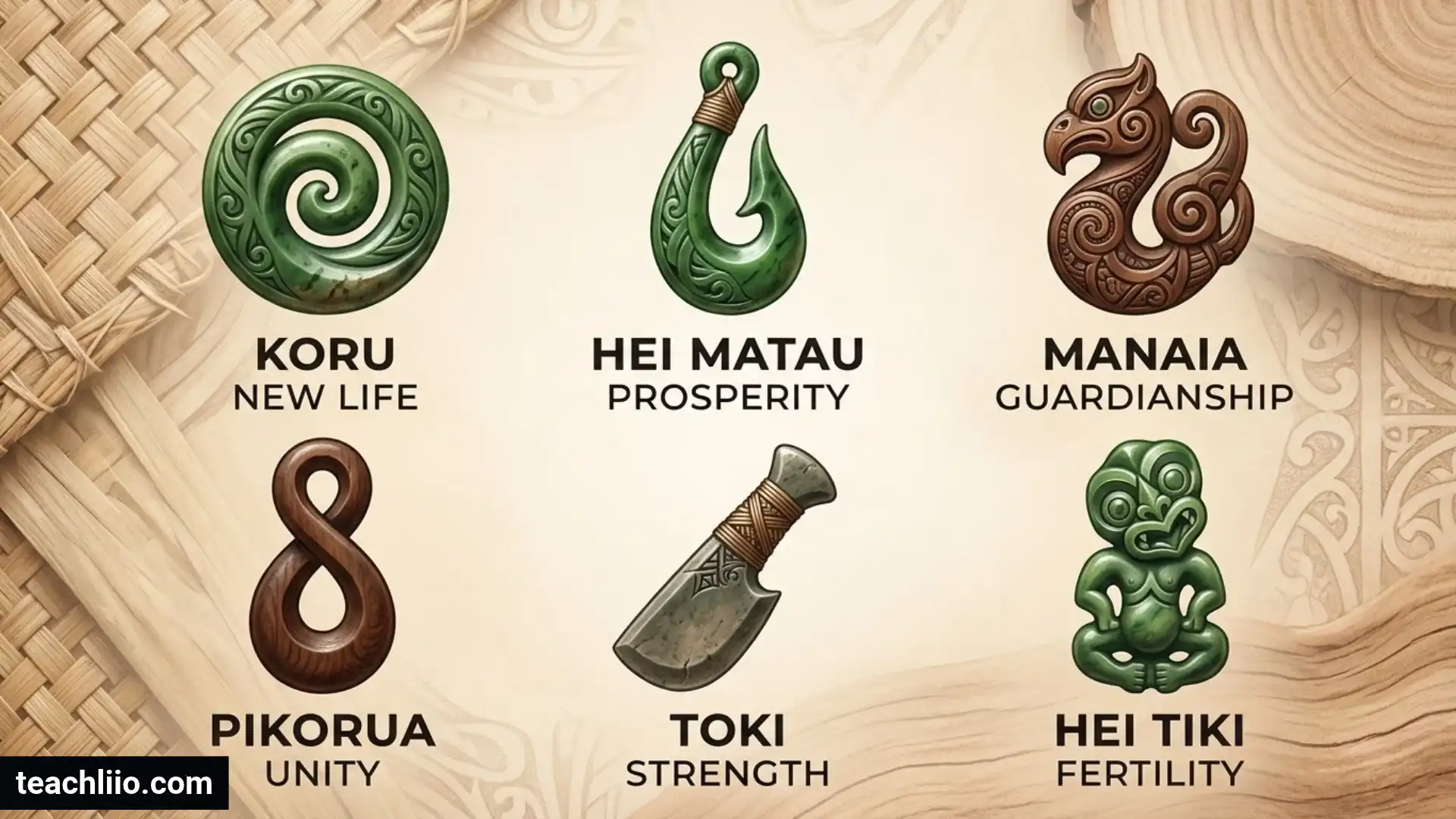
Māori symbols are an important part of the history, identity, and artistic traditions of the Māori people of Aotearoa New Zealand. From beautiful spiral designs to carved fishhooks and traditional woven patterns, these symbols communicate ideas about nature, family, ancestry, strength, and the connections between people and their surroundings.
Some of the most recognizable Māori designs include the koru, hei matau, manaia, pikorua, hei tiki, and toki. Each has a distinctive appearance and cultural background. For example, the koru is inspired by an unfurling fern frond and is associated with new beginnings and growth, while the hei matau represents a traditional fishhook and is connected with abundance and strength.
Māori symbols appear in many forms of traditional artwork, including wood carving, greenstone jewelry, weaving, painting, and tā moko (traditional Māori tattooing). However, not every Māori cultural concept is a visual symbol, and not every design has one universally accepted meaning.
In this guide, you will discover more than 20 Māori symbols and traditional patterns, their commonly recognized meanings, their cultural importance, and the stories behind them. You will also learn about Māori tattoos, greenstone pendants, traditional artwork, and the importance of respecting Māori cultural heritage.
What Are Māori Symbols?
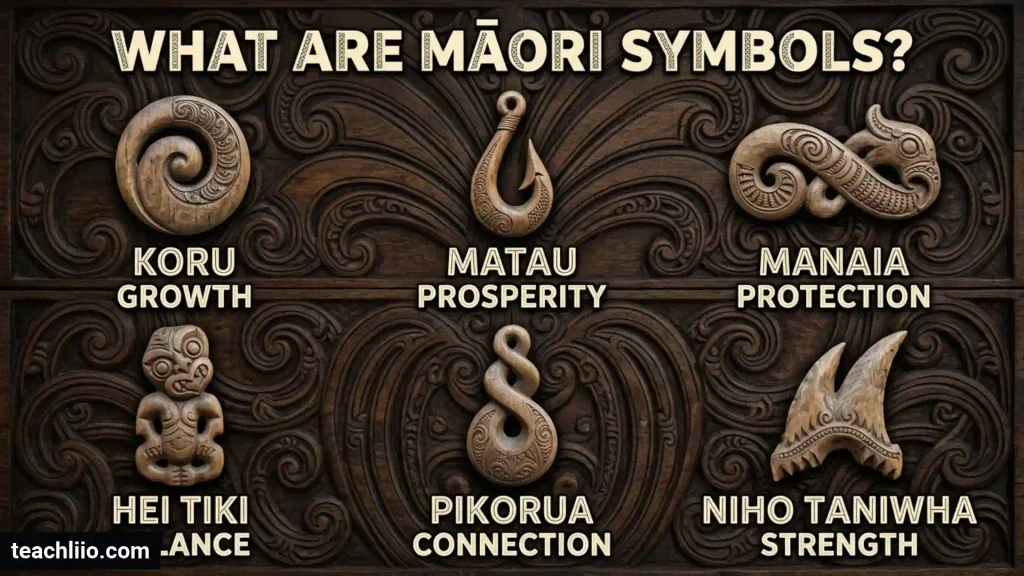
Māori symbols are visual designs, patterns, and artistic forms used to communicate cultural knowledge, identity, history, and relationships. They are part of a wider artistic tradition known as toi Māori.
Traditional Māori artwork can tell stories that connect people with their ancestors, families, communities, and the natural world. Before written records became widespread, oral traditions and artistic expressions played important roles in preserving and sharing knowledge.
Māori designs appear in several traditional art forms.
Whakairo: Traditional Māori Carving
Whakairo is the Māori practice of carving materials such as wood, stone, and bone. Carved designs can appear on meeting houses, canoes, tools, weapons, and personal ornaments.
These carvings may represent ancestors, important stories, and community identity. Their meanings often depend on the particular artwork and the people connected to it.
Kōwhaiwhai: Traditional Painted Patterns
Kōwhaiwhai refers to decorative painted patterns, especially those found on the rafters of Māori meeting houses, known as wharenui.
These designs commonly feature flowing curves, spirals, and repeated forms. They can communicate genealogy, history, and tribal identity.
Tukutuku: Traditional Woven Panels
Tukutuku panels are decorative woven structures traditionally displayed inside meeting houses. They feature geometric patterns created using natural materials and carefully arranged weaving techniques.
Tāniko: Geometric Weaving
Tāniko is a traditional Māori decorative weaving technique, particularly associated with the borders of fine garments. Its patterns include triangles, diamonds, diagonal lines, and stepped forms.
Te Ara Encyclopedia of New Zealand+1
20+ Māori Symbols and Their Meanings
Māori artistic traditions contain many recognizable designs. Some are individual motifs, while others are geometric patterns, carved figures, or broader cultural concepts.
The following examples explain their appearance, background, and commonly documented interpretations.
1. Koru – New Beginnings and Growth
The Living Spiral: The Deeper Meaning of the Koru in Pounamu
The koru is one of the most recognizable Māori designs. Its shape is inspired by the unfurling frond of the silver fern, a plant closely associated with New Zealand.
The spiral represents the natural process of growth and renewal. Its circular form is also associated with harmony and the continuation of life.
Common meanings and associations:
- New beginnings
- Personal growth
- Renewal
- Harmony
- Connection with origins
The koru appears in traditional carving, painting, jewelry, and contemporary Māori artwork. Its recognizable shape makes it a popular design for people interested in natural growth and positive change.
iponz.govt.nz+1
2. Hei Matau – Strength and Abundance
New Zealand Jade Hei Matau Pendant | Mountain Jade NZ
Hei matau is a fishhook-shaped Māori design inspired by the traditional fishing tools used by Māori communities.
Fishing has long been important to Māori life, providing food and supporting connections with coastal environments. The fishhook therefore carries associations with abundance, strength, and determination.
Common meanings and associations:
- Abundance
- Strength
- Determination
- Connection with the ocean
- Good fortune during water journeys
Hei matau is particularly popular in pounamu jewelry. Its shape makes it one of the easiest Māori designs to recognize.
iponz.govt.nz+1
3. Manaia – Spiritual Guardian
Carved Manaia – Wood Carving – Maori Carvings – An Eye 4 Art
The manaia is a distinctive figure found in Māori carving and decorative artwork. It is traditionally described as having a bird-like head, a human-like body, and a fish-like tail.
The figure is commonly associated with spiritual guardianship, guidance, and strength. It is often understood as connecting different aspects of the spiritual and natural worlds.
Common meanings and associations:
- Spiritual guidance
- Guardianship
- Strength
- Protection
- Balance
The manaia appears in wood carving, bone ornaments, and pounamu jewelry. Its exact appearance and interpretation can vary across artistic traditions.
iponz.govt.nz
4. Pikorua – Connection and Relationships
Double Pikorua – Pounamu Large Pendant – Arrowtown Stonework
The pikorua is a recognizable twisted design that can appear as two connected strands or paths.
It is commonly interpreted as representing the joining of two people or spirits. The design is also associated with the continuing paths of life and the relationships that connect individuals.
Common meanings and associations:
- Relationships
- Friendship
- Connection
- Shared journeys
- Lasting bonds
Pikorua pendants are often exchanged as meaningful gifts between people who value their relationship.
iponz.govt.nz
5. Hei Tiki – Ancestry and Cultural Identity
Hei tiki (pendant in human form) | Collections Online – Museum of New Zealand Te Papa Tongarewa
The hei tiki is a traditional human-shaped pendant and one of the best-known Māori ornaments.
These carved treasures are often passed down through generations and can embody a wearer’s family history and ancestral connections.
However, its exact historical meaning is not completely settled. Different interpretations connect the human figure with Tiki, Hine-i-te-iwaiwa, or an unborn child.
Important associations:
- Ancestral heritage
- Genealogy
- Family connections
- Fertility in some traditional interpretations
- Cultural identity
Hei tiki should be understood as a culturally significant treasure rather than simply a decorative necklace.
collections.tepapa.govt.nz
6. Toki – Strength and Determination
New Zealand Greenstone Adze Pendant | Mountain Jade NZ
The toki design represents a traditional adze, a tool used for cutting, shaping, and carving materials.
Because the tool required skill and control, its pendant form became associated with strength, determination, and personal discipline.
Common meanings and associations:
- Strength
- Control
- Determination
- Skill
- Leadership
The toki is particularly popular in contemporary pounamu jewelry.
iponz.govt.nz
7. Roimata – Tears and Comfort
Roimata Pounamu Pendant | by Sands Carving Studio – Auckland Museum Online Store
Roimata means teardrop. In Māori decorative traditions, the name is also associated with a particular tukutuku pattern.
The teardrop form is connected with sadness and grief. It has also been used as a meaningful gift to comfort someone experiencing a difficult time.
Common meanings and associations:
- Grief
- Sadness
- Compassion
- Comfort
- Emotional support
It is important to distinguish the teardrop-shaped pendant interpretation from the specific woven pattern called roimata.
iponz.govt.nz+1
8. Mangōpare – Hammerhead Shark Motif
Mangopare Pattern A4 Display Poster – Māori Art
Mangōpare is a Māori motif inspired by the hammerhead shark.
The design is associated with the animal’s distinctive shape and is used in traditional artistic patterns. It is commonly connected with strength, determination, and power.
Common associations:
- Strength
- Power
- Courage
- Determination
- Resilience
Mangōpare is an example of how Māori artists draw inspiration from the natural world.
9. Niho Taniwha – Traditional Geometric Pattern
Niho taniwha translates as taniwha teeth. It is a traditional geometric design made from triangular forms.
The pattern appears in Māori weaving and decorative art. Its shape resembles a series of pointed teeth, creating a strong repeated visual structure.
Common associations:
- Strength
- Traditional identity
- Geometric balance
- Cultural heritage
The name describes the design’s appearance, but its precise interpretation should be understood in the context of the artwork and community.
10. Pātiki – Flounder Pattern
Tukutuku Panel – Pātiki, Nihoniho 1993 | Record | DigitalNZ
Pātiki is a diamond-shaped geometric motif named after the flounder fish.
It is found in traditional tukutuku patterns and is recognizable by its symmetrical diamond outline.
Common associations:
- Traditional fishing connections
- Natural inspiration
- Geometric design
- Cultural craftsmanship
11. Poutama – Learning and Progress
Traditional Maori Poutama pattern with geometric steps in red, yellow, and black colors
Poutama is a stepped geometric pattern commonly used in traditional tukutuku panels.
Its ascending steps are associated with education, progress, and advancement. The design is often interpreted as a visual representation of the journey toward knowledge.
Common meanings and associations:
- Learning
- Education
- Progress
- Achievement
- Ascension
It is one of the best-known examples of meaningful geometric patterns in Māori weaving.
Te Ara Encyclopedia of New Zealand+1
12. Kaokao – Angular Traditional Pattern
Tukutuku Panel – Kaokao 1993 | Record | DigitalNZ
Kaokao is a traditional geometric pattern whose name refers to the armpits. Its design commonly resembles repeated W-shaped or M-shaped lines.
It appears in tāniko and other Māori decorative traditions.
Common associations:
- Traditional craftsmanship
- Geometric repetition
- Cultural identity
- Strength in some interpretations
Its exact meaning can vary, and it should not be assigned one universal symbolic interpretation.
13. Puhoro – Flowing Movement
File:Maori-rafter24.svg – Wikimedia Commons

Puhoro is a flowing decorative motif found in Māori artistic traditions, including tā moko.
Its curved and moving forms create a sense of energy and visual movement.
Common associations:
- Movement
- Energy
- Flowing patterns
- Traditional artistic expression
It is particularly recognizable in traditional body-art designs and carved decoration.
14. Wheku – Ancestral Carved Face
15 best things to do in North Island, New Zealand | Rough Guides
Wheku refers to a carved face found in Māori artistic traditions.
These faces may appear in meeting house carvings and other traditional artworks. They can represent ancestors and communicate stories connected with a particular community.
Common associations:
- Ancestral identity
- Family history
- Heritage
- Cultural memory
The identity and meaning of a particular wheku should be understood through its specific carving and community context.
15. Pītau – Unfurling Fern Design
NZ Greenstone Medium Koru Pendant (AX078) Hapopo Pounamu – Greenstone Shop
Pītau refers to an unfurling fern form used in Māori decorative art.
Its appearance is connected with the growth of new fern fronds and the natural forms found in the New Zealand environment.
Common associations:
- Natural growth
- Renewal
- Plant life
- Traditional decoration
Pītau and koru are closely related in visual inspiration, but the words and their uses should not automatically be treated as interchangeable.
16. Nihoniho – Small Teeth Pattern
Niho Taniwha — Manawa Tapu | Tā Moko – Toi Māori
Nihoniho means little teeth. It is a traditional geometric pattern made using a series of small triangular shapes.
The design is used in tāniko weaving and reflects the detailed geometric skills of Māori textile artists.
Key characteristics:
- Repeated small triangles
- Geometric balance
- Traditional weaving
- Decorative repetition
17. Waharua – Double Mouth Pattern
Waharua – A2 Print — Manawa Tapu | Tā Moko – Toi Māori
Waharua is a traditional tāniko pattern whose name means double mouth.
It is characterized by a diamond-shaped outline and belongs to the wider collection of geometric designs used in Māori weaving.
Key characteristics:
- Diamond-shaped structure
- Repeated geometric forms
- Traditional textile decoration
- Māori weaving heritage
18. Purapurawhetū – Star Seeds Pattern
Purapurawhetū is a named tukutuku design associated with star seeds.
It can be recognized by a panel covered in repeated white crosses, creating a distinctive geometric appearance.
This pattern demonstrates how Māori weaving combines visual repetition with culturally meaningful names.
Te Ara Encyclopedia of New Zealand
19. Ruru – The Morepork Owl
Ruru | Morepork | New Zealand Birds Online
Ruru is the Māori name for the morepork, a native owl of New Zealand.
The bird appears in Māori knowledge and stories about the natural environment. Its calls and nighttime habits make it a recognizable part of the country’s wildlife.
Important associations:
- Native wildlife
- Natural heritage
- Traditional knowledge
- Cultural stories
Its specific symbolic significance depends on the particular story or community. It should not automatically be described as a universal Māori symbol of wisdom.
20. Taniwha – Powerful Beings in Māori Traditions
Maori Taonga Taniwha Panel Wood Carving from Maniapoto Iwi New Zealand – silverferngallery
Taniwha are powerful beings in Māori traditions. They are frequently associated with particular places, waterways, and ancestral narratives.
Some are described as guardians, while others have more dangerous or complex roles.
Common cultural associations:
- Powerful ancestral stories
- Connections with particular places
- Guardianship in some traditions
- Natural environments
- Māori oral history
Taniwha are important cultural beings, not simply decorative symbols with one fixed meaning.
Traditional Māori Patterns and Their Meanings
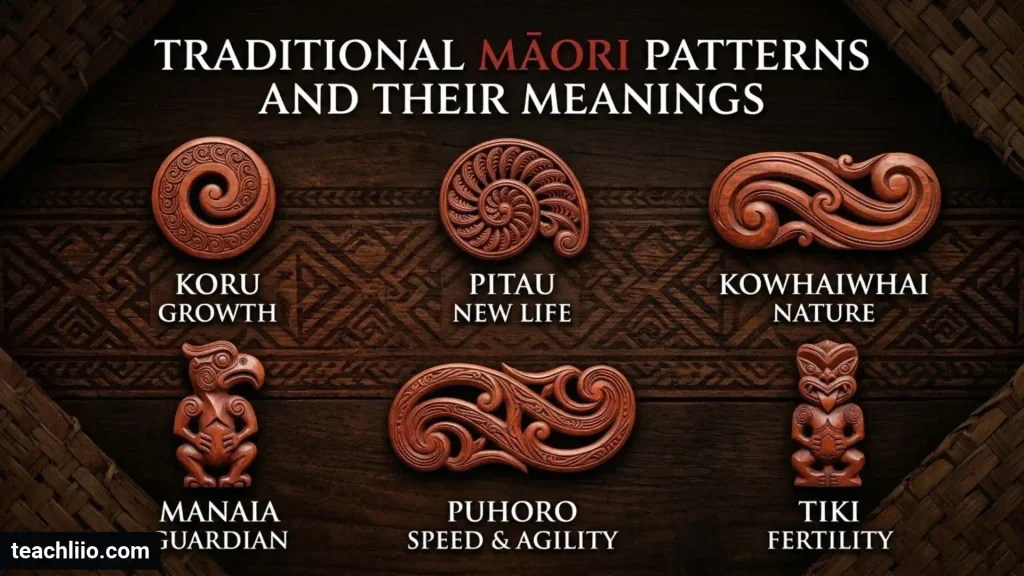
Māori patterns are an important part of traditional art. They appear in meeting houses, clothing, woven panels, and decorative carvings. Many designs use repeated lines, curves, triangles, and geometric shapes to communicate cultural knowledge.
Kauwhata Marae Visual Recording Initiative
10
Kōwhaiwhai Patterns
Kōwhaiwhai are painted decorative patterns traditionally found on the rafters of meeting houses. They commonly feature flowing curves, spirals, and repeated designs.
They can communicate ancestral connections, tribal histories, and cultural identity. Individual patterns may have particular meanings within the communities that use them.
Tukutuku Patterns
Tukutuku are woven panels traditionally displayed inside meeting houses. They are made using carefully arranged natural materials and geometric techniques.
Popular designs include poutama, pātiki, niho taniwha, and roimata. Each pattern has a distinctive appearance and name.
Tāniko Patterns
Tāniko is a decorative weaving technique used especially on the borders of traditional Māori garments.
Its patterns commonly include triangles, diamonds, diagonal lines, and stepped shapes. Some traditional pattern meanings have been lost over time, so it is important not to invent interpretations for every design.
Te Ara Encyclopedia of New Zealand+1
Māori Tattoo Symbols and Their Cultural Meanings
Nights for Tuesday 18 December 2018 Nights | RNZ
7
Māori tattooing is known as tā moko. It is a significant cultural art form that can communicate personal identity, genealogy, ancestry, and relationships with a community.
Unlike ordinary decorative tattoos, traditional tā moko is connected with cultural knowledge and identity.
What Is Tā Moko?
Tā moko is the traditional Māori practice of tattooing. Its designs can communicate information about a person’s background, identity, and relationships.
Traditional patterns are not simply selected because they look attractive. Their meaning depends on the individual and the cultural context.
What Is Moko Kauae?
Moko kauae refers to traditional Māori chin tattooing. It holds particular cultural significance for Māori women and can express identity, ancestry, and connections with their communities.
Why Are Māori Tattoo Designs Different?
Māori tattoo designs can differ according to personal identity, family background, and tribal traditions. Some patterns are associated with particular histories and relationships.
For this reason, copying a traditional tā moko design as a generic tattoo can disregard the cultural significance behind it.
Te Papa+1
Māori Greenstone Symbols and Their Meanings
Pounamu NZ – Pounamu Necklaces – Pounamu Earrings – An Eye 4 Art
Pounamu, commonly called New Zealand greenstone, is a highly valued natural stone in Māori culture. It has traditionally been used to create ornaments, tools, and important cultural treasures.
Greenstone pendants come in different shapes, including koru, hei matau, toki, and hei tiki.
What Is Pounamu?
Pounamu is a type of nephrite jade and other culturally recognized greenstone found in New Zealand. It is especially associated with the South Island, known in Māori as Te Waipounamu.
It is valued for its beauty, strength, and cultural importance. Many pounamu objects are treasured and passed between generations.
Popular Pounamu Pendant Shapes
| Pendant | Common association |
| Koru | Growth and renewal |
| Hei matau | Strength and abundance |
| Toki | Determination and control |
| Pikorua | Relationships and connection |
| Hei tiki | Ancestry and cultural heritage |
| Roimata | Grief and comfort |
These associations help explain why different pendant shapes are chosen as meaningful gifts. However, a pendant’s significance may also come from its maker, history, ownership, and personal connections.
What Do Māori Symbols Represent?
Although Māori designs have different forms and histories, several recurring themes appear throughout traditional artistic practices.
Strength and Courage
The toki and mangōpare are commonly associated with strength and determination. Their forms demonstrate how traditional tools and animals inspire meaningful artistic designs.
Growth and New Beginnings
The koru is especially associated with renewal, growth, and the natural cycle of life. Its unfurling fern shape makes it a recognizable representation of new beginnings.
Family and Ancestral Connections
Whakapapa is the Māori concept of genealogy and relationships between generations. Traditional carvings and ornaments can preserve and communicate these connections.
Relationships and Connection
The pikorua is commonly interpreted as representing relationships and the joining of two people or spirits.
Protection and Guardianship
The manaia is traditionally associated with spiritual guardianship and guidance. Taniwha also appear as guardians in some Māori traditions, although their roles differ between stories.
Are Māori Symbols the Same Across Every Tribe?
No. Māori symbols and patterns do not necessarily have identical meanings across every iwi (tribe) and hapū (subtribe).
A design may represent a particular ancestor, family history, or important event within one community. Another community may understand a similar-looking pattern differently.
Names and interpretations of traditional weaving patterns can also vary between tribes.
Therefore, it is better to understand Māori symbols through their specific cultural and historical context instead of assuming every design has one universal definition.
Te Ara Encyclopedia of New Zealand+1
Can Anyone Use Māori Symbols?
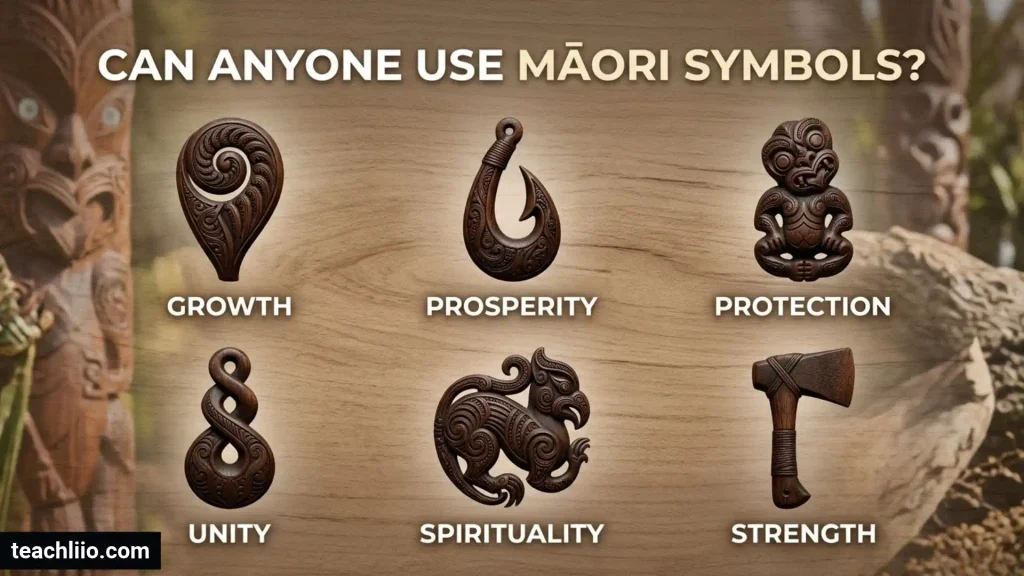
Māori designs are increasingly visible in jewelry, fashion, tattoos, branding, and contemporary artwork. However, their cultural significance deserves careful consideration.
Some designs are connected with particular ancestors, communities, and traditional knowledge. Using them without understanding their background can cause cultural harm or misrepresentation.
Cultural Respect and Tikanga
Tikanga refers to Māori customs, values, and appropriate ways of doing things.
When using Māori-inspired designs, consider the following:
- Research the cultural background of the design.
- Avoid treating traditional patterns as meaningless decorations.
- Consult knowledgeable Māori artists or cultural experts.
- Respect designs associated with particular iwi and communities.
- Credit artists when using their original artwork.
- Consider cultural permission where appropriate.
Why Supporting Māori Artists Matters
Māori artists carry important cultural knowledge and artistic skills. Working with them can help ensure that designs are accurate, meaningful, and culturally appropriate.
New Zealand’s Intellectual Property Office recommends engaging Māori artists, designers, and cultural experts when incorporating Māori elements into creative and commercial projects.
Intellectual Property Office of New Zealand+2
Frequently Asked Questions
What Are the Most Popular Māori Symbols?
Some of the most recognizable Māori designs include koru, hei matau, manaia, pikorua, hei tiki, and toki. They are associated with growth, abundance, guardianship, relationships, ancestry, and determination.
What Does the Māori Koru Symbol Mean?
The koru represents new beginnings, growth, renewal, and harmony. Its spiral shape is inspired by an unfurling silver fern frond.
What Is the Māori Symbol for Strength?
The toki is commonly associated with strength, control, and determination. Mangōpare, inspired by the hammerhead shark, is also associated with power and resilience.
What Does the Māori Fish Hook Mean?
The hei matau represents a traditional fishhook and is associated with abundance, strength, and determination. It is also connected with good fortune when traveling over water.
What Does the Manaia Symbol Represent?
The manaia is commonly understood as a spiritual guardian. It is associated with guidance, protection, and connections between different worlds.
What Does the Māori Double Twist Mean?
The pikorua is commonly associated with relationships, friendship, and the joining of two people or spirits. Its twisted appearance represents connected paths.
What Does the Hei Tiki Represent?
The hei tiki is a traditional human-shaped pendant associated with ancestral heritage and genealogy. Its exact historical meaning remains uncertain, with several interpretations existing in Māori traditions.
What Is the Māori Symbol for Protection?
The manaia is widely associated with spiritual guardianship and protection. Taniwha can also serve as guardians in particular Māori stories and traditions.
What Are Traditional Māori Patterns Called?
Important Māori artistic patterns include kōwhaiwhai, tukutuku, and tāniko. These traditional art forms use painted scrollwork, woven panels, and geometric textile designs.
Are Māori Symbols Used in Tattoos?
Yes. Traditional Māori tattooing, known as tā moko, uses culturally meaningful designs connected with identity, ancestry, and genealogy. It is important to understand and respect its cultural significance.
What Is the Difference Between Koru and Pītau?
Both are connected with the unfurling fern. Koru is a widely recognized spiral motif, while pītau refers to an unfurling fern form used in decorative designs.
Conclusion
Māori symbols represent an important part of the artistic heritage, identity, and cultural knowledge of the Māori people. From the koru and hei matau to the manaia, pikorua, and traditional weaving patterns, these designs communicate meaningful connections with nature, ancestors, family, and community.
Understanding Māori symbols requires more than memorizing a list of meanings. Their significance can depend on the artwork, the artist, the iwi, and the traditions behind each design.
Whether you are interested in Māori tattoos, greenstone pendants, traditional carvings, or geometric patterns, learning about their cultural background offers a deeper appreciation of Māori art.
Most importantly, these designs should be approached with respect. They are not simply decorative shapes but part of a living cultural heritage that continues to be preserved and developed by Māori communities today.

I’m Hugo Wetherby, a British author interested in the numbers behind everyday questions. I explore quantities, populations, measurements, records, comparisons, and surprising statistics, turning complicated information into accessible answers. I believe a simple “how many” question can lead to fascinating discoveries, and I enjoy helping readers find those answers.
Books:
How Many? A Guide to Everyday Numbers
The Great Book of Numbers and Quantities