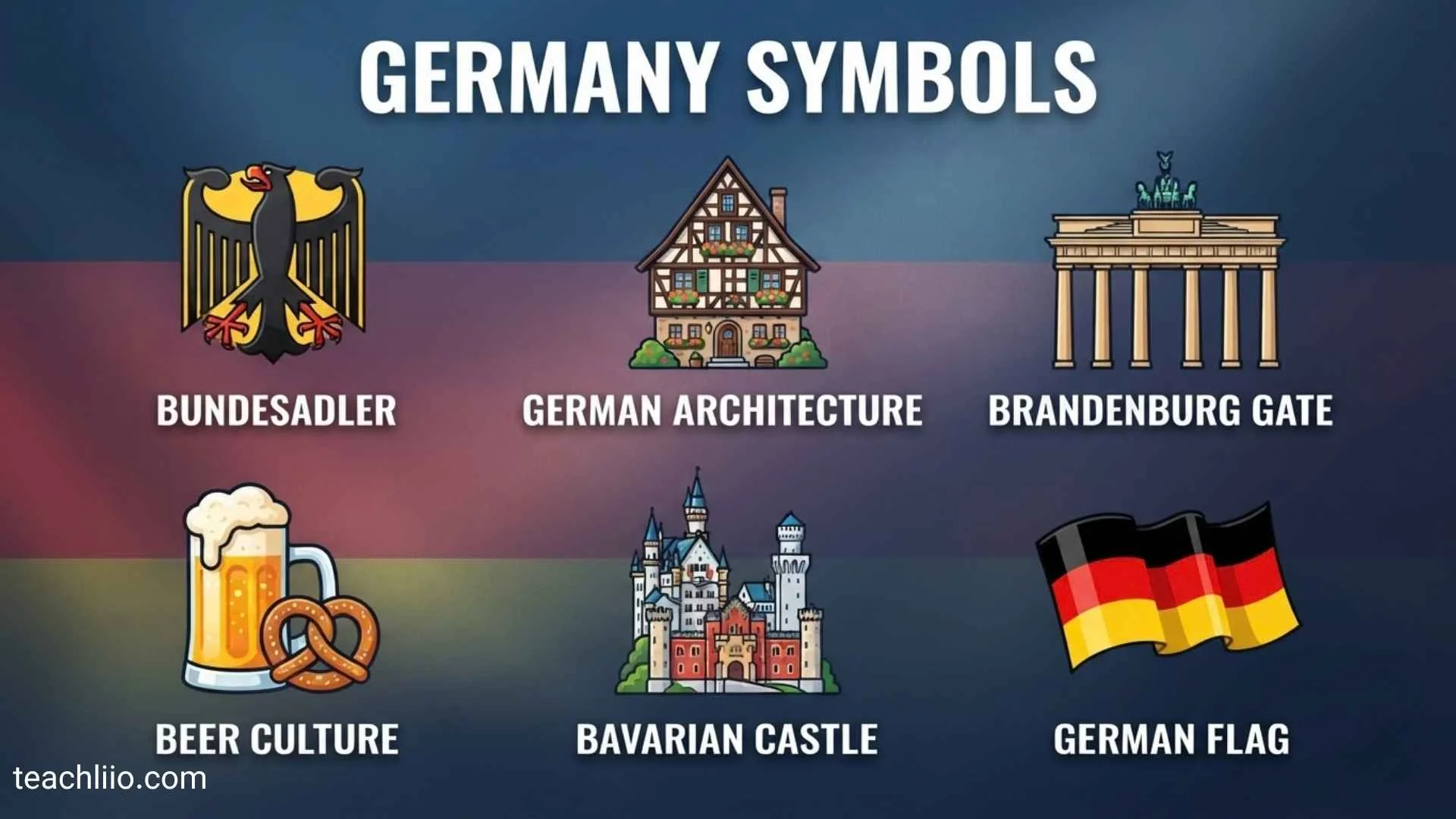
Germany has many symbols that represent its history, identity, culture, and political traditions. Some are official state symbols, while others became important through history, architecture, art, regional traditions, or everyday life.
The German flag, Federal Eagle, coat of arms, national anthem, Brandenburg Gate, oak tree, and black-red-gold colors are among the most recognizable examples. Cultural symbols such as pretzels, castles, beer, and traditional clothing are also strongly associated with Germany, although they do not all have the same official status.
Understanding the difference between an official symbol and a popular cultural image is important. For example, the Federal Eagle is an official state emblem, while the Brandenburg Gate is a famous landmark associated with German history and reunification. Similarly, Lederhosen and dirndls are strongly connected with Bavaria but should not automatically be treated as symbols representing every part of Germany.
This guide explores the most important Germany symbols and their meanings, explains their historical background, and shows how these symbols are understood in modern Germany.
What Are Germany Symbols?
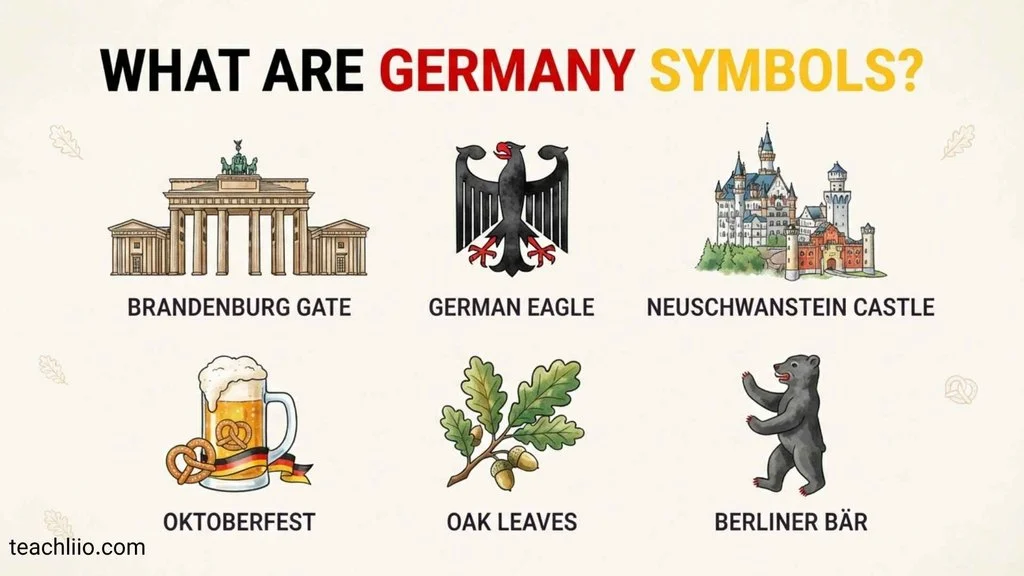
Germany symbols are objects, colors, buildings, emblems, traditions, and cultural images that represent Germany or important parts of its history and identity.
Some have an official role. Others became recognizable because of their historical importance or cultural popularity.
The most important categories include:
- Official state symbols: the Federal Eagle, German flag, national colors, coat of arms, and national anthem
- Historical symbols: the oak, Iron Cross, and other symbols connected with different periods of German history
- Landmark symbols: the Brandenburg Gate and Reichstag Building
- Cultural symbols: pretzels, beer, castles, traditional clothing, and other familiar images
- Modern representations: symbols appearing on coins, government buildings, public institutions, and national events
This distinction matters because not everything commonly associated with Germany is an official national symbol.
Germany Symbols at a Glance
| Symbol | Main Association | Type |
| German Flag | Unity, freedom, democratic tradition | Official |
| Black, Red and Gold | German national identity | Official colors |
| Federal Eagle | State authority and sovereignty | Official |
| German Coat of Arms | Federal state and national identity | Official |
| National Anthem | Unity, justice, freedom | Official |
| Brandenburg Gate | History, division and reunification | Landmark |
| Oak Tree | Strength, endurance and tradition | Historical/Cultural |
| Iron Cross | German military history | Historical |
| Reichstag Building | Parliament and democracy | Landmark |
| Pretzel | German food culture | Cultural |
| Beer | German brewing tradition | Cultural |
| Castles | German history and architecture | Cultural |
| Lederhosen and Dirndl | Alpine and Bavarian tradition | Regional/Cultural |
This table gives a quick overview, but the meaning of each symbol becomes clearer when its history and modern use are considered.
Official National and State Symbols of Germany
Germany’s official symbols have a particularly important role because they represent the Federal Republic of Germany itself rather than simply German culture.
The German Flag
The German flag is one of the most recognizable symbols of the country. It consists of three horizontal stripes:
- Black at the top
- Red in the middle
- Gold at the bottom
The modern black-red-gold combination has a long connection with German political history and ideas of national unity and freedom.
The colors became especially important during the 19th century, when movements for German unity and constitutional government were growing. They were later used by democratic Germany and eventually became the national colors of the reunified Federal Republic.
Today, the German flag can be seen on government buildings, during national celebrations, sporting events, international meetings, and other official occasions.
What Do the German Flag Colors Mean?
People sometimes give each individual color a simple symbolic meaning, but the historical development of black, red, and gold is more complicated than a fixed three-part definition.
Together, the colors became strongly associated with ideas of unity, freedom, and democratic political traditions.
Their importance is connected to movements that sought a united and constitutionally governed Germany. Because of this history, the colors have meaning beyond simple decoration.
The flag therefore represents both the German state and important chapters in the country’s political development.
The Federal Eagle
The Federal Eagle, known in German as the Bundesadler, is one of Germany’s most important official symbols.
The eagle has a much older history than modern Germany. The bird appeared in the heraldic traditions of the Holy Roman Empire and later German states. Because the eagle was associated with authority and imperial power, it became deeply connected with German state traditions.
The modern Federal Eagle is used by institutions of the Federal Republic, although its exact artistic form can vary.
You may encounter the eagle on:
- Government documents
- Official buildings
- Coins
- Institutional seals
- Parliamentary materials
- Court and government settings
- Other official representations
The eagle is therefore more than a decorative image. It represents the continuity and authority of the German state.
The German Coat of Arms
Germany’s federal coat of arms features a black eagle on a golden-yellow shield.
The coat of arms is closely connected with the Federal Eagle but should not be confused with every artistic representation of the eagle.
The design has deep historical roots and connects modern Germany with older European and German heraldic traditions.
The coat of arms is especially important in official contexts because it identifies the Federal Republic and its institutions.
The German National Anthem
Germany’s national anthem is another official national symbol.
The official anthem uses the third stanza of “Das Deutschlandlied,” with music composed by Joseph Haydn. The words emphasize unity, justice, and freedom.
The anthem is used during important state occasions and other formal events.
Its history is particularly important because earlier versions of the song were used in very different political periods. Modern Germany’s official use focuses on the third stanza, reflecting the country’s contemporary democratic identity.
Famous Symbols of Germany and Their Meanings
Not every famous German symbol is an official state emblem. Some became important because they represent major events, places, traditions, or aspects of German cultural identity.
The Brandenburg Gate
The Brandenburg Gate is one of Germany’s most famous landmarks and one of the strongest visual symbols associated with the country.
Located in Berlin, it was originally built in the late 18th century as a monumental city gate.
Its symbolic meaning changed dramatically over time.
During the Cold War, the Brandenburg Gate stood near the Berlin Wall and became associated with the division between East and West Germany. After the Berlin Wall fell in 1989, the gate became a powerful symbol of German reunification.
Today, the Brandenburg Gate represents several layers of German history:
- Berlin’s historical development
- The division of Germany
- The end of the Cold War
- German reunification
- Modern national identity
This transformation makes the Brandenburg Gate especially important when discussing German symbols.
The Oak Tree and Oak Leaves
The oak has a long cultural and historical association with Germany.
Oak trees are known for their strength, longevity, and ability to survive for many years. Because of these characteristics, the oak became connected with ideas such as endurance, strength, and national tradition.
Oak leaves and branches also appeared in German art, military decorations, coins, monuments, and political imagery.
The oak should be understood as a traditional and historical symbol, rather than simply assuming it has the same official status as the German flag or Federal Eagle.
The Iron Cross
The Iron Cross is one of the most recognizable symbols associated with German military history.
It was originally established as a military decoration in the Kingdom of Prussia in 1813. Over time, it became connected with different periods of German military history.
Its meaning therefore depends heavily on historical context.
The Iron Cross should not automatically be interpreted as a symbol of modern Germany as a whole. Its strongest associations are with military history and the armed forces.
The symbol has also changed in design and use over different periods, so historical context is essential when discussing it.
The Reichstag Building
The Reichstag Building in Berlin is another powerful modern symbol of Germany.
The building has witnessed major periods of German history, including the German Empire, the Weimar Republic, the Nazi period, the division of Germany, and the reunification era.
Today, it houses the German Bundestag.
Its modern significance is closely connected with parliamentary democracy. The famous glass dome has also become a popular architectural feature and tourist attraction.
Unlike the Federal Eagle or German flag, the Reichstag is primarily a landmark and institutional symbol rather than a formal national emblem.
German Cultural Symbols
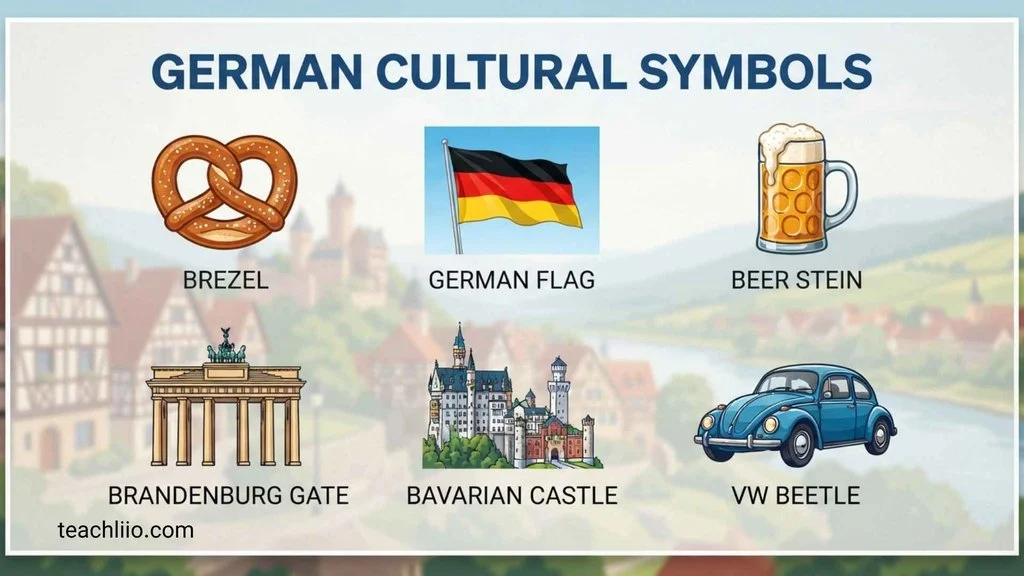
Germany is also represented internationally through food, architecture, clothing, craftsmanship, and everyday cultural traditions.
These should be described as cultural symbols or associations, not automatically as official national symbols.
German Pretzel
The pretzel is one of the foods most commonly associated with German-speaking Europe.
Its twisted shape and long history have made it a familiar image of German food culture, especially in southern Germany.
Pretzels are particularly prominent in Bavaria and at traditional festivals.
However, their popularity does not make the pretzel an official symbol of the German state.
German Beer
Beer is another widely recognized part of Germany’s cultural image.
Germany has a long brewing tradition, with many regional styles and brewing customs. Beer festivals and traditional beer gardens have also contributed to its international reputation.
The important point is that Germany does not have one single beer culture. Different regions have developed their own brewing traditions and specialties.
Beer is therefore best described as a cultural symbol of German brewing heritage, not an official national emblem.
German Castles
Germany is famous for its castles, fortresses, and historic palaces.
These buildings represent the country’s complex history, including medieval states, royal families, regional rulers, military conflicts, and changing political borders.
Castles such as Neuschwanstein have become internationally recognizable images of Germany.
They are particularly useful symbols when discussing German architecture and tourism because they connect history with the modern travel experience.
Cuckoo Clocks
Cuckoo clocks are strongly associated with Germany, especially the Black Forest region.
Traditional cuckoo clocks became famous for their mechanical designs and distinctive hourly cuckoo sound.
Although they are not official national symbols, they represent German craftsmanship and the heritage of the Black Forest.
Traditional German Clothing
Traditional clothing can also be associated with Germany, but regional differences matter.
Lederhosen are strongly associated with Bavaria and Alpine regions, while the dirndl is particularly connected with southern German and Alpine traditions.
These outfits have become internationally recognizable images of Germany, especially through festivals and tourism.
However, they do not represent the everyday clothing of all Germans or the cultural traditions of every German state.
German Symbols You Can See on Euro Coins
German euro coins provide an interesting way to understand several important German symbols.
The designs were deliberately connected with German national and cultural imagery.
Federal Eagle on the €1 and €2 Coins
The German €1 and €2 coins feature the Federal Eagle.
This makes the eagle a symbol that people can encounter in everyday life rather than only on government documents.
Brandenburg Gate on 10, 20 and 50 Cent Coins
The Brandenburg Gate appears on Germany’s 10, 20, and 50 cent coins.
Its inclusion reflects its importance as a historical representation of Germany and Berlin.
The gate is especially meaningful because it became associated with both German division and reunification.
Oak Twig on 1, 2 and 5 Cent Coins
The smaller German euro coins feature an oak twig.
This design connects the country’s currency with the historical and cultural importance of the oak.
Together, the German euro coins create an interesting visual collection of national imagery:
- Federal Eagle
- Brandenburg Gate
- Oak twig
Germany Symbols Through History
German symbols cannot be fully understood without considering the country’s changing political history.
Germany has not always existed in its current form. Different political states and systems used different flags, emblems, colors, and imagery.
Symbols Before Modern Germany
Before the creation of the modern German nation-state, German-speaking territories were divided among numerous political entities.
The Holy Roman Empire used the eagle as an important imperial symbol. The eagle tradition continued to influence later German heraldry.
Symbols of the German Empire
After German unification in 1871, the German Empire adopted its own imperial symbols, including black-white-red colors.
These should not be confused with today’s black-red-gold national flag.
Symbols of the Weimar Republic
After World War I, the Weimar Republic restored black, red, and gold as national colors.
These colors became strongly connected with Germany’s democratic constitutional tradition.
Symbols During the Nazi Period
The Nazi regime introduced its own political symbols and visual language between 1933 and 1945.
These symbols belong to that specific dictatorship and historical period. They should not be presented as symbols of modern Germany.
Germany’s modern democratic state uses different official symbols and treats Nazi propaganda and unconstitutional-organization symbols within a specific legal framework.
East and West Germany
After World War II, Germany was divided into the Federal Republic of Germany in the west and the German Democratic Republic in the east.
Each state developed its own political symbols and visual identity.
This division lasted until German reunification in 1990.
Modern Reunified Germany
Modern Germany uses the black-red-gold flag and Federal Eagle within the constitutional framework of the Federal Republic.
The country’s modern symbols therefore connect present-day democratic institutions with a much longer and sometimes complicated historical development.
German Symbols vs Bavarian Symbols
One of the most important distinctions for anyone researching Germany symbols is the difference between German national culture and Bavarian culture.
Bavaria is one of Germany’s 16 federal states and has an especially strong international cultural image.
Symbols commonly associated with Bavaria include:
- Lederhosen
- Dirndls
- Oktoberfest
- Pretzels
- Beer gardens
- Alpine landscapes
- Traditional Bavarian hats
These are certainly part of German culture, but they are not equally representative of every German region.
Germany also contains very different regional traditions in places such as North Rhine-Westphalia, Saxony, Hamburg, Schleswig-Holstein, Baden-Württemberg, Hesse, and other states.
Recognizing these regional differences makes a discussion of German symbols more accurate.
Are Nazi Symbols National Symbols of Germany?
No. Nazi-era political symbols belong to the history of National Socialist Germany and should not be presented as symbols of the modern Federal Republic of Germany.
This distinction is especially important when discussing the eagle because the eagle itself has a much older history and was used by German states long before the Nazi period.
Modern Germany’s Federal Eagle is part of the constitutional and governmental symbolism of the Federal Republic.
Germany also has laws governing the public use and dissemination of certain symbols associated with unconstitutional organizations. There are specific exceptions for purposes such as education, scholarship, art, research, and historical reporting.
The historical context should therefore always be made clear when discussing symbols from Germany’s Nazi period.
Why Are Some Symbols Restricted in Germany?
Germany’s legal system places restrictions on certain propaganda materials and symbols associated with unconstitutional organizations.
These rules are connected to Germany’s historical experience with National Socialism and the use of propaganda by extremist organizations.
However, restrictions do not mean that historical discussion is prohibited. Educational institutions, museums, historians, journalists, filmmakers, and researchers can discuss and display historical symbols in appropriate contexts under applicable legal exceptions.
For a symbols article, the key distinction is between studying a historical symbol and using it as contemporary extremist propaganda.
What Do German Symbols Represent Today?
Modern German symbols represent several overlapping ideas.
The black-red-gold flag is connected with German national identity, unity, and democratic traditions.
The Federal Eagle represents the German state and its institutional authority.
The Brandenburg Gate represents an important journey through German history, particularly division and reunification.
The oak represents a long-standing cultural and historical tradition.
The Reichstag Building represents Germany’s modern parliamentary democracy.
Meanwhile, food, castles, traditional crafts, and regional clothing provide cultural images that people around the world associate with Germany.
Together, these symbols show that national identity is not represented by one object alone. It is built from political traditions, historical experiences, architecture, regional cultures, and everyday life.
Frequently Asked Questions
What is the main symbol of Germany?
Germany has several important national symbols rather than one single symbol that represents everything. The Federal Eagle is one of its principal official state emblems, while the black-red-gold flag is the country’s most recognizable national flag.
What animal represents Germany?
The eagle is the animal most strongly associated with the German state. The Federal Eagle, or Bundesadler, is an official state emblem with roots extending back through German and European heraldic history.
Why is the eagle a symbol of Germany?
The eagle has been associated with German political authority for centuries. Its historical use can be traced through the Holy Roman Empire and later German states, eventually becoming the Federal Eagle used by the modern German state.
What do the German flag colors mean?
Black, red, and gold have a long history connected with German unity, freedom, and democratic political traditions. Their meaning developed through historical movements rather than being limited to three simple individual color definitions.
What is the most famous German landmark symbol?
The Brandenburg Gate is one of Germany’s most recognizable landmarks. It became particularly important as a symbol of German division during the Cold War and reunification after the fall of the Berlin Wall.
Is the Brandenburg Gate a national symbol of Germany?
It is an important national and historical symbol, but it is different from official state emblems such as the Federal Eagle and national flag. Its importance comes primarily from its historical and cultural significance.
Is the oak tree a German national symbol?
The oak has a strong historical and cultural association with Germany and has appeared in German art, coins, decorations, and political imagery. It is best understood as a traditional symbol rather than treating it as equivalent to the country’s official state emblems.
What symbols are on German euro coins?
German euro coins feature three important images. The €1 and €2 coins show the Federal Eagle, the 10, 20, and 50 cent coins show the Brandenburg Gate, and the 1, 2, and 5 cent coins feature an oak twig.
Is the Iron Cross a symbol of modern Germany?
The Iron Cross is primarily associated with German military history. It originated as a Prussian military decoration and was used during several historical periods. Its meaning therefore depends strongly on the context in which it appears.
Is the German eagle the same as the Nazi eagle?
The historical eagle tradition is much older than National Socialism. The Federal Eagle of modern Germany belongs to the Federal Republic’s state symbolism, while Nazi-era eagle imagery belonged to a specific dictatorship and political system.
Are lederhosen a symbol of Germany?
Lederhosen are a traditional form of clothing strongly associated with Bavaria and Alpine culture. They have become an international image of Germany, but they are more accurately described as a regional cultural symbol rather than an official German national symbol.
What are the most famous German cultural symbols?
Common cultural associations include pretzels, beer, castles, cuckoo clocks, traditional clothing, and historic architecture. Their importance varies by region, so they should not be confused with official state symbols.
Conclusion
Germany’s symbols tell a story that is much richer than a simple list of national icons. The German flag, black-red-gold colors, Federal Eagle, coat of arms, and national anthem represent the modern state and its democratic traditions. Other symbols, including the Brandenburg Gate, oak, Iron Cross, and Reichstag Building, help explain important parts of German history.
Cultural images such as pretzels, beer, castles, cuckoo clocks, and traditional clothing provide another perspective on German identity. At the same time, regional traditions such as lederhosen and dirndls show why it is important to distinguish Germany as a whole from individual regions such as Bavaria.
Perhaps the most interesting feature of German symbols is how their meanings have changed over time. The Brandenburg Gate moved from being a historic monument to becoming a powerful representation of division and reunification. The black-red-gold colors became closely associated with unity and democratic traditions, while the Federal Eagle connects the modern state with centuries of heraldic history.
Understanding these differences makes it easier to appreciate Germany symbols and their meanings without confusing official emblems, historical imagery, cultural traditions, and regional icons. Together, they provide a visual record of Germany’s past and its identity today.

I’m Oscar Radcliffe, a British writer who enjoys uncovering the numbers hidden within ordinary questions. My work explores quantities, counts, statistics, measurements, and fascinating comparisons across different subjects. I aim to present reliable information clearly, helping readers satisfy their curiosity while discovering interesting facts they may never have considered before.
Books:
The Science of Counting
How Many? Fascinating Numbers Explained