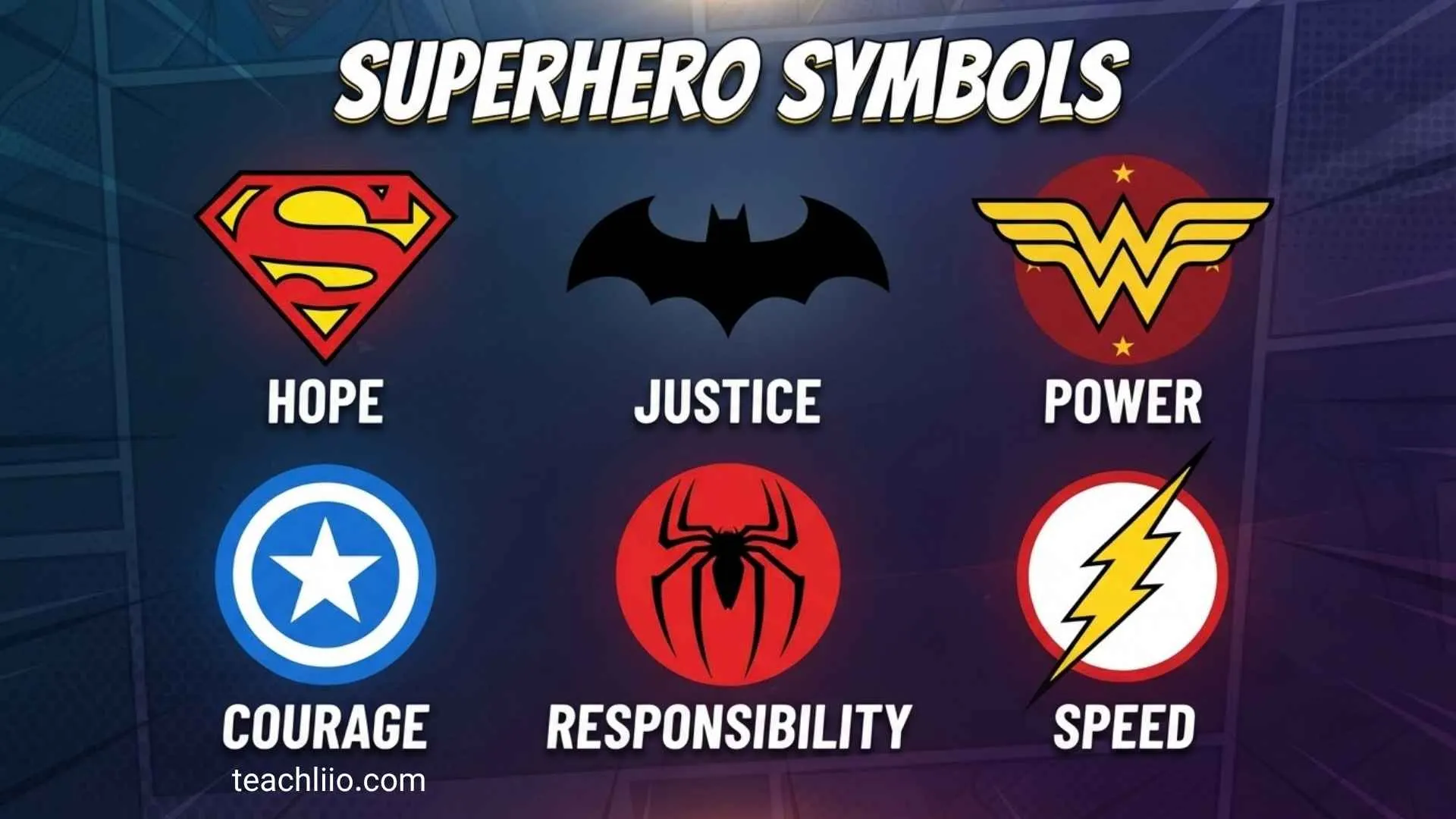
Superhero symbols are some of the most recognizable images in popular culture. A simple bat, spider, shield, lightning bolt, star, or letter can instantly remind people of a particular hero, team, power, or fictional universe.
But superhero symbols are more than logos placed on costumes. They can represent a character’s identity, origin, powers, family, values, mission, or legacy. Some are designed to inspire hope, while others are meant to create fear. Team symbols can also communicate belonging and shared purpose.
In this guide, we’ll explore famous superhero symbols and their meanings, including major Marvel and DC characters, team emblems, animal symbols, power-based designs, symbol evolution, and tips for creating an original superhero emblem.
Superhero Symbols and Their Meanings at a Glance
The following table provides a quick reference to some of the best-known superhero symbols and the ideas commonly associated with them.
| Superhero | Main Symbol | Common Meaning |
| Superman | S Shield | Identity, hope, Kryptonian heritage |
| Batman | Bat | Fear, mystery, justice |
| Wonder Woman | Eagle/Winged Emblem | Amazonian identity, strength |
| The Flash | Lightning Bolt | Speed, energy, movement |
| Green Lantern | Lantern Emblem | Willpower, Corps membership |
| Aquaman | A/Atlantean Emblem | Atlantean identity and power |
| Green Arrow | Arrow | Precision, skill, heroism |
| Shazam | Lightning Bolt | Magical power and transformation |
| Spider-Man | Spider | Origin, powers, agility |
| Iron Man | Armor/Arc Reactor Imagery | Technology, invention, identity |
| Captain America | Star and Shield | Defense, heroism, identity |
| Thor | Hammer/Thor Imagery | Asgardian heritage and power |
| Hulk | Hulk Lettering/Symbolic Imagery | Strength and transformation |
| Black Panther | Panther | Wakandan identity and royalty |
| Wolverine | Claw/Animal Imagery | Mutant identity and ferocity |
| Deadpool | Masked Face | Identity, humor, mercenary persona |
| Daredevil | DD | Identity and superhero persona |
| Fantastic Four | 4 | Team identity |
| Avengers | A | Team membership |
| X-Men | X | Mutant identity and team membership |
These associations can vary between comic-book eras, adaptations, alternate universes, and storylines. A symbol may have an official fictional explanation in one version and a somewhat different interpretation in another.
What Are Superhero Symbols?
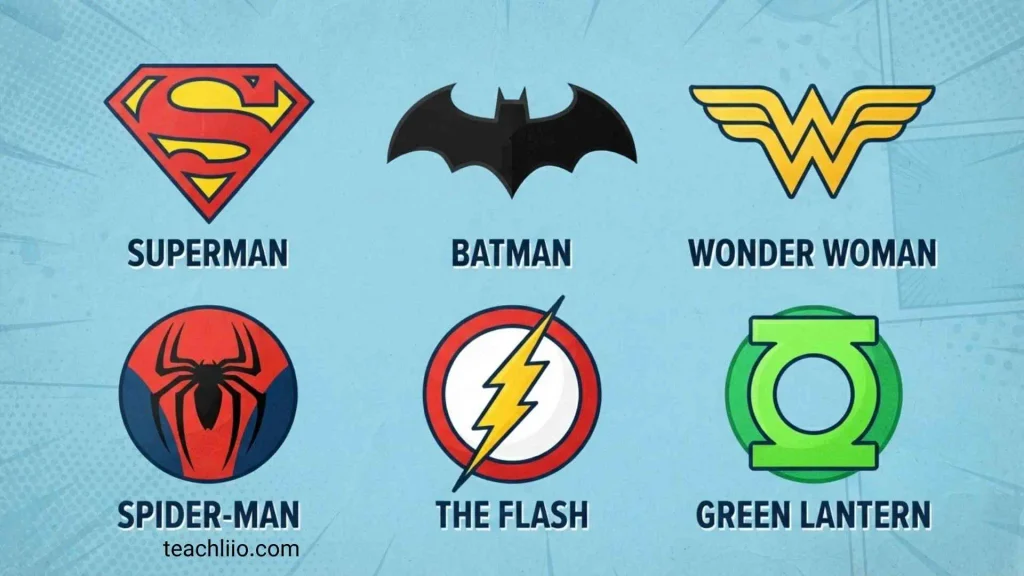
Superhero symbols are visual signs, emblems, icons, or insignia associated with fictional superheroes, teams, organizations, or fictional worlds.
They may appear on:
- Costumes
- Shields
- Vehicles
- Weapons
- Buildings
- Headquarters
- Technology
- Books and comics
- Movie costumes
- Video games
- Merchandise
A symbol can identify a character without showing their face or using their full name.
For example, a bat-shaped emblem can immediately suggest Batman, while a spider emblem can identify Spider-Man. A lightning bolt can remind audiences of The Flash or other speed-based characters depending on the context.
This makes symbols an important part of visual storytelling.
Why Do Superheroes Have Symbols?
Superhero symbols serve several purposes at the same time. They help establish identity, communicate character traits, and make a hero visually memorable.
Symbols Create Instant Recognition
A good superhero symbol can be recognized in a fraction of a second.
This matters because comic-book characters often appear in busy action scenes. A distinctive emblem allows readers and viewers to identify a hero quickly.
Symbols Communicate Character Traits
The imagery selected for a superhero often connects with their personality or powers.
A spider suggests Spider-Man’s origin and abilities. A bat connects with Batman’s mysterious persona. A lightning bolt visually communicates speed and energy when used for The Flash.
Symbols Build a Hero’s Identity
A superhero may have a civilian identity and a heroic identity. The emblem helps visually separate the two.
The symbol can become part of the character’s costume, equipment, vehicles, and public image.
Symbols Represent Ideas
Some superhero symbols carry broader concepts such as:
- Hope
- Courage
- Justice
- Protection
- Strength
- Freedom
- Responsibility
- Fear
- Sacrifice
- Leadership
The exact meaning depends on the fictional universe and storyline.
Famous DC Superhero Symbols
DC Comics has created many of the world’s most recognizable superhero emblems. Their designs often connect directly with a hero’s name, origin, powers, or fictional history.
Superman Symbol
6
Superman’s famous S shield is one of the most recognizable superhero symbols ever created.
At the most basic level, the emblem identifies Superman and his Kryptonian heritage. Different versions of Superman’s story have provided different in-universe explanations for the symbol.
In several modern interpretations, the House of El emblem is connected with the concept of hope. This gives the symbol significance beyond simply representing the letter associated with Superman’s name.
The design has changed over the years, but the shield shape and central S-like form have remained important parts of Superman’s visual identity.
Batman Symbol
Batman uses a bat symbol as one of the central elements of his identity.
The bat connects to Bruce Wayne’s decision to turn fear into a tool. Rather than allowing criminals to see him simply as another masked crime fighter, Batman cultivates a frightening and mysterious image.
The emblem has appeared in numerous forms. Some versions show a plain black bat silhouette, while others place the bat inside a yellow oval or use more stylized shapes.
Regardless of the version, the bat remains closely connected with Batman’s identity, mystery, and fear-based persona.
Wonder Woman Symbol
Wonder Woman has used several variations of an eagle-inspired or stylized winged emblem.
The eagle imagery contributes to the character’s visual identity and can suggest strength, freedom, courage, and an elevated perspective.
Modern adaptations have simplified and redesigned the emblem for different costumes and visual styles.
The symbol also helps distinguish Wonder Woman from other heroes by giving her costume a strong, recognizable central shape.
The Flash Symbol
The Flash is strongly associated with a lightning bolt inside a circular design.
Lightning is an effective visual choice for a character whose defining ability is extraordinary speed. It suggests energy, movement, sudden action, and power.
The Flash emblem has changed in color and styling across adaptations, but the lightning motif remains central.
Green Lantern Symbol
The Green Lantern emblem represents the Green Lantern identity and, more broadly, membership in the Green Lantern Corps.
Its circular design contains a recognizable lantern-inspired motif. The symbol is closely associated with the power of the Green Lantern ring and the larger mythology surrounding the Corps.
Unlike a symbol that belongs only to one individual, the Green Lantern emblem can represent an entire group of heroes.
Aquaman Symbol
Aquaman has used several symbols and costume emblems across different eras.
His imagery often incorporates shapes associated with Atlantis, the sea, and his identity as a ruler of Atlantis.
The character’s famous trident is also an important visual element, although it functions more as a weapon and character artifact than a simple logo.
Aquaman’s symbolism therefore combines Atlantean heritage, royalty, the ocean, and power.
Green Arrow Symbol
Green Arrow’s visual identity naturally centers on the arrow.
The arrow represents precision, archery skill, and the character’s distinctive method of fighting crime.
Because an arrow is a familiar and easily recognizable shape, it works effectively as both a costume emblem and a representation of the hero’s abilities.
Shazam Symbol
Shazam is strongly associated with a lightning bolt.
The lightning motif reflects the magical power associated with Billy Batson’s transformation into Shazam.
The emblem is especially appropriate because lightning provides an immediate visual connection to supernatural energy, transformation, and power.
Famous Marvel Superhero Symbols
Marvel’s superhero symbols often connect characters with their powers, origins, identities, families, or teams.
Spider-Man Symbol
Spider-Man’s spider emblem is a direct visual connection to his origin and powers.
Peter Parker develops spider-like abilities after being bitten by a radioactive spider in the traditional origin story. The spider symbol therefore immediately communicates an important part of his identity.
Different Spider-Man costumes have used different versions of the spider. Some designs make it large and prominent, while others use a smaller emblem.
The symbol can represent agility, climbing ability, speed, and Spider-Man’s connection to his unusual origin.
Iron Man Symbol
5
Iron Man does not have one universally fixed symbol in the same way as Batman or Superman.
Instead, several visual elements are strongly associated with Tony Stark’s superhero identity.
The armor itself is perhaps the most recognizable. The helmet and glowing arc reactor are also important visual identifiers.
These elements communicate:
- Advanced technology
- Engineering
- Invention
- Armor
- Tony Stark’s superhero identity
Iron Man demonstrates that a superhero’s visual symbol does not always need to be a traditional logo.
Captain America Symbol
Captain America’s most recognizable symbol is his star and shield design.
The star has become strongly associated with his heroic identity, while the shield represents defense and protection.
The shield also serves an important practical purpose within the story. It is not merely decorative; it is a piece of equipment that Captain America uses in combat.
This combination of symbol and weapon makes Captain America’s imagery particularly distinctive.
Thor Symbol
Thor’s visual identity is closely connected with Mjolnir, his hammer, and other Asgardian imagery.
The hammer represents power, heritage, and Thor’s role within Asgardian mythology.
Although Mjolnir is primarily a weapon and magical artifact rather than a conventional logo, it functions as a powerful visual symbol for Thor.
When audiences see the hammer, they can often identify Thor immediately.
Hulk Symbol
The Hulk does not have one universally consistent emblem like Superman’s shield.
Instead, his visual identity comes from his distinctive appearance, enormous physical strength, and transformation from Bruce Banner.
The character is frequently represented through Hulk-related lettering, artwork, or imagery.
The broader symbolism surrounding Hulk centers on transformation, uncontrolled power, physical strength, and the relationship between Bruce Banner and his alter ego.
Black Panther Symbol
Black Panther’s identity is closely associated with the panther.
The animal connects with the character’s name, abilities, and role within Wakanda.
The panther can also symbolize stealth, strength, agility, and power.
Black Panther’s imagery is additionally connected with Wakandan culture, technology, royalty, and heritage, making the symbol more than a simple animal logo.
Wolverine Symbol
Wolverine’s visual identity is strongly connected to the wolverine animal and claw imagery.
His claws are among his most recognizable physical characteristics. They visually communicate his fighting style and aggressive combat abilities.
The X-Men identity is also important because Wolverine is closely associated with the broader mutant and X-Men mythology.
Deadpool Symbol
Deadpool’s symbol is closely associated with his distinctive masked face.
The red-and-black mask has become an instantly recognizable visual identifier for the character.
Unlike Superman’s shield or Batman’s bat, Deadpool’s imagery often emphasizes his costume and facial mask rather than a single abstract emblem.
This supports the character’s unusual, humorous, and irreverent persona.
Daredevil Symbol
Daredevil has commonly been associated with the DD emblem on his costume.
The letters connect to his superhero name and provide a simple visual identifier.
Different costume versions have altered the size, location, and styling of the emblem, but the basic connection to Daredevil’s name remains clear.
Marvel and DC Team Symbols
Not every superhero symbol belongs to an individual. Some of the most recognizable emblems identify groups.
Avengers Symbol
The Avengers are commonly represented by a large A enclosed within a circular design.
The symbol communicates team identity rather than representing one specific hero.
It can appear on uniforms, equipment, buildings, promotional material, and other elements connected with the team.
X-Men Symbol
The X is strongly associated with the X-Men.
The letter is particularly effective because it connects directly with the team’s name while remaining simple enough to function as a recognizable emblem.
The X can represent mutant identity and membership in the broader X-Men community.
Fantastic Four Symbol
The Fantastic Four are represented by the number 4, usually enclosed within a circular design.
The symbol is straightforward: the number identifies the four core members of the team.
It also works effectively as a team emblem because it can be placed on costumes, vehicles, buildings, and technology.
Justice League Symbol
The Justice League has used different logos and visual treatments across various eras.
The emblem generally communicates the group’s identity as a collective team of superheroes rather than representing one individual.
Because team lineups can change, the group symbol provides continuity even when individual characters come and go.
Teen Titans Symbol
The Teen Titans have also used different visual identities across comics and adaptations.
Their symbols generally serve as team identifiers and help distinguish the group from other DC superhero organizations.
The exact emblem can vary depending on the particular version of the team.
Types of Superhero Symbols
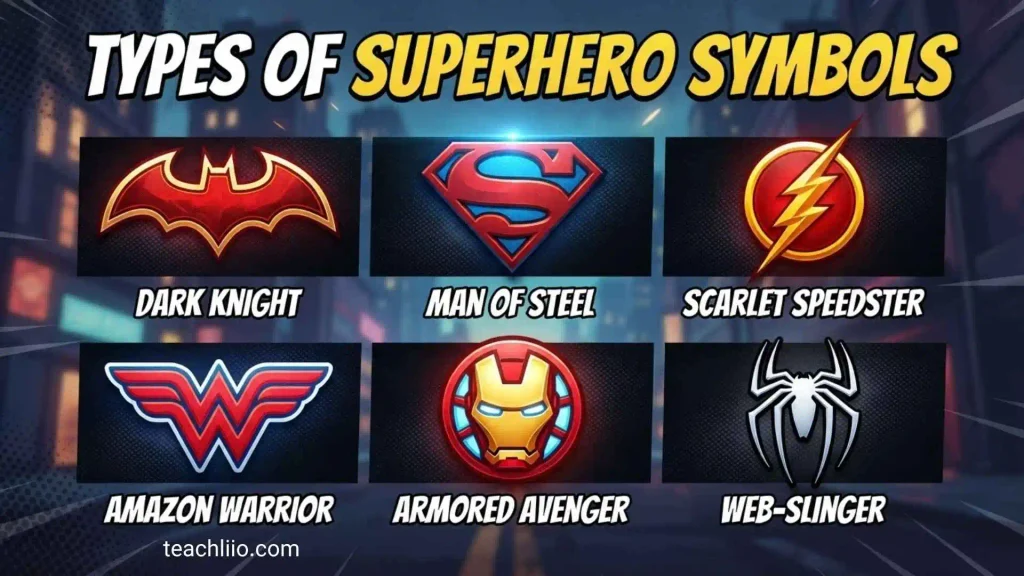
Superhero emblems can be grouped into several broad categories.
Animal Symbols
Animal imagery is one of the most common forms of superhero symbolism.
Examples include:
- Batman’s bat
- Spider-Man’s spider
- Black Panther’s panther
- Wolverine’s animal association
- Wonder Woman’s eagle-inspired imagery
Animal symbols work because audiences already have associations with particular creatures.
Letter Symbols
Letters are another simple and effective design choice.
Examples include:
- Superman’s S
- Avengers’ A
- X-Men’s X
- Fantastic Four’s 4
- Daredevil’s DD
Letter-based symbols are especially useful when the character or team’s name can be represented by one or two recognizable characters.
Shield Symbols
Shields can represent protection, defense, heritage, and courage.
Superman’s shield and Captain America’s shield are two of the most famous examples, although they use very different designs and storytelling meanings.
Weapon Symbols
Weapons can become symbols when they are strongly connected with a superhero.
Examples include:
- Thor’s hammer
- Captain America’s shield
- Aquaman’s trident
- Green Arrow’s arrows
A weapon can identify a hero while also representing their abilities or history.
Power-Based Symbols
Some symbols visually communicate a character’s defining power.
The Flash’s lightning bolt is a clear example.
Other power-based designs can represent:
- Energy
- Flight
- Magic
- Technology
- Strength
- Speed
- Cosmic abilities
Team Symbols
Team symbols represent membership in a larger group.
Examples include the Avengers, X-Men, Fantastic Four, Justice League, and Green Lantern Corps.
These symbols help establish a shared identity among characters who may otherwise have very different individual designs.
What Do Superhero Symbols Represent?
Although every superhero has a different story, certain themes appear repeatedly.
Strength
Bold symbols can communicate physical or emotional strength.
However, strength does not always mean muscular power. It can also represent determination, resilience, courage, or the ability to protect others.
Hope
Some superhero symbols become associated with hope because of the character’s role as an inspiring figure.
The symbol can remind fictional characters and audiences that the hero represents something larger than themselves.
Justice
Many superheroes use symbols that become connected with their mission to confront crime or protect innocent people.
The exact philosophy of justice varies between characters.
Fear
Fear is particularly important to darker heroes.
Batman is the clearest example because his bat imagery is deliberately connected to fear and mystery.
Identity
A superhero emblem can separate the hero’s public identity from their ordinary civilian identity.
It can become a visual shorthand for the character’s entire persona.
Legacy
A symbol can survive even when the person wearing it changes.
This is especially relevant to team identities and superhero mantles. A symbol may therefore represent a legacy rather than only one individual.
Why Do Superhero Symbols Change?
Superhero symbols evolve because fictional characters evolve.
A character who has existed for decades may appear in many different storytelling eras. Artists and filmmakers may redesign the costume to suit a new visual style.
Changes can result from:
- Comic-book reboots
- New artists
- New writers
- Movie adaptations
- Animated adaptations
- Video games
- Alternate universes
- Costume changes
- Modern design preferences
A redesigned symbol does not necessarily mean the original symbol has disappeared. Different versions can continue to exist within different stories and adaptations.
Superhero Symbols vs. Logos vs. Emblems
The words symbol, logo, and emblem are often used interchangeably when discussing superhero designs, but there are slight differences.
A logo primarily identifies a character, team, brand, or fictional property.
A symbol can have a broader meaning and may represent an idea, power, identity, or fictional tradition.
An emblem generally refers to a distinctive visual mark associated with a person, group, or organization.
A superhero costume design can function as all three at once.
For example, a symbol may identify Superman while also representing his fictional heritage and heroic ideals.
Marvel Superhero Symbols vs. DC Superhero Symbols
Marvel and DC both use highly recognizable superhero imagery, but their characters have different fictional histories and design traditions.
Marvel symbols often connect closely with:
- Character powers
- Mutant identity
- Technology
- Team membership
- Personal origins
- Scientific or cosmic concepts
DC symbols frequently connect with:
- Mythology
- Heroic identity
- Family or fictional heritage
- Justice
- Legacy
- Distinctive animal or letter imagery
These are broad patterns rather than strict rules. Both publishers use many different design approaches across their characters and eras.
How to Create an Original Superhero Symbol
Creating an original superhero symbol starts with understanding the character.
Start With the Hero’s Identity
Ask what makes the superhero different.
Is the character a scientist, warrior, detective, alien, magician, speedster, inventor, or protector?
The answer can guide the visual concept.
Connect the Symbol to the Story
A strong emblem should have some relationship to the character.
For example, a fictional hero connected with storms might use a stylized cloud, lightning pattern, or atmospheric shape.
Keep the Design Simple
A complicated emblem may look impressive at a large size but become difficult to recognize when printed on a small costume badge.
Simple shapes are usually easier to remember.
Choose Meaningful Shapes
Different shapes can create different visual impressions.
A shield can suggest protection. A circle can suggest unity or completeness. Sharp angles can create a more aggressive appearance.
These are design associations rather than universal meanings.
Make It Distinctive
An original superhero symbol should not simply imitate an existing famous emblem.
Creating something visually distinct helps establish an independent identity.
Test It at Different Sizes
A useful superhero symbol should work on:
- A costume
- A comic panel
- A small icon
- A poster
- A website
- A collectible
- A vehicle
If the design remains recognizable at different sizes, it is more versatile.
Easy Superhero Symbols to Draw
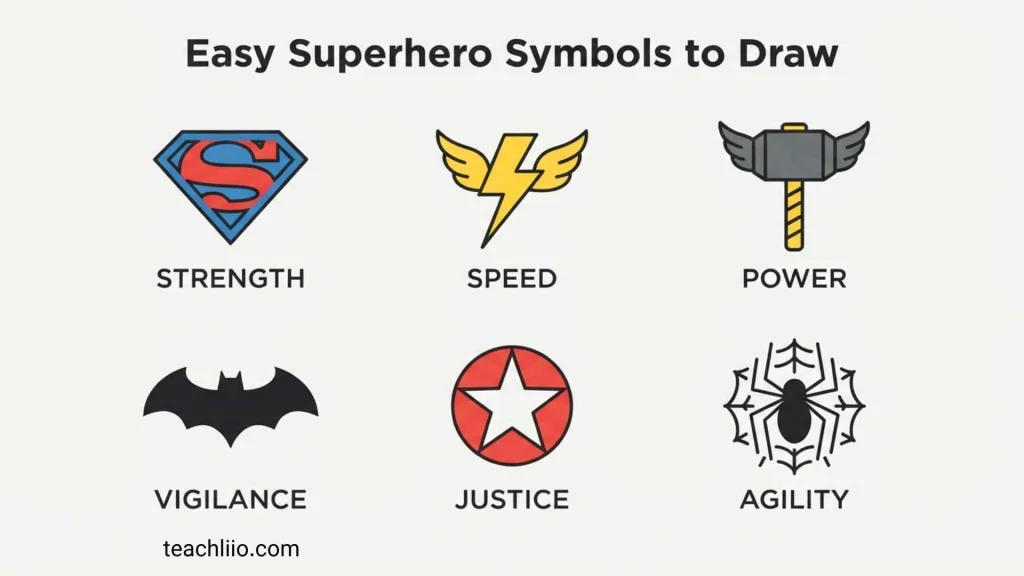
If you’re learning to draw superhero symbols, begin with simple shapes.
Lightning Bolt
A lightning bolt can be created with a few straight lines and works well for speed or energy-themed characters.
Shield
A shield shape can be drawn using a simple geometric outline.
Star
A star is another beginner-friendly symbol that can represent heroism, guidance, or a cosmic theme depending on the fictional character.
Spider
A basic spider can be created from an oval body and several curved or straight legs.
Bat Silhouette
A simplified bat shape can be constructed from a central body and symmetrical wings.
Letter Emblem
A custom letter inside a circle, shield, or geometric frame can create an original superhero identity.
When creating artwork for publication or commercial use, remember that famous superhero characters and their distinctive visual properties may be protected by intellectual-property rights.
Superhero Symbols in Movies, Comics, and Games
A superhero symbol can look different depending on the medium.
Comic Books
Comic artists can exaggerate symbols to make them visually powerful within a panel.
Movies
Film costumes often use materials, textures, shadows, and three-dimensional details that are difficult to reproduce in traditional comic artwork.
Animation
Animated versions usually simplify designs so symbols remain clear during movement.
Video Games
Games may use multiple costume variations and alternate versions of an emblem.
This explains why fans sometimes see several legitimate-looking versions of the same superhero symbol.
Why Superhero Symbols Are So Memorable
The strongest superhero symbols usually combine simplicity with meaning.
A memorable emblem tends to have:
- A clear silhouette
- A strong connection to the character
- Limited visual complexity
- Consistent use
- Distinctive shapes
- Emotional associations
- Repetition across media
The symbol becomes more recognizable every time audiences see it connected with the same character.
Over time, the emblem can become almost as recognizable as the hero’s name or costume.
Frequently Asked Questions
What are the most famous superhero symbols?
Some of the most recognizable include Superman’s shield, Batman’s bat, Spider-Man’s spider, The Flash’s lightning bolt, Captain America’s star and shield, Green Lantern’s emblem, Wonder Woman’s emblem, and Black Panther’s panther imagery.
What do superhero symbols mean?
They can represent a hero’s identity, powers, origin, values, fictional heritage, mission, team membership, or legacy.
What is Superman’s symbol?
Superman’s best-known symbol is the S-shaped shield associated with his identity and Kryptonian heritage. In several modern interpretations, the House of El emblem is also connected with hope.
What does Batman’s symbol represent?
Batman uses the bat as a visual representation of his chosen identity and his strategy of using fear and mystery against criminals.
What does Spider-Man’s symbol represent?
Spider-Man’s spider emblem connects directly with his spider-related powers and origin.
Which superhero has a lightning bolt symbol?
The Flash is especially associated with a lightning bolt emblem. Shazam also uses lightning imagery connected with his magical powers.
What are Marvel superhero symbols?
Marvel superhero symbols include Spider-Man’s spider, Captain America’s star and shield, the Avengers’ A, the X-Men’s X, Black Panther’s panther imagery, and many other character and team emblems.
What are DC superhero symbols?
DC superhero symbols include Superman’s shield, Batman’s bat, Wonder Woman’s emblem, The Flash’s lightning bolt, Green Lantern’s emblem, Aquaman’s imagery, and symbols associated with many other DC characters and teams.
Why do superheroes have logos?
Superhero logos help audiences identify characters and teams while also communicating elements of their fictional identity, powers, mission, or history.
Why do superhero logos change?
Symbols can change because of new comic eras, costume redesigns, film adaptations, animation, video games, reboots, and alternate versions of a character.
Are superhero symbols copyrighted?
Some superhero symbols and related artwork can be protected by intellectual-property laws, including copyright and trademark protections depending on the specific design, use, and jurisdiction. Anyone planning commercial use should check the applicable rights rather than assuming a famous superhero emblem is free to use.
Can I create my own superhero symbol?
Yes. You can create an original superhero emblem by connecting the design with your character’s identity, powers, story, or values while avoiding unnecessary similarity to existing protected characters or logos.
What makes a superhero symbol memorable?
Simplicity, distinctive shapes, consistent use, strong character association, and meaningful storytelling all help make a superhero symbol memorable.
Conclusion
Superhero symbols combine visual identity and storytelling in a remarkably small space. A bat can communicate Batman’s mysterious identity, a spider can connect Spider-Man with his origin, a lightning bolt can suggest speed or magical power, and a shield can communicate protection and heritage.
The meaning of a symbol is not always universal. Comic-book characters can have different designs and explanations across decades of stories, films, animation, games, and alternate universes. Understanding that variation makes it easier to appreciate why a familiar emblem can have several interpretations.
Whether you’re researching superhero symbols and meanings, comparing Marvel and DC emblems, learning how superhero logos evolved, or designing an original character, the most important principle remains the same: a memorable symbol should tell part of the hero’s story before the character even says a word.

I’m Oscar Radcliffe, a British writer who enjoys uncovering the numbers hidden within ordinary questions. My work explores quantities, counts, statistics, measurements, and fascinating comparisons across different subjects. I aim to present reliable information clearly, helping readers satisfy their curiosity while discovering interesting facts they may never have considered before.
Books:
The Science of Counting
How Many? Fascinating Numbers Explained