Squid Game is known for more than its intense survival games. Its colorful sets, geometric shapes, masks, uniforms, giant doll, staircases, and childhood-inspired designs all help create the show’s unique visual identity. Some of these elements have clear practical functions, while others invite deeper interpretations about power, identity, money, fear, and control.
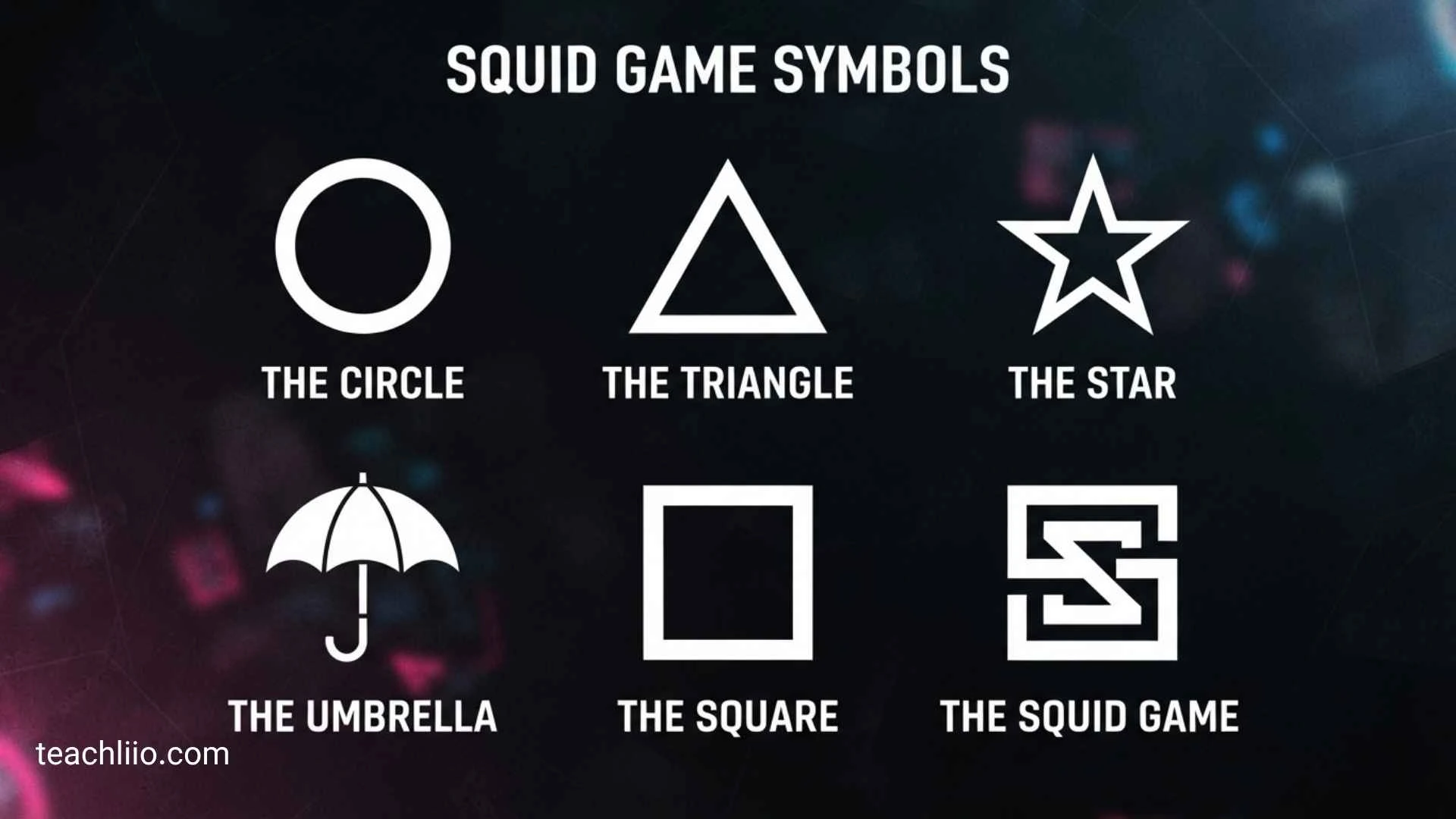
The most recognizable Squid Game symbols are the circle, triangle, and square. They appear on guards’ masks, cards, and other parts of the game system. But the symbolism goes much further. Colors, costumes, the Young-hee doll, the staircase, the glass bridge, the piggy bank, and even the contrast between cheerful children’s games and deadly consequences contribute to the story’s meaning.
This guide explains the major Squid Game symbols, what they represent in the story, and which interpretations are supported by the show’s creators or production team.
Squid Game Symbols and Meanings at a Glance
| Symbol | Main meaning or role |
| Circle | Lower-level guard role and the basic geometry of the game system |
| Triangle | Armed guard role and enforcement |
| Square | Higher-ranking management and authority |
| Guard masks | Hidden identity, hierarchy, and dehumanization |
| Green tracksuits | Players, childhood nostalgia, vulnerability |
| Pink uniforms | Guards, surveillance, control, and visual contrast |
| Black mask | Front Man’s authority and mystery |
| Young-hee doll | Childhood innocence transformed into danger |
| Staircase | Confusion, repetition, entrapment, and controlled movement |
| Glass bridge | Risk, uncertainty, and difficult choices |
| Dalgona shapes | Childhood games mixed with survival pressure |
| Piggy bank | Prize money, debt, and financial desperation |
| Pink coffins | Playful appearance contrasted with death |
| Squid shape | The traditional game that gives the series its name |
| Colorful game sets | Childhood fantasy contrasted with brutal consequences |
These meanings are not all official definitions. Some are direct production or story details, while others are reasonable interpretations based on how the symbols are used.
What Do the Squid Game Symbols Mean?
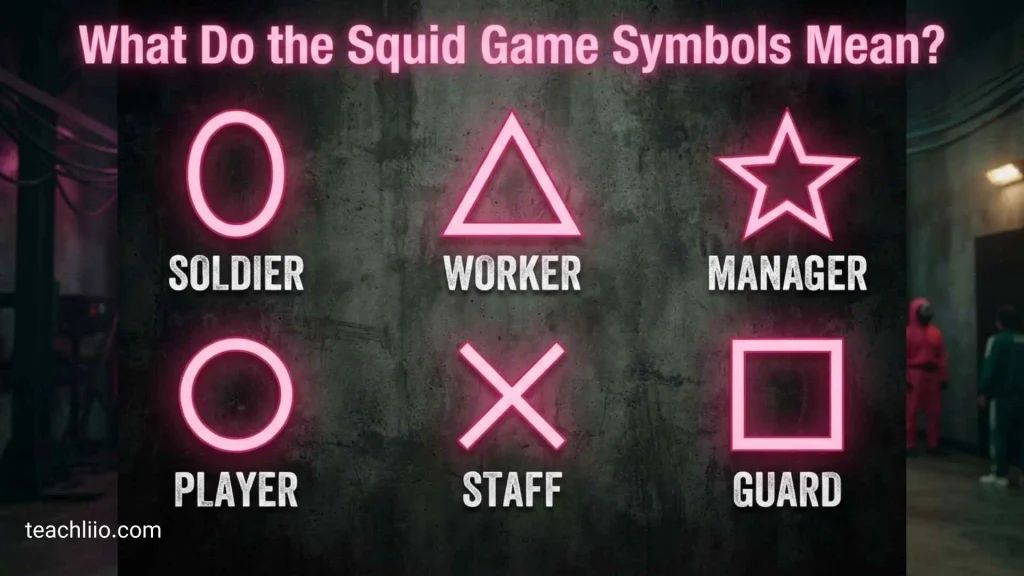
Squid Game uses a visual system that makes its fictional world easy to recognize. Production designer Chae Kyoung-sun explained that the circle, triangle, and square were deliberately incorporated into the production because they are the basic shapes of Squid Game itself. They appear in places such as business cards, with masks being one of their most prominent uses.
The important point is that these shapes are not random decoration. They connect the game, guards, hierarchy, and visual identity of the series.
Why Does Squid Game Use Symbols?
Symbols allow viewers to understand the game’s world without lengthy explanations. A viewer can see a triangle on a mask and immediately recognize that the person belongs to a particular guard group.
The same visual language is repeated throughout the environment. This repetition creates a world where everything feels organized, monitored, and controlled.
At the same time, the bright colors and simple geometric designs resemble children’s games and toys. That creates one of the show’s most important contrasts: something that looks innocent can have deadly consequences.
Netflix has described the production design as deliberately nostalgic, with simple childlike decorations placed alongside the consequences of losing the games.
Why Are Circle, Triangle, and Square So Important?
The three shapes come directly from the traditional Squid Game playing area. They therefore have both a literal connection to the game and a visual connection to the organization running it.
The production designer said the shapes were intentionally planted throughout the series. Their repeated appearance makes them function almost like a visual code.
Circle, Triangle, and Square Symbols
The circle, triangle, and square are the most recognizable symbols in Squid Game. They are especially important on the guards’ masks.
Circle Symbol
The circle identifies the lowest-level workers among the masked guards.
These workers perform basic tasks and are generally lower in the hierarchy than triangle and square guards. Their simple shape also fits the show’s broader geometric visual language.
From a symbolic perspective, the circle can be read as part of the system’s effort to remove individuality. Instead of learning who each worker is, viewers see a simple shape that tells them what role that person performs.
This interpretation is supported by the way the shapes function as an organizational code, although the deeper symbolic meaning of the circle is not something that should be presented as a universally confirmed definition.
Triangle Symbol
The triangle is associated with armed guards responsible for enforcement and violence.
The shape therefore becomes closely connected with the visible threat within the game environment. When viewers see a triangle mask, they know the person wearing it has a more forceful role than a circle worker.
The triangle also fits the broader geometric design language of the show. Its repeated use turns a simple shape into a recognizable marker of authority and danger.
Square Symbol
The square represents a higher level of authority among the masked workers.
Square guards have greater responsibility and are connected with supervision and management. This makes the three shapes work as a visual hierarchy.
Rather than relying on names or lengthy explanations, the show allows the audience to understand organizational roles through masks.
What the Three Shapes Represent
The simplest way to understand them is:
Circle = worker
Triangle = armed enforcement
Square = higher-level management
But their role goes beyond job titles. Together, they show how the game’s organization transforms human beings into categories.
That is one reason the masks are so visually powerful. The audience sees the role before seeing the individual.
Squid Game Masks and Their Meanings
Masks are among the strongest symbols in the series because they hide the faces of the people operating the games.
Guard Masks
The guards’ masks perform a practical function: they conceal individual identities. But visually, they also turn people into parts of a larger machine.
The shape on the mask tells the audience where that person fits into the hierarchy.
This makes the mask a symbol of identity being replaced by function.
The production designer specifically identified the masks as one of the strongest places where the circle, triangle, and square system was used.
Why Do the Guards Hide Their Faces?
Hiding faces creates distance between the guards and the players. It also makes the guards appear interchangeable.
From a storytelling perspective, this helps create an environment where individual identity becomes less important than the rules of the system.
The masks also make the game organizers feel mysterious. Viewers are encouraged to wonder who these people are, who gives them orders, and who controls the entire operation.
Front Man’s Black Mask
The Front Man’s black mask creates a visual distinction between him and ordinary guards.
His mask represents a higher level of authority and mystery. Unlike the simpler geometric masks used by the workers, his appearance emphasizes his position outside the ordinary guard hierarchy.
The black color also gives his character a visually darker and more isolated presence.
Squid Game Colors and Their Meanings
Color is one of the most important parts of Squid Game’s visual storytelling.
The production team deliberately used strong colors to distinguish groups and create the show’s unusual mixture of childhood nostalgia and danger. Chae Kyoung-sun has discussed the intentional use of colors in the production design.
What Does Green Mean in Squid Game?
Green is strongly associated with the players through their tracksuits.
The color works with the old-fashioned sportswear appearance to create a connection with school days, childhood activities, and group uniforms.
At the same time, the green tracksuits make the players visually identifiable as a group. They are individuals with different personalities, but the uniform makes them look like members of the same system.
So green can be understood as both a visual marker for players and part of the show’s nostalgic childhood aesthetic.
What Does Pink Mean in Squid Game?
Pink is strongly associated with the guards.
The bright pink uniforms create an unusual contrast with the violence these characters carry out. That contrast is one of the reasons the show’s visual style feels so unsettling.
Netflix’s production-design coverage notes that pink became particularly important to Gi-hun’s memories and was deliberately associated with the soldiers and the deaths he witnessed.
What Does Black Mean in Squid Game?
Black is used for characters and spaces associated with greater authority, secrecy, and mystery.
The Front Man’s black appearance separates him visually from the pink-clad guards and green-clad players.
It therefore helps create a three-level visual contrast:
Green players → Pink guards → Black authority
This should be understood as a visual reading of the series rather than a claim that every color has one fixed universal meaning.
What About Purple, Orange, and Other Colors?
Later seasons expand the show’s color vocabulary.
For example, Netflix’s behind-the-scenes coverage explains that purple was used in Season 2 as the walls moved closer toward the command center, with the production designer connecting purple historically to nobles or upper-class figures.
Orange also becomes important in Season 2’s Mingle game. The production team described orange as a way to evoke warmth and happy memories, while the colorful doors were inspired by the high-saturation colors of children’s crayons or oil pastels.
This shows why it is better to study Squid Game colors in context rather than assigning one universal meaning to each color.
Young-hee Doll Symbolism
The giant Young-hee doll is one of the most recognizable images from Squid Game.
She appears during Red Light, Green Light, where players must move when instructed and stop when the game changes.
Childhood and Innocence
Young-hee’s appearance is deliberately connected to childhood imagery.
That makes her frightening because the audience recognizes something that looks like a children’s character but sees it placed inside a deadly competition.
The same principle appears throughout the series: familiar childhood experiences are transformed into situations involving extreme consequences.
Why Is the Doll So Unsettling?
The doll’s size, stillness, sudden movements, and emotionless expression make a familiar childhood image feel threatening.
Her role also shows how simple rules can become terrifying when the consequences are changed.
Netflix’s official material continues to identify Young-hee as the iconic doll at the center of Red Light, Green Light.
Squid Game Staircase Symbolism
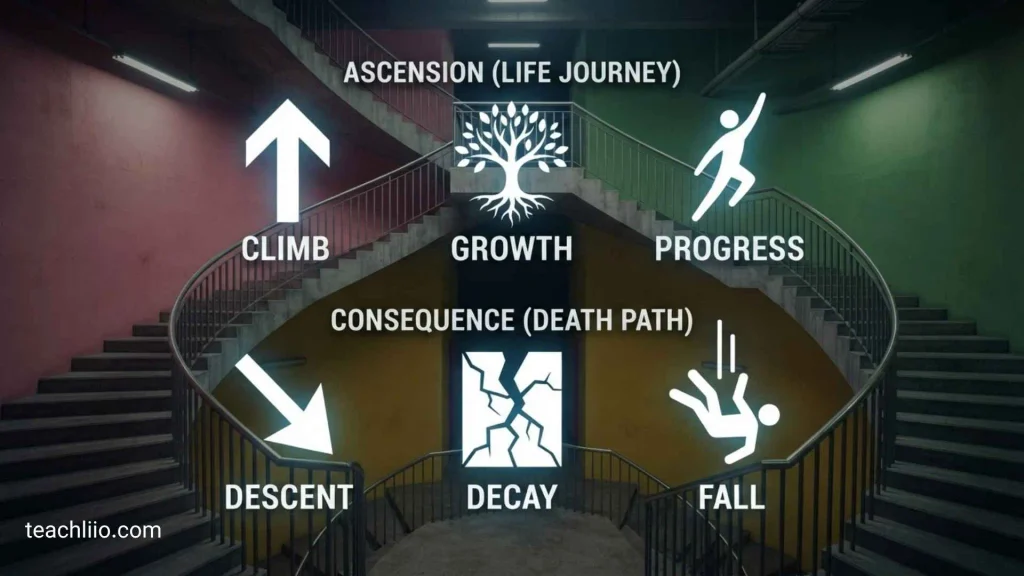
The colorful staircase is one of the show’s most memorable settings.
It looks playful and almost like a children’s maze, but its structure can make the characters appear trapped inside a confusing system.
The Maze
The stairways repeatedly turn, cross, and connect different levels.
This design makes it difficult for viewers to understand the space at first glance. The result is a visual environment where characters seem to move constantly without truly escaping.
Netflix’s production-design coverage notes that the interconnected stairways were inspired by the visual logic associated with M.C. Escher’s Relativity.
Entrapment and Control
The staircase can be interpreted as a visual representation of the game’s controlled environment.
Players move because they are told where to go. The building appears enormous, but the characters have very little actual freedom.
The repeated movement through corridors and stairs can therefore suggest confusion, repetition, hierarchy, and entrapment.
These are interpretive meanings rather than a single official definition.
Symbols in the Squid Game Games
The games themselves function as symbols because they transform familiar childhood activities into high-pressure survival contests.
Red Light, Green Light
The first game introduces the central contradiction of the series.
Red Light, Green Light is normally associated with simple childhood play. In Squid Game, the same basic rules become a matter of life and death.
The game therefore establishes the show’s larger visual idea: childhood innocence can exist beside extreme danger.
Dalgona Shapes
The Dalgona game uses simple shapes such as the circle, triangle, star, and umbrella.
Players must carefully remove the selected shape from a honeycomb candy without breaking it. Netflix’s official game guide confirms these four shape choices and the basic rules of the challenge.
The shapes are important because something visually simple becomes a test of patience, skill, pressure, and luck.
Glass Bridge
The Glass Bridge represents uncertainty more than a fixed symbolic code.
Players must decide which glass panels to step on, knowing that an incorrect choice can eliminate them.
As an interpretation, the bridge can represent risk, incomplete information, pressure, and irreversible choices.
The important point is that the show turns a normal physical structure into a visual representation of uncertainty.
The Squid Game
The original Squid Game is the source of the series’ name and its geometric identity.
The final Sky Squid Game continues this visual connection by using three towers shaped as a square, triangle, and circle. Netflix’s official guide confirms that these shapes form the structure of the final competition.
The result is a full-circle design: the shapes introduced throughout the series return to the final game.
The Piggy Bank and Prize Money
The giant piggy bank filled with money is one of the clearest financial symbols in Squid Game.
Money and Desperation
The contestants enter the competition because of serious financial problems. The prize therefore represents more than wealth.
It represents the possibility of escaping debt and starting a different life.
At the same time, the growing prize creates a disturbing relationship between money and the deaths occurring below it.
Life and Financial Value
The piggy bank can be interpreted as a visual reminder that every elimination increases the value of the remaining prize.
That creates one of the show’s central questions: How much is survival worth when money is involved?
The interpretation connects naturally to the series’ broader focus on debt, inequality, desperation, and the choices people make under financial pressure.
Pink Coffins and Other Death Imagery
The coffins in Squid Game create another striking visual contradiction.
They can look almost like decorated gifts, using bright colors and ribbons instead of the dark imagery audiences might expect from a story about death.
Why Do the Coffins Look Like Gifts?
The design continues the show’s use of childlike or celebratory imagery.
Something that resembles a present contains a dead contestant.
This contrast makes the violence more disturbing because the visual presentation refuses to match the seriousness of what is happening.
Playfulness and Violence
The pink coffins are part of the show’s larger visual strategy:
bright colors + childhood imagery + deadly consequences
That combination appears repeatedly throughout the series and helps explain why Squid Game feels visually different from a conventional survival thriller.
Why Does Squid Game Use Children’s Symbols?
This is one of the most important questions for understanding the series.
The games are simple because most viewers can understand their rules immediately. But the simplicity also creates a powerful contrast with the consequences.
A playground, candy shape, doll, colorful staircase, or school-style uniform normally suggests childhood.
Squid Game places these familiar elements inside an environment where losing can mean death.
Netflix has explicitly described the production design as nostalgic, with childhood games and childlike decorations contrasted against the consequences of losing.
This contrast can be interpreted as part of the show’s broader examination of competition, desperation, power, and human behavior.
What Does the Squid Game Logo Mean?
The show’s recognizable geometric identity is closely connected to the traditional Squid Game itself.
The circle, triangle, and square are not simply branding elements added after the story was created. They are part of the game’s physical design and were deliberately incorporated throughout the production.
That is why the same shapes appear in multiple places.
They connect:
- the original children’s game
- the guards’ hierarchy
- the game’s organization
- the visual identity of the series
- the final competition
The repeated shapes make the entire world feel like one interconnected system.
Are Squid Game Symbol Meanings Official or Fan Interpretations?
Not every interpretation found online has been officially confirmed.
This distinction matters.
Official or Production-Based Details
Some facts are directly supported by creators or production designers. For example, the production designer has explained the deliberate use of circle, triangle, and square shapes.
The production team has also discussed the deliberate use of colors and the design of the stairways and game sets.
Reasonable Symbolic Interpretations
Other meanings come from examining how an element functions repeatedly in the story.
For example, viewers can reasonably interpret the staircase as representing entrapment because the characters repeatedly navigate a confusing controlled environment.
That does not mean the production designer officially declared, “the staircase means entrapment.”
Fan Theories
Some online theories go much further and assign secret meanings to every number, color, shape, or background detail.
These can be interesting, but they should not be presented as confirmed facts unless the creators or production sources support them.
A trustworthy article should always distinguish confirmed information from interpretation and fan theory.
How to Understand Squid Game Symbolism
You do not need to memorize every supposed meaning to analyze the show’s symbols.
Look for Repetition
If an object, color, shape, or image appears repeatedly, ask why.
Repeated visual elements are more likely to have a storytelling function than a completely random background detail.
Look at Color and Costume
Ask which characters wear a particular color.
If players consistently wear one color while guards wear another, the color is helping separate groups and communicate their roles.
Study the Setting
The environment can tell you as much as dialogue.
The staircases, dormitory, game rooms, and brightly colored arenas all contribute to the show’s atmosphere.
Connect Symbols to Characters

A symbol can change meaning depending on who interacts with it.
For example, pink may represent the guards early in the story, but later it can become connected with Gi-hun’s memories of the people and events he experienced.
Netflix’s production-design discussion specifically notes how pink becomes associated with Gi-hun’s memories and the Squid Game soldiers.
Separate Facts From Interpretation
This is the most important step.
Ask:
- Did the creators explain this?
- Does the symbol repeatedly appear in the story?
- Does it connect to a character or theme?
- Is the meaning supported by the context?
- Is it a fan theory rather than an established fact?
This approach prevents overinterpreting every visual detail.
Frequently Asked Questions
What do the Squid Game symbols mean?
The main symbols include the circle, triangle, and square, which form part of the game’s visual and organizational system. Other important symbols include masks, colors, the Young-hee doll, staircases, the piggy bank, glass bridge, and the Squid Game itself.
What does the circle mean in Squid Game?
The circle is used on the masks of lower-level workers. It is part of the geometric system that identifies roles within the game organization.
What does the triangle mean in Squid Game?
The triangle identifies armed guards who carry out enforcement duties. It therefore becomes associated with authority and physical control within the game.
What does the square mean in Squid Game?
The square identifies higher-ranking management personnel. It helps visually communicate hierarchy among the masked workers.
What do the Squid Game masks mean?
The masks hide individual identities while showing the role or rank of the wearer through geometric symbols. They can also be interpreted as representing the replacement of individual identity with an assigned function.
What does green symbolize in Squid Game?
Green is strongly associated with the players through their tracksuits. Its appearance contributes to the show’s nostalgic sportswear and childhood aesthetic while visually grouping the contestants together.
What does pink symbolize in Squid Game?
Pink is associated with the guards and the game’s enforcement system. Its bright appearance creates a deliberate contrast with the violence carried out by the characters wearing it.
What does Young-hee symbolize?
Young-hee is closely connected with childhood imagery and the Red Light, Green Light game. Her familiar childlike appearance becomes disturbing because the game places innocent-looking imagery inside a deadly environment.
What does the staircase symbolize in Squid Game?
The staircase can be interpreted as representing confusion, repetition, limited freedom, and entrapment. Its maze-like design makes the characters appear to move through a controlled system without an obvious escape.
What does the Squid Game logo mean?
The series’ geometric identity is connected to the traditional Squid Game and its circle, triangle, and square playing area. These shapes were deliberately incorporated throughout the production.
Why does Squid Game use children’s games?
Children’s games are simple and immediately recognizable, which makes their rules easy to understand. More importantly, the series contrasts childhood nostalgia with extreme consequences, creating an unsettling difference between appearance and reality.
Are all Squid Game symbols intentional?
No. Some visual details are clearly designed and repeated, while other interpretations come from viewers. The safest approach is to distinguish confirmed production details from reasonable interpretation and fan theories.
Conclusion
The Squid Game symbols are a major part of what makes the series visually memorable. The circle, triangle, and square create a recognizable language for the game’s hierarchy, while the masks turn that language into a system of identity and control.
Colors add another layer. Green identifies the players, pink is closely associated with the guards, and black helps separate the Front Man from the ordinary workers. The Young-hee doll, colorful staircase, glass bridge, piggy bank, and pink coffins extend the same visual strategy.
Perhaps the most important idea is the contrast between childhood and danger. Familiar games, simple shapes, bright colors, toys, and playful environments are repeatedly placed beside fear, violence, money, and survival.
Some meanings are directly supported by the creators and production team, while others are interpretations based on how the symbols function in the story. Keeping that distinction clear makes it easier to understand Squid Game without turning fan theories into facts.
In the end, the symbols work together as one visual system. They make the game world recognizable while reinforcing its larger themes of hierarchy, control, identity, financial desperation, choice, and survival.

I’m Hugo Wetherby, a British author interested in the numbers behind everyday questions. I explore quantities, populations, measurements, records, comparisons, and surprising statistics, turning complicated information into accessible answers. I believe a simple “how many” question can lead to fascinating discoveries, and I enjoy helping readers find those answers.
Books:
How Many? A Guide to Everyday Numbers
The Great Book of Numbers and Quantities