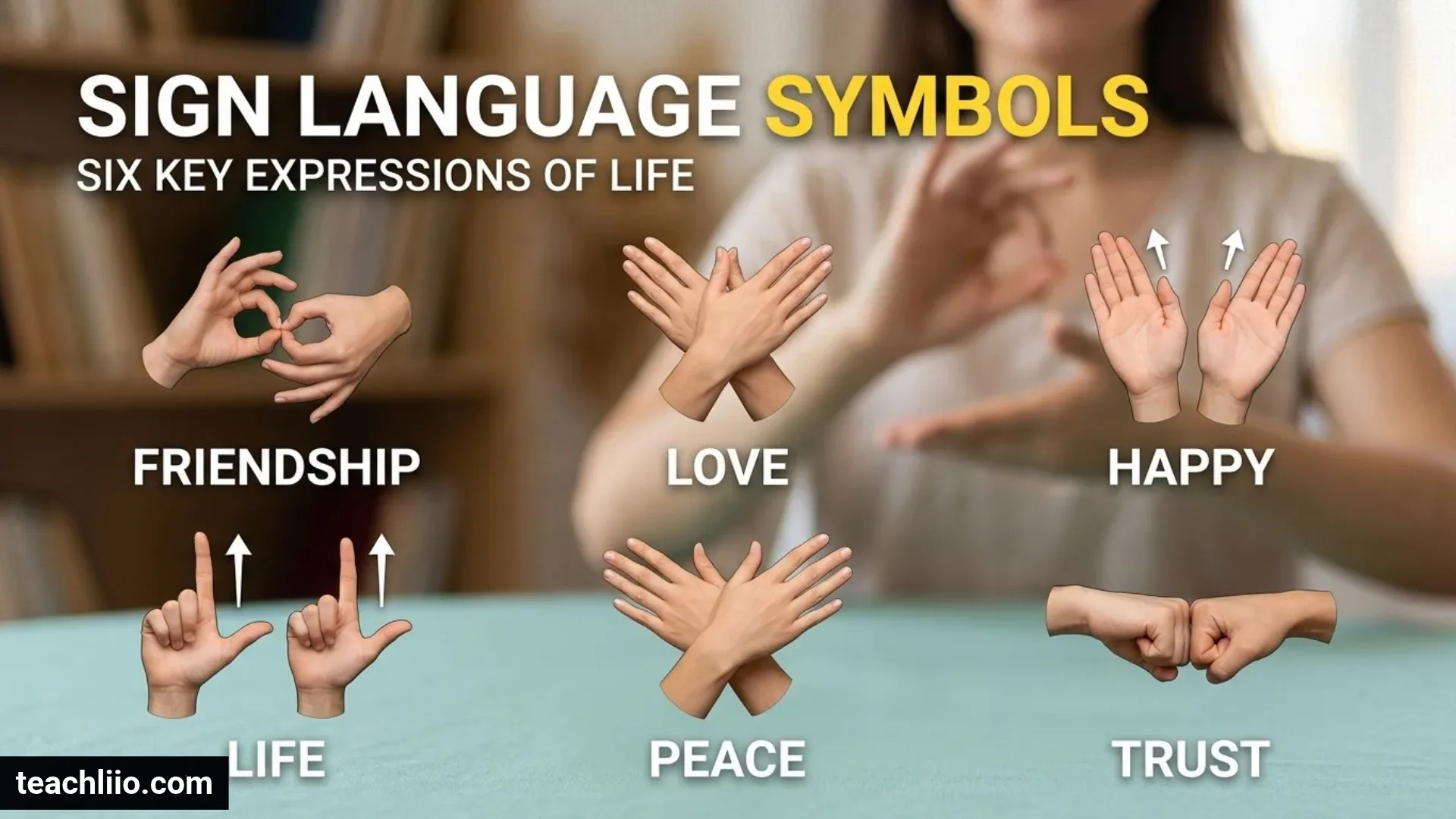
Sign language symbols help people communicate through hand shapes, movements, facial expressions, and body positions instead of spoken words. From simple greetings like hello and thank you to the American Sign Language (ASL) alphabet, these visual signs make it possible to share thoughts, feelings, questions, and everyday information.
Whether you want to learn basic sign language, understand common hand gestures, recognize alphabet symbols, or communicate with someone who is deaf or hard of hearing, learning these signs is a useful place to start.
In this guide, you’ll explore common sign language symbols and their meanings, the ASL alphabet from A to Z, number signs, everyday vocabulary, emotional expressions, and different signed languages around the world. You’ll also discover practical tips for learning sign language as a beginner.
What Are Sign Language Symbols?
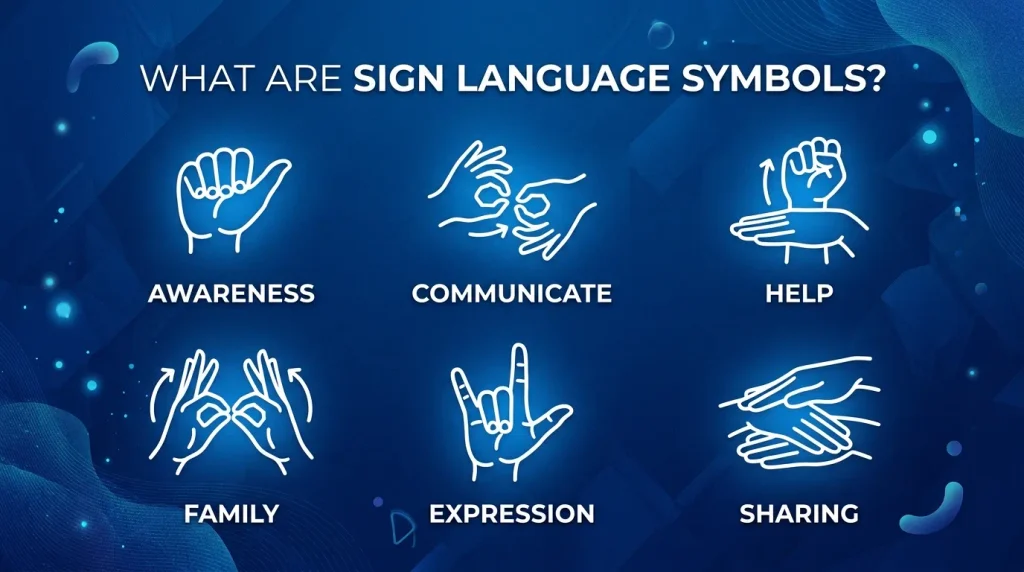
Sign language symbols are visual elements used to communicate words, ideas, questions, and emotions through a signed language. They involve specific hand shapes, movements, locations, palm orientations, and facial expressions.
Unlike ordinary hand gestures, signs belong to an organized language with its own vocabulary and grammatical rules. For example, American Sign Language uses specific signs to communicate concepts such as family, love, help, water, and friendship.
Sign language is not simply spoken English translated into hand movements. It is a complete form of communication with linguistic structures that allow people to express simple and complex ideas.
There is also no single universal sign language. Different Deaf communities have developed their own signed languages, including American Sign Language (ASL), British Sign Language (BSL), Australian Sign Language (Auslan), Indian Sign Language (ISL), and Pakistani Sign Language (PSL).
Understanding this difference is important because a sign used in one language may have a completely different meaning or form in another.
How Do Sign Language Symbols Work?
Sign language uses several visual elements that work together to communicate meaning. Understanding these elements makes it easier to recognize signs and learn how they are produced.
Hand Shapes
Handshape describes how the fingers and thumb are arranged when making a sign. Some signs use an open palm, while others require a closed fist, extended fingers, or a particular combination of fingers.
For example, the ASL alphabet uses different hand shapes to represent English letters. Learning these shapes helps beginners recognize and produce individual letters.
Hand Orientation
Hand orientation refers to the direction your palm and fingers face while making a sign. Your palm may face toward your body, away from your body, upward, or sideways.
Changing the direction of a hand can sometimes change the meaning of a sign. Therefore, beginners should pay attention to palm orientation instead of focusing only on finger positions.
Hand Movement
Movement explains how your hands travel when producing a sign. Some signs remain in one position, while others involve tapping, rotating, lifting, or moving between different locations.
For example, the ASL sign for thank you involves moving an open hand forward from near the chin. The movement is an essential part of the sign.
Hand Location
Hand location describes where a sign is produced. Depending on the sign, your hands may be positioned near your forehead, chin, chest, shoulder, or another part of your body.
The location can contribute to the meaning, so copying only the hand shape may not produce the correct sign.
Facial Expressions and Body Language
Facial expressions are an important part of signed communication. They can communicate emotions, questions, emphasis, and grammatical information.
For example, raised eyebrows are commonly used with certain yes-or-no questions in ASL. Other facial expressions help communicate feelings such as happiness, confusion, surprise, and sadness.
These visual elements work together to make sign language expressive and meaningful.
Common Sign Language Symbols and Their Meanings
Learning everyday signs is a practical way to begin communicating. The following examples introduce commonly taught American Sign Language signs.
Remember that written descriptions are only learning aids. Watch a reliable demonstration to understand the complete hand position, orientation, and movement.
1. Hello
Meaning: Greeting or welcoming someone
The ASL sign for hello resembles a small salute. Raise your open hand near your forehead and move it outward.
It is commonly used when meeting someone, starting a conversation, or greeting a friend.
2. Thank You
Meaning: Gratitude and appreciation
Place your open hand near your chin with your palm facing inward. Move it forward and slightly downward.
This sign is useful when expressing appreciation after receiving help, a gift, or a kind gesture.
3. Please
Meaning: Politeness or making a request
Place an open hand against your chest and move it in a circular motion.
You can use this sign when politely asking for assistance, food, water, or something else.
4. Sorry
Meaning: Apology or regret
Make a closed fist and place it against your chest. Move it in a small circular motion.
This sign communicates an apology when you make a mistake or want to express regret.
5. I Love You
Meaning: Love, affection, and care
The ASL I LOVE YOU sign combines the hand shapes for the letters I, L, and Y.
Extend your thumb, index finger, and little finger while keeping your middle and ring fingers folded.
It is widely recognized as an expression of affection and emotional connection.
6. Yes
Meaning: Agreement or confirmation
Make a closed fist and move it slightly up and down, resembling a nodding head.
Use this sign when agreeing with someone or answering a question positively.
7. No
Meaning: Disagreement or refusal
Bring your index and middle fingers toward your thumb in a closing movement.
This sign is commonly used to communicate a negative response or refusal.
8. Help
Meaning: Assistance or support
Make a thumbs-up hand shape with one hand and place it on the palm of your other hand. Move both hands upward together.
This sign is useful when asking someone for assistance or offering support.
9. Water
Meaning: Drinking water or requesting a drink
Form the ASL letter W with your dominant hand and bring your fingertips toward your chin in a small tapping movement.
You can use this sign when asking for water or discussing drinking.
10. Friend
Meaning: Friendship and companionship
Hook the index fingers of both hands together, then change their positions.
This sign represents a connection between two people and is useful when talking about friends and relationships.
American Sign Language Alphabet Symbols (A–Z)
The American Sign Language alphabet is one of the most useful starting points for beginners. It contains 26 hand shapes representing the letters of the English alphabet.
This system is called fingerspelling. It allows people to spell names, places, unfamiliar words, and other terms that do not have an established sign.
ASL uses a one-handed fingerspelling alphabet, while British Sign Language generally uses a two-handed alphabet.
ASL Alphabet Chart
The following table provides a basic overview of the ASL alphabet.
| Letter | General handshape description |
| A | Closed fist with thumb alongside |
| B | Four fingers extended together, thumb folded |
| C | Curved hand shaped like C |
| D | Index finger extended, other fingers form a circle |
| E | Fingers curled toward the palm |
| F | Thumb and index finger form a circle |
| G | Index finger and thumb extended sideways |
| H | Index and middle fingers extended together |
| I | Little finger extended |
| J | Little finger traces a J-shaped movement |
| K | Index and middle fingers extended with thumb positioned between them |
| L | Thumb and index finger form an L |
| M | Thumb tucked beneath three fingers |
| N | Thumb tucked beneath two fingers |
| O | Fingers and thumb form a rounded shape |
| P | K handshape directed downward |
| Q | G-like handshape directed downward |
| R | Index and middle fingers crossed |
| S | Closed fist with thumb across the fingers |
| T | Thumb placed between index and middle fingers |
| U | Index and middle fingers extended together |
| V | Index and middle fingers separated |
| W | Three fingers extended |
| X | Index finger bent into a hook |
| Y | Thumb and little finger extended |
| Z | Index finger traces a Z-shaped movement |
Important: These are simplified descriptions, not complete instructions for producing every letter. J and Z require movement, while other letters use stationary hand shapes. Some letters can also be difficult to distinguish without seeing the correct palm orientation.
How to Practice Fingerspelling
Start with a few letters at a time instead of memorizing the entire alphabet in one session.
- Practice letters A through F.
- Continue with G through L.
- Learn M through R.
- Finish with S through Z.
- Practice spelling your name.
- Try spelling familiar words and places.
Watch demonstrations from fluent ASL signers to learn the correct hand positions. Regular practice will help you recognize letters more quickly.
Sign Language Number Symbols (0–10)
Number signs are important for communicating ages, dates, prices, quantities, and other everyday information.
In ASL, numbers have specific hand shapes and conventions. Here is a beginner-friendly overview.
| Number | General handshape |
| 0 | Fingers and thumb form a circle |
| 1 | Index finger extended |
| 2 | Index and middle fingers extended |
| 3 | Thumb, index, and middle fingers extended |
| 4 | Four fingers extended, thumb folded |
| 5 | All five fingers extended |
| 6 | Thumb touches little finger |
| 7 | Thumb touches ring finger |
| 8 | Thumb touches middle finger |
| 9 | Thumb touches index finger |
| 10 | Thumb-up handshape with a small twisting movement |
How to Use Number Signs in Everyday Communication
Number signs are useful in many situations.
- Age: Communicate how old you are.
- Prices: Discuss the cost of products and services.
- Dates: Share information about birthdays and appointments.
- Telephone numbers: Spell out numerical contact information.
- Quantities: Communicate how many items you need.
Some number conventions vary according to context. Learn the appropriate forms from a reliable ASL teaching resource rather than assuming that every number follows the same pattern.
Sign Language Symbols for Everyday Words
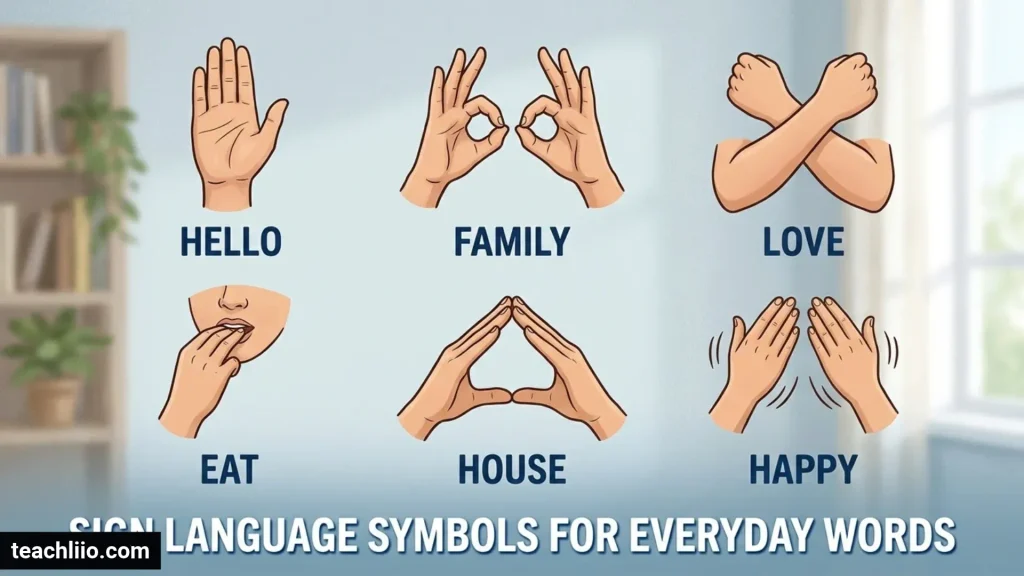
Everyday vocabulary makes communication more practical. Instead of learning random signs, beginners can organize their learning around common situations.
Family Signs
Family vocabulary helps people talk about relationships and relatives.
Useful ASL vocabulary includes:
- Mother
- Father
- Sister
- Brother
- Baby
- Family
- Friend
- Grandmother
- Grandfather
These signs are useful when introducing relatives or talking about family activities.
Food and Drink Signs
Food-related vocabulary is helpful at home, restaurants, schools, and other social settings.
Useful signs include:
- Eat
- Drink
- Water
- Milk
- Bread
- Hungry
- Apple
- Coffee
- More
Learning food vocabulary makes it easier to communicate preferences and requests during meals.
Education Signs
Students, teachers, and parents may find educational vocabulary particularly useful.
Examples include:
- School
- Teacher
- Student
- Book
- Learn
- Study
- Read
- Write
- Understand
These signs can support communication in classrooms and educational environments.
Daily Activity Signs
Daily activity vocabulary helps people communicate routine actions and needs.
Examples include:
- Home
- Work
- Sleep
- Walk
- Help
- Bathroom
- Go
- Come
- Stop
Learn the correct ASL hand shapes and movements for each word before using them in conversation.
Sign Language Symbols for Emotions and Feelings
Emotions are an important part of human communication. Sign languages allow people to express feelings through specific signs, facial expressions, and body movements.
Love
Love communicates affection, care, and emotional connection. The ASL sign for love is commonly produced by crossing both arms over the chest in a hugging motion.
Happy
Happy represents pleasure, excitement, and positive feelings. In ASL, it is generally made by moving open hands upward across the chest.
Sad
Sad communicates unhappiness, disappointment, or emotional distress. The ASL sign commonly involves moving open hands downward along the face.
Angry
Angry represents frustration, irritation, or strong negative feelings. The ASL sign involves a tense handshape near the face with a movement associated with the expression.
Afraid
Afraid communicates fear, worry, or nervousness. The ASL sign uses a movement involving both hands near the chest.
Excited
Excited expresses enthusiasm and positive energy. ASL uses a repeated movement of the hands near the chest to communicate this feeling.
Facial expressions are particularly important when signing emotions. They help communicate the intensity and context of a feeling.
What Are the Different Types of Sign Language Around the World?
Sign languages have developed within different Deaf communities and cultures. They are not simply regional versions of one universal language.
Understanding their differences helps learners choose the right language for their communication needs.
American Sign Language (ASL)
American Sign Language is widely used in the United States and parts of Canada. It has its own vocabulary, grammar, and one-handed fingerspelling alphabet.
ASL is a natural language, not a word-for-word translation of English.
British Sign Language (BSL)
British Sign Language is used by Deaf communities in the United Kingdom. It has a different vocabulary and grammatical structure from ASL.
One major difference is its two-handed fingerspelling alphabet.
Australian Sign Language (Auslan)
Auslan is the signed language used by Deaf communities in Australia. It has historical connections with British Sign Language and developed its own vocabulary and regional characteristics.
Indian Sign Language (ISL)
Indian Sign Language is used by Deaf communities in India. It has its own vocabulary, grammar, and regional variations.
Learners interested in communicating with Deaf people in India should study ISL rather than assume ASL signs will be understood.
Pakistani Sign Language (PSL)
Pakistani Sign Language is used by Deaf communities in Pakistan. It is an important language for communication, education, and accessibility within the country.
People interested in learning PSL can explore the Pakistan Sign Language Dictionary and educational resources from Deaf organizations.
French Sign Language (LSF)
French Sign Language has an important place in sign language history. It influenced the development of several signed languages, including ASL, although these languages are not identical.
Are Sign Language Symbols Universal?
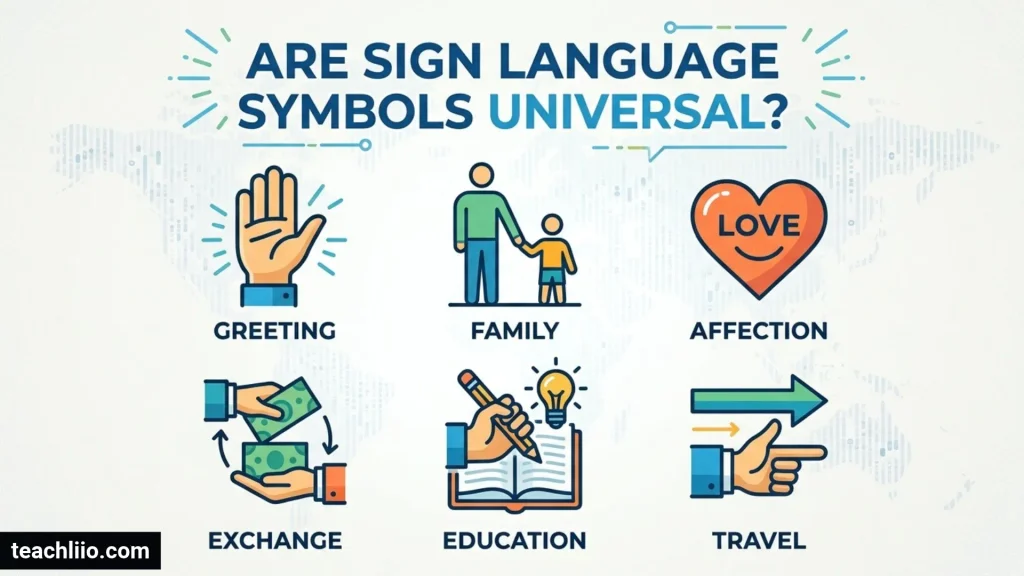
No, sign language symbols are not universal. Different signed languages use their own signs, grammar, and communication conventions.
For example, a handshape used for a particular word in ASL may represent something different in BSL or another signed language.
Even countries that share the same spoken language may have different signed languages.
Regional variations also exist within individual signed languages. Two people using ASL may sometimes use different signs for the same concept because of their regional backgrounds or community experiences.
This is why choosing the appropriate signed language is important. If you live in the United States, ASL may be a practical choice. If you want to communicate with Deaf people in Pakistan, learning PSL is more relevant.
How to Learn Sign Language Symbols as a Beginner
Learning sign language takes time, practice, and patience. Beginners can make steady progress by following a structured learning routine.
Follow a Seven-Day Beginner Practice Plan
A simple weekly schedule can help you build a foundation.
| Day | Learning activity |
| Day 1 | Learn ASL letters A–F |
| Day 2 | Practice letters G–L |
| Day 3 | Learn letters M–R |
| Day 4 | Practice letters S–Z |
| Day 5 | Learn 10 everyday signs |
| Day 6 | Practice numbers and simple questions |
| Day 7 | Review vocabulary and practice a short conversation |
This is an introductory plan, not a complete fluency program. Continue learning and practicing beyond the first week.
Watch Fluent Signers
Video lessons help you understand hand movements, facial expressions, and palm orientation. Choose educational demonstrations from fluent signers and qualified instructors.
Practice in Front of a Mirror
A mirror allows you to observe your hand positions and compare them with demonstrations.
Practice slowly and focus on accuracy before increasing your speed.
Learn From Deaf Communities
Learning directly from Deaf signers provides valuable information about natural communication, cultural practices, and regional variations.
Consider joining beginner classes, workshops, or community learning programs.
Avoid Common Beginner Mistakes
Some common mistakes include:
- Assuming all sign languages are the same.
- Learning hand shapes without studying movement.
- Ignoring facial expressions.
- Treating sign language as word-for-word English.
- Practicing without checking accuracy.
- Using random gestures instead of established signs.
Avoiding these mistakes will help you develop more accurate communication skills.
Why Are Sign Language Symbols Important?
Sign language symbols play an important role in communication, accessibility, education, and social inclusion.
Here are some reasons they matter.
- Better communication: They help Deaf and hard-of-hearing people share information and express their thoughts.
- Greater accessibility: Sign language can make schools, workplaces, healthcare services, and public spaces more inclusive.
- Stronger relationships: Learning signs helps family members, friends, and colleagues communicate more effectively.
- Educational opportunities: Signed languages provide access to learning and information for Deaf students.
- Cultural understanding: Learning sign language helps people appreciate Deaf communities and their linguistic traditions.
- Everyday independence: Knowing useful signs can make daily interactions easier.
Sign languages are not simply alternative communication tools. They are complete languages connected to the identities, cultures, and experiences of Deaf communities.
Where Can You Learn Sign Language Symbols?
Choosing reliable learning resources is important because incorrect hand positions and movements can lead to misunderstandings.
Here are some useful places to begin:
- ASL resources: Explore educational materials and dictionaries from established American Deaf organizations and ASL learning institutions.
- British Sign Language resources: Use BSL dictionaries and learning materials designed for British signers.
- Pakistan Sign Language Dictionary: Explore PSL vocabulary and learning resources for communication in Pakistan.
- Deaf-led classes: Look for qualified Deaf instructors and community-based learning programs.
- Video lessons: Choose demonstrations that show the complete hand movement, facial expression, and palm orientation.
Whenever possible, learn from fluent signers and practice with people who regularly use the language.
Frequently Asked Questions
What Are the Basic Symbols in Sign Language?
Basic ASL signs include hello, thank you, please, sorry, yes, no, help, water, friend, and I love you. Beginners can also start with the alphabet and numbers to develop a useful vocabulary.
How Many Symbols Are There in Sign Language?
There is no single fixed number of sign language symbols. Every signed language has its own vocabulary, and new signs and variations develop over time. ASL includes thousands of established signs, as well as fingerspelling and regional variations.
How Do You Say Hello in Sign Language?
In ASL, hello resembles a small salute. Raise your open hand near your forehead and move it outward. The sign is commonly used to greet someone or begin a conversation.
What Does Three Fingers Mean in Sign Language?
Three extended fingers can represent different things depending on the handshape, thumb position, palm orientation, movement, and signed language. In ASL, the number three generally uses the thumb, index finger, and middle finger extended.
What Is the Difference Between ASL and BSL?
ASL stands for American Sign Language, while BSL stands for British Sign Language. They have different vocabulary and grammar. ASL generally uses a one-handed fingerspelling alphabet, whereas BSL uses a two-handed alphabet.
How Do You Sign I Love You?
In ASL, the I LOVE YOU sign combines the letters I, L, and Y. Extend your thumb, index finger, and little finger while keeping your middle and ring fingers folded.
Can I Learn Sign Language at Home?
Yes. Beginners can learn through online courses, video demonstrations, dictionaries, and practice exercises. However, communicating with fluent signers and qualified instructors is important for improving accuracy and developing natural communication skills.
Are Sign Language Symbols Different for Left-Handed People?
Left-handed people can sign using their left hand as their dominant hand. Some signs may require adjustments to hand positioning or movement, but the goal is to produce the correct sign clearly and consistently.
What Is the Easiest Way to Memorize Sign Language Symbols?
Start with a small group of signs, practice them regularly, and connect each sign with its meaning. Watching demonstrations, using flashcards, spelling familiar words, and practicing with other signers can make learning easier.
Where Can I Learn Pakistani Sign Language?
You can begin with the Pakistan Sign Language Dictionary and educational resources from Deaf organizations in Pakistan. Local classes and Deaf-led learning programs are also valuable options.
Is Sign Language the Same as Body Language?
No. Body language includes general gestures, facial expressions, and physical movements. Sign language is a complete linguistic system with its own vocabulary and grammar. Facial expressions and body movements also contribute to the meaning of signed communication.
Conclusion
Sign language symbols provide a meaningful way to communicate through hand shapes, movements, facial expressions, and body positions. From the ASL alphabet and number signs to everyday expressions such as hello, thank you, help, and I love you, each sign can help people share information and build stronger connections.
If you are a beginner, start by learning the alphabet, practicing common words, and gradually expanding your vocabulary. Explore the signed language used by the community you want to communicate with, whether that is ASL, BSL, ISL, PSL, or another language.
Remember that learning sign language involves more than memorizing hand gestures. It requires understanding movement, grammar, facial expressions, and Deaf culture. With consistent practice and guidance from fluent signers, you can develop useful communication skills and gain a deeper appreciation for the people and communities who use signed languages.

I’m Hugo Wetherby, a British author interested in the numbers behind everyday questions. I explore quantities, populations, measurements, records, comparisons, and surprising statistics, turning complicated information into accessible answers. I believe a simple “how many” question can lead to fascinating discoveries, and I enjoy helping readers find those answers.
Books:
How Many? A Guide to Everyday Numbers
The Great Book of Numbers and Quantities